

Brains swinging in concert: cortical phase synchronization while playing guitar.
Open accessThe DOI matches its Crossref record; 47 of the 47 references it cites were found in a registry or an index.
Abstract
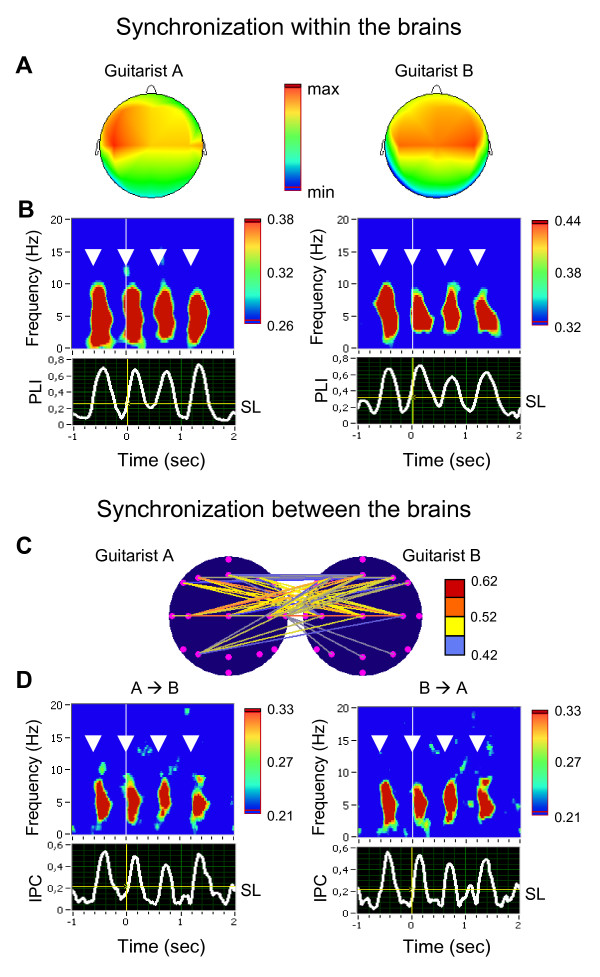
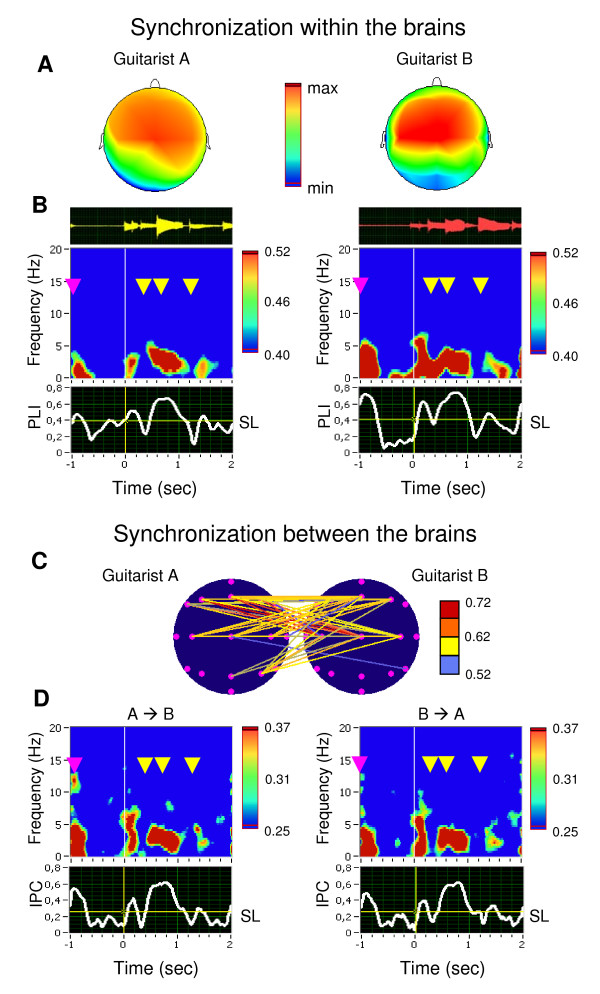
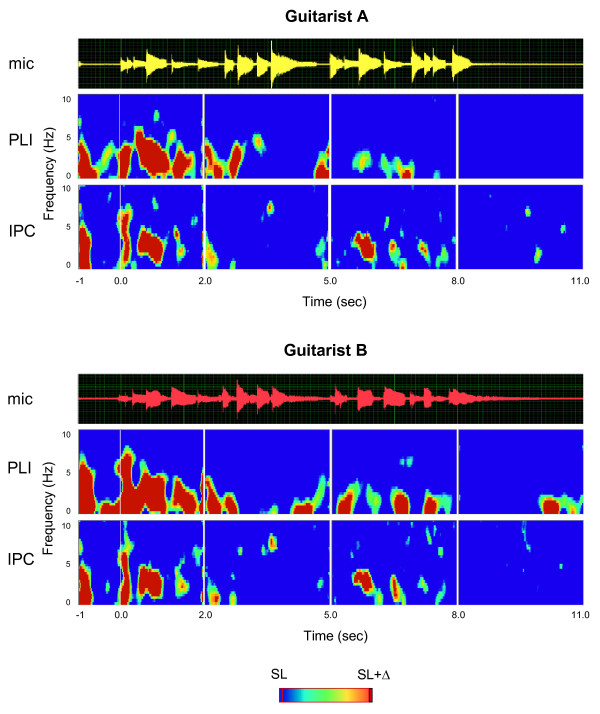
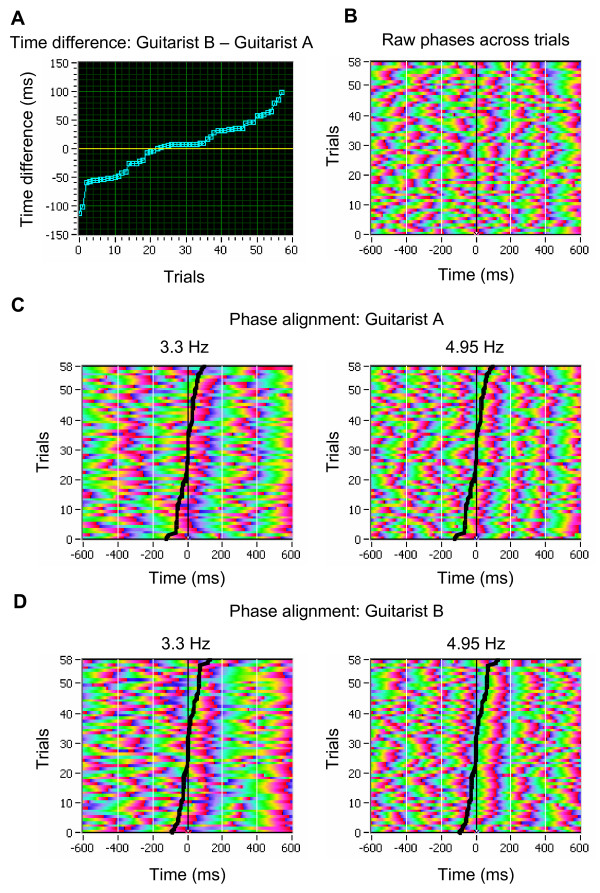
BACKGROUND: Brains interact with the world through actions that are implemented by sensory and motor processes. A substantial part of these interactions consists in synchronized goal-directed actions involving two or more individuals. Hyperscanning techniques for assessing fMRI simultaneously from two individuals have been developed. However, EEG recordings that permit the assessment of synchronized neuronal activities at much higher levels of temporal resolution have not yet been simultaneously assessed in multiple individuals and analyzed in the time-frequency domain. In this study, we simultaneously recorded EEG from the brains of each of eight pairs of guitarists playing a short melody together to explore the extent and the functional significance of synchronized cortical activity in the course of interpersonally coordinated actions. RESULTS: By applying synchronization algorithms to intra- and interbrain analyses, we found that phase synchronization both within and between brains increased significantly during the periods of (i) preparatory metronome tempo setting and (ii) coordinated play onset. Phase alignment extracted from within-brain dynamics was related to behavioral play onset asynchrony between guitarists. CONCLUSION: Our findings show that interpersonally coordinated actions are preceded and accompanied by between-brain oscillatory couplings. Presumably, these couplings reflect similarities in the temporal properties of the individuals' percepts and actions. Whether between-brain oscillatory couplings play a causal role in initiating and maintaining interpersonal action coordination needs to be clarified by further research.
Overview
The claims and statistics of this paper haven’t been checked yet.
Free: it reads the open-access text and checks the first 5 claims that cite a source we can check. Create a free account to check every claim.
Integrity signals
Registry
Cites
Statistics
Figures
Verification
Claims the paper makes
The claims and statistics of this paper haven’t been checked yet.
Free: it reads the open-access text and checks the first 5 claims that cite a source we can check. Create a free account to check every claim.
Claims other papers make about this one
Each is checked against this paper’s own text: does it say what the citing paper says it does?
The source backs part of the claim, not all of it — or backs it for a different population, condition or comparison.
In the citing paper
“The results showed that interpersonally coordinated actions (i.e., behavioral synchrony) are preceded and accompanied by interbrain oscillatory couplings in the prefrontal cortices.”
From Synchrony in Psychotherapy: A Review and an Integrative Framework for the Therapeutic Alliance (2016) · cites this paper as Lindenberger et al., 2009
Experimental — accuracy not yet measuredThe cited source says what the claim attributes to it.
In the citing paper
“Nevertheless, the link between movement synchrony and inter-brain coupling has been confirmed in motor tasks (Lindenberger et al., 2009).”
From Synchrony in Psychotherapy: A Review and an Integrative Framework for the Therapeutic Alliance (2016) · cites this paper as Lindenberger et al., 2009
Self-check
Percentages, sums and reported differences re-computed from the paper’s own numbers.
The self-check needs the paper’s full text.
Citations
Cites
Neuronal Oscillations in Cortical Networks
Buzsáki, G., & Draguhn, A. (2004) · Science · doi:10.1126/science.1099745 · Cited by 6,576 · cited 1×
“Network oscillations may functionally bias stimulus selection, form transient binding of neuronal assemblies, and facilitate synaptic plasticity [37].”
BackgroundA new method for off-line removal of ocular artifact
Gratton, G., Coles, M. G. H., & Donchin, E. (1983) · Electroencephalography and Clinical Neurophysiology · doi:10.1016/0013-4694(83)90135-9 · Cited by 5,055 · cited 1×
“5 to 70 Hz, and corrected for eye movements using the Gratton and Coles algorithm [43].”
MethodUnderstanding and sharing intentions: The origins of cultural cognition
Tomasello, M., Carpenter, M., Call, J., Behne, T., & Moll, H. (2005) · Behavioral and Brain Sciences · doi:10.1017/s0140525x05000129 · Cited by 4,882 · cited 2×
“Considerable research indicates that synchronized neuronal activity in perception and action [7-10] and oscillatory couplings between cortical and muscle activities during voluntary movement [11,12] are among the mechanisms supporting brain-body-world interactions [6,13-15].”
BackgroundThe brainweb: phase synchronization and large-scale integration
Varela, F., Lachaux, J.-P., Rodriguez, E., & Martinerie, J. (2001) · Nature Reviews Neuroscience · doi:10.1038/35067550 · Cited by 4,761 · cited 2×
“First, brain oscillations bind spatially distributed but functionally related information at the level of individual neurons, cell assemblies, and cortical areas [6-10].”
BackgroundNeurophysiological mechanisms underlying the understanding and imitation of action
Rizzolatti, G., Fogassi, L., & Gallese, V. (2001) · Nature Reviews Neuroscience · doi:10.1038/35090060 · Cited by 3,302 · cited 2×
“Neural activity in medial prefrontal cortex is selectively enhanced during theory of mind tasks [27,28].”
BackgroundModulation of Oscillatory Neuronal Synchronization by Selective Visual Attention
Fries, P., Reynolds, J. H., Rorie, A. E., & Desimone, R. (2001) · Science · doi:10.1126/science.1055465 · Cited by 2,786 · cited 2×
“First, brain oscillations bind spatially distributed but functionally related information at the level of individual neurons, cell assemblies, and cortical areas [6-10].”
BackgroundNeuronal Synchrony: A Versatile Code for the Definition of Relations?
Singer, W. (1999) · Neuron · doi:10.1016/s0896-6273(00)80821-1 · Cited by 2,581 · cited 1×
“Considerable research indicates that synchronized neuronal activity in perception and action [7-10] and oscillatory couplings between cortical and muscle activities during voluntary movement [11,12] are among the mechanisms supporting brain– body–world interactions [6,13-15].”
BackgroundExcitatory actions of gaba during development: the nature of the nurture
Ben-Ari, Y. (2002) · Nature Reviews Neuroscience · doi:10.1038/nrn920 · Cited by 2,448 · cited 1×
“In two interacting individuals adjusting their activity patterns through reciprocal sensory and motor pathways, synchronous brain activity can arise through temporally adjusted activity modulation [22-24] and does not need a substrate in form of connected neurons.”
BackgroundDevelopment and neurophysiology of mentalizing
Frith, U., & Frith, C. D. (2003) · Philosophical Transactions of the Royal Society of London. Series B: Biological Sciences · doi:10.1098/rstb.2002.1218 · Cited by 2,306 · cited 1×
“Considerable research indicates that synchronized neuronal activity in perception and action [7-10] and oscillatory couplings between cortical and muscle activities during voluntary movement [11,12] are among the mechanisms supporting brain-body-world interactions [6,13-15].”
BackgroundFunctional imaging of ‘theory of mind’
Gallagher, H. L., & Frith, C. D. (2003) · Trends in Cognitive Sciences · doi:10.1016/s1364-6613(02)00025-6 · Cited by 2,092 · cited 2×
“Neural activity in medial prefrontal cortex is selectively enhanced during theory of mind tasks [27,28].”
Background
Cited by
Items 301–400 of 444
Liu, X., Becker, B., Wang, Y., Mei, Y., Dou, H., & Lei, Y. (2025) · npj Science of Learning · doi:10.1038/s41539-025-00318-1 · Cited by 4
“As the HbO signal is more sensitive to changes in cerebral blood fl ow than the deoxyHb signal 68,69 , only HbO time series were analyzed in this study.”
Sensory multi-brain stimulation enhances dyadic cooperative behavior
Leiva, I., Barraza, P., Rodríguez, E., & Dumas, G. (2025) · Social Cognitive and Affective Neuroscience · doi:10.1093/scan/nsaf104 · Cited by 8
Not complex enough for complexity: Some intricacies of interpersonal synergies theory
Vial, I., & Cornejo, C. (2021) · New Ideas in Psychology · doi:10.1016/j.newideapsych.2021.100914 · Cited by 6
Huang, R.-Y., Zhang, X., Liang, Z.-W., Cai, L., Peng, X.-R., Cen, Y.-S., & Yu, J. (2024) · Experimental Gerontology · doi:10.1016/j.exger.2024.112499 · Cited by 6
Zhong, Y., Zhang, Y., Zhang, C., Liu, J., Wang, H., & Liu, Y. (2024) · Cerebral Cortex · doi:10.1093/cercor/bhae260 · Cited by 4
Towards oscillations-based simulation of social systems: a neurodynamic approach
Plikynas, D., Basinskas, G., & Laukaitis, A. (2014) · Connection Science · doi:10.1080/09540091.2014.956293 · Cited by 6
“Group-wide EEG studies are giving birth to new interdisciplinary research areas such as social neuroscience, team neurodynamics, and neuroeconomics (Lindenberger et al., 2009; Newandee et al., 1996).”
BackgroundWeissmark, M. S. (2020) · doi:10.1093/oso/9780190686345.001.0001 · Cited by 5
Zhang, J., Su, C., Zapała, D., Zhu, L., Cui, G., & Kong, W. (2019) · IEEE International Conference on Bioinformatics and Biomedicine (BIBM) · doi:10.1109/bibm47256.2019.8983380 · Cited by 4
“Related works have shown that the synchronous oscillations will be evoked when multiple subjects have social interactions [18]-[21], which may provide us with a ‘switch’ between resting and task states.”
BackgroundQuantum Mind, Magnetic Body, and Biological Body
Pitkänen, M. (2010) · Journal of consciousness exploration & research · Cited by 7
Pitkänen, M. (2012) · Journal of consciousness exploration & research · Cited by 4
Critical Roles of Implicit Interpersonal Information in Communication
Kashino, M., Shimojo, S., & Watanabe, K. (2016) · Springer eBooks · doi:10.1007/978-4-431-55867-5_10 · Cited by 5
“However, due to some technical limitations in fMRI, we believe that “hyperscanning EEG” of two participants may open new vistas on the neural mechanisms underlying social relationships and decision making [28, 29, 32, 33] by providing a tool for quantifying neural synchronization in face-to-face interactions with high…”
BackgroundStrang, A. J., Funke, G. J., Satterfield, K., Miller, B. T., Menke, L. E., & Brown, R. D. (2015) · Proceedings of the Human Factors and Ergonomics Society Annual Meeting · doi:10.1177/1541931215591021 · Cited by 5
Vettel, J. M., Lauharatanahirun, N., Wasylyshyn, N., Roy, H., Fernandez, R., Cooper, N., Paul, A. M., O’Donnell, M. B., Johnson, T., Metcalfe, J., et al. (2018) · Advances in intelligent systems and computing · doi:10.1007/978-3-319-94223-0_12 · Cited by 5
“hyperscanning: [14]), including rhythmic tapping [15] and musicians performing [16].”
BackgroundInteractive rhythms in the wild, in the brain, and in silico.
Anichini, M., Kloots, M. D. H., & Ravignani, A. (2020) · Canadian Journal of Experimental Psychology/Revue canadienne de psychologie expérimentale · doi:10.1037/cep0000224 · Cited by 5
“Given their high temporal resolution, EEG In the musical domain, Lindenberger et al. (2009) used EEG hyperscanning to measure synchronized neural activity between pairs of participants playing the guitar.”
BackgroundInter-brain synchronization in the practice of Tibetan monastic debatePreprint
van Vugt, M. K., Pollock, J., Johnson, B., Gyatso, K., Norbu, N., Lodroe, T., Gyaltsen, T., Aadhentsang, T., Thakchoe, J., Khechok, J., et al. (2018) · MindRxiv (OSF Preprints) · doi:10.31231/osf.io/f2ept · Cited by 5
Do the Modern Neurosciences Call for a New Model of Organizational Cognition?
Seni, D. A. (2012) · Science & Education · doi:10.1007/s11191-011-9385-9 · Cited by 3
“Others propose that organizational knowledge is somehow embedded or incarnated in the routines of organizations, in organizational cultures, in processes and in action programs ( Levitt and March 1988 ).”
BackgroundUnveiling the Neural Signature of Group Cohesion in Music Co‐Audition
Ding, Y., Sun, B., Tang, Y., & Zhang, D. (2025) · Annals of the New York Academy of Sciences · doi:10.1111/nyas.70105 · Cited by 5
Optimization of fMRI-Derived ROIs Based on Coherent Functional Interaction Patterns
Deng, F., Zhu, D., & Liu, T. (2012) · Lecture notes in computer science · doi:10.1007/978-3-642-33454-2_27 · Cited by 3
“In [4], Lindenberger et al. used electroencephalography (EEG) to measure the within-brain functional interaction.”
BackgroundNeuronal Oscillatory Signatures of Joint Attention and Intersubjectivity in Arrhythmic Coaction
Maÿe, A., Wang, T., & Engel, A. K. (2021) · Frontiers in Human Neuroscience · doi:10.3389/fnhum.2021.767208 · Cited by 3
“3The study (Lindenberger et al., 2009) investigated guitarists playing a short melody together.”
BackgroundIshtiaque, F., Motahar, E. B., Sajal, M. S. R., Amin, M. A., Sarker, F., & Mamun, K. A. (2023) · International Conference on Software, Knowledge, Information Management and Applications (SKIMA) · doi:10.1109/skima59232.2023.10387369 · Cited by 3
“This phenomenon is known as brain-to-brain synchrony [10].”
BackgroundBrain plasticity and rehabilitation by using Near-Infrared Spectroscopy
Balconi, M. (2016) · Neuropsychological Trends · doi:10.7358/neur-2016-019-balc · Cited by 4
Balconi, M., Bartolo, A., & Fronda, G. (2020) · Gesture · doi:10.1075/gest.20013.bal · Cited by 4
Hawkins, S., & Farrant, C. (2022) · Frontiers in Psychology · doi:10.3389/fpsyg.2021.801574 · Cited by 6
Plikynas, D., & Raudys, Š. (2015) · Springer eBooks · doi:10.1007/978-3-319-18153-0_12 · Cited by 3
A Cross-Brain Interaction Platform Based on Neurofeedback Using Electroencephalogram
Zhang, R., & Zhao, X. (2018) · Lecture notes in computer science · doi:10.1007/978-3-319-91470-1_19 · Cited by 3
Newman, L. A., Cao, M., Täuber, S., & van Vugt, M. K. (2024) · PsyArXiv (OSF Preprints) · doi:10.31234/osf.io/5vgp9 · Cited by 5
Physiological Synchrony Evoked by Attentional Engagement: A Systematic Review Based on CiteSpace
Liu, Q., Yang, X., & Zhang, W. (2024) · SAGE Open · doi:10.1177/21582440241298400 · Cited by 2
“…is one of the most temporally accurate neural recording devices and is also portable and suitable for the natural environment (Dick et al., 2014; Lindenberger et al., 2009), but while EEG characterizes the functional activity of nerves, other neural recording techniques are more informative…”
Cyborg synchrony: integrating human physiology into affective generative music AI
Ng, S., Sargent, K., & Snell, J. J. (2025) · Frontiers in Computer Science · doi:10.3389/fcomp.2025.1593905 · Cited by 3
Müller, & Lindenberger, U. (2026) · Nonlinear Dynamics · doi:10.1007/s11071-025-12153-5 · Cited by 2
“Musical interaction, like kissing, is among the earliest and most universal forms of social bonding, eliciting inter-brain synchronization linked to shared affect and coordinated action [8, 9, 21, 48, 65, 66].”
InfluentialSelf-citationJiang, L., Zou, Q., & Yu, S. (2026) · Biological Psychology · doi:10.1016/j.biopsycho.2026.109367 · Cited by 1
Riva, G. (2023) · Qwerty · doi:10.30557/qw000073 · Cited by 6
Puxeddu, M. G., Rinaldini, G., & Astolfi, L. (2024) · IEEE International Conference on Bioinformatics and Biomedicine (BIBM) · doi:10.1109/bibm62325.2024.10821937 · Cited by 2
“It has been applied to investigate brain synchronization in healthy individuals during activities such as simple conversations [5], parent-infant gaze communication [6], guitar playing [7], romantic kissing [8], or teacher-student interactions [9].”
Doğuş, Y., & Alptekin, S. (2025) · Sakarya University Journal of Education · doi:10.19126/suje.1667279 · Cited by 2
A Preliminary Study of Interaction Effects on Brain Activity during Cooperative Work Using fNIRS
Hiroyasu, T., Goto, M., Yamamoto, U., & Yokouchi, H. (2013) · Conference proceedings/Conference proceedings - IEEE International Conference on Systems, Man, and Cybernetics · doi:10.1109/smc.2013.662 · Cited by 2
“Electrorencephalography (EEG) has also been employed in hyperscanning [5].”
MethodDoes machine-mediated interaction induce inter-brain synchrony? — A hyperscanning study
Hachmeister, N., Finke, A., & Ritter, H. J. (2014) · Annual International Conference of the IEEE Engineering in Medicine and Biology Society (EMBC) · doi:10.1109/embc.2014.6943766 · Cited by 2
12. Studying Human-Human interaction to build the future of Human-Robot interaction
D’Ausilio, A., Lohan, K. S., Badino, L., & Sciutti, A. (2015) · doi:10.1515/9783110471137-012 · Cited by 3
“…a growing body of neuroscientific evidence indicates that such interpersonal coordination or “group mind” phenomena occurring during interactive tasks are mediated by synchronized cortical activity (Hasson et al., 2012; Loehr et al., 2013; Schippers et al., 2010; Lindenberger et al., 2009).”
BackgroundHari, R., & Puce, A. (2017) · Oxford University Press eBooks · doi:10.1093/med/9780190497774.003.0018 · Cited by 2
Williams, J. B., & Sachs, M. (2023) · The MIT Press eBooks · doi:10.7551/mitpress/14186.003.0022 · Cited by 3
Social Psychology of the Digital Age: The Interpersonal Neuroscience of Mediated Communication
Spapé, M., & Ravaja, N. (2014) · Lecture notes in computer science · doi:10.1007/978-3-319-07632-4_47 · Cited by 4
Culture and Self–Other Overlap in Neural Circuits
Varnum, M. E. W., & Hampton, R. S. (2017) · Wiley eBooks · doi:10.1002/9781119181361.ch18 · Cited by 2
Frequency-Dependent Inter-Brain Synchrony is Modulated by Social Interaction in Freely Moving MicePreprint
Scaglione, A., Lucchesi, J., Mascaro, A. L. A., & Pavone, F. S. (2024) · bioRxiv (Cold Spring Harbor Laboratory) · doi:10.1101/2024.05.21.593536 · Cited by 4
Dynamic Theta-Alpha Inter-Brain Model during Mother-Preschooler Cooperation
Xu, J., Li, Y., Su, R., Wu, S., Wu, C., Wang, H., Zhu, Q., Fang, Y., Jiang, F., Tong, S., et al. (2025) · IEEE Journal of Biomedical and Health Informatics · doi:10.1109/jbhi.2025.3603544 · Cited by 3
“With the advent of hyperscanning techniques [7], [8], [9], [10], [11], researchers are now capable of measuring inter-brain synchrony (IBS) during mother-child interactions by simultaneously monitoring two brains [5], [12], [13], [14], [15], [16].”
The Neural Dynamics of Interpersonal Synchrony
Dippong, J., & Overton, J. (2025) · Handbooks of sociology and social research · doi:10.1007/978-3-031-95615-7_18 · Cited by 2
Synchronizacja oparta na rytmie jako przedrefleksyjna matryca komunikacji społecznej
Herda, J. (2025) · Roczniki Kulturoznawcze · doi:10.18290/rkult25164.8 · Cited by 1
Now is the time: operationalizing generative neurophenomenology through interpersonal methods
Monnier, A., Adel, L., & Dumas, G. (2025) · Neuroscience of Consciousness · doi:10.1093/nc/niaf052 · Cited by 4
“…functional near-infrared spectroscopy, functional magnetic resonance imaging, magnetoencephalography),hyperscanning captures brain activity across participants during live interaction, enabling analyses of inter-brain synchrony (Lindenberger et al. 2009; Dumas et al. 2010; Konvalinka et al.2014).”
Intonation and timing in singing early music is unrelated to respiration synchronization
Schreiber, A., Frieler, K., & Lange, E. B. (2026) · Scientific Reports · doi:10.1038/s41598-026-39565-6 · Cited by 2
Li, Y., Li, S., Xie, J. X. J., Yao, D., Li, F., Xu, P., Wu, J., & Jiang, L. (2026) · NeuroImage · doi:10.1016/j.neuroimage.2026.121865 · Cited by 1
Self-citationLiu, J., Wu, Y. H., Wang, Z., Deng, Y., Jin, Z., Sun, X., Jiang, Y., Wang, G., Zhang, M., Jiang, F., et al. (2026) · Human Brain Mapping · doi:10.1002/hbm.70503 · Cited by 1
“As HbO is more sensitive to changes in cerebral blood flow (Lindenberger et al. 2009), we focused on HbO data in this study.”
Schussel, L. (2026) · Frontiers in Cognition · doi:10.3389/fcogn.2026.1719931 · Cited by 1
Yang, Q., Zhan, Z., Mei, H., Cai, S., Dong, Z., Lin, Z., Zhang, X., Luo, L., Xu, B., & Li, W. (2026) · International Journal of Computer-Supported Collaborative Learning · doi:10.1007/s11412-026-09480-z · Cited by 1
“fNIRS data collected during the resting state and problem-solving phases focused on HbO concentration changes, as HbO is more sensitive than HbR to hemodynamic changes (Hoshi, 2007; Lindenberger et al., 2009).”
Agent-Based Nonlocal Social Systems: Neurodynamic Oscillations Approach
Plikynas, D., & Masteika, S. (2014) · Lecture notes in computer science · doi:10.1007/978-3-319-07632-4_24 · Cited by 1
Musical Synchronization, Social Interaction and the Brain
Waclawik, K., Watson, S. L., & Grahn, J. A. (2016) · Cambridge University Press eBooks · doi:10.1017/cbo9781107279353.030 · Cited by 1
The Background of the Study on Interpersonal Coordination
Inui, N. (2018) · Springer eBooks · doi:10.1007/978-981-13-1765-1_2 · Cited by 1
Diversity and Ethnic Conflicts
Weissmark, M. S. (2020) · Oxford University Press eBooks · doi:10.1093/oso/9780190686345.003.0008 · Cited by 1
Nagornova, Z. V., & Shemyakina, N. V. (2024) · Journal of Evolutionary Biochemistry and Physiology · doi:10.1134/s0022093024010083 · Cited by 1
“…synchroni(cid:2) zation and intersubject (interbrain) synchronization between participants in low-frequency bands (delta, theta, and low alpha EEG bands) in frontal and cen(cid:2) tral regions [6] and an increase in desynchronization (assessed for participants separately) in the alpha EEG band [7].”
Norwood, M. F., Pretty, D., Marsh, C., Shirota, C., Gillet, C., Zeeman, H., & Kendall, E. (2024) · Springer eBooks · doi:10.1007/978-3-031-64699-7_15 · Cited by 1
Luo, H., Cai, Y., Lin, X., & Duan, L. F. (2024) · Biomedical Optics Express · doi:10.1364/boe.542554 · Cited by 1
The Zen of Music: On the Energetics of Music as a Source of Personal Well-Being
Graber, O. P. (2025) · CSR, sustainability, ethics & governance · doi:10.1007/978-3-031-75566-8_7 · Cited by 1
Yamamoto, U., Goto, M., Yokouchi, H., & Hiroyasu, T. (2014) · World Automation Congress (WAC) · doi:10.1109/wac.2014.6935648 · Cited by 1
“Electroencephalography (EEG) has also been employed in hyperscanning [5], but EEG cannot precisely detect the location of the origin of a neuroelectrical signal.”
MethodConversational Alignment: A Study of Neural Coherence and Speech Entrainment
Jensen, K. M., Borrie, S. A., Studenka, B. E., & Gillam, R. B. (2016) · Digital Commons - USU (Utah State University) · doi:10.26076/46bb-1261 · Cited by 3
Overview of Social Neuroscience
Liu, Y., Luo, Y., & Zhang, D. (2014) · Scientia Sinica Vitae · doi:10.1360/n052013-00073 · Cited by 1
Neurophysiological Signals Processing
Borghini, G., Aricò, P., Flumeri, G. D., & Babiloni, F. (2017) · Biosystems & biorobotics · doi:10.1007/978-3-319-58598-7_6 · Cited by 2
Schmicking, D. A. (2017) · Gestalt theory · doi:10.1515/gth-2017-0015 · Cited by 1
Weissmark, M. S. (2020) · Oxford University Press eBooks · doi:10.1093/oso/9780190686345.003.0005 · Cited by 1
The communicative processes of musicians engaged in synchronous play
Faber, S. E. M. (2014) · Jyväskylä University Digital Archive (University of Jyväskylä) · Cited by 1
Toward a standard model of musical improvisationPreprint
Faber, S. E. M., & McIntosh, A. R. (2019) · PsyArXiv (OSF Preprints) · doi:10.31234/osf.io/w5b3r · Cited by 1
Brain Connectivity and Its Applications
Sanei, S., & Chambers, J. A. (2021) · Wiley eBooks · doi:10.1002/9781119386957.ch8 · Cited by 1
Czepiel, A. M. (2023) · Research Publications (Maastricht University) · doi:10.26481/dis.20231002ac · Cited by 1
Zhao, C., Wang, X., Hao, W., Liu, S., Chen, Z., Wang, H., Song, H., Hu, L., Zhao, L., & Yujiang, G. U. O. (2026) · Mindfulness · doi:10.21203/rs.3.rs-9901586/v1 · Cited by 1
Sanei, S. (2013) · Wiley eBooks · doi:10.1002/9781118622162.ch8
The Neural Systems Involved in Motor Cognition and Social Contact
Hétu, S., & Jackson, P. L. (2012) · Palgrave Macmillan UK eBooks · doi:10.1057/9780230360792_9 · Cited by 1
Discovering network-level functional interactions from working memory fMRI data
Jiang, X., Lv, J., Zhu, D., Zhang, T., Li, X., Hu, X., Guo, L., & Liu, T. (2014) · IEEE International Symposium on Biomedical Imaging (ISBI) · doi:10.1109/isbi.2014.6867797
“This result echoes prior literature reports that found the functional brain interaction at the onset or starting point of certain events is strongest [13].”
ResultZhang, H., Li, Y., & Tang, Z. (2011) · Computer and Information Science · doi:10.5539/cis.v4n3p18
“Keywords: Event-related synchronization (ERS), Acoustic stimuli, Event-related potential (ERP), Electroencephalogram (EEG), 40 Hz acoustic stimuli”
BackgroundDesign Principles for Electronic Musical Instruments
Thompson, D. (2010)
JĀZEPA VĪTOLA LATVIJAS MŪZIKAS AKADĒMIJA
Bernhofs, V. (2013)
Brain correlates of social cognition and interaction
Mandel, A. (2015) · Aaltodoc (Aalto University)
Weissmark, M. S. (2020) · Oxford University Press eBooks · doi:10.1093/oso/9780190686345.003.0007
Weissmark, M. S. (2020) · Oxford University Press eBooks · doi:10.1093/oso/9780190686345.003.0006
Weissmark, M. S. (2020) · Oxford University Press eBooks · doi:10.1093/oso/9780190686345.003.0001
Weissmark, M. S. (2020) · Oxford University Press eBooks · doi:10.1093/oso/9780190686345.003.0009
L’hyperscanning: o come comunicano i cervelli nelle organizzazioni?
Balconi, M., & Fronda, G. (2020) · Studi e ricerche · doi:10.7359/954-2020-bal4
Sensorimotor Synchronization: The Effect of Musical Training and Musicality of Stimulus
Finlay, D. (2020) · NORMA
Douglas, C. L. (2021) · DalSpace (Dalhousie University)
Brain mechanisms of parenting in co-parenting spouses and parent-child dyads
Azhari, N. A. (2021) · DR-NTU (Nanyang Technological University) · doi:10.32657/10356/152297
(2016) · Dunod eBooks · doi:10.3917/dunod.nadel.2016.01.0187
Listening: Flexibility through Noise, Resonance through Rhythm
Denham, S. L., & Winkler, I. (2021) · Oxford University Press eBooks · doi:10.1093/oxfordhb/9780190274054.013.39
Weissmark, M. S. (2020) · Oxford University Press eBooks · doi:10.1093/oso/9780190686345.003.0002
Weissmark, M. S. (2020) · Oxford University Press eBooks · doi:10.1093/oso/9780190686345.003.0004
Weissmark, M. S. (2020) · Oxford University Press eBooks · doi:10.1093/oso/9780190686345.003.0003
Weissmark, M. S. (2020) · Oxford University Press eBooks · doi:10.1093/oso/9780190686345.003.0010
Lundy, T., James, C. E., & Reybrouck, M. (2022) · Frontiers research topics · doi:10.3389/978-2-83250-291-4
Hidden Repertoires in the Brain Accessed by Music in Aging and Neurodegeneration
Faber, S. E. M., & McIntosh, A. R. (2023) · The MIT Press eBooks · doi:10.7551/mitpress/14186.003.0023
Hari, R., & Puce, A. (2023) · Oxford University Press eBooks · doi:10.1093/med/9780197542187.003.0019
Cognitive Properties of Behavioural Synchronization
Lamontagne, A., & Gaunet, F. (2023) · Springer eBooks · doi:10.1007/978-3-031-48449-0_4
Estudo da conectividade funcional entre cérebros de pessoas em cooperação
Bazán, P. R. (2023) · Digital Library of Theses and Dissertations (Universidade de São Paulo) · doi:10.11606/t.5.2023.tde-18122023-125751
Weissmark, M. S. (2020) · Oxford University Press eBooks · doi:10.1093/oso/9780190686345.002.0007
Weissmark, M. S. (2020) · Oxford University Press eBooks · doi:10.1093/oso/9780190686345.002.0004
Weissmark, M. S. (2020) · Oxford University Press eBooks · doi:10.1093/oso/9780190686345.002.0015
Metadata
- Authors
- Lindenberger, U., Li, S.-C., Gruber, W., & Müller, V.
- Affiliations
- Max Planck Institute for Human Development (DE)
- University of Salzburg (AT)
- Corresponding author
- Lindenberger, Ulman
- Müller, Viktor
- Venue
- BMC Neuroscience
- Published
- 2009-03-17
- Volume
- 10
- Issue
- 1
- Pages
- 22-22
- ISSN
- 1471-2202 (ISSN-L)
- PMC
- PMC2662862
- OpenAlex
- W2056689588
- Cited by
- 444
- References
- 47
- Citations by year
- 2026: 35 · 2025: 26 · 2024: 31 · 2023: 30 · 2022: 26 · 2021: 36 · 2020: 52 · 2019: 18 · 2018: 29 · 2017: 31 · 2016: 21 · 2015: 21 · 2014: 23 · 2013: 22 · 2012: 19
- FWCI
- 15.65
- Type
- journal article
- Language
- en
- Open access
- gold
- doi.org
- Licence
- cc-by
- creativecommons.org/licenses/by/2.0 (tdm)
- Locations
- BMC Neuroscience (publishedVersion, cc-by)
- PubMed Central (publishedVersion, cc-by)
- PubMed (publishedVersion)
- DOAJ (DOAJ: Directory of Open Access Journals) (submittedVersion, cc-by-sa)
- Max Planck Institute for Plasma Physics (submittedVersion)
- Max Planck Digital Library (submittedVersion, other-oa)
- MPG.PuRe (Max Planck Society) (submittedVersion, other-oa)
- Funders
- Deutsche Forschungsgemeinschaft
- Max-Planck-Gesellschaft
- Topics
- Social Sciences › Psychology › Social Psychology › Action Observation and Synchronization
- Life Sciences › Neuroscience › Cognitive Neuroscience › Neural dynamics and brain function
- Life Sciences › Neuroscience › Cognitive Neuroscience › Neuroscience and Music Perception
- Keywords
- inter-brain synchrony, phase synchronization, interpersonal coordination, joint action, guitar performance, time-frequency analysis, oscillatory coupling, music performance
- MeSH terms
- Adult, Attention, Brain, Brain Mapping, Cerebral Cortex, Cortical Synchronization, Electroencephalography, Female, Humans, Magnetic Resonance Imaging, Male, Young Adult
About these checks
Registry, retraction, Cites and statistics results are computed, not judged, with one exception: a printed reference that no index lists is read once by a model before it counts as a citation error. Claims are extracted by a model and kept only when their quote appears verbatim in the text; each cited source is then checked, with a model’s help, for whether it says what the claim relies on. Those verdicts can be wrong — read the claim’s quote and the cited source before relying on one.
Statistics and arithmetic are recomputed, not judged.
Confidence bands are shown only for fields calibrated on our annotated test set. None is calibrated yet, so no band is shown.
What counts as a claim ›How we measure confidence ›How we check this ›
Are you an author, or do you see a problem with this page? Request a review
Data sources
Bibliographic data: Semantic Scholar, OpenAlex, Crossref.
Contains information from the Semantic Scholar Academic Graph Datasets, made available under the ODC Attribution License (ODC-BY 1.0).
Semantic Scholar’s data is described in: Kinney, R., et al. (2023). The Semantic Scholar Open Data Platform. arXiv:2301.10140.
