

Brains swinging in concert: cortical phase synchronization while playing guitar.
Open accessThe DOI matches its Crossref record; 47 of the 47 references it cites were found in a registry or an index.
Abstract
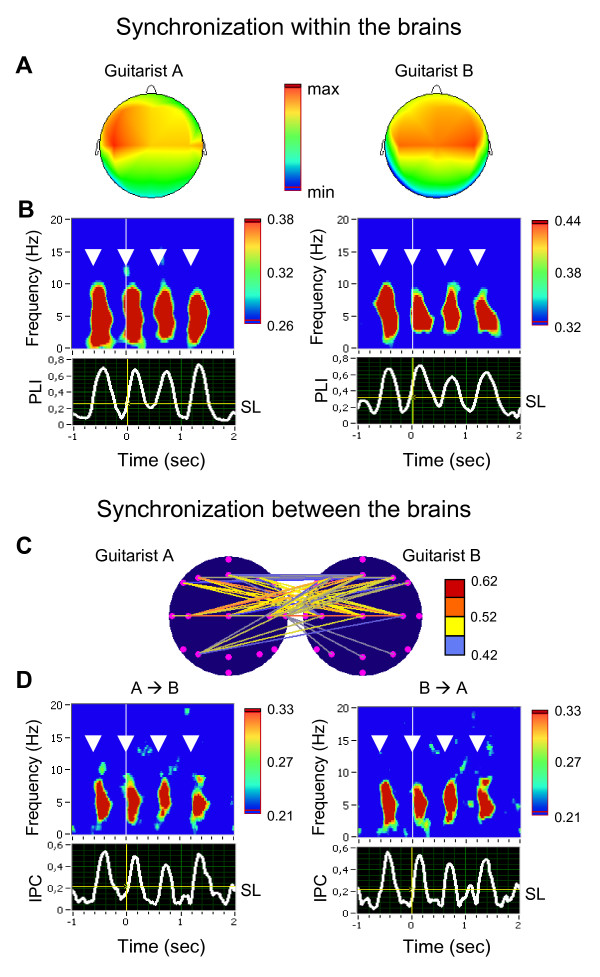
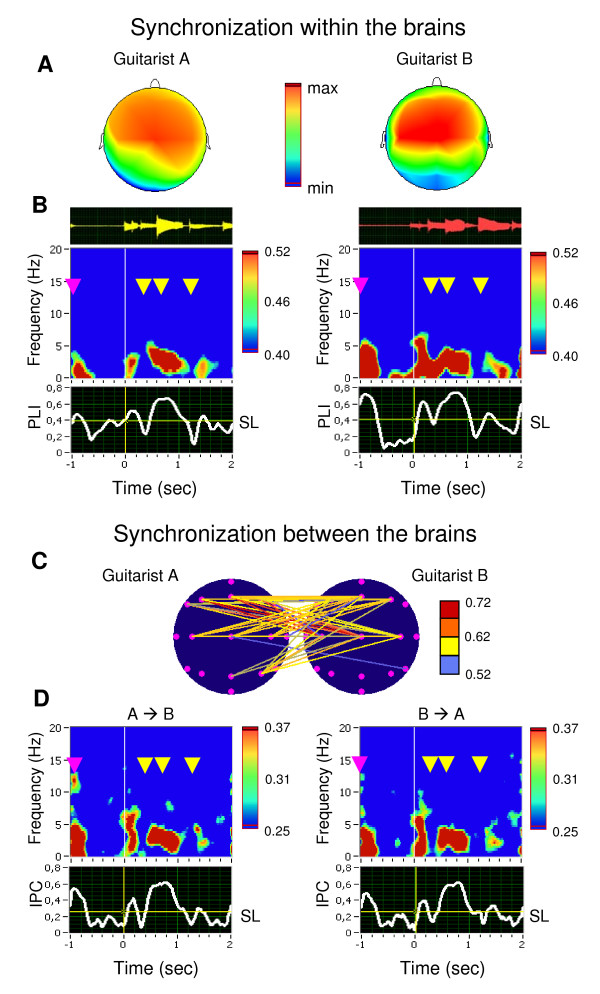
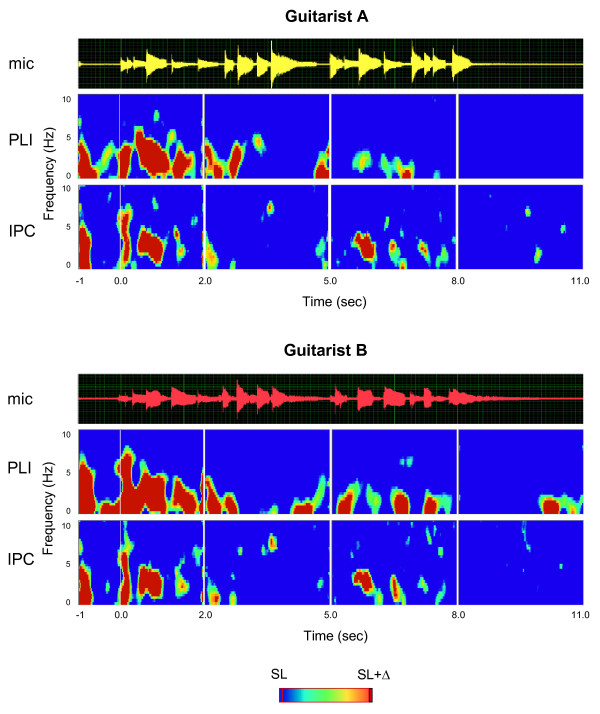
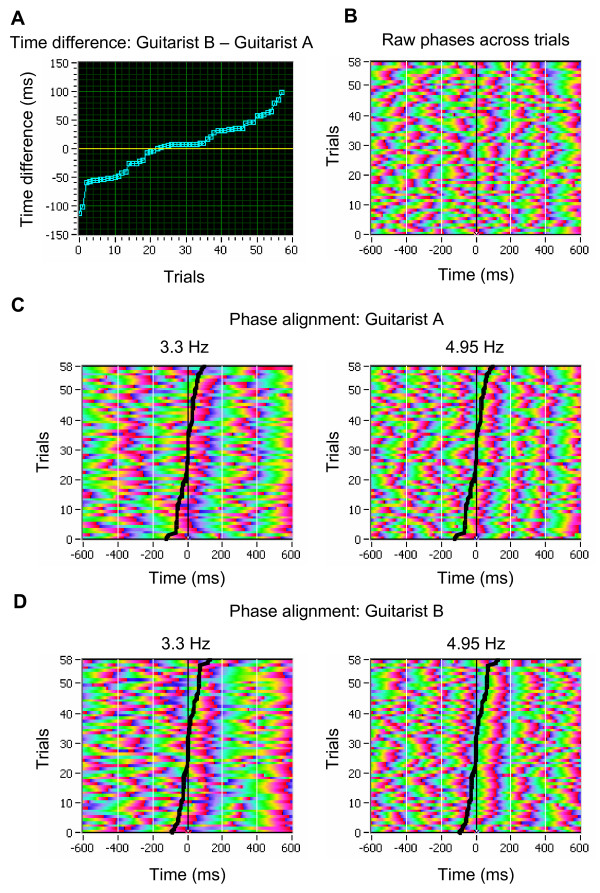
BACKGROUND: Brains interact with the world through actions that are implemented by sensory and motor processes. A substantial part of these interactions consists in synchronized goal-directed actions involving two or more individuals. Hyperscanning techniques for assessing fMRI simultaneously from two individuals have been developed. However, EEG recordings that permit the assessment of synchronized neuronal activities at much higher levels of temporal resolution have not yet been simultaneously assessed in multiple individuals and analyzed in the time-frequency domain. In this study, we simultaneously recorded EEG from the brains of each of eight pairs of guitarists playing a short melody together to explore the extent and the functional significance of synchronized cortical activity in the course of interpersonally coordinated actions. RESULTS: By applying synchronization algorithms to intra- and interbrain analyses, we found that phase synchronization both within and between brains increased significantly during the periods of (i) preparatory metronome tempo setting and (ii) coordinated play onset. Phase alignment extracted from within-brain dynamics was related to behavioral play onset asynchrony between guitarists. CONCLUSION: Our findings show that interpersonally coordinated actions are preceded and accompanied by between-brain oscillatory couplings. Presumably, these couplings reflect similarities in the temporal properties of the individuals' percepts and actions. Whether between-brain oscillatory couplings play a causal role in initiating and maintaining interpersonal action coordination needs to be clarified by further research.
Overview
The claims and statistics of this paper haven’t been checked yet.
Free: it reads the open-access text and checks the first 5 claims that cite a source we can check. Create a free account to check every claim.
Integrity signals
Registry
Cites
Statistics
Figures
Verification
Claims the paper makes
The claims and statistics of this paper haven’t been checked yet.
Free: it reads the open-access text and checks the first 5 claims that cite a source we can check. Create a free account to check every claim.
Claims other papers make about this one
Each is checked against this paper’s own text: does it say what the citing paper says it does?
The source backs part of the claim, not all of it — or backs it for a different population, condition or comparison.
In the citing paper
“The results showed that interpersonally coordinated actions (i.e., behavioral synchrony) are preceded and accompanied by interbrain oscillatory couplings in the prefrontal cortices.”
From Synchrony in Psychotherapy: A Review and an Integrative Framework for the Therapeutic Alliance (2016) · cites this paper as Lindenberger et al., 2009
Experimental — accuracy not yet measuredThe cited source says what the claim attributes to it.
In the citing paper
“Nevertheless, the link between movement synchrony and inter-brain coupling has been confirmed in motor tasks (Lindenberger et al., 2009).”
From Synchrony in Psychotherapy: A Review and an Integrative Framework for the Therapeutic Alliance (2016) · cites this paper as Lindenberger et al., 2009
Self-check
Percentages, sums and reported differences re-computed from the paper’s own numbers.
The self-check needs the paper’s full text.
Citations
Cites
Neuronal Oscillations in Cortical Networks
Buzsáki, G., & Draguhn, A. (2004) · Science · doi:10.1126/science.1099745 · Cited by 6,576 · cited 1×
“Network oscillations may functionally bias stimulus selection, form transient binding of neuronal assemblies, and facilitate synaptic plasticity [37].”
BackgroundA new method for off-line removal of ocular artifact
Gratton, G., Coles, M. G. H., & Donchin, E. (1983) · Electroencephalography and Clinical Neurophysiology · doi:10.1016/0013-4694(83)90135-9 · Cited by 5,055 · cited 1×
“5 to 70 Hz, and corrected for eye movements using the Gratton and Coles algorithm [43].”
MethodUnderstanding and sharing intentions: The origins of cultural cognition
Tomasello, M., Carpenter, M., Call, J., Behne, T., & Moll, H. (2005) · Behavioral and Brain Sciences · doi:10.1017/s0140525x05000129 · Cited by 4,882 · cited 2×
“Considerable research indicates that synchronized neuronal activity in perception and action [7-10] and oscillatory couplings between cortical and muscle activities during voluntary movement [11,12] are among the mechanisms supporting brain-body-world interactions [6,13-15].”
BackgroundThe brainweb: phase synchronization and large-scale integration
Varela, F., Lachaux, J.-P., Rodriguez, E., & Martinerie, J. (2001) · Nature Reviews Neuroscience · doi:10.1038/35067550 · Cited by 4,761 · cited 2×
“First, brain oscillations bind spatially distributed but functionally related information at the level of individual neurons, cell assemblies, and cortical areas [6-10].”
BackgroundNeurophysiological mechanisms underlying the understanding and imitation of action
Rizzolatti, G., Fogassi, L., & Gallese, V. (2001) · Nature Reviews Neuroscience · doi:10.1038/35090060 · Cited by 3,302 · cited 2×
“Neural activity in medial prefrontal cortex is selectively enhanced during theory of mind tasks [27,28].”
BackgroundModulation of Oscillatory Neuronal Synchronization by Selective Visual Attention
Fries, P., Reynolds, J. H., Rorie, A. E., & Desimone, R. (2001) · Science · doi:10.1126/science.1055465 · Cited by 2,786 · cited 2×
“First, brain oscillations bind spatially distributed but functionally related information at the level of individual neurons, cell assemblies, and cortical areas [6-10].”
BackgroundNeuronal Synchrony: A Versatile Code for the Definition of Relations?
Singer, W. (1999) · Neuron · doi:10.1016/s0896-6273(00)80821-1 · Cited by 2,581 · cited 1×
“Considerable research indicates that synchronized neuronal activity in perception and action [7-10] and oscillatory couplings between cortical and muscle activities during voluntary movement [11,12] are among the mechanisms supporting brain– body–world interactions [6,13-15].”
BackgroundExcitatory actions of gaba during development: the nature of the nurture
Ben-Ari, Y. (2002) · Nature Reviews Neuroscience · doi:10.1038/nrn920 · Cited by 2,448 · cited 1×
“In two interacting individuals adjusting their activity patterns through reciprocal sensory and motor pathways, synchronous brain activity can arise through temporally adjusted activity modulation [22-24] and does not need a substrate in form of connected neurons.”
BackgroundDevelopment and neurophysiology of mentalizing
Frith, U., & Frith, C. D. (2003) · Philosophical Transactions of the Royal Society of London. Series B: Biological Sciences · doi:10.1098/rstb.2002.1218 · Cited by 2,306 · cited 1×
“Considerable research indicates that synchronized neuronal activity in perception and action [7-10] and oscillatory couplings between cortical and muscle activities during voluntary movement [11,12] are among the mechanisms supporting brain-body-world interactions [6,13-15].”
BackgroundFunctional imaging of ‘theory of mind’
Gallagher, H. L., & Frith, C. D. (2003) · Trends in Cognitive Sciences · doi:10.1016/s1364-6613(02)00025-6 · Cited by 2,092 · cited 2×
“Neural activity in medial prefrontal cortex is selectively enhanced during theory of mind tasks [27,28].”
Background
Cited by
Sensorimotor synchronization: a review of recent research (2006–2012).
Repp, B. H., & Su, Y.-H. (2013) · Psychonomic Bulletin & Review · doi:10.3758/s13423-012-0371-2 · Cited by 1,204
Brain-to-brain coupling: a mechanism for creating and sharing a social world
Hasson, U., Ghazanfar, A. A., Galantucci, B., Garrod, S., & Keysers, C. (2012) · Trends in Cognitive Sciences · doi:10.1016/j.tics.2011.12.007 · Cited by 1,140
Inter-Brain Synchronization during Social Interaction
Dumas, G., Nadel, J., Soussignan, R., Martinerie, J., & Garnero, L. (2010) · PLoS ONE · doi:10.1371/journal.pone.0012166 · Cited by 966
Can social interaction constitute social cognition?
De Jaegher, H., Di Paolo, E., & Gallagher, S. (2010) · Trends in Cognitive Sciences · doi:10.1016/j.tics.2010.06.009 · Cited by 911
Cui, X., Bryant, D. M., & Reiss, A. L. (2012) · NeuroImage · doi:10.1016/j.neuroimage.2011.09.003 · Cited by 807
“EEG-based hyperscanning has enabled the study of social interaction in a more naturalistic environment (Astolfi et al., 2010; Dumas et al., 2010; Lindenberger et al., 2009), for example in poker playing (Babiloni et al.”
Towards the utilization of EEG as a brain imaging tool
Michel, C. M., & Murray, M. M. (2012) · NeuroImage · doi:10.1016/j.neuroimage.2011.12.039 · Cited by 738
“Recently, such connectivity measures have also been used to study functional interactions between the brains of different subjects called “hyperscanning” (Astolfi et al., 2010; Dumas et al., 2010; Lindenberger et al., 2009).”
BackgroundSocial neuroscience and hyperscanning techniques: past, present and future.
Babiloni, F., & Astolfi, L. (2014) · Neuroscience & Biobehavioral Reviews · doi:10.1016/j.neubiorev.2012.07.006 · Cited by 573
“B) Patterns of interbrain coherence during simultaneous music production between two guitarists in an EEG hyperscanning experiment (head seen from above, nose up) (Lindenberger et al., 2009).”
BackgroundMethodInfluentialMusic and social bonding: “self-other†merging and neurohormonal mechanisms
Tarr, B., Launay, J., & Dunbar, R. I. M. (2014) · Frontiers in Psychology · doi:10.3389/fpsyg.2014.01096 · Cited by 548
“Indeed, behavioral synchrony has also been demonstrated to induce common neural signatures between interacting agents (Oullier et al., 2005; Tognoli et al., 2007; Lindenberger et al., 2009; Dumas et al., 2010).”
BackgroundHyperscanning: A Valid Method to Study Neural Inter-Brain Underpinnings of Social Interaction
Czeszumski, A., Eustergerling, S., Lang, A., Menrath, D., Gerstenberger, M., Schuberth, S., Schreiber, F., Rendon, Z. Z., & König, P. (2020) · Frontiers in Human Neuroscience · doi:10.3389/fnhum.2020.00039 · Cited by 511
“However, concerning prominent frequency bands related with movement synchronization, the reported results do not seem to be conclusive: while some effects were mainly within the alpha (10–12 Hz) and beta (∼20 Hz) range, others specifically excluded the alpha range and instead emphasized a synchronization in the theta…”
BackgroundMethodInfluentialKeller, P. E., Novembre, G., & Hove, M. J. (2014) · Philosophical Transactions of the Royal Society B: Biological Sciences · doi:10.1098/rstb.2013.0394 · Cited by 466
Synchrony in Psychotherapy: A Review and an Integrative Framework for the Therapeutic Alliance
Koole, S. L., & Tschacher, W. (2016) · Frontiers in Psychology · doi:10.3389/fpsyg.2016.00862 · Cited by 456
“For instance, one experiment simultaneously recorded the brain actions of guitarists playing a short melody together (Lindenberger et al., 2009).”
BackgroundReindl, V., Gerloff, C., Scharke, W., & Konrad, K. (2018) · NeuroImage · doi:10.1016/j.neuroimage.2018.05.060 · Cited by 411
Embodiment and sense-making in autism
De Jaegher, H. (2013) · Frontiers in Integrative Neuroscience · doi:10.3389/fnint.2013.00015 · Cited by 388
Interpersonal body and neural synchronization as a marker of implicit social interaction
Yun, K., Watanabe, K., & Shimojo, S. (2012) · Scientific Reports · doi:10.1038/srep00959 · Cited by 379
Centrality of social interaction in human brain function.
Hari, R., Henriksson, L., Malinen, S., & Parkkonen, L. (2015) · Neuron · doi:10.1016/j.neuron.2015.09.022 · Cited by 370
The Psychology of Rituals: An Integrative Review and Process-Based Framework
Hobson, N. M., Schroeder, J., Risen, J. L., Xygalatas, D., & Inzlicht, M. (2018) · Personality and Social Psychology Review · doi:10.1177/1088868317734944 · Cited by 354
The interactive brain hypothesis
Di Paolo, E., & De Jaegher, H. (2012) · Frontiers in Human Neuroscience · doi:10.3389/fnhum.2012.00163 · Cited by 328
“…as a detached interpreter of social stimuli (see e.g., Van Overwalle, 2009) and to pay attention to neural mechanisms involved in embodied social interaction (Schilbach et al., 2006; Tognoli et al., 2007; Lindenberger et al., 2009; Dumas et al., 2010; Redcay et al., 2010; Pfeiffer et al., 2011).”
BackgroundKonvalinka, I., & Roepstorff, A. (2012) · Frontiers in Human Neuroscience · doi:10.3389/fnhum.2012.00215 · Cited by 324
“A different approach was taken by Lindenberger et al. (2009), who looked at inter-brain phase synchronization. They recorded dual EEG while pairs of guitarists played a short melody together. They found phase synchronized theta and delta oscillations both within and between brains prior to and while playing the melody…”
BackgroundMethodBrain-to-brain coupling during handholding is associated with pain reduction
Goldstein, P., Weissman-Fogel, I., Dumas, G., & Shamay-Tsoory, S. G. (2018) · Proceedings of the National Academy of Sciences · doi:10.1073/pnas.1703643115 · Cited by 311
“Considering the high temporal resolution and low sensitivity to motion artifacts of EEG, hyperscanning studies with EEG have provided compelling evidence of interbrain synchronization during various cognitive tasks, such as during conversations (47), spontaneous gestural imitation (48, 49), prisoner’s dilemma game (50…”
BackgroundCooperation in lovers: An fNIRS-based hyperscanning study
Pan, Y., Cheng, X., Zhang, Z., Li, X., & Hu, Y. (2017) · Human Brain Mapping · doi:10.1002/hbm.23421 · Cited by 307
“Hyperscanning can be used with fMRI (e.g., Chiu et al., 2008; Li et al., 2009), EEG (e.g., Lindenberger et al., 2009), and fNIRS (e.g., Cheng et al., 2015; Jiang et al., 2015; Tang et al., 2016).”
MethodIntra- and interbrain synchronization and network properties when playing guitar in duets
Sänger, J., Müller, V., & Lindenberger, U. (2012) · Frontiers in Human Neuroscience · doi:10.3389/fnhum.2012.00312 · Cited by 305
“In addition, and informed by the Lindenberger et al. (2009) findings, we also compared segments of coordinated play onset with segments of mere joint playing.”
BackgroundResultInfluentialSelf-citationOn the interpretation of synchronization in EEG hyperscanning studies: a cautionary note
Burgess, A. P. (2013) · Frontiers in Human Neuroscience · doi:10.3389/fnhum.2013.00881 · Cited by 270
“…Makeig, 2007; Tognoli et al., 2007, 2011a,b; Chung et al., 2008; Tognoli, 2008; Yun et al., 2008; Astolfi et al., 2009, 2010a,b,c, 2011a,b, 2012; Lindenberger et al., 2009; Dumas et al., 2010, 2012a,b; Fallani et al., 2010; Dodel et al., 2011; Lachat et al., 2012; Naeem et al., 2012a,b; Sanger…”
BackgroundMethodInfluentialConsumer Grade EEG Measuring Sensors as Research Tools: A Review
Sawangjai, P., Hompoonsup, S., Leelaarporn, P., Kongwudhikunakorn, S., & Wilaiprasitporn, T. (2020) · IEEE Sensors Journal · doi:10.1109/jsen.2019.2962874 · Cited by 267
“The experiments generally aim to explore the brain mechanisms as subjects undergo different tasks such as the Prisoner’s Dilemma [246]–[249], Chicken’s Game [250], “Bridge-like” card game [246], [251], [252], music related study [253]–[255], and movement imitation/synchronization [256]–[259].”
BackgroundCardiac and Respiratory Patterns Synchronize between Persons during Choir Singing
Müller, V., & Lindenberger, U. (2011) · PLoS ONE · doi:10.1371/journal.pone.0024893 · Cited by 256
“This leads to the question how these rhythms interact with each other and the external environment [1], especially if this environment is extended to interacting people [2,3].”
BackgroundSelf-citationCheng, X., Li, X., & Hu, Y. (2015) · Human Brain Mapping · doi:10.1002/hbm.22754 · Cited by 253
“As the Hbo signal is more sensitive to the changes in cerebral blood flow than the Hbr signal [Hoshi, 2003; Lindenberger et al., 2009], only Hbo time series were analyzed in current study.”
BackgroundNozawa, T., Sasaki, Y., Sakaki, K., Yokoyama, R., & Kawashima, R. (2016) · NeuroImage · doi:10.1016/j.neuroimage.2016.03.059 · Cited by 235
“, 2012) and electroencephalography (EEG) studies (Astolfi et al., 2010; De Vico Fallani et al., 2010; Dumas et al., 2010; Kawasaki et al., 2013; Konvalinka et al., 2014; Lindenberger et al., 2009; Sanger et al., 2012) have shown that verbal and nonverbal communication induces interpersonal relationships among neural a…”
Northoff, G., & Huang, Z. (2017) · Neuroscience & Biobehavioral Reviews · doi:10.1016/j.neubiorev.2017.07.013 · Cited by 229
Kawasaki, M., Yamada, Y., Ushiku, Y., Miyauchi, E., & Yamaguchi, Y. (2013) · Scientific Reports · doi:10.1038/srep01692 · Cited by 228
Konvalinka, I., Bauer, M., Stahlhut, C., Hansen, L. K., Roepstorff, A., & Frith, C. D. (2014) · NeuroImage · doi:10.1016/j.neuroimage.2014.03.003 · Cited by 228
Keller, P. E., & Appel, M. (2010) · Music Perception · doi:10.1525/mp.2010.28.1.27 · Cited by 201
Music and communication in music psychology
Cross, I. (2014) · Psychology of Music · doi:10.1177/0305735614543968 · Cited by 194
“Interestingly, some of the earliest studies to demonstrate coordination of brain activity across interacting individuals explored musical interaction (Lindenberger et al., 2009), and recent work has shown that even joint music listening can activate similar”
BackgroundInvestigating Cooperative Behavior in Ecological Settings: An EEG Hyperscanning Study
Toppi, J., Borghini, G., Petti, M., He, E. J., De Giusti, V., He, B., Astolfi, L., & Babiloni, F. (2016) · PLOS ONE · doi:10.1371/journal.pone.0154236 · Cited by 198
Pan, Y., Novembre, G., Song, B., Li, X., & Hu, Y. (2018) · NeuroImage · doi:10.1016/j.neuroimage.2018.08.005 · Cited by 192
“Indeed, music is an inherently social activity and has proven to be a good test case for social phenomena (D'Ausilio et al., 2015; Lindenberger et al., 2009; Osaka et al., 2015; Keller et al., 2017).”
From social behaviour to brain synchronization: Review and perspectives in hyperscanning
Dumas, G., Lachat, F., Martinerie, J., Nadel, J., & George, N. (2011) · IRBM · doi:10.1016/j.irbm.2011.01.002 · Cited by 194
Cooperation makes two less-creative individuals turn into a highly-creative pair
Xue, H., Lu, K., & Hao, N. (2018) · NeuroImage · doi:10.1016/j.neuroimage.2018.02.007 · Cited by 190
Sex differences in neural and behavioral signatures of cooperation revealed by fNIRS hyperscanning
Baker, J. M., Liu, N., Cui, X., Vrticka, P., Saggar, M., Hosseini, S. M. H., & Reiss, A. L. (2016) · Scientific Reports · doi:10.1038/srep26492 · Cited by 195
The role of temporal prediction abilities in interpersonal sensorimotor synchronization
Pecenka, N., & Keller, P. E. (2011) · Experimental Brain Research · doi:10.1007/s00221-011-2616-0 · Cited by 189
Brain-to-brain synchronization across two persons predicts mutual prosociality
Hu, Y., Hu, Y., Li, X., Pan, Y., & Cheng, X. (2017) · Social Cognitive and Affective Neuroscience · doi:10.1093/scan/nsx118 · Cited by 180
“…captured the synchronous oscillatory activities (in alpha, delta or theta frequency bands) across individuals in time counting (Mu et al., 2016), fingertip moving (Yun et al., 2012), gesture imitating (Dumas et al., 2010) and instrument playing (Lindenberger et al., 2009; Müller et al., 2013).”
BackgroundInteractive Brain Activity: Review and Progress on EEG-Based Hyperscanning in Social Interactions
Liu, D., Liu, S., Liu, X., Zhang, C., Li, A., Jin, C., Chen, Y., Wang, H., & Zhang, X. (2018) · Frontiers in Psychology · doi:10.3389/fpsyg.2018.01862 · Cited by 182
Axmacher, N., Cohen, M. X., Fell, J., Haupt, S., Dümpelmann, M., Elger, C. E., Schlaepfer, T. E., Lenartz, D., Sturm, V., & Ranganath, C. (2010) · Neuron · doi:10.1016/j.neuron.2010.02.006 · Cited by 183
“…of between-subject amplitude correlation was that the specific temporal pattern of expected and unexpected items would induce systematic fluctuations of EEG amplitudes—e.g., related to primacy, recency, and temporal variations of expectations (Hasson et al., 2004; Lindenberger et al., 2009).”
BackgroundOsaka, N., Minamoto, T., Yaoi, K., Azuma, M., Shimada, Y. M., & Osaka, M. (2015) · Frontiers in Psychology · doi:10.3389/fpsyg.2015.01811 · Cited by 161
“…et al., 2002) or neuroeconomics (King-Casas et al., 2005), and electroencephalography (EEG) for social interactions (Astolfi et al., 2011), card game (Babiloni et al., 2006), instrument playing (Lindenberger et al., 2009), and cooperative prisoner’s dilemma games (De Vico Fallani et al., 2010).”
BackgroundMethodInfluentialIntra- and Inter-Brain Synchronization during Musical Improvisation on the Guitar
Müller, V., Sänger, J., & Lindenberger, U. (2013) · PLoS ONE · doi:10.1371/journal.pone.0073852 · Cited by 159
“In a previous study [4], we observed duets of guitarists playing a short melody in unison.”
BackgroundResultInfluentialSelf-citationDance on the Brain: Enhancing Intra- and Inter-Brain Synchrony
Basso, J. C., Satyal, M. K., & Rugh, R. (2021) · Frontiers in Human Neuroscience · doi:10.3389/fnhum.2020.584312 · Cited by 215
“For example, interpersonal brain synchrony increases during such tasks as cooperative game playing, coordinated walking, group humming, guitar playing, and problem-solving (Lindenberger et al., 2009; Cui et al., 2012; Jiang et al., 2012; Müller et al., 2013; Osaka et al., 2014; Nozawa et al., 2016; Ikeda et al., 2017;…”
BackgroundMethodInter-brain synchrony and cooperation context in interactive decision making
Hu, Y., Pan, Y., Shi, X., Cai, Q., Li, X., & Cheng, X. (2018) · Biological Psychology · doi:10.1016/j.biopsycho.2017.12.005 · Cited by 166
Body sway reflects leadership in joint music performance
Chang, A., Livingstone, S. R., Bosnyak, D. J., & Trainor, L. J. (2017) · Proceedings of the National Academy of Sciences · doi:10.1073/pnas.1617657114 · Cited by 183
“These oscillatory activities might also play a role in the prediction of the intentions and actions of others (21, 56, 57).”
BackgroundHyperscanning neuroimaging technique to reveal the “two-in-one” system in social interactions
Koike, T., Tanabe, H. C., & Sadato, N. (2015) · Neuroscience Research · doi:10.1016/j.neures.2014.11.006 · Cited by 145
A Multi-Brain Framework for Social Interaction
Kingsbury, L., & Hong, W. (2020) · Trends in Neurosciences · doi:10.1016/j.tins.2020.06.008 · Cited by 167
“This is partly because noninvasive techniques such as fMRI and EEG cannot resolve neural dynamics at the single-cell level, precluding the possibility of linking region- and brain-wide activity with microcircuit computations.”
BackgroundMethodInfluentialFishburn, F. A., Murty, V. P., Hlutkowsky, C. O., MacGillivray, C. E., Bemis, L. M., Murphy, M. E., Huppert, T. J., & Perlman, S. B. (2018) · Social Cognitive and Affective Neuroscience · doi:10.1093/scan/nsy060 · Cited by 144
Cooperation Makes a Group be More Creative
Lu, K., Xue, H., Nozawa, T., & Hao, N. (2018) · Cerebral Cortex · doi:10.1093/cercor/bhy215 · Cited by 153
Szymanski, C., Pesquita, A., Brennan, A., Perdikis, D., Enns, J. T., Brick, T. R., Müller, V., & Lindenberger, U. (2017) · NeuroImage · doi:10.1016/j.neuroimage.2017.03.013 · Cited by 150
“At the beginning of each experimental session, participants filled out questionnaires that assessed personality (NEO Five-Factor-Inventory, Costa and McCrae, 1992) and interpersonal values (Circumplex scales of interpersonal values, Locke, 2000).”
Self-citationInterpersonal synchrony enhanced through 20 Hz phase-coupled dual brain stimulation
Novembre, G., Knoblich, G., Dunne, L., & Keller, P. E. (2017) · Social Cognitive and Affective Neuroscience · doi:10.1093/scan/nsw172 · Cited by 140
“Finally, this account fits with the observation that inter-brain synchrony is particularly pronounced under high coordination demands, such as when two musicians establish synchronization in a duet (Lindenberger et al., 2009; S€ anger et al., 2012).”
BackgroundMethodInfluentialPerceived interpersonal synchrony increases empathy: Insights from autism spectrum disorder
Koehne, S., Hatri, A., Cacioppo, J. T., & Dziobek, I. (2015) · Cognition · doi:10.1016/j.cognition.2015.09.007 · Cited by 162
Valencia, A. L., & Froese, T. (2020) · Neuroscience of Consciousness · doi:10.1093/nc/niaa010 · Cited by 150
“1999), Inter-brain Phase Coherence (IPC) (Lindenberger et al. 2009), and Partial Directed Coherence (PDC) (Astolfi et al.”
BackgroundMethodInfluentialHakim, U., Felice, S. D., Pinti, P., Zhang, X., Noah, J. A., Ono, Y., Burgess, P. W., Hamilton, A. F. D. C., Hirsch, J., & Tachtsidis, I. (2023) · NeuroImage · doi:10.1016/j.neuroimage.2023.120354 · Cited by 157
Directionality in hyperbrain networks discriminates between leaders and followers in guitar duets
Sänger, J., Müller, V., & Lindenberger, U. (2013) · Frontiers in Human Neuroscience · doi:10.3389/fnhum.2013.00234 · Cited by 126
“Within the alpha and beta bands, we selected “frequencies of interest” (FOIs), based on observations reported by Lindenberger et al. (2009), according to which synchronization maxima are likely to occur at multiples of the metronome frequency.”
BackgroundMethodSelf-citationTowards a two-body neuroscience
Dumas, G. (2011) · Communicative & Integrative Biology · doi:10.4161/cib.4.3.15110 · Cited by 127
Balconi, M., & Vanutelli, M. E. (2017) · Frontiers in Computational Neuroscience · doi:10.3389/fncom.2017.00086 · Cited by 130
“Lindenberger et al. (2009) found that, when playing a short melody together, dyads of guitarists showed increased phase synchronized theta and delta oscillations.”
BackgroundAnatomical Connectivity Influences both Intra- and Inter-Brain Synchronizations
Dumas, G., Chavez, M., Nadel, J., & Martinerie, J. (2012) · PLoS ONE · doi:10.1371/journal.pone.0036414 · Cited by 117
“Hyperscanning-EEG have opened the explorations to the millisecond time-scale [23,24].”
BackgroundDual brain stimulation enhances interpersonal learning through spontaneous movement synchrony
Pan, Y., Novembre, G., Song, B., Zhu, Y., & Hu, Y. (2021) · Social Cognitive and Affective Neuroscience · doi:10.1093/scan/nsaa080 · Cited by 109
Li, R., Mayseless, N., Balters, S., & Reiss, A. L. (2021) · NeuroImage · doi:10.1016/j.neuroimage.2021.118263 · Cited by 121
“…measurement of brain activity from multiple individuals, has been recently proposed to study social interactions using advanced brain imaging techniques, including fMRI (Bilek et al., 2015; Lee et al., 2010) and electroencephalography (EEG) (Babiloni and Astolfi, 2014; Lindenberger et al., 2009).”
Liu, J., Zhang, R., Geng, B., Zhang, T., Yuan, D., Otani, S., & Li, X. (2019) · NeuroImage · doi:10.1016/j.neuroimage.2019.03.004 · Cited by 109
Ahn, S., Cho, H., Kwon, M., Kim, K., Kwon, H., Kim, B. S., Chang, W. S., Chang, J. W., & Jun, S. C. (2017) · Human Brain Mapping · doi:10.1002/hbm.23834 · Cited by 129
Physiological compliance for social gaming analysis: Cooperative versus competitive play
Chanel, G., Kivikangas, J. M., & Ravaja, N. (2012) · Interacting with Computers · doi:10.1016/j.intcom.2012.04.012 · Cited by 110
“However, those methods have mainly been applied to brain signals analysis [40] and not to peripheral signals.”
MethodSurviving COVID-19: The Neuroscience of Smart Working and Distance Learning
Riva, G., Wiederhold, B. K., & Mantovani, F. (2021) · Cyberpsychology, Behavior, and Social Networking · doi:10.1089/cyber.2021.0009 · Cited by 105
“29 As explained by Gole-man and Boyatzis, 4 ‘‘You can see oscillators in action when you watch people about to kiss; their movements look like a dance, one body responding to the other seamlessly.”
Liu, T., Duan, L. F., Dai, R., Pelowski, M. J., & Zhu, C. (2021) · NeuroImage · doi:10.1016/j.neuroimage.2021.118147 · Cited by 119
Interpersonal Coordination: Methods, Achievements, and Challenges
Cornejo, C., Cuadros, Z., Morales, R., & Mayor, J. P. (2017) · Frontiers in Psychology · doi:10.3389/fpsyg.2017.01685 · Cited by 127
“…to examine the neurophysiological level of interpersonal coordination are functional magnetic resonance imaging (fMRI) (Jasmin et al., 2016), electroencephalography (EEG) (Lindenberger et al., 2009; Yun et al., 2012), and nearinfrared spectroscopy (NIRS) (Cui et al., 2012; Holper et al., 2012).”
BackgroundInfluentialHyPyP: a Hyperscanning Python Pipeline for inter-brain connectivity analysis
Ayrolles, A., Brun, F., Chen, P., Djalovski, A., Beauxis, Y., Delorme, R., Bourgeron, T., Dikker, S., & Dumas, G. (2020) · Social Cognitive and Affective Neuroscience · doi:10.1093/scan/nsaa141 · Cited by 122
“It has been adopted in a series of musical coordination studies (Lindenberger et al., 2009; Sänger et al., 2012).”
MethodThe Brain Behind the Response: Insights Into Turn-taking in Conversation From Neuroimaging
Bögels, S., & Levinson, S. C. (2017) · Research on Language and Social Interaction · doi:10.1080/08351813.2017.1262118 · Cited by 101
Nam, C. S., Choo, S., Huang, J., & Park, J. (2020) · Applied Sciences · doi:10.3390/app10196669 · Cited by 100
“Three of the studies looked at musicians who played guitar [25,85,86], and three other studies looked at musicians who played the saxophone [23,87,88].”
MethodPhysio-behavioral coupling in a cooperative team task: Contributors and relations.
Strang, A. J., Funke, G. J., Russell, S. M., Dukes, A. W., & Middendorf, M. S. (2014) · Journal of Experimental Psychology: Human Perception and Performance · doi:10.1037/a0033125 · Cited by 94
Santosa, H., Aarabi, A., Perlman, S. B., & Huppert, T. J. (2017) · Journal of Biomedical Optics · doi:10.1117/1.jbo.22.5.055002 · Cited by 106
Reciprocity and alignment: quantifying coupling in dynamic interactions
Dumas, G., & Fairhurst, M. T. (2021) · Royal Society Open Science · doi:10.1098/rsos.210138 · Cited by 88
“77 Within the musical domain, research has explored these mesoscopic scales looking at small groups of ensemble players 48,78 to the one of a chorus.”
BackgroundHow relevant is social interaction in second language learning?
Verga, L., & Kotz, S. A. (2013) · Frontiers in Human Neuroscience · doi:10.3389/fnhum.2013.00550 · Cited by 111
“Indeed, synchronized EEG activity in frontal and central regions has been found in theta and delta oscillations of pairs of guitarists playing a melody together (Lindenberger et al., 2009); similarly, when pairs of participants are required to spontaneously imitate each others, their brain activity becomes synchronize…”
BackgroundContent-specific coordination of listeners' to speakers' EEG during communication
Kuhlen, A. K., Allefeld, C., & Haynes, J.-D. (2012) · Frontiers in Human Neuroscience · doi:10.3389/fnhum.2012.00266 · Cited by 87
“…in various domains, for example, by observing individuals while they were playing a game of cards (Astolfi et al., 2010), tapping their fingers in synchrony (Tognoli et al., 2007), imitating each other’s hand movements (Dumas et al., 2010), or playing guitar together (Lindenberger et al., 2009).”
BackgroundThe Socio-Temporal Brain: Connecting People in Time
Schirmer, A., Meck, W. H., & Penney, T. B. (2016) · Trends in Cognitive Sciences · doi:10.1016/j.tics.2016.08.002 · Cited by 83
Singer, T. (2009) · Elsevier eBooks · doi:10.1016/b978-0-12-374176-9.00017-8 · Cited by 86
Shimizu, N., Umemura, T., Matsunaga, M., & Hirai, T. (2017) · Aging & Mental Health · doi:10.1080/13607863.2017.1379048 · Cited by 90
Neural correlates of non-verbal social interactions: A dual-EEG study
Ménoret, M., Varnet, L., Fargier, R., Cheylus, A., Curie, A., Portes, V. D., Nazir, T. A., & Paulignan, Y. (2013) · Neuropsychologia · doi:10.1016/j.neuropsychologia.2013.10.001 · Cited by 90
“Lindenberger et al. (2009) and Dumas et al. (2010) measured interactional synchrony to determine when two areas (inter or intra-brain) were similarly activated.”
Musical friends and foes: The social cognition of affiliation and control in improvised interactions
Aucouturier, J., & Canonne, C. (2017) · Cognition · doi:10.1016/j.cognition.2017.01.019 · Cited by 93
Cognitive Neurophysiologic Synchronies: What Can They Contribute to the Study of Teamwork?
Stevens, R. H., Galloway, T. L., Wang, P., & Berka, C. (2011) · Human Factors The Journal of the Human Factors and Ergonomics Society · doi:10.1177/0018720811427296 · Cited by 84
Spontaneous dyadic behavior predicts the emergence of interpersonal neural synchrony
Koul, A., Ahmar, D., Iannetti, G. D., & Novembre, G. (2023) · NeuroImage · doi:10.1016/j.neuroimage.2023.120233 · Cited by 75
Social Interaction in Games: Measuring Physiological Linkage and Social Presence
Ekman, I., Chanel, G., Järvelä, S., Kivikangas, J. M., Salminen, M., & Ravaja, N. (2012) · Simulation & Gaming · doi:10.1177/1046878111422121 · Cited by 74
“Phase synchronization has been frequently used to study brain signals (Lachaux et al., 1999; Linderberger, Li, Gruber, & Muller, 2009; Stam, 2005).”
BackgroundMethodThe coordination dynamics of social neuromarkers
Tognoli, E., & Kelso, J. A. S. (2015) · Frontiers in Human Neuroscience · doi:10.3389/fnhum.2015.00563 · Cited by 81
“The entire non-invasive armamentarium of the neurosciences has been harnessed toward the goal of discovering neural mechanisms of human social behavior, for instance using EEG (Babiloni et al., 2002; Sebanz et al., 2006; Tognoli et al., 2007; Lindenberger et al., 2009; Dumas, et al., 2010; De Vico Fallani, 2010), MEG…”
InfluentialEEG hyperscanning study of inter-brain synchrony during cooperative and competitive interaction
Sinha, N., Maszczyk, T., Wanxuan, Z., Tan, J. H. W., & Dauwels, J. (2016) · Conference proceedings/Conference proceedings - IEEE International Conference on Systems, Man, and Cybernetics · doi:10.1109/smc.2016.7844990 · Cited by 86
“For instance, [12] has reported synchronous neural activities between brains of the subjects as they play guitar together, reflecting interpersonal coordination.”
BackgroundNeural signatures of team coordination are revealed by multifractal analysis
Likens, A. D., Amazeen, P. G., Stevens, R., Galloway, T. L., & Gorman, J. C. (2014) · Social Neuroscience · doi:10.1080/17470919.2014.882861 · Cited by 79
“Mandelbrot (1983) introduced the notion of a scaling exponent to describe self-similarity in natural phenomena.”
BackgroundDoes the brain know who is at the origin of what in an imitative interaction?
Dumas, G., Martinerie, J., Soussignan, R., & Nadel, J. (2012) · Frontiers in Human Neuroscience · doi:10.3389/fnhum.2012.00128 · Cited by 74
“Hyperscanning meth-ods have been recently used to explore interpersonal coordination (Tognoli et al., 2007; Lindenberger et al., 2009), inter-brain connectivity-related to decision-making (Astolfi et al., 2010), or inter-brain synchronization during imitative interaction (Dumas et al., 2010), but so…”
Brain-to-Brain Coupling in the Gamma-Band as a Marker of Shared Intentionality
Barraza, P., Pérez, A., & Rodríguez, E. (2020) · Frontiers in Human Neuroscience · doi:10.3389/fnhum.2020.00295 · Cited by 77
Interactive brains, social minds
Sänger, J., Lindenberger, U., & Müller, V. (2011) · Communicative & Integrative Biology · doi:10.4161/cib.17934 · Cited by 71
“The studies by Lindenberger et al.(50) and Dumas et al.”
Self-citationMusic Performance As an Experimental Approach to Hyperscanning Studies
Acquadro, M., Congedo, M., & Riddeer, D. D. (2016) · Frontiers in Human Neuroscience · doi:10.3389/fnhum.2016.00242 · Cited by 84
Affective Synchrony and Autonomic Coupling during Cooperation: A Hyperscanning Study
Vanutelli, M. E., Gatti, L., Angioletti, L., & Balconi, M. (2017) · BioMed Research International · doi:10.1155/2017/3104564 · Cited by 69
Endogenous sources of interbrain synchrony in duetting pianists
Gugnowska, K., Novembre, G., Kohler, N., Villringer, A., Keller, P. E., & Sammler, D. (2021) · Cerebral Cortex · doi:10.1093/cercor/bhab469 · Cited by 77
“…synchrony merely reflects the similar tracking of shared sensorimotor information by each individual’s brain or can stem from aligned cognitive processes relevant for social interaction (Lindenberger et al. 2009; Burgess 2013; Kingsbury and Hong 2020; Hamilton 2021; Novembre and Iannetti 2021).”
InfluentialPast and future of near-infrared spectroscopy in studies of emotion and social neuroscience
Balconi, M., & Molteni, E. (2015) · Journal of Cognitive Psychology · doi:10.1080/20445911.2015.1102919 · Cited by 79
Multiple-Brain Connectivity During Third Party Punishment: an EEG Hyperscanning Study
Ciaramidaro, A., Toppi, J., Casper, C., Freitag, C. M., Siniatchkin, M., & Astolfi, L. (2018) · Scientific Reports · doi:10.1038/s41598-018-24416-w · Cited by 74
MEG dual scanning: a procedure to study real-time auditory interaction between two persons
Baess, P., Zhdanov, A., Mandel, A., Parkkonen, L., Hirvenkari, L., Mäkelä, J. P., Jousmäki, V., & Hari, R. (2012) · Frontiers in Human Neuroscience · doi:10.3389/fnhum.2012.00083 · Cited by 69
“Moreover, brain rhythms that have been hypothesized to play an important role in social interaction (Wilson and Wilson, 2005; Tognoli et al., 2007; Schroeder et al., 2008; Lindenberger et al., 2009; Scott et al., 2009; Dumas et al., 2010; Hasson et al., 2012) are very fast (5–20 Hz) compared with hemodynamic variation…”
BackgroundInfluentialStudying parent-child interaction with hyperscanning
Nguyen, T., Bánki, A., Marková, G., & Hoehl, S. (2020) · Progress in brain research · doi:10.1016/bs.pbr.2020.05.003 · Cited by 85
We can work it out: an enactive look at cooperation
Fantasia, V., De Jaegher, H., & Fasulo, A. (2014) · Frontiers in Psychology · doi:10.3389/fpsyg.2014.00874 · Cited by 67
“In section 3, we start applying these ideas to understanding cooperation.”
BackgroundMethodZhang, M., Liu, T., Pelowski, M. J., & Yu, D. (2017) · Scientific Reports · doi:10.1038/s41598-017-06764-1 · Cited by 75
Zhang, M., Liu, T., Pelowski, M. J., Jia, H., & Yu, D. (2017) · Brain and Cognition · doi:10.1016/j.bandc.2017.08.008 · Cited by 72
Balconi, M., Pezard, L., Nandrino, J.-L., & Vanutelli, M. E. (2017) · PLOS ONE · doi:10.1371/journal.pone.0187652 · Cited by 66
Synchronization in human musical rhythms and mutually interacting complex systems
Hennig, H. (2014) · Proceedings of the National Academy of Sciences · doi:10.1073/pnas.1324142111 · Cited by 77
“4 for an overview), coordination of speech rhythm (25), social interactions (26), cortical phase synchronization while playing guitar in duets (27, 28), and improvisation in classical music performances (29).”
Background
Metadata
- Authors
- Lindenberger, U., Li, S.-C., Gruber, W., & Müller, V.
- Affiliations
- Max Planck Institute for Human Development (DE)
- University of Salzburg (AT)
- Corresponding author
- Lindenberger, Ulman
- Müller, Viktor
- Venue
- BMC Neuroscience
- Published
- 2009-03-17
- Volume
- 10
- Issue
- 1
- Pages
- 22-22
- ISSN
- 1471-2202 (ISSN-L)
- PMC
- PMC2662862
- OpenAlex
- W2056689588
- Cited by
- 444
- References
- 47
- Citations by year
- 2026: 35 · 2025: 26 · 2024: 31 · 2023: 30 · 2022: 26 · 2021: 36 · 2020: 52 · 2019: 18 · 2018: 29 · 2017: 31 · 2016: 21 · 2015: 21 · 2014: 23 · 2013: 22 · 2012: 19
- FWCI
- 15.65
- Type
- journal article
- Language
- en
- Open access
- gold
- doi.org
- Licence
- cc-by
- creativecommons.org/licenses/by/2.0 (tdm)
- Locations
- BMC Neuroscience (publishedVersion, cc-by)
- PubMed Central (publishedVersion, cc-by)
- PubMed (publishedVersion)
- DOAJ (DOAJ: Directory of Open Access Journals) (submittedVersion, cc-by-sa)
- Max Planck Institute for Plasma Physics (submittedVersion)
- Max Planck Digital Library (submittedVersion, other-oa)
- MPG.PuRe (Max Planck Society) (submittedVersion, other-oa)
- Funders
- Deutsche Forschungsgemeinschaft
- Max-Planck-Gesellschaft
- Topics
- Social Sciences › Psychology › Social Psychology › Action Observation and Synchronization
- Life Sciences › Neuroscience › Cognitive Neuroscience › Neural dynamics and brain function
- Life Sciences › Neuroscience › Cognitive Neuroscience › Neuroscience and Music Perception
- Keywords
- inter-brain synchrony, phase synchronization, interpersonal coordination, joint action, guitar performance, time-frequency analysis, oscillatory coupling, music performance
- MeSH terms
- Adult, Attention, Brain, Brain Mapping, Cerebral Cortex, Cortical Synchronization, Electroencephalography, Female, Humans, Magnetic Resonance Imaging, Male, Young Adult
About these checks
Registry, retraction, Cites and statistics results are computed, not judged, with one exception: a printed reference that no index lists is read once by a model before it counts as a citation error. Claims are extracted by a model and kept only when their quote appears verbatim in the text; each cited source is then checked, with a model’s help, for whether it says what the claim relies on. Those verdicts can be wrong — read the claim’s quote and the cited source before relying on one.
Statistics and arithmetic are recomputed, not judged.
Confidence bands are shown only for fields calibrated on our annotated test set. None is calibrated yet, so no band is shown.
What counts as a claim ›How we measure confidence ›How we check this ›
Are you an author, or do you see a problem with this page? Request a review
Data sources
Bibliographic data: Semantic Scholar, OpenAlex, Crossref.
Contains information from the Semantic Scholar Academic Graph Datasets, made available under the ODC Attribution License (ODC-BY 1.0).
Semantic Scholar’s data is described in: Kinney, R., et al. (2023). The Semantic Scholar Open Data Platform. arXiv:2301.10140.
