

Brains swinging in concert: cortical phase synchronization while playing guitar.
Open accessThe DOI matches its Crossref record; 47 of the 47 references it cites were found in a registry or an index.
Abstract
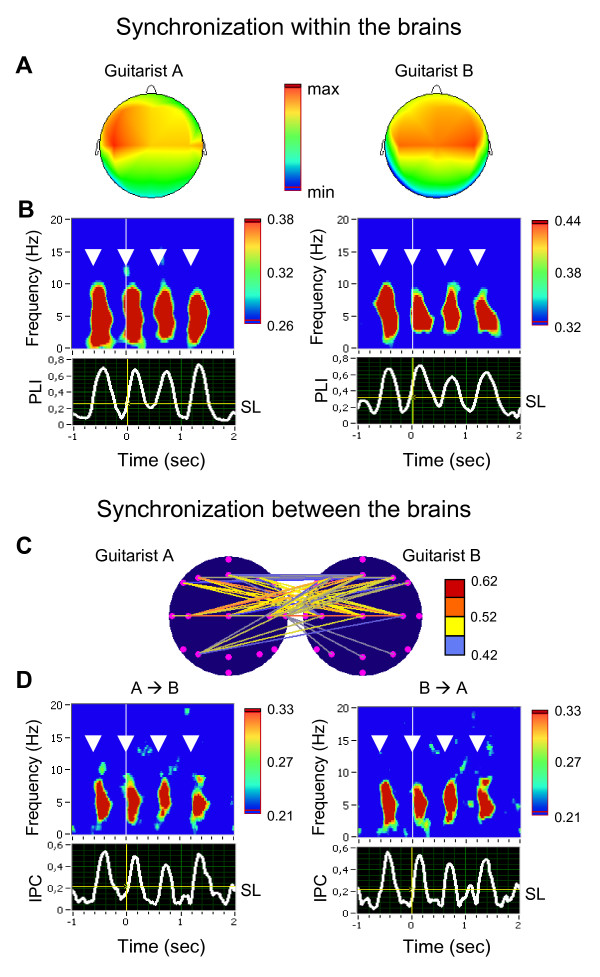
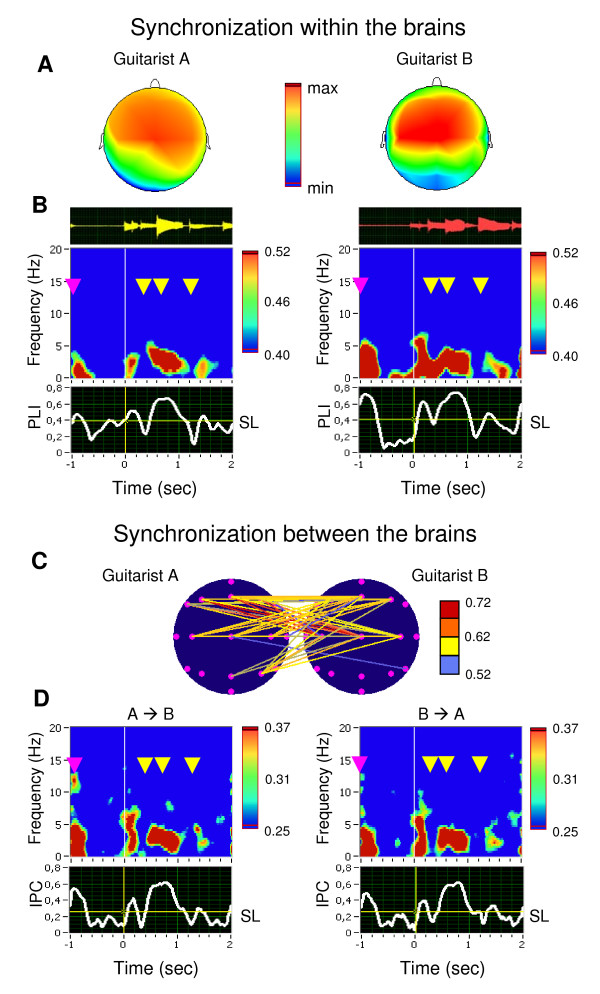
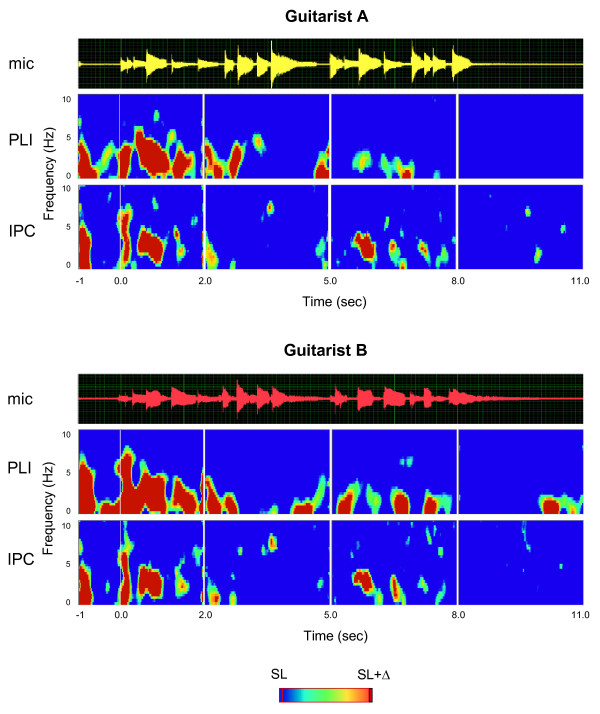
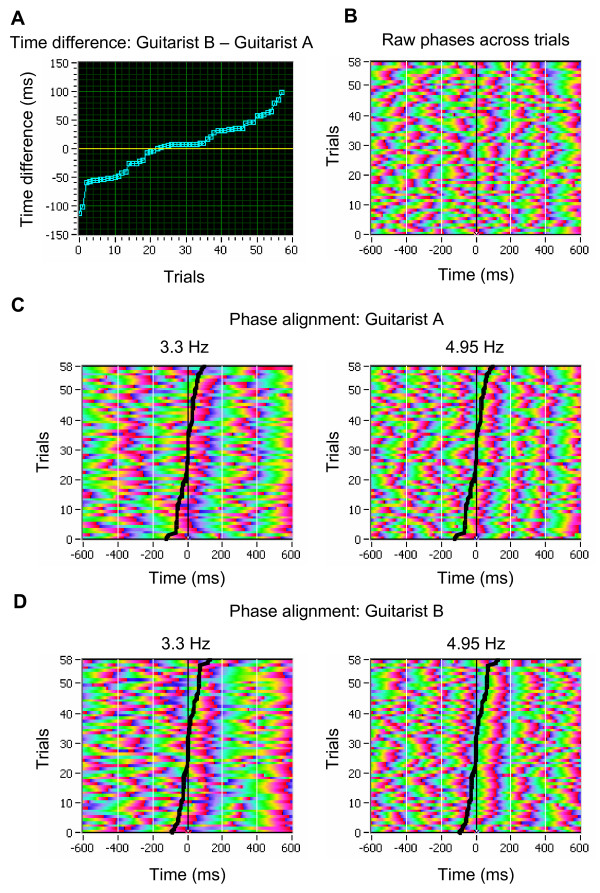
BACKGROUND: Brains interact with the world through actions that are implemented by sensory and motor processes. A substantial part of these interactions consists in synchronized goal-directed actions involving two or more individuals. Hyperscanning techniques for assessing fMRI simultaneously from two individuals have been developed. However, EEG recordings that permit the assessment of synchronized neuronal activities at much higher levels of temporal resolution have not yet been simultaneously assessed in multiple individuals and analyzed in the time-frequency domain. In this study, we simultaneously recorded EEG from the brains of each of eight pairs of guitarists playing a short melody together to explore the extent and the functional significance of synchronized cortical activity in the course of interpersonally coordinated actions. RESULTS: By applying synchronization algorithms to intra- and interbrain analyses, we found that phase synchronization both within and between brains increased significantly during the periods of (i) preparatory metronome tempo setting and (ii) coordinated play onset. Phase alignment extracted from within-brain dynamics was related to behavioral play onset asynchrony between guitarists. CONCLUSION: Our findings show that interpersonally coordinated actions are preceded and accompanied by between-brain oscillatory couplings. Presumably, these couplings reflect similarities in the temporal properties of the individuals' percepts and actions. Whether between-brain oscillatory couplings play a causal role in initiating and maintaining interpersonal action coordination needs to be clarified by further research.
Overview
The claims and statistics of this paper haven’t been checked yet.
Free: it reads the open-access text and checks the first 5 claims that cite a source we can check. Create a free account to check every claim.
Integrity signals
Registry
Cites
Statistics
Figures
Verification
Claims the paper makes
The claims and statistics of this paper haven’t been checked yet.
Free: it reads the open-access text and checks the first 5 claims that cite a source we can check. Create a free account to check every claim.
Claims other papers make about this one
Each is checked against this paper’s own text: does it say what the citing paper says it does?
The source backs part of the claim, not all of it — or backs it for a different population, condition or comparison.
In the citing paper
“The results showed that interpersonally coordinated actions (i.e., behavioral synchrony) are preceded and accompanied by interbrain oscillatory couplings in the prefrontal cortices.”
From Synchrony in Psychotherapy: A Review and an Integrative Framework for the Therapeutic Alliance (2016) · cites this paper as Lindenberger et al., 2009
Experimental — accuracy not yet measuredThe cited source says what the claim attributes to it.
In the citing paper
“Nevertheless, the link between movement synchrony and inter-brain coupling has been confirmed in motor tasks (Lindenberger et al., 2009).”
From Synchrony in Psychotherapy: A Review and an Integrative Framework for the Therapeutic Alliance (2016) · cites this paper as Lindenberger et al., 2009
Self-check
Percentages, sums and reported differences re-computed from the paper’s own numbers.
The self-check needs the paper’s full text.
Citations
Cites
Neuronal Oscillations in Cortical Networks
Buzsáki, G., & Draguhn, A. (2004) · Science · doi:10.1126/science.1099745 · Cited by 6,576 · cited 1×
“Network oscillations may functionally bias stimulus selection, form transient binding of neuronal assemblies, and facilitate synaptic plasticity [37].”
BackgroundA new method for off-line removal of ocular artifact
Gratton, G., Coles, M. G. H., & Donchin, E. (1983) · Electroencephalography and Clinical Neurophysiology · doi:10.1016/0013-4694(83)90135-9 · Cited by 5,055 · cited 1×
“5 to 70 Hz, and corrected for eye movements using the Gratton and Coles algorithm [43].”
MethodUnderstanding and sharing intentions: The origins of cultural cognition
Tomasello, M., Carpenter, M., Call, J., Behne, T., & Moll, H. (2005) · Behavioral and Brain Sciences · doi:10.1017/s0140525x05000129 · Cited by 4,882 · cited 2×
“Considerable research indicates that synchronized neuronal activity in perception and action [7-10] and oscillatory couplings between cortical and muscle activities during voluntary movement [11,12] are among the mechanisms supporting brain-body-world interactions [6,13-15].”
BackgroundThe brainweb: phase synchronization and large-scale integration
Varela, F., Lachaux, J.-P., Rodriguez, E., & Martinerie, J. (2001) · Nature Reviews Neuroscience · doi:10.1038/35067550 · Cited by 4,761 · cited 2×
“First, brain oscillations bind spatially distributed but functionally related information at the level of individual neurons, cell assemblies, and cortical areas [6-10].”
BackgroundNeurophysiological mechanisms underlying the understanding and imitation of action
Rizzolatti, G., Fogassi, L., & Gallese, V. (2001) · Nature Reviews Neuroscience · doi:10.1038/35090060 · Cited by 3,302 · cited 2×
“Neural activity in medial prefrontal cortex is selectively enhanced during theory of mind tasks [27,28].”
BackgroundModulation of Oscillatory Neuronal Synchronization by Selective Visual Attention
Fries, P., Reynolds, J. H., Rorie, A. E., & Desimone, R. (2001) · Science · doi:10.1126/science.1055465 · Cited by 2,786 · cited 2×
“First, brain oscillations bind spatially distributed but functionally related information at the level of individual neurons, cell assemblies, and cortical areas [6-10].”
BackgroundNeuronal Synchrony: A Versatile Code for the Definition of Relations?
Singer, W. (1999) · Neuron · doi:10.1016/s0896-6273(00)80821-1 · Cited by 2,581 · cited 1×
“Considerable research indicates that synchronized neuronal activity in perception and action [7-10] and oscillatory couplings between cortical and muscle activities during voluntary movement [11,12] are among the mechanisms supporting brain– body–world interactions [6,13-15].”
BackgroundExcitatory actions of gaba during development: the nature of the nurture
Ben-Ari, Y. (2002) · Nature Reviews Neuroscience · doi:10.1038/nrn920 · Cited by 2,448 · cited 1×
“In two interacting individuals adjusting their activity patterns through reciprocal sensory and motor pathways, synchronous brain activity can arise through temporally adjusted activity modulation [22-24] and does not need a substrate in form of connected neurons.”
BackgroundDevelopment and neurophysiology of mentalizing
Frith, U., & Frith, C. D. (2003) · Philosophical Transactions of the Royal Society of London. Series B: Biological Sciences · doi:10.1098/rstb.2002.1218 · Cited by 2,306 · cited 1×
“Considerable research indicates that synchronized neuronal activity in perception and action [7-10] and oscillatory couplings between cortical and muscle activities during voluntary movement [11,12] are among the mechanisms supporting brain-body-world interactions [6,13-15].”
BackgroundFunctional imaging of ‘theory of mind’
Gallagher, H. L., & Frith, C. D. (2003) · Trends in Cognitive Sciences · doi:10.1016/s1364-6613(02)00025-6 · Cited by 2,092 · cited 2×
“Neural activity in medial prefrontal cortex is selectively enhanced during theory of mind tasks [27,28].”
Background
Cited by
Items 201–300 of 444
Dyadic inter-brain EEG coherence induced by interoceptive hyperscanning
Balconi, M., & Angioletti, L. (2023) · Scientific Reports · doi:10.1038/s41598-023-31494-y · Cited by 28
Wang, Y., Zhang, J., Li, Y., Qi, S., Zhang, F., Ball, L. J., & Duan, H. (2023) · Cerebral Cortex · doi:10.1093/cercor/bhad301 · Cited by 25
Are We in Flow Neurophysiological Correlates of Flow States in a Collaborative Game
Labonté-LeMoyne, É., Léger, P., Resseguier, B., Bastarache-Roberge, M.-C., Frédette, M., Sénécal, S., & Courtemanche, F. (2016) · CHI Conference Extended Abstracts on Human Factors in Computing Systems (CHI EA) · doi:10.1145/2851581.2892356 · Cited by 30
“Indeed, multiple studies on two people working towards a common goal have found coherence between their brains [14, 15, 23] even in the absence of visual contact [7].”
BackgroundThe role of prefrontal cortex in a moral judgment task using functional near‐infrared spectroscopy
Dashtestani, H., Zaragoza, R., Kermanian, R., Knutson, K. M., Halem, M., Casey, A., Karamzadeh, N. S., Anderson, A. A., Boccara, C., & Gandjbakhche, A. (2018) · Brain and Behavior · doi:10.1002/brb3.1116 · Cited by 25
Towards a standard model of musical improvisation
Faber, S. E. M., & McIntosh, A. R. (2019) · European Journal of Neuroscience · doi:10.1111/ejn.14567 · Cited by 30
The Dialogue Between Two or More Brains: The “Hyperscanning” for Organization
Balconi, M., & Fronda, G. (2020) · Frontiers in Psychology · doi:10.3389/fpsyg.2020.598332 · Cited by 26
Brain Signatures of Team Performance
Dodel, S., Cohn, J. V., Mersmann, J., Luu, P., Forsythe, C., & Jirsa, V. (2011) · Lecture notes in computer science · doi:10.1007/978-3-642-21852-1_35 · Cited by 26
Shemyakina, N. V., & Nagornova, Z. V. (2021) · Human Physiology · doi:10.1134/s0362119721010126 · Cited by 23
A neurodynamic model of inter-brain coupling in the gamma band
Moreau, Q., Adel, L., Douglas, C. L., Ranjbaran, G., & Dumas, G. (2022) · Journal of Neurophysiology · doi:10.1152/jn.00224.2022 · Cited by 24
Maidhof, C., Müller, V., Lartillot, O., Agres, K., Bloska, J., Asano, R., Odell‐Miller, H., & Fachner, J. C. (2023) · Frontiers in Psychology · doi:10.3389/fpsyg.2023.1155732 · Cited by 27
“Note that this result is in line with previous research on guitarists playing in duet (Lindenberger et al., 2009; Sänger et al., 2012; Müller et al., 2013; Müller and Lindenberger, 2019, 2022).”
Self-citationSaul, M. A., He, X., Black, S., & Charles, F. (2022) · Frontiers in Psychology · doi:10.3389/fpsyg.2021.568921 · Cited by 26
“In experiments implementing leader-follower dynamics with guitar playing, research has shown interbrain synchronisation in theta and delta waves between the frontal and central sites of the interacting brains (Lindenberger et al., 2009; Sänger et al., 2012).”
Suggestions for a New Integration in the Psychology of Morality
Sunar, D. G. (2009) · Social and Personality Psychology Compass · doi:10.1111/j.1751-9004.2009.00191.x · Cited by 22
Ciaramidaro, A., Toppi, J., Vogel, P., Freitag, C. M., Siniatchkin, M., & Astolfi, L. (2024) · NeuroImage · doi:10.1016/j.neuroimage.2024.120783 · Cited by 22
“An increased inter-brain connectivity between two brains during interaction versus non-interaction conditions has already been reported in previous studies (Astolfi et al., 2020, Astolfi et al., 2010, Dumas et al., 2012, Lindenberger et al., 2009).”
ResultFilho, E., Bertollo, M., Robazza, C., & Comani, S. (2015) · Frontiers in Psychology · doi:10.3389/fpsyg.2015.00799 · Cited by 21
Role of language control during interbrain phase synchronization of cross-language communication
Liu, H., Zhang, M., Pérez, A., Xie, N., Li, B., & Liu, Q. (2019) · Neuropsychologia · doi:10.1016/j.neuropsychologia.2019.05.014 · Cited by 21
Does musical interaction in a jazz duet modulate peripersonal space?
Dell’Anna, A., Rosso, M., Bruno, V., Garbarini, F., Leman, M., & Berti, A. (2021) · Psychological Research · doi:10.1007/s00426-020-01365-6 · Cited by 20
Emergence of Neuronal Synchronisation in Coupled Areas
Protachevicz, P. R., Hansen, M., Iarosz, K. C., Caldas, I. L., Batista, A. M., & Kurths, J. (2021) · Frontiers in Computational Neuroscience · doi:10.3389/fncom.2021.663408 · Cited by 25
“It was also reported for subjects playing guitar (Lindenberger et al., 2009), meditating (Herbert et al.”
BackgroundAn adaptive cognitive-social model for mirroring and social bonding during synchronous joint action
Accetto, M., Treur, J., & Villa, V. (2018) · Procedia Computer Science · doi:10.1016/j.procs.2018.11.002 · Cited by 19
Jin, Z., Yin, J., Pan, Y., Zhang, Y., Li, Y., Xu, X., & Luo, J. (2024) · NeuroImage · doi:10.1016/j.neuroimage.2024.120757 · Cited by 22
“Due to the higher signal to-noise ratio of HbO (Hoshi, 2003; Lindenberger et al., 2009), we further processed HbO in this study.”
MethodSchmid, W. (2013) · Nordic Journal of Music Therapy · doi:10.1080/08098131.2013.783096 · Cited by 26
Combining EEG, MIDI, and motion capture techniques for investigating musical performance
Maidhof, C., Kästner, T., & Makkonen, T. (2013) · Behavior Research Methods · doi:10.3758/s13428-013-0363-9 · Cited by 21
“…& Altenmüller, 2011; Strübing, Herrojo Ruiz, Jabusch, & Altenmüller, 2012); and the neural 2 Note that the modified FTAP version could in principle also be used with the NIRS technology. correlates of ensemble performances (Babiloni et al., 2012; Babiloni et al., 2011; Lindenberger et al., 2009).”
BackgroundMethodInfluentialIdentifying Flow in Video Games: Towards a New Observation-Based Method
Borderie, J., & Michinov, N. (2016) · International Journal of Gaming and Computer-Mediated Simulations · doi:10.4018/ijgcms.2016070102 · Cited by 21
Hunt, A. M. (2015) · Frontiers in Human Neuroscience · doi:10.3389/fnhum.2015.00342 · Cited by 18
Beyond Dyadic Coupling: The Method of Multivariate Surrogate Synchrony (mv-SUSY)
Meier, D., & Tschacher, W. (2021) · Entropy · doi:10.3390/e23111385 · Cited by 22
“At this time scale, synchrony can be detected in A and B’s body movement [2,3], neural activity [4], or physiological activations [5,6].”
BackgroundKang, K., Orlandi, S., Leung, J., Akter, M., Lorenzen, N., Chau, T. T., & Thaut, M. H. (2023) · European Journal of Neuroscience · doi:10.1111/ejn.16036 · Cited by 19
“Lindenberger et al. (2009) and Sänger et al. (2012) investigated interbrain synchrony during guitar duets.”
BackgroundSchaefer, L. V., & Bittmann, F. N. (2018) · Scientific Reports · doi:10.1038/s41598-018-33579-5 · Cited by 18
Zhou, S., Yang, H., Yang, H., & Liu, T. (2023) · Social Cognitive and Affective Neuroscience · doi:10.1093/scan/nsad031 · Cited by 18
“For example, Lindenberger et al. (2009) examined interbrain connectivity during duet guitar playing and found significant connections between participants even when they played different parts.”
BackgroundA Brain‐To‐Brain Mechanism for Social Transmission of Threat Learning
Pan, Y., Vinding, M. C., Zhang, L., Lundqvist, D., & Olsson, A. (2023) · Advanced Science · doi:10.1002/advs.202304037 · Cited by 19
Simultaneous EEG Acquisition System for Multiple Users: Development and Related Issues
Lee, S., Cho, H., Kim, K., & Jun, S. C. (2019) · Sensors · doi:10.3390/s19204592 · Cited by 19
“Dyadic interactions have been studied during various tasks, such as visual gaze-based interactions [2,3], verbal interactions [4–6], hand movements [7–9], the social game [10], and music performance [11–13], among others.”
BackgroundLi, Q., Wang, D., Xiao, W., Tang, Y., Sun, Q., Sun, B., & Hu, Z. (2024) · npj Science of Learning · doi:10.1038/s41539-024-00286-y · Cited by 22
“Since the HbO concentration is more sensitive to changes in cerebral blood fl ow than the HbR concentration 55 , this study focusedontheHbOconcentration,whichalignswithpreviousfNIRS-based hyperscanning studies 20,21,56,57 .”
The various forms of neuroplasticity: Biological bases of learning and teaching
Tovar-Moll, F. F., & Lent, R. (2016) · Prospects · doi:10.1007/s11125-017-9388-7 · Cited by 54
Intra-Brain Connectivity vs. Inter-Brain Connectivity in Gestures Reproduction: What Relationship?
Balconi, M., & Fronda, G. (2021) · Brain Sciences · doi:10.3390/brainsci11050577 · Cited by 17
“Other studies have investigated the processes underlying the execution and observation of gestures, showing a direct link between action coding and decoding [17,18], which leads interagents involved in non-verbal interactions to perceive themselves as part of a proper joint action, thus developing “resonance mechanism…”
BackgroundResultInfluentialCoomans, E. M., Geraedts, I. K., Deijen, J. B., Keeser, D., Pogarell, O. M., & Engelbregt, H. (2021) · Advances in Cognitive Psychology · doi:10.5709/acp-0334-7 · Cited by 18
Algumaei, M. Y., Hettiarachchi, I. T., Farghaly, M., & Bhatti, A. (2023) · IEEE Access · doi:10.1109/access.2023.3332907 · Cited by 21
“While EEG studies have traditionally been conducted in controlled laboratory environments with standard paradigms [23], there is ongoing progress towards incorporating more naturalistic paradigms, such as playing musical instruments [24] and engaging in romantic kissing [25], [26].”
BackgroundReconstructing the upward path to structural realism
Beni, M. D. (2016) · European Journal for Philosophy of Science · doi:10.1007/s13194-016-0167-8 · Cited by 15
“There are a number of interesting studies that confirm the existence of structural resemblance between the structure of stimuli and different patterns of neuronal processing within the brains of different subjects (Lindenberger et al. 2009; Sänger et al. 2012).”
BackgroundFilho, E., Rettig, J., Gaspar, P. D., & Bagni, G. (2022) · Psychology of sport and exercise · doi:10.1016/j.psychsport.2022.102198 · Cited by 18
Angioletti, L., & Balconi, M. (2022) · Frontiers in Neuroergonomics · doi:10.3389/fnrgo.2022.1012810 · Cited by 15
“These results partially confirmed our first hypothesis suggesting the presence of low-frequency oscillations (delta and theta band) in frontal and central electrode locations during the performance of the motor synchronization task in the focused condition, which may signify coordinated and regulated motor activity (L…”
BackgroundResultInfluentialHorowitz‐Kraus, T., & Gashri, C. (2023) · Biology · doi:10.3390/biology12020241 · Cited by 18
Cho, P. S., Escoffier, N., Mao, Y., Green, C. K., & Davis, R. (2020) · Social Neuroscience · doi:10.1080/17470919.2020.1727949 · Cited by 19
Bracken, B. K., Alexander, V., Zak, P. J., Romero, V. L., & Barraza, J. A. (2014) · Lecture notes in computer science · doi:10.1007/978-3-319-07527-3_1 · Cited by 20
“Likewise, in simultaneously recorded pairs of musicians, increased synchronization in EEG signals (most strongly in frontotemporal locations) were found to be coordinated both during the playing and preparation period (metronome tempo setting) [4].”
BackgroundEntrainment as a basis for co-ordinated actions in speech
Ogden, R., & Hawkins, S. (2015) · White Rose Research Online (University of Leeds, The University of Sheffield, University of York) · Cited by 29
Pseudo‐mutual gazing enhances interbrain synchrony during remote joint attention tasking
Chuang, C., & Hsu, H. (2023) · Brain and Behavior · doi:10.1002/brb3.3181 · Cited by 18
“With respect to frequency bands, we hypothesized that elevated IBS might be observed inthedeltaandthetabands,potentiallyasresultsofinterpersonalsen-sory and motor synchrony (Balconi & Angioletti, 2023; Lindenberger et al., 2009) and cooperative joint-action tasks (Wang et al., 2020).”
Socializing Sensorimotor Contingencies
Lübbert, A., Göschl, F., Krause, H., Schneider, T. R., Maÿe, A., & Engel, A. K. (2021) · Frontiers in Human Neuroscience · doi:10.3389/fnhum.2021.624610 · Cited by 16
Kang, K., Orlandi, S., Lorenzen, N., Chau, T. T., & Thaut, M. H. (2022) · Developmental Neurorehabilitation · doi:10.1080/17518423.2022.2051628 · Cited by 17
“Previous hyperscanning studies in music ensembles also showed a higher interbrain synchronization at delta and theta frequencies when musicians started playing a short melody together.(8,9) In contrast to the YP dyad, the highest PLV manifested in alpha frequency bands in the YT dyad.”
BackgroundBalconi, M., Crivelli, D., & Cassioli, F. (2022) · Information · doi:10.3390/info13070312 · Cited by 15
“Examples of applications were carried out and an electrophysiological synchronization occurs between the agents in terms of inter-brain connectivity [24] and intra-brain connectivity.”
BackgroundA Standard Framework for Social Cognition: interoperable algorithms for inference and representationPreprint
Barnby, J. M., Alon, N., Bellucci, G., Schilbach, L., Frith, C., & Bell, V. (2023) · PsyArXiv (OSF Preprints) · doi:10.31234/osf.io/cmgu7 · Cited by 18
The effects of an acute Tai Chi on emotional memory and prefrontal cortex activation: a fNIRS study
Wang, H., Guo, Y., Fan, H., Chen, Z., Liu, S., Zhao, L., & Shi, Y. (2025) · Frontiers in Behavioral Neuroscience · doi:10.3389/fnbeh.2024.1520508 · Cited by 16
Balconi, M., & Angioletti, L. (2024) · Neuroscience Letters · doi:10.1016/j.neulet.2024.137789 · Cited by 16
Zhou, X., Hong, X., & Wong, P. C. M. (2024) · Psychological Science · doi:10.1177/09567976241237699 · Cited by 15
“Previous studies have reported increased IBC in the lFC between TD individuals in joint versus solo singing (Osaka et al., 2015) and in coordinated versus uncoordinated musical plays (Lindenberger et al., 2009), consistent with our results.”
Communities of Song: Collective Musical Participation and Group Singing Experiences In Victoria, BC
Specker, S. K. (2015) · The Arbutus Review · doi:10.18357/ar.speckersk.512014 · Cited by 18
Connecting the Brain to Itself through an Emulation
Serruya, M. D. (2017) · Frontiers in Neuroscience · doi:10.3389/fnins.2017.00373 · Cited by 17
“…phase features of the recorded activity. at emulated cortices representing temporal and lateral parietal regions in the 6–12 Hz oscillatory range, both in terms of covarying amplitude (Dumas et al., 2010) and precise temporal phase synchronization (Lindenberger et al., 2009; Sänger et al., 2013).”
BackgroundTowards a multi-brain perspective on communication in dialogue
Kuhlen, A. K., Allefeld, C., Anders, S., & Haynes, J. (2015) · Cambridge University Press eBooks · doi:10.1017/cbo9781107323667.009 · Cited by 15
Palhares, P. T., Sas, M. I., & Gonçalves, Ó. F. (2024) · Neuroscience & Biobehavioral Reviews · doi:10.1016/j.neubiorev.2024.105920 · Cited by 16
“…and psychological mechanisms for interpersonal coordination in real time (Keller et al., 2014), including inter-brain synchronisation (IBS) (Gugnowska et al., 2022; Lindenberger et al., 2009; S ¨ anger et al., 2012), as well as the relationship between self and other (Novembre et al., 2016).”
BackgroundGrasso‐Cladera, A., Costa‐Cordella, S., Mattoli-Sánchez, J., Vilina, E., Santander, V., Hiltner, S. E., & Parada, F. J. (2024) · Social Neuroscience · doi:10.1080/17470919.2024.2409758 · Cited by 16
“A measure that represents the degree of constancy in phase differences across trials between two electrodes measured from two brains simultaneously (Lindenberger et al., 2009)”
Schaefer, L. V., & Bittmann, F. N. (2022) · Brain Sciences · doi:10.3390/brainsci12060703 · Cited by 12
“During joint guitar playing, each subject perceives the same acoustic input [44,46,107].”
BackgroundChabin, T., Tio, G., Comte, A., Joucla, C., Gabriel, D., & Pazart, L. (2020) · Frontiers in Psychology · doi:10.3389/fpsyg.2019.02954 · Cited by 16
Interbrain substrates of role switching during mother–child interaction
Li, Y., Wu, S., Xu, J., Wang, H., Zhu, Q., Shi, W., Fang, Y., Jiang, F., Tong, S., Zhang, Y., et al. (2024) · Human Brain Mapping · doi:10.1002/hbm.26672 · Cited by 18
“Recently, with the advent of hyperscanning techniques, researchers have been able to characterize the inter-brain synchrony by monitoring two or more brains concurrently (Czeszumski et al., 2020; Lindenberger et al., 2009; Montague et al., 2002; Wang et al., 2018), which sheds light on the neural mechanisms of interac…”
BackgroundThe Interacting Body: Intra- and Interindividual Processes During Imitation
Nadel, J., & Dumas, G. (2014) · Journal of Cognitive Education and Psychology · doi:10.1891/1945-8959.13.2.163 · Cited by 13
Reciprocity and alignment: quantifying coupling in dynamic interactionsPreprint
Fairhurst, M. T., & Dumas, G. (2019) · PsyArXiv (OSF Preprints) · doi:10.31234/osf.io/nmg4x · Cited by 12
Why behaviour matters: Studying inter-brain coordination during child-caregiver interaction
Haresign, I. M., Phillips, E., & Wass, S. V. (2024) · Developmental Cognitive Neuroscience · doi:10.1016/j.dcn.2024.101384 · Cited by 12
“…employed to compare changes in interbrain coordination relative to chance, around specific behavioural events, in order to determine significant patterns of interbrain coordination and their temporal scales (e.g., Lindenberger et al., 2009; Gugnowska et al., 2022; Marriott Haresign et al., 2023).”
Misal, V., Akiri, S., Taherzadeh, S., McGowan, H., Williams, G., Jenkins, J. L., Mentis, H. M., & Kleinsmith, A. (2020) · Companion Publication of the International Conference on Multimodal Interaction (ICMI Companion) · doi:10.1145/3395035.3425250 · Cited by 12
“as level of social engagement [11], coordinated behavior [34], and team performance [10].”
BackgroundWatanabe, H., Shimojo, A., Yagyu, K., Sonehara, T., Takano, K., Boasen, J., Shiraishi, H., Yokosawa, K., & Saito, T. (2022) · PLoS ONE · doi:10.1371/journal.pone.0270090 · Cited by 12
Ogawa, Y., & Shimada, S. (2023) · Virtual Worlds · doi:10.3390/virtualworlds2020008 · Cited by 10
“Previous studies have reported that inter-brain neural synchronization occurred in the frontal regions of subjects’ brain during various types of cooperative tasks, including cooperative motor tasks [15,20,23,39–41], ensemble guitar playing or singing [16,42], faceto-face dialog [21], teacher-student interaction [43,4…”
BackgroundSupercomplexity: bridging the gap between aesthetics and cognition
Bortolotti, A., Candeloro, G., Palumbo, R., & Sacco, P. L. (2025) · Frontiers in Neuroscience · doi:10.3389/fnins.2025.1552363 · Cited by 11
Balconi, M., & Angioletti, L. (2023) · Information · doi:10.3390/info14050289 · Cited by 10
Fattal, J., McAdams, D. P., & Mittal, V. A. (2025) · Neuroscience & Biobehavioral Reviews · doi:10.1016/j.neubiorev.2025.106037 · Cited by 14
Cortical Sensitivity to Guitar Note Patterns: EEG Entrainment to Repetition and Key
Bridwell, D. A., Leslie, E., McCoy, D. Q., Plis, S., & Calhoun, V. D. (2017) · Frontiers in Human Neuroscience · doi:10.3389/fnhum.2017.00090 · Cited by 10
“…is optimal (i.e., follows Weber’s Law) for tempo’s from 1 to 5 Hz (Drake and Botte, 1993), individuals are sensitive to musical pulses up to 10 Hz (Repp, 2003), and maximum EEG synchronization appears between guitar duos playing to a metronome between 4 and 7 Hz (Lindenberger et al., 2009).”
BackgroundA neurocognitive framework for comparing linguistic and musical interactions
Hadley, L. V., & Pickering, M. J. (2018) · Language Cognition and Neuroscience · doi:10.1080/23273798.2018.1551556 · Cited by 10
“between the brains of interacting musicians correlates with their play-onset synchrony (Lindenberger et al., 2009).”
BackgroundSocial pain sharing boosts interpersonal brain synchronization in female cooperation
Jiao, Z., Song, J., Yang, X., Chen, Y., & Han, G. (2024) · Acta Psychologica · doi:10.1016/j.actpsy.2024.104138 · Cited by 10
Towards a multi-brain framework for hypnosis: a review of quantitative methods
Farahzadi, Y., & Kekecs, Z. (2021) · American Journal of Clinical Hypnosis · doi:10.1080/00029157.2020.1865129 · Cited by 8
Situational States Influence on Team Workload Demands in Cyber Defense Exercise
Ask, T. F., Sütterlin, S., Knox, B. J., & Lugo, R. G. (2021) · Lecture notes in computer science · doi:10.1007/978-3-030-90328-2_1 · Cited by 9
Sonic Patterns, Spirituality and Brain Function: The Sound Component of Neurotheology
Hill, D. R., & Saroka, K. S. (2010) · NeuroQuantology · doi:10.14704/nq.2010.8.4.358 · Cited by 11
“…recording of the brain activity of two guitarists playing in synchrony show that the two brains become synchronized at approximately 4-5 Hz (Lindenberger et al., 2009), a central frequency of the theta (4 Hz to 7 Hz) band that has been frequently associated with both creativity and altered…”
BackgroundMotor resonance evoked by observation of subtle nonverbal behavior
van Ulzen, N. R., Fiorio, M., & Cesari, P. (2013) · Social Neuroscience · doi:10.1080/17470919.2013.804878 · Cited by 11
Computational methods of brain-to-brain coupling during human interaction
Wang, Y., Yang, X., Yao, X., & Fu, C. (2020) · Chinese Science Bulletin (Chinese Version) · doi:10.1360/tb-2020-0642 · Cited by 8
A unifying mechanism governing inter-brain neural relationship during social interactions
Zhang, W., Rose, M. C., & Yartsev, M. M. (2022) · eLife · doi:10.7554/elife.70493 · Cited by 10
“, 2017; Zhang and Yartsev, 2019) or coherence (Cui et al., 2012; Dikker et al., 2017; Dumas et al., 2010; Goldstein et al., 2018; Levy et al., 2017; Lindenberger et al., 2009; Montague et al., 2002; Mu et al., 2017; Stolk et al., 2014; Yang et al., 2020; Yun et al., 2012).”
BackgroundYap, S. S., Ramseyer, F., Fachner, J. C., Maidhof, C., Tschacher, W., & Tucek, G. (2022) · Frontiers in Human Neuroscience · doi:10.3389/fnhum.2022.912729 · Cited by 8
“In music, “synchrony” could mean a period of phase-locking to an external referent, such as a metronome (Lindenberger et al., 2009).”
BackgroundNeural Correlates of Transmitted Light Experience during Meditation: A Pilot Hyperscanning Study
Fenwick, P. B. C., Luft, C. D. B., Ioannides, A. A., & Bhattacharya, J. (2019) · NeuroQuantology · doi:10.14704/nq.2019.17.1.1318 · Cited by 11
Washburn, A., Wright, M. J., Chafe, C., & Fujioka, T. (2021) · Frontiers in Psychology · doi:10.3389/fpsyg.2021.707090 · Cited by 13
“…(EEG) hyperscanning has also revealed theta-and delta-band oscillatory coupling between musicians’ cortical activity during coordination (Lindenberger et al., 2009), and stronger alpha-and beta-band oscillatory coupling for follower to leader behavior than vice versa during guitar duet…”
BackgroundNeurobiological Approaches to Interpersonal Coordination: Achievements and Pitfalls
Cornejo, C., Cuadros, Z., & Morales, R. (2017) · Springer eBooks · doi:10.1007/978-3-319-68421-5_4 · Cited by 8
Hyper-brain hyper-frequency network topology dynamics when playing guitar in quartet
Müller, V., & Lindenberger, U. (2024) · Frontiers in Human Neuroscience · doi:10.3389/fnhum.2024.1416667 · Cited by 7
Self-citationTakeuchi, N. (2024) · Mathematical Biosciences & Engineering · doi:10.3934/mbe.2024226 · Cited by 9
The contagion of neurologic Immersion predicts retail purchases
Rancati, G., Ghosh, K., Barraza, J. A., & Zak, P. J. (2025) · Frontiers in Neuroscience · doi:10.3389/fnins.2025.1533784 · Cited by 6
“Our approach was motivated by an extensive set of findings showing synchronized physiologic responses by individuals during shared experiences (Lindenberger et al., 2009; Holper et al., 2012).”
Distinct fNIRS Inter-Brain Coupling Patterns for Cooperation versus Competition in a Tennis Game
Zhang, H., Liu, H., Li, Z., & Zhang, D. (2025) · Social Cognitive and Affective Neuroscience · doi:10.1093/scan/nsaf060 · Cited by 6
Bidirectional information flow in cooperative learning reflects emergent leadership
Li, Y., Wang, Y., Su, C., Deng, F. Y., & Pan, Y. (2025) · Communications Biology · doi:10.1038/s42003-025-08445-6 · Cited by 8
Rhythms of interaction – the timescales of social coordination and why they matter
Hamilton, A. F. D. C., Southgate, V., Miskowiak, K. W., Bjertrup, A. J., Lomoriello, A. S., Felice, S. D., Liu, R., & Konvalinka, I. (2026) · Neuroscience & Biobehavioral Reviews · doi:10.1016/j.neubiorev.2026.106827 · Cited by 9
“…theta) corresponding to timescales ranging from 140 ms to 1 s, which are proximal to rhythms of behavioural coordination, and hence INC was likely driven by the shared sensorimotor input, i.e., phase locking of auditory stimuli and movements (Lindenberger et al., 2009; S ¨ anger et al., 2012).”
Russo, C., & Senese, V. P. (2023) · European Journal of Neuroscience · doi:10.1111/ejn.15890 · Cited by 6
“…the intercerebral activity of joint actions (Balconi et al., 2015; Dumas et al., 2010, 2011; Kawasaki et al., 2013; Konvalinka et al., 2014; Lindenberger et al., 2009; Ménoret et al., 2014; Sänger et al., 2012; Tognoli et al., 2007; Yun et al., 2012), the interencephalic activity of shared…”
BackgroundReligion and the Body: Modern Science and the Construction of Religious Meaning
Cave, D., & Norris, R. S. (2011) · BRILL eBooks · doi:10.1163/9789004225343 · Cited by 13
The Cultural Neuroscience of Socioeconomic Status
Kwon, J. Y., Hampton, R. S., & Varnum, M. E. W. (2017) · Springer eBooks · doi:10.1007/978-3-319-68421-5_16 · Cited by 6
Balconi, M., & Fronda, G. (2021) · Culture and Brain · doi:10.1007/s40167-021-00103-y · Cited by 8
“…as demonstrated by different studies, during joint interactions, an increase in brain and behavioral synchronization occurs between interacting individuals (Balconi & Fronda, 2020a, 2020b, 2021; Balconi et al., 2020; Balconi & Vanutelli, 2017; Lindenberger et al., 2009; Vanutelli et al., 2016).”
BackgroundThe Psychology of Rituals: An Integrative Review and Process-Based FrameworkPreprint
Hobson, N. M., Risen, J. L., & Inzlicht, M. (2017) · SSRN Electronic Journal · doi:10.2139/ssrn.2944235 · Cited by 9
Ma, Y., Li, Z., Chen, L., Liu, Q., & Yang, L. (2025) · Ocean Engineering · doi:10.1016/j.oceaneng.2025.124106 · Cited by 5
Non-verbal joint action in healthy adults: a systematic scoping review of EEG-hyperscanning research
Fano, A. D., Fiedler, P., Zappasodi, F., Bertollo, M., & Comani, S. (2025) · Social Cognitive and Affective Neuroscience · doi:10.1093/scan/nsaf050 · Cited by 7
Li, X., Li, Y., Wang, X., Bai, H., Deng, W., Cai, N., & Hu, W. (2022) · Neuropsychologia · doi:10.1016/j.neuropsychologia.2022.108239 · Cited by 5
TGD BASED VIEW ABOUT LIVING MATTER AND REMOTE MENTAL INTERACTIONSPreprint
Pitkänen, M. (2012) · viXra · Cited by 5
Rodríguez, E., Martìnez, C., Díaz, M., Flores, J., Álvarez‐Ruf, J., Carla Crempien, C., Valdés, C., Campos-Arteaga, G., Artigas, C., Armijo, I., et al. (2018) · Studies in Psychology Estudios de Psicología · doi:10.1080/02109395.2017.1407902 · Cited by 5
Stuldreher, I. V., de Winter, J., Thammasan, N., & Brouwer, A.-M. (2019) · Conference proceedings/Conference proceedings - IEEE International Conference on Systems, Man, and Cybernetics · doi:10.1109/smc.2019.8913927 · Cited by 6
“The simplest indices average over multiple physiological channels after assessing PS separately per channel, such as [7], [4], [28], [38], or average over multiple physiological channels before assessing PS, such as”
BackgroundStevens, R. H., & Galloway, T. L. (2022) · Frontiers in Human Neuroscience · doi:10.3389/fnhum.2022.932468 · Cited by 6
“Simultaneous multi-brain recordings (hyperscanning) have often used the lower limits of neuroimaging technologies to document synchronized millisecond to seconds-long shifts in the EEG phase or amplitude (Lindenberger et al., 2009; Dumas et al., 2010; Hasson et al., 2012; Filho et al., 2016; Muller et al., 2021).”
MethodThe Geometry of Behavioral and Brain Dynamics in Team Coordination
Dodel, S., Tognoli, E., & Kelso, J. A. S. (2013) · Lecture notes in computer science · doi:10.1007/978-3-642-39454-6_14 · Cited by 6
“Studies of brain activity during social interaction - but not team cognition - have found brain rhythms associated with social coordination [11], inter-brain coherence [12,13], inter-brain”
BackgroundDecoding Human Interaction Type From Inter-Brain Synchronization by Using EEG Brain Network
Wang, X., Shi, R., Wu, X., & Zhang, J. (2023) · IEEE Journal of Biomedical and Health Informatics · doi:10.1109/jbhi.2023.3329742 · Cited by 5
“…found that IBS in the δ and θ bands increases significantly during the performance and is strongest at the beginning and disappears at the end [40] In another study, pairs of guitarists played a duet repeatedly in two voices, and researchers found an increase in IBS of low-frequency rhythmic…”
BackgroundLi, Q., Zimmermann, M., & Konvalinka, I. (2025) · Journal of Neuroscience Methods · doi:10.1016/j.jneumeth.2024.110355 · Cited by 9
Metadata
- Authors
- Lindenberger, U., Li, S.-C., Gruber, W., & Müller, V.
- Affiliations
- Max Planck Institute for Human Development (DE)
- University of Salzburg (AT)
- Corresponding author
- Lindenberger, Ulman
- Müller, Viktor
- Venue
- BMC Neuroscience
- Published
- 2009-03-17
- Volume
- 10
- Issue
- 1
- Pages
- 22-22
- ISSN
- 1471-2202 (ISSN-L)
- PMC
- PMC2662862
- OpenAlex
- W2056689588
- Cited by
- 444
- References
- 47
- Citations by year
- 2026: 35 · 2025: 26 · 2024: 31 · 2023: 30 · 2022: 26 · 2021: 36 · 2020: 52 · 2019: 18 · 2018: 29 · 2017: 31 · 2016: 21 · 2015: 21 · 2014: 23 · 2013: 22 · 2012: 19
- FWCI
- 15.65
- Type
- journal article
- Language
- en
- Open access
- gold
- doi.org
- Licence
- cc-by
- creativecommons.org/licenses/by/2.0 (tdm)
- Locations
- BMC Neuroscience (publishedVersion, cc-by)
- PubMed Central (publishedVersion, cc-by)
- PubMed (publishedVersion)
- DOAJ (DOAJ: Directory of Open Access Journals) (submittedVersion, cc-by-sa)
- Max Planck Institute for Plasma Physics (submittedVersion)
- Max Planck Digital Library (submittedVersion, other-oa)
- MPG.PuRe (Max Planck Society) (submittedVersion, other-oa)
- Funders
- Deutsche Forschungsgemeinschaft
- Max-Planck-Gesellschaft
- Topics
- Social Sciences › Psychology › Social Psychology › Action Observation and Synchronization
- Life Sciences › Neuroscience › Cognitive Neuroscience › Neural dynamics and brain function
- Life Sciences › Neuroscience › Cognitive Neuroscience › Neuroscience and Music Perception
- Keywords
- inter-brain synchrony, phase synchronization, interpersonal coordination, joint action, guitar performance, time-frequency analysis, oscillatory coupling, music performance
- MeSH terms
- Adult, Attention, Brain, Brain Mapping, Cerebral Cortex, Cortical Synchronization, Electroencephalography, Female, Humans, Magnetic Resonance Imaging, Male, Young Adult
About these checks
Registry, retraction, Cites and statistics results are computed, not judged, with one exception: a printed reference that no index lists is read once by a model before it counts as a citation error. Claims are extracted by a model and kept only when their quote appears verbatim in the text; each cited source is then checked, with a model’s help, for whether it says what the claim relies on. Those verdicts can be wrong — read the claim’s quote and the cited source before relying on one.
Statistics and arithmetic are recomputed, not judged.
Confidence bands are shown only for fields calibrated on our annotated test set. None is calibrated yet, so no band is shown.
What counts as a claim ›How we measure confidence ›How we check this ›
Are you an author, or do you see a problem with this page? Request a review
Data sources
Bibliographic data: Semantic Scholar, OpenAlex, Crossref.
Contains information from the Semantic Scholar Academic Graph Datasets, made available under the ODC Attribution License (ODC-BY 1.0).
Semantic Scholar’s data is described in: Kinney, R., et al. (2023). The Semantic Scholar Open Data Platform. arXiv:2301.10140.
