

Brains swinging in concert: cortical phase synchronization while playing guitar.
Open accessThe DOI matches its Crossref record; 47 of the 47 references it cites were found in a registry or an index.
Abstract
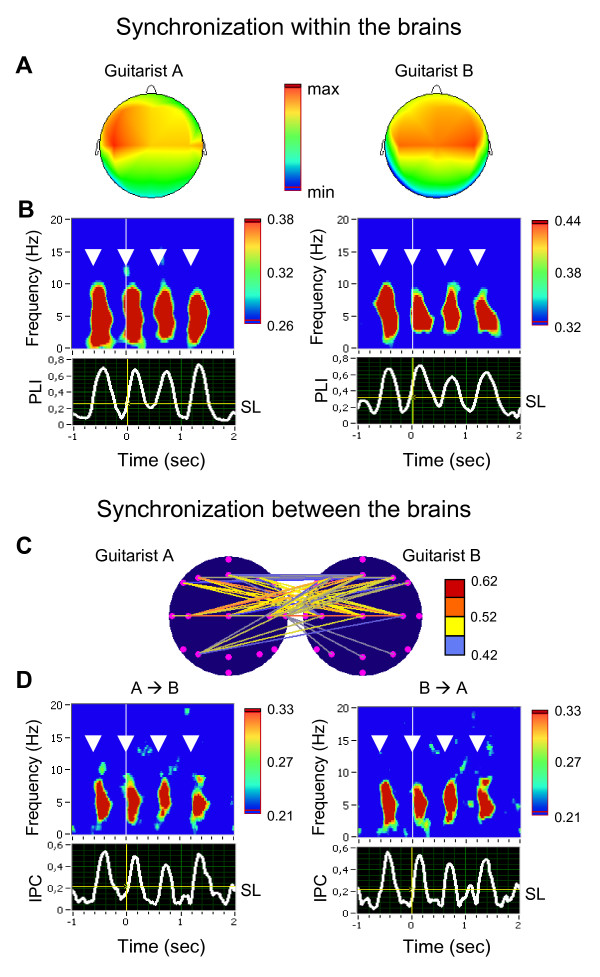
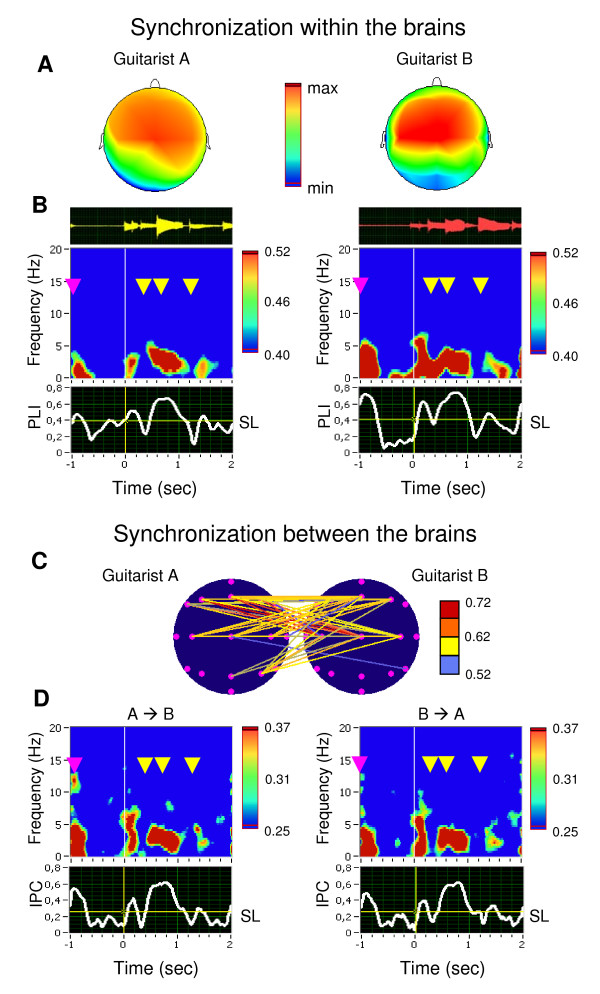
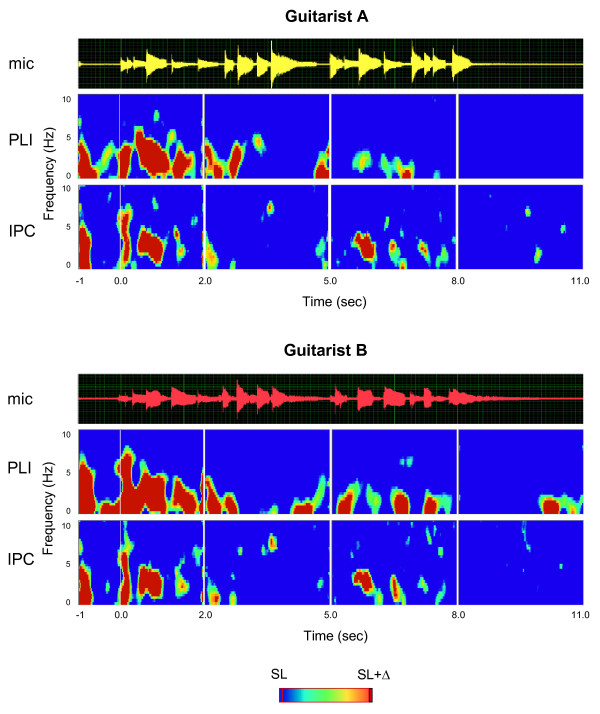
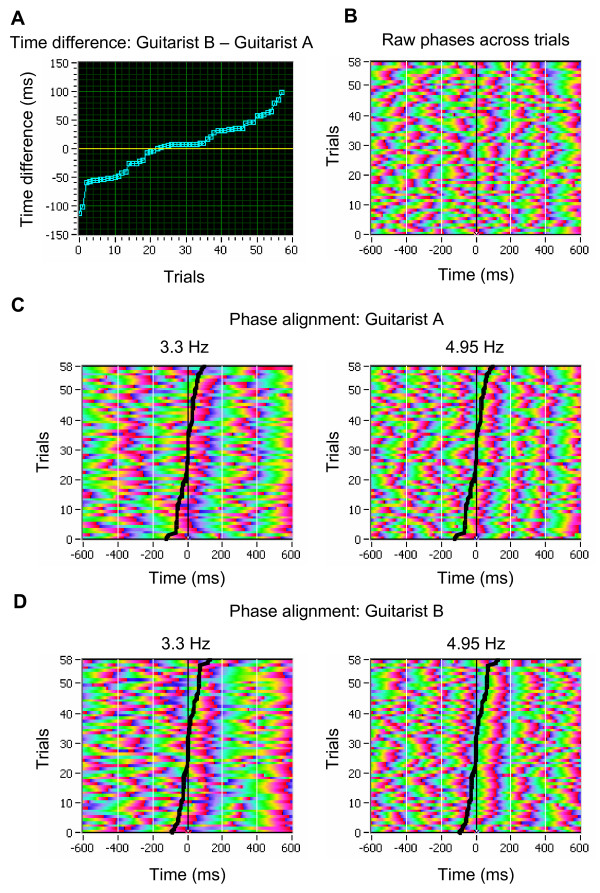
BACKGROUND: Brains interact with the world through actions that are implemented by sensory and motor processes. A substantial part of these interactions consists in synchronized goal-directed actions involving two or more individuals. Hyperscanning techniques for assessing fMRI simultaneously from two individuals have been developed. However, EEG recordings that permit the assessment of synchronized neuronal activities at much higher levels of temporal resolution have not yet been simultaneously assessed in multiple individuals and analyzed in the time-frequency domain. In this study, we simultaneously recorded EEG from the brains of each of eight pairs of guitarists playing a short melody together to explore the extent and the functional significance of synchronized cortical activity in the course of interpersonally coordinated actions. RESULTS: By applying synchronization algorithms to intra- and interbrain analyses, we found that phase synchronization both within and between brains increased significantly during the periods of (i) preparatory metronome tempo setting and (ii) coordinated play onset. Phase alignment extracted from within-brain dynamics was related to behavioral play onset asynchrony between guitarists. CONCLUSION: Our findings show that interpersonally coordinated actions are preceded and accompanied by between-brain oscillatory couplings. Presumably, these couplings reflect similarities in the temporal properties of the individuals' percepts and actions. Whether between-brain oscillatory couplings play a causal role in initiating and maintaining interpersonal action coordination needs to be clarified by further research.
Overview
The claims and statistics of this paper haven’t been checked yet.
Free: it reads the open-access text and checks the first 5 claims that cite a source we can check. Create a free account to check every claim.
Integrity signals
Registry
Cites
Statistics
Figures
Verification
Claims the paper makes
The claims and statistics of this paper haven’t been checked yet.
Free: it reads the open-access text and checks the first 5 claims that cite a source we can check. Create a free account to check every claim.
Claims other papers make about this one
Each is checked against this paper’s own text: does it say what the citing paper says it does?
The source backs part of the claim, not all of it — or backs it for a different population, condition or comparison.
In the citing paper
“The results showed that interpersonally coordinated actions (i.e., behavioral synchrony) are preceded and accompanied by interbrain oscillatory couplings in the prefrontal cortices.”
From Synchrony in Psychotherapy: A Review and an Integrative Framework for the Therapeutic Alliance (2016) · cites this paper as Lindenberger et al., 2009
Experimental — accuracy not yet measuredThe cited source says what the claim attributes to it.
In the citing paper
“Nevertheless, the link between movement synchrony and inter-brain coupling has been confirmed in motor tasks (Lindenberger et al., 2009).”
From Synchrony in Psychotherapy: A Review and an Integrative Framework for the Therapeutic Alliance (2016) · cites this paper as Lindenberger et al., 2009
Self-check
Percentages, sums and reported differences re-computed from the paper’s own numbers.
The self-check needs the paper’s full text.
Citations
Cites
Neuronal Oscillations in Cortical Networks
Buzsáki, G., & Draguhn, A. (2004) · Science · doi:10.1126/science.1099745 · Cited by 6,576 · cited 1×
“Network oscillations may functionally bias stimulus selection, form transient binding of neuronal assemblies, and facilitate synaptic plasticity [37].”
BackgroundA new method for off-line removal of ocular artifact
Gratton, G., Coles, M. G. H., & Donchin, E. (1983) · Electroencephalography and Clinical Neurophysiology · doi:10.1016/0013-4694(83)90135-9 · Cited by 5,055 · cited 1×
“5 to 70 Hz, and corrected for eye movements using the Gratton and Coles algorithm [43].”
MethodUnderstanding and sharing intentions: The origins of cultural cognition
Tomasello, M., Carpenter, M., Call, J., Behne, T., & Moll, H. (2005) · Behavioral and Brain Sciences · doi:10.1017/s0140525x05000129 · Cited by 4,882 · cited 2×
“Considerable research indicates that synchronized neuronal activity in perception and action [7-10] and oscillatory couplings between cortical and muscle activities during voluntary movement [11,12] are among the mechanisms supporting brain-body-world interactions [6,13-15].”
BackgroundThe brainweb: phase synchronization and large-scale integration
Varela, F., Lachaux, J.-P., Rodriguez, E., & Martinerie, J. (2001) · Nature Reviews Neuroscience · doi:10.1038/35067550 · Cited by 4,761 · cited 2×
“First, brain oscillations bind spatially distributed but functionally related information at the level of individual neurons, cell assemblies, and cortical areas [6-10].”
BackgroundNeurophysiological mechanisms underlying the understanding and imitation of action
Rizzolatti, G., Fogassi, L., & Gallese, V. (2001) · Nature Reviews Neuroscience · doi:10.1038/35090060 · Cited by 3,302 · cited 2×
“Neural activity in medial prefrontal cortex is selectively enhanced during theory of mind tasks [27,28].”
BackgroundModulation of Oscillatory Neuronal Synchronization by Selective Visual Attention
Fries, P., Reynolds, J. H., Rorie, A. E., & Desimone, R. (2001) · Science · doi:10.1126/science.1055465 · Cited by 2,786 · cited 2×
“First, brain oscillations bind spatially distributed but functionally related information at the level of individual neurons, cell assemblies, and cortical areas [6-10].”
BackgroundNeuronal Synchrony: A Versatile Code for the Definition of Relations?
Singer, W. (1999) · Neuron · doi:10.1016/s0896-6273(00)80821-1 · Cited by 2,581 · cited 1×
“Considerable research indicates that synchronized neuronal activity in perception and action [7-10] and oscillatory couplings between cortical and muscle activities during voluntary movement [11,12] are among the mechanisms supporting brain– body–world interactions [6,13-15].”
BackgroundExcitatory actions of gaba during development: the nature of the nurture
Ben-Ari, Y. (2002) · Nature Reviews Neuroscience · doi:10.1038/nrn920 · Cited by 2,448 · cited 1×
“In two interacting individuals adjusting their activity patterns through reciprocal sensory and motor pathways, synchronous brain activity can arise through temporally adjusted activity modulation [22-24] and does not need a substrate in form of connected neurons.”
BackgroundDevelopment and neurophysiology of mentalizing
Frith, U., & Frith, C. D. (2003) · Philosophical Transactions of the Royal Society of London. Series B: Biological Sciences · doi:10.1098/rstb.2002.1218 · Cited by 2,306 · cited 1×
“Considerable research indicates that synchronized neuronal activity in perception and action [7-10] and oscillatory couplings between cortical and muscle activities during voluntary movement [11,12] are among the mechanisms supporting brain-body-world interactions [6,13-15].”
BackgroundFunctional imaging of ‘theory of mind’
Gallagher, H. L., & Frith, C. D. (2003) · Trends in Cognitive Sciences · doi:10.1016/s1364-6613(02)00025-6 · Cited by 2,092 · cited 2×
“Neural activity in medial prefrontal cortex is selectively enhanced during theory of mind tasks [27,28].”
BackgroundJoint action: bodies and minds moving together
SEBANZ, N., BEKKERING, H., & KNOBLICH, G. (2006) · Trends in Cognitive Sciences · doi:10.1016/j.tics.2005.12.009 · Cited by 1,950 · cited 2×
“Discussion Synchronized brain activities within one brain have been observed before in relation to various tasks including music perception [29,35].”
BackgroundHippocampal electrical activity and voluntary movement in the rat
Vanderwolf, C. H. (1969) · Electroencephalography and Clinical Neurophysiology · doi:10.1016/0013-4694(69)90092-3 · Cited by 1,928 · cited 1×
“For instance, Vanderwolf's "voluntary movement" hypothesis [38,39] suggests that theta rhythms support intentional movement.”
BackgroundIntersubject synchronization of cortical activity during natural vision
Hasson, U., Nir, Y., Levy, I., Fuhrmann, G., & Malach, R. (2004) · Science · doi:10.1126/science.1089506 · Cited by 1,839 · cited 3×
“Background Brain activities supporting human social interactions have recently become an important topic of scientific inquiry [1-6].”
BackgroundWhen the brain plays music: auditory–motor interactions in music perception and production
Zatorre, R. J., Chen, J. L., & Penhune, V. B. (2007) · Nature Reviews Neuroscience · doi:10.1038/nrn2152 · Cited by 1,754 · cited 3×
“Activation and synchronization at temporal and medial parietal brain regions were expected as well because these regions have been shown to be involved in music production [26] and coordinated behavior [25].”
BackgroundRadical embodiment: neural dynamics and consciousness
Thompson, E., & Varela, F. J. (2001) · Trends in Cognitive Sciences · doi:10.1016/s1364-6613(00)01750-2 · Cited by 1,144 · cited 3×
“First, brain oscillations bind spatially distributed but functionally related information at the level of individual neurons, cell assemblies, and cortical areas [6-10].”
BackgroundVisuomotor integration is associated with zero time-lag synchronization among cortical areas
Roelfsema, P. R., Engel, A. K., König, P., & Singer, W. (1997) · Nature · doi:10.1038/385157a0 · Cited by 1,136 · cited 1×
“Onset times and frequency ranges of coherent or synchronized oscillations are sufficiently fast [19] to permit, in principle, the speed and precision of information exchange required by interpersonal action coordination.”
BackgroundBuzsáki, G. (2005) · Hippocampus · doi:10.1002/hipo.20113 · Cited by 872 · cited 2×
“Oscillations in the theta frequency range are prominent in the human and animal EEG, with possible functional roles covering a wide spectrum of behaviors, ranging from orienting reflexes to conditioning, arousal, attention, learning, and memory binding mechanisms [38].”
BackgroundHyperscanning: Simultaneous fMRI during Linked Social Interactions
Montague, P. (2002) · NeuroImage · doi:10.1006/nimg.2002.1150 · Cited by 833
The manifold nature of interpersonal relations: the quest for a common mechanism
Gallese, V. (2003) · Philosophical Transactions of the Royal Society of London. Series B: Biological Sciences · doi:10.1098/rstb.2002.1234 · Cited by 681 · cited 4×
“, mirroring) the coordinated behavior between oneself and others [2,3].”
BackgroundInfluentialDevelopment and plasticity of cortical processing architectures
Singer, W. (1995) · Science · doi:10.1126/science.270.5237.758 · Cited by 669
Developing networks play a similar melody
Ben-Ari, Y. (2001) · Trends in Neurosciences · doi:10.1016/s0166-2236(00)01813-0 · Cited by 614 · cited 1×
“In two interacting individuals adjusting their activity patterns through reciprocal sensory and motor pathways, synchronous brain activity can arise through temporally adjusted activity modulation [22-24] and does not need a substrate in form of connected neurons.”
BackgroundOscillations in local field potentials of the primate motor cortex during voluntary movement.
Sanes, J. N., & Donoghue, J. P. (1993) · Proceedings of the National Academy of Sciences · doi:10.1073/pnas.90.10.4470 · Cited by 590 · cited 1×
“Second, coherent oscillations support both perception [2,12,20] and motor performance [11,12,21].”
BackgroundA PET exploration of the neural mechanisms involved in reciprocal imitation
Decety, J., Chaminade, T., Grèzes, J., & Meltzoff, A. N. (2002) · NeuroImage · doi:10.1006/nimg.2001.0938 · Cited by 445 · cited 3×
“Background Brain activities supporting human social interactions have recently become an important topic of scientific inquiry [1-6].”
BackgroundThe phi complex as a neuromarker of human social coordination
Tognoli, E., Lagarde, J., DeGuzman, G. C., & Kelso, J. A. S. (2007) · Proceedings of the National Academy of Sciences · doi:10.1073/pnas.0611453104 · Cited by 437
Interactive minds: life-span perspectives on the social foundation of cognition
(1996) · Choice Reviews Online · doi:10.5860/choice.34-2459 · Cited by 424
Human Cortical Muscle Coherence Is Directly Related to Specific Motor Parameters
Kilner, J. M., Baker, S. N., Salenius, S., Hari, R., & Lemon, R. N. (2000) · The Journal of Neuroscience · doi:10.1523/jneurosci.20-23-08838.2000 · Cited by 418 · cited 4×
“In addition, low-frequency oscillations are involved in limb and hand movements [11,12,30-32], and in sensorimotor integration [33].”
BackgroundInfluentialHand Movement Direction Decoded from MEG and EEG
Waldert, S., Preissl, H., Demandt, E., Braun, C., Birbaumer, N., Aertsen, A., & Mehring, C. (2008) · The Journal of Neuroscience · doi:10.1523/jneurosci.5171-07.2008 · Cited by 415 · cited 1×
“In addition, low-frequency oscillations are involved in limb and hand movements [11,12,30-32], and in sensorimotor integration [33].”
BackgroundEEG–EMG, MEG–EMG and EMG–EMG frequency analysis: physiological principles and clinical applications
Grosse, P., Cassidy, M. J., & Brown, P. (2002) · Clinical Neurophysiology · doi:10.1016/s1388-2457(02)00223-7 · Cited by 391 · cited 4×
“Considerable research indicates that synchronized neuronal activity in perception and action [7-10] and oscillatory couplings between cortical and muscle activities during voluntary movement [11,12] are among the mechanisms supporting brain– body–world interactions [6,13-15].”
BackgroundInfluentialHuman θ Oscillations Related to Sensorimotor Integration and Spatial Learning
Caplan, J. B., Madsen, J. R., Schulze-Bonhage, A., Aschenbrenner-Scheibe, R., Newman, E. L., & Kahana, M. J. (2003) · The Journal of Neuroscience · doi:10.1523/jneurosci.23-11-04726.2003 · Cited by 365 · cited 1×
“In addition, low-frequency oscillations are involved in limb and hand movements [11,12,30-32], and in sensorimotor integration [33].”
BackgroundNeuronal assemblies: necessity, signature and detectability
Singer, W., Engel, A. K., Kreiter, A. K., Munk, M. H. J., Neuenschwander, S., & Roelfsema, P. R. (1997) · Trends in Cognitive Sciences · doi:10.1016/s1364-6613(97)01079-6 · Cited by 296 · cited 2×
“First, brain oscillations bind spatially distributed but functionally related information at the level of individual neurons, cell assemblies, and cortical areas [6-10].”
BackgroundFunctional coupling of human cortical sensorimotor areas during bimanual skill acquisition
Andres, F. G., Mima, T., Schulman, A. E., Dichgans, J., Hallett, M., & Gerloff, C. (1999) · Brain · doi:10.1093/brain/122.5.855 · Cited by 293 · cited 1×
“In addition, low-frequency oscillations are involved in limb and hand movements [11,12,30-32], and in sensorimotor integration [33].”
BackgroundMirror Neurons and the Evolution of Brain and Language
(2002) · Advances in Consciousness Research · doi:10.1075/aicr.42 · Cited by 259
Tonic, phasic, and transient EEG correlates of auditory awareness in drowsiness
Makeig, S., & Jung, T.-P. (1996) · Cognitive Brain Research · doi:10.1016/0926-6410(95)00042-9 · Cited by 248 · cited 1×
“Second, coherent oscillations support both perception [2,12,20] and motor performance [11,12,21].”
BackgroundBrain wave synchronization and entrainment to periodic acoustic stimuli
Will, U., & Berg, E. (2007) · Neuroscience Letters · doi:10.1016/j.neulet.2007.07.036 · Cited by 209 · cited 1×
“Recently, increased brainwave synchronization at delta frequency measured by ITC (inter-trial coherence, a phase synchronization measure like PLI) was found as a response to periodic stimulation with slow repetition rates of 1–8 Hz [36].”
BackgroundSynchronization in performed ensemble music
Rasch, R. A. (1979) · TNO Repository · Cited by 184
Long-Range Synchrony in the γ Band: Role in Music Perception
Bhattacharya, J., Petsche, H., & Pereda, E. (2001) · Journal of Neuroscience · doi:10.1523/jneurosci.21-16-06329.2001 · Cited by 182 · cited 1×
“Discussion Synchronized brain activities within one brain have been observed before in relation to various tasks including music perception [29,35].”
BackgroundFlores-Gutiérrez, E. O., Díaz, J.-L., Barrios, F. A., Favila-Humara, R., Guevara, M. Á., del Río‐Portilla, Y., & Corsi‐Cabrera, M. (2007) · International Journal of Psychophysiology · doi:10.1016/j.ijpsycho.2007.03.004 · Cited by 169 · cited 1×
“There is evidence to suggest that these regions could be activated during music perception and also during music production [26] as well as through pleasant feelings induced by the music [40,41].”
BackgroundBhattacharya, J., & Petsche, H. (2005) · Signal Processing · doi:10.1016/j.sigpro.2005.07.007 · Cited by 164 · cited 1×
“, n:m) synchronization as well as nonlinear (or weak) synchronization [34] may also be important for interbrain dynamics and should be investigated in the future.”
BackgroundMeaningful interactions can enhance visual discrimination of human agents
Neri, P., Luu, J. Y., & Levi, D. M. (2006) · Nature Neuroscience · doi:10.1038/nn1759 · Cited by 146 · cited 1×
“Some common examples are walking with someone at a set pace, playing collective sports or fighting [16], dancing [16,17], Published: 17 March 2009”
BackgroundLifespan differences in cortical dynamics of auditory perception
Müller, V., Gruber, W., Klimesch, W., & Lindenberger, U. (2009) · Developmental Science · doi:10.1111/j.1467-7687.2009.00834.x · Cited by 69
Self-citationFlores-Gutiérrez, E. O., Díaz, J.-L., Barrios, F. A., Guevara, M. Á., del Río‐Portilla, Y., Corsi‐Cabrera, M., & Flores-Gutiérrez, E. O. (2008) · International Journal of Psychophysiology · doi:10.1016/j.ijpsycho.2008.07.007 · Cited by 64 · cited 1×
“There is evidence to suggest that these regions could be activated during music perception and also during music production [26] as well as through pleasant feelings induced by the music [40,41].”
BackgroundSymmetry building and symmetry breaking in synchronized movement
Boker, S. M., & Rotondo, J. L. (2002) · Advances in Consciousness Research · doi:10.1075/aicr.42.14bok · Cited by 52 · cited 1×
“Some common examples are walking with someone at a set pace, playing collective sports or fighting [16], dancing [16,17], Published: 17 March 2009”
BackgroundDirected coherence as a measure of interhemispheric correlation of EEG
Wang, G., & Takigawa, M. (1992) · International Journal of Psychophysiology · doi:10.1016/0167-8760(92)90051-c · Cited by 49 · cited 1×
“Fourth, we did not analyze the directionality of interbrain synchronization processes using asymmetric synchronization measures [42].”
MethodDeiber, M., Caldara, R., Ibañez, V., & Hauert, C.-A. (2001) · Clinical Neurophysiology · doi:10.1016/s1388-2457(01)00536-3 · Cited by 49 · cited 1×
“In addition, low-frequency oscillations are involved in limb and hand movements [11,12,30-32], and in sensorimotor integration [33].”
BackgroundInteractive minds in a life-span perspective: Prologue
Baltes, P. B., & Staudinger, U. M. (1996) · MPG.PuRe (Max Planck Society) · Cited by 18
Frith, C., & Wolpert, D. M. (2003) · UCL Discovery (University College London) · Cited by 11
Frith, C., & Wolpert, D. M. (2003) · Philosophical Transactions of the Royal Society B Biological Sciences · doi:10.1098/rstb.2002.1260 · Cited by 9
Cited by
Sensorimotor synchronization: a review of recent research (2006–2012).
Repp, B. H., & Su, Y.-H. (2013) · Psychonomic Bulletin & Review · doi:10.3758/s13423-012-0371-2 · Cited by 1,204
Brain-to-brain coupling: a mechanism for creating and sharing a social world
Hasson, U., Ghazanfar, A. A., Galantucci, B., Garrod, S., & Keysers, C. (2012) · Trends in Cognitive Sciences · doi:10.1016/j.tics.2011.12.007 · Cited by 1,140
Inter-Brain Synchronization during Social Interaction
Dumas, G., Nadel, J., Soussignan, R., Martinerie, J., & Garnero, L. (2010) · PLoS ONE · doi:10.1371/journal.pone.0012166 · Cited by 966
Can social interaction constitute social cognition?
De Jaegher, H., Di Paolo, E., & Gallagher, S. (2010) · Trends in Cognitive Sciences · doi:10.1016/j.tics.2010.06.009 · Cited by 911
Cui, X., Bryant, D. M., & Reiss, A. L. (2012) · NeuroImage · doi:10.1016/j.neuroimage.2011.09.003 · Cited by 807
“EEG-based hyperscanning has enabled the study of social interaction in a more naturalistic environment (Astolfi et al., 2010; Dumas et al., 2010; Lindenberger et al., 2009), for example in poker playing (Babiloni et al.”
Metadata
- Authors
- Lindenberger, U., Li, S.-C., Gruber, W., & Müller, V.
- Affiliations
- Max Planck Institute for Human Development (DE)
- University of Salzburg (AT)
- Corresponding author
- Lindenberger, Ulman
- Müller, Viktor
- Venue
- BMC Neuroscience
- Published
- 2009-03-17
- Volume
- 10
- Issue
- 1
- Pages
- 22-22
- ISSN
- 1471-2202 (ISSN-L)
- PMC
- PMC2662862
- OpenAlex
- W2056689588
- Cited by
- 444
- References
- 47
- Citations by year
- 2026: 35 · 2025: 26 · 2024: 31 · 2023: 30 · 2022: 26 · 2021: 36 · 2020: 52 · 2019: 18 · 2018: 29 · 2017: 31 · 2016: 21 · 2015: 21 · 2014: 23 · 2013: 22 · 2012: 19
- FWCI
- 15.65
- Type
- journal article
- Language
- en
- Open access
- gold
- doi.org
- Licence
- cc-by
- creativecommons.org/licenses/by/2.0 (tdm)
- Locations
- BMC Neuroscience (publishedVersion, cc-by)
- PubMed Central (publishedVersion, cc-by)
- PubMed (publishedVersion)
- DOAJ (DOAJ: Directory of Open Access Journals) (submittedVersion, cc-by-sa)
- Max Planck Institute for Plasma Physics (submittedVersion)
- Max Planck Digital Library (submittedVersion, other-oa)
- MPG.PuRe (Max Planck Society) (submittedVersion, other-oa)
- Funders
- Deutsche Forschungsgemeinschaft
- Max-Planck-Gesellschaft
- Topics
- Social Sciences › Psychology › Social Psychology › Action Observation and Synchronization
- Life Sciences › Neuroscience › Cognitive Neuroscience › Neural dynamics and brain function
- Life Sciences › Neuroscience › Cognitive Neuroscience › Neuroscience and Music Perception
- Keywords
- inter-brain synchrony, phase synchronization, interpersonal coordination, joint action, guitar performance, time-frequency analysis, oscillatory coupling, music performance
- MeSH terms
- Adult, Attention, Brain, Brain Mapping, Cerebral Cortex, Cortical Synchronization, Electroencephalography, Female, Humans, Magnetic Resonance Imaging, Male, Young Adult
About these checks
Registry, retraction, Cites and statistics results are computed, not judged, with one exception: a printed reference that no index lists is read once by a model before it counts as a citation error. Claims are extracted by a model and kept only when their quote appears verbatim in the text; each cited source is then checked, with a model’s help, for whether it says what the claim relies on. Those verdicts can be wrong — read the claim’s quote and the cited source before relying on one.
Statistics and arithmetic are recomputed, not judged.
Confidence bands are shown only for fields calibrated on our annotated test set. None is calibrated yet, so no band is shown.
What counts as a claim ›How we measure confidence ›How we check this ›
Are you an author, or do you see a problem with this page? Request a review
Data sources
Bibliographic data: Semantic Scholar, OpenAlex, Crossref.
Contains information from the Semantic Scholar Academic Graph Datasets, made available under the ODC Attribution License (ODC-BY 1.0).
Semantic Scholar’s data is described in: Kinney, R., et al. (2023). The Semantic Scholar Open Data Platform. arXiv:2301.10140.
