

Brains swinging in concert: cortical phase synchronization while playing guitar.
Open accessThe DOI matches its Crossref record; 47 of the 47 references it cites were found in a registry or an index.
Abstract
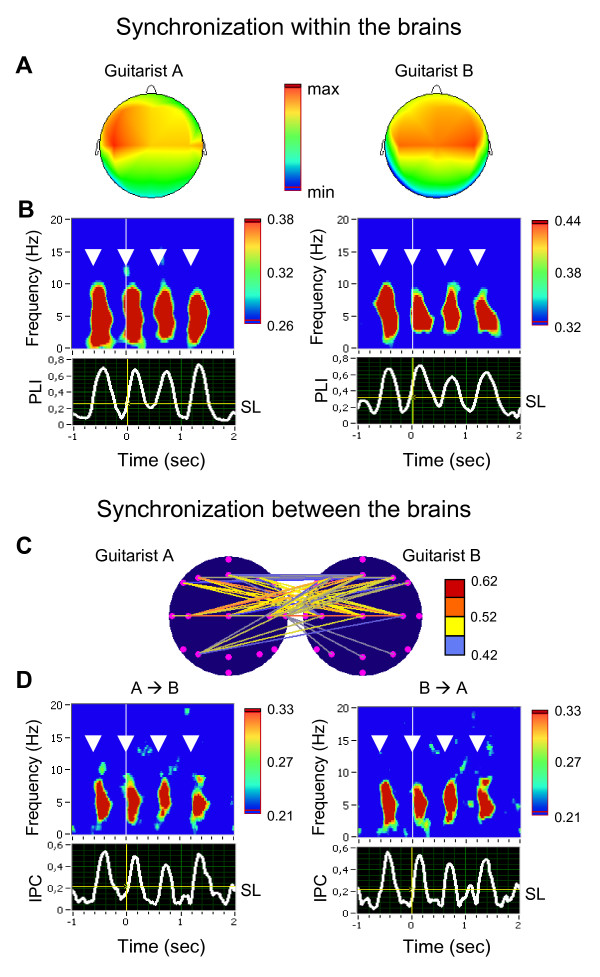
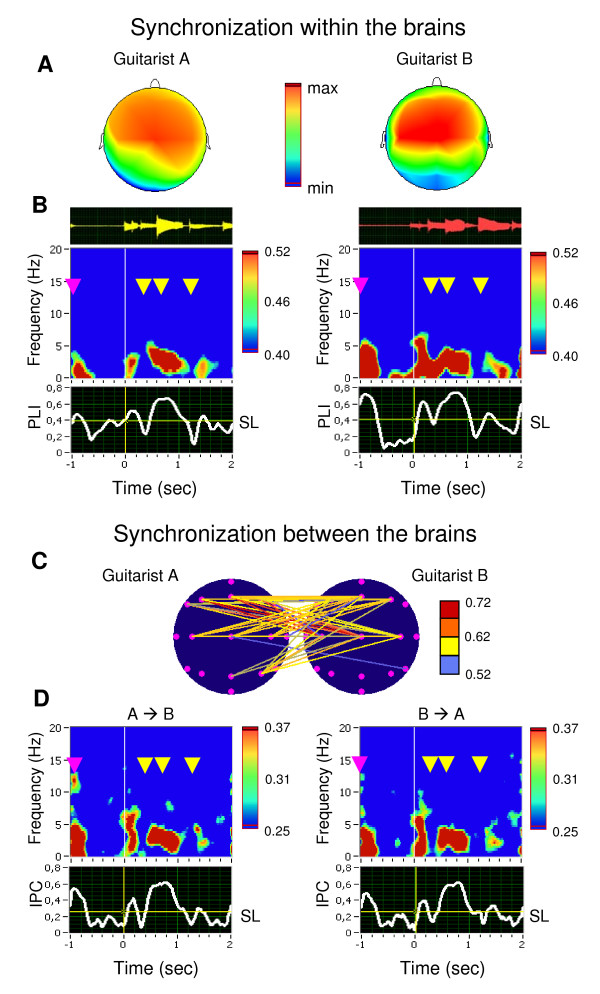
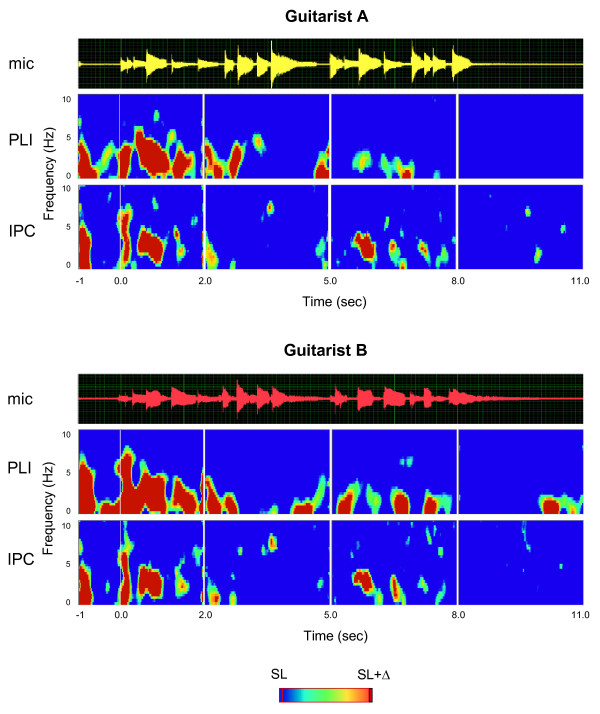
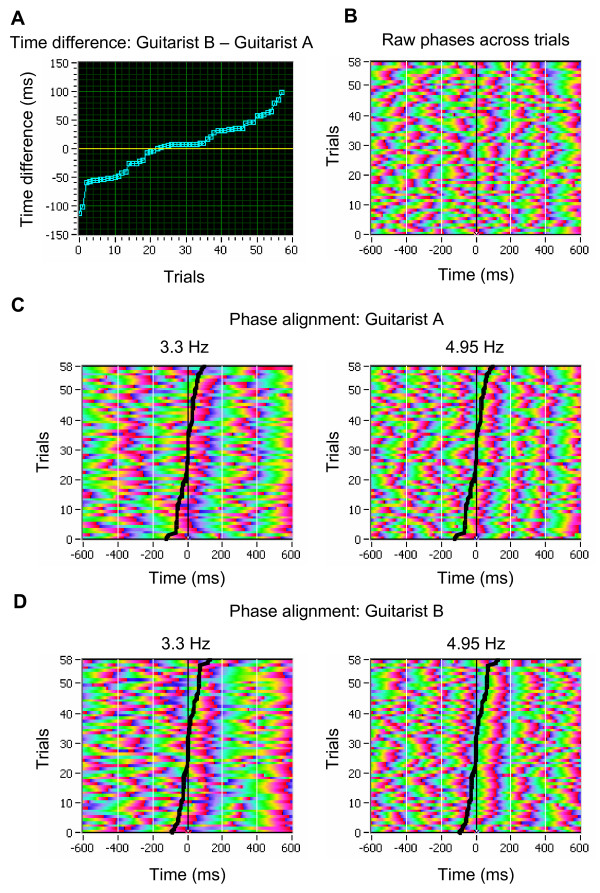
BACKGROUND: Brains interact with the world through actions that are implemented by sensory and motor processes. A substantial part of these interactions consists in synchronized goal-directed actions involving two or more individuals. Hyperscanning techniques for assessing fMRI simultaneously from two individuals have been developed. However, EEG recordings that permit the assessment of synchronized neuronal activities at much higher levels of temporal resolution have not yet been simultaneously assessed in multiple individuals and analyzed in the time-frequency domain. In this study, we simultaneously recorded EEG from the brains of each of eight pairs of guitarists playing a short melody together to explore the extent and the functional significance of synchronized cortical activity in the course of interpersonally coordinated actions. RESULTS: By applying synchronization algorithms to intra- and interbrain analyses, we found that phase synchronization both within and between brains increased significantly during the periods of (i) preparatory metronome tempo setting and (ii) coordinated play onset. Phase alignment extracted from within-brain dynamics was related to behavioral play onset asynchrony between guitarists. CONCLUSION: Our findings show that interpersonally coordinated actions are preceded and accompanied by between-brain oscillatory couplings. Presumably, these couplings reflect similarities in the temporal properties of the individuals' percepts and actions. Whether between-brain oscillatory couplings play a causal role in initiating and maintaining interpersonal action coordination needs to be clarified by further research.
Overview
The claims and statistics of this paper haven’t been checked yet.
Free: it reads the open-access text and checks the first 5 claims that cite a source we can check. Create a free account to check every claim.
Integrity signals
Registry
Cites
Statistics
Figures
Verification
Claims the paper makes
The claims and statistics of this paper haven’t been checked yet.
Free: it reads the open-access text and checks the first 5 claims that cite a source we can check. Create a free account to check every claim.
Claims other papers make about this one
Each is checked against this paper’s own text: does it say what the citing paper says it does?
The source backs part of the claim, not all of it — or backs it for a different population, condition or comparison.
In the citing paper
“The results showed that interpersonally coordinated actions (i.e., behavioral synchrony) are preceded and accompanied by interbrain oscillatory couplings in the prefrontal cortices.”
From Synchrony in Psychotherapy: A Review and an Integrative Framework for the Therapeutic Alliance (2016) · cites this paper as Lindenberger et al., 2009
Experimental — accuracy not yet measuredThe cited source says what the claim attributes to it.
In the citing paper
“Nevertheless, the link between movement synchrony and inter-brain coupling has been confirmed in motor tasks (Lindenberger et al., 2009).”
From Synchrony in Psychotherapy: A Review and an Integrative Framework for the Therapeutic Alliance (2016) · cites this paper as Lindenberger et al., 2009
Self-check
Percentages, sums and reported differences re-computed from the paper’s own numbers.
The self-check needs the paper’s full text.
Citations
Cites
Neuronal Oscillations in Cortical Networks
Buzsáki, G., & Draguhn, A. (2004) · Science · doi:10.1126/science.1099745 · Cited by 6,576 · cited 1×
“Network oscillations may functionally bias stimulus selection, form transient binding of neuronal assemblies, and facilitate synaptic plasticity [37].”
BackgroundA new method for off-line removal of ocular artifact
Gratton, G., Coles, M. G. H., & Donchin, E. (1983) · Electroencephalography and Clinical Neurophysiology · doi:10.1016/0013-4694(83)90135-9 · Cited by 5,055 · cited 1×
“5 to 70 Hz, and corrected for eye movements using the Gratton and Coles algorithm [43].”
MethodUnderstanding and sharing intentions: The origins of cultural cognition
Tomasello, M., Carpenter, M., Call, J., Behne, T., & Moll, H. (2005) · Behavioral and Brain Sciences · doi:10.1017/s0140525x05000129 · Cited by 4,882 · cited 2×
“Considerable research indicates that synchronized neuronal activity in perception and action [7-10] and oscillatory couplings between cortical and muscle activities during voluntary movement [11,12] are among the mechanisms supporting brain-body-world interactions [6,13-15].”
BackgroundThe brainweb: phase synchronization and large-scale integration
Varela, F., Lachaux, J.-P., Rodriguez, E., & Martinerie, J. (2001) · Nature Reviews Neuroscience · doi:10.1038/35067550 · Cited by 4,761 · cited 2×
“First, brain oscillations bind spatially distributed but functionally related information at the level of individual neurons, cell assemblies, and cortical areas [6-10].”
BackgroundNeurophysiological mechanisms underlying the understanding and imitation of action
Rizzolatti, G., Fogassi, L., & Gallese, V. (2001) · Nature Reviews Neuroscience · doi:10.1038/35090060 · Cited by 3,302 · cited 2×
“Neural activity in medial prefrontal cortex is selectively enhanced during theory of mind tasks [27,28].”
BackgroundModulation of Oscillatory Neuronal Synchronization by Selective Visual Attention
Fries, P., Reynolds, J. H., Rorie, A. E., & Desimone, R. (2001) · Science · doi:10.1126/science.1055465 · Cited by 2,786 · cited 2×
“First, brain oscillations bind spatially distributed but functionally related information at the level of individual neurons, cell assemblies, and cortical areas [6-10].”
BackgroundNeuronal Synchrony: A Versatile Code for the Definition of Relations?
Singer, W. (1999) · Neuron · doi:10.1016/s0896-6273(00)80821-1 · Cited by 2,581 · cited 1×
“Considerable research indicates that synchronized neuronal activity in perception and action [7-10] and oscillatory couplings between cortical and muscle activities during voluntary movement [11,12] are among the mechanisms supporting brain– body–world interactions [6,13-15].”
BackgroundExcitatory actions of gaba during development: the nature of the nurture
Ben-Ari, Y. (2002) · Nature Reviews Neuroscience · doi:10.1038/nrn920 · Cited by 2,448 · cited 1×
“In two interacting individuals adjusting their activity patterns through reciprocal sensory and motor pathways, synchronous brain activity can arise through temporally adjusted activity modulation [22-24] and does not need a substrate in form of connected neurons.”
BackgroundDevelopment and neurophysiology of mentalizing
Frith, U., & Frith, C. D. (2003) · Philosophical Transactions of the Royal Society of London. Series B: Biological Sciences · doi:10.1098/rstb.2002.1218 · Cited by 2,306 · cited 1×
“Considerable research indicates that synchronized neuronal activity in perception and action [7-10] and oscillatory couplings between cortical and muscle activities during voluntary movement [11,12] are among the mechanisms supporting brain-body-world interactions [6,13-15].”
BackgroundFunctional imaging of ‘theory of mind’
Gallagher, H. L., & Frith, C. D. (2003) · Trends in Cognitive Sciences · doi:10.1016/s1364-6613(02)00025-6 · Cited by 2,092 · cited 2×
“Neural activity in medial prefrontal cortex is selectively enhanced during theory of mind tasks [27,28].”
Background
Cited by
Items 401–444 of 444
Forman, R. K. C., & Wald‐Fuhrmann, M. (2024) · Pastoral Psychology · doi:10.1007/s11089-024-01142-x · Cited by 2
“In this modality, subjects are not listening to music, for example, but rather are playing or singing together (Lindenberger et al., 2009; Müller et al., 2022; Müller & Lindenberger, 2019; Sänger et al., 2012).”
BackgroundWeissmark, M. S. (2020) · Oxford University Press eBooks · doi:10.1093/oso/9780190686345.002.0008
Weissmark, M. S. (2020) · Oxford University Press eBooks · doi:10.1093/oso/9780190686345.002.0003
Weissmark, M. S. (2020) · Oxford University Press eBooks · doi:10.1093/oso/9780190686345.002.0005
Nagornova, Z. V., & Shemyakina, N. V. (2024) · Журнал эволюционной биохимии и физиологии · doi:10.31857/s0044452924010088
Grimm, G., Daeglau, M., Hohmann, V., & Debener, S. (2024) · IEEE International Symposium on the Internet of Sounds (IS2) · doi:10.1109/is262782.2024.10704205 · Cited by 4
“Several studies on EEG hyperscanning in musicians have been performed locally [13]–[15].”
BackgroundUniform hyperscanning paradigm to study cooperation and competition
Nogueira-Islas, P. A., Olguín-Rodríguez, P. V., Tlahuext-Aca, H., & Müller, M. (2024) · MethodsX · doi:10.1016/j.mex.2024.103139
“Lindenberger et al. [ 3 ] found that when two guitarists played a musical piece in a joint manner, their brain activity synchronized in key parts of the execution within the 2–10 Hz range.”
Imitation as a Synchronizer of Minds and Brains
Nadel, J. (2025) · Oxford University Press eBooks · doi:10.1093/oso/9780192865373.003.0017
Fachner, J. C., & Yap, S. S. (2025) · Neurocultural health and wellbeing · doi:10.1007/978-3-031-88578-5_20
What are we? Collective neuroscience, metaphysics, and theology
Stump, E. (2025) · Religious Studies · doi:10.1017/s0034412525100814
Zhang, H., Chang, Y., Ahati, S., Pu, J., & Liu, T. (2025) · Quarterly Journal of Experimental Psychology · doi:10.1177/17470218251367720
“As the HbO signal is more sensitive to changes in blood flow (Lindenberger et al., 2009), only the HbO signal was analyzed as our index in the current study.”
The Role of Neural Synchronization in Social Interaction: Insights from a Collaborative EEG StudyPreprint
Mora, M. F., Martín, D. C., Serrano, J. I., & del Castillo, M. D. (2025) · Research Square · doi:10.21203/rs.3.rs-7139606/v1
Pollock, J., Pfeiffer, M., Sigelmier, G., & Miller, C. (2025) · Handbooks of sociology and social research · doi:10.1007/978-3-031-95615-7_6
Robledo, J.-P., Cross, I. R. M., Phillips, M., Kearney, J., & Taylor, J. R. (2026) · Neuroscience & Biobehavioral Reviews · doi:10.1016/j.neubiorev.2026.106826 · Cited by 1
The Brainwave Interaction of Dual-Person Collaborative Tasks in a Virtual Reality Environmental Game
Huang, C.-J., Wang, C.-T., Lee, T.-M., & Lee, P.-L. (2025) · IEEE Access · doi:10.1109/access.2025.3620852
“Frontal and fronto-central regions have shown robust inter-brain connectivity during various forms of social interaction, including cooperation, imitation, communication, and musical performance [31], [32], [33], [34], [35], [36].”
Inter-brain ERPs alignment during a joint Simon task: An EEG hyperscanning study
Miti, F., Toppi, J., Ciaramidaro, A., Astolfi, L., Iani, C., & Rubichi, S. (2026) · PLoS ONE · doi:10.1371/journal.pone.0338934
Gan, X., Yu, L., Shuyi, L., Luo, Y., & Hu, Y. (2026) · Biological Psychology · doi:10.1016/j.biopsycho.2026.109215
Alina, R. O. B. U., & NEMES, A. D. (2026) · International Journal of Scientific Development and Research · doi:10.56975/ijsdr.v11i2.307275
Hyperscanning and Mirror Neurons: Musical Ensemble Playing from a Neuroscientific Perspective
Neuhaus, C. (2026) · IntechOpen eBooks · doi:10.5772/intechopen.1013555 · Cited by 1
Liu, Y., Cheng, S., & Wang, J. (2026) · International Journal of Human-Computer Interaction · doi:10.1080/10447318.2026.2641708
TEAM FLOW NEUROZONE: Neurodynamic Team Harmonization in Elite Sports
Alina, R. O. B. U., & NEMES, A. D. (2026) · International Journal of Scientific Development and Research · doi:10.56975/ijsdr.v11i3.308159
Ménoret, M. (2013) · theses.fr (ABES) · doi:10.70675/c6faa90bzd06fz48e1z9f41z9da9f95220da · Cited by 1
Méthodes pour l'électroencéphalographie multi-sujet et application aux interfaces cerveau-ordinateur
Korczowski, L. (2018) · theses.fr (ABES) · doi:10.70675/38d2a12fz024fz4d84z8a8az0dc16b2cff6a · Cited by 2
Verdière, K. J. (2019) · theses.fr (ABES) · doi:10.70675/50277d0dz64c3z45d2z9f9dzf5f377a679d6 · Cited by 1
Douglas, C. L., Tremblay, A., & Newman, A. J. (2026) · Journal of Cognitive Neuroscience · doi:10.1162/jocn.a.2595
The Challenges of Communication and Collaboration in Teaching in 21st-Century Higher Education
Tadesse, T. (2026) · Springer eBooks · doi:10.1007/978-981-95-5997-8_17 · Cited by 1
Müller, V. (2026) · Frontiers in Network Physiology · doi:10.3389/fnetp.2026.1776969 · Cited by 1
“…be fully reduced to shared input or output but displays intrinsic self-organizing tendencies, reflecting mutual entrainment and collective timing (Lindenberger et al., 2009; Sänger et al., 2012; 2013; Szymanski et al., 2017b; Gvirts and Perlmutter, 2020; Müller et al., 2021; Novembre and…”
Self-citationLinking to Established Frameworks
Roeloffs, J. (2026) · The frontiers collection · doi:10.1007/978-3-032-20068-6_14
Dyadic emotional and cognitive shifts in moral decision-making: EEG and autonomic similarity
Angioletti, L., Ciminaghi, F., & Balconi, M. (2026) · Social Neuroscience · doi:10.1080/17470919.2026.2684410
“Simultaneously, neural oscillations, particularly in frontal and temporo-central regions, may index the modulation of cognitive control, empathy, and social attunement (Balconi & Canavesio, 2016; Lindenberger et al., 2009).”
Tetradic Dynamics of Dyadic Sensorimotor Coordination: A Multiscale EEG Hyperscanning StudyPreprint
Olarewaju, E., Palaniyappan, L. K., & Dumas, G. (2026) · bioRxiv (Cold Spring Harbor Laboratory) · doi:10.64898/2026.06.21.732435 · Cited by 1
Buzamat, A., Poboroniuc, M.-S., Irimia, D.-C., Mirela, S., & Mavhima, S. E. (2026) · World Congress on Medical Physics and Biomedical Engineering, September 7 - 12, 2009, Munich, Germany · doi:10.1007/978-3-032-24045-3_20
Valenzuela, L., Cavallaro, R., Mangeng, A., Pérez-Arenas, X., Carollo, A., Esposito, G., Medel, V., & Soto, V. (2026) · NeuroImage · doi:10.1016/j.neuroimage.2026.122116
Why Great Teams Perform Well: Inter-Brain Synchrony, Psychophysiological Alignment, and Team Flow
Michael, M., Valencia, E., Kotler, S., & Requejo, G. (2026) · Springer eBooks · doi:10.1007/978-3-032-21528-4_10
Delta oscillations in human communication
Kokkinou, A., & Orgs, G. (2026) · Neuroscience & Biobehavioral Reviews · doi:10.1016/j.neubiorev.2026.106918
Shared experiences of social exclusion enhance inter-brain synchronization
Lin, Y., Jiao, Z., & Huang, A. (2026) · Acta Psychologica · doi:10.1016/j.actpsy.2026.107731
Cognition and Cognitive Architectures in Behavioral Science
Grayot, J. D. (2026) · Elsevier eBooks · doi:10.1016/b978-0-443-40622-5.00078-5
Projective identification and social psychology: is projective identification a unique construct?
Weinberg, I. (2026) · Psychoanalytic Psychotherapy · doi:10.1080/02668734.2026.2716103
Yang, Y., Han, Z., Wang, M., Xie, X., Zou, Y., He, L., & LIANG, D. (2026) · Brain and Language · doi:10.1016/j.bandl.2026.105844
Self-Selected Versus Assigned Emotion Regulation in Pain Expectancy: Behavioral and fNIRS Evidence
Qiao, Q., Du, J., Fang, F., & Shi, P. (2026) · Brain Sciences · doi:10.3390/brainsci16101030
“Previous studies have consistently shown that HbO concentration changes reliably reflect local cerebral blood flow and exhibit a superior signal-to-noise ratio compared to HbR; therefore, HbO concentration was selected as the primary measure of task-evoked cortical activation [42].”
Positive interactions and active mentalizing facilitate inter-brain synchronization in couples
Schneider, I., Moreau, Q., Neudecker, D., Herpertz, S. C., & Dumas, G. (2026) · Social Cognitive and Affective Neuroscience · doi:10.1093/scan/nsag083
“Inter-brain synchronization has been observed across multiple frequency bands and topographies, including theta (4–8Hz; Lindenberger et al .”
Herda, J. (2026) · Roczniki Filozoficzne · doi:10.18290/rf26743.8
Interbrain synchronization tracks reciprocal social inference during strategic interactionPreprint
Qu, C., Wang, S.-Z., Cai, S.-G., Zeng, Z., & Dreher, J.-C. (2026) · Research Square · doi:10.21203/rs.3.rs-11313426/v1
Neuroscience methods of social interactions
Votinov, M. (2026) · Elsevier eBooks · doi:10.1016/b978-0-443-34080-2.00006-8
Metadata
- Authors
- Lindenberger, U., Li, S.-C., Gruber, W., & Müller, V.
- Affiliations
- Max Planck Institute for Human Development (DE)
- University of Salzburg (AT)
- Corresponding author
- Lindenberger, Ulman
- Müller, Viktor
- Venue
- BMC Neuroscience
- Published
- 2009-03-17
- Volume
- 10
- Issue
- 1
- Pages
- 22-22
- ISSN
- 1471-2202 (ISSN-L)
- PMC
- PMC2662862
- OpenAlex
- W2056689588
- Cited by
- 444
- References
- 47
- Citations by year
- 2026: 35 · 2025: 26 · 2024: 31 · 2023: 30 · 2022: 26 · 2021: 36 · 2020: 52 · 2019: 18 · 2018: 29 · 2017: 31 · 2016: 21 · 2015: 21 · 2014: 23 · 2013: 22 · 2012: 19
- FWCI
- 15.65
- Type
- journal article
- Language
- en
- Open access
- gold
- doi.org
- Licence
- cc-by
- creativecommons.org/licenses/by/2.0 (tdm)
- Locations
- BMC Neuroscience (publishedVersion, cc-by)
- PubMed Central (publishedVersion, cc-by)
- PubMed (publishedVersion)
- DOAJ (DOAJ: Directory of Open Access Journals) (submittedVersion, cc-by-sa)
- Max Planck Institute for Plasma Physics (submittedVersion)
- Max Planck Digital Library (submittedVersion, other-oa)
- MPG.PuRe (Max Planck Society) (submittedVersion, other-oa)
- Funders
- Deutsche Forschungsgemeinschaft
- Max-Planck-Gesellschaft
- Topics
- Social Sciences › Psychology › Social Psychology › Action Observation and Synchronization
- Life Sciences › Neuroscience › Cognitive Neuroscience › Neural dynamics and brain function
- Life Sciences › Neuroscience › Cognitive Neuroscience › Neuroscience and Music Perception
- Keywords
- inter-brain synchrony, phase synchronization, interpersonal coordination, joint action, guitar performance, time-frequency analysis, oscillatory coupling, music performance
- MeSH terms
- Adult, Attention, Brain, Brain Mapping, Cerebral Cortex, Cortical Synchronization, Electroencephalography, Female, Humans, Magnetic Resonance Imaging, Male, Young Adult
About these checks
Registry, retraction, Cites and statistics results are computed, not judged, with one exception: a printed reference that no index lists is read once by a model before it counts as a citation error. Claims are extracted by a model and kept only when their quote appears verbatim in the text; each cited source is then checked, with a model’s help, for whether it says what the claim relies on. Those verdicts can be wrong — read the claim’s quote and the cited source before relying on one.
Statistics and arithmetic are recomputed, not judged.
Confidence bands are shown only for fields calibrated on our annotated test set. None is calibrated yet, so no band is shown.
What counts as a claim ›How we measure confidence ›How we check this ›
Are you an author, or do you see a problem with this page? Request a review
Data sources
Bibliographic data: Semantic Scholar, OpenAlex, Crossref.
Contains information from the Semantic Scholar Academic Graph Datasets, made available under the ODC Attribution License (ODC-BY 1.0).
Semantic Scholar’s data is described in: Kinney, R., et al. (2023). The Semantic Scholar Open Data Platform. arXiv:2301.10140.
