

The DOI matches its Crossref record; 57 of the 58 references it cites were found in a registry or an index; none of the 46 sources its claims cite is checked for support yet.
Relative expression of genes of terpene metabolism in different tissues of Artemisia annuaL
Open accessAbstract
Background: Recently, Artemisia annua L. (annual or sweet wormwood) has received increasing attention due to the fact that the plant produces the sesquiterpenoid endoperoxide artemisinin, which today is widely used for treatment of malaria. The plant produces relatively small amounts of artemisinin and a worldwide shortage of the drug has led to intense research in order to increase the yield of artemisinin. In order to improve our understanding of terpene metabolism in the plant and to evaluate the competition for precursors, which may influence the yield of artemisinin, we have used qPCR to estimate the expression of 14 genes of terpene metabolism in different tissues. Results: The four genes of the artemisinin biosynthetic pathway (amorpha-4,11-diene synthase, amorphadiene-12-hydroxylase, artemisinic aldehyde ∆11(13) reductase and aldehyde dehydrogenase 1) showed remarkably higher expression (between ~40- to ~500-fold) in flower buds and young leaves compared to other tissues (old leaves, stems, roots, hairy root cultures). Further, dihydroartemisinic aldehyde reductase showed a very high expression only in hairy root cultures. Germacrene A and caryophyllene synthase were mostly expressed in young leaves and flower buds while epi-cedrol synthase was highly expressed in old leaves. 3-Hydroxy-3-methyl-glutaryl coenzyme A reductase exhibited lower expression in old leaves compared to other tissues. Farnesyldiphosphate synthase, squalene synthase, and 1-deoxy-D-xylulose-5-phosphate reductoisomerase showed only modest variation in expression in the different tissues, while expression of 1-deoxy-D-xylulose-5-phosphate synthase was 7-8-fold higher in flower buds and young leaves compared to old leaves. Conclusions: Four genes of artemisinin biosynthesis were highly expressed in flower buds and young leaves (tissues showing a high density of glandular trichomes). The expression of dihydroartemisinic aldehyde reductase has been suggested to have a negative effect on artemisinin production through reduction of dihydroartemisinic aldehyde to dihydroartemisinic alcohol. However, our results show that this enzyme is expressed only at low levels in tissues producing artemisinin and consequently its effect on artemisinin production may be limited. Finally, squalene synthase but not other sesquiterpene synthases appears to be a significant competitor for farnesyl diphosphate in artemisinin-producing tissues.
Overview
AI snapshot
Written from the paper’s full text.
TL;DR
qPCR profiling of 14 terpene-metabolism genes across *Artemisia annua* tissues showed that four artemisinin biosynthetic genes (ADS, CYP71AV1, DBR2, ALDH1) are highly expressed in flower buds and young leaves. The authors conclude that squalene synthase may compete significantly for farnesyl diphosphate in artemisinin-producing tissues, whereas RED1 is unlikely to limit artemisinin production.
Key findings
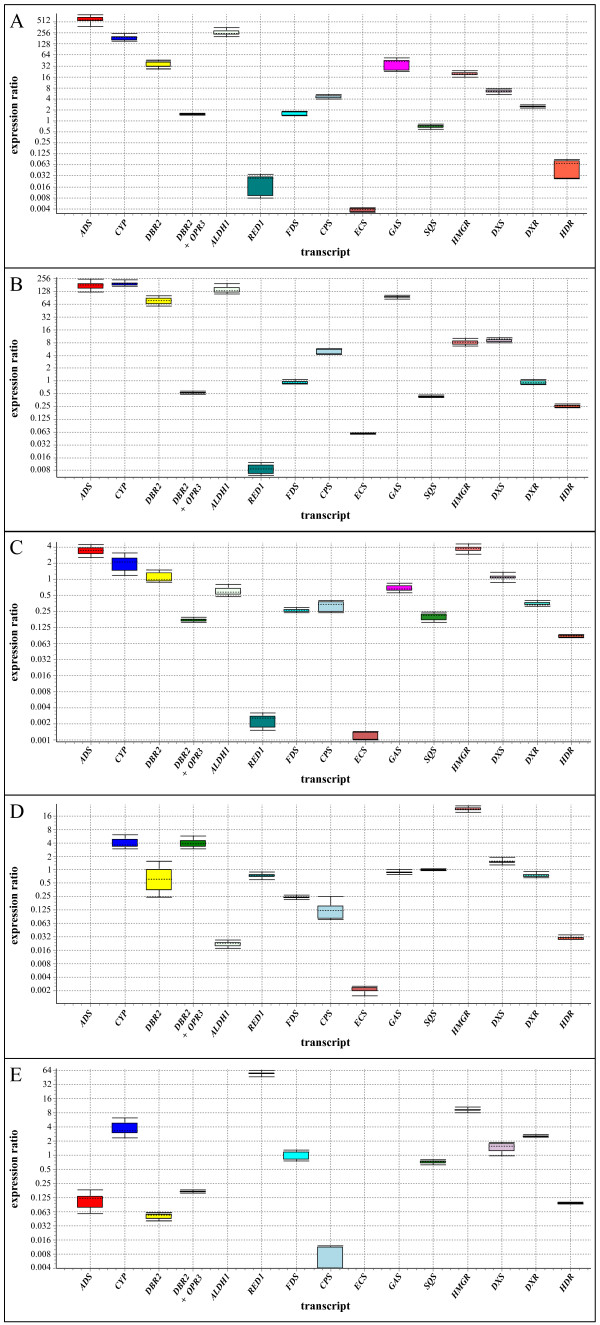
- The four artemisinin pathway genes showed ~40- to ~500-fold higher expression in flower buds and young leaves than in old leaves, stems, roots, and hairy roots: ADS ~500- and ~150-fold, CYP71AV1 ~150- and ~150-fold, DBR2 ~40- and ~70-fold, and ALDH1 ~250- and ~130-fold in flower buds and young leaves, respectively.
- RED1 was highly expressed in hairy roots (~50-fold more than old leaves) but low in flower buds, young leaves, and stems; the authors conclude RED1 likely has limited influence on artemisinin production because of low expression in artemisinin-producing tissues, high Km for dihydroartemisinic aldehyde, and low relative turnover potential.
- DXS expression was 7–8-fold higher in flower buds and young leaves than in old leaves; HDR was 10–30-fold higher in old leaves than in other tissues; HMGR was ~20- and ~8-fold higher in flower buds and young leaves than in old leaves; FDS, SQS, and DXR varied only modestly.
- ADS dominated sesquiterpene synthase expression in flower buds and young leaves (normalized transcript amounts 8780 and 6654 vs. GAS in stems = 1), while ECS was highly expressed in old leaves (43000); assuming SQS kcat ~1 s−1, SQS had about 45- and 25-fold higher FDP turnover potential than ADS in flower buds and young leaves.
Methods
- *Artemisia annua* L. cv Artemis plants were grown under 16 h days/8 h nights, then flower buds were induced by 21 days of short-day treatment (8 h day); flower buds, young leaves, old leaves, stems, roots, and hairy root cultures were collected from 5–6-month-old plants.
- RNA was extracted, reverse transcribed, and analyzed by qPCR with 18 primer pairs for 14 terpene-metabolism transcripts plus reference genes; primer efficiencies ranged from 1.82 to 1.93, and CPR, β-actin, and PAL were selected as reference genes using BestKeeper.
- Relative expression was calculated with REST 2009 and the 2^-ΔΔCT method; fluorescence microscopy was used to compare trichome densities, with young leaves estimated at ~300±40 trichomes/cm² and old leaves at 130±25 trichomes/cm².
Limitations
- The paper states that no kcat value is available for CYP71AV1, so it was excluded from the relative turnover estimation; it also states that no information is available on intracellular transport of artemisinin pathway intermediates, and that expression data in Table 3 come from different studies and varieties and are not directly comparable.
- Evident from the text: the study measures transcript levels by qPCR, not enzyme protein abundance or activity; the turnover-potential estimates assume transcription is proportional to active sites, enzymes work at substrate saturation, and the NADPH/NADP+ ratio is optimal.
Model-written summary. Check it against the paper before relying on it.
Integrity signals
Registry
Cites
Statistics
Figures
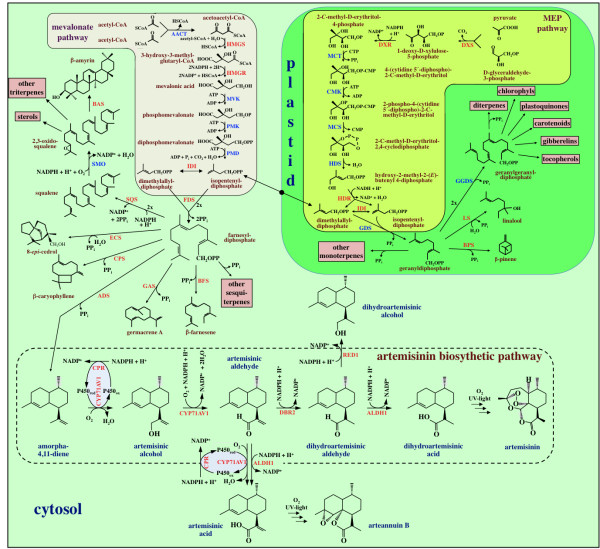
Verification
Claims the paper makes
38 Not checked yet · 35 Own result · 27 Own interpretation · 7 Own method · 2 No basis given
A result the paper reports from its own data — it cites no other source for it, so there is none to check. The quote shows it is in the paper.
In the paper
“3-Hydroxy-3-methyl-glutaryl coenzyme A reductase exhibited lower expression in old leaves compared to other tissues.”
§ Relative expression of genes of terpene metabolism in different tissues of Artemisia annua L > Abstract > Results
plaincorrelational- Asserted: passes — The authors put it forward as true.
- Checkable: passes — It can be checked against evidence.
- Load-bearing: unclear — It is unclear whether the paper’s conclusions depend on it.
- Based: passes — The paper gives a reason why it holds.
A result the paper reports from its own data — it cites no other source for it, so there is none to check. The quote shows it is in the paper.
In the paper
“Germacrene A and caryophyllene synthase were mostly expressed in young leaves and flower buds while epi-cedrol synthase was highly expressed in old leaves.”
§ Relative expression of genes of terpene metabolism in different tissues of Artemisia annua L > Abstract > Results
plaincorrelational- Asserted: passes — The authors put it forward as true.
- Checkable: passes — It can be checked against evidence.
- Load-bearing: unclear — It is unclear whether the paper’s conclusions depend on it.
- Based: passes — The paper gives a reason why it holds.
A result the paper reports from its own data — it cites no other source for it, so there is none to check. The quote shows it is in the paper.
In the paper
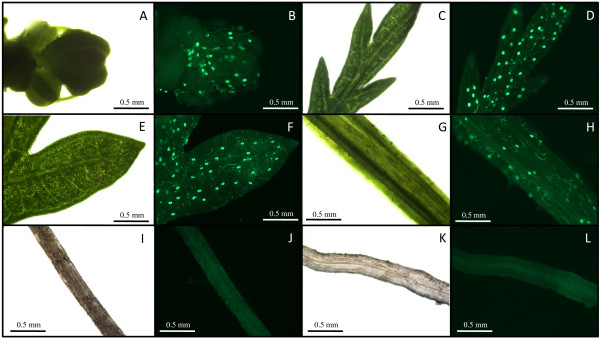
“From Figure 2, it is evident that young leaves (panels C and D) carry considerably higher density of trichomes than older leaves (panels E and F).”
- Also stated in: § Trichomes · hedged
“We have estimated, by counting trichomes, that on young leaves there are around 300±40 trichomes/cm2 while the corresponding number for old leaves was 130 ± 25 trichomes/cm2.”
§ Relative expression of genes of terpene metabolism in different tissues of Artemisia annua L > Results and Discussion > Trichomes
plaincorrelational- Asserted: passes — The authors put it forward as true.
- Checkable: passes — It can be checked against evidence.
- Load-bearing: unclear — It is unclear whether the paper’s conclusions depend on it.
- Based: passes — The paper gives a reason why it holds.
- Also stated in: § Trichomes · hedged
A result the paper reports from its own data — it cites no other source for it, so there is none to check. The quote shows it is in the paper.
In the paper
“Further, dihydroartemisinic aldehyde reductase showed a very high expression only in hairy root cultures.”
§ Relative expression of genes of terpene metabolism in different tissues of Artemisia annua L > Abstract > Results
plaincorrelational- Asserted: passes — The authors put it forward as true.
- Checkable: passes — It can be checked against evidence.
- Load-bearing: unclear — It is unclear whether the paper’s conclusions depend on it.
- Based: passes — The paper gives a reason why it holds.
A result the paper reports from its own data — it cites no other source for it, so there is none to check. The quote shows it is in the paper.
In the paper
“our results show that this enzyme is expressed only at low levels in tissues producing artemisinin”
§ Relative expression of genes of terpene metabolism in different tissues of Artemisia annua L > Abstract > Conclusions
plain- Asserted: passes — The authors put it forward as true.
- Checkable: passes — It can be checked against evidence.
- Load-bearing: passes — The paper’s conclusions depend on it.
- Based: passes — The paper gives a reason why it holds.
A result the paper reports from its own data — it cites no other source for it, so there is none to check. The quote shows it is in the paper.
In the paper
“Germacrene A and caryophyllene synthase were mostly expressed in young leaves and flower buds while epi-cedrol synthase was highly expressed in old leaves.”
§ Relative expression of genes of terpene metabolism in different tissues of Artemisia annua L > Abstract > Results
plaincorrelational- Asserted: passes — The authors put it forward as true.
- Checkable: passes — It can be checked against evidence.
- Load-bearing: unclear — It is unclear whether the paper’s conclusions depend on it.
- Based: passes — The paper gives a reason why it holds.
A result the paper reports from its own data — it cites no other source for it, so there is none to check. The quote shows it is in the paper.
In the paper
“Farnesyldiphosphate synthase, squalene synthase, and 1-deoxy-D-xylulose-5-phosphate reductoisomerase showed only modest variation in expression in the different tissues”
§ Relative expression of genes of terpene metabolism in different tissues of Artemisia annua L > Abstract > Results
plain- Asserted: passes — The authors put it forward as true.
- Checkable: passes — It can be checked against evidence.
- Load-bearing: unclear — It is unclear whether the paper’s conclusions depend on it.
- Based: passes — The paper gives a reason why it holds.
A result the paper reports from its own data — it cites no other source for it, so there is none to check. The quote shows it is in the paper.
In the paper
“Germacrene A and caryophyllene synthase were mostly expressed in young leaves and flower buds while epi-cedrol synthase was highly expressed in old leaves.”
§ Relative expression of genes of terpene metabolism in different tissues of Artemisia annua L > Abstract > Results
plaincorrelational- Asserted: passes — The authors put it forward as true.
- Checkable: passes — It can be checked against evidence.
- Load-bearing: unclear — It is unclear whether the paper’s conclusions depend on it.
- Based: passes — The paper gives a reason why it holds.
A result the paper reports from its own data — it cites no other source for it, so there is none to check. The quote shows it is in the paper.
In the paper
“The four genes of the artemisinin biosynthetic pathway (amorpha-4,11-diene synthase, amorphadiene-12-hydroxylase, artemisinic aldehyde ∆11(13) reductase and aldehyde dehydrogenase 1) showed remarkably higher expression (between ~40- to ~500-fold) in flower buds and young leaves compared to other tissues (old leaves, stems, roots, hairy root cultures).”
§ Relative expression of genes of terpene metabolism in different tissues of Artemisia annua L > Abstract > Results
plaincorrelational- Asserted: passes — The authors put it forward as true.
- Checkable: passes — It can be checked against evidence.
- Load-bearing: passes — The paper’s conclusions depend on it.
- Based: passes — The paper gives a reason why it holds.
A result the paper reports from its own data — it cites no other source for it, so there is none to check. The quote shows it is in the paper.
In the paper
“while expression of 1-deoxy-D-xylulose-5-phosphate synthase was 7-8-fold higher in flower buds and young leaves compared to old leaves.”
§ Relative expression of genes of terpene metabolism in different tissues of Artemisia annua L > Abstract > Results
plaincorrelational- Asserted: passes — The authors put it forward as true.
- Checkable: passes — It can be checked against evidence.
- Load-bearing: unclear — It is unclear whether the paper’s conclusions depend on it.
- Based: passes — The paper gives a reason why it holds.
- It may state two separate claims as one. 25
- The quote only partly states this claim. 1
- Probably not a substantial claim. 30
A result the paper reports from its own data — it cites no other source for it, so there is none to check. The quote shows it is in the paper.
In the paper
“i.e. ~500 and ~150 times more ADS, ~150 and ~150 times more CYP71AV1, ~40 and ~70 times more DBR2 and ~250 and ~130 times more ALDH1 in flower buds and young leaves, respectively.”
§ Relative expression of genes of terpene metabolism in different tissues of Artemisia annua L > Results and Discussion > Gene expression
plaincorrelational- Asserted: passes — The authors put it forward as true.
- Checkable: passes — It can be checked against evidence.
- Load-bearing: passes — The paper’s conclusions depend on it.
- Based: passes — The paper gives a reason why it holds.
It may state two separate claims as one.
A result the paper reports from its own data — it cites no other source for it, so there is none to check. The quote shows it is in the paper.
In the paper
“i.e. ~500 and ~150 times more ADS, ~150 and ~150 times more CYP71AV1, ~40 and ~70 times more DBR2 and ~250 and ~130 times more ALDH1 in flower buds and young leaves, respectively.”
§ Relative expression of genes of terpene metabolism in different tissues of Artemisia annua L > Results and Discussion > Gene expression
plaincorrelational- Asserted: passes — The authors put it forward as true.
- Checkable: passes — It can be checked against evidence.
- Load-bearing: passes — The paper’s conclusions depend on it.
- Based: passes — The paper gives a reason why it holds.
It may state two separate claims as one.
A result the paper reports from its own data — it cites no other source for it, so there is none to check. The quote shows it is in the paper.
In the paper
“i.e. ~500 and ~150 times more ADS, ~150 and ~150 times more CYP71AV1, ~40 and ~70 times more DBR2 and ~250 and ~130 times more ALDH1 in flower buds and young leaves, respectively.”
§ Relative expression of genes of terpene metabolism in different tissues of Artemisia annua L > Results and Discussion > Gene expression
plaincorrelational- Asserted: passes — The authors put it forward as true.
- Checkable: passes — It can be checked against evidence.
- Load-bearing: passes — The paper’s conclusions depend on it.
- Based: passes — The paper gives a reason why it holds.
It may state two separate claims as one.
A result the paper reports from its own data — it cites no other source for it, so there is none to check. The quote shows it is in the paper.
In the paper
“around 20- and 8-fold more expression was seen in highly biosynthetically active flower buds and young leaves, respectively, than in old leaves (Figure 3).”
- Also stated in: § Gene expression · plain
“HMGR also was enhanced 20-fold in roots.”
§ Relative expression of genes of terpene metabolism in different tissues of Artemisia annua L > Results and Discussion > Gene expression
plaincorrelational- Asserted: passes — The authors put it forward as true.
- Checkable: passes — It can be checked against evidence.
- Load-bearing: passes — The paper’s conclusions depend on it.
- Based: passes — The paper gives a reason why it holds.
It may state two separate claims as one. The quote only partly states this claim.
- Also stated in: § Gene expression · plain
A result the paper reports from its own data — it cites no other source for it, so there is none to check. The quote shows it is in the paper.
In the paper
“Transcripts of all the genes studied could be detected in all tissues at different amounts using qPCR. The only exception was that no ADS could be detected in roots.”
§ Relative expression of genes of terpene metabolism in different tissues of Artemisia annua L > Results and Discussion > Gene expression
hedged- Asserted: passes — The authors put it forward as true.
- Checkable: passes — It can be checked against evidence.
- Load-bearing: passes — The paper’s conclusions depend on it.
- Based: passes — The paper gives a reason why it holds.
It may state two separate claims as one.
A result the paper reports from its own data — it cites no other source for it, so there is none to check. The quote shows it is in the paper.
In the paper
“i.e. ~500 and ~150 times more ADS, ~150 and ~150 times more CYP71AV1, ~40 and ~70 times more DBR2 and ~250 and ~130 times more ALDH1 in flower buds and young leaves, respectively.”
§ Relative expression of genes of terpene metabolism in different tissues of Artemisia annua L > Results and Discussion > Gene expression
plaincorrelational- Asserted: passes — The authors put it forward as true.
- Checkable: passes — It can be checked against evidence.
- Load-bearing: passes — The paper’s conclusions depend on it.
- Based: passes — The paper gives a reason why it holds.
It may state two separate claims as one.
A result the paper reports from its own data — it cites no other source for it, so there is none to check. The quote shows it is in the paper.
In the paper
“glandular trichomes of A. annua were visualized by fluorescence microscopy (Figure 2) and found in all aerial tissues of the plant such as flower buds (panels A and B), leaves (panels C-F), stems (panels G and H) at different densities, but as expected not on roots (panels I and J) or hairy root cultures of A. annua (panels K and L).”
§ Relative expression of genes of terpene metabolism in different tissues of Artemisia annua L > Results and Discussion > Trichomes
plain- Asserted: passes — The authors put it forward as true.
- Checkable: passes — It can be checked against evidence.
- Load-bearing: unclear — It is unclear whether the paper’s conclusions depend on it.
- Based: passes — The paper gives a reason why it holds.
It may state two separate claims as one.
The paper states this without a source or data behind it here, so there is nothing to check it against. The quote shows it is in the paper.
In the paper
“Finally, no ADS could be detected in roots of A. annua while small amounts were found in hairy roots.”
§ Relative expression of genes of terpene metabolism in different tissues of Artemisia annua L > Results and Discussion > Gene expression
plain- Asserted: passes — The authors put it forward as true.
- Checkable: passes — It can be checked against evidence.
- Load-bearing: unclear — It is unclear whether the paper’s conclusions depend on it.
- Based: passes — The paper gives a reason why it holds.
It may state two separate claims as one.
None of the sources cited for this claim have been checked yet.
In the paper
“low relative turnover potential”
§ Relative expression of genes of terpene metabolism in different tissues of Artemisia annua L > Results and Discussion > Gene expression
plain- Asserted: passes — The authors put it forward as true.
- Checkable: passes — It can be checked against evidence.
- Load-bearing: passes — The paper’s conclusions depend on it.
- Based: passes — The paper gives a reason why it holds.
Probably not a substantial claim.
None of the sources cited for this claim have been checked yet.
In the paper
“only partial localization to trichomes”
§ Relative expression of genes of terpene metabolism in different tissues of Artemisia annua L > Results and Discussion > Gene expression
plain- Asserted: passes — The authors put it forward as true.
- Checkable: passes — It can be checked against evidence.
- Load-bearing: passes — The paper’s conclusions depend on it.
- Based: passes — The paper gives a reason why it holds.
Probably not a substantial claim.
A result the paper reports from its own data — it cites no other source for it, so there is none to check. The quote shows it is in the paper.
In the paper
“The two FDS genes from A. annua show 96.6% nucleotide sequence identity and the segment that was amplified with the primers used (Table 1) is identical in the two genes.”
§ Relative expression of genes of terpene metabolism in different tissues of Artemisia annua L > Results and Discussion > Gene expression
plain- Asserted: passes — The authors put it forward as true.
- Checkable: passes — It can be checked against evidence.
- Load-bearing: passes — The paper’s conclusions depend on it.
- Based: passes — The paper gives a reason why it holds.
It may state two separate claims as one.
A result the paper reports from its own data — it cites no other source for it, so there is none to check. The quote shows it is in the paper.
In the paper
“The expression of DXR appears to be somewhat enhanced in flower buds and hairy roots but lower in stems and roots.”
§ Relative expression of genes of terpene metabolism in different tissues of Artemisia annua L > Results and Discussion > Gene expression
hedgedcorrelational- Asserted: passes — The authors put it forward as true.
- Checkable: passes — It can be checked against evidence.
- Load-bearing: unclear — It is unclear whether the paper’s conclusions depend on it.
- Based: passes — The paper gives a reason why it holds.
It may state two separate claims as one.
A result the paper reports from its own data — it cites no other source for it, so there is none to check. The quote shows it is in the paper.
In the paper
“The expression of ECS was much lower in flower buds and young leaves than in old leaves (Figure 3A and 3B), while expression of CPS and GAS was considerably higher in these tissues as compared to old leaves.”
§ Relative expression of genes of terpene metabolism in different tissues of Artemisia annua L > Results and Discussion > Gene expression
plaincorrelational- Asserted: passes — The authors put it forward as true.
- Checkable: passes — It can be checked against evidence.
- Load-bearing: passes — The paper’s conclusions depend on it.
- Based: passes — The paper gives a reason why it holds.
It may state two separate claims as one.
None of the sources cited for this claim have been checked yet.
In the paper
“Dihydroartemisinic acid is formed from artemisinic aldehyde in two steps via dihydroartemisinic aldehyde. The reduction is catalyzed by artemisinic aldehyde Δ11(13) reductase (DBR2) [15] and the oxidation to the acid by aldehyde dehydrogenase 1 (ALDH1) [16].”
§ Relative expression of genes of terpene metabolism in different tissues of Artemisia annua L > Background
What the sources say
- Not checked yetcites [15] Zhang Y, Teoh KH, Reed DW, Maes L, Goossens A, Olson DJ, Ross AR, Covello PS: The molecular cloning of artemisinic aldehyde Δ11(13) reductase and its role in glandular trichome-dependent biosynthesis of artemisinin in Artemisia annua. J Biol Chem. 2008, 283: 21501-21508. 10.1074/jbc.M803090200. source
- Not checked yetcites [16] Teoh KH, Polichuk DR, Reed DW, Covello PS: Molecular cloning of an aldehyde dehydrogenase implicated in artemisinin biosynthesis in Artemsia annua. Botany. 2009, 87: 635-642. 10.1139/B09-032. source
plaindirect- Asserted: passes — The authors put it forward as true.
- Checkable: passes — It can be checked against evidence.
- Load-bearing: fails — The paper’s conclusions may not depend on it.
- Based: passes — The paper gives a reason why it holds.
Probably not a substantial claim. The paper’s conclusions may not depend on it.
None of the sources cited for this claim have been checked yet.
In the paper
“so far five different sesquiterpene synthases (epi-cedrol synthase (ECS) [5], amorpha-4,11-diene synthase (ADS) [6]; β-caryophyllene synthase (CPS) [7], germacrene A synthase (GAS) [8] and β-farnesene synthase (BFS) [9] have been cloned from the plant.”
§ Relative expression of genes of terpene metabolism in different tissues of Artemisia annua L > Background
What the sources say
- Not checked yetcites [5] Mercke P, Crock J, Croteau R, Brodelius PE: Cloning, expression and characterization of epi-cedrol synthase, a sesquiterpene cyclase from Artemisia annua L. Arch Biochem Biophys. 1999, 369: 213-222. 10.1006/abbi.1999.1358. source
- Not checked yetcites [6] Mercke P, Bengtsson M, Bouwmeester HJ, Posthumus MA, Brodelius PE: Molecular cloning, expression, and characterization of amorpha-4,11-diene synthase, a key enzyme of artemisinin biosynthesis in Artemisia annua L. Arch Biochem Biophys. 2000, 381: 173-180. 10.1006/abbi.2000.1962. source
- Not checked yetcites [7] Cai Y, Jia J-W, Crock J, Lin Z-X, Chen X-Y, Croteau R: A cDNA clone for β-caryophyllene synthase from Artemisia annua. Phytochemistry. 2002, 61: 523-529. 10.1016/S0031-9422(02)00265-0. source
plain- Asserted: passes — The authors put it forward as true.
- Checkable: passes — It can be checked against evidence.
- Load-bearing: passes — The paper’s conclusions depend on it.
- Based: passes — The paper gives a reason why it holds.
Probably not a substantial claim.
None of the sources cited for this claim have been checked yet.
In the paper
“recent feeding experiments with artemisinic acid [13] and dihydroartemisinic acid [14] have shown that the latter substance is the precursor of artemisinin.”
§ Relative expression of genes of terpene metabolism in different tissues of Artemisia annua L > Background
What the sources say
- Not checked yetcites [13] Brown GD, Sy LK: In vivo transformations of artemisinic acid in Artemisia annua plants. Tetrahedron. 2006, 63: 9548-9566. 10.1016/j.tet.2007.06.062. source
- Not checked yetcites [14] Brown GD, Sy LK: In vivo transformations of dihydroartemisinic acid in Artemisia annua plants. Tetrahedron. 2004, 60: 1139-1159. 10.1016/j.tet.2003.11.070. source
boosteddirect- Asserted: passes — The authors put it forward as true.
- Checkable: passes — It can be checked against evidence.
- Load-bearing: fails — The paper’s conclusions may not depend on it.
- Based: passes — The paper gives a reason why it holds.
Probably not a substantial claim. The paper’s conclusions may not depend on it.
None of the sources cited for this claim have been checked yet.
In the paper
“it is well established that the production of specific terpenoids, including artemisinin, takes place within the secretory cells of such trichomes [21,22].”
§ Relative expression of genes of terpene metabolism in different tissues of Artemisia annua L > Results and Discussion > Trichomes
What the sources say
- Not checked yetcites [21] Ferreira JFS, Janick J: Distribution of artemisinin in Artemisia annua. Progress in new crops. Edited by: Janick J. Arlington: ASHS Press; 1996,579-584.
- Not checked yetcites [22] Tellez MR, Canel C, Rimando AM, Duke SO: Differential accumulation of isoprenoids in glanded and glandless Artemisia annua L. Phytochemistry. 1999, 52: 1035-1040. 10.1016/S0031-9422(99)00308-8. source
boosteddirect- Asserted: passes — The authors put it forward as true.
- Checkable: passes — It can be checked against evidence.
- Load-bearing: fails — The paper’s conclusions may not depend on it.
- Based: passes — The paper gives a reason why it holds.
Probably not a substantial claim. The paper’s conclusions may not depend on it.
None of the sources cited for this claim have been checked yet.
In the paper
“The first committed step in artemisinin biosynthesis is the conversion of FDP to amorpha-4,11-diene by ADS [6,11].”
§ Relative expression of genes of terpene metabolism in different tissues of Artemisia annua L > Background
What the sources say
- Not checked yetcites [6] Mercke P, Bengtsson M, Bouwmeester HJ, Posthumus MA, Brodelius PE: Molecular cloning, expression, and characterization of amorpha-4,11-diene synthase, a key enzyme of artemisinin biosynthesis in Artemisia annua L. Arch Biochem Biophys. 2000, 381: 173-180. 10.1006/abbi.2000.1962. source
- Not checked yetcites [11] Bouwmeester HJ, Wallaart TE, Janssen MH, van Loo B, Jansen BJ, Posthumus MA, Schmidt CO, de Kraker JW, Konig WA, Franssen MC: Amorpha-4, 11-diene synthase catalyses the first probable step in artemisinin biosynthesis. Phytochemistry. 1999, 52: 843-854. 10.1016/S0031-9422(99)00206-X. source
plaindirect- Asserted: passes — The authors put it forward as true.
- Checkable: passes — It can be checked against evidence.
- Load-bearing: fails — The paper’s conclusions may not depend on it.
- Based: passes — The paper gives a reason why it holds.
Probably not a substantial claim. The paper’s conclusions may not depend on it.
In the paper
“The conversion of dihydroartemisinic acid to artemisinin is believed to be a non-enzymatic spontaneous reaction [14].”
§ Relative expression of genes of terpene metabolism in different tissues of Artemisia annua L > Background
What the sources say
- Not checked yetcites [14] Brown GD, Sy LK: In vivo transformations of dihydroartemisinic acid in Artemisia annua plants. Tetrahedron. 2004, 60: 1139-1159. 10.1016/j.tet.2003.11.070. source
hedged- Asserted: passes — The authors put it forward as true.
- Checkable: passes — It can be checked against evidence.
- Load-bearing: fails — The paper’s conclusions may not depend on it.
- Based: passes — The paper gives a reason why it holds.
Probably not a substantial claim. The paper’s conclusions may not depend on it.
In the paper
“The genetic variation within A. annua appears to be high. At least two chemotypes with different compositions of the essential oil during the vegetative period have been described [19].”
§ Relative expression of genes of terpene metabolism in different tissues of Artemisia annua L > Background
What the sources say
- Not checked yetcites [19] Wallaart TE, Pras N, Beekman AC, Quax WJ: Seasonal variation of artemisinin and its biosynthetic precursors in plants of Artemisia annua of different geographical origin; proof for the existence of chemotypes. Planta Med. 2000, 66: 57-62. 10.1055/s-2000-11115. source
hedged- Asserted: passes — The authors put it forward as true.
- Checkable: passes — It can be checked against evidence.
- Load-bearing: fails — The paper’s conclusions may not depend on it.
- Based: passes — The paper gives a reason why it holds.
Probably not a substantial claim. The paper’s conclusions may not depend on it. It may state two separate claims as one.
In the paper
“In the following step, amorpha-4,11-diene is hydroxylated to yield artemisinic alcohol. This reaction is catalyzed by a cytochrome P450 dependent hydroxylase (CYP71AV1) [12].”
§ Relative expression of genes of terpene metabolism in different tissues of Artemisia annua L > Background
What the sources say
- Not checked yetcites [12] Teoh KH, Polichuk DR, Reed DW, Nowak G, Covello PS: Artemisia annua L. (Asteraceae) trichome-specific cDNAs reveal CYP71AV1, a cytochrome P450 with a key role in the biosynthesis of the antimalarial sesquiterpene lactone artemisinin. FEBS Lett. 2006, 580: 1411-1416. 10.1016/j.febslet.2006.01.065. source
plaindirect- Asserted: passes — The authors put it forward as true.
- Checkable: passes — It can be checked against evidence.
- Load-bearing: fails — The paper’s conclusions may not depend on it.
- Based: passes — The paper gives a reason why it holds.
Probably not a substantial claim. The paper’s conclusions may not depend on it.
In the paper
“According to previous investigations, there is no conversion in planta of artemisinic acid to dihydroartemisinic acid or vice versa [13].”
§ Relative expression of genes of terpene metabolism in different tissues of Artemisia annua L > Background
What the sources say
- Not checked yetcites [13] Brown GD, Sy LK: In vivo transformations of artemisinic acid in Artemisia annua plants. Tetrahedron. 2006, 63: 9548-9566. 10.1016/j.tet.2007.06.062. source
plain- Asserted: passes — The authors put it forward as true.
- Checkable: passes — It can be checked against evidence.
- Load-bearing: fails — The paper’s conclusions may not depend on it.
- Based: passes — The paper gives a reason why it holds.
Probably not a substantial claim. The paper’s conclusions may not depend on it.
In the paper
“The major components of the essential oil from A. annua are mono- and sesquiterpenes produced in trichomes [4].”
§ Relative expression of genes of terpene metabolism in different tissues of Artemisia annua L > Background
What the sources say
- Not checked yetcites [4] Simon JE, Charles D, Cebert E, Grant L, Janick J, Whipkey A: Artemisia annua L.: a promising aromatic and medicinal. Advances in new crops. Edited by: Janick J and Simon JE. Portland: Timber Press; 1990, 522-526.
plaindirect- Asserted: passes — The authors put it forward as true.
- Checkable: passes — It can be checked against evidence.
- Load-bearing: fails — The paper’s conclusions may not depend on it.
- Based: passes — The paper gives a reason why it holds.
Probably not a substantial claim. The paper’s conclusions may not depend on it. It may state two separate claims as one.
What the paper did — it cites no source for this, so there is none to check. The quote shows it is in the paper.
In the paper
“In total, 14 different transcripts have been monitored using three reference genes.”
§ Relative expression of genes of terpene metabolism in different tissues of Artemisia annua L > Background
plain- Asserted: passes — The authors put it forward as true.
- Checkable: passes — It can be checked against evidence.
- Load-bearing: passes — The paper’s conclusions depend on it.
- Based: passes — The paper gives a reason why it holds.
Probably not a substantial claim.
What the paper did — it cites no source for this, so there is none to check. The quote shows it is in the paper.
In the paper
“All graphs represent the values of two independent qPCR runs with cDNA prepared from different plants. Sample triplicates were used in all qPCR runs.”
§ Relative expression of genes of terpene metabolism in different tissues of Artemisia annua L > Results and Discussion > Gene expression
plain- Asserted: passes — The authors put it forward as true.
- Checkable: passes — It can be checked against evidence.
- Load-bearing: fails — The paper’s conclusions may not depend on it.
- Based: passes — The paper gives a reason why it holds.
Probably not a substantial claim. The paper’s conclusions may not depend on it. It may state two separate claims as one.
A conclusion the paper draws from its own results — it cites no other source for it, so there is none to check. The quote shows it is in the paper.
In the paper
“All these sesquiterpene synthases may compete for the same substrate, farnesyl diphosphate (FDP), which is a precursor of artemisinin.”
§ Relative expression of genes of terpene metabolism in different tissues of Artemisia annua L > Background
hedgedconditional- Asserted: passes — The authors put it forward as true.
- Checkable: passes — It can be checked against evidence.
- Load-bearing: passes — The paper’s conclusions depend on it.
- Based: passes — The paper gives a reason why it holds.
Probably not a substantial claim.
In the paper
“Furthermore the yield of terpenoids in various plants is highly dependent on trichome abundance [23].”
§ Relative expression of genes of terpene metabolism in different tissues of Artemisia annua L > Results and Discussion > Trichomes
What the sources say
- Not checked yetcites [23] Biswas KK, Foster AJ, Aung T, Mahmoud SS: Essential oil production: relationship with abundance of glandular trichomes in aerial surface of plants. Acta Physiol Plant. 2009, 31: 13-19. 10.1007/s11738-008-0214-y. source
boostedcorrelational- Asserted: passes — The authors put it forward as true.
- Checkable: passes — It can be checked against evidence.
- Load-bearing: fails — The paper’s conclusions may not depend on it.
- Based: passes — The paper gives a reason why it holds.
Probably not a substantial claim. The paper’s conclusions may not depend on it.
What the paper did — it cites no source for this, so there is none to check. The quote shows it is in the paper.
In the paper
“Two independent triplet reactions were used for the calculation of average CT-values.”
§ Relative expression of genes of terpene metabolism in different tissues of Artemisia annua L > Results and Discussion > Gene expression
plain- Asserted: passes — The authors put it forward as true.
- Checkable: passes — It can be checked against evidence.
- Load-bearing: fails — The paper’s conclusions may not depend on it.
- Based: passes — The paper gives a reason why it holds.
Probably not a substantial claim. The paper’s conclusions may not depend on it.
In the paper
“It is well established that DXS, the first enzyme of the MEP pathway, plays a major role in the overall regulation of the pathway [33].”
§ Relative expression of genes of terpene metabolism in different tissues of Artemisia annua L > Results and Discussion > Gene expression
What the sources say
- Not checked yetcites [33] Cordoba E, Salmi M, León P: Unravelling the regulatory mechanisms that modulate the MEP pathway in higher plants. J Exp Bot. 2009, 60: 2933-2943. 10.1093/jxb/erp190. source
boosteddirect- Asserted: passes — The authors put it forward as true.
- Checkable: passes — It can be checked against evidence.
- Load-bearing: fails — The paper’s conclusions may not depend on it.
- Based: passes — The paper gives a reason why it holds.
Probably not a substantial claim. The paper’s conclusions may not depend on it.
In the paper
“Stermer et al. showed that the HMGR activity is much reduced in mature tissues, correlating well with the results presented here [27].”
§ Relative expression of genes of terpene metabolism in different tissues of Artemisia annua L > Results and Discussion > Gene expression
What the sources say
- Not checked yetcites [27] Stermer BA, Bianchini GM, Korth KL: Regulation of HMG-CoA reductase activity in plants. J Lipid Res. 1994, 35: 1133-1140. source
plaindirect- Asserted: passes — The authors put it forward as true.
- Checkable: passes — It can be checked against evidence.
- Load-bearing: fails — The paper’s conclusions may not depend on it.
- Based: passes — The paper gives a reason why it holds.
Probably not a substantial claim. The paper’s conclusions may not depend on it.
In the paper
“it has recently been shown that one C5-unit of FDP, the precursor of artemisinin, is produced by the MEP pathway [34].”
§ Relative expression of genes of terpene metabolism in different tissues of Artemisia annua L > Results and Discussion > Gene expression
What the sources say
- Not checked yetcites [34] Schramek N, Wang H, Römisch-Margl W, Keil B, Radykewicz T, Winzenhörlein B, Beerhues L, Bacher A, Rohdich F, Gershenzon J, Liu B, Eisenreich W: Artemisinin biosynthesis in growing plants of Artemisia annua. A 13CO2 study. Phytochemistry. 2010, 71: 179-187. 10.1016/j.phytochem.2009.10.015. source
boosteddirect- Asserted: passes — The authors put it forward as true.
- Checkable: passes — It can be checked against evidence.
- Load-bearing: passes — The paper’s conclusions depend on it.
- Based: passes — The paper gives a reason why it holds.
Probably not a substantial claim.
None of the sources cited for this claim have been checked yet.
In the paper
“HMGR is a rate-limiting enzyme of the mevalonate pathway [24,25], and recently it has been shown that HMGR expression limits artemisinin formation in A. annua [26].”
§ Relative expression of genes of terpene metabolism in different tissues of Artemisia annua L > Results and Discussion > Gene expression
What the sources say
- Not checked yetcites [24] Chappell J, Wolf F, Proulx J, Cuellar R, Saunders C: Is the reaction catalyzed by 3-hydroxy-3-methylglutaryl coenzyme A reductase a rate-limiting step for isoprenoid biosynthesis in plants?. Plant Physiol. 1995, 109: 1337-1343. source
- Not checked yetcites [25] Schaller H, Grausem B, Benveniste P, Chye M-L, Tan CT, Song Y-H, Chua N-H: Expression of the Hevea brasiliensis (H.B.K.) müll. Arg. 3-hydroxy-3-methylglutaryl coenzyme A reductase 1 in tobacco results in sterol overproduction. Plant Physiol. 1995, 109: 761-770. source
- Not checked yetcites [26] Ram M, Khan MA, Jha P, Khan S, Kiran U, Ahmad MM, Javed S, Abdin MZ: HMG-CoA reductase limits artemisinin biosynthesis and accumulation in Artemisia annua L. plants. Acta Physiol Plant. 2010, 32: 859-866. 10.1007/s11738-010-0470-5. source
boosteddirect- Asserted: passes — The authors put it forward as true.
- Checkable: passes — It can be checked against evidence.
- Load-bearing: unclear — It is unclear whether the paper’s conclusions depend on it.
- Based: passes — The paper gives a reason why it holds.
It may state two separate claims as one.
A conclusion the paper draws from its own results — it cites no other source for it, so there is none to check. The quote shows it is in the paper.
In the paper
“From Figure 3, we may conclude that only part of the FDS1/FDS2 activity is present in trichomes and involved in artemisinin biosynthesis.”
§ Relative expression of genes of terpene metabolism in different tissues of Artemisia annua L > Results and Discussion > Gene expression
hedged- Asserted: passes — The authors put it forward as true.
- Checkable: passes — It can be checked against evidence.
- Load-bearing: passes — The paper’s conclusions depend on it.
- Based: passes — The paper gives a reason why it holds.
It may state two separate claims as one.
In the paper
“due to a high Km for dihydroartemisinic aldehyde”
§ Relative expression of genes of terpene metabolism in different tissues of Artemisia annua L > Results and Discussion > Gene expression
What the sources say
- Not checked yetcites [18] Rydén A-M, Ruyter-Spira C, Quax WJ, Osada H, Muranaka T, Kayser O, Bouwmeester H: The Molecular cloning of dihydroartemisinic aldehyde reductase and its implication in artemisinin biosynthesis in Artemisia annua. Planta Med. 2010, 76 (15): 1778-1783. source
plain- Asserted: passes — The authors put it forward as true.
- Checkable: passes — It can be checked against evidence.
- Load-bearing: passes — The paper’s conclusions depend on it.
- Based: passes — The paper gives a reason why it holds.
Probably not a substantial claim.
A conclusion the paper draws from its own results — it cites no other source for it, so there is none to check. The quote shows it is in the paper.
In the paper
“Obviously, the relative amount of the biosynthetic enzymes is much higher in young trichomes, and the regulation of expression of these enzymes appears to be linked to the developmental stage of the trichomes.”
§ Relative expression of genes of terpene metabolism in different tissues of Artemisia annua L > Results and Discussion > Gene expression
hedgedcorrelational- Asserted: passes — The authors put it forward as true.
- Checkable: passes — It can be checked against evidence.
- Load-bearing: passes — The paper’s conclusions depend on it.
- Based: passes — The paper gives a reason why it holds.
It may state two separate claims as one.
In the paper
“These compounds have been isolated from hairy root cultures of A. annua [45].”
§ Relative expression of genes of terpene metabolism in different tissues of Artemisia annua L > Results and Discussion > Gene expression
What the sources say
- Not checked yetcites [45] Banerjee S, Zehra M, Gupta MM, Kumar S: Agrobacterium rhizogenes-mediated transformation of Artemisia annua: production of transgenic plants. Planta Med. 1997, 63: 467-469. 10.1055/s-2006-957737. source
plain- Asserted: passes — The authors put it forward as true.
- Checkable: passes — It can be checked against evidence.
- Load-bearing: unclear — It is unclear whether the paper’s conclusions depend on it.
- Based: passes — The paper gives a reason why it holds.
It may state two separate claims as one.
A conclusion the paper draws from its own results — it cites no other source for it, so there is none to check. The quote shows it is in the paper.
In the paper
“it may be assumed that as amorpha-4,11-diene is formed by ADS, it is efficiently converted all the way to dihydroartemisinic acid, which accumulates in this chemotype of A. annua”
§ Relative expression of genes of terpene metabolism in different tissues of Artemisia annua L > Results and Discussion > Gene expression
hedgeddirect- Asserted: passes — The authors put it forward as true.
- Checkable: passes — It can be checked against evidence.
- Load-bearing: passes — The paper’s conclusions depend on it.
- Based: passes — The paper gives a reason why it holds.
It may state two separate claims as one.
In the paper
“FDS2 is often inducible and found in special tissues at particular stages of development [28] and is also involved in phytoalexin biosynthesis.”
§ Relative expression of genes of terpene metabolism in different tissues of Artemisia annua L > Results and Discussion > Gene expression
What the sources say
- Not checked yetcites [28] Cunillera N, Boronat A, Ferrer A: Spatial and temporal patterns of GUS expression directed by 5' regions of the Arabidopsis thaliana farnesyl diphosphate synthase genes FPS1 and FPS2. Plant Mol Biol. 2000, 44: 747-758. 10.1023/A:1026588708849. source
plaincorrelational- Asserted: passes — The authors put it forward as true.
- Checkable: passes — It can be checked against evidence.
- Load-bearing: fails — The paper’s conclusions may not depend on it.
- Based: passes — The paper gives a reason why it holds.
Probably not a substantial claim. The paper’s conclusions may not depend on it. It may state two separate claims as one.
A conclusion the paper draws from its own results — it cites no other source for it, so there is none to check. The quote shows it is in the paper.
In the paper
“The original number of trichomes seem to be spread out on a larger surface as the leaf expands with age.”
§ Relative expression of genes of terpene metabolism in different tissues of Artemisia annua L > Results and Discussion > Trichomes
hedgedconditional- Asserted: passes — The authors put it forward as true.
- Checkable: passes — It can be checked against evidence.
- Load-bearing: fails — The paper’s conclusions may not depend on it.
- Based: passes — The paper gives a reason why it holds.
Probably not a substantial claim. The paper’s conclusions may not depend on it.
None of the sources cited for this claim have been checked yet.
In the paper
“Overexpression of FDS1 in A. annua results in an increase in artemisinin production [29,30] indicating that it is a rate-limiting enzyme in this pathway.”
§ Relative expression of genes of terpene metabolism in different tissues of Artemisia annua L > Results and Discussion > Gene expression
What the sources say
- Not checked yetcites [29] Han JL, Liu BY, Ye HC, Wang H, Li ZQ, Li GF: Effects of overexpression of the endogenouse farnesyl diphosphate synthase on the artemisinin content in Artemisia annua L. J Integr Plant Biol. 2006, 48: 482-487. 10.1111/j.1744-7909.2006.00208.x. source
- Not checked yetcites [30] Banyai W, Kirdmanee C, Mii M, Supaibulwatana K: Overexpression of farnesyl pyrophosphate synthase (FPS) gene affected artemisinin content and growth of Artemisia annuaL. Plant Cell Tiss Organ Cult.
hedgeddirect- Asserted: passes — The authors put it forward as true.
- Checkable: passes — It can be checked against evidence.
- Load-bearing: unclear — It is unclear whether the paper’s conclusions depend on it.
- Based: passes — The paper gives a reason why it holds.
It may state two separate claims as one.
In the paper
“DXR and HDR may also have rate-limiting roles for the production of IDP and DMADP [33].”
§ Relative expression of genes of terpene metabolism in different tissues of Artemisia annua L > Results and Discussion > Gene expression
What the sources say
- Not checked yetcites [33] Cordoba E, Salmi M, León P: Unravelling the regulatory mechanisms that modulate the MEP pathway in higher plants. J Exp Bot. 2009, 60: 2933-2943. 10.1093/jxb/erp190. source
hedgedconditional- Asserted: passes — The authors put it forward as true.
- Checkable: passes — It can be checked against evidence.
- Load-bearing: fails — The paper’s conclusions may not depend on it.
- Based: passes — The paper gives a reason why it holds.
Probably not a substantial claim. The paper’s conclusions may not depend on it.
In the paper
“The BestKeeper software [52] was used to search for stable reference genes among all genes tested.”
§ Relative expression of genes of terpene metabolism in different tissues of Artemisia annua L > Methods > Quantitative PCR (qPCR)
What the sources say
- Not checked yetcites [52] Pfaffl MW, Tichopád A, Prgomet C, Neuvians TP: Determination of stable housekeeping genes, differentially regulated target genes and sample integrity: BestKeeper - Excel-based tool using pair-wise correlations. Biotechnol Lett. 2004, 26: 509-515. 10.1023/B:BILE.0000019559.84305.47. source
plain- Asserted: passes — The authors put it forward as true.
- Checkable: passes — It can be checked against evidence.
- Load-bearing: passes — The paper’s conclusions depend on it.
- Based: passes — The paper gives a reason why it holds.
Probably not a substantial claim.
What the paper did — it cites no source for this, so there is none to check. The quote shows it is in the paper.
In the paper
“Triplets of all samples were run, and a negative control of the Master Mix in addition of primers was performed in all qPCR runs.”
§ Relative expression of genes of terpene metabolism in different tissues of Artemisia annua L > Methods > Quantitative PCR (qPCR)
plain- Asserted: passes — The authors put it forward as true.
- Checkable: passes — It can be checked against evidence.
- Load-bearing: fails — The paper’s conclusions may not depend on it.
- Based: passes — The paper gives a reason why it holds.
Probably not a substantial claim. The paper’s conclusions may not depend on it. It may state two separate claims as one.
What the paper did — it cites no source for this, so there is none to check. The quote shows it is in the paper.
In the paper
“Any outliers in the triplets were detected by Grubbs test and removed.”
§ Relative expression of genes of terpene metabolism in different tissues of Artemisia annua L > Methods > Quantitative PCR (qPCR)
plain- Asserted: passes — The authors put it forward as true.
- Checkable: passes — It can be checked against evidence.
- Load-bearing: fails — The paper’s conclusions may not depend on it.
- Based: passes — The paper gives a reason why it holds.
Probably not a substantial claim. The paper’s conclusions may not depend on it.
A conclusion the paper draws from its own results — it cites no other source for it, so there is none to check. The quote shows it is in the paper.
In the paper
“Assuming a kcat-value for the A. annua SQS in the order of 1 sec-1 (= 2 FDPs used per second), results in about 45- and 25-fold higher turnover potential, of FDP to products, for SQS, as compared to the turnover potential of ADS in flower buds and young leaves, respectively.”
§ Relative expression of genes of terpene metabolism in different tissues of Artemisia annua L > Results and Discussion > Gene expression
hedgedcorrelational- Asserted: passes — The authors put it forward as true.
- Checkable: passes — It can be checked against evidence.
- Load-bearing: passes — The paper’s conclusions depend on it.
- Based: passes — The paper gives a reason why it holds.
It may state two separate claims as one.
- The authors state this as an assumption: The kcat-value for A. annua SQS is in the order of 1 sec-1.
A conclusion the paper draws from its own results — it cites no other source for it, so there is none to check. The quote shows it is in the paper.
In the paper
“high DBR2 activity will result in an efficient formation of dihydroartemisinic aldehyde, dihydroartemisinic acid and artemisinin while high CYP71AV1 activity may result in artemisinic acid and arteannuin B”
§ Relative expression of genes of terpene metabolism in different tissues of Artemisia annua L > Conclusions
hedgedconditional- Asserted: passes — The authors put it forward as true.
- Checkable: passes — It can be checked against evidence.
- Load-bearing: passes — The paper’s conclusions depend on it.
- Based: passes — The paper gives a reason why it holds.
It may state two separate claims as one.
In the paper
“The A. annua enzyme has been cloned and is similar to the enzymes from A. thaliana and Nicotiana tabacum [48].”
§ Relative expression of genes of terpene metabolism in different tissues of Artemisia annua L > Results and Discussion > Gene expression
What the sources say
- Not checked yetcites [48] Liu CZ, Ye HC, Wang H, Li GF: Molecular cloning, Escherichia coli expression and genomic organization of squalene synthase gene from Artemisia annua. Acta Bot Sin. 2003, 45: 608-613.
plain- Asserted: passes — The authors put it forward as true.
- Checkable: passes — It can be checked against evidence.
- Load-bearing: fails — The paper’s conclusions may not depend on it.
- Based: passes — The paper gives a reason why it holds.
Probably not a substantial claim. The paper’s conclusions may not depend on it. It may state two separate claims as one.
In the paper
“a kcat = 3.3 sec-1 has been reported for a soluble recombinant yeast enzyme [47]”
§ Relative expression of genes of terpene metabolism in different tissues of Artemisia annua L > Results and Discussion > Gene expression
What the sources say
- Not checked yetcites [47] Zhang D, Jennings SM, Robinson GW, Poulter CD: Yeast squalene synthase: Expression, purification and characterization of soluble recombinant enzyme. Arch Biochem Biophys. 1993, 304: 133-143. 10.1006/abbi.1993.1331. source
plain- Asserted: passes — The authors put it forward as true.
- Checkable: passes — It can be checked against evidence.
- Load-bearing: fails — The paper’s conclusions may not depend on it.
- Based: passes — The paper gives a reason why it holds.
Probably not a substantial claim. The paper’s conclusions may not depend on it.
In the paper
“The mean efficiency of the amplicons was calculated by the program Linreg v. 12.1 based on the log linear phase of the amplification curve [51].”
§ Relative expression of genes of terpene metabolism in different tissues of Artemisia annua L > Methods > Quantitative PCR (qPCR)
What the sources say
- Not checked yetcites [51] Ruijter JM, Ramakers C, Hoogaars WMH, Karlen Y, Bakker O, van den Hoff MJB, Moorman AFM: Amplification efficiancy, linking baseline and bias in the analysis of quantitative PCR data. Nucl Acids Res. 2009, 37: e45-10.1093/nar/gkp045. source
plain- Asserted: passes — The authors put it forward as true.
- Checkable: passes — It can be checked against evidence.
- Load-bearing: passes — The paper’s conclusions depend on it.
- Based: passes — The paper gives a reason why it holds.
Probably not a substantial claim.
The authors state this as an assumption.
The number of active sites is proportional to the level of transcription.
“we assume that the number of active sites is proportional to the level of transcription”
The authors state this as an assumption.
The enzymes are working at substrate saturation with an optimal NADPH/NADP+ ratio.
“that the enzymes are working at substrate saturation with an optimal NADPH/NADP+ ratio”
The authors state this as an assumption.
Under these conditions, the kcat-value is a good indicator of the conversion of substrate to product.
“Under such conditions the kcat-value is a good indicator of the conversion of substrate to product.”
The authors state this as an assumption.
DBR2 and ALDH1 are acting on the same pool of intermediates.
“assuming that they are acting on the same pool of intermediates”
The paper relies on this without support.
FDP is used for the synthesis of squalene, which is the precursor of sterols and triterpenes.
“In addition, FDP is used for the synthesis of squalene, which is the precursor of sterols and triterpenes.”
The authors state this as an assumption.
Only one percent of the FDS1 activity is found in trichome cells.
“If we assume that only one percent of the FDS1 activity is found in trichome cells”
The authors state this as an assumption.
The kcat-value for A. annua SQS is in the order of 1 sec-1.
“Assuming a kcat-value for the A. annua SQS in the order of 1 sec-1 (= 2 FDPs used per second)”
Claims other papers make about this one
Each is checked against this paper’s own text: does it say what the citing paper says it does?
The cited source says what the claim attributes to it.
In the citing paper
“These and other changes were largely restricted to the juvenile leaves (Supplemental T ables 1 and 2, Fig S5) which are relatively dense in glandular trichomes (29) and exhibit high expression levels of terpene synthases (30).”
From Artemisia annua mutant impaired in artemisinin synthesis demonstrates importance of nonenzymatic conversion in terpenoid metabolism (2016) · cites this paper as [30]
Self-check
Percentages, sums and reported differences re-computed from the paper’s own numbers.
Each contradiction between two passages listed here was confirmed by an independent check.
Rated minor: it would not touch a result — a value no result rests on, a p-value that stays on the same side of the significance level, or a conflict that is clerical, resolved elsewhere in the paper, or outside its own findings.
In the paper
§ Relative expression of genes of terpene metabolism in different tissues of Artemisia annua L > Results and Discussion > Gene expression
“It may, however, be concluded from Table 3 that the biosynthetic enzymes are expressed in flower buds, leaves and stems that carry glandular trichomes but not in roots.”
§ Relative expression of genes of terpene metabolism in different tissues of Artemisia annua L > Results and Discussion > Gene expression
“| CYP71AV1 | +++++ | +++ | + | n.d. | + | RT-PCR | [12] |”
Citations
Cites
Analysis of Relative Gene Expression Data Using Real-Time Quantitative PCR and the 2−ΔΔCT Method
Livak, K. J., & Schmittgen, T. D. (2001) · Methods · doi:10.1006/meth.2001.1262 · Cited by 180,860
Pfaffl, M. W. (2002) · Nucleic Acids Research · doi:10.1093/nar/30.9.e36 · Cited by 7,377
Pfaffl, M. W., Tichopad, A., Prgomet, C., & Neuvians, T. P. (2004) · Biotechnology Letters · doi:10.1023/b:bile.0000019559.84305.47 · Cited by 5,065
Amplification efficiency: linking baseline and bias in the analysis of quantitative PCR data
Ruijter, J. M., Ramakers, C., Hoogaars, W. M. H., Karlen, Y., Bakker, O., van den Hoff, M. J. B., & Moorman, A. F. M. (2009) · Nucleic Acids Research · doi:10.1093/nar/gkp045 · Cited by 3,043
Production of the antimalarial drug precursor artemisinic acid in engineered yeast
Ro, D.-K., Paradise, E. M., Ouellet, M., Fisher, K. J., Newman, K. L., Ndungu, J. M., Ho, K. A., Eachus, R. A., Ham, T. S., Kirby, J., et al. (2006) · Nature · doi:10.1038/nature04640 · Cited by 2,805
Teoh, K. H., Polichuk, D. R., Reed, D. W., Nowak, G., & Covello, P. S. (2006) · FEBS Letters · doi:10.1016/j.febslet.2006.01.065 · Cited by 409
12-Oxophytodienoate reductase 3 (OPR3) is the isoenzyme involved in jasmonate biosynthesis
Schaller, F., Biesgen, C., Müssig, C., Altmann, T., & Weiler, E. W. (2000) · Planta · doi:10.1007/s004250050706 · Cited by 377
The Biosynthesis of Artemisinin (Qinghaosu) and the Phytochemistry of Artemisia annua L. (Qinghao)
Brown, G. D. (2010) · Molecules · doi:10.3390/molecules15117603 · Cited by 363
Unravelling the regulatory mechanisms that modulate the MEP pathway in higher plants
Cordoba, E., Salmi, M., & Leon, P. (2009) · Journal of Experimental Botany · doi:10.1093/jxb/erp190 · Cited by 346
Chappell, J., Wolf, F., Proulx, J., Cuellar, R., & Saunders, C. (1995) · Plant Physiology · doi:10.1104/pp.109.4.1337 · Cited by 335
Research works printed but not linked: 2
- Rydén A-M: Identification, characterization and expression of early biosynthetic genes from Artemisia annua. PhD Thesis. University of Groningen, Department of Pharmaceutical Biology; 2010.
- Ferreira JFS, Janick J: Distribution of artemisinin in Artemisia annua. Progress in new crops. Edited by: Janick J. Arlington: ASHS Press; 1996,579-584.
Cited by
Sorted by citations
Lu, X., Zhang, L., Zhang, F., Jiang, W., Shen, Q., Zhang, L., Lv, Z., Wang, G., & Tang, K. (2013) · New Phytologist · doi:10.1111/nph.12207 · Cited by 299
Yan, T., Chen, M., Shen, Q., Li, L., Fu, X., Pan, Q., Tang, Y., Shi, P., Lv, Z., Jiang, W., et al. (2016) · New Phytologist · doi:10.1111/nph.14205 · Cited by 232
Fuentes, P., Zhou, F., Erban, A., Karcher, D., Kopka, J., & Bock, R. (2016) · eLife · doi:10.7554/elife.13664 · Cited by 203
Shi, P., Fu, X., Shen, Q., Liu, M., Pan, Q., Tang, Y., Jiang, W., Lv, Z., Yan, T., Ma, Y., et al. (2017) · New Phytologist · doi:10.1111/nph.14789 · Cited by 178
Yadav, R. K., Sangwan, R. S., Sabir, F., Srivastava, A. K., & Sangwan, N. S. (2013) · Plant Physiology and Biochemistry · doi:10.1016/j.plaphy.2013.10.023 · Cited by 170
Metadata
- Authors
- Olofsson, L., Engström, A., Lundgren, A., & Brodelius, P. E.
- Affiliations
- Linnaeus University (SE)
- Corresponding author
- Brodelius, Peter E
- ORCID
- Brodelius, Peter E
- Venue
- BMC Plant Biology
- Published
- 2011-03-09
- Volume
- 11
- Issue
- 1
- Pages
- 45-45
- ISSN
- 1471-2229 (ISSN-L)
- PMC
- PMC3063820
- OpenAlex
- W2152443621
- Semantic Scholar
- e41f2ceecfaa54b3effd7809549e01ce6db0e30a
- Cited by
- 144
- References
- 58
- Citations by year
- 2026: 4 · 2025: 5 · 2024: 9 · 2023: 6 · 2022: 8 · 2021: 7 · 2020: 5 · 2019: 10 · 2018: 6 · 2017: 10 · 2016: 18 · 2015: 13 · 2014: 12 · 2013: 15 · 2012: 10
- FWCI
- 5.59
- Type
- journal article
- Language
- en
- Open access
- gold
- doi.org
- Licence
- cc-by
- Locations
- BMC Plant Biology (publishedVersion, cc-by)
- PubMed Central (publishedVersion, cc-by)
- PubMed (publishedVersion)
- DOAJ (DOAJ: Directory of Open Access Journals) (submittedVersion, cc-by-sa)
- Funders
- Mahidol University
- Topics
- Life Sciences › Biochemistry, Genetics and Molecular Biology › Molecular Biology › Plant biochemistry and biosynthesis
- Physical Sciences › Chemistry › Organic Chemistry › Sesquiterpenes and Asteraceae Studies
- Life Sciences › Agricultural and Biological Sciences › Plant Science › Plant tissue culture and regeneration
- Keywords
- Artemisia annua, artemisinin biosynthesis, terpene metabolism, gene expression, tissue-specific gene expression, amorpha-4,11-diene synthase, ALDH1, germacrene A synthase, HMGR, farnesyl diphosphate synthase, squalene synthase, 1-deoxy-D-xylulose 5-phosphate synthase, 1-deoxy-D-xylulose 5-phosphate reductoisomerase, hairy root culture
- MeSH terms
- Aldehyde Dehydrogenase 1 Family, Isoenzymes, Oxidoreductases, Plant Proteins, Gene Expression Regulation, Plant, RNA, Plant, Alkyl and Aryl Transferases, Gene Expression Profiling, Artemisia annua, Artemisinins, Retinal Dehydrogenase
About these checks
Registry, retraction, Cites and statistics results are computed, not judged, with one exception: a printed reference that no index lists is read once by a model before it counts as a citation error. Claims are extracted by a model and kept only when their quote appears verbatim in the text; each cited source is then checked, with a model’s help, for whether it says what the claim relies on. Those verdicts can be wrong — read the claim’s quote and the cited source before relying on one.
A language model drew the claims from the paper on 2026-10-09, under version 3 of the claim definition (model deepseek-v4.1-flash, prompt extract-v3).
A second model labelled each claim on 2026-10-09 (model jev-1.13-20260917, definition revision gold-guideline-v0.2).
Statistics and arithmetic are recomputed, not judged.
Confidence bands are shown only for fields calibrated on our annotated test set. None is calibrated yet, so no band is shown.
What counts as a claim ›How we measure confidence ›How we check this ›
Are you an author, or do you see a problem with this page? Request a review
