

Group cognitive behavioural therapy for women with depression: pilot and feasibility study for a randomised controlled trial using mixed methods
Open accessThe DOI matches its Crossref record; 27 of the 27 references it cites were found in a registry or an index.
Abstract
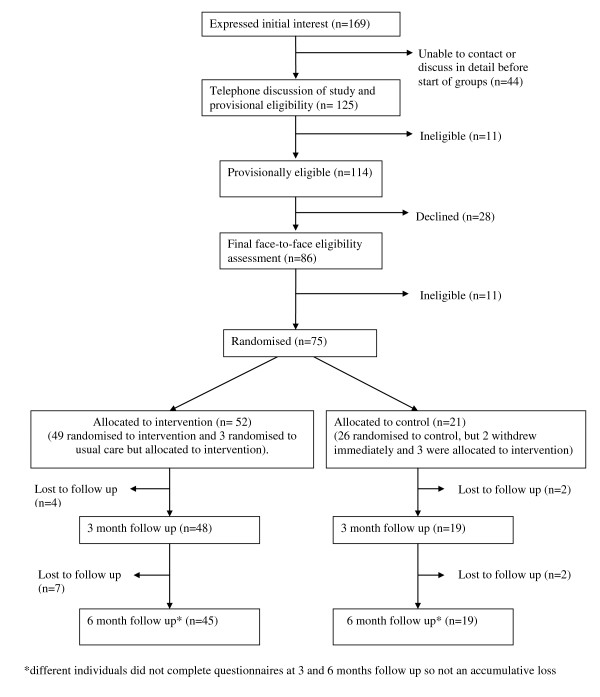
BACKGROUND: Group Cognitive Behavioural Therapy (CBT) may provide a means of improving mental health among people with depression but few studies have explored its effectiveness. Our aim was to examine the feasibility and acceptability of a randomised controlled trial of a group intervention based on CBT principles for women with depression in primary care. METHODS: Women aged 30 to 55 years were recruited and randomly assigned to either 12 weeks of the group intervention or usual care (control). The group intervention was based on a manual and used CBT and problem solving principles with weekly topics including raising activity levels, spotting and catching negative thoughts, problem solving and relaxation. Women were recruited from deprived areas of Bristol. The groups were run by facilitators with some experience and background in group work and one weeks training in use of the course manual. Assessments of mental health were made using measures including the PHQ-9. Follow-up was at 3 and 6 months after the intervention. Qualitative methods were used to support the design of the intervention and to help understand issues of acceptability and feasibility. Interviews were conducted with all participants at baseline and at 3 and 6 months although detailed qualitative analysis was based on a purposive sample of 20 participants at the 3 time points. RESULTS: Of the 86 participants assessed for eligibility, 52 were allocated to the intervention arm and 21 to the control group. The intervention was delivered according to the manual despite the limited training of the facilitators. The intervention was received favourably by participants and facilitators, with good attendance at sessions for those who engaged with the intervention. Follow up rates at 3 and 6 months for women in both the intervention and control arms were also good. The trial methodology used was appropriate and feasible. CONCLUSIONS: This study showed that a randomised controlled trial of group CBT for women with depression is feasible and the intervention is acceptable, and may possibly prove to be effective in a larger trial. The cost effectiveness of group CBT for depression should be explored further in a full trial. TRIAL REGISTRATION: NCT00663078.
Overview
The claims and statistics of this paper haven’t been checked yet.
Free: it reads the open-access text and checks the first 5 claims that cite a source we can check. Create a free account to check every claim.
Integrity signals
Registry
Cites
Statistics
Figures
Verification
Claims the paper makes
The claims and statistics of this paper haven’t been checked yet.
Free: it reads the open-access text and checks the first 5 claims that cite a source we can check. Create a free account to check every claim.
Claims other papers make about this one
Each is checked against this paper’s own text: does it say what the citing paper says it does?
The cited source says what the claim attributes to it.
In the citing paper
“although their evidence base is yet to be fully established (Cuijpers et al. , 2008; Cramer et al. , 2011).”
From Do depressed and anxious men do groups? What works and what are the barriers to help seeking? (2014) · cites this paper as Cramer et al. , 2011
The cited source says what the claim attributes to it.
In the citing paper
“An early evaluation of the acceptability of a complex intervention is imperative, as it can highlight aspects of the interventions that can be modified before a trial [32,33].”
Self-check
Percentages, sums and reported differences re-computed from the paper’s own numbers.
The self-check needs the paper’s full text.
Citations
Cites
The PHQ-9: Validity of a brief depression severity measure
Kroenke, K., Spitzer, R. L., & Williams, J. B. W. (2001) · Journal of General Internal Medicine · doi:10.1046/j.1525-1497.2001.016009606.x · Cited by 44,910
WARE, J. E., KOSINSKI, M., & KELLER, S. D. (1996) · Medical Care · doi:10.1097/00005650-199603000-00003 · Cited by 17,392 · cited 2×
“Details of the measures included in the baseline and follow-up questionnaires were as follows: (cid:129) Patient Health Questionnaire [13] (cid:129) Anxiety symptoms: Beck Anxiety Inventory [14] (cid:129) Health Status: Physical and Mental component scores from the Short Form-12 Questionnaire [15] (cid:129) Dysfunctio…”
MethodAn inventory for measuring clinical anxiety: Psychometric properties.
Beck, A. T., Epstein, N., Brown, G., & Steer, R. A. (1988) · Journal of Consulting and Clinical Psychology · doi:10.1037/0022-006x.56.6.893 · Cited by 14,407
Qualitative research practice: a guide for social science students and researchers
(2003) · Choice Reviews Online · doi:10.5860/choice.41-1319 · Cited by 10,543
Spitzer, R. L. (1999) · JAMA · doi:10.1001/jama.282.18.1737 · Cited by 9,802 · cited 1×
“PHQ-9 scores of 5, 10, 15, and 20 represent mild, moderate, moderately severe, and severe depression, respectively [12].”
BackgroundSherbourne, C. D., & Stewart, A. L. (1991) · Social Science & Medicine · doi:10.1016/0277-9536(91)90150-b · Cited by 6,643 · cited 2×
“Details of the measures included in the baseline and follow-up questionnaires were as follows: (cid:129) Patient Health Questionnaire [13] (cid:129) Anxiety symptoms: Beck Anxiety Inventory [14] (cid:129) Health Status: Physical and Mental component scores from the Short Form-12 Questionnaire [15] (cid:129) Dysfunctio…”
MethodGender differences in depression: Critical review
Piccinelli, M., & Wilkinson, G. (2000) · British Journal of Psychiatry · doi:10.1192/bjp.177.6.486 · Cited by 2,376
Cognitive self-statements in depression: Development of an automatic thoughts questionnaire
Hollon, S. D., & Kendall, P. C. (1980) · Cognitive Therapy and Research · doi:10.1007/bf01178214 · Cited by 1,480 · cited 2×
“Details of the measures included in the baseline and follow-up questionnaires were as follows: (cid:129) Patient Health Questionnaire [13] (cid:129) Anxiety symptoms: Beck Anxiety Inventory [14] (cid:129) Health Status: Physical and Mental component scores from the Short Form-12 Questionnaire [15] (cid:129) Dysfunctio…”
MethodDesigning and evaluating complex interventions to improve health care
Campbell, N. C., Murray, E., Darbyshire, J., Emery, J., Farmer, A., Griffiths, F., Guthrie, B., Lester, H., Wilson, P., & Kinmonth, A. L. (2007) · BMJ · doi:10.1136/bmj.39108.379965.be · Cited by 1,331 · cited 1×
“This study encompasses Phases I and II of the MRC framework for evaluation of complex interventions which are necessary preliminary steps towards conducting a full trial of group CBT [8].”
MethodGroup Interpersonal Psychotherapy for Depression in Rural Uganda: A Randomized Controlled Trial
Bolton, P., Bass, J., Neugebauer, R., Verdeli, H., Clougherty, K. F., Wickramaratne, P., Speelman, L., Ndogoni, L., & Weissman, M. (2003) · JAMA · doi:10.1001/jama.289.23.3117 · Cited by 655 · cited 2×
“Other studies showing positive results for group psychological therapy include a 12 week intervention delivered by non-medical health workers to low income Chilean women with major depression [18] and a 16 week course delivered by trained villagers in Uganda [27].”
Background
Research works printed but not linked: 4
- Nice >National Institute for Clinical Excellence (NICE) Depression: The treatment and management of depression in adults (update) 2009 London: DoH
- Clarke GN Lewinsohn PM Hops H Adolescent Coping with Depression Course 1990 Oregon: Castalia Press
- Katon W Ludman E Simon G The Depression Helpbook 2002 Boulder: Bull Publishing Company
- Blackburn IM James IM Milne DI Reichelt FK Cognitive Therapy Scale - Revised 2001 Northumberland: Tyne & Wear NHS Trust
Cited by
Watts, S. E., Turnell, A., Kladnitski, N., Newby, J. M., & Andrews, G. (2015) · Journal of Affective Disorders · doi:10.1016/j.jad.2014.12.025 · Cited by 188
Effect of psychotherapy for depression on quality of life: meta-analysis
Kolovos, S., Kleiboer, A., & Cuijpers, P. (2016) · British Journal of Psychiatry · doi:10.1192/bjp.bp.115.175059 · Cited by 153
Cristea, I. A., Huibers, M. J. H., David, D., Hollon, S. D., Andersson, G., & Cuijpers, P. (2015) · Clinical Psychology Review · doi:10.1016/j.cpr.2015.08.003 · Cited by 135
Hughes-Morley, A., Young, B., Waheed, W., Small, N., & Bower, P. (2015) · Journal of Affective Disorders · doi:10.1016/j.jad.2014.10.005 · Cited by 132
Midgley, N., Ansaldo, F., & Target, M. (2014) · Psychotherapy · doi:10.1037/a0034179 · Cited by 128
Wiles, N., Thomas, L., Abel, A., Barnes, M., Carroll, F., Ridgway, N., Sherlock, S., Turner, N., Button, K., Odondi, L., et al. (2014) · Health Technology Assessment · doi:10.3310/hta18310 · Cited by 127
Zhang, A., Borhneimer, L. A., Weaver, A., Franklin, C., Hai, A. H., Guz, S., & Li, S. (2019) · Journal of Behavioral Medicine · doi:10.1007/s10865-019-00046-z · Cited by 150
“…(2013) 1 0 0 0 1 2 Carta et al. (2012) 1 0 1 0 0 2 Clarke et al. (2005) 1 0 1 0 0 2 Clarke et al. (2017) 1 1 1 0 1 4 Conradi et al. (2008) 1 0 0 0 0 1 Cramer et al. (2011) 1 1 1 0 1 4 Craske et al. (2011) 1 1 1 1 1 5 Cully et al. (2017) 1 1 0 0 1 3 De Graaf et al. (2009) 1 0 0 0 1 2 Dwight-Johnson…”
InfluentialCognitive behaviour therapy for depression in primary care: systematic review and meta-analysis
Santoft, F., Axelsson, E., Öst, L.-G., Hedman-Lagerlöf, M., Fust, J., & Hedman-Lagerlöf, E. (2019) · Psychological Medicine · doi:10.1017/s0033291718004208 · Cited by 105
“…Laidlaw et al., 2008; Lovell et al., 2008; Wiles et al., 2008; Kessler et al., 2009; Serfaty et al., 2009; Hegerl et al., 2010; Naylor et al., 2010; Cramer et al., 2011; Dwight-Johnson et al., 2011; Ekers et al., 2011; Joling et al., 2011; Levin et al., 2011; Casañas et al., 2012; Power and…”
Okumura, Y., & Ichikura, K. (2014) · Journal of Affective Disorders · doi:10.1016/j.jad.2014.04.023 · Cited by 86
Zhang, A., Franklin, C., Jing, S., Bornheimer, L. A., Hai, A. H., Himle, J. A., Kong, D., & Ji, Q. (2019) · Journal of Affective Disorders · doi:10.1016/j.jad.2018.12.008 · Cited by 80
The effect of treatment as usual on major depressive disorder: A meta-analysis
Kolovos, S., van Tulder, M. W., Cuijpers, P., Prigent, A., Chevreul, K., Riper, H., & Bosmans, J. E. (2017) · Journal of Affective Disorders · doi:10.1016/j.jad.2016.12.013 · Cited by 79
“We detected only one study that was at high risk for “other” source of bias, where three participants were moved from the control to the intervention group to facilitate a “viable therapeutic group”.(Cramer et al., 2011).”
BackgroundThe effects of psychotherapy for depression on anxiety symptoms: a meta-analysis
Weitz, E., Kleiboer, A., van Straten, A., & Cuijpers, P. (2018) · Psychological Medicine · doi:10.1017/s0033291717003622 · Cited by 77
“Cramer et al. (2011) Adults Dep symptoms CBT CAU Grp 12 46 19 BAI + + sr − US”
BackgroundMcRory, B. (2012) · British Journal of Healthcare Assistants · doi:10.12968/bjha.2012.6.5.236 · Cited by 74
No pain, no gain: Depressed clients' experiences of cognitive behavioural therapy
Barnes, M., Sherlock, S., Thomas, L., Kessler, D., Kuyken, W., Owen‐Smith, A., Lewis, G., Wiles, N., & Turner, K. (2013) · British Journal of Clinical Psychology · doi:10.1111/bjc.12021 · Cited by 63
Karyotaki, E., Smit, Y., de Beurs, D. P., Henningsen, K. H., Robays, J., Huibers, M. J. H., Weitz, E., & Cuijpers, P. (2016) · Depression and Anxiety · doi:10.1002/da.22491 · Cited by 56
Patient experiences of psychological therapy for depression: a qualitative metasynthesis
McPherson, S., Wicks, C., & Tercelli, I. (2020) · BMC Psychiatry · doi:10.1186/s12888-020-02682-1 · Cited by 52
The effects of psychotherapy for adult depression on social support: a meta-analysis
Park, M., Cuijpers, P., van Straten, A., & Reynolds, C. F. (2014) · Cognitive Therapy and Research · doi:10.1007/s10608-014-9630-z · Cited by 44
“The five studies (Chesney et al. 2003; Cramer et al. 2011; Evans and Connis 1995; Kelly et al. 1993; Rahman et al. 2008) reporting outcomes at 6–12 month follow-up resulted in an effect size on social support of 0.32 (95 % CI -0.00 to 0.64).”
BackgroundMethodInfluentialImproving patients’ experience and outcome of total joint replacement: the RESTORE programme
Blom, A. W., Artz, N. J., Beswick, A. D., Burston, A., Dieppe, P. A., Elvers, K. T., Gooberman‐Hill, R., Horwood, J. P., Jepson, P., Johnson, E. C., et al. (2016) · Programme Grants for Applied Research · doi:10.3310/pgfar04120 · Cited by 53
“However, other feasibility and pilot studies using a postal recruitment method have reported similarly low response rates.(547,556,557) Despite the low recruitment rate, retention of participants and questionnaire completion were high and similar between the trial arms, suggesting that randomisation and outcomes asses…”
BackgroundResultDo depressed and anxious men do groups? What works and what are the barriers to help seeking?
Cramer, H., Horwood, J., Payne, S., Araya, R., Lester, H., & Salisbury, C. (2014) · Primary Health Care Research & Development · doi:10.1017/s1463423613000297 · Cited by 29
“, 2006) although their evidence base is yet to be fully established (Cuijpers et al., 2008; Cramer et al., 2011).”
BackgroundMethodSelf-citationSaracutu, M., Edwards, D. J., Davies, H., & Rance, J. (2018) · BMJ Open · doi:10.1136/bmjopen-2018-021866 · Cited by 29
Gryesten, J. R., Poulsen, S., Moltu, C., Biering, E. B., Møller, K. A., & Arnfred, S. (2023) · Administration and Policy in Mental Health and Mental Health Services Research · doi:10.1007/s10488-023-01301-x · Cited by 35
“…that low levels of motivation, difficulty in understanding the CBT model or preference for another model, and lack of capability or willingness to do homework are associated with impaired outcomes in CBT (Barnes et al., 2013; Cramer et al., 2011 ; Ghaderi et al., 2022; Nilsson et al., 2007).”
BackgroundScazufca, M., Nakamura, C. A., Peters, T. J., Henrique, M. G., Seabra, A. C., La-Rotta, E. I. G., Franzin, R. M., Martins, D. F., van de Ven, P. W. J., Hollingworth, W., et al. (2020) · Trials · doi:10.1186/s13063-020-04826-w · Cited by 26
Self-citationFerguson, M. C., McNicol, E. D., Kleykamp, B. A., Sandoval, K. E., Haroutounian, S., Holzer, K. J., Kerns, R. D., Veasley, C., Turk, D. C., & Dworkin, R. H. (2022) · Journal of Pain · doi:10.1016/j.jpain.2022.09.001 · Cited by 24
Newbold, A., Hardy, G. E., & Byng, R. (2013) · Journal of Mental Health · doi:10.3109/09638237.2013.815333 · Cited by 21
“…research comparing the effectiveness of group versus individual CBT indicates only small differences in effectiveness (Lockwood et al., 2004), suggesting that group CBT may be a valid response to the high demand on primary care mental health services (Cramer et al., 2011; Kellett et al., 2007).”
BackgroundDevelopment of a digital intervention for psychedelic preparation (DIPP)
McAlpine, R. G., Sacchet, M. D., Simonsson, O., Khan, M. M., Krajnović, K., Morometescu, L., & Kamboj, S. K. (2024) · Scientific Reports · doi:10.1038/s41598-024-54642-4 · Cited by 18
Morris, L., Innes, A., Smith, E., Williamson, T., & McEvoy, P. (2021) · Dementia · doi:10.1177/14713012211018929 · Cited by 17
“The use of a facilitator manual, care partner handbook and other resources (e.g. videos), which were wellreceived by participants and facilitators, provides a strong basis for a replicable standardized intervention (Cramer et al., 2011).”
BackgroundMethodMorris, L., Mansell, W., Emsley, R., Bates, R., Comiskey, J., Pistorius, E., & McEvoy, P. (2016) · Psychology and Psychotherapy: Theory, Research and Practice · doi:10.1111/papt.12070 · Cited by 14
Nakamura, C. A., Scazufca, M., Moretti, F. A., Didone, T. V. N., Martins, M. M. D. S., Pereira, L. A., de Souza, C. H. Q., de Oliveira, G. M., da Costa, M. O., Machado, M., et al. (2022) · Trials · doi:10.1186/s13063-022-06623-z · Cited by 18
Self-citationBernharðsdóttir, J., Champion, J. D., & Skärsäter, I. (2013) · Journal of Psychiatric and Mental Health Nursing · doi:10.1111/jpm.12106 · Cited by 21
Wylde, V., Marques, E., Artz, N., Blom, A., & Gooberman-Hill, R. (2014) · Trials · doi:10.1186/1745-6215-15-176 · Cited by 12
“Early evaluation of the acceptability of a complex intervention can highlight aspects of the intervention that can then be modified prior to a definitive trial [25-27].”
BackgroundResultClaus, N., Marzano, L., Loechner, J., Starman‐Wöhrle, K., Voggt, A., Loy, F., Wermuth, I., Haemmerle, S., Engelmann, L., Bley, M., et al. (2019) · BMC Psychiatry · doi:10.1186/s12888-019-2273-6 · Cited by 14
Corbière, M., Lachance, J.-P., Jean-Baptiste, F., Hache‐Labelle, C., Riopel, G., & Lecomte, T. (2021) · Journal of Occupational Rehabilitation · doi:10.1007/s10926-021-09991-6 · Cited by 10
Mixed Methodology in Group Research: Lessons Learned
Shannonhouse, L., Barden, S. M., & McDonald, C. P. (2017) · The Journal for Specialists in Group Work · doi:10.1080/01933922.2016.1264521 · Cited by 11
Jones, M., Råbu, M., Røssberg, J. I., & Ulberg, R. (2020) · International Journal of Environmental Research and Public Health · doi:10.3390/ijerph17134628 · Cited by 18
Frey, M., Pietsch, K., Weninger, L., Brockhaus, M., Loy, F., Claus, N., Wagenbüchler, P., Kornbichler, S., Kroboth, J., Georgii, B., et al. (2020) · Pilot and Feasibility Studies · doi:10.1186/s40814-020-00573-6 · Cited by 9
Jäger, M., Terry, J., & Rance, J. (2021) · International Journal of Osteopathic Medicine · doi:10.1016/j.ijosm.2021.12.004 · Cited by 6
“An early evaluation of the acceptability of a complex intervention is imperative, as it can highlight aspects of the interventions that can be modified before a trial [32,33].”
BackgroundMoreno, E. V., Ortiz, M. T. A., Sánchez, F. J., García‐Palacios, A., Monreal‐Bartolomé, A., Gili, M., García‐Campayo, J., & Mayoral, F. (2024) · JMIR mhealth and uhealth · doi:10.2196/55483 · Cited by 10
“These criteria were determined based on previous studies [28,31,47-51] in the absence of a gold standard criterion.”
MethodFathi, A., Renner, W., & Juen, B. H. (2016) · Bulletin of the Menninger Clinic · doi:10.1521/bumc.2016.80.2.166 · Cited by 8
Bernharðsdóttir, J., Thome, M., Skärsäter, I., & Champion, J. D. (2017) · Journal of Nursing Education and Practice · doi:10.5430/jnep.v8n3p64 · Cited by 5
“[10] This finding is comparable to those from other qualitative studies that did not include students.[46, 47] Participants in this current intervention explained the beneficial outcomes in the combination of education, cognitive restructuring and group discussions.”
ResultBarnes, G. L., Lawrence, V. C., Khondoker, M. R., Stewart, R. J., & Brown, J. S. L. (2017) · Behavioral Sleep Medicine · doi:10.1080/15402002.2017.1301942 · Cited by 9
“Participant’s views about the workshop format reflected the multiple factors previously associated with social experiences of group CBT interventions (Cramer et al., 2011; Simmonds et al., 2013).”
BackgroundKökdağ, C., & Sütcü, S. T. (2016) · Psikiyatride Guncel Yaklasimlar - Current Approaches in Psychiatry · doi:10.18863/pgy.37237 · Cited by 9
Frenette, É., Ouellet, M., Guay, S., Lebel, J., Békés, V., & Belleville, G. (2023) · Journal of Clinical Psychology · doi:10.1002/jclp.23497 · Cited by 4
Saracutu, M. M. (2019) · Cronfa (Swansea University) · doi:10.23889/suthesis.54524
“An early evaluation of the acceptability of a complex intervention can highlight aspects of the interventions that can be modified before a definitive trial (McCracken et al., 2014; Cramer et al., 2011).”
BackgroundMcAlpine, R. G., Krajnović, K., Khan, M. M., Morometescu, L., Simonsson, O., Sacchet, M. D., & Kamboj, S. K. (2023) · doi:10.31234/osf.io/9ev27
Naughton, G., Lloyd‐Evans, B., Billings, J., Gray, H., Ambler, G., Barber, N., Chipp, B., Clare, J., Conneely, M., Evlat, G., et al. (2025) · medRxiv · doi:10.1101/2025.10.08.25337563
Metadata
- Authors
- Cramer, H., Salisbury, C., Conrad, J., Eldred, J., & Araya, R.
- Affiliations
- University of Bristol (GB)
- Avon and Wiltshire Mental Health Partnership NHS Trust (GB)
- Corresponding author
- Cramer, Helen
- Venue
- BMC Psychiatry
- Published
- 2011-05-13
- Volume
- 11
- Issue
- 1
- Pages
- 82-82
- ISSN
- 1471-244X (ISSN-L)
- PMC
- PMC3119185
- OpenAlex
- W2010251246
- Cited by
- 45
- References
- 26
- Citations by year
- 2025: 1 · 2024: 2 · 2023: 3 · 2022: 2 · 2021: 3 · 2020: 4 · 2019: 4 · 2018: 3 · 2017: 3 · 2016: 6 · 2015: 2 · 2014: 6 · 2013: 5 · 2012: 1
- FWCI
- 4.95
- Type
- journal article
- Language
- en
- Open access
- gold
- doi.org
- Licence
- Locations
- BMC Psychiatry (publishedVersion, cc-by)
- PubMed Central (publishedVersion, cc-by)
- PubMed (publishedVersion)
- DOAJ (DOAJ: Directory of Open Access Journals) (submittedVersion, cc-by-sa)
- Research Portal (King's College London) (submittedVersion)
- Bristol Research (University of Bristol) (submittedVersion, cc-by)
- Funders
- National Institute for Health and Care Research
- University of Bristol
- NIHR School for Primary Care Research
- Topics
- Social Sciences › Psychology › Experimental and Cognitive Psychology › Anxiety, Depression, Psychometrics, Treatment, Cognitive Processes
- Social Sciences › Psychology › Clinical Psychology › Psychotherapy Techniques and Applications
- Social Sciences › Psychology › Applied Psychology › Digital Mental Health Interventions
- Keywords
- group cognitive behavioral therapy, depression, women, primary care, feasibility, acceptability, trial design, problem solving, relaxation, PHQ-9, underserved areas, cost-effectiveness
- MeSH terms
- Adult, Depression, Female, Humans, Middle Aged, Patient Acceptance of Health Care, Pilot Projects, Primary Health Care, Psychiatric Status Rating Scales, Psychotherapy, Group, Cognitive Behavioral Therapy, Women's Health
About these checks
Registry, retraction, Cites and statistics results are computed, not judged, with one exception: a printed reference that no index lists is read once by a model before it counts as a citation error. Claims are extracted by a model and kept only when their quote appears verbatim in the text; each cited source is then checked, with a model’s help, for whether it says what the claim relies on. Those verdicts can be wrong — read the claim’s quote and the cited source before relying on one.
Statistics and arithmetic are recomputed, not judged.
Confidence bands are shown only for fields calibrated on our annotated test set. None is calibrated yet, so no band is shown.
What counts as a claim ›How we measure confidence ›How we check this ›
Are you an author, or do you see a problem with this page? Request a review
Data sources
Bibliographic data: Semantic Scholar, OpenAlex, Crossref.
Contains information from the Semantic Scholar Academic Graph Datasets, made available under the ODC Attribution License (ODC-BY 1.0).
Semantic Scholar’s data is described in: Kinney, R., et al. (2023). The Semantic Scholar Open Data Platform. arXiv:2301.10140.
