

The global distribution of fatal pesticide self-poisoning: Systematic review
Open accessThe DOI matches its Crossref record; 100 of the 102 references it cites were found in a registry or an index.
Abstract
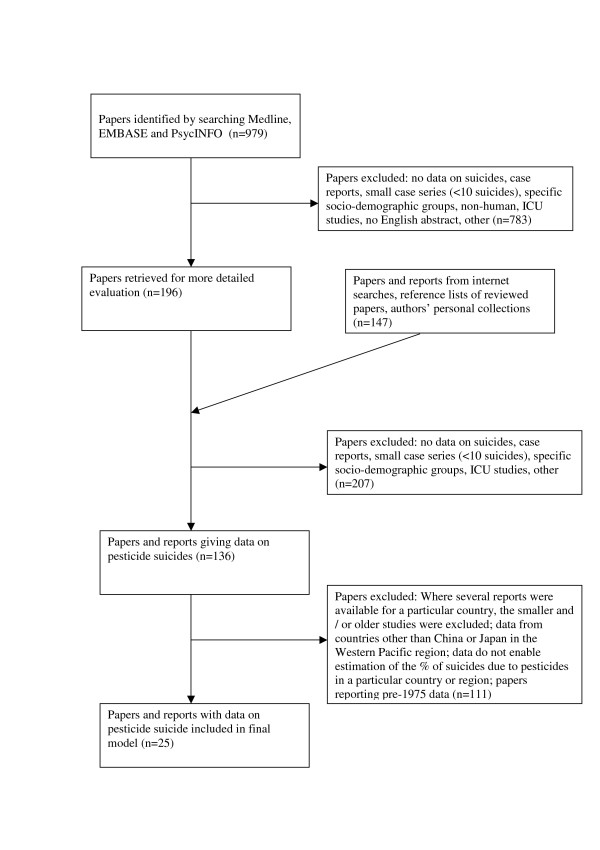
Background: Evidence is accumulating that pesticide self-poisoning is one of the most commonly used methods of suicide worldwide, but the magnitude of the problem and the global distribution of these deaths is unknown. Methods: We have systematically reviewed the worldwide literature to estimate the number of pesticide suicides in each of the World Health Organisation's six regions and the global burden of fatal self-poisoning with pesticides. We used the following data sources: Medline, EMBASE and psycINFO (1990–2007), papers cited in publications retrieved, the worldwide web (using Google) and our personal collections of papers and books. Our aim was to identify papers enabling us to estimate the proportion of a country's suicides due to pesticide self-poisoning. Results: We conservatively estimate that there are 258,234 (plausible range 233,997 to 325,907) deaths from pesticide self-poisoning worldwide each year, accounting for 30% (range 27% to 37%) of suicides globally. Official data from India probably underestimate the incidence of suicides; applying evidence-based corrections to India's official data, our estimate for world suicides using pesticides increases to 371,594 (range 347,357 to 439,267). The proportion of all suicides using pesticides varies from 4% in the European Region to over 50% in the Western Pacific Region but this proportion is not concordant with the volume of pesticides sold in each region; it is the pattern of pesticide use and the toxicity of the products, not the quantity used, that influences the likelihood they will be used in acts of fatal self-harm. Conclusion: Pesticide self-poisoning accounts for about one-third of the world's suicides. Epidemiological and toxicological data suggest that many of these deaths might be prevented if (a) the use of pesticides most toxic to humans was restricted, (b) pesticides could be safely stored in rural communities, and (c) the accessibility and quality of care for poisoning could be improved.
Overview
The claims and statistics of this paper haven’t been checked yet.
Free: it reads the open-access text and checks the first 5 claims that cite a source we can check. Create a free account to check every claim.
Integrity signals
Registry
Cites
Statistics
Figures
Verification
Claims the paper makes
The claims and statistics of this paper haven’t been checked yet.
Free: it reads the open-access text and checks the first 5 claims that cite a source we can check. Create a free account to check every claim.
Claims other papers make about this one
Each is checked against this paper’s own text: does it say what the citing paper says it does?
The source backs part of the claim, not all of it — or backs it for a different population, condition or comparison.
In the citing paper
“Pesticide ingestion was employed in approximately one-third of suicides worldwide, mostly in rural Asia and Latin America.(138)”
From Improving Suicide Prevention Through Evidence-Based Strategies: A Systematic Review (2021) · cites this paper as [138]
Experimental — accuracy not yet measuredThe source backs part of the claim, not all of it — or backs it for a different population, condition or comparison.
In the citing paper
“Pesticides are highly lethal, the leading suicide method worldwide, and the decline in suicide deaths worldwide is largely due to restricting access to pesticides where those deaths happen, namely in rural China,(138, 158) India(129) and Sri Lanka.(159)”
From Improving Suicide Prevention Through Evidence-Based Strategies: A Systematic Review (2021) · cites this paper as [138]
Experimental — accuracy not yet measured
Self-check
Percentages, sums and reported differences re-computed from the paper’s own numbers.
The self-check needs the paper’s full text.
Citations
Cites
Risk factors for suicide in China: a national case-control psychological autopsy study
Phillips, M. R., Yang, G., Zhang, Y., Wang, L., Ji, H., & Zhou, M. (2002) · The Lancet · doi:10.1016/s0140-6736(02)11681-3 · Cited by 928 · cited 2×
“7%) 47,720 to 82,680 Western Pacific A 155 35,000 1,050 (3%) 1,050 to 1,050 [68] B 1,562 296,000 183,520 (62%) 171,680 to 195,360 [70] Sub-total (W Pacific) 331,000 184,570 (55.”
Self-citationPatterns and problems of deliberate self-poisoning in the developing world
Eddleston, M. (2000) · QJM · doi:10.1093/qjmed/93.11.715 · Cited by 828 · cited 1×
“OP insecticides appear to be the most commonly ingested pesticides in rural Asia, accounting for around two thirds of cases[77].”
Self-citationSuicide rates in China, 1995–99
Phillips, M. R., Li, X., & Zhang, Y. (2002) · The Lancet · doi:10.1016/s0140-6736(02)07954-0 · Cited by 800 · cited 10×
“In our internet searches we particularly focused on identifying data for those countries in each of the six WHO regions that are likely to make the greatest contribution to the world burden of pesticide suicides because of their large populations: Nigeria and Ethiopia (Africa); United States of America, Brazil and Mex…”
InfluentialSelf-citationSuicide by intentional ingestion of pesticides: a continuing tragedy in developing countries
Gunnell, D., & Eddleston, M. (2003) · International Journal of Epidemiology · doi:10.1093/ije/dyg307 · Cited by 643 · cited 3×
“Recent extrapolations of data from a few countries in Asia suggest that there may be 300,000 suicides by deliberate ingestion of pesticides annually in this region alone[6,7].”
Self-citationPhillips, M. R., Li, X., Zhang, Y., & Eddleston, M. (2002) · The Lancet · doi:10.1016/s0140-6736(02)09269-3 · Cited by 382 · cited 1×
“Recent detailed studies of rural India suggest that the true number of suicides may be 2–3 fold higher than official estimates and concentrated in rural areas where pesticide poisoning is common[67,64] a pattern that is also found in China [ 74 ].”
BackgroundSelf-citationRUBENSTEIN, R. (1958) · Archives of Neurology And Psychiatry · doi:10.1001/archneurpsyc.1958.02340010121011 · Cited by 382
Eddleston, M., Eyer, P., Worek, F., Mohamed, F., Senarathna, L., von Meyer, L., Juszczak, E., Hittarage, A., Azhar, S., Dissanayake, W., et al. (2005) · The Lancet · doi:10.1016/s0140-6736(05)67598-8 · Cited by 369 · cited 1×
“Paraquat and aluminium phosphide self-poisoning have case-fatality in excess of 70%[10] [11] whereas case fatality for the organophosphorus (OP) insecticides dimethoate and chlorpyrifos are 23% and 8% respectively.[76] Based on the crude assumption that overall case fatality following pesticide self-poisoning worldwid…”
Self-citationKonradsen, F., van der Hoek, W., Cole, D. C., Hutchinson, G., Daisley, H., Singh, S., & Eddleston, M. (2003) · Toxicology · doi:10.1016/s0300-483x(03)00339-1 · Cited by 322 · cited 1×
“Restricting access to the most toxic pesticides is of paramount importance to reduce the number of severe selfpoisoning episodes[86].”
Self-citationSuicides in young people in rural southern India
Aaron, R., Joseph, A., Abraham, S., Muliyil, J., George, K., Prasad, J., Minz, S., Abraham, V. J., & Bose, A. (2004) · The Lancet · doi:10.1016/s0140-6736(04)15896-0 · Cited by 298 · cited 1×
“40% of the suicides in 15–19 year olds used pesticides in 1992–2001 [93] Lalwani et al.”
Pesticide poisoning in south India: opportunities for prevention and improved medical management
Srinivas Rao, C., Venkateswarlu, V., Surender, T., Eddleston, M., & Buckley, N. A. (2005) · Tropical Medicine & International Health · doi:10.1111/j.1365-3156.2005.01412.x · Cited by 228 · cited 1×
“Depending on the particular OP ingested, around 20–30% of patients require intubation [78,79].”
Self-citation
Research works printed but not linked: 6
- Obembe A Ilechukwu STC Tunwashe OL Odukoya O Self poisoning as seen in Lagos University Teaching Hospital: A Four Year Review The Nigerian Medical Practitioner 1986 11 49 53
- WHO Mental Health and Substance Abuse Facts and Figures Suicide Prevention: Emerging from Darkness 2007 South East Asia: WHO
- Khan N Poisoning in a medical unit of Dhaka Medical College Hospital in 1983 Bangladesh Medical Journal 1985 14 9 12
- Heijnen H WHO Bangladesh: International Programme OnChemical Safety 2001
- World Health Organization and IASP International Association for Suicide Prevention Safer Access to Pesticides: Community Interventions 2006 Geneva: Management of Mental and Brain Disorders, Department of Mental Health and Substance Abuse World Health Organization
- Kumar P Sharma SL Suicides in rural Punjab 2006 Punjab: Institute for Development and Communication (IDC)
Cited by
Items 901–974 of 974
Sachin, S., Mohanty, P., Nanda, D. K., Bhuyan, S. K., & Mohapatra, N. (2024) · SSR Institute of International Journal of Life Sciences · doi:10.21276/ssr-iijls.2024.10.3.29 · Cited by 1
Chauhan, G., Amar, R., Chauhan, G., Parikh, K. K., & Amin, B. (2024) · SSR Institute of International Journal of Life Sciences · doi:10.21276/ssr-iijls.2024.10.3.30
Tveito, K. (2024) · Tidsskrift for Den norske legeforening · doi:10.4045/tidsskr.24.0447
Kumar, A., Chaudhary, S. C., Usman, K., Kumar, V., Sawlani, K. K., Patel, M. L., Singh, A., Kumar, A., Sonkar, G. K., & Rathore, S. (2024) · Annals of African Medicine · doi:10.4103/aam.aam_20_24
“[1] It is one of the preferred means of committing suicide in India, and organophosphate (OP) poisoning continues to be a frequent reason for admission to hospitals and intensive care units (ICUs).”
SUBSTYTUCJA EGZOGENNYCH CHOLINESTERAZ W LECZENIU CIĘŻKICH ZATRUĆ ZWIĄZKAMI FOSFOROORGANICZNYMI
Ryniak, S., & Harbut, P. (2024) · Wiadomości Lekarskie · doi:10.36740/wlek202408280
A prospective analysis of organophopshorous posioning at a Tertiary Care Hospital Vijaywada
Babu, M. V., Devchand, N., Krishnajaneyulu, A., Muralidhar, M., & Sushma, M. (2024) · IP International Journal of Forensic Medicine and Toxicological Sciences · doi:10.18231/j.ijfmts.2024.020
Griffiths, D., Hanif, J., McCammon, J., McMaster, L., & Gemmell, C. (2024) · Cureus · doi:10.7759/cureus.75149
“Other cases report non-accidental ingestion of OP with 30% of suicide cases globally due to OP intoxication [9] and most patients received atropine and pralidoxime.”
Two-Month Study on Acute Poisoning Cases in a Tertiary Care Hospital in BangladeshPreprint
Majumder, S. N., & Amin, M. R. (2025) · medRxiv · doi:10.1101/2025.03.21.25324397
Retrospective analysis of the poisoning cases in four different regions of the world
Kordbacheh, H., Shishani, L. F., Kolci, K., Alomar, R., Hamze, B., & Aydın, A. (2025) · Journal of Research in Pharmacy · doi:10.12991/jrespharm.1664946
Estrada-Gómez, S., Salinas-Restrepo, C., Vargas-Muñoz, L. J., Guzmán, F., Segura, C., Plá, D., Sanz, L., & Calvete, J. J. (2025) · Toxicon X · doi:10.1016/j.toxcx.2025.100224 · Cited by 1
“Chemical in-secticides lack phyletic selectivity, an important issue due to the environmental impact, toxicity for pollinators and impact in human health, as reflected by 250,000 yearly deaths from insecticide poisoning (Gunnell et al., 2007).”
Paraquat Poisoning—Race against Time: A Case Report
Singhal, V., Singh, P., & Kaur, S. (2025) · Indian Journal of Critical Care Case Report · doi:10.5005/jp-journals-11006-0191
Chandrashekara, K. M., Suroshe, S. S., Hithesh, G. R., Chander, S., Kumar, R., Nagaraju, K. G., Kummari, S., Siddaswamy, R. H., Mallanagouda, C., Madhuri, E. V., et al. (2025) · Horticulturae · doi:10.3390/horticulturae11091045
A rare case of levothyroxine overdose
Bunwarie, Y., Daya, R., Parak, A., & Bayat, Z. (2025) · Journal of Endocrinology Metabolism and Diabetes of South Africa · doi:10.1080/16089677.2025.2548085
Othman, M. N. (2025) · Tropical biomedicine · doi:10.47665/tb.42.3.012
“…pesticide ingestion results in over 168,000 deaths annually, accounting for 20% of all suicides, with most cases reported from developing countries (Gunnell et al ., 2007; Mew et al ., 2017) In Malaysia, according to National Poison Centre from 2006 to 2015, about 10% of reported cases was due to…”
Deadly Duality: Unravelling Pulmonary Thromboembolism in Paraquat Poisoning
Ramakrishnan, G., & Navya, K. K. (2025) · Apollo Medicine · doi:10.1177/09760016251381978
“In our case [Figure 4], the possible prothrombin time, bleeding time and clotting time were normal.”
Urquizu, E., Cuiller, M., Παπαδοπούλου, Γ., Pubill, D., Raldúa, D., Camarasa, J., Escubedo, E., & López‐Arnau, R. (2025) · Antioxidants · doi:10.3390/antiox14121463 · Cited by 1
“Several reviews estimated 3 million of intoxications per year with 220,000 deaths, being in the majority intentional, either resulting from a suicidal form or in terrorist attacks [2–4], highlighting acute OP poisoning as a significant public health concern.”
Boedeker, W., Watts, M., Clausing, P., & Marquez, E. (2020) · Figshare · doi:10.6084/m9.figshare.13346337
Zheng, W., Han, L., Fan, Y., Yi, M., Lu, X., Yang, J., Peng, X., & Yang, Y. (2023) · Figshare · doi:10.6084/m9.figshare.22721527
Boedeker, W., Watts, M., Clausing, P., & Marquez, E. (2020) · Figshare · doi:10.6084/m9.figshare.13346340
Zheng, W., Han, L., Fan, Y., Yi, M., Lu, X., Yang, J., Peng, X., & Yang, Y. (2023) · Figshare · doi:10.6084/m9.figshare.22721521
Boedeker, W., Watts, M., Clausing, P., & Marquez, E. (2020) · Figshare · doi:10.6084/m9.figshare.13346343
Boedeker, W., Watts, M., Clausing, P., & Marquez, E. (2020) · Figshare · doi:10.6084/m9.figshare.13346328
Boedeker, W., Watts, M., Clausing, P., & Marquez, E. (2020) · Figshare · doi:10.6084/m9.figshare.13346331
Zheng, W., Han, L., Fan, Y., Yi, M., Lu, X., Yang, J., Peng, X., & Yang, Y. (2023) · Figshare · doi:10.6084/m9.figshare.22721536
Boedeker, W., Watts, M., Clausing, P., & Marquez, E. (2020) · Figshare · doi:10.6084/m9.figshare.13346322
Zheng, W., Han, L., Fan, Y., Yi, M., Lu, X., Yang, J., Peng, X., & Yang, Y. (2023) · Figshare · doi:10.6084/m9.figshare.22721518
Zheng, W., Han, L., Fan, Y., Yi, M., Lu, X., Yang, J., Peng, X., & Yang, Y. (2023) · Figshare · doi:10.6084/m9.figshare.22721530
Zheng, W., Han, L., Fan, Y., Yi, M., Lu, X., Yang, J., Peng, X., & Yang, Y. (2023) · Figshare · doi:10.6084/m9.figshare.22721533
Zheng, W., Han, L., Fan, Y., Yi, M., Lu, X., Yang, J., Peng, X., & Yang, Y. (2023) · Figshare · doi:10.6084/m9.figshare.22721524
Boedeker, W., Watts, M., Clausing, P., & Marquez, E. (2020) · Figshare · doi:10.6084/m9.figshare.13346334
A Study on Acute Pesticide Poisoning in a Tertiary Care Center Of Eastern Nepal
Mandal, M. K., & Mandal, N. K. (2025) · Nepal Medical College Journal · doi:10.3126/nmcj.v27i4.88108
Zhou, S., Cui, Y., Li, L., Zhang, P., Zhu, Z., Yuan, L., & Zhao, M. (2025) · Toxicology Letters · doi:10.1016/j.toxlet.2025.111816
İçli, N. (2025) · Sağlık Akademisi Kastamonu · doi:10.25279/sak.1840064
Tarım İlaçlarının Oral Alımı ile İntihar Olgusu
GÖK, E., & KILIÇ, S. (2025) · Turkish Journal of Forensic Medicine · doi:10.61970/adlitip.1480233
Bhuva, H., Darji, V. M., & Lakdawala, B. M. (2026) · Annals of Indian Psychiatry · doi:10.4103/aip.aip_165_24
Oktari, V., Saleh, M. I., Zulkarnain, M., & Damiri, N. (2025) · International Journal of Safety and Security Engineering · doi:10.18280/ijsse.151115
Genotoxic and mutagenic response of routinely used pesticides at existent field concentrations
Sharma, S., Samarth, R. M., Sharma, M., Sharma, R., Sarma, D. K., Mathur, N., & Nunia, V. (2026) · Journal of the Saudi Society of Agricultural Sciences · doi:10.1007/s44447-025-00123-7
“It has been speculated that exposure to these pesticides either by occupational, accidental or intentional can lead to severe health menace (Gunnell D, et al., 2007).”
Paraquat Toxicity in Humans: Advances in Diagnosis, Management and Prevention
Mondal, R. N., Jahan, S. M. S., Rani, M., Ali, S. S., & Islam, M. N. (2026) · Dinajpur Medical College Journal · doi:10.69861/djmcj.2026.19.1.17
Diomandé, S., Salla, M., KONATE, M. L., & Traoré, K. (2025) · International Journal of Biological and Chemical Sciences · doi:10.4314/ijbcs.v19i6.22
Upendra, R. R., Mandaliya, R. N., & Patel, M. K. (2026) · International Journal of Current Pharmaceutical Review and Research · doi:10.25258/ijcpr.18.3.72
Amélioration d'une enzyme hyperthermostable pour la dégradation des organophosphorés
Jacquet, P. (2017) · theses.fr (ABES) · doi:10.70675/868e59b0z5b89z42a0z9b0fzb6fce6d43e72 · Cited by 3
Conjugated molecules for the elaboration of optical sensors for water monitoring
Cotrina, C. J. M. (2023) · theses.fr (ABES) · doi:10.70675/43ee5c50zef1fz41a9zb6fcza8c1aacdc9ed
Alzahrani, S., Ajaj, H., Salim, D. A., Toonisi, A., Alhusayni, Y. M., & Toonisi, F. (2026) · Journal of Medical and Health Studies · doi:10.32996/jmhs.2026.7.6.5
“Acute organophosphorus poisoning is a major global toxicologic problem and continues to account for substantial morbidity and mortality, particularly in rural and agricultural regions of low-and middle-income countries (Buckley et al., 2005; Gunnell et al., 2007; Rambabu et al., 2019).”
Predictors of intermediate syndrome after organophosphorus poisoning and its management in Nepal
Khanal, K., & Poudel, S. (2026) · Acute and Critical Care · doi:10.4266/acc.002825
“Education on safe pesticide use, including personal protective equipment, is essential to prevent recurrent exposures, particularly in agricultural communities [35].”
The natural history of paraquat-associated stomatitis: A four-stage model
Thavarajah, R., & Mohandoss, A. A. (2026) · Journal of Forensic and Legal Medicine · doi:10.1016/j.jflm.2026.103161
Huang, G., Zhang, S., Wu, B., Su, Z., Li, B., Mao, P., Hu, S., & Li, J. (2026) · Frontiers in Medicine · doi:10.3389/fmed.2026.1637549
Acute Poisoning with Organophosphate Insecticides : A Report of 26 Cases and Literature Review
Choubane, N. (2026) · Tunisian Journal of Emergency Medicine · doi:10.66759/ta774b65
Nallathambi, N., Kumar, S. I. S., Shantharam, R. V., Sivanandam, S., Nikita, M., Shaaruk, D., Ramadas, A. N., Neha, S., & Rahuman, A. S. A. A. (2026) · International Journal of Research in Medical Sciences · doi:10.18203/2320-6012.ijrms20261339
Al‐Khateeb, L. A., El-Shaheny, R. N., El‐Maghrabey, M., Elmorsy, M. A., & Hashem, H. M. (2026) · Luminescence · doi:10.1002/bio.70508
Childhood and adolescent poisoning: a prospective analysis from the largest poison control centre
Soomar, S. M., Awais, M., Qadir, M. A., Sohail, A., Irfan, O., Abdullah, A., Qamar, M. A., Irfan, B., Sultan, M. O., & Khan, N. U. (2026) · BMC Pediatrics · doi:10.1186/s12887-026-07062-4
Economic Burden of Pesticide-Attributable Neurological Disease in MENA RegionPreprint
Darwish, A., Samy, A., Amin, A., Al-Nady, J., Sami, S., & Sherif, M. (2026) · Research Square · doi:10.21203/rs.3.rs-9670402/v1
Khan, M. A., Pathak, S., Khan, M. K. J., & Mishra, N. (2026) · Cureus · doi:10.7759/cureus.111840
“In India, poisoning accounts for 5-15% of all emergency admissions at tertiary care hospitals and approximately 60,000-80,000 deaths annually [1,2].”
Eva, A. A., Fatema, F., Saha, S., Rahman, A., & Asaduzzaman, M. (2026) · Journal of Medical Case Reports · doi:10.1186/s13256-026-06285-4
“When evidence-based corrections are applied to India’s likely underreported official data, the global estimate rises to 371,594 deaths, underscoring the substantial contribution of pesticide ingestion [2].”
Sociodemographic Characteristics of Poisoning Cases Admitted in Tertiary Care Hospital, Dang, Nepal
Dhital, P. S., & Belbase, G. (2026) · Journal of Rapti Academy of Health Sciences · doi:10.70027/jrahs75
Suresh, K. S., Mahender, G., & JArchana, D. G. (2026) · Student s Journal of Health Research Africa · doi:10.51168/sjhrafrica.v7i2.2788
Venkatesan, K., Subramanyan, P. V. H. H., G, M. K. P., Ranganathan, P., Muralidharan, C. K., Geethanjali, A., & Ramana, K. (2026) · International Journal of Drug Delivery Technology · doi:10.25258/ijddt.16.67s.40
Xu, Y., Wang, X., Li, C., Yang, F., Zhang, Y., Ren, L., & Lyu, Z. (2026) · Journal of Medical Entomology · doi:10.1093/jme/tjag123
Lucero, B. A., Navas, G., Muñoz-Quezada, M. T., Buralli, R. J., & Ceballos-Vásquez, P. (2026) · Social Science & Medicine · doi:10.1016/j.socscimed.2026.119561
Multidimensional characterization of heterogeneity in pesticide co-exposure patterns
Su, H., Zhang, L., Tian, W., Lu, B., Guo, X., & Liu, Y. (2026) · Frontiers in Chemistry · doi:10.3389/fchem.2026.1890266
“…rural populations—particularly middle-aged and elderly farmers—are frequently exposed to pesticides and often lack adequate protective measures (Li et al., 2023; Sun et al., 2019; Tudi et al., 2022), increasing susceptibility to accidental poisoning (Gunnell et al., 2007; London and Bailie, 2001).”
Jang, D. H., Cabrera, J., Starr, J. P., Insana, A., Viaene, A. N., Greenwood, J. C., Shofer, F. S., Ehinger, J. K., Kao, S.-H., & Kilbaugh, T. J. (2026) · Journal of Medical Toxicology · doi:10.1007/s13181-026-01144-6
“Organophosphate (OP) compounds are widely used in agri-culture as pesticides and insecticides and are also found in certain chemical warfare nerve agents [1, 2].”
Ahmed, J., Uddin, K. M., & Nahar, E. (2026) · Dinajpur Medical College Journal · doi:10.69861/djmcj.2026.19.2.20
Monthly and Sex-Specific Suicide Mortality in Turkey: Implications for Intensive Care (2007-2024)
Sezer, S. S. (2026) · Journal of Medical Topics and Updates · doi:10.58651/jomtu.1988669
Varma, P. P., Srinivas, M., & Vijaya, B. (2026) · Acta Medica International · doi:10.21276/amit.2026.v13.i2.819
Mehedi, T., Islam, S., Choudhury, T., & Rahman, A. S. M. M. (2026) · TAJ Journal of Teachers Association · doi:10.70818/k4s8s413
Tejas Kumar, M., Babu, R., N, V. H., & S, K. M. M. (2026) · IP International Journal of Forensic Medicine and Toxicological Sciences · doi:10.18231/j.ijfmts.10518.1788424913
Raj, D. S., Malik, V., & Kumar, D. A. (2026) · American journal of forensic psychology · doi:10.61336/ajfp/2026-01-56
Bereda, G. (2026) · Respiratory Medicine Case Reports · doi:10.1016/j.rmcr.2026.102524
“Organophosphate (OP) pesticide poisoning remains an important global public health and clinical problem, particularly in regions where highly hazardous pesticides are readily accessible, and pesticide self-poisoning contributes substantially to poisoning-related morbidity and mortality [7].”
Human CYP1A2 metabolism of organophosphorus pesticides and nerve agent surrogatesPreprint
Shriwas, P., Politeski, M., Scarpitti, B., Revnew, A., Lane, T. R., Ekins, S., Hadad, C. M., & McElroy, C. A. (2026) · bioRxiv (Cold Spring Harbor Laboratory) · doi:10.64898/2026.10.20.760143
Hurisa, Z., Demissie, A., Mekonen, N., Asefa, B., Girma, A., Bekele, H., & Gebremeskel, T. (2026) · Health Science Reports · doi:10.1002/hsr2.73455
Mohamed, S. A., Zaki, R. M., Danial, A. W., El‐Dean, A. M. K., Saddik, A. A., Abd-Elnabi, A. D., Tolba, M. S., & Fouad, M. R. (2026) · RSC Advances · doi:10.1039/d6ra08710h
Kumar, M. K., Praveen, K., Venkataramanaiah, E., Rao, J. M., Padma, D., & Ramadevi, M. (2026) · Journal of the Association of Physicians of India · doi:10.59556/japi.74.1699
Metadata
- Authors
- Gunnell, D., Eddleston, M., Phillips, M. R., & Konradsen, F.
- Affiliations
- University of Bristol (GB)
- South Asian Clinical Toxicology Research Collaboration (LK)
- Beijing HuiLongGuan Hospital (CN)
- University of Copenhagen (DK)
- Corresponding author
- Gunnell, David
- Venue
- BMC Public Health
- Published
- 2007-12
- Volume
- 7
- Issue
- 1
- Pages
- 357-357
- ISSN
- 1471-2458 (ISSN-L)
- PMC
- PMC2262093
- OpenAlex
- W2149111967
- Cited by
- 969
- References
- 102
- Citations by year
- 2026: 32 · 2025: 41 · 2024: 36 · 2023: 54 · 2022: 63 · 2021: 65 · 2020: 72 · 2019: 66 · 2018: 57 · 2017: 118 · 2016: 60 · 2015: 55 · 2014: 49 · 2013: 50 · 2012: 35
- FWCI
- 4.43
- Type
- journal article
- Language
- en
- Open access
- gold
- doi.org
- Licence
- cc-by
- creativecommons.org/licenses/by/2.0 (tdm)
- creativecommons.org/licenses/by/2.0 (vor, 20 d)
- Locations
- BMC Public Health (publishedVersion, cc-by)
- PubMed Central (publishedVersion, cc-by)
- PubMed (publishedVersion)
- DOAJ (DOAJ: Directory of Open Access Journals) (submittedVersion)
- Research at the University of Copenhagen (University of Copenhagen) (submittedVersion)
- Bristol Research (University of Bristol) (submittedVersion)
- Topics
- Social Sciences › Psychology › Clinical Psychology › Suicide and Self-Harm Studies
- Life Sciences › Pharmacology, Toxicology and Pharmaceutics › Toxicology › Pesticide Exposure and Toxicity
- Social Sciences › Sociology and Political Science › Homicide, Infanticide, and Child Abuse
- Keywords
- pesticide self-poisoning, pesticide suicide, suicide, global burden of disease, WHO regions, pesticide toxicity, pesticide storage
- MeSH terms
- Suicide Prevention, Humans, Pesticides, Poisoning, Safety, Suicide, Global Health, Incidence
About these checks
Registry, retraction, Cites and statistics results are computed, not judged, with one exception: a printed reference that no index lists is read once by a model before it counts as a citation error. Claims are extracted by a model and kept only when their quote appears verbatim in the text; each cited source is then checked, with a model’s help, for whether it says what the claim relies on. Those verdicts can be wrong — read the claim’s quote and the cited source before relying on one.
Statistics and arithmetic are recomputed, not judged.
Confidence bands are shown only for fields calibrated on our annotated test set. None is calibrated yet, so no band is shown.
What counts as a claim ›How we measure confidence ›How we check this ›
Are you an author, or do you see a problem with this page? Request a review
Data sources
Bibliographic data: Semantic Scholar, OpenAlex, Crossref.
Contains information from the Semantic Scholar Academic Graph Datasets, made available under the ODC Attribution License (ODC-BY 1.0).
Semantic Scholar’s data is described in: Kinney, R., et al. (2023). The Semantic Scholar Open Data Platform. arXiv:2301.10140.
