

Mediators of physical activity behaviour change among adult non-clinical populations: a review update
Open accessThe DOI matches its Crossref record; 71 of the 73 references it cites were found in a registry or an index.
Abstract
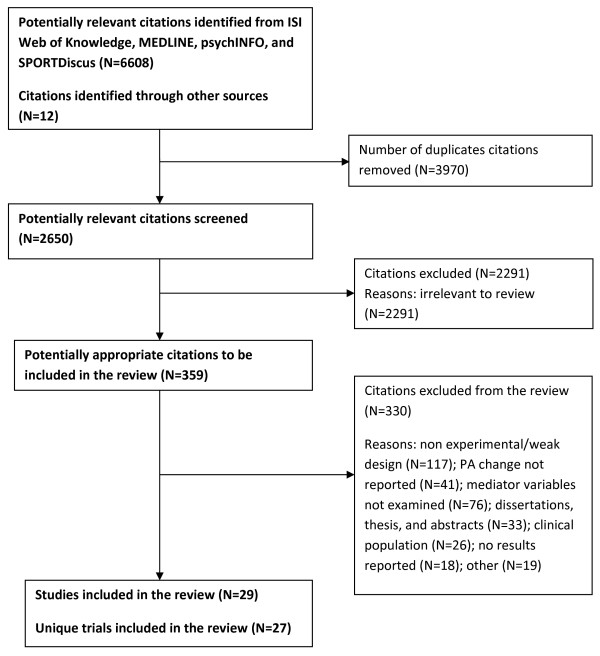
BACKGROUND: An understanding of the determinants of physical activity through mediators of behaviour change is important in order to evaluate the efficacy of interventions. Prior reviews on this topic noted that few studies employed mediator analyses in experimental physical activity trials; the purpose of this review is to update these prior reviews in order to evaluate the state of our present understanding of interventions that include proposed mediators of behaviour change. METHODS: Literature was identified through electronic database (e.g., MEDLINE, psychINFO) searching. Studies were eligible if they described a published experimental or quasi-experimental trial examining the effect of an intervention on physical activity behaviour and mediator change in non-clinical adult populations. Quality of included studies was assessed and the analyses examined the symmetry between mediators and behaviour change. RESULTS: Twenty seven unique trials passed the eligibility criteria and 22 were included in the analysis with scores of moderate or higher quality. Half of the studies reviewed failed to show an intervention effect on PA. The remaining studies showed evidence that the intervention affected changes in the proposed mediators, but tests of mediated effect were performed in only six of these 11 cases and demonstrated mixed outcomes. Differences by theory were not discernable at this time, but self-regulation constructs had the most evidence for mediation. CONCLUSION: Published literature employing mediators of change analyses in experimental designs is still relatively elusive since the time of prior reviews; however, the general null findings of changes in mediating constructs from these interventions are a more timely concern. Changes in self-regulation constructs may have the most effect on changes in PA while self-efficacy and outcome expectation type constructs have negligible but limited findings. Innovation and increased fidelity of interventions is needed and should be a priority for future research.
Overview
The claims and statistics of this paper haven’t been checked yet.
Free: it reads the open-access text and checks the first 5 claims that cite a source we can check. Create a free account to check every claim.
Integrity signals
Registry
Cites
Statistics
Figures
Verification
Claims the paper makes
The claims and statistics of this paper haven’t been checked yet.
Free: it reads the open-access text and checks the first 5 claims that cite a source we can check. Create a free account to check every claim.
Claims other papers make about this one
Each is checked against this paper’s own text: does it say what the citing paper says it does?
The source backs part of the claim, not all of it — or backs it for a different population, condition or comparison.
In the citing paper
“most of the research showing a stronger effect for identified regulation has been cross-sectional and a few studies, including experimental studies lasting for several years, have shown intrinsic motivation to be critical for longer-term engagement [44,32].”
From Exercise, physical activity, and self-determination theory: A systematic review (2012) · cites this paper as [44]
Experimental — accuracy not yet measuredThe source backs part of the claim, not all of it — or backs it for a different population, condition or comparison.
In the citing paper
“Relations from perceived autonomy support to exercise behavior, via psychological needs and regulatory styles have been tested (in part or all) in several studies and in general these confirm the proposed sequences [17,44,43,77,76,38,33].”
From Exercise, physical activity, and self-determination theory: A systematic review (2012) · cites this paper as [44]
Experimental — accuracy not yet measuredThe cited source says what the claim attributes to it.
In the citing paper
“The 11‐item Mediation Quality Checklist tool, initially formulated by Lubans et al. (2008) and adapted by Cerin et al. (2009) and Rhodes and Pfaeffli (2010), was employed to assess the mediation study quality of empirical studies”
From The Mechanisms Underlying the Relationship Between Self‐Compassion and Psychological Outcomes in Adult Populations: A Systematic Review. (2025) · cites this paper as Rhodes and Pfaeffli (2010)
The check wasn’t confident either way, so it gives no verdict — never disputed.
In the citing paper
“Seven studies (K = 7) found associations for identified regulation in multivariate analysis, but only bivariate associations for intrinsic motivation [44,45,43,42,41].”
From Exercise, physical activity, and self-determination theory: A systematic review (2012) · cites this paper as [44]
Experimental — accuracy not yet measuredIn the citing paper
“For studies employing formal tests of mediation, assessment of methodological quality was complemented with a checklist tool developed specifically for mediation analysis by Lubans, Foster, and Biddle [34], and subsequently adapted by Rhodes and Pfaeffli [35].”
From Successful behavior change in obesity interventions in adults: a systematic review of self-regulation mediators (2015) · cites this paper as [35]
Self-check
Percentages, sums and reported differences re-computed from the paper’s own numbers.
The self-check needs the paper’s full text.
Citations
Cites
The theory of planned behavior
Ajzen, I. (1991) · Organizational Behavior and Human Decision Processes · doi:10.1016/0749-5978(91)90020-t · Cited by 134,657
Baron, R. M., & Kenny, D. A. (1986) · Journal of Personality and Social Psychology · doi:10.1037/0022-3514.51.6.1173 · Cited by 91,532 · cited 4×
“Overall, Baranowski and colleagues noted several limits to the extant literature which were subsequently mirrored in the 10 studies reviewed by Lewis et al. Most strident was the finding that very limited literature had tested the proposed mediating mechanisms with a formal statistical test such as those outlined in B…”
InfluentialSelf-efficacy: The exercise of control
Bandura, A., Freeman, W. H., & Lightsey, R. (1999) · Journal of Cognitive Psychotherapy · doi:10.1891/0889-8391.13.2.158 · Cited by 46,835
Intrinsic Motivation and Self-Determination in Human Behavior
Deci, E. L., & Ryan, R. M. (1985) · doi:10.1007/978-1-4899-2271-7 · Cited by 26,772
Intrinsic Motivation and Self-Determination in Human Behavior
Miller, K. A., Deci, E. L., & Ryan, R. M. (1988) · Contemporary Sociology · doi:10.2307/2070638 · Cited by 15,312
Pharmacological interventions for somatoform disorders in adults
Kleinstäuber, M., Witthöft, M., Steffanowski, A., van Marwijk, H., Hiller, W., & Lambert, M. J. (2014) · Cochrane Database of Systematic Reviews · doi:10.1002/14651858.cd010628.pub2 · Cited by 11,335
‘Small Changes' to Diet and Physical Activity Behaviors for Weight Management
Hills, A. P., Byrne, N. M., Lindstrom, R., & Hill, J. O. (2013) · Obesity Facts · doi:10.1159/000345030 · Cited by 9,493
A comparison of methods to test mediation and other intervening variable effects
MacKinnon, D. P., Lockwood, C. M., Hoffman, J. M., West, S. G., & Sheets, V. (2002) · Psychological Methods · doi:10.1037/1082-989x.7.1.83 · Cited by 9,406 · cited 2×
“Most strident was the finding that very limited literature had tested the proposed mediating mechanisms with a formal statistical test such as those outlined in Baron and Kenny [16] and more recently the productof coefficient tests recommended by MacKinnon and colleagues [10].”
Cohen, J. (1992) · Psychological Bulletin · doi:10.1037//0033-2909.112.1.155 · Cited by 8,771
Grading quality of evidence and strength of recommendations
(2004) · BMJ · doi:10.1136/bmj.328.7454.1490 · Cited by 8,477
Cited by
Correlates of physical activity: why are some people physically active and others not?
Bauman, A. E., Reis, R. S., Sallis, J. F., Wells, J. C., Loos, R. J., & Martin, B. W. (2012) · The Lancet · doi:10.1016/s0140-6736(12)60735-1 · Cited by 4,151
Exercise, physical activity, and self-determination theory: A systematic review
Teixeira, P. J., Carraça, E. V., Markland, D., Silva, M. N., & Ryan, R. M. (2012) · International Journal of Behavioral Nutrition and Physical Activity · doi:10.1186/1479-5868-9-78 · Cited by 2,963
New Canadian Physical Activity Guidelines
Tremblay, M. S., Warburton, D. E. R., Janssen, I., Paterson, D. H., Latimer, A. E., Rhodes, R. E., Kho, M. E., Hicks, A., LeBlanc, A. G., Zehr, L., et al. (2011) · Applied Physiology, Nutrition, and Metabolism · doi:10.1139/h11-009 · Cited by 1,238
“2010) and mediators of physical activity behaviour change (Rhodes and Pfaeffli 2010).”
BackgroundSelf-citationTeixeira, P. J., Carraça, E. V., Marques, M. M., Rutter, H., Oppert, J.-M., De Bourdeaudhuij, I., Lakerveld, J., & Brug, J. (2015) · BMC Medicine · doi:10.1186/s12916-015-0323-6 · Cited by 711
“For studies employing formal tests of mediation, assessment of methodological quality was complemented with a checklist tool developed specifically for mediation analysis by Lubans, Foster, and Biddle [34], and subsequently adapted by Rhodes and Pfaeffli [35].”
MethodOlander, E. K., Fletcher, H., Williams, S., Atkinson, L., Turner, A., & French, D. P. (2013) · International Journal of Behavioral Nutrition and Physical Activity · doi:10.1186/1479-5868-10-29 · Cited by 590
“The conclusion that self-efficacy is not the only route to behaviour change is in line with a recent review update which concluded that there is currently limited support for self-efficacy to act as a mediator of physical activity changes [86], in contrast to a commonly held view [8].”
Canadian Sedentary Behaviour Guidelines for Children and Youth
Tremblay, M. S., LeBlanc, A. G., Janssen, I., Kho, M. E., Hicks, A., Murumets, K., Colley, R. C., & Duggan, M. (2011) · Applied Physiology, Nutrition, and Metabolism · doi:10.1139/h11-012 · Cited by 548
“Specifically, with advances in technology and an increasing popularity for handheld, portable devices, ‘‘sedentary multitasking’’ is increasingly common (e.g., children and youth are able watch television, talk on the phone, and use the computer at the same time) (Rideout et al. 2010).”
BackgroundFrench, D. P., Olander, E. K., Chisholm, A., & Mc Sharry, J. (2014) · Annals of Behavioral Medicine · doi:10.1007/s12160-014-9593-z · Cited by 532
“Despite this, the evidence that self-efficacy is a determinant [10] or mediator [11] or cause [12] of changes in adult physical activity is still not entirely compelling, at least partly because the studies needed to provide such evidence have not been conducted.”
BackgroundTheories of physical activity behaviour change: A history and synthesis of approaches
Rhodes, R. E., McEwan, D., & Rebar, A. L. (2019) · Psychology of Sport and Exercise · doi:10.1016/j.psychsport.2018.11.010 · Cited by 476
Self-citationA Review and Meta-Analysis of Affective Judgments and Physical Activity in Adult Populations
Rhodes, R. E., Fiala, B., & Conner, M. (2009) · Annals of Behavioral Medicine · doi:10.1007/s12160-009-9147-y · Cited by 429
Self-citationMotivation, self-determination, and long-term weight control
Teixeira, P. J., Silva, M. N., Mata, J., Palmeira, A. L., & Markland, D. (2012) · International Journal of Behavioral Nutrition and Physical Activity · doi:10.1186/1479-5868-9-22 · Cited by 422
“and its inherent attributes and experiential elements, which could per se undermine behavior change [35].”
BackgroundShort, C. E., DeSmet, A., Woods, C., Williams, S. L., Maher, C., Middelweerd, A., Müller, A. M., Wark, P. A., Vandelanotte, C., Poppe, L., et al. (2018) · Journal of Medical Internet Research · doi:10.2196/jmir.9397 · Cited by 400
“The assessment of change in these mechanisms and the conduction of a formal mediation analysis have been increasingly encouraged in the behavioral sciences [51,52] to investigate whether interventions are working as intended (ie, that the selected eHealth and mHealth strategies are indeed influencing determinants and…”
BackgroundGourlan, M., Bernard, P., Bortolon, C., Romain, A. J., Lareyre, O., Carayol, M., Ninot, G., & Boiché, J. (2016) · Health Psychology Review · doi:10.1080/17437199.2014.981777 · Cited by 353
“Since all the constructs of a given theory do not have comparable weight on behaviour modification (Amireault, Godin, Vézina-Im, 2013; Rhodes & Pfaeffli, 2010), construct selection is relevant.”
BackgroundPhysical Activity Promotion in the Health Care System
Vuori, I. M., Lavie, C. J., & Blair, S. N. (2013) · Mayo Clinic Proceedings · doi:10.1016/j.mayocp.2013.08.020 · Cited by 323
White, R. L., Vella, S., Biddle, S., Sutcliffe, J., Guagliano, J. M., Uddin, R., Burgin, A., Apostolopoulos, M., Nguyen, T., Young, C., et al. (2024) · International Journal of Behavioral Nutrition and Physical Activity · doi:10.1186/s12966-024-01676-6 · Cited by 298
Pratt, M., Sarmiento, O. L., Montes, F., Ogilvie, D., Marcus, B. H., Perez, L. G., & Brownson, R. C. (2012) · The Lancet · doi:10.1016/s0140-6736(12)60736-3 · Cited by 295
Lai, S. K., Costigan, S. A., Morgan, P. J., Lubans, D. R., Stodden, D. F., Salmon, J., & Barnett, L. M. (2014) · Sports Medicine · doi:10.1007/s40279-013-0099-9 · Cited by 291
“This finding is consistent with the adult literature, whereby theory-based PA interventions appear to be more successful than atheoretical approaches [67, 68].”
ResultLatimer, A. E., Brawley, L. R., & Bassett, R. L. (2010) · International Journal of Behavioral Nutrition and Physical Activity · doi:10.1186/1479-5868-7-36 · Cited by 270
“To supplement the database search, the reference lists of the extracted articles and relevant review articles including the review by Rhodes and Pfaeffli in this issue [17] were searched resulting in the identification of an additional 14 articles (3 message framing studies, 9 message tailoring studies, and 2 self-eff…”
Canadian Physical Activity Guidelines for the Early Years (aged 0–4 years)
Tremblay, M. S., LeBlanc, A. G., Carson, V., Choquette, L., Connor Gorber, S., Dillman, C., Duggan, M., Gordon, M. J., Hicks, A., Janssen, I., et al. (2012) · Applied Physiology, Nutrition, and Metabolism · doi:10.1139/h2012-018 · Cited by 269
“The background literature to inform and develop the messaging recommendations for the new guidelines can be found else-where (Latimer et al. 2010; Rhodes and Pfaeffli 2010; www. csep.ca).”
Advancing Physical Activity Theory: A Review and Future Directions
Rhodes, R. E., & Nigg, C. R. (2011) · Exercise and Sport Sciences Reviews · doi:10.1097/jes.0b013e31821b94c8 · Cited by 204
“The literature surrounding PA interventions using the entire SET (and not solely the self-efficacy construct) is limited, however, and has mixed support (41).”
BackgroundInfluentialSelf-citationStockton, D., Kellett, S., Berrios, R., Sirois, F., Wilkinson, N., & Miles, G. (2019) · Behavioural and Cognitive Psychotherapy · doi:10.1017/s1352465818000553 · Cited by 193
“It is also worth noting that the methodological quality assessment tool itself (Rhodes and Pfaeffli, 2010) may have had poor reliability for the statistical methods used.”
MethodRhodes, R. E., & Yao, C. A. (2015) · International Journal of Behavioral Nutrition and Physical Activity · doi:10.1186/s12966-015-0168-6 · Cited by 198
“Volitional behaviors used to maintain or hone intentions have sound empirical evidence in the PA domain generally [97-101] and within a stage-based model such as the transtheoretical model of behavior change [102].”
BackgroundSelf-citationRhodes, R. E., & Dickau, L. (2013) · British Journal of Sports Medicine · doi:10.1136/bjsports-2011-090411 · Cited by 182
Self-citationCanadian Sedentary Behaviour Guidelines for the Early Years (aged 0–4 years)
Tremblay, M. S., LeBlanc, A. G., Carson, V., Choquette, L., Connor Gorber, S., Dillman, C., Duggan, M., Gordon, M. J., Hicks, A., Janssen, I., et al. (2012) · Applied Physiology, Nutrition, and Metabolism · doi:10.1139/h2012-019 · Cited by 174
Rhodes, R. E., Boudreau, P., Josefsson, K. W., & Ivarsson, A. (2021) · Health Psychology Review · doi:10.1080/17437199.2019.1706614 · Cited by 172
Self-citationWhat Predicts Intention-Behavior Discordance? A Review of the Action Control Framework
Rhodes, R. E., & de Bruijn, G.-J. (2013) · Exercise and Sport Sciences Reviews · doi:10.1097/jes.0b013e3182a4e6ed · Cited by 173
“This finding also has evidence from experimental designs, where motivation-based interventions still have some effect on behavior despite high initial intentions (26).”
BackgroundResultSelf-citationGardner, B., & Lally, P. (2013) · Journal of Behavioral Medicine · doi:10.1007/s10865-012-9442-0 · Cited by 173
Rhodes, R. E., Kaushal, N., & Quinlan, A. (2016) · Health Psychology Review · doi:10.1080/17437199.2016.1143334 · Cited by 188
“The results suggest that identity/schema may be tied to the capacity and use of volitional strategies for physical activity, which are among the strongest proximal agents of behavior change (Carraro & Gaudreau, 2013; Conn et al., 2011; Hagger & Luszczynska, 2014; Rhodes & Pfaeffli, 2010).”
BackgroundSelf-citationBluethmann, S. M., Bartholomew, L. K., Murphy, C. C., & Vernon, S. W. (2017) · Health Education & Behavior · doi:10.1177/1090198116647712 · Cited by 148
“…of the behavior, specifically targeting these determinants with the appropriate theoretical change methods and assuring that methods were used in a manner the theory would suggest to maximize effectiveness (Bartholomew & Mullen, 2011; Peters, de Bruin, & Crutzen, 2013; Rhodes & Pfaeffli, 2010).”
MethodThe Evolving Understanding of Physical Activity Behavior
Rhodes, R. E. (2016) · Advances in motivation science · doi:10.1016/bs.adms.2016.11.001 · Cited by 209
Self-citationTang, M. Y., Smith, D. M., Mc Sharry, J., Hann, M., & French, D. P. (2019) · Annals of Behavioral Medicine · doi:10.1093/abm/kay090 · Cited by 141
Morris, J., Oliver, T., Kroll, T., & MacGillivray, S. (2012) · Stroke Research and Treatment · doi:10.1155/2012/195249 · Cited by 127
“Discussion Studies of the general population indicate that psychological and some social influences on PA behaviour may be modifiable through intervention [17, 19].”
BackgroundMethodResultInfluentialAn Updated Review of Interventions that Include Promotion of Physical Activity for Adult Men
Bottorff, J. L., Seaton, C. L., Johnson, S. T., Caperchione, C. M., Oliffe, J. L., More, K. R., Jaffer-Hirji, H., & Tillotson, S. M. (2014) · Sports Medicine · doi:10.1007/s40279-014-0286-3 · Cited by 144
“Others have called for more research to examine the potential mediating role of theoretical factors in the success of interventions [76, 77], and it seems timely to also suggest that researchers ought to investigate the potential role of gender-related factors within the effectiveness of…”
BackgroundRaman, J., Smith, E., & Hay, P. (2013) · Journal of Obesity · doi:10.1155/2013/240128 · Cited by 118
“, fruit consumption [40], saturated fat consumption [40], adolescent screen-viewing behavior associated with consumption of sugar-sweetened beverages [41], and physical activity [42]).”
BackgroundLetts, L. J., Ginis, K. A. M., Faulkner, G., Colquhoun, H. L., Levac, D. E., & Gorczynski, P. F. (2011) · Rehabilitation Psychology · doi:10.1037/a0023624 · Cited by 122
Need satisfaction, motivational regulations and exercise: moderation and mediation effects
Josefsson, K. W., Lindwall, M., & Ivarsson, A. (2015) · International Journal of Behavioral Nutrition and Physical Activity · doi:10.1186/s12966-015-0226-0 · Cited by 149
“Still, almost ten years later, health statistics show discouragingly low levels of PA and exercise levels (see [5]), and many interventions promoting PA and exercise are considered ineffective [6, 7].”
BackgroundThe role of mindfulness in physical activity: a systematic review
Schneider, J., Malinowski, P., Watson, P. M., & Lattimore, P. (2019) · Obesity Reviews · doi:10.1111/obr.12795 · Cited by 106
Thompson, E. L., Vamos, C. A., & Daley, E. M. (2015) · Journal of sport and health science/Journal of Sport and Health Science · doi:10.1016/j.jshs.2015.08.001 · Cited by 124
“For instance, studies applying theoretical constructs to improve PA levels in adult, non-pregnant populations have been successful.(45) Intervention mapping is a potential tool for future research to integrate the findings on the salient theoretical determinants that impact PA during pregnancy in this review to promot…”
BackgroundPredicting adoption and maintenance of physical activity in the context of dual-process theories
Strobach, T., Englert, C., Jekauc, D., & Pfeffer, I. (2020) · Performance Enhancement & Health · doi:10.1016/j.peh.2020.100162 · Cited by 120
Streber, R., Peters, S., & Pfeifer, K. (2016) · Archives of Physical Medicine and Rehabilitation · doi:10.1016/j.apmr.2015.11.020 · Cited by 104
Pilot study of a family physical activity planning intervention among parents and their children
Rhodes, R. E., Naylor, P., & McKay, H. A. (2009) · Journal of Behavioral Medicine · doi:10.1007/s10865-009-9237-0 · Cited by 106
“The results of this study are generally commensurate with prior reviews among adult populations that demonstrate the efficacy of self-regulatory approaches on physical activity behavior (Lewis et al. 2002; Rhodes and Pfaeffli 2009 ).”
BackgroundResultSelf-citationBehavioural interventions to increase the physical activity of cardiac patients: a review
Ferrier, S., Blanchard, C. M., Vallis, M., & Giacomantonio, N. (2011) · European Journal of Cardiovascular Prevention & Rehabilitation · doi:10.1097/hjr.0b013e32833ace0e · Cited by 88
Cheval, B., Sarrazin, P. G., Isoard‐Gautheur, S., Radel, R., & Friese, M. (2015) · Health Psychology · doi:10.1037/hea0000102 · Cited by 100
“…direct effects of PA-promoting messages on objective MVPA (for reviews, see Bauman & Chau, 2009; Cavill & Bauman, 2004; Latimer et al., 2010; Marcus et al., 1998; Rhodes & Pfaeffli, 2010) we had no strong expectations concerning a significant direct effect of the PA-promoting message on MVPA.”
Kes�niemi, A., Riddoch, C. J., Reeder, B., Blair, S. N., & S�rensen, T. I. (2010) · International Journal of Behavioral Nutrition and Physical Activity · doi:10.1186/1479-5868-7-41 · Cited by 84
“At the conference, experts presented evidence from detailed systematic reviews in which they updated findings on PA and health outcomes, including dose-response relationships and possible adverse effects of PA [5-9].”
Why and how back pain interventions work: What can we do to find out?
Mansell, G., Kamper, S. J., & Kent, P. (2013) · Best Practice & Research Clinical Rheumatology · doi:10.1016/j.berh.2013.10.001 · Cited by 82
Process description and evaluation of Canadian Physical Activity Guidelines development
Tremblay, M. S., Kho, M. E., Tricco, A. C., & Duggan, M. (2010) · International Journal of Behavioral Nutrition and Physical Activity · doi:10.1186/1479-5868-7-42 · Cited by 81
“The Consensus panel, CSEP PAMG Steering Committee and methodological consultants reviewed the five reviews [30-34].”
InfluentialIterative development of MobileMums: a physical activity intervention for women with young children
Fjeldsoe, B. S., Miller, Y. D., O’Brien, J. L., & Marshall, A. L. (2012) · International Journal of Behavioral Nutrition and Physical Activity · doi:10.1186/1479-5868-9-151 · Cited by 80
“Constructs from this theory have been endorsed as important for eliciting initiation of physical activity behaviour change in the general adult population [29] and specifically among women with young children [25,30].”
BackgroundMatheson, G. O., Klügl, M., Dvořák, J., Engebretsen, L., Meeuwisse, W. H., Schwellnus, M. P., Blair, S. N., van Mechelen, W., Derman, W. E., Börjesson, M., et al. (2011) · British Journal of Sports Medicine · doi:10.1136/bjsports-2011-090328 · Cited by 104
“62 149 Monitoring compliance and adherence is key to effecting behavioural change.”
BackgroundShort, C. E., James, E. L., Plotnikoff, R. C., & Girgis, A. (2011) · International Journal of Behavioral Nutrition and Physical Activity · doi:10.1186/1479-5868-8-113 · Cited by 77
Vader, K., Doulas, T., Patel, R., & Miller, J. (2019) · Disability and Rehabilitation · doi:10.1080/09638288.2019.1676834 · Cited by 96
“Previous behavior change research has identified complex and important factors that can influence adherence to physical activity in the general population [38].”
BackgroundAffective Judgment and Physical Activity in Youth: Review and Meta-Analyses
Nasuti, G., & Rhodes, R. E. (2013) · Annals of Behavioral Medicine · doi:10.1007/s12160-012-9462-6 · Cited by 98
Self-citationStacey, F. G., James, E. L., Chapman, K., & Lubans, D. R. (2016) · International Journal of Behavioral Nutrition and Physical Activity · doi:10.1186/s12966-016-0372-z · Cited by 74
“As this was a highly motivated sample, it would be interesting to assess other constructs which may have been important, such as motivation, habit, or PA planning [32, 67, 68].”
BackgroundResultInfluentialPredictors of Physical Activity Change Among Adults Using Observational Designs
Rhodes, R. E., & Quinlan, A. (2014) · Sports Medicine · doi:10.1007/s40279-014-0275-6 · Cited by 94
“The limited findings in our review map closer to the reviews of PA intervention mediators [9, 11, 111] and validate that predictors of PA change may be closer to what one might require when targeting variables for PA intervention.”
BackgroundSelf-citationFrench, D. (2013) · British Journal of Health Psychology · doi:10.1111/bjhp.12038 · Cited by 82
A Qualitative Analysis of Emotional Facilitators in Exercise
Wienke, B., & Jekauc, D. (2016) · Frontiers in Psychology · doi:10.3389/fpsyg.2016.01296 · Cited by 96
“…Amireault et al., 2013; perception of competence, social affiliation, environmental conditions, sense of autonomy, specific physical activity; Rhodes and Kates, 2015), the capability of established theoretical frameworks is fairly limited (Rhodes and Pfaeffli, 2010; Amireault et al., 2013).”
BackgroundMensinger, J. L., & Meadows, A. (2017) · Psychology of Sport and Exercise · doi:10.1016/j.psychsport.2017.01.010 · Cited by 71
Reciprocal within-day associations between incidental affect and exercise: An EMA study
Emerson, J. A., Dunsiger, S., & Williams, D. M. (2018) · Psychology & Health · doi:10.1080/08870446.2017.1341515 · Cited by 70
“These factors explain a significant, but modest amount of variation in PA behaviour (Baranowski, Anderson, & Carmack, 1998; Rhodes & Pfaeffli, 2010; Rogers & Prentice-Dunn, 1997).”
Backgroundde Bruijn, G., Rhodes, R. E., & van Osch, L. (2011) · Journal of Behavioral Medicine · doi:10.1007/s10865-011-9380-2 · Cited by 84
“Models focusing on important and modifiable determinants of exercise behaviour are thought to be relevant for exercise intervention development (Rhodes & Pfaeffli, 2010).”
BackgroundSelf-citationBaranowski, T., Baranowski, J., Thompson, D., & Buday, R. (2011) · Journal of Diabetes Science and Technology · doi:10.1177/193229681100500204 · Cited by 68
Rhodes, R. E., & Nasuti, G. (2011) · Preventive Medicine · doi:10.1016/j.ypmed.2011.06.002 · Cited by 85
Self-citationMurray, J., Brennan, S., French, D., Patterson, C., Kee, F., & Hunter, R. F. (2018) · Annals of Behavioral Medicine · doi:10.1093/abm/kay012 · Cited by 72
Brief Physical Activity-Related Psychosocial Measures: Reliability and Construct Validity
Carlson, J. A., Sallis, J. F., Wagner, N., Calfas, K. J., Patrick, K., Groesz, L. M., & Norman, G. J. (2012) · Journal of Physical Activity and Health · doi:10.1123/jpah.9.8.1178 · Cited by 63
Lippke, S. (2014) · Journal of Diabetes and Obesity · doi:10.15436/2376-0494.14.009 · Cited by 70
Direito, A., Walsh, D. M. J., Hinbarji, M., Albatal, R., Tooley, M., Whittaker, R., & Maddison, R. (2017) · Health Education & Behavior · doi:10.1177/1090198117742438 · Cited by 69
“…(nonclinical population) Planning and other self-regulation techniques affected increases in PA over SE and outcome expectations Rhodes and Pfaeffli (2010) Self-efficacy (sedentary population) Barrier SE mediated PA throughout intervention; relationship between task SE and PA…”
BackgroundKnittle, K. P., Gucht, V. D., Hurkmans, E. J., Vlieland, T. P. M. V., & Maes, S. (2016) · Arthritis Care & Research · doi:10.1002/acr.22647 · Cited by 64
LeBlanc, A. G., Berry, T. R., Deshpande, S., Duggan, M., Faulkner, G., Latimer‐Cheung, A. E., O’Reilly, N., Rhodes, R. E., Spence, J. C., & Tremblay, M. S. (2015) · Applied Physiology, Nutrition, and Metabolism · doi:10.1139/apnm-2014-0464 · Cited by 67
Self-citationAittasalo, M., Livson, M., Lusa, S., Romo, A., Vähä‐Ypyä, H., Tokola, K., Sievänen, H. T., Mänttäri, A., & Vasankari, T. J. (2017) · BMC Public Health · doi:10.1186/s12889-017-4229-4 · Cited by 69
Quested, E., Ntoumanis, N., Thøgersen‐Ntoumani, C., Hagger, M. S., & Hancox, J. E. (2016) · International Review of Sport and Exercise Psychology · doi:10.1080/1750984x.2016.1217342 · Cited by 61
Papandonatos, G. D., Williams, D. M., Jennings, E., Napolitano, M. A., Bock, B. C., DUNSIGER, S. I., & Marcus, B. H. (2011) · Health Psychology · doi:10.1037/a0026667 · Cited by 64
“…explicitly targeted by the intervention (behavioral and cognitive processes, self-efficacy, decisional balance), we found behavioral processes to have the strongest effect for both intervention delivery channels, consistent with previous research (Lewis et al., 2002; Rhodes & Pfaeffli, 2010).”
BackgroundMethodResultInfluentialWilcox, S., Liu, J., Addy, C. L., Turner‐McGrievy, G. M., Burgis, J. T., Wingard, E. E., Dahl, A. A., Whitaker, K. M., Schneider, L., & Boutté, A. K. (2018) · Contemporary Clinical Trials · doi:10.1016/j.cct.2018.01.008 · Cited by 57
“These variables were selected because they have been shown to be mediators of behavior change in general adult populations [73] and/or important variables in predicting GWG in pregnancy [74], and they”
MethodKang, S., Lee, K., & Kwon, S. (2019) · Psychology and Health · doi:10.1080/08870446.2019.1699089 · Cited by 66
“Through Rhodes and Pfaeffli (2010), they recommended ‘affect change’ may be the most effective intervention for changing PA.”
BackgroundLubans, D. R., Morgan, P. J., Weaver, K., Callister, R., Dewar, D. L., Costigan, S. A., Finn, T. L., Smith, J., Upton, L., & Plotnikoff, R. C. (2012) · BMC Public Health · doi:10.1186/1471-2458-12-427 · Cited by 48
“A poor understanding of the mechanisms of behavior change in PA interventions has been noted in the literature [65,66].”
BackgroundYiga, P., Ogwok, P., Achieng, J., Auma, M. D., Seghers, J., & Matthys, C. (2020) · Public Health Nutrition · doi:10.1017/s1368980020003432 · Cited by 54
“Finally, social support has been shown to have a large influence on behaviour(29,35).”
BackgroundValle, C. G., Tate, D. F., Mayer, D. K., Allicock, M., & Cai, J. (2015) · Journal of Adolescent and Young Adult Oncology · doi:10.1089/jayao.2014.0034 · Cited by 48
Sweet, S. N., Fortier, M., Strachan, S. M., Blanchard, C. M., & Boulay, P. (2014) · Health Psychology Research · doi:10.4081/hpr.2014.1008 · Cited by 60
Marr, J., & Wilcox, S. (2015) · American Journal of Health Education · doi:10.1080/19325037.2015.1023477 · Cited by 62
Exercise habit strength, planning and the theory of planned behaviour: An action control approach
de Bruijn, G. (2010) · Psychology of sport and exercise · doi:10.1016/j.psychsport.2010.10.002 · Cited by 51
Panter, J., & Ogilvie, D. (2015) · BMJ Open · doi:10.1136/bmjopen-2015-007593 · Cited by 55
Nouvelles Directives canadiennes en matière d’activité physique
Tremblay, M. S., Warburton, D. E. R., Janssen, I., Paterson, D. H., Latimer‐Cheung, A. E., Rhodes, R. E., Kho, M. E., Hicks, A. L., LeBlanc, A. G., Zehr, L., et al. (2011) · Applied Physiology, Nutrition, and Metabolism · doi:10.1139/h11-010 · Cited by 51
Self-citationWorkgroup, T. C. P. A. G. M. R., Latimer‐Cheung, A. E., Rhodes, R. E., Kho, M. E., Tomasone, J. R., Gainforth, H. L., Kowalski, K. A., Nasuti, G., Perrier, M.-J., & Duggan, M. (2013) · BMC Public Health · doi:10.1186/1471-2458-13-419 · Cited by 54
Self-citationArrogi, A., Schotte, A., Bogaerts, A., Boen, F., & Seghers, J. (2017) · BMC Public Health · doi:10.1186/s12889-016-3965-1 · Cited by 50
“, weighing PA benefits and barriers) [32], all arising from different theories and tested among adults and children [33, 34].”
BackgroundFuchs, R., Seelig, H., Göhner, W., Burton, N. W., & Brown, W. J. (2012) · Psychology and Health · doi:10.1080/08870446.2012.695020 · Cited by 52
Fortier, M., Sweet, S. N., Tulloch, H. E., Blanchard, C. M., Sigal, R. J., Kenny, G. P., & Reid, R. D. (2011) · Journal of Health Psychology · doi:10.1177/1359105311408948 · Cited by 57
“For instance, self-regulation variables, such as planning, have been demonstrated as key mediating variables in physical activity research (Rhodes and Pfaeffli, 2010).”
BackgroundBarrett, S., Begg, S. J., O’Halloran, P., & Kingsley, M. (2020) · International Journal of Behavioral Nutrition and Physical Activity · doi:10.1186/s12966-020-01063-x · Cited by 42
“The changes in PA self-efficacy potentially mediated the changes in PA amongst the groups [47].”
BackgroundChopik, W. J., & O’Brien, E. (2017) · Health Psychology · doi:10.1037/hea0000432 · Cited by 48
Hadgraft, N. T., WINKLER, E. A. H., Healy, G. N., Lynch, B. M., Neuhaus, M., Eakin, E., Dunstan, D. W., Owen, N. G., & Fjeldsoe, B. S. (2017) · International Journal of Behavioral Nutrition and Physical Activity · doi:10.1186/s12966-017-0483-1 · Cited by 46
“Constructs derived from health behaviour theories, such as Social Cognitive Theory [11] and the Theory of Planned Behaviour [12], are often targeted in physical activity interventions [13].”
BackgroundChen, C., Finne, E., Kopp, A., & Jekauc, D. (2020) · Frontiers in Psychology · doi:10.3389/fpsyg.2020.587757 · Cited by 62
“So far, three reviews have summarized the classification of mediators of PA (Lewis et al., 2002; Rhodes and Pfaeffli, 2010; Murray et al., 2018); however, research into the mediation role of PAV have been narrow, incomplete, and problematic, due to the somewhat limited sample size.”
BackgroundKangasniemi, A. M., Lappalainen, R., Kankaanpää, A., Tolvanen, A., & Tammelin, T. (2015) · BMC Public Health · doi:10.1186/s12889-015-1604-x · Cited by 37
“) constructs appeared to be more effective than other types of interventions [9,12].”
BackgroundMediating Mechanisms in a Physical Activity Intervention: A Test of Habit Formation
Kaushal, N., Rhodes, R. E., Meldrum, J. T., & Spence, J. C. (2018) · Journal of Sport and Exercise Psychology · doi:10.1123/jsep.2017-0307 · Cited by 45
Self-citationGrimshaw, S. L., Taylor, N. F., Mechinaud, F. M., Conyers, R. K., & Shields, N. (2020) · Pediatric Blood & Cancer · doi:10.1002/pbc.28264 · Cited by 40
Rodrigues, B., Carraça, E. V., Francisco, B. B., Nobre, I., Cortez‐Pinto, H., & Santos, I. (2023) · Journal of Cancer Survivorship · doi:10.1007/s11764-023-01390-5 · Cited by 43
“In line with prior research [70–73], interventions based on TPB and TTM led to mixed findings, with some studies pointing towards positive changes in the outcomes of interest, while others could not find significant effects.”
ResultActive lifestyles in older adults: an integrated predictive model of physical activity and exercise
Galli, F., Chirico, A., Mallia, L., Girelli, L., Laurentiis, M. D., Lucidi, F., Giordano, A., & Botti, G. (2018) · Oncotarget · doi:10.18632/oncotarget.25352 · Cited by 36
“Different theories have been used in order to evaluate older adults’ active behaviors and to guide interventions that promote EX or PA [14, 15].”
BackgroundExploring Affective Responses to Different Exercise Intensities in Low-Active Young Adolescents
Stych, K., & Parfitt, G. (2011) · Journal of Sport and Exercise Psychology · doi:10.1123/jsep.33.4.548 · Cited by 46
“Rinehart (1998) explains that the “fundamental thrust of fictional ethnography is to get at both the affective feel of the experience and the cognitive ‘truth’ of it” (p.”
BackgroundUniversity students' ability-expectancy beliefs and subjective task values for exergames
Vernadakıs, N., Kouli, O., Tsitskari, E., Gioftsidou, A. F., & Antonıou, P. (2014) · Computers & Education · doi:10.1016/j.compedu.2014.02.010 · Cited by 43
“In addition, the researchers assessed motivation by using a previously tested tool where children were given the option to work for playtime.”
MethodDurand, C. P., Oluyomi, A., Gabriel, K. P., Salvo, D., Sener, I. N., Hoelscher, D. M., Knell, G., Tang, X., Porter, A. K., Robertson, M. C., et al. (2016) · Frontiers in Public Health · doi:10.3389/fpubh.2016.00103 · Cited by 39
“The accelerometer data collection package also included (1) an introductory letter, (2) detailed written instructions, (3) a list of frequently asked questions with responses, (4) instructions on how to access an instructional YouTube video that detailed proper accelerometer wear (https://goo.”
BackgroundMethodRomain, A. J., Caudroit, J., Hokayem, M., & Bernard, P. (2018) · Canadian Journal of Behavioural Science/Revue canadienne des sciences du comportement · doi:10.1037/cbs0000093 · Cited by 40
“To better understand the efficacy and mechanisms of PA interventions, the analysis of TTM mediators is key (Rhodes & Pfaeffli, 2010), though few studies have addressed this issue.”
BackgroundLundqvist, S., Börjesson, M., Larsson, M. E. H., Cider, Å., & Hagberg, L. (2019) · BMC Public Health · doi:10.1186/s12889-019-6830-1 · Cited by 37
“[18] suggests that changes in correlates may lead to changes in PA [16, 18, 19], thus identifying why and how treatments exert their effects [20].”
BackgroundRhodes, R. E., Fiala, B., & Nasuti, G. (2012) · Behavioral Medicine · doi:10.1080/08964289.2012.695411 · Cited by 36
Self-citationSelf-Control is Associated with Physical Activity and Fitness among Young Males
Kinnunen, M. I., Suihko, J., Hankonen, N. E., Absetz, P., & Jallinoja, P. T. (2012) · Behavioral Medicine · doi:10.1080/08964289.2012.693975 · Cited by 38
“30 – 32 Self-regulation techniques like planning, self-monitoring or goal settings may be taught also to individuals low in trait self-control.”
BackgroundBehavioral theory and transportation cycling research: Application of Diffusion of Innovations
Nehme, E. K., Pérez, A., Ranjit, N., Amick, B. C., & Kohl, H. W. (2016) · Journal of Transport & Health · doi:10.1016/j.jth.2016.05.127 · Cited by 39
Cha, J. E., Boggiss, A. L., Serlachius, A. S., Cavadino, A., Kirby, J. N., & Consedine, N. S. (2022) · Mindfulness · doi:10.1007/s12671-022-01935-2 · Cited by 44
“…measurement, mediator variables and measures, physical health outcomes and measures, quality ratings for Downs and Black (Downs & Black, 1998), test of mediation, correlations, results of mediational analyses, co-variates (if reported), and mediation checklist (Rhodes & Pfaeffli, 2010).”
BackgroundMethod
Metadata
- Authors
- Rhodes, R. E., & Pfaeffli, L. A.
- Affiliations
- University of Victoria (CA)
- Corresponding author
- Rhodes, Ryan E
- ORCID
- Rhodes, Ryan E
- Venue
- International Journal of Behavioral Nutrition and Physical Activity
- Published
- 2010
- Volume
- 7
- Issue
- 1
- Pages
- 37
- ISSN
- 1479-5868 (ISSN-L)
- PMC
- PMC2876989
- OpenAlex
- W2126819320
- Cited by
- 277
- References
- 73
- Citations by year
- 2026: 4 · 2025: 8 · 2024: 4 · 2023: 7 · 2022: 11 · 2021: 19 · 2020: 18 · 2019: 19 · 2018: 20 · 2017: 17 · 2016: 26 · 2015: 19 · 2014: 26 · 2013: 24 · 2012: 24
- FWCI
- 16.68
- Type
- journal article
- Language
- en
- Open access
- gold
- doi.org
- Licence
- cc-by
- Locations
- International Journal of Behavioral Nutrition and Physical Activity (publishedVersion, cc-by)
- Europe PMC (PubMed Central) (publishedVersion, cc-by)
- PubMed Central (publishedVersion, cc-by)
- PubMed (publishedVersion)
- UVic’s Research and Learning Repository (University of Victoria) (submittedVersion, cc-by)
- DOAJ (DOAJ: Directory of Open Access Journals) (submittedVersion, cc-by-sa)
- Funders
- Public Health Agency of Canada
- Public Health Agency
- Topics
- Health Sciences › Medicine › Public Health, Environmental and Occupational Health › Physical Activity and Health
- Social Sciences › Psychology › Applied Psychology › Behavioral Health and Interventions
- Social Sciences › Psychology › Social Psychology › Motivation and Self-Concept in Sports
- Keywords
- exercise behavior change, self-regulation, self-efficacy, outcome expectations, intervention fidelity, physical activity interventions, indirect effects
About these checks
Registry, retraction, Cites and statistics results are computed, not judged, with one exception: a printed reference that no index lists is read once by a model before it counts as a citation error. Claims are extracted by a model and kept only when their quote appears verbatim in the text; each cited source is then checked, with a model’s help, for whether it says what the claim relies on. Those verdicts can be wrong — read the claim’s quote and the cited source before relying on one.
Statistics and arithmetic are recomputed, not judged.
Confidence bands are shown only for fields calibrated on our annotated test set. None is calibrated yet, so no band is shown.
What counts as a claim ›How we measure confidence ›How we check this ›
Are you an author, or do you see a problem with this page? Request a review
Data sources
Bibliographic data: Semantic Scholar, OpenAlex, Crossref.
Contains information from the Semantic Scholar Academic Graph Datasets, made available under the ODC Attribution License (ODC-BY 1.0).
Semantic Scholar’s data is described in: Kinney, R., et al. (2023). The Semantic Scholar Open Data Platform. arXiv:2301.10140.
