

Mediators of physical activity behaviour change among adult non-clinical populations: a review update
Open accessThe DOI matches its Crossref record; 71 of the 73 references it cites were found in a registry or an index.
Abstract
BACKGROUND: An understanding of the determinants of physical activity through mediators of behaviour change is important in order to evaluate the efficacy of interventions. Prior reviews on this topic noted that few studies employed mediator analyses in experimental physical activity trials; the purpose of this review is to update these prior reviews in order to evaluate the state of our present understanding of interventions that include proposed mediators of behaviour change. METHODS: Literature was identified through electronic database (e.g., MEDLINE, psychINFO) searching. Studies were eligible if they described a published experimental or quasi-experimental trial examining the effect of an intervention on physical activity behaviour and mediator change in non-clinical adult populations. Quality of included studies was assessed and the analyses examined the symmetry between mediators and behaviour change. RESULTS: Twenty seven unique trials passed the eligibility criteria and 22 were included in the analysis with scores of moderate or higher quality. Half of the studies reviewed failed to show an intervention effect on PA. The remaining studies showed evidence that the intervention affected changes in the proposed mediators, but tests of mediated effect were performed in only six of these 11 cases and demonstrated mixed outcomes. Differences by theory were not discernable at this time, but self-regulation constructs had the most evidence for mediation. CONCLUSION: Published literature employing mediators of change analyses in experimental designs is still relatively elusive since the time of prior reviews; however, the general null findings of changes in mediating constructs from these interventions are a more timely concern. Changes in self-regulation constructs may have the most effect on changes in PA while self-efficacy and outcome expectation type constructs have negligible but limited findings. Innovation and increased fidelity of interventions is needed and should be a priority for future research.
Overview
The claims and statistics of this paper haven’t been checked yet.
Free: it reads the open-access text and checks the first 5 claims that cite a source we can check. Create a free account to check every claim.
Integrity signals
Registry
Cites
Statistics
Figures
Verification
Claims the paper makes
The claims and statistics of this paper haven’t been checked yet.
Free: it reads the open-access text and checks the first 5 claims that cite a source we can check. Create a free account to check every claim.
Claims other papers make about this one
Each is checked against this paper’s own text: does it say what the citing paper says it does?
The source backs part of the claim, not all of it — or backs it for a different population, condition or comparison.
In the citing paper
“most of the research showing a stronger effect for identified regulation has been cross-sectional and a few studies, including experimental studies lasting for several years, have shown intrinsic motivation to be critical for longer-term engagement [44,32].”
From Exercise, physical activity, and self-determination theory: A systematic review (2012) · cites this paper as [44]
Experimental — accuracy not yet measuredThe source backs part of the claim, not all of it — or backs it for a different population, condition or comparison.
In the citing paper
“Relations from perceived autonomy support to exercise behavior, via psychological needs and regulatory styles have been tested (in part or all) in several studies and in general these confirm the proposed sequences [17,44,43,77,76,38,33].”
From Exercise, physical activity, and self-determination theory: A systematic review (2012) · cites this paper as [44]
Experimental — accuracy not yet measuredThe cited source says what the claim attributes to it.
In the citing paper
“The 11‐item Mediation Quality Checklist tool, initially formulated by Lubans et al. (2008) and adapted by Cerin et al. (2009) and Rhodes and Pfaeffli (2010), was employed to assess the mediation study quality of empirical studies”
From The Mechanisms Underlying the Relationship Between Self‐Compassion and Psychological Outcomes in Adult Populations: A Systematic Review. (2025) · cites this paper as Rhodes and Pfaeffli (2010)
The check wasn’t confident either way, so it gives no verdict — never disputed.
In the citing paper
“Seven studies (K = 7) found associations for identified regulation in multivariate analysis, but only bivariate associations for intrinsic motivation [44,45,43,42,41].”
From Exercise, physical activity, and self-determination theory: A systematic review (2012) · cites this paper as [44]
Experimental — accuracy not yet measuredIn the citing paper
“For studies employing formal tests of mediation, assessment of methodological quality was complemented with a checklist tool developed specifically for mediation analysis by Lubans, Foster, and Biddle [34], and subsequently adapted by Rhodes and Pfaeffli [35].”
From Successful behavior change in obesity interventions in adults: a systematic review of self-regulation mediators (2015) · cites this paper as [35]
Self-check
Percentages, sums and reported differences re-computed from the paper’s own numbers.
The self-check needs the paper’s full text.
Citations
Cites
The theory of planned behavior
Ajzen, I. (1991) · Organizational Behavior and Human Decision Processes · doi:10.1016/0749-5978(91)90020-t · Cited by 134,657
Baron, R. M., & Kenny, D. A. (1986) · Journal of Personality and Social Psychology · doi:10.1037/0022-3514.51.6.1173 · Cited by 91,532 · cited 4×
“Overall, Baranowski and colleagues noted several limits to the extant literature which were subsequently mirrored in the 10 studies reviewed by Lewis et al. Most strident was the finding that very limited literature had tested the proposed mediating mechanisms with a formal statistical test such as those outlined in B…”
InfluentialSelf-efficacy: The exercise of control
Bandura, A., Freeman, W. H., & Lightsey, R. (1999) · Journal of Cognitive Psychotherapy · doi:10.1891/0889-8391.13.2.158 · Cited by 46,835
Intrinsic Motivation and Self-Determination in Human Behavior
Deci, E. L., & Ryan, R. M. (1985) · doi:10.1007/978-1-4899-2271-7 · Cited by 26,772
Intrinsic Motivation and Self-Determination in Human Behavior
Miller, K. A., Deci, E. L., & Ryan, R. M. (1988) · Contemporary Sociology · doi:10.2307/2070638 · Cited by 15,312
Pharmacological interventions for somatoform disorders in adults
Kleinstäuber, M., Witthöft, M., Steffanowski, A., van Marwijk, H., Hiller, W., & Lambert, M. J. (2014) · Cochrane Database of Systematic Reviews · doi:10.1002/14651858.cd010628.pub2 · Cited by 11,335
‘Small Changes' to Diet and Physical Activity Behaviors for Weight Management
Hills, A. P., Byrne, N. M., Lindstrom, R., & Hill, J. O. (2013) · Obesity Facts · doi:10.1159/000345030 · Cited by 9,493
A comparison of methods to test mediation and other intervening variable effects
MacKinnon, D. P., Lockwood, C. M., Hoffman, J. M., West, S. G., & Sheets, V. (2002) · Psychological Methods · doi:10.1037/1082-989x.7.1.83 · Cited by 9,406 · cited 2×
“Most strident was the finding that very limited literature had tested the proposed mediating mechanisms with a formal statistical test such as those outlined in Baron and Kenny [16] and more recently the productof coefficient tests recommended by MacKinnon and colleagues [10].”
Cohen, J. (1992) · Psychological Bulletin · doi:10.1037//0033-2909.112.1.155 · Cited by 8,771
Grading quality of evidence and strength of recommendations
(2004) · BMJ · doi:10.1136/bmj.328.7454.1490 · Cited by 8,477
The Transtheoretical Model of Health Behavior Change.
Prochaska, J. O., & Velicer, W. F. (1997) · American Journal of Health Promotion · doi:10.4278/0890-1171-12.1.38 · Cited by 7,782 · cited 15×
“Proposed mediators included constructs from TTM [47], SCT [30], PMT [46], SDT [35], and TPB[48] and duration of the intervention ranged from two weeks [46] to one year [37].”
InfluentialHealth Promotion by Social Cognitive Means
Bandura, A. (2004) · Health Education & Behavior · doi:10.1177/1090198104263660 · Cited by 7,238
The cochrane database of systematic reviews
Geddes, J. (1996) · Journal of Psychosomatic Research · doi:10.1016/s0022-3999(96)90063-x · Cited by 5,989
Cochrane Handbook for Systematic Reviews of Interventions
Higgins, J. P. T., Green, S., & Ben Van Den, A. (2020) · International Coaching Psychology Review · doi:10.53841/bpsicpr.2020.15.2.123 · Cited by 5,670
The Theory of Planned Behavior
Ajzen, I. (2012) · Handbook of Theories of Social Psychology: Volume 1 · doi:10.4135/9781446249215.n22 · Cited by 5,350
Moher, D., Cook, D. J., Eastwood, S., Olkin, I., Rennie, D., & Stroup, D. F. (1999) · The Lancet · doi:10.1016/s0140-6736(99)04149-5 · Cited by 4,826
Transtheoretical therapy: Toward a more integrative model of change.
Prochaska, J. O., & DiClemente, C. C. (1982) · Psychotherapy: Theory, Research & Practice · doi:10.1037/h0088437 · Cited by 3,922 · cited 3×
“Prochaska JO, DiClemente CC: Transtheoretical therapy: Toward a more integrative model of change.”
Intention—Behavior Relations: A Conceptual and Empirical Review
Sheeran, P. (2002) · European Review of Social Psychology · doi:10.1080/14792772143000003 · Cited by 3,688
Health promotion from the perspective of Social Cognitive Theory
Bandura, A. (1998) · Psychology & Health · doi:10.1080/08870449808407422 · Cited by 3,087
Health behavior and health education
(1990) · Choice Reviews Online · doi:10.5860/choice.28-2173 · Cited by 2,922
Rogers, R. W., & Rogers, R. W. (1983) · Medical Entomology and Zoology · Cited by 2,577
Medicine and Science in Sports and Exercise-1980
Tipton, C. M. (1980) · Medicine & Science in Sports & Exercise · doi:10.1249/00005768-198021000-00001 · Cited by 1,631
Chen, H.-T. (1990) · Medical Entomology and Zoology · Cited by 1,227
(2018) · Routledge eBooks · doi:10.4324/9781315167534 · Cited by 1,139
Ajzen, I., & Driver, B. L. (1991) · Leisure Sciences · doi:10.1080/01490409109513137 · Cited by 935 · cited 10×
“Proposed mediators included constructs from TTM [47], SCT [30], PMT [46], SDT [35], and TPB[48] and duration of the intervention ranged from two weeks [46] to one year [37].”
InfluentialJournal of Sport and Exercise Psychology
Gill, D. L. (1987) · Journal of Sport Psychology · doi:10.1123/jsp.9.1.1 · Cited by 861
Mediating variable framework in physical activity interventions
Baranowski, T., Anderson, C., & Carmack, C. (1998) · American Journal of Preventive Medicine · doi:10.1016/s0749-3797(98)00080-4 · Cited by 846 · cited 7×
“Intervention efforts have met with very modest success in changing PA [3,4].”
InfluentialNoar, S. M., & Zimmerman, R. S. (2005) · Health Education Research · doi:10.1093/her/cyg113 · Cited by 793 · cited 4×
“At the forefront of these considerations is the application of sound behavioural theory when designing interventions [6].”
InfluentialMilne, S., Orbell, S., & Sheeran, P. (2002) · British Journal of Health Psychology · doi:10.1348/135910702169420 · Cited by 699
Interventions for promoting physical activity
Foster, C., Hillsdon, M., Thorogood, M., Kaur, A., & Wedatilake, T. (2005) · Cochrane Database of Systematic Reviews · doi:10.1002/14651858.cd003180.pub2 · Cited by 692 · cited 2×
“Intervention efforts have met with very modest success in changing PA [3,4].”
Hurling, R., Catt, M., De Boni, M., Fairley, B. W., Hurst, T., Murray, P., Richardson, A., & Sodhi, J. S. (2007) · Journal of Medical Internet Research · doi:10.2196/jmir.9.2.e7 · Cited by 536 · cited 4×
“Self-Regulatory Processes Defined generally as planning, scheduling, and self-organizational behaviours, self-regulatory processes were measured in some capacity in 16 of the 22 studies [28,31,32,34,36-38,40,41,44,46-48,50,51,58].”
InfluentialFactors influencing behavior and behavior change.
Fishbein, M., Triandis, H. C., Kanfer, F. H., Becker, M., & Se, M. (2000) · Cited by 506
Journal of Physical Activity and Health
(2023) · Journal of Physical Activity and Health · doi:10.1123/jpah · Cited by 475
A Review and Meta-Analysis of Affective Judgments and Physical Activity in Adult Populations
Rhodes, R. E., Fiala, B., & Conner, M. (2009) · Annals of Behavioral Medicine · doi:10.1007/s12160-009-9147-y · Cited by 429
Self-citationMisleading tests of health behavior theories
Weinstein, N. D. (2007) · Annals of Behavioral Medicine · doi:10.1207/s15324796abm3301_1 · Cited by 417 · cited 1×
“There has been a proliferation of correlation-based theory testing in the general health behaviour domain with recent advocacy for experimental testing [7,8].”
Lubans, D. R., Foster, C., & Biddle, S. J. H. (2008) · Preventive Medicine · doi:10.1016/j.ypmed.2008.07.011 · Cited by 388
Psychosocial mediators of physical activity behavior among adults and children
Lewis, B. A., Marcus, B. H., Pate, R. R., & Dunn, A. L. (2002) · American Journal of Preventive Medicine · doi:10.1016/s0749-3797(02)00471-3 · Cited by 363 · cited 9×
“Analysis methods Studies were grouped in total and by SCT [17], the TTM [13], TPB [18], protection motivation theory (PMT) [19], and SDT [14] based on a priori classification of psychological theories [9].”
InfluentialThe Theories of Reasoned Action and Planned Behavior Applied to Exercise: A Meta-analytic Update
Downs, D. S., & Hausenblas, H. A. (2005) · Journal of Physical Activity and Health · doi:10.1123/jpah.2.1.76 · Cited by 357
Maintenance of physical activity following an individualized motivationally tailored intervention
Bock, B. C., Marcus, B. H., Pinto, B. M., & Forsyth, L. H. (2001) · Annals of Behavioral Medicine · doi:10.1207/s15324796abm2302_2 · Cited by 275 · cited 9×
“effects for the intervention on PA [28,32,36,40,49-51] and all but one of these [51] also reported non-significant effects for the action theory test.”
InfluentialFortier, M. S., Sweet, S. N., O’Sullivan, T. L., & Williams, G. C. (2007) · Psychology of Sport and Exercise · doi:10.1016/j.psychsport.2006.10.006 · Cited by 271 · cited 16×
“Proposed mediators included constructs from TTM [47], SCT [30], PMT [46], SDT [35], and TPB[48] and duration of the intervention ranged from two weeks [46] to one year [37].”
InfluentialCerin, E., & MacKinnon, D. P. (2009) · Public Health Nutrition · doi:10.1017/s1368980008003649 · Cited by 210 · cited 3×
“To evaluate the mediation capacity of a theory, the behavioural link and action link are important first steps in mediation [11].”
Evidence-informed physical activity guidelines for Canadian adults.
Warburton, D. E. R., Katzmarzyk, P. T., Rhodes, R. E., & Shephard, R. J. (2007) · PubMed · Cited by 201
Self-citationKinmonth, A.-L., Wareham, N. J., Hardeman, W., Sutton, S., Prevost, A. T., Fanshawe, T., Williams, K. M., Ekelund, U., Spiegelhalter, D., & Griffin, S. J. (2008) · The Lancet · doi:10.1016/s0140-6736(08)60070-7 · Cited by 200
(2000) · American Journal of Public Health · doi:10.2105/ajph.90.1.25 · Cited by 187
Cerin, E., Barnett, A., & Baranowski, T. (2009) · Journal of Nutrition Education and Behavior · doi:10.1016/j.jneb.2009.03.129 · Cited by 176 · cited 2×
“Studies were coded by whether the intervention was effective in changing behaviour and subsequently with an approach used by Cerin and colleagues [22] that outlines mediator models by tests of action theory, conceptual theory, and simultaneous test of both action and conceptual theories (i.”
Theory of Planned Behavior: Implications for an email-based physical activity intervention
Parrott, M. W., Tennant, L. K., Olejnik, S. F., & Poudevigne, M. S. (2007) · Psychology of sport and exercise · doi:10.1016/j.psychsport.2007.07.002 · Cited by 168 · cited 15×
“Nine studies employed such variables in these studies [29,34,35,39,40,43, 48 ,50,51] but five of these studies did not show support for the effectiveness of the intervention on changes in PA [40,43,49- 51] nor did they demonstrate significant action theory tests on the social constructs.”
InfluentialReger, B., Cooper, L., Booth‐Butterfield, S., Smith, H., Bauman, A. E., Wootan, M. G., Middlestadt, S. E., Marcus, B. H., & Greer, F. A. (2002) · Preventive Medicine · doi:10.1006/pmed.2002.1074 · Cited by 167 · cited 10×
“The methods for these studies include two experimental persuasive communication interventions among undergraduates [40,48] and one quasi-experimental community design [50].”
InfluentialPlotnikoff, R. C., Blanchard, C., Hotz, S. B., & Rhodes, R. (2001) · Measurement in Physical Education and Exercise Science · doi:10.1207/s15327841mpee0504_01 · Cited by 159 · cited 1×
“Self-Regulatory Processes Defined generally as planning, scheduling, and self-organizational behaviours, self-regulatory processes were measured in some capacity in 16 of the 22 studies [28,31,32,34,36-38,40,41,44,46-48,50,51,58].”
Self-citationWarburton, D. E. R., Katzmarzyk, P. T., Rhodes, R. E., & Shephard, R. J. (2007) · Applied Physiology, Nutrition, and Metabolism · doi:10.1139/h07-123 · Cited by 152
Self-citationPlotnikoff, R. C., McCargar, L. J., Wilson, P. M., & Loucaides, C. A. (2005) · American Journal of Health Promotion · doi:10.4278/0890-1171-19.6.422 · Cited by 134 · cited 3×
“Protection Motivation Theory Two studies have applied PMT (defined as including at least two constructs as specified by Rogers [19]) [46,56].”
Dallow, C. B., & Anderson, J. (2003) · American Journal of Health Promotion · doi:10.4278/0890-1171-17.6.373 · Cited by 116 · cited 7×
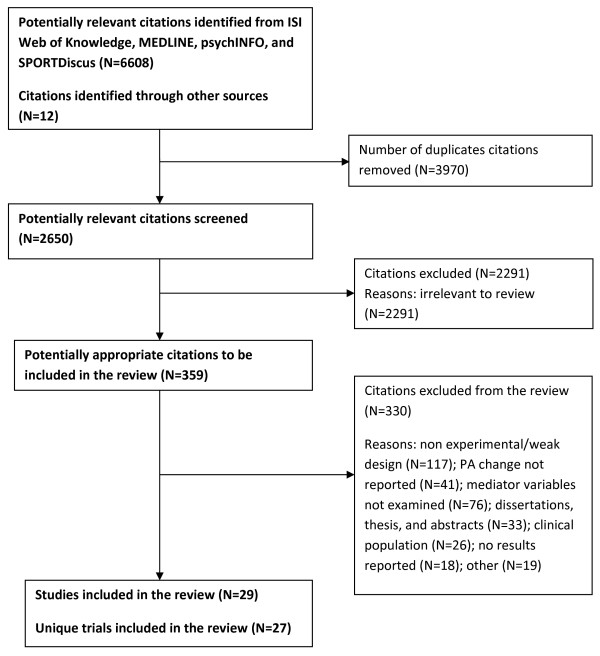
“Twenty nine studies describing 27 unique trials passed the eligibility criteria and were therefore included [25-52] (see Figure 1 based on QUOROM/PRISM guidelines [53]).”
InfluentialHallam, J. S., & Petosa, R. (2004) · Health Education & Behavior · doi:10.1177/1090198103259164 · Cited by 112 · cited 12×
“Of these 11 studies to show evidence that the intervention could change PA and support the action test link, only five reported a conceptual theory test [27,29,44,47,52], and six reported a mediator test [27,29,37,44,47,52].”
InfluentialJones, L. W., Sinclair, R. C., Rhodes, R. E., & Courneya, K. S. (2004) · British Journal of Health Psychology · doi:10.1348/1359107042304605 · Cited by 108 · cited 10×
“The methods for these studies include two experimental persuasive communication interventions among undergraduates [40,48] and one quasi-experimental community design [50].”
InfluentialSelf-citationA randomized pilot test of “moms on the move”: A physical activity intervention for WIC mothers
Fahrenwald, N. L., Atwood, J. R., Walker, S. N., Johnson, D. R., & Berg, K. (2004) · Annals of Behavioral Medicine · doi:10.1207/s15324796abm2702_2 · Cited by 107 · cited 6×
“Twenty nine studies describing 27 unique trials passed the eligibility criteria and were therefore included [25-52] (see Figure 1 based on QUOROM/PRISM guidelines [53]).”
InfluentialMoms in motion: a group-mediated cognitive-behavioral physical activity intervention
Cramp, A. G., & Brawley, L. R. (2006) · International Journal of Behavioral Nutrition and Physical Activity · doi:10.1186/1479-5868-3-23 · Cited by 99
Ash, S., Reeves, M. M., Bauer, J. D., van Dover, T., Vivanti, A., Leong, C. C., O'Moore‐Sullivan, T. M., & Capra, S. M. (2006) · International Journal of Obesity · doi:10.1038/sj.ijo.0803263 · Cited by 97 · cited 4×
“Of these, nine had null effects of the intervention on PA change [25,26,28,32,36,40,49-51] and only two of these showed support for subsequent action theory tests [25,26].”
InfluentialMediators of physical activity behavior change: A multivariate approach.
Napolitano, M. A., Papandonatos, G. D., Lewis, B. A., Whiteley, J. A., Williams, D. M., King, A. C., Bock, B. C., Pinto, B., & Marcus, B. H. (2008) · Health Psychology · doi:10.1037/0278-6133.27.4.409 · Cited by 97 · cited 21×
“Of these 11 studies to show evidence that the intervention could change PA and support the action test link, only five reported a conceptual theory test [27,29,44,47,52], and six reported a mediator test [27,29,37,44,47,52].”
InfluentialPsychosocial Factors Related to Physical Activity and Weight Loss in Overweight Women
GALLAGHER, K. I., JAKICIC, J. M., NAPOLITANO, M. A., & MARCUS, B. H. (2006) · Medicine & Science in Sports & Exercise · doi:10.1249/01.mss.0000218137.25970.c6 · Cited by 94 · cited 10×
“effects for the intervention on PA [28,32,36,40,49-51] and all but one of these [51] also reported non-significant effects for the action theory test.”
InfluentialEnhancing Theoretical Fidelity: An E-mail—Based Walking Program Demonstration
Rovniak, L. S., Hovell, M. F., Wojcik, J. R., Winett, R. A., & Martinez-Donate, A. P. (2005) · American Journal of Health Promotion · doi:10.4278/0890-1171-20.2.85 · Cited by 90 · cited 9×
“These studies generally had null results on the proposed mediators as well with only four [25,26,41,51] of the 11 samples demonstrating evidence that the intervention had an action theory link.”
InfluentialLittle, P. S., Dorward, M., Gralton, S., Hammerton, L., Pillinger, J., White, P., Moore, M. V., McKenna, J., & Payne, S. A. (2004) · Europe PMC (PubMed Central) · Cited by 80
Cerin, E., Taylor, L., Leslie, E. R., & Owen, N. G. (2006) · Journal of Clinical Epidemiology · doi:10.1016/j.jclinepi.2005.11.008 · Cited by 78 · cited 8×
“Of these 11 studies to show evidence that the intervention could change PA and support the action test link, only five reported a conceptual theory test [27,29,44,47,52], and six reported a mediator test [27,29,37,44,47,52].”
InfluentialBlanchard, C. M., Fortier, M., Sweet, S., O’Sullivan, T., Hogg, W., Reid, R. D., & Sigal, R. J. (2007) · Annals of Behavioral Medicine · doi:10.1007/bf02874557 · Cited by 77 · cited 7×
“Of these 11 studies to show evidence that the intervention could change PA and support the action test link, only five reported a conceptual theory test [27,29,44,47,52], and six reported a mediator test [27,29,37,44,47,52].”
InfluentialPlotnikoff, R. C., Brunet, S., Courneya, K. S., Spence, J. C., Birkett, N. J., Marcus, B., & Whiteley, J. (2007) · American Journal of Health Promotion · doi:10.4278/0890-1171-21.6.501 · Cited by 64 · cited 7×
“effects for the intervention on PA [28,32,36,40,49-51] and all but one of these [51] also reported non-significant effects for the action theory test.”
InfluentialKloek, G. C., van Lenthe, F. J., van Nierop, P. W. M., Koelen, M. A., & Mackenbach, J. P. (2005) · Health & Place · doi:10.1016/j.healthplace.2005.09.002 · Cited by 60 · cited 2×
“In terms of quality rating, five trials were identified as low quality [33,39,42,45,54] and were not subsequently included in the analyses (see Additional file 5).”
The Built-In Environment: The Role of Personality and Physical Activity
Rhodes, R. E. (2006) · Exercise and Sport Sciences Reviews · doi:10.1249/00003677-200604000-00008 · Cited by 59 · cited 1×
“Some of this may arise from differences in genetic predisposition and other individual differences that are not easily intervened upon [64], while some of these decisions may be the result of informed free will.”
Self-citationDinger, M. K., Heesch, K. C., Cipriani, G., & Qualls, M. (2006) · Journal of science and medicine in sport · doi:10.1016/j.jsams.2006.07.011 · Cited by 57 · cited 9×
“effects for the intervention on PA [28,32,36,40,49-51] and all but one of these [51] also reported non-significant effects for the action theory test.”
InfluentialBennett, J. A., Young, H. M., Nail, L. M., Winters-Stone, K., & Hanson, G. (2008) · Nursing Research · doi:10.1097/01.nnr.0000280661.34502.c1 · Cited by 57
Effects of a Tailored Follow-Up Intervention on Health Behaviors, Beliefs, and Attitudes
Jacobs, A. D., Ammerman, A. S., Ennett, S. T., Campbell, M. K., Tawney, K. W., Aytur, S. A., Marshall, S. W., Will, J. C., & Rosamond, W. D. (2004) · Journal of Women's Health · doi:10.1089/1540999041281016 · Cited by 54 · cited 3×
“Nine studies employed such variables in these studies [29,34,35,39,40,43,48,50,51] but five of these studies did not show support for the effectiveness of the intervention on changes in PA [40,43,4951] nor did they demonstrate significant action theory tests on the social constructs.”
Effects of a Self-Determination Theory–Based Mail-Mediated Intervention on Adults' Exercise Behavior
Levy, S. S., & Cardinal, B. J. (2004) · American Journal of Health Promotion · doi:10.4278/0890-1171-18.5.345 · Cited by 49 · cited 8×
“Cardinal BJ, Spaziani MD: Effects of Classroom and Virtual "Lifetime Fitness for Health" Instruction on College Students' Exercise Behavior.”
InfluentialPsychosocial Mediators of Physical Activity in a Randomized Controlled Intervention Trial
Lewis, B. A., Forsyth, L. H., Pinto, B. M., Bock, B. C., Roberts, M., & Marcus, B. H. (2006) · Journal of Sport and Exercise Psychology · doi:10.1123/jsep.28.2.193 · Cited by 45 · cited 9×
“Of these 11 studies to show evidence that the intervention could change PA and support the action test link, only five reported a conceptual theory test [27,29,44,47,52], and six reported a mediator test [27,29,37,44,47,52].”
InfluentialElbel, R., Aldana, S., Bloswick, D., & Lyon, J. L. (2003) · WORK: A Journal of Prevention, Assessment & Rehabilitation · doi:10.3233/wor-2003-00320 · Cited by 33 · cited 2×
“In terms of quality rating, five trials were identified as low quality [33,39,42,45,54] and were not subsequently included in the analyses (see Additional file 5).”
Mediator Analysis of Moms on the Move
Fahrenwald, N. L., Atwood, J. R., & Johnson, D. R. (2005) · Western Journal of Nursing Research · doi:10.1177/0193945904273275 · Cited by 33 · cited 8×
“Of these 11 studies to show evidence that the intervention could change PA and support the action test link, only five reported a conceptual theory test [27,29,44,47,52], and six reported a mediator test [27,29,37,44,47,52].”
InfluentialPartnering to unlock the mysteries of oral diseases and injuries
Capilouto, E. I. (2002) · American Journal of Preventive Medicine · doi:10.1016/s0749-3797(02)00456-7 · Cited by 2
Cited by
Correlates of physical activity: why are some people physically active and others not?
Bauman, A. E., Reis, R. S., Sallis, J. F., Wells, J. C., Loos, R. J., & Martin, B. W. (2012) · The Lancet · doi:10.1016/s0140-6736(12)60735-1 · Cited by 4,151
Exercise, physical activity, and self-determination theory: A systematic review
Teixeira, P. J., Carraça, E. V., Markland, D., Silva, M. N., & Ryan, R. M. (2012) · International Journal of Behavioral Nutrition and Physical Activity · doi:10.1186/1479-5868-9-78 · Cited by 2,963
New Canadian Physical Activity Guidelines
Tremblay, M. S., Warburton, D. E. R., Janssen, I., Paterson, D. H., Latimer, A. E., Rhodes, R. E., Kho, M. E., Hicks, A., LeBlanc, A. G., Zehr, L., et al. (2011) · Applied Physiology, Nutrition, and Metabolism · doi:10.1139/h11-009 · Cited by 1,238
“2010) and mediators of physical activity behaviour change (Rhodes and Pfaeffli 2010).”
BackgroundSelf-citationTeixeira, P. J., Carraça, E. V., Marques, M. M., Rutter, H., Oppert, J.-M., De Bourdeaudhuij, I., Lakerveld, J., & Brug, J. (2015) · BMC Medicine · doi:10.1186/s12916-015-0323-6 · Cited by 711
“For studies employing formal tests of mediation, assessment of methodological quality was complemented with a checklist tool developed specifically for mediation analysis by Lubans, Foster, and Biddle [34], and subsequently adapted by Rhodes and Pfaeffli [35].”
MethodOlander, E. K., Fletcher, H., Williams, S., Atkinson, L., Turner, A., & French, D. P. (2013) · International Journal of Behavioral Nutrition and Physical Activity · doi:10.1186/1479-5868-10-29 · Cited by 590
“The conclusion that self-efficacy is not the only route to behaviour change is in line with a recent review update which concluded that there is currently limited support for self-efficacy to act as a mediator of physical activity changes [86], in contrast to a commonly held view [8].”
Metadata
- Authors
- Rhodes, R. E., & Pfaeffli, L. A.
- Affiliations
- University of Victoria (CA)
- Corresponding author
- Rhodes, Ryan E
- ORCID
- Rhodes, Ryan E
- Venue
- International Journal of Behavioral Nutrition and Physical Activity
- Published
- 2010
- Volume
- 7
- Issue
- 1
- Pages
- 37
- ISSN
- 1479-5868 (ISSN-L)
- PMC
- PMC2876989
- OpenAlex
- W2126819320
- Cited by
- 277
- References
- 73
- Citations by year
- 2026: 4 · 2025: 8 · 2024: 4 · 2023: 7 · 2022: 11 · 2021: 19 · 2020: 18 · 2019: 19 · 2018: 20 · 2017: 17 · 2016: 26 · 2015: 19 · 2014: 26 · 2013: 24 · 2012: 24
- FWCI
- 16.68
- Type
- journal article
- Language
- en
- Open access
- gold
- doi.org
- Licence
- cc-by
- Locations
- International Journal of Behavioral Nutrition and Physical Activity (publishedVersion, cc-by)
- Europe PMC (PubMed Central) (publishedVersion, cc-by)
- PubMed Central (publishedVersion, cc-by)
- PubMed (publishedVersion)
- UVic’s Research and Learning Repository (University of Victoria) (submittedVersion, cc-by)
- DOAJ (DOAJ: Directory of Open Access Journals) (submittedVersion, cc-by-sa)
- Funders
- Public Health Agency of Canada
- Public Health Agency
- Topics
- Health Sciences › Medicine › Public Health, Environmental and Occupational Health › Physical Activity and Health
- Social Sciences › Psychology › Applied Psychology › Behavioral Health and Interventions
- Social Sciences › Psychology › Social Psychology › Motivation and Self-Concept in Sports
- Keywords
- exercise behavior change, self-regulation, self-efficacy, outcome expectations, intervention fidelity, physical activity interventions, indirect effects
About these checks
Registry, retraction, Cites and statistics results are computed, not judged, with one exception: a printed reference that no index lists is read once by a model before it counts as a citation error. Claims are extracted by a model and kept only when their quote appears verbatim in the text; each cited source is then checked, with a model’s help, for whether it says what the claim relies on. Those verdicts can be wrong — read the claim’s quote and the cited source before relying on one.
Statistics and arithmetic are recomputed, not judged.
Confidence bands are shown only for fields calibrated on our annotated test set. None is calibrated yet, so no band is shown.
What counts as a claim ›How we measure confidence ›How we check this ›
Are you an author, or do you see a problem with this page? Request a review
Data sources
Bibliographic data: Semantic Scholar, OpenAlex, Crossref.
Contains information from the Semantic Scholar Academic Graph Datasets, made available under the ODC Attribution License (ODC-BY 1.0).
Semantic Scholar’s data is described in: Kinney, R., et al. (2023). The Semantic Scholar Open Data Platform. arXiv:2301.10140.
