

Systematic review of the health benefits of physical activity and fitness in school-aged children and youth
Open accessThe DOI matches its Crossref record; 114 of the 116 references it cites were found in a registry or an index; none of the 128 sources its claims cite is checked for support yet.
Abstract
BACKGROUND: The purpose was to: 1) perform a systematic review of studies examining the relation between physical activity, fitness, and health in school-aged children and youth, and 2) make recommendations based on the findings. METHODS: The systematic review was limited to 7 health indicators: high blood cholesterol, high blood pressure, the metabolic syndrome, obesity, low bone density, depression, and injuries. Literature searches were conducted using predefined keywords in 6 key databases. A total of 11,088 potential papers were identified. The abstracts and full-text articles of potentially relevant papers were screened to determine eligibility. Data was abstracted for 113 outcomes from the 86 eligible papers. The evidence was graded for each health outcome using established criteria based on the quantity and quality of studies and strength of effect. The volume, intensity, and type of physical activity were considered. RESULTS: Physical activity was associated with numerous health benefits. The dose-response relations observed in observational studies indicate that the more physical activity, the greater the health benefit. Results from experimental studies indicate that even modest amounts of physical activity can have health benefits in high-risk youngsters (e.g., obese). To achieve substantive health benefits, the physical activity should be of at least a moderate intensity. Vigorous intensity activities may provide even greater benefit. Aerobic-based activities had the greatest health benefit, other than for bone health, in which case high-impact weight bearing activities were required. CONCLUSION: The following recommendations were made: 1) Children and youth 5-17 years of age should accumulate an average of at least 60 minutes per day and up to several hours of at least moderate intensity physical activity. Some of the health benefits can be achieved through an average of 30 minutes per day. [Level 2, Grade A]. 2) More vigorous intensity activities should be incorporated or added when possible, including activities that strengthen muscle and bone [Level 3, Grade B]. 3) Aerobic activities should make up the majority of the physical activity. Muscle and bone strengthening activities should be incorporated on at least 3 days of the week [Level 2, Grade A].
Overview
CoChat Summary
TL;DR
This systematic review found physical activity is associated with numerous health benefits in school-aged children and youth, with observational dose-response evidence suggesting more activity yields greater benefit. It recommends an average of at least 60 minutes per day of at least moderate activity, with some benefits achievable at 30 minutes per day, plus added vigorous and muscle/bone-strengthening activities.
Key findings
- From 11,088 unique citations, 86 eligible papers yielded 113 outcomes across 7 health indicators. Physical activity was associated with benefits; observational studies showed dose-response relations, and experimental studies indicated even modest activity can benefit high-risk youngsters (e.g., obese).
- Metabolic syndrome: summary odds ratio for least active vs most active was 1.68 (95% CI 1.22–2.31) in 3 self-report studies; least fit vs most fit was 6.79 (95% CI 5.11–9.03) in 4 fitness studies. Obesity: median odds ratio was 1.33 for self-reported activity and 3.79 for objective measures. Cholesterol: unfit girls were 1.89 (1.12–3.17) times and unfit boys 3.68 (2.55–5.31) times more likely to have hypercholesterolemia than moderately/high fit peers.
- Recommendations: children and youth 5–17 years should accumulate an average of at least 60 minutes per day and up to several hours of at least moderate intensity activity; some health benefits can be achieved through an average of 30 minutes per day [Level 2, Grade A]. More vigorous activities should be incorporated when possible, including muscle- and bone-strengthening activities [Level 3, Grade B]; aerobic activities should make up the majority, with muscle and bone strengthening on at least 3 days per week [Level 2, Grade A].
- Bone: as little as 10 minutes of moderate-to-high impact activities on as little as 2 or 3 days per week can have a modest effect on bone mineral density when combined with general weight-bearing aerobic activities. Injuries: all 3 included studies reported higher injury rates in active children/youth and clear dose-response relations; vigorous sports risk estimates were high.
Methods
- Systematic review limited to 7 health indicators: high blood cholesterol, high blood pressure, metabolic syndrome, obesity, low bone density, depression, and injuries. Searches used predefined keywords in 6 databases (MEDLINE, EMBASE, CINAHL, PsycINFO, Evidence-Based Medicine Reviews, SPORTDiscus) to January 2008, limited to human participants, English language, and ages 5–17 years.
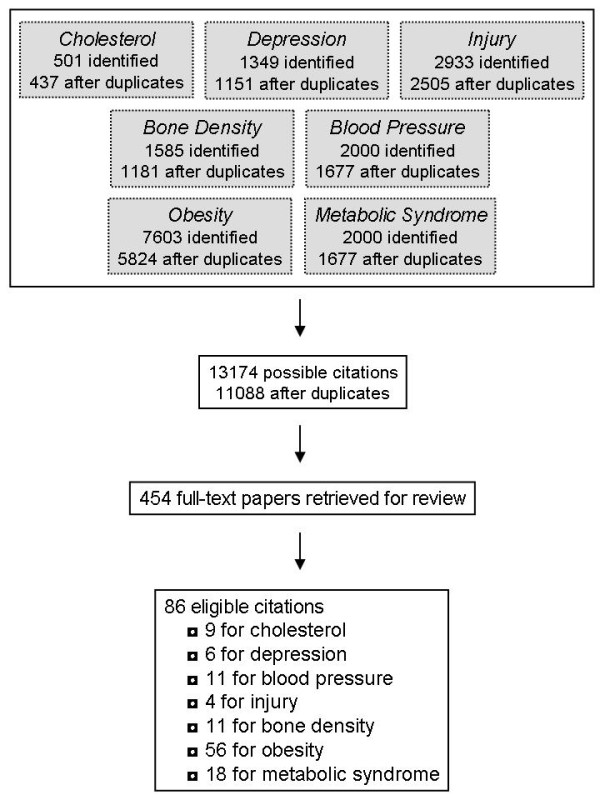
- After duplicates, 11,088 unique citations were screened; 454 full-text articles were reviewed; 86 unique citations met eligibility and 113 outcomes were abstracted. Observational studies had to report dichotomous outcomes; intervention studies were excluded if they included dietary or other behavioral components that could independently affect outcomes.
- Evidence was graded using pre-specified criteria based on quantity/quality of studies and strength of effect; meta-analyses were performed when at least 4 studies were available. RCT quality was assessed with the Downs and Black checklist, and effect sizes used Cohen’s d and ratio-score criteria.
Limitations
- Stated: unpublished and non-English studies were excluded, no extensive cross-referencing of reference lists was performed, the review was limited to 7 health outcomes, and many observational studies were excluded because they did not report dichotomous outcomes; these may have biased results and recommendations.
- Stated RCT limitations: samples were small and non-representative, statistical power was often lacking, adverse events were rarely reported, dropout details were limited, and intent-to-treat analyses were not performed; therefore Level 2 was the highest level assignable to any recommendation.
- Evident from the text: the nature of dose-response relations (linear vs curvilinear) often remained unclear, and the moderating effects of age and sex were not systematically addressed across outcomes.
Model-written summary. Check it against the paper before relying on it.
Integrity signals
Registry
Cites
Statistics
Figures
Verification
Claims the paper makes
0 Valid · 0 Not valid · 42 Not checked · 127 Own results and interpretations
A result the paper reports from its own data — it cites no other source for it, so there is none to check. The quote shows it is in the paper.
In the paper
“Results from experimental studies indicate that even modest amounts of physical activity can have health benefits in high-risk youngsters (e.g., obese).”
§ Systematic review of the health benefits of physical activity and fitness in school-aged children and youth > Abstract > Results
hedgedstates a cause- Asserted: passes — The authors put it forward as true.
- Checkable: passes — It can be checked against evidence.
- Load-bearing: passes — The paper’s conclusions depend on it.
- Based: passes — The paper gives a reason why it holds.
A result the paper reports from its own data — it cites no other source for it, so there is none to check. The quote shows it is in the paper.
In the paper
“Physical activity was associated with numerous health benefits.”
§ Systematic review of the health benefits of physical activity and fitness in school-aged children and youth > Abstract > Results
plainstates an association- Asserted: passes — The authors put it forward as true.
- Checkable: passes — It can be checked against evidence.
- Load-bearing: passes — The paper’s conclusions depend on it.
- Based: passes — The paper gives a reason why it holds.
A result the paper states — it cites no source for it, so there is none to check. The quote shows it is in the paper.
In the paper
“Aerobic-based activities had the greatest health benefit, other than for bone health, in which case high-impact weight bearing activities were required.”
§ Systematic review of the health benefits of physical activity and fitness in school-aged children and youth > Abstract > Results
plainstates an association- Asserted: passes — The authors put it forward as true.
- Checkable: passes — It can be checked against evidence.
- Load-bearing: passes — The paper’s conclusions depend on it.
- Based: passes — The paper gives a reason why it holds.
A result the paper reports from its own data — it cites no other source for it, so there is none to check. The quote shows it is in the paper.
In the paper
“The dose-response relations observed in observational studies indicate that the more physical activity, the greater the health benefit.”
§ Systematic review of the health benefits of physical activity and fitness in school-aged children and youth > Abstract > Results
hedgedstates an association- Asserted: passes — The authors put it forward as true.
- Checkable: passes — It can be checked against evidence.
- Load-bearing: passes — The paper’s conclusions depend on it.
- Based: passes — The paper gives a reason why it holds.
None of the sources cited for this claim have been checked yet.
In the paper
“The results indicated that unfit girls, defined as the lowest 20% fit, were 1.89 (95% confidence interval: 1.12-3.17) times more likely to have hypercholesterolemia and 1.03 (0.74-1.43) times more likely to have a low HDL-cholesterol by comparison to moderately and high fit girls.”
§ Systematic review of the health benefits of physical activity and fitness in school-aged children and youth > Results > Cholesterol and blood lipids
hedgedstates an associationn = 3,110- Asserted: passes — The authors put it forward as true.
- Checkable: passes — It can be checked against evidence.
- Load-bearing: passes — The paper’s conclusions depend on it.
- Based: passes — The paper gives a reason why it holds.
103 more claims
Create a free account to see all 169 claims and every source verdict.
- Probably not a substantial claim. 26
- The quote only partly states this claim. 2
- It may state two separate claims as one. 37
Claims other papers make about this one
Each is checked against this paper’s own text: does it say what the citing paper says it does?
The source backs part of the claim, not all of it — or backs it for a different population, condition or comparison.
In the citing paper
“Research indicates that those who are physically active show or report better overall physical and mental health, a higher level of fitness and a lower level of obesity than their sedentary or physically inactive counterparts1–4”
From Physical activity and health in Chinese children and adolescents: expert consensus statement (2020) (2020) · cites this paper as [2]
Experimental — accuracy not yet measuredThe cited source says what the claim attributes to it.
In the citing paper
“The association with overweight/obesity tends to be stronger when moderate to vigorous-intensity physical activities are performed.2”
From Physical activity and health in Chinese children and adolescents: expert consensus statement (2020) (2020) · cites this paper as [2]
The cited source says what the claim attributes to it.
In the citing paper
“Among physical activity interventions, the effects of physical activity independent of dietary changes on measures indicative of weight reduction (eg, BMI, total fat, abdominal fat) tend to be in the small range.2”
From Physical activity and health in Chinese children and adolescents: expert consensus statement (2020) (2020) · cites this paper as [2]
The cited source says what the claim attributes to it.
In the citing paper
“In general, as the level of physical activity increases, the likelihood of injury increases.2”
From Physical activity and health in Chinese children and adolescents: expert consensus statement (2020) (2020) · cites this paper as [2]
The cited source says what the claim attributes to it.
In the citing paper
“Systematic reviews have shown that physical activity (PA) is associated with greater mental health, 6 and a reduced risk of mental ill-health, specifically depression and anxiety.7,8”
From Domain-Specific Physical Activity and Mental Health: A Meta-analysis (2017) · cites this paper as [8]
2 more claims about this paper
Create a free account to see every claim other papers make about this one.
Self-check
Percentages, sums and reported differences re-computed from the paper’s own numbers.
Each contradiction between two passages listed here was confirmed by an independent check.
Rated major: it would touch a result — a value a result rests on, reported and recomputed p-values on opposite sides of the significance level, two passages that conflict with no sign which is right, or a cited work retracted before this paper was published.
In the paper
§ Systematic review of the health benefits of physical activity and fitness in school-aged children and youth > Discussion > Recommendations based on systematic review
“More vigorous intensity activities should be incorporated or added when possible, including activities that strengthen muscle and bone. [Level 3, Grade B].”
§ Systematic review of the health benefits of physical activity and fitness in school-aged children and youth > Discussion > Recommendations based on systematic review
“This recommendation was given a lower grade (Grade C) because of the potential increase in injury risk associated with more vigorous intensity activities and sports.”
Rated minor: it would not touch a result — a value no result rests on, a p-value that stays on the same side of the significance level, or a conflict that is clerical, resolved elsewhere in the paper, or outside its own findings.
In the paper
§ Systematic review of the health benefits of physical activity and fitness in school-aged children and youth > Results > Metabolic syndrome
“Sixteen articles examining the metabolic syndrome met the inclusion criteria.”
§ Systematic review of the health benefits of physical activity and fitness in school-aged children and youth > Results > Metabolic syndrome
“Eight of the 17 identified studies were observational in nature”
Rated minor: it would not touch a result — a value no result rests on, a p-value that stays on the same side of the significance level, or a conflict that is clerical, resolved elsewhere in the paper, or outside its own findings.
In the paper
“A total of 31 observational studies (24 cross-sectional, 3 prospective cohort, 2 case-control, 1 mixed) were retrieved”
§ Systematic review of the health benefits of physical activity and fitness in school-aged children and youth > Results > Overweight and obesity
Reported 31 · recomputed 30
Rated minor: it would not touch a result — a value no result rests on, a p-value that stays on the same side of the significance level, or a conflict that is clerical, resolved elsewhere in the paper, or outside its own findings.
In the paper
“437 citations were identified for cholesterol, 1151 for depression, 2505 for injury, 1181 for bone density, 1677 for blood pressure, 5824 for obesity, and 1677 for the metabolic syndrome. Thus, the grand total was 13174.”
§ Systematic review of the health benefits of physical activity and fitness in school-aged children and youth > Results > Literature review
Reported 13174 · recomputed 14452
Citations
Cites
Downs, S. H., & Black, N. (1998) · Journal of Epidemiology and Community Health · doi:10.1136/jech.52.6.377 · Cited by 8,252
Evidence Based Physical Activity for School-age Youth
Strong, W. B., Malina, R. M., Blimkie, C. J. R., Daniels, S. R., Dishman, R. K., Gutin, B., Hergenroeder, A. C., Must, A., Nixon, P. A., Pivarnik, J. M., et al. (2005) · The Journal of Pediatrics · doi:10.1016/j.jpeds.2005.01.055 · Cited by 4,222
Systematic Reviews: Synthesis of Best Evidence for Clinical Decisions
Cook, D. J., Mulrow, C. D., & Haynes, R. B. (1997) · Annals of Internal Medicine · doi:10.7326/0003-4819-126-5-199703010-00006 · Cited by 2,184
Andersen, L. B., Harro, M., Sardinha, L. B., Froberg, K., Ekelund, U., Brage, S., & Anderssen, S. A. (2006) · The Lancet · doi:10.1016/s0140-6736(06)69075-2 · Cited by 1,473
Lau, D. C. W., Douketis, J. D., Morrison, K. M., Hramiak, I. M., Sharma, A. M., Ur, E., & Panel, F. M. O. T. O. C. C. P. G. E. (2007) · Canadian Medical Association Journal · doi:10.1503/cmaj.061409 · Cited by 1,154
Paterson, D. H., & Warburton, D. E. (2010) · International Journal of Behavioral Nutrition and Physical Activity · doi:10.1186/1479-5868-7-38 · Cited by 953
A systematic review of the evidence for Canada's Physical Activity Guidelines for Adults
Warburton, D. E., Charlesworth, S., Ivey, A., Nettlefold, L., & Bredin, S. S. (2010) · International Journal of Behavioral Nutrition and Physical Activity · doi:10.1186/1479-5868-7-39 · Cited by 902 · cited 1×
“This report was part of a much larger project around Canada's physical activity guidelines, and comparable systematic reviews for adults [ 10 ] and older adults [11] have also been published in the journal.”
A meta-regression to examine the relationship between aerobic fitness and cognitive performance
Etnier, J. L., Nowell, P. M., Landers, D. M., & Sibley, B. A. (2006) · Brain Research Reviews · doi:10.1016/j.brainresrev.2006.01.002 · Cited by 749
Is the Canadian childhood obesity epidemic related to physical inactivity?
Tremblay, M. S., & Willms, J. D. (2003) · International Journal of Obesity · doi:10.1038/sj.ijo.0802376 · Cited by 517
Nassis, G. P., Papantakou, K., Skenderi, K., Triandafillopoulou, M., Kavouras, S. A., Yannakoulia, M., Chrousos, G. P., & Sidossis, L. S. (2005) · Metabolism · doi:10.1016/j.metabol.2005.05.013 · Cited by 469
Research works printed but not linked: 1
- Petitti DB Meta-Analysis, Decision Analysis, and Cost-Effective Analysis 1994 New York, NY: Oxford University Press
Cited by
Items 4,501–4,600 of 4,834
Gee, C. M., Tsui, B., Ginis, K. A. M., Bennett, E., Arbour‐Nicitopoulos, K. P., & Voss, C. (2024) · Disabilities · doi:10.3390/disabilities4040053
Diabetes hospital admission in adults, 2010 and 2015 (or nearest year)
OECD (2017) · Health at a glance · doi:10.1787/health_glance-2017-graph75-en
Share of children with Type 1 diabetes per 1000 population, 2015
(2017) · Health at a glance · doi:10.1787/health_glance-2017-graph30-en
Swinney, K. B., Bentley, S. S., Ganzar, L. A., Tierny, N., Baker, B., Brown, H. S., Salvo, D., & Hoelscher, D. M. (2026) · Adolescents · doi:10.3390/adolescents6040055
“In children and adolescents, physical activity is associated with improved mental health, cardiovascular health, cognitive function, and learning outcomes [4,5].”
La pratique sportive des jeunes : évolution des préférences et raisons de l'abandon
Gatouillat, C. (2019) · theses.fr (ABES) · doi:10.70675/57e975dez95e8z47ddz8fe8z42d008c6bbac · Cited by 1
ИНТЕРЕС НА СТУДЕНТИТЕ ЗА ВКЛУЧУВАЊЕ ВО АКТИВНОСТИ НА ОТВОРЕНО
Sivevska, D., Попеска, Б., & Магловска, Ц. Р. (2020) · Yearbook - Faculty of Tourism and Business Logistics · doi:10.46763/yfnts2031335s
YELKEN, M. E., Sezer, B. S., Hepsert, S., Küçüksayan, H., Temel, N. C., Mugan, G., & Yilmaz, U. (2026) · Frontiers in Physiology · doi:10.3389/fphys.2026.1847163
Stone, M., Faulkner, G., & Buliung, R. (2013) · Maladies chroniques et blessures au Canada · doi:10.24095/hpcdp.33.2.02f
Physical education pedagogies and physical activity in primary school children
Crotti, M. (2021) · Liverpool John Moores University
Huang, X., & Zhang, W. (2023) · Advances in Engineering Technology Research · doi:10.56028/aetr.3.1.633
Li, C., Shangguan, Y., Zhong, Z., Zhou, R., Wang, H., & Li, D. (2026) · European Journal of Pediatrics · doi:10.1007/s00431-026-07341-3
“The outcomes were documented in alignment with the Preferred Reporting Items for Systematic Reviews and Meta-Analyses (PRISMA) statement [9, 10].”
Hur mår våra barn och unga? Förändringar i barns och ungas hälsa över tid: en kunskapsöversikt
Hellström, L. (2023) · doi:10.24834/isbn.9789178773794 · Cited by 7
Marques, A., Ribeiro, T., Gaspar, T., Loureiro, N., Guedes, F. B., & de Matos, M. G. (2026) · Sport Sciences for Health · doi:10.1007/s11332-026-01904-5
Braga, L. (2014) · The Research Repository @ WVU (West Virginia University) · doi:10.33915/etd.266
Fatores associados à inatividade física em adolescentes: um artigo de revisão
Alves, C. F. D. A., & Ribeiro‐Silva, R. D. C. (2013) · EDUFBA eBooks · doi:10.7476/9788523212209.0007 · Cited by 8
Age-Related Anthropometric Changes in Schoolboys Aged 12 to 14
Gaži, M., Roy, S., Islam, M. A., Abdullah, M., Mahara, A., Rahaman, A., & Rakib, M. R. (2026) · Journal of Sport Biomechanics · doi:10.66224/jsportbiomech.12.2.154
“Moreover, activity level plays a key role in shaping body composition; physically active adolescents typically have lower fat mass and higher lean body mass compared to their inactive peers (47).”
Stone, M. R., Faulkner, G., Mitra, R., & Buliung, R. N. (2021) · doi:10.32920/14639181
Corr, M. (2020) · Mary Immaculate Research Repository (Mary Immaculate College)
Давибіда, Н. О., Bezpalova, N. M., & Магдич, І. П. (2025) · Медсестринство · doi:10.11603/2411-1597.2025.3-4.15736
Effects of an in-school physical activity–based lifestyle intervention on mental well-being
Kirschner, M., Golsteijn, R. H. J., Kikkert, R., Savelberg, H. H. C. M., & de Groot, R. H. M. (2025) · Health Education Journal · doi:10.1177/00178969251352401 · Cited by 1
“Possibly the total of eight classes of PA offered in the 20-week intervention period was not enough to achieve the recommended hour per day for SMW benefits to take place (Janssen and LeBlanc, 2010).”
The Influence of the Demographic Factor on the Growth and Development of Younger School-Age Girls
Hadžić, R., Bajrić, O., & Dragutinović, K. (2020) · Спортске науке и здравље - АПЕИРОН · doi:10.7251/ssh2002159h
Updating radiographic parameters for the healthy growing hip: are current parameters still valid?
Hütter, K., Smolle, M. A., Butter, S., et al. (2026) · Journal of Orthopaedics and Traumatology · doi:10.1186/s10195-026-00917-7
Duncan, S., Smith, M., Mavoa, S., Stewart, T. I., Ivory, V. C., McPhee, J. S., & Schofield, G. (2013)
Herbert, J., Warchoł, K., Przednówek, K., & Grzywacz, R. (2018) · Polish Journal of Sport and Tourism · doi:10.2478/pjst-2018-0017 · Cited by 1
Parents' attitudes about the physical activity of children with different levels of BMI
Živković, D., Živković, M., Purenović-Ivanović, T., Đošić, A., Ranđelović, N., & Pantelić, S. (2024) · Antropološki i teoantropološki pogled na fizičke aktivnosti · doi:10.5937/atavpa24022z
Maras, D. (2013) · Carleton University's Institutional Repository (MacOdrum Library, Carleton University) · doi:10.22215/etd/2013-09894 · Cited by 7
Health financing sources by type of revenue, 2015 (or nearest year)
(2017) · Health at a glance · doi:10.1787/health_glance-2017-graph118-en
Mello, J. B., & Bergmann, G. G. (2013) · EXTRAMUROS - Revista de Extensão da Univasf
Physical Activity and Influencing Factors of International Students in China
Wang, J., Zong, B., & Long, B. (2020) · International Symposium on Management and Social Sciences (ISMSS) · doi:10.2991/assehr.k.201202.129
The Effect of Physical Activity on the Memory of Schoolchildren
Polevoy, G. G. (2022) · Journal of Higher Education Theory and Practice · doi:10.33423/jhetp.v22i16.5597 · Cited by 1
Wilhite, B. C., Hennessy, E., Economos, C. D., Sacheck, J. M., Zive, R., Odalen, C., Herrick, S., & Hatfield, D. P. (2025) · doi:10.2196/preprints.73510
Weight Stigma’s Relationship to the Practice and Maintenance of Physical Activity
Rojas-Sánchez, A. (2019) · theses.fr (ABES) · doi:10.70675/152715c2z4dbfz40bez916dz999325dee07b
Association Between Motor Competence and Body Mass Index in Children Aged 10-13
CEYHAN, A., & Söğüt, M. (2021) · Turkiye Klinikleri Journal of Sports Sciences · doi:10.5336/sportsci.2020-76449 · Cited by 1
Le bien-être des élèves : comment le définir et l'évaluer
OECD (2018) · Programme international pour le suivi des acquis des élèves · doi:10.1787/9789264288850-6-fr
Life expectancy at birth and GDP per capita, 2015 (or nearest year)
(2017) · Health at a glance · doi:10.1787/health_glance-2017-graph7-en
The effectiveness of physical activity promotion program during summer vacation
Matsui, M., & Togashi, K. (2019) · 体力科學 · doi:10.7600/jspfsm.68.145
EFEKTI ČASA FIZIČKOG VASPITANJA NA FUNKCIONALNE SPOSOBNOSTI UČENIKA
Mekić, R., Mavrić, A., Čaprić, I., Zećirović, A., & Mekić, M. (2021) · SPORT I ZDRAVLJE · doi:10.7251/siz2101007m · Cited by 2
Caesarean section rates, 2015 (or nearest year)
(2017) · Health at a glance · doi:10.1787/health_glance-2017-graph169-en · Cited by 1
Sasayama, K. (2026) · Health Science Reports · doi:10.1002/hsr2.72134
Fitness, cardiovascular and metabolic risk factors: A correlational study
Batalau, R., Cruz, J., Gonçalves, R., Santos, M., Leal, J., & Palmeira, A. L. (2017) · Motricidade · doi:10.6063/motricidade.10319 · Cited by 1
dos Santos, B. L., dos Santos, J. P. R., Gomes-Júnior, J. D. S., Bezerra, E. D. S., Barbosa, S., Araújo, B. G. S., da Silva, F. T. M., Magalhães, J. P., Zymbal, V., Costa, E. C., et al. (2025) · Retos · doi:10.47197/retos.v64.110467
Schuck, T., & Siener, M. (2026) · International Journal of Sports Science & Coaching · doi:10.1177/17479541251407995
Davidson, J. A., Creasy, S. A., Meneses, E., Brinton, J. T., Bernard, A., Bowen, A. E., Hawkins, S. M. M., Cree, M. G., Nadeau, K. J., Melanson, E. L., et al. (2026) · Sleep Health · doi:10.1016/j.sleh.2026.02.006
Akah, R. T., & Ndlovu, N. (2025) · F1000Research · doi:10.12688/f1000research.173657.1
Understanding neighbourhood space use by Canadian children and youth during COVID-19
Gillespie, M. A. M. (2023) · doi:10.32920/24084759.v1
Trend in physical activity levels among children aged 11 to 14
Đošić, A., Živković, D., Purenović-Ivanović, T., Ranđelović, N., & Pantelić, S. (2024) · Fizicko vaspitanje i sport kroz vekove · doi:10.5937/spes2402109d
Aslam, S., Bin, S. Y., & Zhao, C. (2025) · Research Square · doi:10.21203/rs.3.rs-6867927/v1 · Cited by 3
Physiotherapy Management of Pediatric Rheumatology Conditions
Maillard, S. M. (2016) · Technical report · doi:10.1016/b978-0-444-63596-9.00025-6 · Cited by 1
Physical activity and social capital in Canadian adolescents
Trites, S. J. (2011) · Carleton University's Institutional Repository (MacOdrum Library, Carleton University) · doi:10.22215/etd/2011-07357 · Cited by 1
Hospital expenditure by type of service, 2015 (or nearest year)
(2017) · Health at a glance · doi:10.1787/health_glance-2017-graph124-en
Qu'est-ce que l'enquête PISA ?
OECD (2018) · Programme international pour le suivi des acquis des élèves · doi:10.1787/9789264288850-4-fr
Arte ornamental em jardins de cura infantis
dos Passos, L. A., Souza, T. J., & Medeiros, J. M. (2023) · Paisagem e Ambiente · doi:10.11606/issn.2359-5361.paam.2023.204506
Качество образования. Направления поиска
Паневина, Н. В. (2006) · Российское предпринимательство
THE PHYSICAL FITNESS STATUS OF MALE STUDENTS OF DONG NAI UNIVERSITY, VIETNAM
Hoai, N. H., Tung, Q. K., & Dat, N. H. (2023) · European Journal of Physical Education and Sport Science · doi:10.46827/ejpe.v9i6.4811
“Health is directly impacted by diet and physical activity [1,2,3,4,5,6].”
Knowles, G. (2015) · University of Birmingham Institutional Research Archive (University of Birmingham)
Stai, M., Aadland, E., & Andersen, J. R. (2024) · Research Square · doi:10.21203/rs.3.rs-3913175/v1
Matsui, M., MATSUNAGA, M., Ishii, K., Kawata, Y., NAKAMURA, E., Someya, Y., Shoji, H., Kito, T., & Suzuki, K. (2026) · Mental health and physical activity · doi:10.1016/j.mhpa.2026.100817
Moreno, A. (2026) · Barcelona Respiratory Network · doi:10.23866/brnrev:2025-m0126
Kirkegaard, H., Petersen, T. L., Klinker, C. D., Ryom, K., Timm, A., Fredslund, E. K., Laursen, M. G., Olesen, L. G., Ladekjær, E., Højgaard, B., et al. (2026) · Research Square · doi:10.21203/rs.3.rs-8788799/v1
The role of exercise in modulating vascular function in childhood and adolescent obesity
Duff, D. (2019) · Arca (British Columbia Electronic Library Network) · doi:10.14288/1.0380065 · Cited by 1
“The results from the Janssen and LeBlanc (2010) review did show that even modest amount of PA can have tremendous health benefits in obese youngsters and should be of moderate intensity, suggesting that even if weight loss is minimal, obese, fit individuals are at reduced risk for CV mortality than…”
BackgroundEstilo de vida saludable en la adolescencia: Relación con autoestima y diferencias según sexo
Moreno, A. G., & Jurado, M. D. M. M. (2023) · Acción Psicológica · doi:10.5944/ap.20.1.39184 · Cited by 3
Ostermeier, E., Reilly, K. C., Ferguson, K. N., Coen, S. E., & Gilliland, J. (2022) · Qualitative Research in Sport Exercise and Health · doi:10.1080/2159676x.2022.2152081
Mannay, D. (2019) · Emerald Group Publishing Limited eBooks · doi:10.1108/s1042-319220190000017008
Sun, G., He, R., Zhang, J., et al. (2026) · Frontiers in Psychology · doi:10.3389/fpsyg.2026.1686950
“…is associated with various health outcomes in children, including maintaining a healthy body weight, reducing the risk of diabetes, hypertension, and cardiovascular diseases, and enhancing emotion regulation and stress management (Janssen and Leblanc, 2010; Poitras et al., 2016; Bao et al., 2024).”
Symbrachydactyly and Sports Participation
Padilla, A. N., Tuberty, S., Wren, T. A. L., et al. (2026) · Journal of Pediatric Orthopaedics · doi:10.1097/bpo.0000000000003245
Best Practices for Strengthening Physical Activity Policies at Childcare
Strang, M. (2017) · NDSU Repository (North Dakota State University)
Exploring self-efficacy as a predictor of activity behaviours in children with cerebral palsy
Ganz, F. (2019) · ERA: Education and Research Archive (University of Alberta) · doi:10.7939/r3-tdds-5f27
Маматкулович, Б. М., Kochkorova, F., Anarkulov, B. K., Anarkulova, A. A., Anarkulov, R. P., Anarkulov, K. F., & Атамырзаевна, К. Г. (2026) · Heart Vessels and Transplantation · doi:10.24969/hvt.2026.631
WITHDRAWN: Risk assessments of low cognitive performance among fishermen's children in Malaysia
Meli, A. M., Zakaria, N. H., Yusof, H. M., Kamarudin, K. S., & Ali, A. (2022) · Journal of Taibah University Medical Sciences · doi:10.1016/j.jtumed.2022.12.014
RetractedInfant mortality, 2015 and change 1990-2015 (or nearest year)
OECD (2017) · Health at a glance · doi:10.1787/health_glance-2017-graph18-en
Daily fruit eating among 15-year-olds, 2013-14
(2017) · Health at a glance · doi:10.1787/health_glance-2017-graph41-en
Mosha, M., Kasagama, E., Ayieko, P., Todd, J., Msuya, S. E., Grosskurth, H., & Filteau, S. (2021) · AAS Open Research · doi:10.12688/aasopenres.13118.2
Validity of the Garmin Vivofit Jr. to Measure Physical Activity During a Youth After-School Program
Peyer, K. L., & Hamilton, K. C. (2022) · Journal for the Measurement of Physical Behaviour · doi:10.1123/jmpb.2021-0039 · Cited by 1
Postoperative sepsis in abdominal surgeries, 2015 (or nearest year)
(2017) · Health at a glance · doi:10.1787/health_glance-2017-graph91-en
Khan, M. J., a, S. N., Ganesan, B., et al. (2023) · Research Square · doi:10.21203/rs.3.rs-3074350/v1
Romanban, D. C., & Gutierrez, M. M. (2022) · International Journal of Multidisciplinary Applied Business and Education Research · doi:10.11594/ijmaber.03.04.17
Smoking among 15-year-olds, 2013-14
(2017) · Health at a glance · doi:10.1787/health_glance-2017-graph35-en
Wagijo, M.-A. R., Altenburg, T. M., Ledebt, A., Bartels, F., van der Kaap, R. K., Bel, K., Voorwinden, S., van Doodewaard, C., van Kann, D., Gubbels, J. S., et al. (2025) · BMC Public Health · doi:10.1186/s12889-025-24461-x · Cited by 1
Ayşe, D. U. R. U., & Akay, D. (2026) · European Planning Studies · doi:10.1080/09654313.2026.2691919
The Moderate Effects of Access to Play Spaces on Adolescents’ Physical Activity
Yu, C.-Y. (2026) · Urban Science · doi:10.3390/urbansci10050222
Breast cancer mortality in women, 2005 and 2015 (or nearest years)
(2017) · Health at a glance · doi:10.1787/health_glance-2017-graph100-en
Smart Healthy Living for Smart Kozhikode Metropolitan Area
Kumar, T. M. V., Puthuvayi, B., & Radhakrishnan, N. (2020) · Advances in 21st century human settlements · doi:10.1007/978-981-15-4615-0_4
Craig, E., Bland, R., & Reilly, J. J. (2013)
Acharya, A. (2023) · Journal of Manmohan Memorial Institute of Health Sciences · doi:10.3126/jmmihs.v8i2.59354
Activating inactive citizens through the organized sports setting: a hurdle race
Ooms, L. (2020) · Utrecht University Repository (Utrecht University) · doi:10.33540/251 · Cited by 1
Defining the physical activity environment in primary schools across North Macedonia: COSI study
Mihajlova, K., Wallace, L. S., Stamenova, A., & Spiroski, I. M. (2025) · Archives of Public Health · doi:10.3889/aph.2025.6125 · Cited by 1
Hospital discharges for cancers, 2015 (or nearest year)
(2017) · Health at a glance · doi:10.1787/health_glance-2017-graph161-en
Arnaiz, P., Guntlisbergen, F., Infanger, D., Gerber, M., Adams, L., Dolley, D., Joubert, N., Nienaber, M., Nqweniso, S., du Randt, R., et al. (2023) · South African Journal of Science · doi:10.17159/sajs.2023/15494 · Cited by 1
“41 Especially girls should be encouraged to increase their time spent in MVPA, as they spent substantially less time in MVPA and showed higher BMI values compared to boys (57.7 vs. 83.8 min/day and 17.8 vs. 16.7 kg/m 2 , respectively).”
BackgroundInfluential
Metadata
- Authors
- Janssen, I., & LeBlanc, A. G.
- Affiliations
- Queen's University (CA)
- Corresponding author
- Janssen, Ian
- Venue
- International Journal of Behavioral Nutrition and Physical Activity
- Published
- 2010
- Volume
- 7
- Issue
- 1
- Pages
- 40
- ISSN
- 1479-5868 (ISSN-L)
- PMC
- PMC2885312
- OpenAlex
- W2145702257
- Semantic Scholar
- ef8d55efd11b9d5e4a4814b6a38ff3d60d820d37
- Cited by
- 4,829
- References
- 116
- Citations by year
- 2026: 185 · 2025: 257 · 2024: 310 · 2023: 304 · 2022: 371 · 2021: 451 · 2020: 459 · 2019: 401 · 2018: 387 · 2017: 490 · 2016: 302 · 2015: 280 · 2014: 250 · 2013: 191 · 2012: 109
- FWCI
- 12.18
- Type
- journal article
- Language
- en
- Open access
- gold
- doi.org
- Licence
- cc-by
- Locations
- International Journal of Behavioral Nutrition and Physical Activity (publishedVersion, cc-by)
- PubMed Central (publishedVersion, cc-by)
- PubMed (publishedVersion)
- DOAJ (DOAJ: Directory of Open Access Journals) (submittedVersion, cc-by-sa)
- Funders
- Public Health Agency of Canada
- Public Health Agency
- Topics
- Health Sciences › Medicine › Public Health, Environmental and Occupational Health › Physical Activity and Health
- Health Sciences › Medicine › Public Health, Environmental and Occupational Health › Obesity, Physical Activity, Diet
- Social Sciences › Life-span and Life-course Studies › Recreational Sport and Physical Activity
- Keywords
- physical activity, physical fitness, school-aged children, youth, health benefits, serum cholesterol, blood pressure, metabolic syndrome, childhood obesity, bone mineral density, depression, injuries, dose-response relationship, aerobic exercise, physical activity guidelines
About these checks
Registry, retraction, Cites and statistics results are computed, not judged, with one exception: a printed reference that no index lists is read once by a model before it counts as a citation error. Claims are extracted by a model and kept only when their quote appears verbatim in the text; each cited source is then checked, with a model’s help, for whether it says what the claim relies on. Those verdicts can be wrong — read the claim’s quote and the cited source before relying on one.
A language model drew the claims from the paper on 2026-10-10, under version 3 of the claim definition (model deepseek-v4.1-flash, prompt extract-v3).
A second model labelled each claim on 2026-10-10 (model jev-1.13-20260917, definition revision gold-guideline-v0.2).
Statistics and arithmetic are recomputed, not judged.
Confidence bands are shown only for fields calibrated on our annotated test set. None is calibrated yet, so no band is shown.
What counts as a claim ›How we measure confidence ›How we check this ›
Are you an author, or do you see a problem with this page? Request a review
Data sources
Bibliographic data: Semantic Scholar, OpenAlex, Crossref.
Contains information from the Semantic Scholar Academic Graph Datasets, made available under the ODC Attribution License (ODC-BY 1.0).
Semantic Scholar’s data is described in: Kinney, R., et al. (2023). The Semantic Scholar Open Data Platform. arXiv:2301.10140.
