

Systematic review of the health benefits of physical activity and fitness in school-aged children and youth
Open accessThe DOI matches its Crossref record; 114 of the 116 references it cites were found in a registry or an index; none of the 128 sources its claims cite is checked for support yet.
Abstract
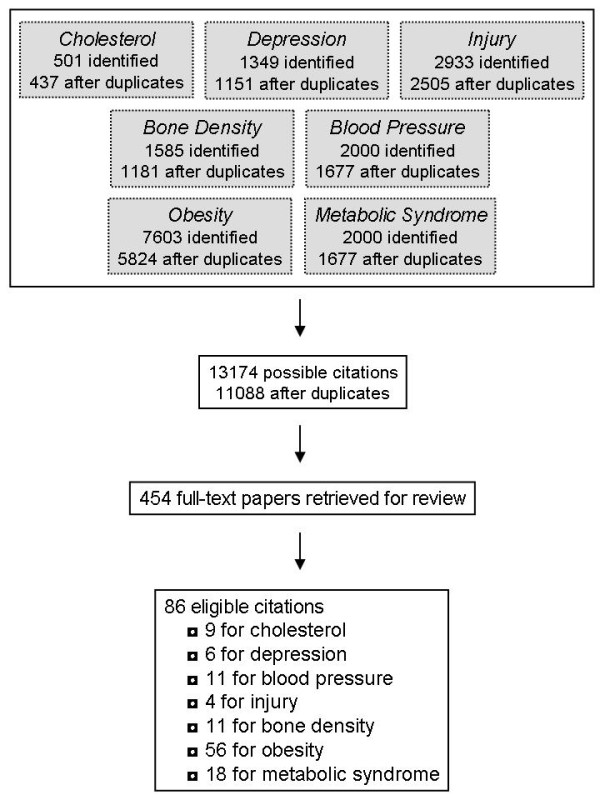
BACKGROUND: The purpose was to: 1) perform a systematic review of studies examining the relation between physical activity, fitness, and health in school-aged children and youth, and 2) make recommendations based on the findings. METHODS: The systematic review was limited to 7 health indicators: high blood cholesterol, high blood pressure, the metabolic syndrome, obesity, low bone density, depression, and injuries. Literature searches were conducted using predefined keywords in 6 key databases. A total of 11,088 potential papers were identified. The abstracts and full-text articles of potentially relevant papers were screened to determine eligibility. Data was abstracted for 113 outcomes from the 86 eligible papers. The evidence was graded for each health outcome using established criteria based on the quantity and quality of studies and strength of effect. The volume, intensity, and type of physical activity were considered. RESULTS: Physical activity was associated with numerous health benefits. The dose-response relations observed in observational studies indicate that the more physical activity, the greater the health benefit. Results from experimental studies indicate that even modest amounts of physical activity can have health benefits in high-risk youngsters (e.g., obese). To achieve substantive health benefits, the physical activity should be of at least a moderate intensity. Vigorous intensity activities may provide even greater benefit. Aerobic-based activities had the greatest health benefit, other than for bone health, in which case high-impact weight bearing activities were required. CONCLUSION: The following recommendations were made: 1) Children and youth 5-17 years of age should accumulate an average of at least 60 minutes per day and up to several hours of at least moderate intensity physical activity. Some of the health benefits can be achieved through an average of 30 minutes per day. [Level 2, Grade A]. 2) More vigorous intensity activities should be incorporated or added when possible, including activities that strengthen muscle and bone [Level 3, Grade B]. 3) Aerobic activities should make up the majority of the physical activity. Muscle and bone strengthening activities should be incorporated on at least 3 days of the week [Level 2, Grade A].
Overview
CoChat Summary
TL;DR
This systematic review found physical activity is associated with numerous health benefits in school-aged children and youth, with observational dose-response evidence suggesting more activity yields greater benefit. It recommends an average of at least 60 minutes per day of at least moderate activity, with some benefits achievable at 30 minutes per day, plus added vigorous and muscle/bone-strengthening activities.
Key findings
- From 11,088 unique citations, 86 eligible papers yielded 113 outcomes across 7 health indicators. Physical activity was associated with benefits; observational studies showed dose-response relations, and experimental studies indicated even modest activity can benefit high-risk youngsters (e.g., obese).
- Metabolic syndrome: summary odds ratio for least active vs most active was 1.68 (95% CI 1.22–2.31) in 3 self-report studies; least fit vs most fit was 6.79 (95% CI 5.11–9.03) in 4 fitness studies. Obesity: median odds ratio was 1.33 for self-reported activity and 3.79 for objective measures. Cholesterol: unfit girls were 1.89 (1.12–3.17) times and unfit boys 3.68 (2.55–5.31) times more likely to have hypercholesterolemia than moderately/high fit peers.
- Recommendations: children and youth 5–17 years should accumulate an average of at least 60 minutes per day and up to several hours of at least moderate intensity activity; some health benefits can be achieved through an average of 30 minutes per day [Level 2, Grade A]. More vigorous activities should be incorporated when possible, including muscle- and bone-strengthening activities [Level 3, Grade B]; aerobic activities should make up the majority, with muscle and bone strengthening on at least 3 days per week [Level 2, Grade A].
- Bone: as little as 10 minutes of moderate-to-high impact activities on as little as 2 or 3 days per week can have a modest effect on bone mineral density when combined with general weight-bearing aerobic activities. Injuries: all 3 included studies reported higher injury rates in active children/youth and clear dose-response relations; vigorous sports risk estimates were high.
Methods
- Systematic review limited to 7 health indicators: high blood cholesterol, high blood pressure, metabolic syndrome, obesity, low bone density, depression, and injuries. Searches used predefined keywords in 6 databases (MEDLINE, EMBASE, CINAHL, PsycINFO, Evidence-Based Medicine Reviews, SPORTDiscus) to January 2008, limited to human participants, English language, and ages 5–17 years.
- After duplicates, 11,088 unique citations were screened; 454 full-text articles were reviewed; 86 unique citations met eligibility and 113 outcomes were abstracted. Observational studies had to report dichotomous outcomes; intervention studies were excluded if they included dietary or other behavioral components that could independently affect outcomes.
- Evidence was graded using pre-specified criteria based on quantity/quality of studies and strength of effect; meta-analyses were performed when at least 4 studies were available. RCT quality was assessed with the Downs and Black checklist, and effect sizes used Cohen’s d and ratio-score criteria.
Limitations
- Stated: unpublished and non-English studies were excluded, no extensive cross-referencing of reference lists was performed, the review was limited to 7 health outcomes, and many observational studies were excluded because they did not report dichotomous outcomes; these may have biased results and recommendations.
- Stated RCT limitations: samples were small and non-representative, statistical power was often lacking, adverse events were rarely reported, dropout details were limited, and intent-to-treat analyses were not performed; therefore Level 2 was the highest level assignable to any recommendation.
- Evident from the text: the nature of dose-response relations (linear vs curvilinear) often remained unclear, and the moderating effects of age and sex were not systematically addressed across outcomes.
Model-written summary. Check it against the paper before relying on it.
Integrity signals
Registry
Cites
Statistics
Figures
Verification
Claims the paper makes
0 Valid · 0 Not valid · 42 Not checked · 127 Own results and interpretations
A result the paper reports from its own data — it cites no other source for it, so there is none to check. The quote shows it is in the paper.
In the paper
“Results from experimental studies indicate that even modest amounts of physical activity can have health benefits in high-risk youngsters (e.g., obese).”
§ Systematic review of the health benefits of physical activity and fitness in school-aged children and youth > Abstract > Results
hedgedstates a cause- Asserted: passes — The authors put it forward as true.
- Checkable: passes — It can be checked against evidence.
- Load-bearing: passes — The paper’s conclusions depend on it.
- Based: passes — The paper gives a reason why it holds.
A result the paper reports from its own data — it cites no other source for it, so there is none to check. The quote shows it is in the paper.
In the paper
“Physical activity was associated with numerous health benefits.”
§ Systematic review of the health benefits of physical activity and fitness in school-aged children and youth > Abstract > Results
plainstates an association- Asserted: passes — The authors put it forward as true.
- Checkable: passes — It can be checked against evidence.
- Load-bearing: passes — The paper’s conclusions depend on it.
- Based: passes — The paper gives a reason why it holds.
A result the paper states — it cites no source for it, so there is none to check. The quote shows it is in the paper.
In the paper
“Aerobic-based activities had the greatest health benefit, other than for bone health, in which case high-impact weight bearing activities were required.”
§ Systematic review of the health benefits of physical activity and fitness in school-aged children and youth > Abstract > Results
plainstates an association- Asserted: passes — The authors put it forward as true.
- Checkable: passes — It can be checked against evidence.
- Load-bearing: passes — The paper’s conclusions depend on it.
- Based: passes — The paper gives a reason why it holds.
A result the paper reports from its own data — it cites no other source for it, so there is none to check. The quote shows it is in the paper.
In the paper
“The dose-response relations observed in observational studies indicate that the more physical activity, the greater the health benefit.”
§ Systematic review of the health benefits of physical activity and fitness in school-aged children and youth > Abstract > Results
hedgedstates an association- Asserted: passes — The authors put it forward as true.
- Checkable: passes — It can be checked against evidence.
- Load-bearing: passes — The paper’s conclusions depend on it.
- Based: passes — The paper gives a reason why it holds.
None of the sources cited for this claim have been checked yet.
In the paper
“The results indicated that unfit girls, defined as the lowest 20% fit, were 1.89 (95% confidence interval: 1.12-3.17) times more likely to have hypercholesterolemia and 1.03 (0.74-1.43) times more likely to have a low HDL-cholesterol by comparison to moderately and high fit girls.”
§ Systematic review of the health benefits of physical activity and fitness in school-aged children and youth > Results > Cholesterol and blood lipids
hedgedstates an associationn = 3,110- Asserted: passes — The authors put it forward as true.
- Checkable: passes — It can be checked against evidence.
- Load-bearing: passes — The paper’s conclusions depend on it.
- Based: passes — The paper gives a reason why it holds.
103 more claims
Create a free account to see all 169 claims and every source verdict.
- Probably not a substantial claim. 26
- The quote only partly states this claim. 2
- It may state two separate claims as one. 37
Claims other papers make about this one
Each is checked against this paper’s own text: does it say what the citing paper says it does?
The source backs part of the claim, not all of it — or backs it for a different population, condition or comparison.
In the citing paper
“Research indicates that those who are physically active show or report better overall physical and mental health, a higher level of fitness and a lower level of obesity than their sedentary or physically inactive counterparts1–4”
From Physical activity and health in Chinese children and adolescents: expert consensus statement (2020) (2020) · cites this paper as [2]
Experimental — accuracy not yet measuredThe cited source says what the claim attributes to it.
In the citing paper
“The association with overweight/obesity tends to be stronger when moderate to vigorous-intensity physical activities are performed.2”
From Physical activity and health in Chinese children and adolescents: expert consensus statement (2020) (2020) · cites this paper as [2]
The cited source says what the claim attributes to it.
In the citing paper
“Among physical activity interventions, the effects of physical activity independent of dietary changes on measures indicative of weight reduction (eg, BMI, total fat, abdominal fat) tend to be in the small range.2”
From Physical activity and health in Chinese children and adolescents: expert consensus statement (2020) (2020) · cites this paper as [2]
The cited source says what the claim attributes to it.
In the citing paper
“In general, as the level of physical activity increases, the likelihood of injury increases.2”
From Physical activity and health in Chinese children and adolescents: expert consensus statement (2020) (2020) · cites this paper as [2]
The cited source says what the claim attributes to it.
In the citing paper
“Systematic reviews have shown that physical activity (PA) is associated with greater mental health, 6 and a reduced risk of mental ill-health, specifically depression and anxiety.7,8”
From Domain-Specific Physical Activity and Mental Health: A Meta-analysis (2017) · cites this paper as [8]
2 more claims about this paper
Create a free account to see every claim other papers make about this one.
Self-check
Percentages, sums and reported differences re-computed from the paper’s own numbers.
Each contradiction between two passages listed here was confirmed by an independent check.
Rated major: it would touch a result — a value a result rests on, reported and recomputed p-values on opposite sides of the significance level, two passages that conflict with no sign which is right, or a cited work retracted before this paper was published.
In the paper
§ Systematic review of the health benefits of physical activity and fitness in school-aged children and youth > Discussion > Recommendations based on systematic review
“More vigorous intensity activities should be incorporated or added when possible, including activities that strengthen muscle and bone. [Level 3, Grade B].”
§ Systematic review of the health benefits of physical activity and fitness in school-aged children and youth > Discussion > Recommendations based on systematic review
“This recommendation was given a lower grade (Grade C) because of the potential increase in injury risk associated with more vigorous intensity activities and sports.”
Rated minor: it would not touch a result — a value no result rests on, a p-value that stays on the same side of the significance level, or a conflict that is clerical, resolved elsewhere in the paper, or outside its own findings.
In the paper
§ Systematic review of the health benefits of physical activity and fitness in school-aged children and youth > Results > Metabolic syndrome
“Sixteen articles examining the metabolic syndrome met the inclusion criteria.”
§ Systematic review of the health benefits of physical activity and fitness in school-aged children and youth > Results > Metabolic syndrome
“Eight of the 17 identified studies were observational in nature”
Rated minor: it would not touch a result — a value no result rests on, a p-value that stays on the same side of the significance level, or a conflict that is clerical, resolved elsewhere in the paper, or outside its own findings.
In the paper
“A total of 31 observational studies (24 cross-sectional, 3 prospective cohort, 2 case-control, 1 mixed) were retrieved”
§ Systematic review of the health benefits of physical activity and fitness in school-aged children and youth > Results > Overweight and obesity
Reported 31 · recomputed 30
Rated minor: it would not touch a result — a value no result rests on, a p-value that stays on the same side of the significance level, or a conflict that is clerical, resolved elsewhere in the paper, or outside its own findings.
In the paper
“437 citations were identified for cholesterol, 1151 for depression, 2505 for injury, 1181 for bone density, 1677 for blood pressure, 5824 for obesity, and 1677 for the metabolic syndrome. Thus, the grand total was 13174.”
§ Systematic review of the health benefits of physical activity and fitness in school-aged children and youth > Results > Literature review
Reported 13174 · recomputed 14452
Citations
Cites
Downs, S. H., & Black, N. (1998) · Journal of Epidemiology and Community Health · doi:10.1136/jech.52.6.377 · Cited by 8,252
Evidence Based Physical Activity for School-age Youth
Strong, W. B., Malina, R. M., Blimkie, C. J. R., Daniels, S. R., Dishman, R. K., Gutin, B., Hergenroeder, A. C., Must, A., Nixon, P. A., Pivarnik, J. M., et al. (2005) · The Journal of Pediatrics · doi:10.1016/j.jpeds.2005.01.055 · Cited by 4,222
Systematic Reviews: Synthesis of Best Evidence for Clinical Decisions
Cook, D. J., Mulrow, C. D., & Haynes, R. B. (1997) · Annals of Internal Medicine · doi:10.7326/0003-4819-126-5-199703010-00006 · Cited by 2,184
Andersen, L. B., Harro, M., Sardinha, L. B., Froberg, K., Ekelund, U., Brage, S., & Anderssen, S. A. (2006) · The Lancet · doi:10.1016/s0140-6736(06)69075-2 · Cited by 1,473
Lau, D. C. W., Douketis, J. D., Morrison, K. M., Hramiak, I. M., Sharma, A. M., Ur, E., & Panel, F. M. O. T. O. C. C. P. G. E. (2007) · Canadian Medical Association Journal · doi:10.1503/cmaj.061409 · Cited by 1,154
Paterson, D. H., & Warburton, D. E. (2010) · International Journal of Behavioral Nutrition and Physical Activity · doi:10.1186/1479-5868-7-38 · Cited by 953
A systematic review of the evidence for Canada's Physical Activity Guidelines for Adults
Warburton, D. E., Charlesworth, S., Ivey, A., Nettlefold, L., & Bredin, S. S. (2010) · International Journal of Behavioral Nutrition and Physical Activity · doi:10.1186/1479-5868-7-39 · Cited by 902 · cited 1×
“This report was part of a much larger project around Canada's physical activity guidelines, and comparable systematic reviews for adults [ 10 ] and older adults [11] have also been published in the journal.”
A meta-regression to examine the relationship between aerobic fitness and cognitive performance
Etnier, J. L., Nowell, P. M., Landers, D. M., & Sibley, B. A. (2006) · Brain Research Reviews · doi:10.1016/j.brainresrev.2006.01.002 · Cited by 749
Is the Canadian childhood obesity epidemic related to physical inactivity?
Tremblay, M. S., & Willms, J. D. (2003) · International Journal of Obesity · doi:10.1038/sj.ijo.0802376 · Cited by 517
Nassis, G. P., Papantakou, K., Skenderi, K., Triandafillopoulou, M., Kavouras, S. A., Yannakoulia, M., Chrousos, G. P., & Sidossis, L. S. (2005) · Metabolism · doi:10.1016/j.metabol.2005.05.013 · Cited by 469
Research works printed but not linked: 1
- Petitti DB Meta-Analysis, Decision Analysis, and Cost-Effective Analysis 1994 New York, NY: Oxford University Press
Cited by
Items 4,401–4,500 of 4,834
Measuring Street Built Environments for Children’s Use: A Systematic Review of Measurement Tools
Cao, X., Meng, X., & Zhang, H. (2025) · Journal of Urban Health · doi:10.1007/s11524-025-01003-9 · Cited by 2
“Evidence shows that street environments support children’s physical activity [3–5], facilitate active school travel and outdoor engagement [6, 7], and positively affect their physical health [8].”
Men’s Physical Activity in Adolescence Predicts Their Physical Activity Parenting as Fathers
de Oliveira, M. H., Grafft, N., Armbruster, S., Park, I. Y., Lo, B. K., Cantu-Aldana, A., Bauer, K. W., Coley, R. L., Haneuse, S., Haines, J., et al. (2026) · Academic Pediatrics · doi:10.1016/j.acap.2026.103277
Canosa-Pasantes, F., Arufe-Giráldez, V., & Navarro-Patón, R. (2024) · Retos · doi:10.47197/retos.v55.103584 · Cited by 6
Fajardo, J., Arnold, C. D., Mensah, M. O., Adjetey, E., Demuyakor, M. E., Tan, X., Oaks, B. M., Adu‐Afarwuah, S., Guyer, A. E., Dewey, K. G., et al. (2025) · British Journal Of Nutrition · doi:10.1017/s0007114525105126
Use Your Brain! Help Change the Narrative Surrounding Concussions in the Media
Backstrom, Z. (2023) · Georgetown Medical Review · doi:10.52504/001c.68101
Salehi, E. N., Brakenridge, C. L., Jaydarifard, S., & Mielke, G. I. (2026) · Sleep Medicine · doi:10.1016/j.sleep.2026.109178
Physician density, by level 2 regions, 2015 (or nearest year)
(2017) · Health at a glance · doi:10.1787/health_glance-2017-graph60-en
Psychosocial Health Status of Adolescent Girls in a Rural Area of Guntur District
Koneru, G. (2020) · Indian Journal of Public Health Research & Development · doi:10.37506/ijphrd.v11i6.9780
Learning Strategies in Physical Education to Improve Physical Fitness: Systematic Literature Review
Adritya, W., & Mashud, M. (2025) · COMPETITOR Jurnal Pendidikan Kepelatihan Olahraga · doi:10.26858/cpjok.v17i2.59 · Cited by 1
Vasconcellos, F. V. D. A. (2014) · Portuguese National Funding Agency for Science, Research and Technology (RCAAP Project by FCT) · doi:10.34626/g502-5p10
Associations Between Domains of Physical Literacy In 8-12 Year-Old Children, by Weight Status
Traversy, G. (2016) · uO Research (University of Ottawa) · doi:10.20381/ruor-5611
Characteristics of adolescents' active lifestyle in the city of Ljubljana
Bon, M. (2020) · Annales Kinesiologiae · doi:10.35469/ak.2019.202 · Cited by 1
Sobolewski, K. M., Schaefer, L., Stoddart, A. L., Humbert, M. L., & ERLANDSON, M. C. (2026) · Journal of Teaching in Physical Education · doi:10.1123/jtpe.2025-0460
Hill, P. J. (2022) · Cronfa (Swansea University) · doi:10.23889/suthesis.60117
Mercier, H. (2018) · ISU Red - Research and eData (Illinois State University) · doi:10.30707/etd2018.mercier.h
de Assis, S. J. C., Sanchis, G. J. B., Meziat‐Filho, N., de Souza, C. G., & Roncalli, Â. G. (2025) · Journal of Bodywork and Movement Therapies · doi:10.1016/j.jbmt.2025.10.023
Self-reported physical activity and attention performance in children aged 10–11 years
Kasović, M., Stračárová, N., & Očić, M. (2026) · PeerJ · doi:10.7717/peerj.20867
“Similarly, Janssen & LeBlanc (2010) found that physical activity positively affects psychological health by reducing depressive symptoms and anxiety while improving self-confidence—factors which indirectly support cognitive development.”
Laidi, A., Bakri, A., Djerioui, M., Bouadjila, O., Laidi, Y., & Gorgan, C.-M. (2025) · Sustainability and Sports Science Journal · doi:10.55860/fzqn4474
Baillie, C. P. T. (2014) · QSpace (Queen's University Library)
Step to It: Exploring Longitudinal Associations Between Physical Activity and Cognition in Children
McPherson, A., Kunkel, J., Mackay, L. M., Garrett, N., Duncan, S., & McPherson, C. (2025) · Journal of Physical Activity and Health · doi:10.1123/jpah.2025-0103 · Cited by 2
The effects of the CHANGE! intervention on children's physical activity and health
Mackintosh, K. A. (2012) · Liverpool John Moores University
Adolescents’ Perceptions of Walking versus Cycling to School in Rural Otago, New Zealand
Calverley, J. R. (2020) · Otago University Research Archive (University of Otago) · Cited by 1
Investigation and description of the New Brain and New Mind hypotheses
Klinedinst, B. S. (2021) · doi:10.31274/td-20240329-457
Talarico, R. (2017) · QSpace (Queen's University Library)
The Modern Rhythmic Motion Pattern as the Content of the Rhythmic Activity
Ugelta, S., & Fitri, M. (2019) · International Conference on Sport Science, Health, and Physical Education (ICSSHPE) · doi:10.2991/icsshpe-18.2019.83
Cunningham, N. R., Zuckerman, J., Kulkarni, M., Searles, A., Fernández-González, A., Serrano‐Ibáñez, E. R., Kovar-Gough, I., & de la Vega, R. (2026) · Journal of Pediatric Psychology · doi:10.1093/jpepsy/jsag064
Kinderfysiotherapie en pediatrische inspanningsfysiologie
van Brussel, M., Nieuwenhuis, M. K., Hulzebos, E. H. J., & van der Net, J. J. (2019) · Bohn Stafleu van Loghum eBooks · doi:10.1007/978-90-368-1870-4_22
Linking Multi-Scalar Site Design to Personal Heat Exposure in SchoolsPreprint
Rogers, M. L., Turner, V. K., & Middel, A. (2026) · SSRN Electronic Journal · doi:10.2139/ssrn.7201749
ESTUDOS DA RELAÇÃO ENTRE EXERCÍCIOS FÍSICOS E DOENÇAS NEURODEGENERATIVAS: REVISÃO EXPLORATÓRIA
SILVA, B. A. E., & MASSAHUD, A. R. (2022) · doi:10.48209/978-65-89949-01-8
Wirsik, N., Sprengeler, O., Brandes, M., & Pohlabeln, H. (2017) · B&G Bewegungstherapie und Gesundheitssport · doi:10.1055/s-0043-107473 · Cited by 1
Thür, A. (2020) · Acta Universitatis de Carolo Eszterházy Nominatae Sectio Sport · doi:10.33040/actauniveszterhazysport.2020.1.21
Sport et cardiologie pédiatrique
Legendre, A. (2020) · Elsevier eBooks · doi:10.1016/b978-2-294-76248-2.00046-0
Gratão, O. A., Rocha, P. R. H., & Cardoso, V. C. (2020) · REALIZAÇÃO · doi:10.30612/realizacao.v7i14.12213
Frazer, A. D. C. (2013) · UVic’s Research and Learning Repository (University of Victoria)
Børn og unges bevægelse i krise
Pawlowski, C. S., & Schmidt, T. (2021) · Forum for idræt · doi:10.7146/ffi.v37i1.128112 · Cited by 2
Callanan, S., Killeen, S. L., Delahunt, A., O’Brien, E. C., Geraghty, A. A., Cushion, R., Gainfort, A., Crowley, R. K., Twomey, P. J., McDonnell, C. M., et al. (2024) · Pediatric Obesity · doi:10.1111/ijpo.13178
“5,46 There is an increasing prevalence of Irish adolescents living with overweight and obesity, 47 which requires greater focus on prevention strategies during the preceding years to halt the trajectory to an unhealthy weight status.”
Kretschmer, L., Salalι, G. D., Andersen, L. B., Hallal, P. C., Northstone, K., Sardinha, L. B., Dyble, M., & Bann, D. (2023) · Figshare · doi:10.6084/m9.figshare.24089228
Paravlic, A. H. (2017) · Human Movement · doi:10.1515/humo-2017-0024
Thakur, M. K., Saraswathy, K. N., & Devi, N. K. (2019) · International Quarterly of Community Health Education · doi:10.1177/0272684x19857566
OECD (2017) · Health at a glance · doi:10.1787/health_glance-2017-67-en
James, J. E. (2015) · Elsevier eBooks · doi:10.1016/b978-0-12-802812-4.00014-x
Bryant, L. J., & Castelli, D. M. (2020) · Wiley eBooks · doi:10.1002/9781119171492.wecad265
Rickwood, G., Temple, V. A., & Meldrum, J. T. (2011)
Certification system as a tool for improving the safety and sustainability of school-related travels
Okraszewska, R., & Mackun, T. (2022) · Journal of Civil Engineering and Transport · doi:10.24136/tren.2022.009
Evaluation of school-based obesity prevention model
Liu, G. (2023) · Theoretical and Natural Science · doi:10.54254/2753-8818/6/20230109
Decorte, E., Jelen, N., & Nuytens, W. (2026) · British Journal of Sports Medicine · doi:10.1136/bjsports-2025-110456
Health implications of the built environment: lessons for an evidence-based design
Ullah, U., iftikhar, S., & Shah, S. M. A. (2022) · Natural and Applied Sciences International Journal (NASIJ) · doi:10.47264/idea.nasij/3.2.3 · Cited by 3
Rowe, T., Graham, J. D., Kandasamy, S., Konopaki, J., Koyama, A., & KWAN, M. Y. W. (2025) · Frontiers in Sports and Active Living · doi:10.3389/fspor.2025.1668416
Excess mortality from bipolar disorder, 2014
(2017) · Health at a glance · doi:10.1787/health_glance-2017-graph97-en
Assessment of physical activity behaviours: methods, levels, and time trends
Dalene, K. E., & Ekelund, U. (2023) · Oxford University Press eBooks · doi:10.1093/med/9780192843968.003.0015 · Cited by 1
Liu, J., & Zhang, X. (2026) · Nutrients · doi:10.3390/nu18152510
“Children aged 10–12 years undergo rapid physical growth while also facing increasing academic demands, making this a particularly sensitive period for establishing healthy behaviors [1,2].”
Marshall, Z. A. (2021) · Cronfa (Swansea University) · doi:10.23889/suthesis.58608
The Effect of a Fabricated Stereotype Threat on Sex Differences in Object Location Memory
Boomgarden, S. A., Nardi, D., & Aronson, J. M. (2019) · Psi Chi Journal of Psychological Research · doi:10.24839/2325-7342.jn24.3.166
Shih, C.-H., Hayes, A. R., Broadnax, M., & Varangis, E. M. L. (2026) · Medicine & Science in Sports & Exercise · doi:10.1249/mss.0000000000003980
Reaching hard to reach youth: Who are the inactive youth?
Säfvenbom, R., Agans, J. P., Kolle, E., & Haugen, T. (2026) · Journal of Health Psychology · doi:10.1177/13591053261430656
Carlton, T. A. (2020) · NCSU Libraries Repository (North Carolina State University Libraries)
12주간 신체활동 늘리기 프로그램 참여가 미취학 어린이들의 신체조성 및 체력요인에 미치는 영향
김, 동., 이, 은., & 임, 승. (2024) · 한국체육학회지 · doi:10.23949/kjpe.2024.5.63.3.6
Downs, S. J. (2016) · Liverpool John Moores University · doi:10.24377/ljmu.t.00004527
Рязанцев, А. И., & Николаевна, Г. И. (2024) · Человеческий капитал. · doi:10.25629/hc.2024.11.23
Spratt-O’Shea, N. (2014) · SETU Waterford Libraries - Open Access Repository · Cited by 1
Drunkenness among 15-year-olds, 2013-14
(2017) · Health at a glance · doi:10.1787/health_glance-2017-graph36-en
Moderate weekly physical activity among adults, 2014
(2017) · Health at a glance · doi:10.1787/health_glance-2017-graph40-en
EDUCAÇÃO FÍSICA NO CURRÍCULO ESCOLAR: PARA QUE SERVE? QUE OPÇÕES EXISTEM? O QUE QUEREMOS ESCOLHER?
Marques, A., & Catunda, R. (2015) · Fiep Bulletin - online · doi:10.16887/85.a2.132 · Cited by 12
Korunmaya İhtiyacı Olan Çocuklarda Hareket Eğitiminin Motor Gelişim ve Yaşam Kalitesine Etkisi
Çalışan, H. Y., & KOÇAK, Ç. V. (2025) · Spor Eğitim Dergisi · doi:10.55238/seder.1634655
Qin, X., Zhu, W., Gao, X., Xu, H., & Chen, Z. (2025) · Heliyon · doi:10.1016/j.heliyon.2025.e42762
Lee, C.-W., Kim, T., & Hwnag, S.-H. (2023) · Korean Journal of Leisure, Recreation & Park · doi:10.26446/kjlrp.2023.3.47.1.79
Tschenett, L., & Baur, H. (2025) · Children · doi:10.3390/children12030382
“In addition, these 60 min should include intensive physical activity at least three times a week in order to have a positive effect on health [2,3].”
Al-Ayed, I., Aldawsari, S. S., Almazyad, A. N., Bazuhair, F. O., & Alshathri, N. A. (2024) · Journal of Medical and Surgical Research · doi:10.46327/msrjg.1.000000000000250
“Literature shows the benefits of physical activity for obesity prevention and overall health (Janssen & Leblanc, 2010), so promoting regular physical activity could be a key strategy in combatting childhood obesity.”
Román, M. D., & Niclis, C. (2022) · The Latin American studies book series · doi:10.1007/978-3-030-94411-7_8
Ekinci, H. B., & ZORLU, G. (2026) · International Review for the Sociology of Sport · doi:10.1177/10126902261418751 · Cited by 1
The impact of physical activity on academic performance in children and adolescents: a meta-analysis
Feng, Z., Zhao, Z., Chen, R., & Liu, Y. (2026) · Frontiers in Psychology · doi:10.3389/fpsyg.2026.1836195
“Yet fewer than half of children and adolescents meet this recommendation, a phenomenon that has caused considerable concern among families and educators alike (Janssen and LeBlanc, 2010).”
Alazem, H., Yaraskavitch, J., Blais, A. Z., McCormick, A., Lougheed, J., Lamontagne, C., Goulet, K., Tsampalieros, A. K., Ward, L. M., Katz, S. L., et al. (2025) · Paediatrics & Child Health · doi:10.1093/pch/pxae085 · Cited by 2
Mother’s perspective of maintaining an active outdoor leisure time of a preschool child
Pišot, S. (2021) · Annales Kinesiologiae · doi:10.35469/ak.2020.223
Establishing the validity and reliability of the ACHV-PE questionnaire into the Spanish language
Buzi, E., Larraz-Domínguez, J. A., Türegün, M., Jarani, J., & Isidori, E. (2020) · Journal of Human Sport and Exercise · doi:10.14198/jhse.2021.161.03
Asthma and COPD hospital admission in adults, 2015 (or nearest year)
(2017) · Health at a glance · doi:10.1787/health_glance-2017-graph72-en
Zamberlan, P., Doria, C. R., Praxedes, A. C. S. R., Ferrer, A. P. S., Souza, D. C., Fonseca, C. B., Yarshell, F. C., Sampaio, P. H. P., Luglio, M., Gualano, B., et al. (2026) · Frontiers in Nutrition · doi:10.3389/fnut.2026.1905544
Health Education and Lifestyles in the Czech Republic
Fialová, L. (2019) · IntechOpen eBooks · doi:10.5772/intechopen.77364 · Cited by 2
The female athlete triad in a subsample of female WWU athletes
Langenberg, C. (2010) · Western CEDAR (Western Washington University) · doi:10.25710/yd5r-kg83
Janssen, I., Roberts, K. C., & Thompson, W. (2017) · Promotion de la santé et prévention des maladies chroniques au Canada · doi:10.24095/hpcdp.37.11.01f · Cited by 2
Self-citationEpidemiology of Injury in Community Club and Youth Sport Organizations
Sabato, T. M., & Caine, D. (2015) · Contemporary pediatric and adolescent sports medicine · doi:10.1007/978-3-319-18141-7_3 · Cited by 1
Competência motora associada à atividade física e obesidade em crianças pré-escolares.
Santos, S. (2017) · Portuguese National Funding Agency for Science, Research and Technology (RCAAP Project by FCT) · doi:10.34626/a213-sx16
Wahi, G., Boyle, M., Morrison, K. M., & Georgiades, K. (2012) · Paediatrics & Child Health · doi:10.1093/pch/17.suppl_a.16aa
Mazumder, A., Chakraborty, P. A., Kothadia, R. J., Gupta, A. D., Haider, S. S., & Gupta, R. D. (2026) · Journal of Physical Activity and Health · doi:10.1123/jpah.2025-0638
КІК-АЕРОБІКА ЯК НЕТРАДИЦІЙНА ФОРМА ФІЗИЧНОЇ КУЛЬТУРИ ШКОЛЯРІВ
Омельяненко, Г. А., Товстопятко, Ф. Ф., Бессарабова, О. В., & Сухорущенко, О. О. (2021) · Visnyk of Zaporizhzhya National University Physical education and Sports · doi:10.26661/2663-5925-2021-1-08 · Cited by 2
Prince, S. A., Lang, J. J., Butler, G., Roberts, K. C., Colley, R. C., Giangregorio, L., & El-Kotob, R. (2023) · Promotion de la santé et prévention des maladies chroniques au Canada · doi:10.24095/hpcdp.43.5.01f
La richesse, le statut social et la variation du bien-être
OECD (2018) · Programme international pour le suivi des acquis des élèves · doi:10.1787/9789264288850-14-fr
Maljak, K. A. (2016) · Human Biology
Metadata
- Authors
- Janssen, I., & LeBlanc, A. G.
- Affiliations
- Queen's University (CA)
- Corresponding author
- Janssen, Ian
- Venue
- International Journal of Behavioral Nutrition and Physical Activity
- Published
- 2010
- Volume
- 7
- Issue
- 1
- Pages
- 40
- ISSN
- 1479-5868 (ISSN-L)
- PMC
- PMC2885312
- OpenAlex
- W2145702257
- Semantic Scholar
- ef8d55efd11b9d5e4a4814b6a38ff3d60d820d37
- Cited by
- 4,829
- References
- 116
- Citations by year
- 2026: 185 · 2025: 257 · 2024: 310 · 2023: 304 · 2022: 371 · 2021: 451 · 2020: 459 · 2019: 401 · 2018: 387 · 2017: 490 · 2016: 302 · 2015: 280 · 2014: 250 · 2013: 191 · 2012: 109
- FWCI
- 12.18
- Type
- journal article
- Language
- en
- Open access
- gold
- doi.org
- Licence
- cc-by
- Locations
- International Journal of Behavioral Nutrition and Physical Activity (publishedVersion, cc-by)
- PubMed Central (publishedVersion, cc-by)
- PubMed (publishedVersion)
- DOAJ (DOAJ: Directory of Open Access Journals) (submittedVersion, cc-by-sa)
- Funders
- Public Health Agency of Canada
- Public Health Agency
- Topics
- Health Sciences › Medicine › Public Health, Environmental and Occupational Health › Physical Activity and Health
- Health Sciences › Medicine › Public Health, Environmental and Occupational Health › Obesity, Physical Activity, Diet
- Social Sciences › Life-span and Life-course Studies › Recreational Sport and Physical Activity
- Keywords
- physical activity, physical fitness, school-aged children, youth, health benefits, serum cholesterol, blood pressure, metabolic syndrome, childhood obesity, bone mineral density, depression, injuries, dose-response relationship, aerobic exercise, physical activity guidelines
About these checks
Registry, retraction, Cites and statistics results are computed, not judged, with one exception: a printed reference that no index lists is read once by a model before it counts as a citation error. Claims are extracted by a model and kept only when their quote appears verbatim in the text; each cited source is then checked, with a model’s help, for whether it says what the claim relies on. Those verdicts can be wrong — read the claim’s quote and the cited source before relying on one.
A language model drew the claims from the paper on 2026-10-10, under version 3 of the claim definition (model deepseek-v4.1-flash, prompt extract-v3).
A second model labelled each claim on 2026-10-10 (model jev-1.13-20260917, definition revision gold-guideline-v0.2).
Statistics and arithmetic are recomputed, not judged.
Confidence bands are shown only for fields calibrated on our annotated test set. None is calibrated yet, so no band is shown.
What counts as a claim ›How we measure confidence ›How we check this ›
Are you an author, or do you see a problem with this page? Request a review
Data sources
Bibliographic data: Semantic Scholar, OpenAlex, Crossref.
Contains information from the Semantic Scholar Academic Graph Datasets, made available under the ODC Attribution License (ODC-BY 1.0).
Semantic Scholar’s data is described in: Kinney, R., et al. (2023). The Semantic Scholar Open Data Platform. arXiv:2301.10140.
