

Fecal microbial determinants of fecal and systemic estrogens and estrogen metabolites: a cross-sectional study
Open accessThe DOI matches its Crossref record; 42 of the 43 references it cites were found in a registry or an index.
Abstract
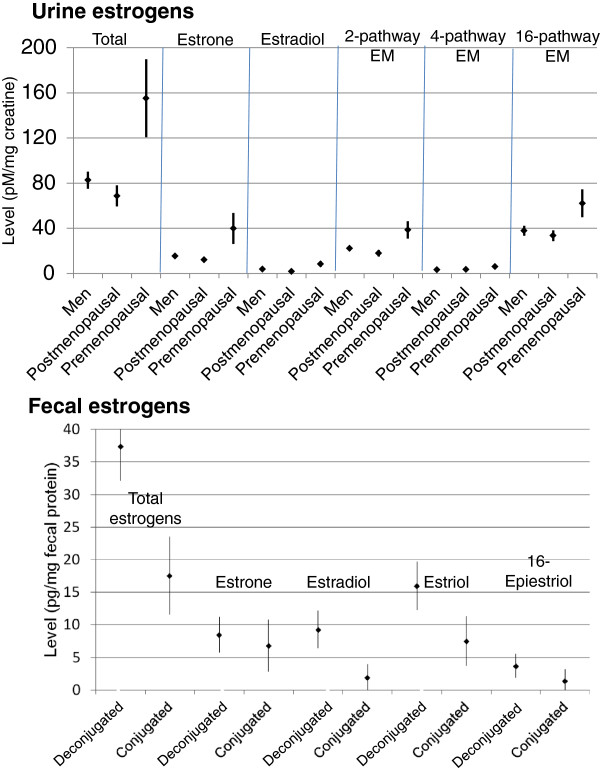
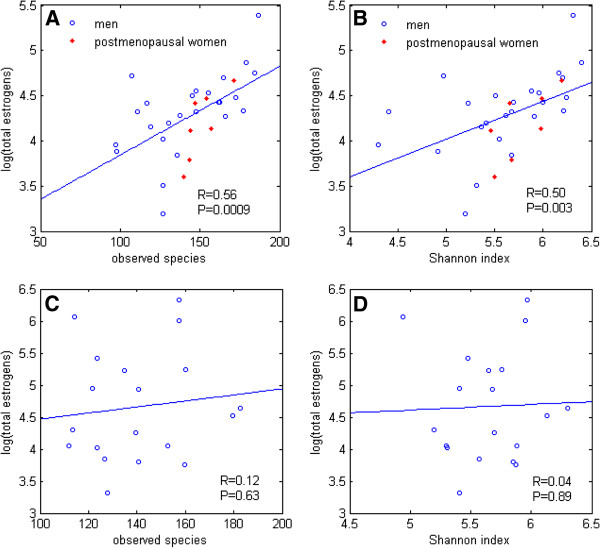
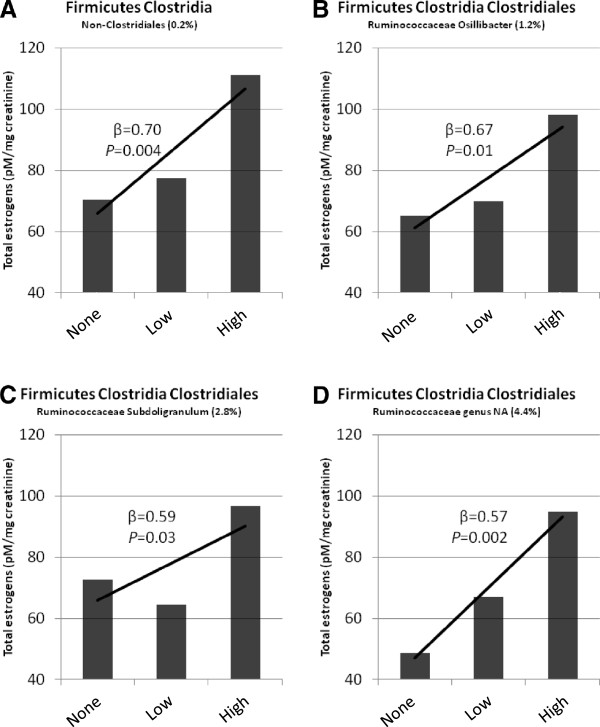
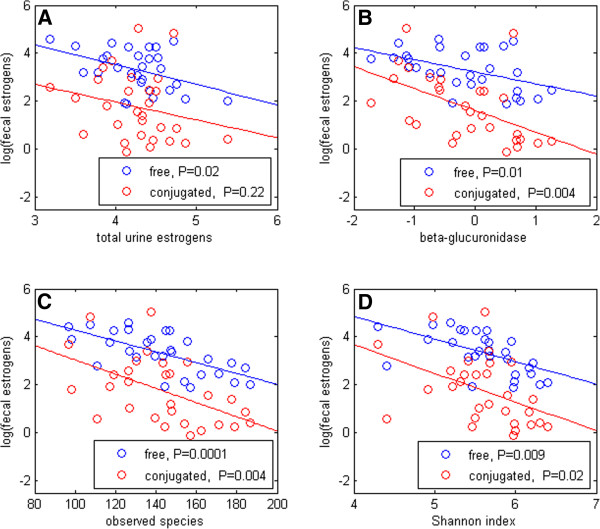
Background: High systemic estrogen levels contribute to breast cancer risk for postmenopausal women, whereas low levels contribute to osteoporosis risk. Except for obesity, determinants of non-ovarian systemic estrogen levels are undefined. We sought to identify members and functions of the intestinal microbial community associated with estrogen levels via enterohepatic recirculation. Methods: Fifty-one epidemiologists at the National Institutes of Health, including 25 men, 7 postmenopausal women, and 19 premenopausal women, provided urine and aliquots of feces, using methods proven to yield accurate and reproducible results. Estradiol, estrone, 13 estrogen metabolites (EM), and their sum (total estrogens) were quantified in urine and feces by liquid chromatography/tandem mass spectrometry. In feces, β-glucuronidase and β-glucosidase activities were determined by realtime kinetics, and microbiome diversity and taxonomy were estimated by pyrosequencing 16S rRNA amplicons. Pearson correlations were computed for each log e estrogen level, log e enzymatic activity level, and microbiome alpha diversity estimate. For the 55 taxa with mean relative abundance of at least 0.1%, ordinal levels were created [zero, low (below median of detected sequences), high] and compared to log e estrogens, β-glucuronidase and β-glucosidase enzymatic activity levels by linear regression. Significance was based on two-sided tests with α=0.05. Results: In men and postmenopausal women, levels of total urinary estrogens (as well as most individual EM) were very strongly and directly associated with all measures of fecal microbiome richness and alpha diversity (R≥0.50, P ≤0.003). These non-ovarian systemic estrogens also were strongly and significantly associated with fecal Clostridia taxa, including non- Clostridiales and three genera in the Ruminococcaceae family (R=0.57−0.70, P =0.03−0.002). Estrone, but not other EM, in urine correlated significantly with functional activity of fecal β-glucuronidase (R=0.36, P =0.04). In contrast, fecal β-glucuronidase correlated inversely with fecal total estrogens, both conjugated and deconjugated (R≤-0.47, P ≤0.01). Premenopausal female estrogen levels, which were collected across menstrual cycles and thus highly variable, were completely unrelated to fecal microbiome and enzyme parameters ( P ≥0.6). Conclusions: Intestinal microbial richness and functions, including but not limited to β-glucuronidase, influence levels of non-ovarian estrogens via enterohepatic circulation. Thus, the gut microbial community likely affects the risk for estrogen-related conditions in older adults. Understanding how Clostridia taxa relate to systemic estrogens may identify targets for interventions. Trial registration: Not applicable.
Overview
The claims and statistics of this paper haven’t been checked yet.
Free: it reads the open-access text and checks the first 5 claims that cite a source we can check. Create a free account to check every claim.
Integrity signals
Registry
Cites
Statistics
Figures
Verification
Claims the paper makes
The claims and statistics of this paper haven’t been checked yet.
Free: it reads the open-access text and checks the first 5 claims that cite a source we can check. Create a free account to check every claim.
Claims other papers make about this one
Each is checked against this paper’s own text: does it say what the citing paper says it does?
The check wasn’t confident either way, so it gives no verdict — never disputed.
In the citing paper
“However, the study reported a statistically significant association between levels of total estrogens and PD index in control women, which was not observed in women with breast cancer.”
From Association Between Sex Hormone Levels and Gut Microbiota Composition and Diversity—A Systematic Review (2022) · cites this paper as [21]
Experimental — accuracy not yet measuredIn the citing paper
“Two studies utilised the same cohort of participants and thus only the cohort from one of the two studies was included for these calculations (see Table 1).(21, 22)”
From Association Between Sex Hormone Levels and Gut Microbiota Composition and Diversity—A Systematic Review (2022) · cites this paper as [21]
In the citing paper
“In addition, the study by Goedert et al.(21) did not find an association between EM:parent estrogen and diversity in healthy women or women with breast cancer.”
From Association Between Sex Hormone Levels and Gut Microbiota Composition and Diversity—A Systematic Review (2022) · cites this paper as [21]
Self-check
Percentages, sums and reported differences re-computed from the paper’s own numbers.
The self-check needs the paper’s full text.
Citations
Cites
QIIME allows analysis of high-throughput community sequencing data
Caporaso, J. G., Kuczynski, J., Stombaugh, J., Bittinger, K., Bushman, F. D., Costello, E. K., Fierer, N., Peña, A. G., Goodrich, J. K., Gordon, J. I., et al. (2010) · Nature Methods · doi:10.1038/nmeth.f.303 · Cited by 34,887 · cited 7×
“Relative abundance of each OTU, alpha diversity, and beta diversity were computed using QIIME [25] for each DNA sample and then averaged on four replicates for each study participant.”
MethodInfluentialUCHIME improves sensitivity and speed of chimera detection
Edgar, R. C., Haas, B. J., Clemente, J. C., Quince, C., & Knight, R. (2011) · Bioinformatics · doi:10.1093/bioinformatics/btr381 · Cited by 15,114
A core gut microbiome in obese and lean twins
Turnbaugh, P. J., Hamady, M., Yatsunenko, T., Cantarel, B. L., Duncan, A., Ley, R. E., Sogin, M. L., Jones, W. J., Roe, B. A., Affourtit, J. P., et al. (2009) · Nature · doi:10.1038/nature07540 · Cited by 7,823 · cited 2×
“Because use of medications, including non-antibiotics [16], and elevated BMI [15,16] are inversely associated with gut microbiome alpha diversity, adjustment for these likely would have strengthened the direct associations that we found herein between alpha diversity and systemic estrogen levels.”
BackgroundThe Ribosomal Database Project: improved alignments and new tools for rRNA analysis
Cole, J. R., Wang, Q., Cardenas, E., Fish, J., Chai, B., Farris, R. J., Kulam-Syed-Mohideen, A. S., McGarrell, D. M., Marsh, T., Garrity, G. M., et al. (2009) · Nucleic Acids Research · doi:10.1093/nar/gkn879 · Cited by 4,762 · cited 2×
“Operational taxonomic units (OTUs) were defined using QIIME as sequences with at least 97% identity, and sequences were classified at the genus level using the Ribosomal Database Project (RDP) naïve Bayesian classifier [27].”
MethodThe NIH Human Microbiome Project
The NIH HMP Working Group, Peterson, J., Garges, S., Giovanni, M., McInnes, P., Wang, L., Schloss, J. A., Bonazzi, V., McEwen, J. E., Wetterstrand, K. A., et al. (2009) · Genome Research · doi:10.1101/gr.096651.109 · Cited by 2,066 · cited 2×
“Classification of operational taxonomic units Sequence read quality used the Institute of Genome Sciences bioinformatics pipeline that complies with standard operating procedures of the National Institutes of Health Human Microbiome Project [24].”
MethodHamady, M., Lozupone, C., & Knight, R. (2010) · The ISME Journal · doi:10.1038/ismej.2009.97 · Cited by 1,099
Alleviating Cancer Drug Toxicity by Inhibiting a Bacterial Enzyme
Wallace, B. D., Wang, H., Lane, K. T., Scott, J. E., Orans, J., Koo, J. S., Venkatesh, M., Jobin, C., Yeh, L.-A., Mani, S., et al. (2010) · Science · doi:10.1126/science.1191175 · Cited by 1,080 · cited 1×
“For example, inhibition of fecal microbial β-glucuronidases may be possible [37], although the relatively weak associations that we found between fecal β-glucuronidase activity and urinary estrogens suggest that enzyme inhibition would not markedly reduce systemic estrogen levels.”
BackgroundPlottel, C. S., & Blaser, M. J. (2011) · Cell Host & Microbe · doi:10.1016/j.chom.2011.10.003 · Cited by 743 · cited 4×
“As postulated and summarized by others [11], our results support the hypothesis that breast cancer risk in postmenopausal women and hip fracture risk in both postmenopausal women and elderly men is modulated by decades-long differences in systemic estrogens attributable to differences in the intestinal microbiota.”
BackgroundResultInfluentialObesity and Breast Cancer: The Estrogen Connection
Cleary, M. P., & Grossmann, M. E. (2009) · Endocrinology · doi:10.1210/en.2009-0070 · Cited by 504 · cited 2×
“Background Breast cancer risk is increased among postmenopausal women who have high levels of endogenous estrogens [1-3].”
BackgroundEstrogen excretion patterns and plasma levels in vegetarian and omnivorous women
Goldin, B. R., Adlercreutz, H., Gorbach, S. L., Warram, J. H., Dwyer, J. T., Swenson, L., & Woods, M. N. (1982) · New England Journal of Medicine · doi:10.1056/nejm198212163072502 · Cited by 474 · cited 1×
“A working hypothesis is that this enterohepatic recirculation affects the half-life and systemic levels of estrogens in men and postmenopausal women, and perhaps during the luteal phase in premenopausal women [9-11].”
Background
Research works printed but not linked: 1
- Raftogianis R, Creveling C, Weinshilboum R, Weisz J: Estrogen metabolism by conjugation. J Natl Cancer Inst Monogr. 2000, 113-124.
Cited by
Items 101–200 of 663
Wu, Y., Yang, X.-Y., Han, B.-S., Hu, Y., An, T., Lv, B., Lian, J., Wang, T., Bao, X., Gao, L., et al. (2022) · Biomedicine & Pharmacotherapy · doi:10.1016/j.biopha.2022.113286 · Cited by 104
The Microbiome and Eating Disorders
Seitz, J., Trinh, S., & Herpertz-Dahlmann, B. (2019) · Psychiatric Clinics of North America · doi:10.1016/j.psc.2018.10.004 · Cited by 94
Ruo, S. W., Alkayyali, T., Win, M., Tara, A., Joseph, C., Kannan, A., Srivastava, K., Ochuba, O., Sandhu, J. K., Went, T. R., et al. (2021) · Cureus · doi:10.7759/cureus.17472 · Cited by 87
“[33] 2012 Observational study: Crosssectional study 51 25 men, seven postmenopausal women, and 19 premenopausal women To identify members and functions of the intestinal microbiota that influence estrogen levels via enterohepatic recirculation.”
BackgroundMethodInfluentialBone Remodeling and the Microbiome
Pacifici, R. (2018) · Cold Spring Harbor Perspectives in Medicine · doi:10.1101/cshperspect.a031203 · Cited by 101
“Interestingly, estrogen depletion has also been associated with decreased a diversity in the gut microbiome (Flores et al. 2012; Fuhrman et al. 2014), whereas microbial diversity in the gut transiently increases with administration of probiotics (Preidis et al. 2012).”
BackgroundInteractions Between Food and Gut Microbiota: Impact on Human Health
Wu, Y., Wan, J., Choe, U., Pham, Q., Schoene, N. W., He, Q., Li, B., Yu, L. L., & Wang, T. T. Y. (2019) · Annual Review of Food Science and Technology · doi:10.1146/annurev-food-032818-121303 · Cited by 103
Correlation of fecal metabolomics and gut microbiota in mice with endometriosis
Ni, Z., Sun, S., Bi, Y., Ding, J., Cheng, W., Yu, J., Zhou, L., Li, M., & Yu, C. (2020) · American Journal of Reproductive Immunology · doi:10.1111/aji.13307 · Cited by 97
The Clinical Link between Human Intestinal Microbiota and Systemic Cancer Therapy
Aarnoutse, R., Ziemons, J., Penders, J., Rensen, S. S., de Vos-Geelen, J., & Smidt, M. L. (2019) · International Journal of Molecular Sciences · doi:10.3390/ijms20174145 · Cited by 83
“It has been suggested that gut bacteria affect the development of breast cancer through modulation of estrogen m tabolism [12,13].”
BackgroundThe gut-eye-lacrimal gland-microbiome axis in Sjögren Syndrome
Trujillo-Vargas, C. M., Schaefer, L., Alam, J., Pflugfelder, S. C., Britton, R. A., & de Paiva, C. S. (2019) · The Ocular Surface · doi:10.1016/j.jtos.2019.10.006 · Cited by 97
“In men and postmenopausal, as oppose to premenopausal women, levels of total urinary non-ovarian estrogens and most of their metabolites were associated with the fecal microbiome diversity [22].”
BackgroundCross, T.-W., Simpson, A. M. R., Lin, C.-Y., Hottmann, N. M., Bhatt, A. P., Pellock, S. J., Nelson, E. R., Loman, B. R., Wallig, M. A., Vivas, E. I., et al. (2023) · Gut Microbes · doi:10.1080/19490976.2023.2295429 · Cited by 96
“39 In our current study, loss of ovarian hormones led to an increase in fecal β-glucuronidase in donor mice.”
BackgroundComprehensive review on the electrochemical biosensors of different breast cancer biomarkers
Mostafa, I. M., Tian, Y., Anjum, S., Hanif, S., Hosseini, M., Lou, B., & Xu, G. (2022) · Sensors and Actuators B Chemical · doi:10.1016/j.snb.2022.131944 · Cited by 94
Cox-York, K. A., Sheflin, A. M., Foster, M. T., Gentile, C. L., Kahl, A., Koch, L. G., Britton, S. L., & Weir, T. L. (2015) · Physiological Reports · doi:10.14814/phy2.12488 · Cited by 84
“There is a paucity of literature regarding changes in gut microbiota with loss of estrogen, but limited human data indicate that gut ecology may change under these circumstances, accompanied by metabolic consequences (Flores et al. 2012; Fuhrman et al. 2014).”
BackgroundMicrobial Alterations and Risk Factors of Breast Cancer: Connections and Mechanistic Insights
Parida, S., & Sharma, D. (2020) · Cells · doi:10.3390/cells9051091 · Cited by 81
Fecal Microbiota Changes in Patients With Postpartum Depressive Disorder
Zhou, Y., Chen, C., Yu, H., & Yang, Z. (2020) · Frontiers in Cellular and Infection Microbiology · doi:10.3389/fcimb.2020.567268 · Cited by 93
“The gut microbiota has been shown to be influenced by E2; meanwhile, the gut microbiota also could regulate E2 level through secreting β-glucuronidase (Flores et al., 2012; Huang et al., 2017).”
BackgroundByrd, D. A., Vogtmann, E., Wu, Z., Han, Y., Wan, Y., Clegg‐Lamptey, J., Yarney, J., Wiafe‐Addai, B., Wiafe, S., Awuah, B., et al. (2021) · International Journal of Cancer · doi:10.1002/ijc.33473 · Cited by 90
Self-citationBile acids and neurological disease
Hurley, M. J., Bates, R., Macnaughtan, J., & Schapira, A. H. V. (2022) · Pharmacology & Therapeutics · doi:10.1016/j.pharmthera.2022.108311 · Cited by 88
“One study has demonstrated that faecal microbiome complexity and richness can be strongly associated with oestrogens levels (Flores et al., 2012) where the gut microbiota regulates oestrogens through secretion of β-glucuronidase.”
BackgroundPrecocious puberty and microbiota: The role of the sex hormone–gut microbiome axis
Calcaterra, V., Rossi, V., Massini, G., Regalbuto, C., Hruby, C., Panelli, S., Bandi, C., & Zuccotti, G. (2022) · Frontiers in Endocrinology · doi:10.3389/fendo.2022.1000919 · Cited by 91
“The supplementation of phytoestrogen is capable of promoting gut colonization from specific bacterial species, and a phytoestrogen-rich diet may be associated with a lower risk of metabolic syndrome in Asian postmenopausal women (57, 58).”
BackgroundEstrogens and female liver health
Chen, K. L., & Madak‐Erdogan, Z. (2017) · Steroids · doi:10.1016/j.steroids.2017.10.015 · Cited by 87
“For example, some bacterial species with β-glucosidase activity can deconjugate estrogens, producing estrogens with higher biological activity [112].”
BackgroundThe Interplay of Sex Steroids, the Immune Response, and the Intestinal Microbiota
de Pace, F., & Watnick, P. I. (2020) · Trends in Microbiology · doi:10.1016/j.tim.2020.11.001 · Cited by 86
Tesei, D., Jewczynko, A., Lynch, A., & Urbaniak, C. (2022) · Life · doi:10.3390/life12040495 · Cited by 88
Larnder, A., Manges, A. R., & Murphy, R. A. (2025) · International Journal of Cancer · doi:10.1002/ijc.35427 · Cited by 87
“…identified seven specific genera: Bacteroides associated with the metabolite to parent estrogen ratio 80 ; Oscillibacter, Subdoligranulum , and Ruminococcaceae genus NA with estrogens and metabolites 23 ; Slackia and Butyricimonas with estradiol 79 ; and Blautia with progesterone 76 (Table 3).”
Salmonella Typhimurium and Multidirectional Communication in the Gut
Gart, E. V., Suchodolski, J. S., Welsh, T. H., Alaniz, R. C., Randel, R. D., & Lawhon, S. D. (2016) · Frontiers in Microbiology · doi:10.3389/fmicb.2016.01827 · Cited by 88
“This idea is supported by the finding that the Salmonella AHL-receptor SdiA was activated in the GI tract of turtles colonized with Aeromonas hydrophila (Smith et al., 2008).”
BackgroundResultSex Differences in the Gut-Brain Axis: Implications for Mental Health
Holingue, C., Budavari, A. C., Rodriguez, K. M., Zisman, C. R., Windheim, G., & Fallin, M. D. (2020) · Current Psychiatry Reports · doi:10.1007/s11920-020-01202-y · Cited by 85
Probiotics ameliorate alveolar bone loss by regulating gut microbiota
Jia, L., Tu, Y., Jia, X., Du, Q., Zheng, X. M., Yuan, Q., Zheng, L., Zhou, X., & Xu, X. (2021) · Cell Proliferation · doi:10.1111/cpr.13075 · Cited by 88
Self-citationCorrie, L., Awasthi, A., Kaur, J., Vishwas, S., Gulati, M., Kaur, I. P., Gupta, G., Kommineni, N., Dua, K., & Singh, S. K. (2023) · Pharmaceuticals · doi:10.3390/ph16020197 · Cited by 85
“Total urine estrogen was reported to be strongly linked with gut microbial diversity in 7 postmenopausal women and 25 men [21].”
BackgroundFrom Microbiome to Inflammation: The Key Drivers of Cervical Cancer
Zhou, Z., Long, H., Cheng, Y., Luo, H., Wen, D., & Gao, L. (2021) · Frontiers in Microbiology · doi:10.3389/fmicb.2021.767931 · Cited by 84
Emerging literature in the Microbiota-Brain Axis and Perinatal Mood and Anxiety Disorders
Rackers, H. S., Thomas, S., Williamson, K., Posey, R., & Kimmel, M. C. (2018) · Psychoneuroendocrinology · doi:10.1016/j.psyneuen.2018.05.020 · Cited by 76
“The gut microbiota is associated with systemic estrogen levels (Flores et al., 2012; Baker et al., 2017).”
BackgroundOsteomicrobiology: The influence of gut microbiota on bone in health and disease
Jones, R. M., Mullé, J. G., & Pacifici, R. (2017) · Bone · doi:10.1016/j.bone.2017.04.009 · Cited by 82
Structural basis for the regulation of β-glucuronidase expression by human gut Enterobacteriaceae
Little, M. S., Pellock, S. J., Walton, W. G., Tripathy, A., & Redinbo, M. R. (2017) · Proceedings of the National Academy of Sciences · doi:10.1073/pnas.1716241115 · Cited by 82
Role of the gut microbiota in the pathogenesis of endometriosis: a review
Guo, C., & Zhang, C. (2024) · Frontiers in Microbiology · doi:10.3389/fmicb.2024.1363455 · Cited by 83
“…through the enterohepatic circulation thereby significantly stimulating the growth of ectopic lesions and participating in the pathological process of periodic bleeding of endometriosis (Plottel and Blaser, 2011; Flores et al., 2012; Shen et al., 2012; Baker et al., 2017; Wei et al., 2023).”
BackgroundRossi, P., Francia, R. D., Quagliariello, V., Savino, E., Tralongo, P., Randazzo, C. L., & Berretta, M. (2018) · Oncotarget · doi:10.18632/oncotarget.24984 · Cited by 79
The role of the gut microbiome in sex differences in arterial pressure
Beale, A. L., Kaye, D. M., & Marques, F. Z. (2019) · Biology of Sex Differences · doi:10.1186/s13293-019-0236-8 · Cited by 78
Chen, K. L. A., Liu, X., Zhao, Y. C., Hieronymi, K., Rossi, G., Auvil, L. S., Welge, M. E., Bushell, C., Smith, R. L., Carlson, K. E., et al. (2018) · Scientific Reports · doi:10.1038/s41598-018-26506-1 · Cited by 78
Song, C., Kim, N., Nam, R. H., Choi, S. I., Lee, H., & Surh, Y. (2020) · Scientific Reports · doi:10.1038/s41598-020-69112-w · Cited by 77
Estradiol and high fat diet associate with changes in gut microbiota in female ob/ob mice
Acharya, K. D., Gao, X., Bless, E. P., Chen, J., & Tetel, M. J. (2019) · Scientific Reports · doi:10.1038/s41598-019-56723-1 · Cited by 74
Microbiome impact on metabolism and function of sex, thyroid, growth and parathyroid hormones.
Kunc, M., Gabrych, A., & Witkowski, J. M. (2015) · Acta Biochimica Polonica · doi:10.18388/abp.2015_1093 · Cited by 67
“In turn bile salts enhance β‑glucuronidase activity (Fujisawa & Mori, 1996), while weight loss elevates its fecal level (Flores et al., 2012b).”
BackgroundHou, M., Ou‐Yang, F., Li, C.-L., Chen, F., Chuang, C., Kan, J., Wu, C.-C., Shih, S., Shiau, J., Kao, L.-C., et al. (2021) · Experimental & Molecular Medicine · doi:10.1038/s12276-021-00686-9 · Cited by 74
Probiotics and Prebiotics: Any Role in Menopause-Related Diseases?
Barrea, L., Verde, L., Auriemma, R. S., Vetrani, C., Cataldi, M., Frías-Toral, E., Pugliese, G., Camajani, E., Savastano, S., Colao, A., et al. (2023) · Current Nutrition Reports · doi:10.1007/s13668-023-00462-3 · Cited by 74
Wang, Y., Li, Y., Bo, L., Zhou, E., Chen, Y., Naranmandakh, S., Xie, W., Ru, Q., Chen, L., Zhu, Z., et al. (2023) · Gut Microbes · doi:10.1080/19490976.2023.2263207 · Cited by 73
“113 It has been reported that non-ovarian estrogen is influenced more by the gut microbiome, 259 which may be one of the reasons why postmenopausal women are more prone to OP.”
BackgroundOncobiosis and Microbial Metabolite Signaling in Pancreatic Adenocarcinoma
Kiss, B., Mikó, E., Sebő, É., Tóth, J., Ujlaki, G., Szabó, J., Uray, K., Bai, P., & Árkosy, P. (2020) · Cancers · doi:10.3390/cancers12051068 · Cited by 73
Vaginal Microbiota Is Stable throughout the Estrous Cycle in Arabian Mares
Barba, M., Martínez‐Boví, R., Quereda, J. J., Mocé, M. L., Plaza‐Dávila, M., Jiménez-Trigos, E., Gómez‐Martín, Á., González‐Torres, P., Carbonetto, B., & García‐Roselló, E. (2020) · Animals · doi:10.3390/ani10112020 · Cited by 71
“Furthermore, it has been shown that gut microbiome dysbiosis is associated to increased blood estrogen concentration, which could alter reproductive function [45].”
BackgroundFu, X., Han, H., Li, Y., Xu, B., Dai, W., Zhang, Y., Zhou, F., Ma, H., & Pei, X. (2021) · Environmental Toxicology · doi:10.1002/tox.23121 · Cited by 72
“The gut microbiome modulates the estrogen level in the host by secreting β-glucuronidase, an enzyme that suppresses the binding of estrogen to its receptors and its subsequent physiological downstream effects.(29,45) The composition of the gut microbiota was recently shown to play an important role in sexual dimorphis…”
BackgroundKovtun, A. S., Averina, O. V., Angelova, I. Y., Yunes, R. А., Zorkina, Y., Morozova, A. Y., Pavlichenko, A. V., Syunyakov, T., Karpenko, O., Kostyuk, G. P., et al. (2022) · Biomedicines · doi:10.3390/biomedicines10092162 · Cited by 72
Impact of Probiotics and Prebiotics on Gut Microbiome and Hormonal Regulation
Basnet, J., Eissa, M., Cardozo, L. L. Y., Romero, D. G., & Rezq, S. (2024) · Gastrointestinal Disorders · doi:10.3390/gidisord6040056 · Cited by 71
“Altering β -glucuronidase activity [98] Dysbiosis may influence the progression of endometriosis in females.”
The Role of Microbiota in the Immunopathogenesis of Endometrial Cancer
Sobstyl, M., Brecht, P., Sobstyl, A., Mertowska, P., & Grywalska, E. (2022) · International Journal of Molecular Sciences · doi:10.3390/ijms23105756 · Cited by 70
“However, estrogen levels in premenopausal women are not affected by the microbiota or the activity of glucuronidase [82].”
BackgroundInfluentialGut Microbiome–Estrobolome Profile in Reproductive-Age Women with Endometriosis
Pai, A. H.-Y., Wang, Y., Lu, P., Wu, H., Xu, J., & Huang, H.-Y. (2023) · International Journal of Molecular Sciences · doi:10.3390/ijms242216301 · Cited by 69
“Lastly, since prior studies had suggested that the enterohepatic recirculation of estrogen contributed to its systemic levels [15,42–44], we applied liquid chromatography/tandem mass spectrometry for highly sensitive and reproducible detection of parent estrogens (estradiol and estrone) and 12…”
MethodThe Role of Lifestyle and Dietary Factors in the Development of Premature Ovarian Insufficiency
Shelling, A. N., & Nasef, N. A. (2023) · Antioxidants · doi:10.3390/antiox12081601 · Cited by 70
“Specifically, non-ovarian oestrogens in male and post-menopausal women were associated with bacterially produced β-glucuronidase enzymes [25].”
BackgroundMicrobial Determinants of Biochemical Individuality and Their Impact on Toxicology and Pharmacology
Patterson, A. D., & Turnbaugh, P. J. (2014) · Cell Metabolism · doi:10.1016/j.cmet.2014.07.002 · Cited by 66
“…lately due to their contributions to the dose-limiting side effects of multiple medications (LoGuidice et al., 2012; Saitta et al., 2014; Wallace et al., 2010), yet these same enzymes also contribute to the enterohepatic circulation of bile acids and the sex hormone estrogen (Flores et al., 2012).”
Menopausal Changes in the Microbiome—A Review Focused on the Genitourinary Microbiome
Park, M. G., Cho, S., & Oh, M. M. (2023) · Diagnostics · doi:10.3390/diagnostics13061193 · Cited by 67
“It has been reported that diversity in intestinal microbiome and functions can affect various estrogen-dependent disorders by altering estrogen concentrations independent of the ovaries [14].”
BackgroundSynergistic effects of APOE and sex on the gut microbiome of young EFAD transgenic mice
Maldonado Weng, J., Parikh, I., Naqib, A., York, J., Green, S. J., Estus, S., & LaDu, M. J. (2019) · Molecular Neurodegeneration · doi:10.1186/s13024-019-0352-2 · Cited by 64
Jaye, K. M., Chang, D., Li, C. G., & Bhuyan, D. J. (2022) · International Journal of Molecular Sciences · doi:10.3390/ijms23169490 · Cited by 67
Xu, M., Zhou, E. Y., & Shi, H. (2025) · Cells · doi:10.3390/cells14050384 · Cited by 69
“Among men, premenopausal women, and postmenopausal women, increased concentrations of estrogenic metabolites, along with reduced estrogen levels, positively correlate with increased microbial diversity, measured using fecal samples, and a reduced risk for breast cancer and metabolic diseases [158].”
Kúdela, E., Líšková, A., Samec, M., Koklesová, L., Holubeková, V., Rokos, T., Kozubík, E., Pribulová, T., Zhai, K., Büsselberg, D., et al. (2021) · The EPMA Journal · doi:10.1007/s13167-021-00244-3 · Cited by 66
“Enteric bacteria can deconjugate estrogens and promote their reabsorption to the circulatory system [49] This leads to the increased glycogen and mucus production and thickening of the epithelium of the lower genital tract.”
BackgroundEstrogens and Body Weight Regulation in Men
Rubinow, K. B. (2017) · Advances in Experimental Medicine and Biology · doi:10.1007/978-3-319-70178-3_14 · Cited by 60
“In a cross-sectional study that included healthy men, urinary estrogen levels exhibited a strong, positive correlation with diversity in intestinal flora and fecal β-glucuronidase activity, leading the authors to posit that the gut microbiome may regulate circulating estrogen levels (Flores et al. 2012).”
Koninckx, P., Ussia, A., Tahlak, M., Adamyan, L. V., Wattiez, A., Martin, D. C., & Gomel, V. (2019) · PubMed Central · Cited by 69
Sex-Bias in Irritable Bowel Syndrome: Linking Steroids to the Gut-Brain Axis
So, S. Y., & Savidge, T. (2021) · Frontiers in Endocrinology · doi:10.3389/fendo.2021.684096 · Cited by 67
Frąszczak, K., Barczyński, B., & Kondracka, A. (2022) · Cancers · doi:10.3390/cancers14194909 · Cited by 67
“and β-glucosidase secreted by microorganisms attach to oestrogen, thus leading to its enhanced reabsorption into the circulation [53,54].”
BackgroundCuervo-Zanatta, D., Garcia-Mena, J., & Perez-Cruz, C. (2021) · Journal of Alzheimer's Disease · doi:10.3233/jad-201367 · Cited by 56
Significance of human microbiome in breast cancer: Tale of an invisible and an invincible
Chadha, J., Nandi, D., Atri, Y., & Nag, A. (2020) · Seminars in Cancer Biology · doi:10.1016/j.semcancer.2020.07.010 · Cited by 63
Sári, Z., Mikó, E., Kovàcs, T., Boratkó, A., Ujlaki, G., Jankó, L., Kiss, B., Uray, K., & Bai, P. (2020) · Cancers · doi:10.3390/cancers12102915 · Cited by 64
“Of note, in addition to the loss of cytostatic properties, the breast cancer oncobiome has an increased capacity for reactive estrogens and increase estrogen enterohepatic circulation [1,93].”
BackgroundEndometriosis research in the -omics era
Goulielmos, G. N., Matalliotakis, M., Matalliotaki, C., Eliopoulos, E., Matalliotakis, I., & Zervou, M. I. (2020) · Gene · doi:10.1016/j.gene.2020.144545 · Cited by 62
“Furthermore, the gut microbiota may leads to endometriosis through its role in the regulation of estrogen cycling (Flores et al., 2012).”
BackgroundMihajlovic, J., Leutner, M., Hausmann, B., Köhl, G., Schwarz, J., Röver, H., Stimakovits, N. M., Wolf, P. S., Maruszczak, K., Bastian, M., et al. (2021) · Environmental Microbiology · doi:10.1111/1462-2920.15517 · Cited by 63
“, 2019) or pre- and post-menopausal women (Flores et al., 2012; Fuhrman et al., 2014).”
BackgroundResultInfluentialThe Microbiome and Gynecologic Cancer: Current Evidence and Future Opportunities
Chambers, L., Bussies, P. L., Vargas, R., Esakov, E. L., Tewari, S., Reizes, O., & Michener, C. M. (2021) · Current Oncology Reports · doi:10.1007/s11912-021-01079-x · Cited by 62
Sex, puberty, and the gut microbiome
Sisk-Hackworth, L., Kelley, S. T., & Thackray, V. G. (2023) · Reproduction · doi:10.1530/rep-22-0303 · Cited by 61
“Studies in humans and rats demonstrated that antibiotic treatment dramatically increased the ratio of conjugated to deconjugated estrogens excreted in urine and feces (Adlercreutz et al. 1984, Goldin & Gorbach 1984, Flores et al. 2012).”
BackgroundPark, S., Kim, D. S., Kang, E. S., Kim, D. B., & Kang, S. (2018) · American Journal of Physiology-Endocrinology and Metabolism · doi:10.1152/ajpendo.00005.2018 · Cited by 54
“Interestingly, gut microbial diversity and composition contribute to the levels of nonovarian estrogen through enterohepatic circulation (8).”
BackgroundBorsom, E. M., Lee, K., & Cope, E. K. (2020) · Brain Sciences · doi:10.3390/brainsci10110814 · Cited by 61
“Depleted systemic estrogens are linked to cognitive decline, memory loss, and reduced fine motor skills [18,19].”
BackgroundHuman gut, breast, and oral microbiome in breast cancer: A systematic review and meta-analysis
Thu, M. S., Chotirosniramit, K., Nopsopon, T., Hirankarn, N., & Pongpirul, K. (2023) · Frontiers in Oncology · doi:10.3389/fonc.2023.1144021 · Cited by 60
“The human microbiota, on the other hand, has drawn considerable interest as a key risk modulator due to its unique function in controlling steroid hormone metabolism by activating various enzymes, including hydroxysteroid dehydrogenase (6, 7).”
BackgroundSchreurs, M. P. H., van Steenwijk, P. J. D. V., Romano, A., Dieleman, S., & Werner, H. M. J. (2021) · Journal of Clinical Medicine · doi:10.3390/jcm10132916 · Cited by 62
“Study Sample Size Patient Characteristics Gut Microbiota Analysis Main Findings Flores et al. (2012) n = 19 premenopausal women n = 7 postmenopausal women n = 22 age matched men (55 yrs and older) Average BMI 26 In feces, β-glucuronidase and β-glucosidase activities were determined by real-time…”
BackgroundMethodInfluentialAnalysis of Gut Microbiota in Patients with Breast Cancer and Benign Breast Lesions
Ma, Z., Qu, M., & Wang, X. (2022) · Polish Journal of Microbiology · doi:10.33073/pjm-2022-019 · Cited by 58
The Gut–Heart Axis: Molecular Perspectives and Implications for Myocardial Infarction
Rivera, K., González, L., Bravo, L., Manjarres, L., & Andía, M. E. (2024) · International Journal of Molecular Sciences · doi:10.3390/ijms252212465 · Cited by 58
“Fecal transplantation and hormone studies further demonstrate sex-related microbiota differences [117–120].”
Chen, Q., Wang, B., Wang, S., Qian, X., Xiu, L., Zhao, J., Zhang, H., Chen, W., & Wang, G. (2021) · Nutrients · doi:10.3390/nu13061793 · Cited by 58
“It is well known that the intestinal microbiome is influenced by estrogen; however, the intestinal microbiome also has a significant effect on the circulating estrogen concentration [58].”
BackgroundSheu, J. J.-C., Chiang, A., Chiang, A.-J., Yan, M.-J., Yen, M.-J., Tseng, C.-C., Lun-Chien, L., Wan, L., Li, C.-J., Tsui, K.-H., et al. (2021) · Biomedicines · doi:10.3390/biomedicines10010174 · Cited by 59
Kovàcs, T., Mikó, E., Ujlaki, G., Yousef, H., Csontos, V., Uray, K., & Bai, P. (2021) · Cancer and Metastasis Reviews · doi:10.1007/s10555-021-10013-3 · Cited by 57
“Goedert and colleagues provided strong evidence for the involvement of Clostridiales in estrogen reactivation in breast cancer patients [73, 121, 122].”
BackgroundThe effects of microbiota on reproductive health: A review
Wang, N., Chen, L., Yi, K., Zhang, B., Li, C., & Zhou, X. (2022) · Critical Reviews in Food Science and Nutrition · doi:10.1080/10408398.2022.2117784 · Cited by 57
“The diversity and composition of the intestinal microbiota influence the levels of non-ovarian estrogens, presumably through effects on enterohepatic circulation (Flores et al. 2012).”
BackgroundPathogenesis of uterine fibroids: current understanding and future directions
Dolmans, M., Petraglia, F., Catherino, W. H., & Donnez, J. (2024) · Fertility and Sterility · doi:10.1016/j.fertnstert.2024.02.048 · Cited by 58
Modulating Microbiota as a New Strategy for Breast Cancer Prevention and Treatment
Wu, H., Ganguly, S., & Tollefsbol, T. O. (2022) · Microorganisms · doi:10.3390/microorganisms10091727 · Cited by 57
Role of the microbiome in oral cancer occurrence, progression and therapy
Li, Z., Liu, Y., & Zhang, L. (2022) · Microbial Pathogenesis · doi:10.1016/j.micpath.2022.105638 · Cited by 56
Gut microbiota and female health
Wang, M.-Y., Sang, L.-X., & Sun, S. (2024) · World Journal of Gastroenterology · doi:10.3748/wjg.v30.i12.1655 · Cited by 54
Arnone, A. A., & Cook, K. L. (2022) · Endocrinology · doi:10.1210/endocr/bqac177 · Cited by 55
Jeong, S., Chokkalla, A. K., Davis, C. K., & Vemuganti, R. (2023) · Molecular Psychiatry · doi:10.1038/s41380-023-02099-8 · Cited by 54
Sobstyl, A., Chałupnik, A., Mertowska, P., & Grywalska, E. (2023) · International Journal of Molecular Sciences · doi:10.3390/ijms241310920 · Cited by 53
“This process can lead to increased exposure to estrogens and potentially exacerbate estrogen-driven conditions such as endometriosis [227,228].”
BackgroundAssociation between the microbiota and women’s cancers – Cause or consequences?
Alizadehmohajer, N., Shojaeifar, S., Nedaeinia, R., Esparvarinha, M., Mohammadi, F., Ferns, G. A., Ghayour‐Mobarhan, M., Manian, M., & Balouchi, A. (2020) · Biomedicine & Pharmacotherapy · doi:10.1016/j.biopha.2020.110203 · Cited by 53
The Problem of Malnutrition Associated with Major Depressive Disorder from a Sex-Gender Perspective
Montero, C. G., Ortega, M. A., Álvarez-Mon, M. Á., Fraile‐Μartinez, O., Romero-Bazán, A., Lahera, G., Montes, J. M. G., Molina-Ruiz, R. M., Mora, F., Rodríguez–Jiménez, R., et al. (2022) · Nutrients · doi:10.3390/nu14051107 · Cited by 54
“The latter plays an important role in the regulation of non-ovarian estrogen levels, affecting the risk of suffering from conditions of a different nature in postmenopausal women and elderly men [64].”
BackgroundMaternal effects in mammals: Broadening our understanding of offspring programming
Edwards, P. D., Lavergne, S. G., McCaw, L. K., Wijenayake, S., Boonstra, R., McGowan, P. O., & Holmes, M. M. (2021) · Frontiers in Neuroendocrinology · doi:10.1016/j.yfrne.2021.100924 · Cited by 52
Estrous cycle and ovariectomy-induced changes in visceral pain are microbiota-dependent
Tramullas, M., Collins, J. M., Fitzgerald, P., Dinan, T. G., O’Mahony, S. M., & Cryan, J. F. (2021) · iScience · doi:10.1016/j.isci.2021.102850 · Cited by 51
The conundrum of breast cancer and microbiome - A comprehensive review of the current evidence
Papakonstantinou, A., Nuciforo, P. G., Borrell, M., Zamora, E., Pimentel, I., Saura, C., & Oliveira, M. (2022) · Cancer Treatment Reviews · doi:10.1016/j.ctrv.2022.102470 · Cited by 51
Ventolini, G., Vieira‐Baptista, P., Seta, F. D., Verstraelen, H., Hoffmann, R., & Lev‐Sagie, A. (2021) · Journal of Lower Genital Tract Disease · doi:10.1097/lgt.0000000000000646 · Cited by 50
Gut-Bone Axis: A Non-Negligible Contributor to Periodontitis
Jia, X., Yang, R., Li, J., Жао, Л., Zhou, X., & Xu, X. (2021) · Frontiers in Cellular and Infection Microbiology · doi:10.3389/fcimb.2021.752708 · Cited by 50
Self-citationVariations in the Gut Microbiota in Breast Cancer Occurrence and Bone Metastasis
Yu, W., Xie, Z., Kai, C., Zhaopeng, C., Li, J., Mengjun, M., Su, Z., Yunshu, C., Wang, P., Wu, Y., et al. (2022) · Frontiers in Microbiology · doi:10.3389/fmicb.2022.894283 · Cited by 50
Sex Difference of Gut Microbiota
Kim, N. (2022) · Springer eBooks · doi:10.1007/978-981-19-0120-1_22 · Cited by 49
Iavarone, I., Greco, P., Verde, M. L., Morlando, M., Torella, M., FRANCISCIS, P. D., & Ronsini, C. (2023) · Medicina · doi:10.3390/medicina59020347 · Cited by 49
“Estrogen levels in postmenopausal patients are associated with both richness of species in gut microbiota and levels of Clostridia taxa in fecal samples [1].”
BackgroundPotential role of gastrointestinal microbiota composition in prostate cancer risk
Amirian, E. S., Petrosino, J. F., Ajami, N. J., Liu, Y., Mims, M. P., & Scheurer, M. E. (2013) · Infectious Agents and Cancer · doi:10.1186/1750-9378-8-42 · Cited by 49
“Some enzymes, such as β-glucuronidases, that may be of particular relevance to prostate cancer development are involved in conjugation and de-conjugation of sex hormones, such as estrogen [51-53].”
BackgroundLi, Y., Dong, B., Wu, W., Wang, J., Jin, H., Chen, K., Huang, K., Huang, S., & Yao, Y. (2022) · Frontiers in Oncology · doi:10.3389/fonc.2022.865121 · Cited by 48
Dysbiosis and extraintestinal cancers
He, R., Qi, P., Shu, L.-Z., Ding, Y., Zeng, P., Wen, G., Xiong, Y., & Deng, H. (2025) · Journal of Experimental & Clinical Cancer Research · doi:10.1186/s13046-025-03313-x · Cited by 49
Jeong, S.-Y., Kang, S., Hua, C. S., Zhang, T., & Park, S. (2017) · Genes & Nutrition · doi:10.1186/s12263-017-0585-z · Cited by 49
“Sex hormones including estrogen and testosterone have been reported to modulate microbial communities [4], and gut microbiota influence systemic levels of sex hormones [5, 6].”
BackgroundThe relationship between menopausal syndrome and gut microbes
Liu, Y., Zhou, Y., Mao, T., Huang, Y., Liang, J., Zhu, M., Yao, P., Zong, Y., Lang, J., & Zhang, Y. (2022) · BMC Women s Health · doi:10.1186/s12905-022-02029-w · Cited by 49
“Estrogen has been showed to influence the gut microbiome, and gut microbiome also had a significant impact on estrogen levels [30, 31].”
BackgroundNi, Z., Ding, J., Zhao, Q., Cheng, W., Yu, J., Zhou, L., Sun, S., & Yu, C. (2021) · American Journal of Reproductive Immunology · doi:10.1111/aji.13471 · Cited by 47
Diet associations in endometriosis: a critical narrative assessment with special reference to gluten
Brouns, F. J. P. H., van Haaps, A. P., Keszthelyi, D., Venema, K., Bongers, M. Y., Maas, J. W. M., & Mijatovic, V. (2023) · Frontiers in Nutrition · doi:10.3389/fnut.2023.1166929 · Cited by 48
“…related increased β -glucuronidase activity can result in elevated estrogens levels whereas a dysbiosis induced decreased activity may induce decreased circulating estrogens (112), which in fact should counteract the earlier suggested positive association between dysbiosis and endometriosis.”
BackgroundCharacterizing the breast cancer lipidome and its interaction with the tissue microbiota
Giallourou, N., Urbaniak, C., Puebla-Barragan, S., Vorkas, P. A., Swann, J. R., & Reid, G. (2021) · Communications Biology · doi:10.1038/s42003-021-02710-0 · Cited by 46
Roles of Gut Microbiome in Bone Homeostasis and Its Relationship with Bone-Related Diseases
Zemanová, N., Omelka, R., Mondočková, V., Kováčová, V., & Martiniaková, M. (2022) · Biology · doi:10.3390/biology11101402 · Cited by 46
“Another study found [81] that a number of unique bacterial species is directly associated with systemic estrogens; thus, the GM could affect the risk for estrogen-related conditions in older adults.”
BackgroundKałuża, J., Komatsu, S., Lauriola, M., Harris, H. R., Bergkvist, L., Michaëlsson, K., & Wolk, A. (2020) · Clinical Nutrition · doi:10.1016/j.clnu.2020.09.013 · Cited by 45
Metadata
- Authors
- Flores, R., Shi, J., Fuhrman, B., Xu, X., Veenstra, T. D., Gail, M. H., Gajer, P., Ravel, J., & Goedert, J. J.
- Affiliations
- National Cancer Institute (US)
- Science Applications International Corporation (United States) (US)
- University of Maryland, Baltimore (US)
- Corresponding author
- Goedert, James J
- ORCID
- Venue
- Journal of Translational Medicine
- Published
- 2012-12
- Volume
- 10
- Issue
- 1
- Pages
- 253-253
- ISSN
- 1479-5876 (ISSN-L)
- PMC
- PMC3552825
- OpenAlex
- W2157570303
- Cited by
- 615
- References
- 43
- Citations by year
- 2026: 57 · 2025: 79 · 2024: 89 · 2023: 80 · 2022: 68 · 2021: 78 · 2020: 61 · 2019: 34 · 2018: 19 · 2017: 22 · 2016: 12 · 2015: 8 · 2014: 5 · 2013: 2
- FWCI
- 1.93
- Type
- journal article
- Language
- en
- Open access
- gold
- doi.org
- Licence
- cc-by
- Locations
- Journal of Translational Medicine (publishedVersion, cc-by)
- Europe PMC (PubMed Central) (publishedVersion, cc-by)
- PubMed Central (publishedVersion, cc-by)
- PubMed (publishedVersion)
- DOAJ (DOAJ: Directory of Open Access Journals) (submittedVersion, cc-by-sa)
- Funders
- RTI International
- National Institutes of Health
- NIH Clinical Center
- Topics
- Life Sciences › Biochemistry, Genetics and Molecular Biology › Molecular Biology › Gut microbiota and health
- Life Sciences › Biochemistry, Genetics and Molecular Biology › Endocrinology › Estrogen and related hormone effects
- Health Sciences › Nursing › Nutrition and Dietetics › Phytoestrogen effects and research
- Keywords
- fecal microbiota, estrogen metabolites, enterohepatic circulation, beta-glucuronidase, β-glucosidase, Clostridia, Ruminococcaceae, estrone, estradiol, urinary estrogens, fecal estrogen, microbiome diversity, postmenopausal women, breast cancer risk, osteoporosis
- MeSH terms
- Adolescent, Adult, Aged, Bacteria, Cross-Sectional Studies, Estrogens, Feces, Female, Humans, Male, Menopause, Middle Aged, Genetic Variation, Biodiversity, Metagenome, Young Adult
About these checks
Registry, retraction, Cites and statistics results are computed, not judged, with one exception: a printed reference that no index lists is read once by a model before it counts as a citation error. Claims are extracted by a model and kept only when their quote appears verbatim in the text; each cited source is then checked, with a model’s help, for whether it says what the claim relies on. Those verdicts can be wrong — read the claim’s quote and the cited source before relying on one.
Statistics and arithmetic are recomputed, not judged.
Confidence bands are shown only for fields calibrated on our annotated test set. None is calibrated yet, so no band is shown.
What counts as a claim ›How we measure confidence ›How we check this ›
Are you an author, or do you see a problem with this page? Request a review
Data sources
Bibliographic data: Semantic Scholar, OpenAlex, Crossref.
Contains information from the Semantic Scholar Academic Graph Datasets, made available under the ODC Attribution License (ODC-BY 1.0).
Semantic Scholar’s data is described in: Kinney, R., et al. (2023). The Semantic Scholar Open Data Platform. arXiv:2301.10140.
