

Fecal microbial determinants of fecal and systemic estrogens and estrogen metabolites: a cross-sectional study
Open accessThe DOI matches its Crossref record; 42 of the 43 references it cites were found in a registry or an index.
Abstract
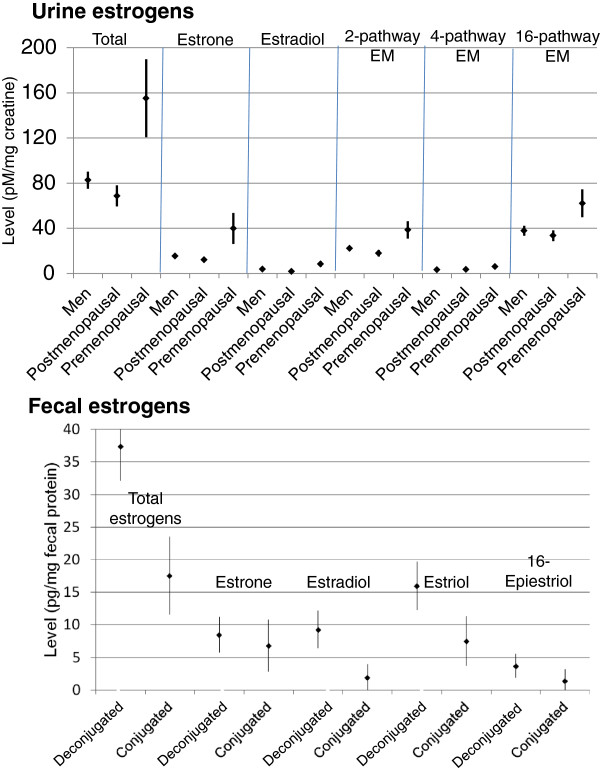
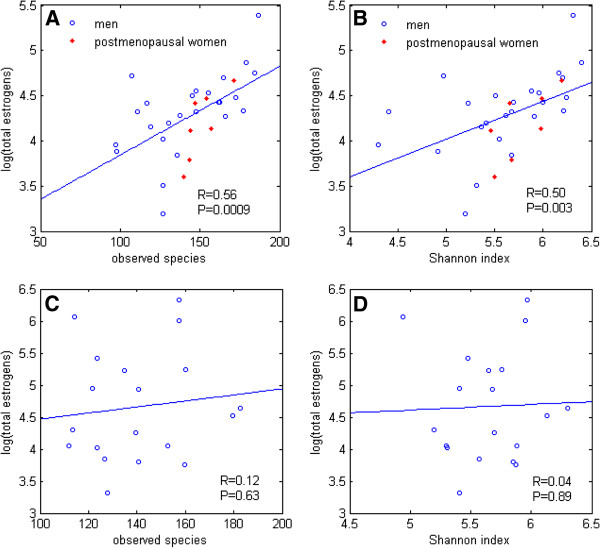
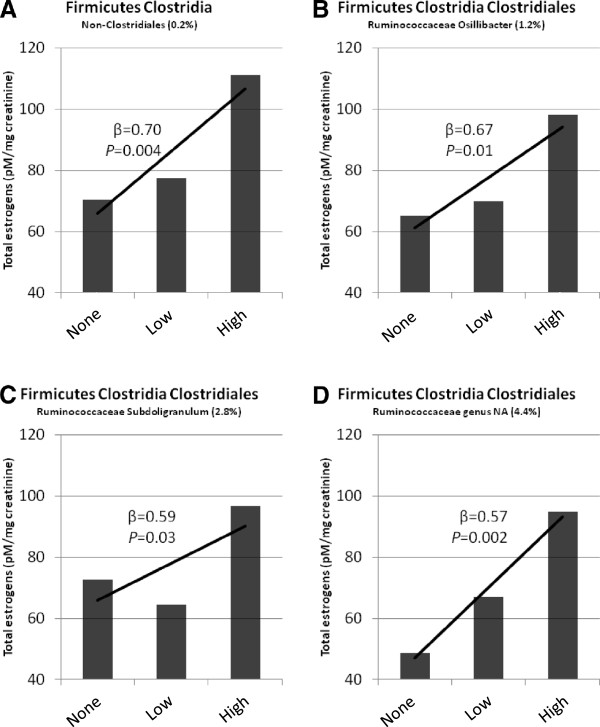
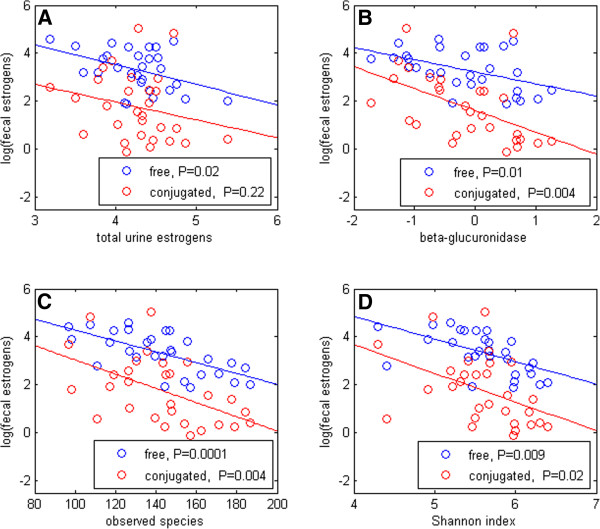
Background: High systemic estrogen levels contribute to breast cancer risk for postmenopausal women, whereas low levels contribute to osteoporosis risk. Except for obesity, determinants of non-ovarian systemic estrogen levels are undefined. We sought to identify members and functions of the intestinal microbial community associated with estrogen levels via enterohepatic recirculation. Methods: Fifty-one epidemiologists at the National Institutes of Health, including 25 men, 7 postmenopausal women, and 19 premenopausal women, provided urine and aliquots of feces, using methods proven to yield accurate and reproducible results. Estradiol, estrone, 13 estrogen metabolites (EM), and their sum (total estrogens) were quantified in urine and feces by liquid chromatography/tandem mass spectrometry. In feces, β-glucuronidase and β-glucosidase activities were determined by realtime kinetics, and microbiome diversity and taxonomy were estimated by pyrosequencing 16S rRNA amplicons. Pearson correlations were computed for each log e estrogen level, log e enzymatic activity level, and microbiome alpha diversity estimate. For the 55 taxa with mean relative abundance of at least 0.1%, ordinal levels were created [zero, low (below median of detected sequences), high] and compared to log e estrogens, β-glucuronidase and β-glucosidase enzymatic activity levels by linear regression. Significance was based on two-sided tests with α=0.05. Results: In men and postmenopausal women, levels of total urinary estrogens (as well as most individual EM) were very strongly and directly associated with all measures of fecal microbiome richness and alpha diversity (R≥0.50, P ≤0.003). These non-ovarian systemic estrogens also were strongly and significantly associated with fecal Clostridia taxa, including non- Clostridiales and three genera in the Ruminococcaceae family (R=0.57−0.70, P =0.03−0.002). Estrone, but not other EM, in urine correlated significantly with functional activity of fecal β-glucuronidase (R=0.36, P =0.04). In contrast, fecal β-glucuronidase correlated inversely with fecal total estrogens, both conjugated and deconjugated (R≤-0.47, P ≤0.01). Premenopausal female estrogen levels, which were collected across menstrual cycles and thus highly variable, were completely unrelated to fecal microbiome and enzyme parameters ( P ≥0.6). Conclusions: Intestinal microbial richness and functions, including but not limited to β-glucuronidase, influence levels of non-ovarian estrogens via enterohepatic circulation. Thus, the gut microbial community likely affects the risk for estrogen-related conditions in older adults. Understanding how Clostridia taxa relate to systemic estrogens may identify targets for interventions. Trial registration: Not applicable.
Overview
The claims and statistics of this paper haven’t been checked yet.
Free: it reads the open-access text and checks the first 5 claims that cite a source we can check. Create a free account to check every claim.
Integrity signals
Registry
Cites
Statistics
Figures
Verification
Claims the paper makes
The claims and statistics of this paper haven’t been checked yet.
Free: it reads the open-access text and checks the first 5 claims that cite a source we can check. Create a free account to check every claim.
Claims other papers make about this one
Each is checked against this paper’s own text: does it say what the citing paper says it does?
The check wasn’t confident either way, so it gives no verdict — never disputed.
In the citing paper
“However, the study reported a statistically significant association between levels of total estrogens and PD index in control women, which was not observed in women with breast cancer.”
From Association Between Sex Hormone Levels and Gut Microbiota Composition and Diversity—A Systematic Review (2022) · cites this paper as [21]
Experimental — accuracy not yet measuredIn the citing paper
“Two studies utilised the same cohort of participants and thus only the cohort from one of the two studies was included for these calculations (see Table 1).(21, 22)”
From Association Between Sex Hormone Levels and Gut Microbiota Composition and Diversity—A Systematic Review (2022) · cites this paper as [21]
In the citing paper
“In addition, the study by Goedert et al.(21) did not find an association between EM:parent estrogen and diversity in healthy women or women with breast cancer.”
From Association Between Sex Hormone Levels and Gut Microbiota Composition and Diversity—A Systematic Review (2022) · cites this paper as [21]
Self-check
Percentages, sums and reported differences re-computed from the paper’s own numbers.
The self-check needs the paper’s full text.
Citations
Cites
QIIME allows analysis of high-throughput community sequencing data
Caporaso, J. G., Kuczynski, J., Stombaugh, J., Bittinger, K., Bushman, F. D., Costello, E. K., Fierer, N., Peña, A. G., Goodrich, J. K., Gordon, J. I., et al. (2010) · Nature Methods · doi:10.1038/nmeth.f.303 · Cited by 34,887 · cited 7×
“Relative abundance of each OTU, alpha diversity, and beta diversity were computed using QIIME [25] for each DNA sample and then averaged on four replicates for each study participant.”
MethodInfluentialUCHIME improves sensitivity and speed of chimera detection
Edgar, R. C., Haas, B. J., Clemente, J. C., Quince, C., & Knight, R. (2011) · Bioinformatics · doi:10.1093/bioinformatics/btr381 · Cited by 15,114
A core gut microbiome in obese and lean twins
Turnbaugh, P. J., Hamady, M., Yatsunenko, T., Cantarel, B. L., Duncan, A., Ley, R. E., Sogin, M. L., Jones, W. J., Roe, B. A., Affourtit, J. P., et al. (2009) · Nature · doi:10.1038/nature07540 · Cited by 7,823 · cited 2×
“Because use of medications, including non-antibiotics [16], and elevated BMI [15,16] are inversely associated with gut microbiome alpha diversity, adjustment for these likely would have strengthened the direct associations that we found herein between alpha diversity and systemic estrogen levels.”
BackgroundThe Ribosomal Database Project: improved alignments and new tools for rRNA analysis
Cole, J. R., Wang, Q., Cardenas, E., Fish, J., Chai, B., Farris, R. J., Kulam-Syed-Mohideen, A. S., McGarrell, D. M., Marsh, T., Garrity, G. M., et al. (2009) · Nucleic Acids Research · doi:10.1093/nar/gkn879 · Cited by 4,762 · cited 2×
“Operational taxonomic units (OTUs) were defined using QIIME as sequences with at least 97% identity, and sequences were classified at the genus level using the Ribosomal Database Project (RDP) naïve Bayesian classifier [27].”
MethodThe NIH Human Microbiome Project
The NIH HMP Working Group, Peterson, J., Garges, S., Giovanni, M., McInnes, P., Wang, L., Schloss, J. A., Bonazzi, V., McEwen, J. E., Wetterstrand, K. A., et al. (2009) · Genome Research · doi:10.1101/gr.096651.109 · Cited by 2,066 · cited 2×
“Classification of operational taxonomic units Sequence read quality used the Institute of Genome Sciences bioinformatics pipeline that complies with standard operating procedures of the National Institutes of Health Human Microbiome Project [24].”
MethodHamady, M., Lozupone, C., & Knight, R. (2010) · The ISME Journal · doi:10.1038/ismej.2009.97 · Cited by 1,099
Alleviating Cancer Drug Toxicity by Inhibiting a Bacterial Enzyme
Wallace, B. D., Wang, H., Lane, K. T., Scott, J. E., Orans, J., Koo, J. S., Venkatesh, M., Jobin, C., Yeh, L.-A., Mani, S., et al. (2010) · Science · doi:10.1126/science.1191175 · Cited by 1,080 · cited 1×
“For example, inhibition of fecal microbial β-glucuronidases may be possible [37], although the relatively weak associations that we found between fecal β-glucuronidase activity and urinary estrogens suggest that enzyme inhibition would not markedly reduce systemic estrogen levels.”
BackgroundPlottel, C. S., & Blaser, M. J. (2011) · Cell Host & Microbe · doi:10.1016/j.chom.2011.10.003 · Cited by 743 · cited 4×
“As postulated and summarized by others [11], our results support the hypothesis that breast cancer risk in postmenopausal women and hip fracture risk in both postmenopausal women and elderly men is modulated by decades-long differences in systemic estrogens attributable to differences in the intestinal microbiota.”
BackgroundResultInfluentialObesity and Breast Cancer: The Estrogen Connection
Cleary, M. P., & Grossmann, M. E. (2009) · Endocrinology · doi:10.1210/en.2009-0070 · Cited by 504 · cited 2×
“Background Breast cancer risk is increased among postmenopausal women who have high levels of endogenous estrogens [1-3].”
BackgroundEstrogen excretion patterns and plasma levels in vegetarian and omnivorous women
Goldin, B. R., Adlercreutz, H., Gorbach, S. L., Warram, J. H., Dwyer, J. T., Swenson, L., & Woods, M. N. (1982) · New England Journal of Medicine · doi:10.1056/nejm198212163072502 · Cited by 474 · cited 1×
“A working hypothesis is that this enterohepatic recirculation affects the half-life and systemic levels of estrogens in men and postmenopausal women, and perhaps during the luteal phase in premenopausal women [9-11].”
Background
Research works printed but not linked: 1
- Raftogianis R, Creveling C, Weinshilboum R, Weisz J: Estrogen metabolism by conjugation. J Natl Cancer Inst Monogr. 2000, 113-124.
Cited by
Estrogen–gut microbiome axis: Physiological and clinical implications
Baker, J. M., Al-Nakkash, L., & Herbst-Kralovetz, M. M. (2017) · Maturitas · doi:10.1016/j.maturitas.2017.06.025 · Cited by 993
“As previously described in this review, a reduction in gut microbiota diversity reduces the estrobolome and therefore the deconjugative ability of the gut microbiome [8].”
BackgroundSex steroid deficiency-associated bone loss is microbiota dependent and prevented by probiotics
Li, J.-Y., Chassaing, B., Tyagi, A. M., Vaccaro, C., Luo, T., Adams, J., Darby, T. M., Weitzmann, M. N., Mulle, J. G., Gewirtz, A. T., et al. (2016) · Journal of Clinical Investigation · doi:10.1172/jci86062 · Cited by 643
“Interestingly, estrogen depletion has also been associated with decreased α-diversity in the gut microbiome (92, 93), while microbial diversity in the gut transiently increases with administration of probiotics (94).”
Sex differences in gut microbiota
Kim, Y. S., Unno, T., Kim, B.-Y., & Park, M.-S. (2020) · The World Journal of Men s Health · doi:10.5534/wjmh.190009 · Cited by 610
“Although the gut microbiota can be modulated by estrogen, gut microbiota can itself also affect the estrogen level by deconjugating the conjugated estrogen molecules excreted through the bile and reabsorbing it through the enterohepatic circulation [46].”
BackgroundThe impact of the gut microbiota on the reproductive and metabolic endocrine system
Qi, X., Yun, C., Pang, Y., & Qiao, J. (2021) · Gut Microbes · doi:10.1080/19490976.2021.1894070 · Cited by 554
“Decreased ratios of estrogen metabolites to parental compounds and decreased fecal microbiota diversity are associated with an increased risk of breast cancer in postmenopausal women.(15) In postmenopausal women, gut microbiota diversity is positively associated with the ratio of estrogen metabolites in urine.”
BackgroundThe Intestinal Microbiome and Estrogen Receptor–Positive Female Breast Cancer
(2016) · JNCI: Journal of the National Cancer Institute · doi:10.1093/jnci/djw029 · Cited by 523
“Goedert and colleagues also demonstrated a relationship between gut microbial richness, systemic and fecal estrogens, and beta-glucuronidase activity in healthy postmenopausal women and men (68).”
BackgroundTargeting the gut and tumor microbiota in cancer
Park, E. M., Chelvanambi, M., Bhutiani, N., Kroemer, G., Zitvogel, L., & Wargo, J. A. (2022) · Nature Medicine · doi:10.1038/s41591-022-01779-2 · Cited by 496
The Microbiome of Aseptically Collected Human Breast Tissue in Benign and Malignant Disease
Hieken, T. J., Chen, J., Hoskin, T. L., Walther-Antonio, M., Johnson, S., Ramaker, S., Xiao, J., Radisky, D. C., Knutson, K. L., Kalari, K. R., et al. (2016) · Scientific Reports · doi:10.1038/srep30751 · Cited by 494
Sex, body mass index, and dietary fiber intake influence the human gut microbiome
Dominianni, C., Sinha, R., Goedert, J. J., Pei, Z., Yang, L., Hayes, R. B., & Ahn, J. (2015) · PLOS ONE · doi:10.1371/journal.pone.0124599 · Cited by 468
“Although mechanisms are unclear, adipose tissue is a source of estrogen production in obese individuals [11], and estrogen-microbiome associations have been suggested [9]; consistent with our findings of interrelationships between sex, BMI, and gut microbiota composition.”
BackgroundSelf-citationThe microbiome and gynaecological cancer development, prevention and therapy
Łaniewski, P., Ilhan, Z. E., & Herbst-Kralovetz, M. M. (2020) · Nature Reviews Urology · doi:10.1038/s41585-020-0286-z · Cited by 450
Comprehensive Review of Uterine Fibroids: Developmental Origin, Pathogenesis, and Treatment
Yang, Q., Ciebiera, M., Bariani, M. V., Ali, M., Elkafas, H., Boyer, T. G., & Al-Hendy, A. (2022) · Endocrine Reviews · doi:10.1210/endrev/bnab039 · Cited by 425
Goedert, J. J., Jones, G., Hua, X., Xu, X., Yu, G., Flores, R., Falk, R. T., Gail, M. H., Shi, J., Ravel, J., et al. (2015) · JNCI: Journal of the National Cancer Institute · doi:10.1093/jnci/djv147 · Cited by 393
“with our previously observed correlations of alpha diversity with systemic estrogen level and EM:parent estrogen ratio (16,33).”
BackgroundSelf-citationUterine Microbiota: Residents, Tourists, or Invaders?
Baker, J. M., Chase, D. M., & Herbst-Kralovetz, M. M. (2018) · Frontiers in Immunology · doi:10.3389/fimmu.2018.00208 · Cited by 392
Matson, V., Chervin, C. S., & Gajewski, T. F. (2021) · Gastroenterology · doi:10.1053/j.gastro.2020.11.041 · Cited by 385
Gut microbial molecules in behavioural and neurodegenerative conditions
Needham, B. D., Kaddurah-Daouk, R., & Mazmanian, S. K. (2020) · Nature Reviews Neuroscience · doi:10.1038/s41583-020-00381-0 · Cited by 379
Breast cancer in postmenopausal women is associated with an altered gut metagenome
Zhu, J., Liao, M., Yao, Z., Liang, W., Li, Q., Liu, J., Yang, H., Ji, Y., Wei, W., Tan, A., et al. (2018) · Microbiome · doi:10.1186/s40168-018-0515-3 · Cited by 377
Bacteria in cancer initiation, promotion and progression
El Tekle, G., & Garrett, W. S. (2023) · Nature Reviews Cancer · doi:10.1038/s41568-023-00594-2 · Cited by 343
Fuhrman, B. J., Feigelson, H. S., Flores, R., Gail, M. H., Xu, X., Ravel, J., & Goedert, J. J. (2014) · The Journal of Clinical Endocrinology & Metabolism · doi:10.1210/jc.2014-2222 · Cited by 339
“In postmenopausal women, enterohepatic recycling of EMs may be an important determinant of their half-lives and therefore their levels in circulation (11, 12).”
BackgroundMethodSelf-citationSerum level of sex steroid hormone is associated with diversity and profiles of human gut microbiome
Shin, J.-H., Park, Y.-H., Sim, M., Kim, S.-A., Joung, H., & Shin, D.-M. (2019) · Research in Microbiology · doi:10.1016/j.resmic.2019.03.003 · Cited by 334
“Also, there are only a few human studies which have examined the changes in the bacterial communities by the sex steroid hormone [16,20], and the results remain controversial in some murine studies [21,22].”
BackgroundRoles of Sex Hormones and Gender in the Gut Microbiota
Yoon, K., & Kim, N. (2021) · Journal of Neurogastroenterology and Motility · doi:10.5056/jnm20208 · Cited by 299
Ata, B., Yildiz, S., Turkgeldi, E., Brocal, V. P., Dinleyici, E. C., Moya, A., & Urman, B. (2019) · Scientific Reports · doi:10.1038/s41598-019-39700-6 · Cited by 291
Shandilya, S., Kumar, S., Kumar Jha, N., Kumar Kesari, K., & Ruokolainen, J. (2022) · Journal of Advanced Research · doi:10.1016/j.jare.2021.09.005 · Cited by 290
“A large number of enteric bacteria were found to metabolize oestrogens [214] and oestrogens also undergo oxidation–reduction reactions in faecal samples [215], suggesting the role of gut microbiota.”
Sex hormones in the modulation of irritable bowel syndrome
Mulak, A. (2014) · World Journal of Gastroenterology · doi:10.3748/wjg.v20.i10.2433 · Cited by 276
Gut microbial beta-glucuronidase: a vital regulator in female estrogen metabolism
Hu, S., Ding, Q., Zhang, W., Kang, M., Ma, J., & Zhao, L. (2023) · Gut Microbes · doi:10.1080/19490976.2023.2236749 · Cited by 274
“In postmenopausal women, it has been proved that reduction of the ratio of estrogen metabolites to parental compounds and the reduction of fecal microbiota diversity are associated with an increased risk of breast cancer.(34,46) Lower gut microbiota diversity may be related to a higher relative abundance of gmGUS-prod…”
BackgroundVemuri, R., Sylvia, K. E., Klein, S. L., Forster, S. C., Plebanski, M., Eri, R., & Flanagan, K. L. (2019) · Seminars in Immunopathology · doi:10.1007/s00281-018-0716-7 · Cited by 265
How biological sex of the host shapes its gut microbiota
Valeri, F., & Endres, K. (2021) · Frontiers in Neuroendocrinology · doi:10.1016/j.yfrne.2021.100912 · Cited by 264
“A study conducted by Flores and colleagues on men (n=25), premenopausal (n=19) and postmenopausal (n=7) women showed a strong association between the non-ovarian urine estrogens with fecal Clostridia taxa, including non-Clostridiales and three genera in the Ruminococcaceae family (phylum Firmicutes) (Flores et al., 20…”
InfluentialZhang, X., Zhong, H., Li, Y., Shi, Z., Ren, H., Zhang, Z., Zhou, X., Tang, S., Han, X., Lin, Y., et al. (2021) · Nature Aging · doi:10.1038/s43587-020-00014-2 · Cited by 250
Self-citationThe Microbiome–Estrogen Connection and Breast Cancer Risk
Parida, S., & Sharma, D. (2019) · Cells · doi:10.3390/cells8121642 · Cited by 241
“This study suggests that fecal β-glucuronidase is negatively proportional to the total estrogen levels in circulation and positively proportional to total urine estrone level [15].”
BackgroundMethodInfluentialMicrobiome—Microbial Metabolome—Cancer Cell Interactions in Breast Cancer—Familiar, but Unexplored
Mikó, E., Kovács, T., Sebő, É., Tóth, J., Csonka, T., Ujlaki, G., Sipos, A., Szabó, J., Méhes, G., & Bai, P. (2019) · Cells · doi:10.3390/cells8040293 · Cited by 220
“Goedert and colleagues have provided strong functional evidence for the role of Clostridiales in estrogen reactivation [116,117] and showed that the relative abundance of Clostridiales increases in breast cancer patients [116–118].”
BackgroundInfluentialKoceva, A., Herman, R., Janež, A., Rakuša, M., & Jensterle, M. (2024) · International Journal of Molecular Sciences · doi:10.3390/ijms25137342 · Cited by 216
“Additionally, the gut microbiota is involved in sex steroid metabolism [85–87].”
BackgroundModulation of bone remodeling by the gut microbiota: A new therapy for osteoporosis
Lyu, Z., Hu, Y., Guo, Y., & Liu, D. (2023) · Bone Research · doi:10.1038/s41413-023-00264-x · Cited by 207
Breast and Gut Microbiota Action Mechanisms in Breast Cancer Pathogenesis and Treatment
Laborda-Illanes, A., Sanchez-Alcoholado, L., Dominguez-Recio, M. E., Jimenez-Rodriguez, B., Lavado, R., Comino-Méndez, I., Alba, E., & Queipo-Ortuño, M. I. (2020) · Cancers · doi:10.3390/cancers12092465 · Cited by 206
“It has been demonstrated that a subset of microbes within the gastrointestinal tract influences estrogen metabolism and the balance of circulating and excreted hormone levels [50].”
BackgroundYou’ve got male: Sex and the microbiota-gut-brain axis across the lifespan
Jaggar, M., Rea, K., Spichak, S., Dinan, T. G., & Cryan, J. F. (2020) · Frontiers in Neuroendocrinology · doi:10.1016/j.yfrne.2019.100815 · Cited by 200
Intestinal microbiota: a potential target for the treatment of postmenopausal osteoporosis
Xu, X., Jia, X., Mo, L., Liu, C., Zheng, L., Yuan, Q., & Zhou, X. (2017) · Bone Research · doi:10.1038/boneres.2017.46 · Cited by 199
Self-citationBreast tissue, oral and urinary microbiomes in breast cancer
Wang, H., Altemus, J., Niazi, F., Green, H., Calhoun, B. C., Sturgis, C., Grobmyer, S. R., & Eng, C. (2017) · Oncotarget · doi:10.18632/oncotarget.21490 · Cited by 198
“In addition to modulating the immune system, these gut microbes are known to play a vital role in estrogen metabolism; the perturbation of this “estrobolome” has been shown to influence systemic levels of estrogen and its metabolites [5, 7, 13, 14].”
BackgroundDiagnosis of endometriosis in the 21st century
Kiesel, L., & Sourouni, M. (2019) · Climacteric · doi:10.1080/13697137.2019.1578743 · Cited by 187
Kovács, T., Mikó, E., Vida, A., Sebő, É., Toth, J., Csonka, T., Boratkó, A., Ujlaki, G., Lente, G., Kovács, P., et al. (2019) · Scientific Reports · doi:10.1038/s41598-018-37664-7 · Cited by 187
Self-citationIntricate Connections between the Microbiota and Endometriosis
Jiang, I., Yong, P. J., Allaire, C., & Bedaiwy, M. A. (2021) · International Journal of Molecular Sciences · doi:10.3390/ijms22115644 · Cited by 186
Gadi, N., Wu, S. C., Spihlman, A. P., & Moulton, V. R. (2020) · Frontiers in Immunology · doi:10.3389/fimmu.2020.02147 · Cited by 186
Zhang, Y.-W., Cao, M.-M., Li, Y.-J., Lu, P.-P., Dai, G.-C., Zhang, M., Wang, H., & Rui, Y.-F. (2022) · Journal of Orthopaedic Translation · doi:10.1016/j.jot.2022.08.003 · Cited by 184
“54 deficiency was related to the intestinal mucosal barrier disruption and was able to undermine various kinds of bone properties through the modulation of GM-bone axis [46,47].”
BackgroundLuu, T. H., Michel, C., Bard, J.-M., Dravet, F., Nazih, H., & Bobin-Dubigeon, C. (2017) · Nutrition and Cancer · doi:10.1080/01635581.2017.1263750 · Cited by 184
A comprehensive analysis of breast cancer microbiota and host gene expression
Thompson, K. J., Ingle, J. N., Tang, X., Chia, N., Jeraldo, P. R., Walther-Antonio, M. R., Kandimalla, K. K., Johnson, S., Yao, J. Z., Harrington, S. C., et al. (2017) · PLOS ONE · doi:10.1371/journal.pone.0188873 · Cited by 183
New Insights Into the Cancer–Microbiome–Immune Axis: Decrypting a Decade of Discoveries
Jain, T., Sharma, P., Are, A. C., Vickers, S. M., & Dudeja, V. (2021) · Frontiers in Immunology · doi:10.3389/fimmu.2021.622064 · Cited by 183
Mörkl, S., Lackner, S., Müller, W., Gorkiewicz, G., Kashofer, K., Oberascher, A., Painold, A., Holl, A., Holzer, P., Meinitzer, A., et al. (2017) · International Journal of Eating Disorders · doi:10.1002/eat.22801 · Cited by 181
“Estrogen levels correlate with microbiome richness and alpha diversity only in postmenopausal females and men, whereas estrogen levels of premenopausal females were unrelated to the gut microbiome (Flores et al., 2012).”
BackgroundEstrogen and Microbiota Crosstalk: Should We Pay Attention?
Chen, K. L., & Madak-Erdogan, Z. (2016) · Trends in Endocrinology & Metabolism · doi:10.1016/j.tem.2016.08.001 · Cited by 181
“Increased estrogen metabolite concentration appears to be strongly associated with microbial diversity, compared to parent estrogens present in fecal specimens [10].”
InfluentialSantos-Marcos, J. A., Mora-Ortiz, M., Tena-Sempere, M., Lopez-Miranda, J., & Camargo, A. (2023) · Biology of Sex Differences · doi:10.1186/s13293-023-00490-2 · Cited by 176
“In men and postmenopausal women, urinary estrogen levels have shown a strong association with gut microbiota richness and alpha-diversity, whereas premenopausal female estrogen levels, highly variable when collected during menstrual cycles, did not show this association [31, 45].”
BackgroundThomas, M., Webb, M., Ghimire, S., Blair, A., Olson, K., Fenske, G. J., Fonder, A. T., Christopher-Hennings, J., Brake, D., & Scaria, J. (2017) · Scientific Reports · doi:10.1038/s41598-017-12481-6 · Cited by 170
The Gut Microbiome and Sex Hormone-Related Diseases
He, S., Li, H., Yu, Z., Zhang, F., Liang, S., Liu, H., Chen, H., & Lü, M. (2021) · Frontiers in Microbiology · doi:10.3389/fmicb.2021.711137 · Cited by 169
Sári, Z., Mikó, E., Kovàcs, T., Jankó, L., Csonka, T., Lente, G., Sebő, É., Tóth, J., Tóth, D., Árkosy, P., et al. (2020) · Cancers · doi:10.3390/cancers12092411 · Cited by 169
“Moreover, the oncobiome has enhanced capacity to increase systemic estrogen levels by increasing enterohepatic circulation [1,2,5].”
BackgroundSelf-citationAssociations Between Endometriosis and Gut Microbiota
Svensson, A., Brunkwall, L., Roth, B., Orho‐Melander, M., & Ohlsson, B. (2021) · Reproductive Sciences · doi:10.1007/s43032-021-00506-5 · Cited by 171
The Importance of Nutrition in Menopause and Perimenopause—A Review
Erdélyi, A., Pálfi, E., Tűű, L., Nas, K., Szűcs, Z., Török, M., Jakab, A., & Várbíró, S. (2023) · Nutrients · doi:10.3390/nu16010027 · Cited by 169
“Estrogen levels can effect gut microbiota [113,114] and microbiome, in turn, can effect serum estrogen levels as certain microbes in the gut (called estrabolome) secrete beta-glucoronidase, a bacterial enzyme that deconjugates estrogens and phytoe-strogens into their active forms which can be…”
Gut microbiota, dietary intakes and intestinal permeability reflected by serum zonulin in women
Mörkl, S., Lackner, S., Meinitzer, A., Mangge, H., Lehofer, M., Halwachs, B., Gorkiewicz, G., Kashofer, K., Painold, A., Holl, A. K., et al. (2018) · European Journal of Nutrition · doi:10.1007/s00394-018-1784-0 · Cited by 150
Association between gut microbiota and bone health: Potential mechanisms and prospective
Chen, Y.-C., Greenbaum, J., Shen, H., & Deng, H.-W. (2017) · The Journal of Clinical Endocrinology & Metabolism · doi:10.1210/jc.2017-00513 · Cited by 165
Sipos, A., Ujlaki, G., Mikó, E., Maka, E., Szabó, J., Uray, K., Krasznai, Z. T., & Bai, P. (2021) · Molecular Medicine · doi:10.1186/s10020-021-00295-2 · Cited by 165
The Role of Gut Microbial β-Glucuronidase in Estrogen Reactivation and Breast Cancer
Sui, Y., Wu, J., & Chen, J. (2021) · Frontiers in Cell and Developmental Biology · doi:10.3389/fcell.2021.631552 · Cited by 162
Molecular Characterization of the Human Stomach Microbiota in Gastric Cancer Patients
Yu, G., Torres, J., Hu, N., Medrano-Guzman, R., Herrera-Goepfert, R., Humphrys, M. S., Wang, L., Wang, C., Ding, T., Ravel, J., et al. (2017) · Frontiers in Cellular and Infection Microbiology · doi:10.3389/fcimb.2017.00302 · Cited by 152
“To examine whether some taxa were missed due to the lack of a bead-beating step in our DNA extraction protocols, we evaluated 2 Chinese tissue samples using two different DNA extraction methods: a DNA extraction method with a bead-beating step and commonly used for microbiome study (Flores et al., 2012) and the method…”
MethodSelf-citationMayneris-Perxachs, J., Arnoriaga-Rodríguez, M., Luque-Córdoba, D., Priego-Capote, F., Pérez-Brocal, V., Moya, A., Burokas, A., Maldonado, R., & Fernández-Real, J.-M. (2020) · Microbiome · doi:10.1186/s40168-020-00913-x · Cited by 159
Next-generation probiotics – do they open new therapeutic strategies for cancer patients?
Kaźmierczak-Siedlecka, K., Skonieczna‐Żydecka, K., Hupp, T., Duchnowska, R., Marek-Trzonkowska, N. M., & Połom, K. (2022) · Gut Microbes · doi:10.1080/19490976.2022.2035659 · Cited by 156
“Further, it has been demonstrated that a subset of microbes within the gastrointestinal tract (collectively referred as estrobolome) influences estrogen metabolism and the balance of circulating and excreted hormone levels.(43,44) Therefore, the intestinal microflora may affect the onset of breast cancer through estro…”
BackgroundMicrobiome and Breast Cancer: New Role for an Ancient Population
Eslami-S, Z., Majidzadeh-A, K., Halvaei, S., Babapirali, F., & Esmaeili, R. (2020) · Frontiers in Oncology · doi:10.3389/fonc.2020.00120 · Cited by 153
Fecal Microbiota Analysis: An Overview of Sample Collection Methods and Sequencing Strategies
Thomas, V., Clark, J., & Doré, J. (2015) · Future Microbiology · doi:10.2217/fmb.15.87 · Cited by 123
Yang, J., Tan, Q., Fu, Q., Zhou, Y., Hu, Y., Tang, S., Zhou, Y., Zhang, J., Qiu, J., & Lv, Q. (2016) · Breast Cancer · doi:10.1007/s12282-016-0734-z · Cited by 149
“However, controversy reports claimed that systemic estrogen was not related to any specific microorganism [33].”
BackgroundInfluentialMost, J., Penders, J., Lucchesi, M., Goossens, G. H., & Blaak, E. E. (2017) · European Journal of Clinical Nutrition · doi:10.1038/ejcn.2017.89 · Cited by 146
Influence of Oral and Gut Microbiota in the Health of Menopausal Women
Vieira, A. T., Castelo, P. M., Ribeiro, D. A., & Ferreira, C. M. (2017) · Frontiers in Microbiology · doi:10.3389/fmicb.2017.01884 · Cited by 129
“…that women with a more diverse gut microbiome and an abundance of four Clostridia taxa exhibited an elevated urinary ratio of hydroxylated estrogen metabolites to parent estrogens (Fuhrman et al., 2014), which is related to the etiology of breast cancer (Flores et al., 2012; Kwa et al., 2016).”
BackgroundQuaranta, G., Sanguinetti, M., & Masucci, L. (2019) · Frontiers in Immunology · doi:10.3389/fimmu.2019.02653 · Cited by 145
Goedert, J. J., Hua, X., Bielecka, A., Okayasu, I., Milne, G. L., Jones, G. S., Fujiwara, M., Sinha, R., Wan, Y., Xu, X., et al. (2018) · British Journal of Cancer · doi:10.1038/bjc.2017.435 · Cited by 144
“However, unlike in the matched controls and in other healthy populations (Flores et al, 2012a; Fuhrman et al, 2014), the cancer cases’ IgA-negative microbiota alpha diversity was not correlated with their oestrogen levels.”
BackgroundSelf-citationShan, J., Ni, Z., Cheng, W., Zhou, L., Zhai, D., Sun, S., & Yu, C. (2021) · Archives of Gynecology and Obstetrics · doi:10.1007/s00404-021-06057-z · Cited by 144
“Previous studies have reported that the gut microbiota can affect systemic estrogen levels [14].”
BackgroundBacterial microbiome of lungs in COPD
Sin, D., Sze, M., & Hogg, J. (2014) · International Journal of Chronic Obstructive Pulmonary Disease · doi:10.2147/copd.s38932 · Cited by 121
“82,83 Some bacteria in the GI tract may be modulated by serum female sex hormone levels, 81,84 which may have an impact on the brain and behavior.”
d’Afflitto, M., Upadhyaya, A., Green, A., & Peiris, M. (2022) · Journal of Clinical Gastroenterology · doi:10.1097/mcg.0000000000001676 · Cited by 142
Breast and gut microbiome in health and cancer
Zhang, J., Xia, Y., & Sun, J. (2021) · Genes & Diseases · doi:10.1016/j.gendis.2020.08.002 · Cited by 125
Ranjan, P., Parihar, A., Jain, S., Kumar, N., Dhand, C., Murali, S., Mishra, D., Sanghi, S. K., Chaurasia, J. P., Srivastava, A. K., et al. (2020) · Analytical Biochemistry · doi:10.1016/j.ab.2020.113996 · Cited by 142
The Microbiome as a Component of the Tumor Microenvironment
Kovàcs, T., Mikó, E., Ujlaki, G., Sári, Z., & Bai, P. (2020) · Advances in experimental medicine and biology · doi:10.1007/978-3-030-35727-6_10 · Cited by 140
Dysbiosis of gut microbiota in patients with esophageal cancer
Deng, Y., Tang, D., Hou, P., Shen, W., Li, H., Wang, T., & Liu, R. (2020) · Microbial Pathogenesis · doi:10.1016/j.micpath.2020.104709 · Cited by 139
Ortega, M. A., Alvarez-Mon, M. A., García-Montero, C., Fraile-Martinez, O., Guijarro, L. G., Lahera, G., Monserrat, J., Valls, P., Mora, F., Rodríguez-Jiménez, R., et al. (2022) · Metabolites · doi:10.3390/metabo12010050 · Cited by 123
“In men and postmenopausal women, gut microbiota diversity and functions influence the levels of non-ovarian estrogens via enterohepatic circulation, where Clostridia taxa and genera from the Ruminococcaceae family could be key microbial populations involved in this regulation [188].”
BackgroundSpotlight on the Gut Microbiome in Menopause: Current Insights
Peters, B. A., Santoro, N. F., Kaplan, R. C., & Qi, Q. (2022) · International Journal of Women s Health · doi:10.2147/ijwh.s340491 · Cited by 139
“These associations were not observed in pre-menopausal women (n = 19), possibly because urine samples were collected irrespective of menstrual cycle timing, and thus highly variable in levels of estrogens.(42) Another study of 60 post-menopausal women observed a positive association of urinary total estrogens with Rum…”
BackgroundInfluentialThe role of the microbiome in the neurobiology of social behaviour
Sarkar, A., Harty, S., Johnson, K. V. ‐., Moeller, A. H., Carmody, R. N., Lehto, S. M., Erdman, S. E., Dunbar, R. I. M., & Burnet, P. W. J. (2020) · Biological Reviews · doi:10.1111/brv.12603 · Cited by 135
“The microbiome plays an important role in the availability of oestrogens (Flores et al., 2012; Fuhrman et al., 2014), and researchers have developed the concept of the ‘estrobolome’, or the total collection of bacterial genes that encodes products capable of metabolising oestrogens (Plottel & Blaser, 2011).”
BackgroundGut Microbiome and Osteoporosis
Ding, K., Hua, F., & Ding, W. (2020) · Aging and disease · doi:10.14336/ad.2019.0523 · Cited by 134
“[109] Flores R, Shi J, Fuhrman B, Xu X, Veenstra TD, Gail MH, et al.”
BackgroundYamazaki, K. (2023) · Japanese Dental Science Review · doi:10.1016/j.jdsr.2023.08.003 · Cited by 136
“Gut microbiota regulates estrogen levels in the body specifically through the production of enzymes that act on steroid hormone metabolic pathways [87].”
BackgroundSex-specific association between gut microbiome and fat distribution
Min, Y., Ma, X., Sankaran, K., Ru, Y., Chen, L., Baiocchi, M., & Zhu, S. (2019) · Nature Communications · doi:10.1038/s41467-019-10440-5 · Cited by 133
Female reproductive dysfunctions and the gut microbiota
Chadchan, S. B., Singh, V., & Kommagani, R. (2022) · Journal of Molecular Endocrinology · doi:10.1530/jme-21-0238 · Cited by 133
Age, Gender, and Women’s Health and the Patient
Houghton, L. A., Heitkemper, M. M., Crowell, M. D., Emmanuel, A. V., Halpert, A. D., McRoberts, J. A., & Toner, B. B. (2016) · Gastroenterology · doi:10.1053/j.gastro.2016.02.017 · Cited by 132
Gut bacteria require neutrophils to promote mammary tumorigenesis
Lakritz, J. R., Poutahidis, T., Mirabal, S., Varian, B. J., Levkovich, T., Ibrahim, Y. M., Ward, J. M., Teng, E. C., Fisher, B., Parry, N., et al. (2015) · Oncotarget · doi:10.18632/oncotarget.3328 · Cited by 119
“Additionally, the microbiome plays a key role in estrogen cycling in the body, and gut dysbiosis results in higher circulating estrogens which has been linked to postmenopausal breast cancer [51–54].”
BackgroundPeters, B. A., Lin, J., Qi, Q., Usyk, M., Isasi, C. R., Mossavar-Rahmani, Y., Derby, C. A., Santoro, N., Perreira, K. M., Daviglus, M. L., et al. (2022) · mSystems · doi:10.1128/msystems.00273-22 · Cited by 130
“were positively associated with gut microbial diversity (25).”
BackgroundThe Gut Microbiome and Female Health
Siddiqui, R., Makhlouf, Z., Alharbi, A. M., Alfahemi, H. H., & Khan, N. A. (2022) · Biology · doi:10.3390/biology11111683 · Cited by 130
Gut microbiome associations with breast cancer risk factors and tumor characteristics: a pilot study
Wu, A. H., Tseng, C., Vigen, C., Yu, Y., Cozen, W., Garcia, A. A., & Spicer, D. (2020) · Breast Cancer Research and Treatment · doi:10.1007/s10549-020-05702-6 · Cited by 111
Kumari, N., KUMARI, R. R., Dua, A., Singh, M., Kumar, R., Singh, P., Duyar‐Ayerdi, S., Pradeep, S., Ojesina, A. I., & Kumar, R. (2024) · Molecular Nutrition & Food Research · doi:10.1002/mnfr.202300688 · Cited by 128
Lithocholic Acid, a Metabolite of the Microbiome, Increases Oxidative Stress in Breast Cancer
Kovács, P., Csonka, T., Kovàcs, T., Sári, Z., Ujlaki, G., Sipos, A. A., Karányi, Z., Szeőcs, D., Hegedűs, C., Uray, K., et al. (2019) · Cancers · doi:10.3390/cancers11091255 · Cited by 126
Shobeiri, P., Kalantari, A., Teixeira, A. L., & Rezaei, N. (2022) · Biology of Sex Differences · doi:10.1186/s13293-022-00422-6 · Cited by 124
“Interestingly, gut microbiota regulates estrogen levels by mediating its metabolism in the enterohepatic circulation [80].”
BackgroundInfluentialLi, B., Liu, M., Wang, Y., Gong, S., Yao, W., Li, W., Gao, H., & Wei, M. (2020) · Biomedicine & Pharmacotherapy · doi:10.1016/j.biopha.2020.110923 · Cited by 119
Current Concepts in Pharmacometabolomics, Biomarker Discovery, and Precision Medicine
Beger, R. D., Schmidt, M. A., & Kaddurah‐Daouk, R. (2020) · Metabolites · doi:10.3390/metabo10040129 · Cited by 117
He, Y., Wang, Q., Xiu, L., Wang, G., Zhao, J., Zhang, H., & Chen, W. (2020) · Food & Function · doi:10.1039/c9fo02554e · Cited by 114
Antwis, R. E., Edwards, K. L., Unwin, B., Walker, S. L., & Shultz, S. (2019) · Microbiome · doi:10.1186/s40168-019-0639-0 · Cited by 113
From Menopause to Neurodegeneration—Molecular Basis and Potential Therapy
Cheng, Y., Lin, C., & Lane, H. (2021) · International Journal of Molecular Sciences · doi:10.3390/ijms22168654 · Cited by 114
“In postmenopausal women, the urinary estrogen level is associated with fecal microbiota [98].”
BackgroundZebrafish: an efficient vertebrate model for understanding role of gut microbiota
Xia, H., Chen, H., Cheng, X., Yin, M., Yao, X., Ma, J., Huang, M., Chen, G., & Liu, H. (2022) · Molecular Medicine · doi:10.1186/s10020-022-00579-1 · Cited by 114
“The imbalance of gut microbiota composition can lead to human reproductive pathologies (Kunc et al. 2016; Flores et al. 2012; Qi et al. 2021).”
BackgroundHussain, T., Murtaza, G., Kalhoro, D. H., Kalhoro, M. S., Metwally, E., Chughtai, M. I., Mazhar, M. U., & Khan, S. A. (2021) · Animal Nutrition · doi:10.1016/j.aninu.2020.11.005 · Cited by 110
“The human gut microbiome regulates estrogen production via b-glucuronidase enzymes (Flores et al., 2012).”
BackgroundInfluentialThe gut microbiota: a puppet master in the pathogenesis of endometriosis?
Laschke, M. W., & Menger, M. D. (2016) · American Journal of Obstetrics and Gynecology · doi:10.1016/j.ajog.2016.02.036 · Cited by 110
Gut microbiota develop towards an adult profile in a sex-specific manner during puberty
Korpela, K., Kallio, S., Salonen, A., Hero, M. T., Kukkonen, A. K., Miettinen, P. J., Savilahti, E., Kohva, E., Kariola, L., Suutela, M., et al. (2021) · Scientific Reports · doi:10.1038/s41598-021-02375-z · Cited by 111
Aghamajidi, A., & Vareki, S. M. (2022) · Cancers · doi:10.3390/cancers14153563 · Cited by 110
Wang, Z., Chen, K., Wu, C., Chen, J., Pan, H., Liu, Y., Wu, P., Yuan, J., Huang, F., Lang, J., et al. (2021) · American Journal of Clinical Nutrition · doi:10.1093/ajcn/nqab194 · Cited by 111
The gut microbiota in breast cancer development and treatment: The good, the bad, and the useful!
Nandi, D., Parida, S., & Sharma, D. (2023) · Gut Microbes · doi:10.1080/19490976.2023.2221452 · Cited by 108
The Gut Microbiome Is Altered in Postmenopausal Women With Osteoporosis and Osteopenia
Rettedal, E. A., Ilesanmi-Oyelere, B. L., Roy, N. C., Coad, J., & Kruger, M. C. (2020) · JBMR Plus · doi:10.1002/jbm4.10452 · Cited by 108
“In a clinical study, the abundance of nonovarian estrogens in postmenopausal women andmenwas correlated with four Clostridia taxa.((32)) Isoflavones are plant-based micronutrients with weakly oestrogenic activity typically found in soy-based products.”
BackgroundNuclear Factor Erythroid 2-Related Factor 2 in Regulating Cancer Metabolism
Smolková, K., Mikó, E., Kovàcs, T., Leguina‐Ruzzi, A., Sipos, A., & Bai, P. (2020) · Antioxidants and Redox Signaling · doi:10.1089/ars.2020.8024 · Cited by 107
“There is a firm link between the etiology of several cancers and bacterial dysbiosis (65, 67, 76, 77, 98, 118, 150, 196).”
Background
Metadata
- Authors
- Flores, R., Shi, J., Fuhrman, B., Xu, X., Veenstra, T. D., Gail, M. H., Gajer, P., Ravel, J., & Goedert, J. J.
- Affiliations
- National Cancer Institute (US)
- Science Applications International Corporation (United States) (US)
- University of Maryland, Baltimore (US)
- Corresponding author
- Goedert, James J
- ORCID
- Venue
- Journal of Translational Medicine
- Published
- 2012-12
- Volume
- 10
- Issue
- 1
- Pages
- 253-253
- ISSN
- 1479-5876 (ISSN-L)
- PMC
- PMC3552825
- OpenAlex
- W2157570303
- Cited by
- 615
- References
- 43
- Citations by year
- 2026: 57 · 2025: 79 · 2024: 89 · 2023: 80 · 2022: 68 · 2021: 78 · 2020: 61 · 2019: 34 · 2018: 19 · 2017: 22 · 2016: 12 · 2015: 8 · 2014: 5 · 2013: 2
- FWCI
- 1.93
- Type
- journal article
- Language
- en
- Open access
- gold
- doi.org
- Licence
- cc-by
- Locations
- Journal of Translational Medicine (publishedVersion, cc-by)
- Europe PMC (PubMed Central) (publishedVersion, cc-by)
- PubMed Central (publishedVersion, cc-by)
- PubMed (publishedVersion)
- DOAJ (DOAJ: Directory of Open Access Journals) (submittedVersion, cc-by-sa)
- Funders
- RTI International
- National Institutes of Health
- NIH Clinical Center
- Topics
- Life Sciences › Biochemistry, Genetics and Molecular Biology › Molecular Biology › Gut microbiota and health
- Life Sciences › Biochemistry, Genetics and Molecular Biology › Endocrinology › Estrogen and related hormone effects
- Health Sciences › Nursing › Nutrition and Dietetics › Phytoestrogen effects and research
- Keywords
- fecal microbiota, estrogen metabolites, enterohepatic circulation, beta-glucuronidase, β-glucosidase, Clostridia, Ruminococcaceae, estrone, estradiol, urinary estrogens, fecal estrogen, microbiome diversity, postmenopausal women, breast cancer risk, osteoporosis
- MeSH terms
- Adolescent, Adult, Aged, Bacteria, Cross-Sectional Studies, Estrogens, Feces, Female, Humans, Male, Menopause, Middle Aged, Genetic Variation, Biodiversity, Metagenome, Young Adult
About these checks
Registry, retraction, Cites and statistics results are computed, not judged, with one exception: a printed reference that no index lists is read once by a model before it counts as a citation error. Claims are extracted by a model and kept only when their quote appears verbatim in the text; each cited source is then checked, with a model’s help, for whether it says what the claim relies on. Those verdicts can be wrong — read the claim’s quote and the cited source before relying on one.
Statistics and arithmetic are recomputed, not judged.
Confidence bands are shown only for fields calibrated on our annotated test set. None is calibrated yet, so no band is shown.
What counts as a claim ›How we measure confidence ›How we check this ›
Are you an author, or do you see a problem with this page? Request a review
Data sources
Bibliographic data: Semantic Scholar, OpenAlex, Crossref.
Contains information from the Semantic Scholar Academic Graph Datasets, made available under the ODC Attribution License (ODC-BY 1.0).
Semantic Scholar’s data is described in: Kinney, R., et al. (2023). The Semantic Scholar Open Data Platform. arXiv:2301.10140.
