

Fecal microbial determinants of fecal and systemic estrogens and estrogen metabolites: a cross-sectional study
Open accessThe DOI matches its Crossref record; 42 of the 43 references it cites were found in a registry or an index.
Abstract
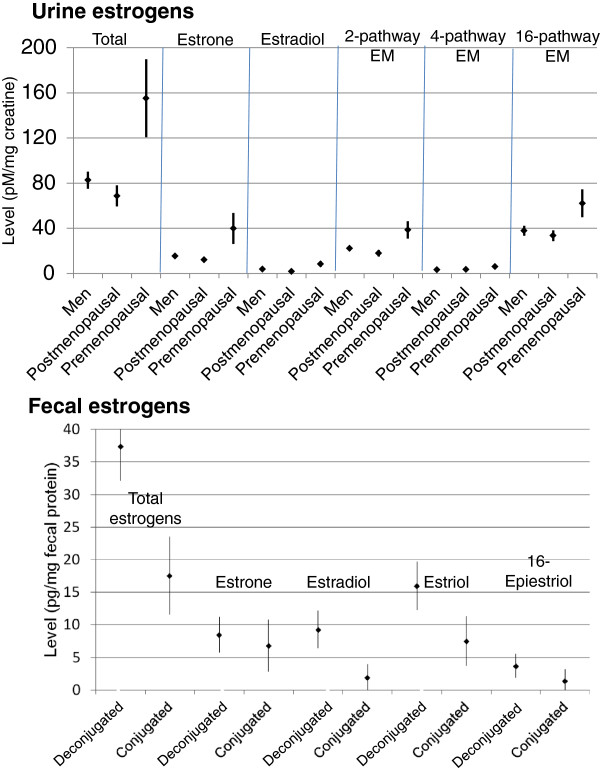
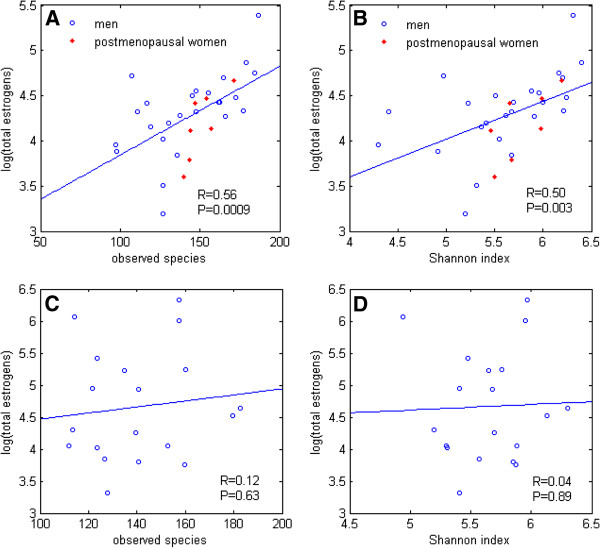
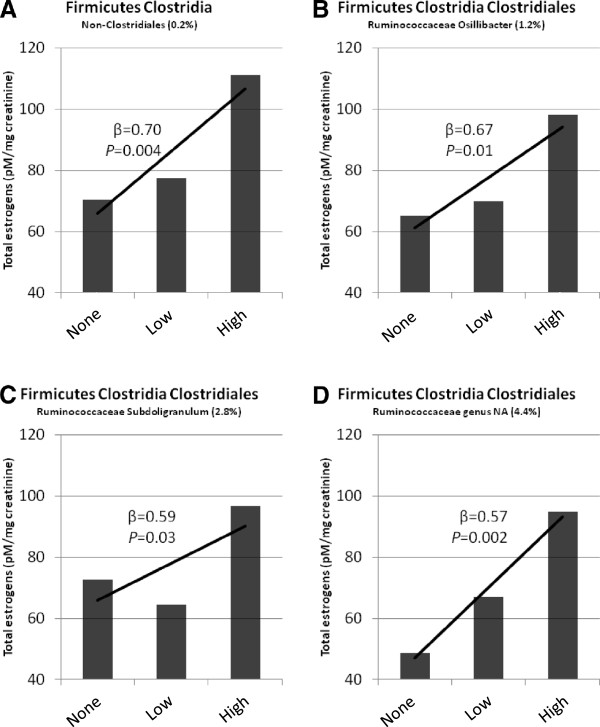
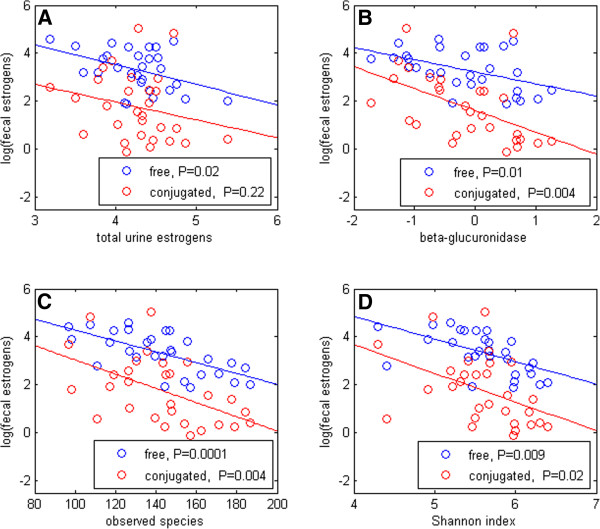
Background: High systemic estrogen levels contribute to breast cancer risk for postmenopausal women, whereas low levels contribute to osteoporosis risk. Except for obesity, determinants of non-ovarian systemic estrogen levels are undefined. We sought to identify members and functions of the intestinal microbial community associated with estrogen levels via enterohepatic recirculation. Methods: Fifty-one epidemiologists at the National Institutes of Health, including 25 men, 7 postmenopausal women, and 19 premenopausal women, provided urine and aliquots of feces, using methods proven to yield accurate and reproducible results. Estradiol, estrone, 13 estrogen metabolites (EM), and their sum (total estrogens) were quantified in urine and feces by liquid chromatography/tandem mass spectrometry. In feces, β-glucuronidase and β-glucosidase activities were determined by realtime kinetics, and microbiome diversity and taxonomy were estimated by pyrosequencing 16S rRNA amplicons. Pearson correlations were computed for each log e estrogen level, log e enzymatic activity level, and microbiome alpha diversity estimate. For the 55 taxa with mean relative abundance of at least 0.1%, ordinal levels were created [zero, low (below median of detected sequences), high] and compared to log e estrogens, β-glucuronidase and β-glucosidase enzymatic activity levels by linear regression. Significance was based on two-sided tests with α=0.05. Results: In men and postmenopausal women, levels of total urinary estrogens (as well as most individual EM) were very strongly and directly associated with all measures of fecal microbiome richness and alpha diversity (R≥0.50, P ≤0.003). These non-ovarian systemic estrogens also were strongly and significantly associated with fecal Clostridia taxa, including non- Clostridiales and three genera in the Ruminococcaceae family (R=0.57−0.70, P =0.03−0.002). Estrone, but not other EM, in urine correlated significantly with functional activity of fecal β-glucuronidase (R=0.36, P =0.04). In contrast, fecal β-glucuronidase correlated inversely with fecal total estrogens, both conjugated and deconjugated (R≤-0.47, P ≤0.01). Premenopausal female estrogen levels, which were collected across menstrual cycles and thus highly variable, were completely unrelated to fecal microbiome and enzyme parameters ( P ≥0.6). Conclusions: Intestinal microbial richness and functions, including but not limited to β-glucuronidase, influence levels of non-ovarian estrogens via enterohepatic circulation. Thus, the gut microbial community likely affects the risk for estrogen-related conditions in older adults. Understanding how Clostridia taxa relate to systemic estrogens may identify targets for interventions. Trial registration: Not applicable.
Overview
The claims and statistics of this paper haven’t been checked yet.
Free: it reads the open-access text and checks the first 5 claims that cite a source we can check. Create a free account to check every claim.
Integrity signals
Registry
Cites
Statistics
Figures
Verification
Claims the paper makes
The claims and statistics of this paper haven’t been checked yet.
Free: it reads the open-access text and checks the first 5 claims that cite a source we can check. Create a free account to check every claim.
Claims other papers make about this one
Each is checked against this paper’s own text: does it say what the citing paper says it does?
The check wasn’t confident either way, so it gives no verdict — never disputed.
In the citing paper
“However, the study reported a statistically significant association between levels of total estrogens and PD index in control women, which was not observed in women with breast cancer.”
From Association Between Sex Hormone Levels and Gut Microbiota Composition and Diversity—A Systematic Review (2022) · cites this paper as [21]
Experimental — accuracy not yet measuredIn the citing paper
“Two studies utilised the same cohort of participants and thus only the cohort from one of the two studies was included for these calculations (see Table 1).(21, 22)”
From Association Between Sex Hormone Levels and Gut Microbiota Composition and Diversity—A Systematic Review (2022) · cites this paper as [21]
In the citing paper
“In addition, the study by Goedert et al.(21) did not find an association between EM:parent estrogen and diversity in healthy women or women with breast cancer.”
From Association Between Sex Hormone Levels and Gut Microbiota Composition and Diversity—A Systematic Review (2022) · cites this paper as [21]
Self-check
Percentages, sums and reported differences re-computed from the paper’s own numbers.
The self-check needs the paper’s full text.
Citations
Cites
QIIME allows analysis of high-throughput community sequencing data
Caporaso, J. G., Kuczynski, J., Stombaugh, J., Bittinger, K., Bushman, F. D., Costello, E. K., Fierer, N., Peña, A. G., Goodrich, J. K., Gordon, J. I., et al. (2010) · Nature Methods · doi:10.1038/nmeth.f.303 · Cited by 34,887 · cited 7×
“Relative abundance of each OTU, alpha diversity, and beta diversity were computed using QIIME [25] for each DNA sample and then averaged on four replicates for each study participant.”
MethodInfluentialUCHIME improves sensitivity and speed of chimera detection
Edgar, R. C., Haas, B. J., Clemente, J. C., Quince, C., & Knight, R. (2011) · Bioinformatics · doi:10.1093/bioinformatics/btr381 · Cited by 15,114
A core gut microbiome in obese and lean twins
Turnbaugh, P. J., Hamady, M., Yatsunenko, T., Cantarel, B. L., Duncan, A., Ley, R. E., Sogin, M. L., Jones, W. J., Roe, B. A., Affourtit, J. P., et al. (2009) · Nature · doi:10.1038/nature07540 · Cited by 7,823 · cited 2×
“Because use of medications, including non-antibiotics [16], and elevated BMI [15,16] are inversely associated with gut microbiome alpha diversity, adjustment for these likely would have strengthened the direct associations that we found herein between alpha diversity and systemic estrogen levels.”
BackgroundThe Ribosomal Database Project: improved alignments and new tools for rRNA analysis
Cole, J. R., Wang, Q., Cardenas, E., Fish, J., Chai, B., Farris, R. J., Kulam-Syed-Mohideen, A. S., McGarrell, D. M., Marsh, T., Garrity, G. M., et al. (2009) · Nucleic Acids Research · doi:10.1093/nar/gkn879 · Cited by 4,762 · cited 2×
“Operational taxonomic units (OTUs) were defined using QIIME as sequences with at least 97% identity, and sequences were classified at the genus level using the Ribosomal Database Project (RDP) naïve Bayesian classifier [27].”
MethodThe NIH Human Microbiome Project
The NIH HMP Working Group, Peterson, J., Garges, S., Giovanni, M., McInnes, P., Wang, L., Schloss, J. A., Bonazzi, V., McEwen, J. E., Wetterstrand, K. A., et al. (2009) · Genome Research · doi:10.1101/gr.096651.109 · Cited by 2,066 · cited 2×
“Classification of operational taxonomic units Sequence read quality used the Institute of Genome Sciences bioinformatics pipeline that complies with standard operating procedures of the National Institutes of Health Human Microbiome Project [24].”
MethodHamady, M., Lozupone, C., & Knight, R. (2010) · The ISME Journal · doi:10.1038/ismej.2009.97 · Cited by 1,099
Alleviating Cancer Drug Toxicity by Inhibiting a Bacterial Enzyme
Wallace, B. D., Wang, H., Lane, K. T., Scott, J. E., Orans, J., Koo, J. S., Venkatesh, M., Jobin, C., Yeh, L.-A., Mani, S., et al. (2010) · Science · doi:10.1126/science.1191175 · Cited by 1,080 · cited 1×
“For example, inhibition of fecal microbial β-glucuronidases may be possible [37], although the relatively weak associations that we found between fecal β-glucuronidase activity and urinary estrogens suggest that enzyme inhibition would not markedly reduce systemic estrogen levels.”
BackgroundPlottel, C. S., & Blaser, M. J. (2011) · Cell Host & Microbe · doi:10.1016/j.chom.2011.10.003 · Cited by 743 · cited 4×
“As postulated and summarized by others [11], our results support the hypothesis that breast cancer risk in postmenopausal women and hip fracture risk in both postmenopausal women and elderly men is modulated by decades-long differences in systemic estrogens attributable to differences in the intestinal microbiota.”
BackgroundResultInfluentialObesity and Breast Cancer: The Estrogen Connection
Cleary, M. P., & Grossmann, M. E. (2009) · Endocrinology · doi:10.1210/en.2009-0070 · Cited by 504 · cited 2×
“Background Breast cancer risk is increased among postmenopausal women who have high levels of endogenous estrogens [1-3].”
BackgroundEstrogen excretion patterns and plasma levels in vegetarian and omnivorous women
Goldin, B. R., Adlercreutz, H., Gorbach, S. L., Warram, J. H., Dwyer, J. T., Swenson, L., & Woods, M. N. (1982) · New England Journal of Medicine · doi:10.1056/nejm198212163072502 · Cited by 474 · cited 1×
“A working hypothesis is that this enterohepatic recirculation affects the half-life and systemic levels of estrogens in men and postmenopausal women, and perhaps during the luteal phase in premenopausal women [9-11].”
Background
Research works printed but not linked: 1
- Raftogianis R, Creveling C, Weinshilboum R, Weisz J: Estrogen metabolism by conjugation. J Natl Cancer Inst Monogr. 2000, 113-124.
Cited by
Items 301–400 of 663
Zhu, Q., Zai, H., Zhang, K., Zhang, X., Luo, N., Li, X., Hu, Y., & Wu, Y. (2022) · Journal of Applied Microbiology · doi:10.1111/jam.15620 · Cited by 22
“The gut microbiota affects oestrogen metabolism and the balance of circulating and excreted hormone levels (Flores et al., 2012; Fuhrman et al., 2014).”
BackgroundChoi, S.-Y., & Choi, J. (2024) · Medicina · doi:10.3390/medicina60030516 · Cited by 22
The ovarian cancer-associated microbiome contributes to the tumor’s inflammatory microenvironment
Zhang, M., Mo, J., Huang, W., Bao, Y., Luo, X., & Yuan, L. (2024) · Frontiers in Cellular and Infection Microbiology · doi:10.3389/fcimb.2024.1440742 · Cited by 22
Klil-Drori, A. J., Taşçılar, K., Yin, H., Aprikian, A. G., Bitton, A., & Azoulay, L. (2016) · American Journal of Epidemiology · doi:10.1093/aje/kwv307 · Cited by 22
“In 2 cross-sectional studies carried out among postmenopausal women and male adults, levels of estrogen metabolites were directly correlated with the diversity of the fecal microbiome (35, 36).”
BackgroundInsight into Cancer Immunity: MHCs, Immune Cells and Commensal Microbiota
Wen, M., Li, Y., Qin, X., Qin, B., & Wang, Q. A. (2023) · Cells · doi:10.3390/cells12141882 · Cited by 21
Bucurica, S., Lupanciuc, M., Radu, F. I., Ștefan, I., Munteanu, A. E., Anghel, D. N., Jinga, M., & Gaman, L. E. (2023) · International Journal of Molecular Sciences · doi:10.3390/ijms242216034 · Cited by 21
“Deconjugated estrogens from the gut are reabsorbed into the enterohepatic circulation by easily diffusing through cell membranes [51–53].”
BackgroundThe microbiome: a link between obesity and breast cancer risk
Gaber, M. K., Arnone, A. A., Vidi, P., & Cook, K. L. (2024) · Frontiers in Microbiomes · doi:10.3389/frmbi.2024.1394719 · Cited by 21
“Additionally, Flores et al. (2012) showed an association between microbial alpha diversity and the levels of urinary estrogens and estrogen metabolites.”
Microbiome-targeted nanoplatforms and engineering approaches in breast cancer therapy
Sabeel, Z., & Zhao, Y. (2025) · Molecular Cancer · doi:10.1186/s12943-025-02456-x · Cited by 21
“Microbial β-glucuronidase plays a critical role by deconjugating estrogens in the intestines, facilitating their reabsorption through enterohepatic circulation and thereby sustaining elevated hormonal exposure [46, 54, 55].”
Sui, K., Tveter, K. M., Bawagan, F. G., Buckendahl, P., Martinez, S. A., Jaffri, Z. H., MacDonell, A. T., Wu, Y., Duran, R. M., Shapses, S. A., et al. (2022) · Frontiers in Pharmacology · doi:10.3389/fphar.2022.900667 · Cited by 20
“Loss of ovarian E2 leads to systemic physiological changes including an altered gut microbiota (Flores et al., 2012; Choi et al., 2017; Chen et al., 2021) and dysregulation of metabolic functions (Mauvais-Jarvis et al.”
BackgroundBiomarkers of reproductive health in wildlife and techniques for their assessment
Ghosal, R., Edwards, K. L., Chiarelli, T. L., Fanson, K. V., Ganswindt, A., Keeley, T., Koester, D. C., Roberts, B. M., Majelantle, T. L., Wauters, J., et al. (2023) · Theriogenology Wild · doi:10.1016/j.therwi.2023.100052 · Cited by 20
Persistence and Sexual Dimorphism of Gut Dysbiosis and Pathobiome after Sepsis and Trauma
Munley, J. A., Park, G., Kelly, L. S., Kannan, K. B., Mankowski, R. T., Casadesús, G., Chakrabarty, P., Wallet, S. M., Maile, R., Bible, L. E., et al. (2024) · Annals of Surgery · doi:10.1097/sla.0000000000006385 · Cited by 20
Early-life gut inflammation drives sex-dependent shifts in the microbiome-endocrine-brain axis
Sullivan, O., Sie, C., Ng, K. M., Cotton, S., Rosete, C., Hamden, J. E., Singh, A. P., Lee, K., Choudhary, J., Kim, J. A., et al. (2024) · Brain Behavior and Immunity · doi:10.1016/j.bbi.2024.12.003 · Cited by 20
Li, D., Lan, X., Xu, L., Zhou, S., Luo, H., Zhang, X., Yu, W., Yang, Y., & Fang, X. (2025) · Frontiers in Immunology · doi:10.3389/fimmu.2025.1552010 · Cited by 20
Jones, G. S., Feigelson, H. S., Falk, R. T., Hua, X., Ravel, J., Yu, G., Flores, R., Gail, M. H., Shi, J., Xu, X., et al. (2019) · PLoS ONE · doi:10.1371/journal.pone.0216114 · Cited by 20
Self-citationWu, Q., Gao, G., Kwok, L. Y., Lv, H., & Sun, Z. (2025) · Journal of Advanced Research · doi:10.1016/j.jare.2025.07.005 · Cited by 19
Organski, A. C., Jorgensen, J. S., & Cross, T.-W. (2021) · Current Opinion in Endocrine and Metabolic Research · doi:10.1016/j.coemr.2021.100284 · Cited by 19
Hatayama, K., Kono, K., Okuma, K., Hasuko, K., Masuyama, H., & Benno, Y. (2023) · Biomedicines · doi:10.3390/biomedicines11020376 · Cited by 19
“Estrogen has been reported to be associated with intestinal microbiota [32,33].”
BackgroundSasaki, T., Matsumoto, Y., Murakami, K., Endo, S., Toyozumi, T., Otsuka, R., Kinoshita, K., Hu, J. H., Iida, S., Morishita, H., et al. (2023) · Esophagus · doi:10.1007/s10388-023-01004-0 · Cited by 19
“Some studies have reported that gut bacteria affect the development of breast cancer by modulating estrogen metabolism [14, 15].”
BackgroundAspartame Intake Delayed Puberty Onset in Female Offspring Rats and Girls
Lin, C., Nguyen, N. N., Tsai, W., Hsieh, R., Wu, H., & Chen, Y. (2024) · Molecular Nutrition & Food Research · doi:10.1002/mnfr.202300270 · Cited by 19
Que, M., Li, S., Qian, X., Li, X., Luo, X., Zhan, G., & Luo, A. (2024) · Neurobiology of Disease · doi:10.1016/j.nbd.2024.106627 · Cited by 19
Toxic effects of DEHP and MEHP on gut-liver axis in rats via intestinal flora and metabolomics
Wang, J., Liu, H., Kou, X., Zhang, Y., Wang, Y., Chen, C.-L., Xiang, Z., Wang, X., Su, C., & Liu, Y.-C. (2024) · iScience · doi:10.1016/j.isci.2024.111135 · Cited by 20
Wang, Z., Fu, H., Zhou, Y., Yan, M., Chen, D., Yang, M. J., Xiao, S., Chen, C., & Huang, L. (2020) · Microbial Biotechnology · doi:10.1111/1751-7915.13695 · Cited by 19
“Conversely, the diversity and composition of gut microbiota are also affected by oestrogen (Flores et al., 2012; Huang et al., 2017).”
BackgroundSex Hormones, the Stool Microbiome, and Subclinical Atherosclerosis in Women With and Without HIV
Peters, B. A., Hanna, D. B., Wang, Y., Weber, K. M., Topper, E., Appleton, A. A., Sharma, A., Hodis, H. N., Santoro, N. F., Guillemette, C., et al. (2023) · The Journal of Clinical Endocrinology & Metabolism · doi:10.1210/clinem/dgad510 · Cited by 19
Navigating complexities of polymorphic microbiomes in endometrial cancer
Jimenez, N. R., Herman, C., Łaniewski, P., Cope, E. K., Lee, K., Mahnert, N. D., Chase, D. M., Caporaso, J. G., & Herbst‐Kralovetz, M. M. (2025) · npj Biofilms and Microbiomes · doi:10.1038/s41522-025-00690-1 · Cited by 20
“Interestingly, Bi fi do-bacterium hasbeenshowntometabolizeestrogeninthegut,whichcouldbe why it is linked with grade 1/2 EEC, as these are estrogen-mediated ECs 57 .”
Zulfiqar, Z., Huang, S., & Shi, Y. (2025) · Animal nutrition · doi:10.1016/j.aninu.2025.05.002 · Cited by 19
Alterations in Fecal Microbiota Linked to Environment and Sex in Red Deer (Cervus elaphus)
Sun, Y., Yu, Y., Guo, J., Zhong, L., & Zhang, M. (2023) · Animals · doi:10.3390/ani13050929 · Cited by 18
“Increased evidence indicates that sex steroid hormone levels are associated with the human gut microbiota [54,55].”
BackgroundDiStefano, J. K. (2023) · Nutrients · doi:10.3390/nu15122670 · Cited by 18
Targeting systemic and gut microbial metabolism in ER+ breast cancer
Heath, H., Mogol, A. N., Casiano, A. S., Zuo, Q., & Madak‐Erdogan, Z. (2024) · Trends in Endocrinology and Metabolism · doi:10.1016/j.tem.2023.12.008 · Cited by 18
Yao, Y., Hu, H., Chen, L., & Zheng, H. (2024) · Frontiers in Microbiology · doi:10.3389/fmicb.2024.1321268 · Cited by 18
“There is growing evidence that the human gut microbiota plays a role in gynecologic diseases (Flores et al., 2012; Lindheim et al., 2017; Parida and Sharma, 2019; Zhao et al., 2020; Zhou et al., 2020; Cao et al., 2024; Huang et al., 2024).”
BackgroundThe role of the gut microbiome in neuroinflammation and chemotherapy-induced peripheral neuropathy
Shatunova, S., Aktar, R., Peiris, M., Lee, J. Y. P., Vetter, I., & Starobova, H. (2024) · European Journal of Pharmacology · doi:10.1016/j.ejphar.2024.176818 · Cited by 18
Menopause and gastrointestinal health and disease
Ley, D., & Saha, S. (2025) · Nature Reviews Gastroenterology & Hepatology · doi:10.1038/s41575-025-01075-7 · Cited by 19
“Total oestrogens, oestradiol, oestrone, and 13 oestrogen metabolites, such as oestriol and 2-hydroxyestrone, have been measured in human faeces and urine 50 .”
Sex-specific mechanisms in the pathogenesis and progression of chronic kidney disease
Li, G., Xu, Z., Yang, H., Zhang, D., Liu, B., Song, Y., Li, Q., Zhang, Y., Zhou, H., & Wang, Y. (2025) · Autoimmunity Reviews · doi:10.1016/j.autrev.2025.103938 · Cited by 17
Ji, J., Zhengrong, G., Li, N., Dong, X. W., Wang, X., Yao, Q., Zhang, Z., Zhang, L., & Cao, L. (2024) · PeerJ · doi:10.7717/peerj.17416 · Cited by 17
“In addition, the abundance of Clostridia in feces was found to be strongly associated with nonovarian systemic estrogens ( Flores et al., 2012 ), which might help to prevent postmenopausal bone loss.”
McCune, E., Sharma, A., Johnson, B., O’Meara, T. A., Theiner, S., Campos, M., Heditsian, D. M., Brain, S., Gilbert, J. A., Esserman, L. J., et al. (2024) · mSystems · doi:10.1128/msystems.01237-24 · Cited by 18
Sex hormones–Gut microbiome axis: An update of what is known so far
Zommiti, M., & Feuilloley, M. G. J. (2025) · Current Opinion in Endocrine and Metabolic Research · doi:10.1016/j.coemr.2025.100571 · Cited by 17
The Urogenital System Microbiota: Is It a New Gamechanger in Urogenital Cancers?
Ece, G. T., Aktaş, A., Caner, A., Sağlık, İ., Atik, T. K., Bağcı, Ö. U., Bilman, F. B., Demirbakan, H., Havuz, S. G., Kaya, E., et al. (2025) · Microorganisms · doi:10.3390/microorganisms13020315 · Cited by 19
“The gut microbiome can produce products capable of metabolizing estrogens and regulating estrogen levels [38,39].”
Broadening horizons: microbiota as a novel biomarker and potential treatment for endometriosis
Wang, M., Liu, W., Zheng, L., Ma, S., Jin, L., Zhao, D., & Li, D. (2025) · Frontiers in Microbiology · doi:10.3389/fmicb.2025.1521216 · Cited by 17
Investigation of the impact of gut microbiotas on fertility of stored sperm by types of hens
Elokil, A., Abouelezz, K., Adetula, A. A., Ahmad, H. I., Mo, C., Sun, C., & Li, S. (2019) · Poultry Science · doi:10.1016/j.psj.2019.10.048 · Cited by 17
“Recently, the role of the estrogengut microbiome axis was discovered to regulate reproductive performance in female mammals through the secretion of the enzyme b-glucuronidase, which deconjugates estrogens into their active forms, and lower microbial composition was estimated to occur in infertile females (Flores et a…”
BackgroundCastejón, P., Cabas, I., Gómez, V., Chaves-Pozo, E., Cerezo, I. M., Moríñigo, M. Á., Martínez‐Manzanares, E., Galindo‐Villegas, J., & Ayala, A. G. (2021) · Frontiers in Immunology · doi:10.3389/fimmu.2021.742827 · Cited by 17
He, Q., Guo, J., Zhang, Q., Yau, Y.-M., Yu, Y., Zhong, Z., Tong, Z.-Y., Yang, Z., & Chen, M. (2022) · Evidence-based Complementary and Alternative Medicine · doi:10.1155/2022/9352833 · Cited by 17
“,e levels of estrogen could be increased by Ruminococcaceae, which was reported in a cross-sectional study [48].”
Kheloui, S., Smith, A., & Ismail, N. (2022) · Frontiers in Neuroendocrinology · doi:10.1016/j.yfrne.2022.101041 · Cited by 19
Yang, F., Liu, C., Lu, X., Liu, S., Zhang, Y., Yu, Y. H., & Long, Y. (2023) · Journal of Functional Foods · doi:10.1016/j.jff.2023.105925 · Cited by 17
Zou, S., Xu, Y., Li, N., Wang, H., Gui, J., & Li, J. (2023) · PLoS ONE · doi:10.1371/journal.pone.0294436 · Cited by 16
Aragón, A., Jurado, R., Jara, J., Rodríguez, J. M., & Orgaz, B. (2024) · Nutrients · doi:10.3390/nu16060861 · Cited by 16
“This process is mediated by microbial enzymes, including β -glucosidases [37] and, especially, β -glucuronidases [31].”
BackgroundLi, V. W., Dong, T. S., Funes, D., Hernandez, L., Kushnir, N. R., Nair, D., Jacobs, J. P., Reddy, S. T., Mayer, E. A., Chang, L., et al. (2024) · Molecular and Cellular Endocrinology · doi:10.1016/j.mce.2025.112534 · Cited by 16
The emerging role of the gut microbiome in polycystic ovary syndrome
He, Y., Jin, X., Wang, H., Dai, H., Lu, X., Zhao, J., Zhang, H., Chen, W., & Wang, G. (2021) · F&S Reviews · doi:10.1016/j.xfnr.2021.03.003 · Cited by 16
Xu, B., Qin, W., Yan, Y., Tang, Y., Zhou, S., Huang, J., Xie, C., Ma, L., & Yan, X. (2021) · Journal of Animal Science and Biotechnology/Journal of animal science and biotechnology · doi:10.1186/s40104-021-00578-y · Cited by 16
“Given that gut microbiota gets involved in regulation of ovarian hormones estradiol and progesterone [12, 33, 34], we then identified the FMT-shifted bacteria.”
BackgroundZhu, S., Chen, H., He, B., Zhang, Y., Li, P., & Kuang, J. (2025) · Frontiers in Microbiology · doi:10.3389/fmicb.2025.1659783 · Cited by 15
Knowledge gaps and research priorities to understand sex differences in immunity
Flanagan, K. L., & Klein, S. L. (2026) · PLoS Biology · doi:10.1371/journal.pbio.3003578 · Cited by 16
“Certain gut bacteria, the genes of which are collectively called the ‘estrobolome’ [79], produce enzymes such as β -glucuronidase that increase estrogen bioavailability and activity [80].”
Blood lipids mediate the effects of gut microbiome on endometriosis: a mendelian randomization study
Su, C., Wan, S., Ding, J., Ni, G., & Ding, H. (2024) · Lipids in Health and Disease · doi:10.1186/s12944-024-02096-y · Cited by 15
“Estrogen loses its biological activity after binding to SHBG [52].”
BackgroundChang, C., & Lam, H. Y. P. (2024) · Anticancer Research · doi:10.21873/anticanres.17035 · Cited by 15
“The microbial β - glucuronidase activity was positively correlated with estrone levels and inversely with total estrogens in older adults (90).”
BackgroundZhang, J., Zhang, J., Li, K., Fu, X., Liang, Y., Zhang, M., Zhuang, S., & Gao, Y.-Y. (2024) · Animals · doi:10.3390/ani15010015 · Cited by 15
Hallmarks of Cancer Cachexia: Sexual Dimorphism in Related Pathways
Satari, S., Mota, I. N. R., Silva, A. C. L., Brito, H. O., Oliveira, P. A., da Costa, R. M. G., & Medeiros, R. (2025) · International Journal of Molecular Sciences · doi:10.3390/ijms26093952 · Cited by 15
Chen, Y., Wang, Y., Shaoyong, W., He, Y., Liu, Y., Wei, S., Gan, Y., Sun, L., Wang, Y., Zong, X., et al. (2025) · Journal of Animal Science and Biotechnology/Journal of animal science and biotechnology · doi:10.1186/s40104-025-01191-z · Cited by 15
“Women with greater gut microbiota diversity exhibited elevated ratios of hydroxylated estrogen metabolites to estradiol in their urine [43].”
The Role of Gut Microbiota in Inflammatory Bowel Disease-Current State of the Art
Safarpour, A. R., Askari, H., Shojaei‐Zarghani, S., Raeis-Abdollahi, E., Jahromi, H. K., Raise‐Abdullahi, P., Daliri, K., Tajbakhsh, A., & Rahmati, L. (2022) · Mini-Reviews in Medicinal Chemistry · doi:10.2174/1389557522666220914093331 · Cited by 15
Rahmani, D., Faal, B., Zali, H., Tackallou, S. H., & Niknam, Z. (2023) · BMC Complementary Medicine and Therapies · doi:10.1186/s12906-023-04167-6 · Cited by 15
“The diversity of the gut microbiome could influence systemic estrogen levels by different processes [42].”
BackgroundUEG Week 2017 Oral Presentations
McNicholl, A. G., Nyssen, O. P., Bordin, D. S., Tepeš, B., Pérez-Aisa, M. A., Vaira, B., Álvarez, M. C., Bujanda, L., Fernández, M. C., Lerang, F., et al. (2017) · United European Gastroenterology Journal · doi:10.1177/2050640617725668 · Cited by 16
Blanco, J. R., del Campo, R., Ortiz, J. A., Olmos, M. L., & Carnero, A. (2025) · Cells · doi:10.3390/cells14221813 · Cited by 14
Zhang, M., Zhai, Z., Yang, B., He, L., Wang, J., Dai, W., Xue, L., Yang, X., Feng, Y., & Wang, H. (2023) · Frontiers in Aging Neuroscience · doi:10.3389/fnagi.2023.1148546 · Cited by 14
“In a cross-sectional study, urinary estrogen levels correlated with fecal microbiota abundance and α-diversity in men and postmenopausal women, and β-glucuronidase production by certain fecal flora was negatively associated with the level of fecal estrogen (Flores et al., 2012).”
BackgroundDeng, B., Gao, Z., Ru, X., Tong, H., Liang, W., Eeckhaut, I., Zhang, L., & Xu, J. (2023) · Aquaculture · doi:10.1016/j.aquaculture.2023.740125 · Cited by 14
Sun, Y., Fan, C., & Lei, D. (2024) · Journal of Affective Disorders · doi:10.1016/j.jad.2024.07.057 · Cited by 14
Liwinski, T., Auer, M. K., Schröder, J., Pieknik, I., Casar, C., Schwinge, D., Henze, L., Stalla, G. K., Lang, U. E., von Klitzing, A., et al. (2024) · BMC Medicine · doi:10.1186/s12916-024-03548-z · Cited by 14
“…be reabsorbed into the plasma and undergo cycles of enterohepatic recirculation [85]. β-glucuronidase activity influences levels of non-ovarian estrogens via this enterohepatic circulation, supporting the hypothesis that decreased β-glucuronidase levels might increase systemic estrogen levels [86].”
Lattanzi, G., Perillo, F., Díaz‐Basabe, A., Caridi, B., Amoroso, C., Baeri, A., Cirrincione, E., Ghidini, M., Galassi, B., Cassinotti, E., et al. (2024) · OncoImmunology · doi:10.1080/2162402x.2024.2425125 · Cited by 14
Dietary fiber consumption and outcomes of different cancers: an umbrella review
He, X., Hou, J., Liu, L., Chen, X., Zhang, L., Pang, C., Tong, Y., Li, H., Chen, F., Peng, R., et al. (2025) · Food & Nutrition Research · doi:10.29219/fnr.v69.11034 · Cited by 15
“Fiber binds to estrogen in the colon, enhancing its excretion and decreasing reabsorption, while also inhibiting β -glucuronidase activity, which hydrolyzes conjugated estrogens (45, 46).”
Interaction between the breast tumor microenvironment and gut microbiome
Tang, G., Millar, E. K. A., Graham, P., & Beretov, J. (2025) · Gut Microbes · doi:10.1080/19490976.2025.2514136 · Cited by 15
“162 It may be the case that the pathogenic hormonal properties of Clostridium out-weigh its protective effects in breast oncogenesis.”
Gut Microbiota in Women with Eating Disorders: A New Frontier in Pathophysiology and Treatment
Marano, G., Rossi, S., Sfratta, G., Acanfora, M., Anesini, M. B., Traversi, G., Lisci, F. M., Rinaldi, L., Pola, R., Gasbarrini, A., et al. (2025) · Nutrients · doi:10.3390/nu17142316 · Cited by 14
“Soy isoflavone supplementation has been shown to increase Bifidobacterium concentrations and suppress the growth of unclassified Clostridiaceae in postmenopausal women [64].”
Bergström, H., Ekström, L., Warnqvist, A., Bergman, P., & Björkhem‐Bergman, L. (2021) · BMC Women s Health · doi:10.1186/s12905-021-01306-4 · Cited by 14
“In a previous study of 25 males and 7 postmenopausal women, a strong association was found between levels of estrogens and their metabolites in urine and the diversity of microbiota in feces [38].”
BackgroundThe Microbiota-Bone-Allergy Interplay
Sirufo, M. M., Pietro, F. D., Catalogna, A., Ginaldi, L., & Martinis, M. D. (2021) · International Journal of Environmental Research and Public Health · doi:10.3390/ijerph19010282 · Cited by 14
“i a ly, t i r i ta ls ears t i fl e ce fla onoids and diethylstilbestrol, estr gens of intestinal origin, whose alteratio influences bone homeo tasis, being the estrogen deficiency directly involved in the risk of postmenopausal OP [49,50].”
BackgroundThe microbiome in PTEN hamartoma tumor syndrome
Byrd, V. S., Getz, T. M., Padmanabhan, R., Arora, H., & Eng, C. (2017) · Endocrine Related Cancer · doi:10.1530/erc-17-0442 · Cited by 14
“This association may be at least partly explained by altered microbial metabolism of estrogen in the dysbiotic microbiome (Flores et al .”
Angiotensin (1–7) Expressing Probiotic as a Potential Treatment for Dementia
Hernandez, A. R., Banerjee, A., Carter, C. S., & Buford, T. W. (2021) · Frontiers in Aging · doi:10.3389/fragi.2021.629164 · Cited by 14
“In any case, estrogen level in males and postmenopausal females correlate with microbiome diversity and richness, though this correlation is absent in pre-menopausal females (Flores et al., 2012).”
Does Gut-breast Microbiota Axis Orchestrates Cancer Progression?
Marino, M. M., Nastri, B. M., D’Agostino, M., Risolo, R., Angelis, A. D., Settembre, G., Rienzo, M., D’Esposito, V., Abbondanza, C., Formisano, P., et al. (2022) · Endocrine Metabolic & Immune Disorders - Drug Targets · doi:10.2174/1871530322666220331145816 · Cited by 14
Sun, H., Liu, Y., Zeng, T., Li, G., Tao, Z., Zhou, X., Jihui, W., Chen, X., Xu, W., Lu, L., et al. (2022) · Frontiers in Veterinary Science · doi:10.3389/fvets.2022.813800 · Cited by 14
Associations of gut microbiome with endogenous estrogen levels in healthy postmenopausal women
Yaghjyan, L., Mai, V., Darville, L. N. F., Cline, J., Wang, X., Ukhanova, M., Tagliamonte, M. S., Martinez, Y. C., Rich, S. N., Koomen, J. M., et al. (2023) · Cancer Causes & Control · doi:10.1007/s10552-023-01728-5 · Cited by 13
Gut microbiome in two high-altitude bird populations showed heterogeneity in sex and life stage
Sun, M., Halimubieke, N., Fang, B., Valdebenito, J. O., Xu, X., Sheppard, S. K., Székely, T., Zhang, T., He, S., Lu, R., et al. (2024) · FEMS Microbes · doi:10.1093/femsmc/xtae020 · Cited by 13
“F rom this, w e suspect this difference might be driven by the sex hormone level (Flores et al. 2012 , Shin et al. 2019 , d’Afflitto et al. 2022 , Yan et al. 2022 ).”
BackgroundSelf-citationHow does gut microbiota affect the vaginitis axis? The mediating role of plasma metabolites
Li, M., Zhang, Q., Wu, T., Ma, L., Hu, D., Yuan, Z., Wang, S., Luo, A., & Zhang, J. (2024) · Microbiology Spectrum · doi:10.1128/spectrum.02263-24 · Cited by 13
“Observational studies have found associations between gut microbiota and polycystic ovarian syndrome (11), endometriosis (12), and gynecologic cancers (13), which may be linked to their influence on estrogen levels (14).”
Zim, A., & Bommareddy, A. (2025) · Cureus · doi:10.7759/cureus.81354 · Cited by 13
“Since then, the Human Microbiome Project GI database has compiled a list of bacterial phyla within the gut that possess the GUS gene, including but not limited to Bacteroidetes, Firmicutes, Verrucomicrobia, and Proteobacteria [18].”
Guo, C., Xiong, Z., Yang, L., Bai, M., Zhu, Y., & Zeng, X. (2025) · Scientific Reports · doi:10.1038/s41598-025-99406-w · Cited by 13
Gut microbiota and ovarian diseases: a new therapeutic perspective
Ju, S., Kang, Z., Yang, L., Xia, Y., Guo, Y. M., Li, S., Yan, H., Mao, Q., Wang, H. P., & Zhong, L. (2025) · Journal of Ovarian Research · doi:10.1186/s13048-025-01684-5 · Cited by 14
“Gut bacteria such as E. coli, Bacteroides fragilis, and Streptococcus agalactiae can uncouple glucuronic acid, leading to the reabsorption of active estrogens, this increases their affinity for estrogen beta (ER-β) receptors and may impact tumor formation in the reproductive system [76].”
Effects of gut microbiota in breast cancer
Kang, L., Chen, H., He, C., & Li, J. (2025) · Frontiers in Oncology · doi:10.3389/fonc.2025.1617410 · Cited by 14
Diet, the Gut Microbiome, and Estrogen Physiology: A Review in Menopausal Health and Interventions
Lim, M. J. S., Parlindungan, E., See, E., Gan, C. H., Yap, R., & Yong, G. J. M. (2026) · Nutrients · doi:10.3390/nu18071052 · Cited by 13
Sári, Z., Kovàcs, T., Csonka, T., Török, M., Sebő, É., Tóth, J., Tóth, D., Mikó, E., Kiss, B., Szeőcs, D., et al. (2020) · Physiology International · doi:10.1556/2060.2020.00016 · Cited by 13
“Increased estrogen reactivation and reuptake supports the proliferation of breast cancer cells [3, 4, 33, 35].”
BackgroundShao, X., Li, J., Xu, F., Chen, D., & Liu, K. (2020) · Canadian Journal of Infectious Diseases and Medical Microbiology · doi:10.1155/2020/8811477 · Cited by 13
“For example, 16-alpha-hydroxylation of estradiol is the metabolite most closely associated with gut microbes [25].”
BackgroundOh, H., Smith‐Warner, S. A., Tamimi, R. M., Wang, M., Xu, X., Hankinson, S. E., Fuhrman, B. J., Ziegler, R. G., & Eliassen, A. H. (2015) · Journal of Nutrition · doi:10.3945/jn.115.212779 · Cited by 13
Self-citationPolyphenols Influence the Development of Endometrial Cancer by Modulating the Gut Microbiota
Baranowska‐Wójcik, E., Winiarska‐Mieczan, A., Olcha, P., Kwiecień, M., Jachimowicz-Rogowska, K., Nowakowski, Ł., Miturski, A., & Gałczyński, K. (2024) · Nutrients · doi:10.3390/nu16050681 · Cited by 12
“Flores et al. [44] found that, in postmenopausal women, oestrogen levels were closely associated with the quantity and diversity of faecal microbiota, with the most correlated taxa being Clostridia and three genera from the Ruminococcaceae family.”
BackgroundNodakenin Ameliorates Ovariectomy-Induced Bone Loss by Regulating Gut Microbiota
Liu, C., Chen, J., Wang, Z., Li, Y., Zhang, Y., & Li, G. (2024) · Molecules · doi:10.3390/molecules29061240 · Cited by 12
“Estrogen deficiency is tightly linked to the disruption of the intestinal mucosal barrier, which adversely affects skeletal properties through the modulation of the GM-bone axis [57,58].”
BackgroundThe testobolome in microbial testosterone metabolism and human health
Veerus, L., Subrahmanian, A., & Blaser, M. J. (2026) · npj Biofilms and Microbiomes · doi:10.1038/s41522-025-00861-0 · Cited by 13
“In contrast, high GUS concentrations in the feces have been inversely correlated with fecal estrogen concentrations in humans 69 , implying that the presence of GUS facilitates the reactivation and reabsorption of estrogens.”
Agoni, L., Roselletti, E., Marasco, G., Martinelli, C. V., Pericolini, E., & Seta, F. D. (2026) · Microorganisms · doi:10.3390/microorganisms14061327 · Cited by 12
The Microbiome in the Obesity-Breast Cancer Axis: Diagnostic and Therapeutic Potential
Avtanski, D. B., Reddy, V. V., Stojchevski, R., Hadzi‐Petrushev, N., & Mladenov, M. I. (2023) · Pathogens · doi:10.3390/pathogens12121402 · Cited by 12
Wang, J., Su, C., Qian, M., Wang, X., Chen, C.-L., Liu, Y.-C., Liu, W., Xiang, Z., & Xu, B. (2024) · Frontiers in Endocrinology · doi:10.3389/fendo.2024.1415216 · Cited by 12
Deciphering the influence of gut and oral microbiomes on menopause for healthy aging
Yu, S., Huang, F., Huang, Y., Yan, F., Li, L., Xu, S., Zhao, Y., Zhang, X., Chen, R., Chen, X., et al. (2024) · Journal of genetics and genomics/Journal of Genetics and Genomics · doi:10.1016/j.jgg.2024.11.010 · Cited by 11
Park, S.-L., Kim, M., & Kim, T. (2025) · Journal of Menopausal Medicine · doi:10.6118/jmm.24024 · Cited by 11
Luo, X., Guo, Y., & Xu, L. (2024) · American Journal of Translational Research · doi:10.62347/gdno7274 · Cited by 11
Parihar, A., Jain, S., Parihar, D. S., Ranjan, P., & Khan, R. (2021) · Elsevier eBooks · doi:10.1016/b978-0-12-823424-2.00007-7 · Cited by 11
Endocrine Disruption and the Gut Microbiome
Acharya, K. D., Parakoyi, A. E. R., & Tetel, M. J. (2021) · Elsevier eBooks · doi:10.1016/b978-0-12-821985-0.00015-3 · Cited by 12
“For example, in postmenopausal women, fecal E2 levels are inversely correlated with b-glucuronidase, providing further evidence that E2 and estrogen-like compounds are recycled in the gut [7].”
BackgroundChioma, O. S., Mallott, E. K., Shah-Gandhi, B., Wiggins, Z., Langford, M., Lancaster, A. W., Gelbard, A. H., Wu, H., Johnson, J. E., LANCASTER, L. H., et al. (2023) · Cells · doi:10.3390/cells12050766 · Cited by 11
“Lactobacillus spp, which were elevated in ABSL-1 stool, can reduce fecal β-glucuronidase activity [45]; future studies that assess the capacity of lactobacilli to enhance urinary estrogen excretion and lower its serum levels are needed.”
BackgroundShi, G., Zhu, B., Wu, Q., Dai, J., & Sheng, N. (2023) · The Science of The Total Environment · doi:10.1016/j.scitotenv.2023.169330 · Cited by 10
Lyu, W., Li, D., Li, S., Hu, H., Zhou, J., & Wang, L. (2024) · Critical Reviews in Food Science and Nutrition · doi:10.1080/10408398.2024.2361306 · Cited by 10
“A deceased β-glucuronidase (gmGUS) activity because of gut microbial diseases can result in reduced conjugation of estrogen and a decrease in the level of circulating estrogens (Flores et al. 2012).”
Characteristics and potential diagnostic value of gut microbiota in ovarian tumor patients
Gong, W., Jin, G., Bao, Y., Liu, Q., Ni, M., Wang, J., Mao, S., Zhang, Y., & Zheng, Z. (2025) · Scientific Reports · doi:10.1038/s41598-025-99912-x · Cited by 10
“Since 80% of breast cancer cases are estrogen receptor positive 22 , the occurrence and development of breast cancer may be related to estrogen metabolism.”
Impact of gut microbiota on endometriosis: linking physical injury to mental health
Li, Y., Hu, Q., Ling, L., Liufeng, Y., Ge, J., & Wu, X. (2025) · Frontiers in Cellular and Infection Microbiology · doi:10.3389/fcimb.2025.1526063 · Cited by 10
Andrews, R., Lacey, A., Roach, H., Tomlinson, R., Kidd, E. J., & Bache, K. (2025) · Clinical Nutrition ESPEN · doi:10.1016/j.clnesp.2025.07.009 · Cited by 10
“Probiotics with oestrogen reactivating properties can modulate β -glucuronidase activity [8 – 11], leading to the hypothesis that probiotics could increase HRT's half-life and reduce the required dosage, thereby enhancing safety, particularly in women susceptible to oestrogen-dependent cancers [7].”
Metadata
- Authors
- Flores, R., Shi, J., Fuhrman, B., Xu, X., Veenstra, T. D., Gail, M. H., Gajer, P., Ravel, J., & Goedert, J. J.
- Affiliations
- National Cancer Institute (US)
- Science Applications International Corporation (United States) (US)
- University of Maryland, Baltimore (US)
- Corresponding author
- Goedert, James J
- ORCID
- Venue
- Journal of Translational Medicine
- Published
- 2012-12
- Volume
- 10
- Issue
- 1
- Pages
- 253-253
- ISSN
- 1479-5876 (ISSN-L)
- PMC
- PMC3552825
- OpenAlex
- W2157570303
- Cited by
- 615
- References
- 43
- Citations by year
- 2026: 57 · 2025: 79 · 2024: 89 · 2023: 80 · 2022: 68 · 2021: 78 · 2020: 61 · 2019: 34 · 2018: 19 · 2017: 22 · 2016: 12 · 2015: 8 · 2014: 5 · 2013: 2
- FWCI
- 1.93
- Type
- journal article
- Language
- en
- Open access
- gold
- doi.org
- Licence
- cc-by
- Locations
- Journal of Translational Medicine (publishedVersion, cc-by)
- Europe PMC (PubMed Central) (publishedVersion, cc-by)
- PubMed Central (publishedVersion, cc-by)
- PubMed (publishedVersion)
- DOAJ (DOAJ: Directory of Open Access Journals) (submittedVersion, cc-by-sa)
- Funders
- RTI International
- National Institutes of Health
- NIH Clinical Center
- Topics
- Life Sciences › Biochemistry, Genetics and Molecular Biology › Molecular Biology › Gut microbiota and health
- Life Sciences › Biochemistry, Genetics and Molecular Biology › Endocrinology › Estrogen and related hormone effects
- Health Sciences › Nursing › Nutrition and Dietetics › Phytoestrogen effects and research
- Keywords
- fecal microbiota, estrogen metabolites, enterohepatic circulation, beta-glucuronidase, β-glucosidase, Clostridia, Ruminococcaceae, estrone, estradiol, urinary estrogens, fecal estrogen, microbiome diversity, postmenopausal women, breast cancer risk, osteoporosis
- MeSH terms
- Adolescent, Adult, Aged, Bacteria, Cross-Sectional Studies, Estrogens, Feces, Female, Humans, Male, Menopause, Middle Aged, Genetic Variation, Biodiversity, Metagenome, Young Adult
About these checks
Registry, retraction, Cites and statistics results are computed, not judged, with one exception: a printed reference that no index lists is read once by a model before it counts as a citation error. Claims are extracted by a model and kept only when their quote appears verbatim in the text; each cited source is then checked, with a model’s help, for whether it says what the claim relies on. Those verdicts can be wrong — read the claim’s quote and the cited source before relying on one.
Statistics and arithmetic are recomputed, not judged.
Confidence bands are shown only for fields calibrated on our annotated test set. None is calibrated yet, so no band is shown.
What counts as a claim ›How we measure confidence ›How we check this ›
Are you an author, or do you see a problem with this page? Request a review
Data sources
Bibliographic data: Semantic Scholar, OpenAlex, Crossref.
Contains information from the Semantic Scholar Academic Graph Datasets, made available under the ODC Attribution License (ODC-BY 1.0).
Semantic Scholar’s data is described in: Kinney, R., et al. (2023). The Semantic Scholar Open Data Platform. arXiv:2301.10140.
