

Effects of arachidonic acid supplementation on training adaptations in resistance-trained males
Open accessThe DOI matches its Crossref record; 61 of the 65 references it cites were found in a registry or an index, and 4 are not checked yet.
Abstract
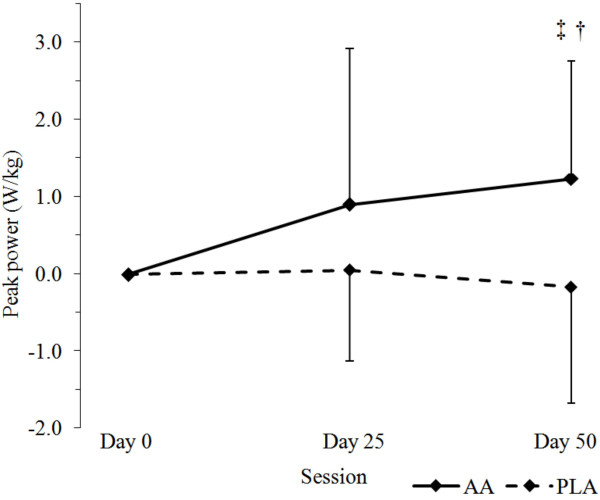
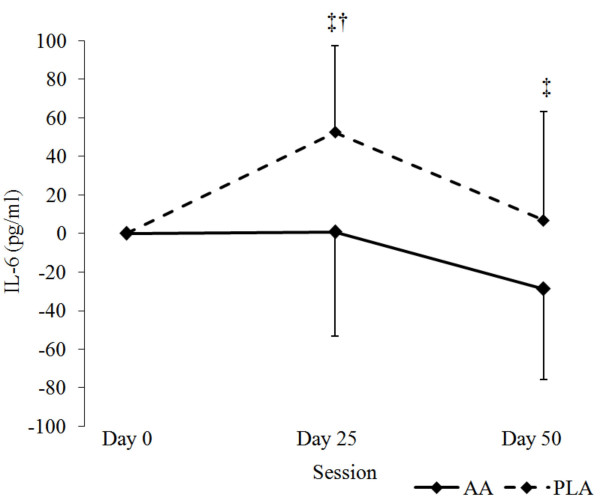
BACKGROUND: To determine the impact of AA supplementation during resistance training on body composition, training adaptations, and markers of muscle hypertrophy in resistance-trained males. METHODS: In a randomized and double blind manner, 31 resistance-trained male subjects (22.1 +/- 5.0 years, 180 +/- 0.1 cm, 86.1 +/- 13.0 kg, 18.1 +/- 6.4% body fat) ingested either a placebo (PLA: 1 g.day-1 corn oil, n = 16) or AA (AA: 1 g.day-1 AA, n = 15) while participating in a standardized 4 day.week-1 resistance training regimen. Fasting blood samples, body composition, bench press one-repetition maximum (1RM), leg press 1RM and Wingate anaerobic capacity sprint tests were completed after 0, 25, and 50 days of supplementation. Percutaneous muscle biopsies were taken from the vastus lateralis on days 0 and 50. RESULTS: Wingate relative peak power was significantly greater after 50 days of supplementation while the inflammatory cytokine IL-6 was significantly lower after 25 days of supplementation in the AA group. PGE2 levels tended to be greater in the AA group. However, no statistically significant differences were observed between groups in body composition, strength, anabolic and catabolic hormones, or markers of muscle hypertrophy (i.e. total protein content or MHC type I, IIa, and IIx protein content) and other intramuscular markers (i.e. FP and EP3 receptor density or MHC type I, IIa, and IIx mRNA expression). CONCLUSION: AA supplementation during resistance-training may enhance anaerobic capacity and lessen the inflammatory response to training. However, AA supplementation did not promote statistically greater gains in strength, muscle mass, or influence markers of muscle hypertrophy.
Overview
The claims and statistics of this paper haven’t been checked yet.
Free: it reads the open-access text and checks the first 5 claims that cite a source we can check. Create a free account to check every claim.
Integrity signals
Registry
Cites
Statistics
Figures
Verification
Claims the paper makes
The claims and statistics of this paper haven’t been checked yet.
Free: it reads the open-access text and checks the first 5 claims that cite a source we can check. Create a free account to check every claim.
Claims other papers make about this one
Each is checked against this paper’s own text: does it say what the citing paper says it does?
The source backs part of the claim, not all of it — or backs it for a different population, condition or comparison.
In the citing paper
“A significant increase in anaerobic peak power was found in the ARA group, but no other changes in strength or body composition were found.”
From ISSN exercise & sports nutrition review update: research & recommendations (2018) · cites this paper as [533]
Experimental — accuracy not yet measured
Self-check
Percentages, sums and reported differences re-computed from the paper’s own numbers.
The self-check needs the paper’s full text.
Citations
Cites
Bradford, M. M. (1976) · Analytical Biochemistry · doi:10.1016/0003-2697(76)90527-3 · Cited by 255,302
The National Center for Biotechnology Information
Benson, D., Boguski, M., Lipman, D. J., & Ostell, J. (1990) · Genomics · doi:10.1016/0888-7543(90)90583-g · Cited by 5,126
National Center for Biotechnology Information
(2019) · Springer Reference Medizin · doi:10.1007/978-3-662-48986-4_301184 · Cited by 1,400
Hormonal Responses and Adaptations to Resistance Exercise and Training
Kraemer, W. J., & Ratamess, N. A. (2005) · Sports Medicine · doi:10.2165/00007256-200535040-00004 · Cited by 1,389 · cited 4×
“For example, reductions in total and/or free testosterone and/or excessive increases in cortisol during training have been related to overtraining [42].”
BackgroundInfluentialBolster, D. R., Crozier, S. J., Kimball, S. R., & Jefferson, L. S. (2002) · Journal of Biological Chemistry · doi:10.1074/jbc.c200171200 · Cited by 851 · cited 1×
“Similarly, EP3 receptor signaling mitigates decrements in cyclic AMP production [54] which promotes the signaling of the mammalian target of rapamycin (mTOR) as well as subsequent assembly of the eukaryotic initiation factor-4G (eIF-4G) [55].”
BackgroundBaar, K., & Esser, K. (1999) · American Journal of Physiology-Cell Physiology · doi:10.1152/ajpcell.1999.276.1.c120 · Cited by 726
The Role of Resistance Exercise Intensity on Muscle Fibre Adaptations
Fry, A. C. (2004) · Sports Medicine · doi:10.2165/00007256-200434100-00004 · Cited by 626
Genetic and pharmacological analysis of prostanoid receptor function
Narumiya, S., & FitzGerald, G. A. (2001) · Journal of Clinical Investigation · doi:10.1172/jci13455 · Cited by 568
Esmarck, B., Andersen, J. L., Olsen, S., Richter, E. A., Mizuno, M., & Kjær, M. (2001) · The Journal of Physiology · doi:10.1111/j.1469-7793.2001.00301.x · Cited by 540 · cited 1×
“Depending on baseline protein intake, subjects were told to ingest 1 to 2 packets of the meal replacement supplement in the morning and/or immediately following each workout [24].”
BackgroundSuction applied to a muscle biopsy maximizes sample size
EVANS, W. J., PHINNEY, S. D., & YOUNG, V. R. (1982) · Medicine & Science in Sports & Exercise · doi:10.1249/00005768-198201000-00018 · Cited by 519
Katsanos, C. S., Kobayashi, H., Sheffield-Moore, M., Aarsland, A., & Wolfe, R. R. (2005) · The American Journal of Clinical Nutrition · doi:10.1093/ajcn/82.5.1065 · Cited by 504
Salem, N., Wegher, B., Mena, P., & Uauy, R. (1996) · Proceedings of the National Academy of Sciences · doi:10.1073/pnas.93.1.49 · Cited by 482
Genetic and pharmacological analysis of prostanoid receptor function
Narumiya, S., & FitzGerald, G. A. (2001) · Journal of Clinical Investigation · doi:10.1172/jci200113455 · Cited by 476
ISSN exercise & sport nutrition review: research & recommendations
Kreider, R. B., Wilborn, C. D., Taylor, L., Campbell, B., Almada, A. L., Collins, R., Cooke, M., Earnest, C. P., Greenwood, M., Kalman, D. S., et al. (2010) · Journal of the International Society of Sports Nutrition · doi:10.1186/1550-2783-7-7 · Cited by 428
Self-citationTsujinaka, T., Fujita, J., Ebisui, C., Yano, M., Kominami, E., Suzuki, K., Tanaka, K., Katsume, A., Ohsugi, Y., Shiozaki, H., et al. (1996) · Journal of Clinical Investigation · doi:10.1172/jci118398 · Cited by 421 · cited 1×
“psin, and ubiquitin pathways [44-48].”
Volpi, E., Mittendorfer, B., Wolf, S. E., & Wolfe, R. R. (1999) · American Journal of Physiology-Endocrinology and Metabolism · doi:10.1152/ajpendo.1999.277.3.e513 · Cited by 418
The COX-2 pathway is essential during early stages of skeletal muscle regeneration
Bondesen, B. A., Mills, S. T., Kegley, K. M., & Pavlath, G. K. (2004) · American Journal of Physiology-Cell Physiology · doi:10.1152/ajpcell.00088.2004 · Cited by 300
Yamashita, A., Sugiura, T., & Waku, K. (1997) · Journal of Biochemistry · doi:10.1093/oxfordjournals.jbchem.a021715 · Cited by 300
Effect of ibuprofen and acetaminophen on postexercise muscle protein synthesis
Trappe, T. A., White, F., Lambert, C. P., Cesar, D., Hellerstein, M., & Evans, W. J. (2002) · American Journal of Physiology-Endocrinology and Metabolism · doi:10.1152/ajpendo.00352.2001 · Cited by 293 · cited 4×
“Trappe and colleagues concluded that COX-2 inhibition inhibited postexercise protein synthesis due to the cessation of PGF2α formation [18].”
BackgroundInfluentialBrose, A., Parise, G., & Tarnopolsky, M. A. (2003) · The Journals of Gerontology Series A: Biological Sciences and Medical Sciences · doi:10.1093/gerona/58.1.b11 · Cited by 274 · cited 1×
“) have been shown to exhibit anabolic, anti-catabolic, and/or ergogenic properties in young, healthy [1] and diseased populations [2-6].”
BackgroundReal-time RT-PCR analysis of housekeeping genes in human skeletal muscle following acute exercise
Mahoney, D. J., Carey, K., Fu, M.-H., Snow, R., Cameron-Smith, D., Parise, G., & Tarnopolsky, M. A. (2004) · Physiological Genomics · doi:10.1152/physiolgenomics.00067.2004 · Cited by 211
Effects of oral creatine and resistance training on myosin heavy chain expression
WILLOUGHBY, D. S., & ROSENE, J. (2001) · Medicine & Science in Sports & Exercise · doi:10.1097/00005768-200110000-00010 · Cited by 209 · cited 2×
“The standardized solutions of total cellular RNA were reverse transcribed to synthesize clonal DNA (cDNA) as described previously [26-30].”
MethodSelf-citationStudies on the Subunit Structure of Myosin
Gazith, J., Himmelfarb, S., & Harrington, W. F. (1970) · Journal of Biological Chemistry · doi:10.1016/s0021-9258(18)63416-7 · Cited by 199
Essentials of Strength and Conditioning
Earle, R., & Baechle, T. R. (2008) · Cited by 192
Arachidonic acid activation of translation initiation signaling in vascular smooth muscle cells
Neeli, I., Yellaturu, C. R., & Rao, G. N. (2003) · Biochemical and Biophysical Research Communications · doi:10.1016/j.bbrc.2003.08.066 · Cited by 191
Effects of Oral Creatine and Resistance Training on Myogenic Regulatory Factor Expression
WILLOUGHBY, D. S., & ROSENE, J. M. (2003) · Medicine & Science in Sports & Exercise · doi:10.1249/01.mss.0000069746.05241.f0 · Cited by 186 · cited 1×
“The standardized solutions of total cellular RNA were reverse transcribed to synthesize clonal DNA (cDNA) as described previously [26-30].”
MethodSelf-citationSources of eicosanoid precursor fatty acid pools in tissues
Zhou, L., & Nilsson, Å. (2001) · Journal of Lipid Research · doi:10.1016/s0022-2275(20)32206-9 · Cited by 184
Rodemann, H. P., Waxman, L., & Goldberg, A. L. (1982) · Journal of Biological Chemistry · doi:10.1016/s0021-9258(18)34187-5 · Cited by 178
Servais, S., Letexier, D., Favier, R., Duchamp, C., & Desplanches, D. (2007) · Free Radical Biology and Medicine · doi:10.1016/j.freeradbiomed.2006.12.001 · Cited by 170
Effects of Whey Isolate, Creatine, and Resistance Training on Muscle Hypertrophy
CRIBB, P. J., WILLIAMS, A. D., STATHIS, C. G., CAREY, M. F., & HAYES, A. (2007) · Medicine & Science in Sports & Exercise · doi:10.1249/01.mss.0000247002.32589.ef · Cited by 165
Tsujinaka, T., Ebisui, C., Fujita, J., Kishibuchi, M., Morimoto, T., Ogawa, A., Katsume, A., Ohsugi, Y., Kominami, E., & Monden, M. (1995) · Biochemical and Biophysical Research Communications - BBRC · doi:10.1006/bbrc.1995.1168 · Cited by 159
Trappe, T. A., Fluckey, J. D., White, F., Lambert, C. P., & Evans, W. J. (2001) · The Journal of Clinical Endocrinology & Metabolism · doi:10.1210/jcem.86.10.7928 · Cited by 159
Ebisui, C., Tsujinaka, T., Morimoto, T., Kan, K., Iijima, S., Yano, M., Kominami, E., Tanaka, K., & Monden, M. (1995) · Clinical Science · doi:10.1042/cs0890431 · Cited by 157
Training affects muscle phospholipid fatty acid composition in humans
Helge, J. W., Wu, B. J., Willer, M., Daugaard, J. R., Storlien, L. H., & Kiens, B. (2001) · Journal of Applied Physiology · doi:10.1152/jappl.2001.90.2.670 · Cited by 150 · cited 1×
“The fatty acid content in sarcoplasmic membrane phospholipids is thought to be contingent upon dietary habits [10,11] and physical activity levels [12,13].”
BackgroundKelley, D. S., Taylor, P. C., Nelson, G. J., & Mackey, B. E. (1998) · Lipids · doi:10.1007/s11745-998-0187-9 · Cited by 143
Fatty acid profile of skeletal muscle phospholipids in trained and untrained young men
Andersson, A., Sjödin, A., Hedman, A., Olsson, R., & Vessby, B. (2000) · American Journal of Physiology-Endocrinology and Metabolism · doi:10.1152/ajpendo.2000.279.4.e744 · Cited by 139
Beyond the Zone: Protein Needs of Active Individuals
Lemon, P. W. R. (2000) · Journal of the American College of Nutrition · doi:10.1080/07315724.2000.10718974 · Cited by 137
Zamir, O. (1992) · Archives of Surgery · doi:10.1001/archsurg.1992.01420020052008 · Cited by 134
Interleukin-6 Expression After Repeated Bouts of Eccentric Exercise
Willoughby, D. S., McFarlin, B., & Bois, C. (2003) · International Journal of Sports Medicine · doi:10.1055/s-2003-37197 · Cited by 124
Self-citationWing, S. S., & Banville, D. (1994) · American Journal of Physiology-Endocrinology and Metabolism · doi:10.1152/ajpendo.1994.267.1.e39 · Cited by 122
Kunapuli, P., Lawson, J. A., Rokach, J. A., Meinkoth, J. L., & FitzGerald, G. A. (1998) · Journal of Biological Chemistry · doi:10.1074/jbc.273.35.22442 · Cited by 122
DHEA enhances effects of weight training on muscle mass and strength in elderly women and men
Villareal, D. T., & Holloszy, J. O. (2006) · American Journal of Physiology-Endocrinology and Metabolism · doi:10.1152/ajpendo.00100.2006 · Cited by 116 · cited 1×
“) have been shown to exhibit anabolic, anti-catabolic, and/or ergogenic properties in young, healthy [1] and diseased populations [2-6].”
BackgroundAdenosine transport in cultured human umbilical vein endothelial cells is reduced in diabetes
Sobrevia, L., Jarvis, S. M., & Yudilevich, D. L. (1994) · American Journal of Physiology-Cell Physiology · doi:10.1152/ajpcell.1994.267.1.c39 · Cited by 113
Effects of Sequential Bouts of Resistance Exercise on Androgen Receptor Expression
WILLOUGHBY, D. S., & TAYLOR, L. (2004) · Medicine & Science in Sports & Exercise · doi:10.1249/01.mss.0000139795.83030.d1 · Cited by 108
Self-citationVandenburgh, H. H., Shansky, J., Solerssi, R., & Chromiak, J. (1995) · Journal of Cellular Physiology · doi:10.1002/jcp.1041630209 · Cited by 103
Gibala, M. J., Interisano, S. A., Tarnopolsky, M. A., Roy, B. D., MacDonald, J. R., Yarasheski, K. E., & MacDougall, J. D. (2000) · Canadian Journal of Physiology and Pharmacology · doi:10.1139/cjpp-78-8-656 · Cited by 95
Dietary Fatty Acid Profile Influences the Composition of Skeletal Muscle Phospholipids in Rats
Ayre, K. J., & Hulbert, A. J. (1996) · Journal of Nutrition · doi:10.1093/jn/126.3.653 · Cited by 92
Effect of oral DHEA on serum testosterone and adaptations to resistance training in young men
Brown, G. A., Vukovich, M. D., Sharp, R. L., Reifenrath, T. A., Parsons, K. A., & King, D. S. (1999) · Journal of Applied Physiology · doi:10.1152/jappl.1999.87.6.2274 · Cited by 90
Myosin heavy-chain mRNA expression after a single session of heavy-resistance exercise
WILLOUGHBY, D. S., & NELSON, M. J. (2002) · Medicine & Science in Sports & Exercise · doi:10.1097/00005768-200208000-00006 · Cited by 83
Self-citationDietary Supplements and Sports Performance: Introduction and Vitamins
Williams, M. H. (2004) · Journal of the International Society of Sports Nutrition · doi:10.1186/1550-2783-1-2-1 · Cited by 82
Vandenburgh, H. H., Shansky, J., Karlisch, P., & Solerssi, R. L. (1993) · Journal of Cellular Physiology · doi:10.1002/jcp.1041550109 · Cited by 80
Goldberg, A. L., Baracos, V. E., Rodemann, P., Waxman, L., & Dinarello, C. A. (1984) · PubMed · Cited by 80
O'Connor, K., Stip, E., Pélissier, M.-C., Aardema, F., Guay, S., Gaudette, G., Van Haaster, I., Robillard, S., Grenier, S., Careau, Y., et al. (2007) · The Canadian Journal of Psychiatry · doi:10.1177/070674370705200310 · Cited by 79
Glucocorticoid Receptor and Ubiquitin Expression after Repeated Eccentric Exercise
WILLOUGHBY, D. S., TAYLOR, M., & TAYLOR, L. (2003) · Medicine & Science in Sports & Exercise · doi:10.1249/01.mss.0000099100.83796.77 · Cited by 78
Self-citationSmith, H. J., Greenberg, N. A., & Tisdale, M. J. (2004) · British Journal of Cancer · doi:10.1038/sj.bjc.6601981 · Cited by 74
Rao, G. N., Madamanchi, N. R., Lele, M., Gadiparthi, L., Gingras, A.-C., Eling, T. E., & Sonenberg, N. (1999) · Journal of Biological Chemistry · doi:10.1074/jbc.274.18.12925 · Cited by 52
Kudo, Y., Liu, K.-Y., Kawado, S., Xiaowei, Z., & Hirano, K. (2001) · Journal of Applied Physics · doi:10.1063/1.1380406 · Cited by 51
Bell, S. J., Chavali, S. R., Bistrian, B. R., Connolly, C. A., Utsunomiya, T., & Forse, R. A. (1996) · Journal of Parenteral and Enteral Nutrition · doi:10.1177/014860719602000143 · Cited by 47
Wilborn, C. D., Kerksick, C. M., Campbell, B. I., Taylor, L. W., Marcello, B. M., Rasmussen, C. J., Greenwood, M. C., Almada, A., & Kreider, R. B. (2004) · Journal of the International Society of Sports Nutrition · doi:10.1186/1550-2783-1-2-12 · Cited by 45 · cited 1×
“This protocol has been shown in prior research to promote significant gains in muscular strength, muscular endurance, and fat free mass [ 25 ].”
MethodSelf-citationEffects of Phosphatidylserine on Exercise Capacity during Cycling in Active Males
KINGSLEY, M. I., MILLER, M., KILDUFF, L. P., McENENY, J., & BENTON, D. (2006) · Medicine & Science in Sports & Exercise · doi:10.1249/01.mss.0000183195.10867.d0 · Cited by 42
ISSN Exercise & Sport Nutrition Review: Research & Recommendations
Kreider, R. B., Almada, A. L., Antonio, J., Broeder, C., Earnest, C., Greenwood, M., Incledon, T., Kalman, D. S., Kleiner, S. M., Leutholtz, B., et al. (2004) · Journal of the International Society of Sports Nutrition · doi:10.1186/1550-2783-1-1-1 · Cited by 38 · cited 1×
“While there is some basic and/or applied data available to support the potential ergogenic value of some nutritional supplements, many lack data supporting efficacy and/or safety [9].”
BackgroundSelf-citationRole of Interleukin-6 in Skeletal Muscle Protein Breakdown and Cathepsin Activity in vivo
Fujita, J., Tsujinaka, T., Ebisui, C., Yano, M., Shiozaki, H., Katsume, A., Ohsugi, Y., & Monden, M. (1996) · European Surgical Research · doi:10.1159/000129477 · Cited by 37
Trappe, T. A. (2001) · The Journal of Clinical Endocrinology & Metabolism · doi:10.1210/jc.86.10.5067 · Cited by 33
Willoughby, D. S., & Priest, J. W. (2001) · Medicine & Science in Sports & Exercise · doi:10.1097/00005768-200105001-00170 · Cited by 18
Self-citationUBIQUITIN AND HSP-72 EXPRESSION AND APOPTOSIS AFTER AN ACUTE BOUT OF ECCENTRIC EXERCSIE
Willoughby, D. S., Rosene, J. M., & Myers, J. (2002) · Medicine & Science in Sports & Exercise · doi:10.1097/00005768-200205001-01040 · Cited by 7
Self-citation
Research works printed but not linked: 1
- Willoughby DS Pelsue S Effects of High-Intensity Strength Training on Steady State Myosin Heavy Chain Isoform Expression Hournal of Exercise Physiology online 2000 3
Cited by
Djuricic, I., & Calder, P. C. (2021) · Nutrients · doi:10.3390/nu13072421 · Cited by 1,015
ISSN exercise & sports nutrition review update: research & recommendations
Kerksick, C. M., Wilborn, C. D., Roberts, M. D., Smith-Ryan, A., Kleiner, S. M., Jäger, R., Collins, R., Cooke, M., Davis, J. N., Galvan, E., et al. (2018) · Journal of the International Society of Sports Nutrition · doi:10.1186/s12970-018-0242-y · Cited by 945
Self-citationKulecka, M., Frączek, B., Mikuła, M., Żeber‐Lubecka, N., Karczmarski, J., Paziewska, A., Ambrożkiewicz, F., Jagusztyn-Krynicka, E. K., Cięszczyk, P., & Ostrowski, J. (2020) · Gut Microbes · doi:10.1080/19490976.2020.1758009 · Cited by 125
Effect of nutritional interventions and resistance exercise on aging muscle mass and strength
Candow, D. G., Forbes, S. C., Little, J. P., Cornish, S. M., Pinkoski, C., & Chilibeck, P. D. (2012) · Biogerontology · doi:10.1007/s10522-012-9385-4 · Cited by 109
Novel Therapeutic and Prevention Approaches for Schistosomiasis: Review
Ridi, R. E., & Tallima, H. (2012) · Journal of Advanced Research · doi:10.1016/j.jare.2012.05.002 · Cited by 91
Metadata
- Authors
- Roberts, M. D., Iosia, M., Kerksick, C. M., Taylor, L. W., Campbell, B., Wilborn, C. D., Harvey, T., Cooke, M., Rasmussen, C., Greenwood, M., Wilson, R., Jitomir, J., Willoughby, D., & Kreider, R. B.
- Affiliations
- University of Oklahoma (US)
- Lee University (US)
- University of West Florida (US)
- University of South Florida (US)
- University of Mary Hardin–Baylor (US)
- United States Military Academy (US)
- Baylor University (US)
- Corresponding author
- Kreider, Richard B
- ORCID
- Venue
- Journal of the International Society of Sports Nutrition
- Publisher
- Informa UK Limited
- Published
- 2007-07-13
- Volume
- 4
- Issue
- 1
- Pages
- 21-21
- ISSN
- 1550-2783 (ISSN-L)
- PMC
- PMC2217562
- OpenAlex
- W2098321190
- Cited by
- 54
- References
- 61
- Citations by year
- 2026: 4 · 2025: 3 · 2024: 4 · 2023: 5 · 2022: 3 · 2021: 4 · 2020: 5 · 2019: 2 · 2018: 3 · 2017: 1 · 2016: 3 · 2015: 5 · 2014: 2 · 2013: 2 · 2012: 4
- FWCI
- 0.55
- Type
- journal article
- Language
- en
- Open access
- gold
- doi.org
- Licence
- Locations
- Journal of the International Society of Sports Nutrition (publishedVersion, cc-by)
- PubMed Central (publishedVersion, cc-by)
- PubMed (publishedVersion)
- Victoria University Research Repository (Victoria University) (submittedVersion)
- DOAJ (DOAJ: Directory of Open Access Journals) (submittedVersion, cc-by-sa)
- Funders
- Baylor University
- Topics
- Health Sciences › Nursing › Nutrition and Dietetics › Muscle metabolism and nutrition
- Health Sciences › Medicine › Physiology (medical) › Exercise and Physiological Responses
- Health Sciences › Medicine › Orthopedics and Sports Medicine › Sports Performance and Training
- Keywords
- resistance training, muscle hypertrophy, anaerobic capacity, Wingate test, interleukin-6, inflammation, prostaglandin E2, muscle strength, body composition, myosin heavy chain isoforms, resistance-trained men
About these checks
Registry, retraction, Cites and statistics results are computed, not judged, with one exception: a printed reference that no index lists is read once by a model before it counts as a citation error. Claims are extracted by a model and kept only when their quote appears verbatim in the text; each cited source is then checked, with a model’s help, for whether it says what the claim relies on. Those verdicts can be wrong — read the claim’s quote and the cited source before relying on one.
Statistics and arithmetic are recomputed, not judged.
Confidence bands are shown only for fields calibrated on our annotated test set. None is calibrated yet, so no band is shown.
What counts as a claim ›How we measure confidence ›How we check this ›
Are you an author, or do you see a problem with this page? Request a review
Data sources
Bibliographic data: Semantic Scholar, OpenAlex, Crossref.
Contains information from the Semantic Scholar Academic Graph Datasets, made available under the ODC Attribution License (ODC-BY 1.0).
Semantic Scholar’s data is described in: Kinney, R., et al. (2023). The Semantic Scholar Open Data Platform. arXiv:2301.10140.
