

Exercise-induced muscle damage is reduced in resistance-trained males by branched chain amino acids: a randomized, double-blind, placebo controlled study
Open accessThe DOI matches its Crossref record; 41 of the 41 references it cites were found in a registry or an index.
Abstract
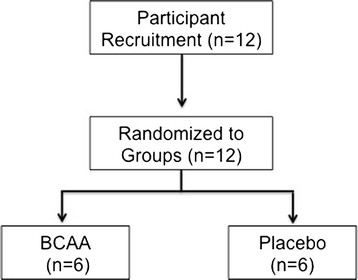
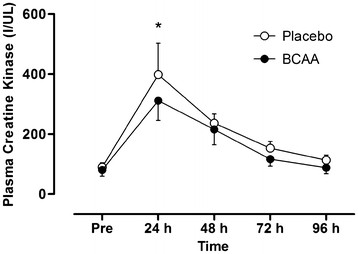
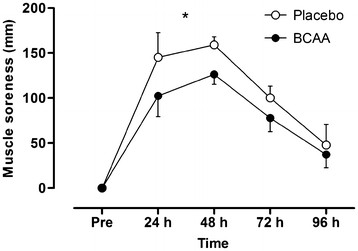
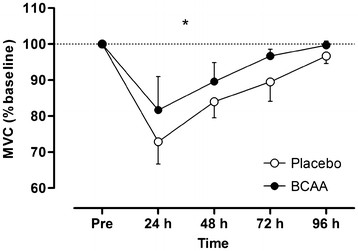
BACKGROUND: It is well documented that exercise-induced muscle damage (EIMD) decreases muscle function and causes soreness and discomfort. Branched-chain amino acid (BCAA) supplementation has been shown to increase protein synthesis and decrease muscle protein breakdown, however, the effects of BCAAs on recovery from damaging resistance training are unclear. Therefore, the aim of this study was to examine the effects of a BCAA supplementation on markers of muscle damage elicited via a sport specific bout of damaging exercise in trained volunteers. METHODS: Twelve males (mean ± SD age, 23 ± 2 y; stature, 178.3 ± 3.6 cm and body mass, 79.6 ± 8.4 kg) were randomly assigned to a supplement (n = 6) or placebo (n = 6) group. The damaging exercise consisted of 100 consecutive drop-jumps. Creatine kinase (CK), maximal voluntary contraction (MVC), muscle soreness (DOMS), vertical jump (VJ), thigh circumference (TC) and calf circumference (CC) were measured as markers of muscle damage. All variables were measured immediately before the damaging exercise and at 24, 48, 72 and 96 h post-exercise. RESULTS: A significant time effect was seen for all variables. There were significant group effects showing a reduction in CK efflux and muscle soreness in the BCAA group compared to the placebo (P<0.05). Furthermore, the recovery of MVC was greater in the BCAA group (P<0.05). The VJ, TC and CC were not different between groups. CONCLUSION: The present study has shown that BCAA administered before and following damaging resistance exercise reduces indices of muscle damage and accelerates recovery in resistance-trained males. It seems likely that BCAA provided greater bioavailablity of substrate to improve protein synthesis and thereby the extent of secondary muscle damage associated with strenuous resistance exercise. CLINICAL TRIAL REGISTRATION NUMBER: NCT01529281.
Overview
The claims and statistics of this paper haven’t been checked yet.
Free: it reads the open-access text and checks the first 5 claims that cite a source we can check. Create a free account to check every claim.
Integrity signals
Registry
Cites
Statistics
Figures
Verification
Claims the paper makes
The claims and statistics of this paper haven’t been checked yet.
Free: it reads the open-access text and checks the first 5 claims that cite a source we can check. Create a free account to check every claim.
Claims other papers make about this one
Each is checked against this paper’s own text: does it say what the citing paper says it does?
The source backs part of the claim, not all of it — or backs it for a different population, condition or comparison.
In the citing paper
“Some researchers have found that BCAA supplementation post-exercise attenuated the decline in myofibrillar protein synthesis, which is vital in preserving lean mass during weight loss [8, 26].”
From In a single-blind, matched group design: Branched-chain amino acid supplementation and resistance training maintains lean body mass during a caloric restricted diet (2016) · cites this paper as [8]
Experimental — accuracy not yet measuredThe cited source says what the claim attributes to it.
In the citing paper
“more recent studies support their ability to favorably promote responses to damaging eccentric muscle contractions [249, 250].”
From ISSN exercise & sports nutrition review update: research & recommendations (2018) · cites this paper as [250]
The cited source says what the claim attributes to it.
In the citing paper
“In this respect, multiple studies have investigated and offered support for BCAA’s ability to promote recovery, mitigate soreness and attenuate losses in force production [249, 250, 537, 538].”
From ISSN exercise & sports nutrition review update: research & recommendations (2018) · cites this paper as [250]
In the citing paper
“However, maintaining an energy deficient diet during a period of intense or unaccustomed resistance training may lead to significant losses in lean mass and decrease work output, thus hindering athletic performance, as well as increasing the risk for acute illness and training-related injury [5, 7, 8].”
In the citing paper
“Resistance training, provision of adequate amounts of dietary protein, and essential amino acids have all been shown to increase muscle protein synthesis in healthy adults [8]”
Self-check
Percentages, sums and reported differences re-computed from the paper’s own numbers.
The self-check needs the paper’s full text.
Citations
Cites
Proske, U., & Morgan, D. L. (2001) · The Journal of Physiology · doi:10.1111/j.1469-7793.2001.00333.x · Cited by 1,399 · cited 1×
“Although the mechanism surrounding muscle soreness following a damaging bout of exercise is not well understood, it seems likely to be related to inflammation, particularly to the connective tissue elements [35] that sensitise nociceptors in muscle and hence increase sensations of pain [36].”
BackgroundJournal of Sports Science and Medicine
Stewart, M. (2014) · Wilderness & Environmental Medicine · doi:10.1016/j.wem.2014.06.007 · Cited by 1,227
McHugh, M. P. (2003) · Scandinavian Journal of Medicine & Science in Sports · doi:10.1034/j.1600-0838.2003.02477.x · Cited by 628 · cited 2×
“The greater conditioning of these participants has almost certainly led to a repeated bout effect [31], whereby, a conditioning bout of exercise (in this case prior training) leads to a decrease in damage indices on subsequent bouts [4,31,32].”
BackgroundThe Prevention and Treatment of Exercise-Induced Muscle Damage
Howatson, G., & van Someren, K. A. (2008) · Sports Medicine · doi:10.2165/00007256-200838060-00004 · Cited by 530 · cited 6×
“The RBE refers to a protective effect or attenuation of damage indices when the exercise is repeated [4,31,32].”
BackgroundInfluentialSelf-citationHigbie, E. J., Cureton, K. J., Warren, G. L., & Prior, B. M. (1996) · Journal of Applied Physiology · doi:10.1152/jappl.1996.81.5.2173 · Cited by 481 · cited 1×
“Although many resistance exercises require both shortening and lengthening contractions, it has been well documented that exercise biased by lengthening contractions are a more powerful stimulus for neuromuscular adaptation compared to shortening contractions [1-3].”
BackgroundAdaptive responses to muscle lengthening and shortening in humans
Hortobagyi, T., Hill, J. P., Houmard, J. A., Fraser, D. D., Lambert, N. J., & Israel, R. G. (1996) · Journal of Applied Physiology · doi:10.1152/jappl.1996.80.3.765 · Cited by 440 · cited 1×
“Although many resistance exercises require both shortening and lengthening contractions, it has been well documented that exercise biased by lengthening contractions are a more powerful stimulus for neuromuscular adaptation compared to shortening contractions [1-3].”
BackgroundHowatson, G., McHugh, M. P., Hill, J. A., Brouner, J., Jewell, A. P., Van Someren, K. A., Shave, R. E., & Howatson, S. A. (2010) · Scandinavian Journal of Medicine & Science in Sports · doi:10.1111/j.1600-0838.2009.01005.x · Cited by 394 · cited 3×
“Although we attempted to control this by asking participants to record food intake during the loading phase and replicate this following the damaging exercise, an approach that has been previous used [11,21], there was no specific control between groups.”
BackgroundResultSelf-citationCold water immersion and recovery from strenuous exercise: a meta-analysis
Leeder, J., Gissane, C., van Someren, K., Gregson, W., & Howatson, G. (2012) · British Journal of Sports Medicine · doi:10.1136/bjsports-2011-090061 · Cited by 321 · cited 1×
“In an attempt to reduce the negative effects of EIMD a number of interventions have been explored; these include cold water immersions [7], antioxidant supplementation [8,9], ergogenic aids [5], non-steroidal anti-inflammatory drugs [10] and nutritional interventions [11].”
BackgroundSelf-citationHow long does the protective effect on eccentric exercise-induced muscle damage last?
NOSAKA, K., SAKAMOTO, K., NEWTON, M., & SACCO, P. (2001) · Medicine & Science in Sports & Exercise · doi:10.1097/00005768-200109000-00011 · Cited by 312 · cited 1×
“Although up to 11 weeks was given between damaging bouts, the RBE has been previously shown to accelerate the recovery of muscle function for between 6 and 9 months following the initial damaging bout [38].”
BackgroundNutraceutical Effects of Branched-Chain Amino Acids on Skeletal Muscle
Shimomura, Y., Yamamoto, Y., Bajotto, G., Sato, J., Murakami, T., Shimomura, N., Kobayashi, H., & Mawatari, K. (2006) · The Journal of Nutrition · doi:10.1093/jn/136.2.529s · Cited by 288 · cited 2×
“Historically, previous literature [21,34] examining”
Result
Cited by
Items 201–237 of 237
Noninvasive Myographical Assessments Following Unaccustomed Resistance Exercise
Boone, C. H. (2019) · STARS (University of Central Florida)
Shellhammer, J. P. (2017) · Carolina Digital Repository (University of North Carolina at Chapel Hill) · doi:10.17615/j7yw-t294
Harden, M. (2019) · Northumbria Research Link (Northumbria University)
Ferrer, D. A. (2018) · Digital Archive @ GSU · doi:10.57709/17654202
Barbosa, W. P., Moreira, A., Bacurau, R. F. P., Gomes, R. V., Capitani, C. D., Tavares, L. D., & Aoki, M. S. (2020) · Revista Brasileira de Ciência e Movimento · doi:10.31501/rbcm.v28i1.10128
Effect of Branched-Chain Alpha-Keto Acid Dehydrogenase Depletion on Myotube Protein Metabolism
Madu, G. (2020) · YorkSpace (York University) · Cited by 1
Ahnan‐Winarno, A. D. (2020) · Scholarworks (University of Massachusetts Amherst) · doi:10.7275/93y5-4233 · Cited by 3
Developing a Pate with Branch Chain Amino Acids and Identifying It Using a QR Code
Brashko, I. S., Тихонов, С. Л., & Tikhonova, M. S. (2021) · IOP Conference Series Earth and Environmental Science · doi:10.1088/1755-1315/666/4/042057
“The use of BCAAs reduces fatigue and improves physical performance [19, 20].”
Backgroundحسن, م. ص., & خليل, م. (2022) · Maǧallaẗ Buḥūṯ Al-Tarbiyyaẗ Al-Rīyāḍiyyaẗ/Maǧallaẗ Buḥūṯ Al-Tarbiyyaẗ Al-Rīyāḍiyyaẗ · doi:10.21608/mbtr.2022.159784.1158
Acute effect of different blood flow restriction protocols on muscle damage
YALÇIN, S., & Beyleroğlu, M. (2023) · Turkish Journal of Kinesiology · doi:10.31459/turkjkin.1227899
Zulfa, Q., Fitranti, D. Y., Wijayanti, H. S., & Noer, E. R. (2023) · AcTion Aceh Nutrition Journal · doi:10.30867/action.v8i1.813
Vatansever, Ş., Zileli, R., Pancar, S., Şahin, Ş., Bırıncı, Y. Z., & Topçu, H. (2023) · Turkish Journal of Kinesiology · doi:10.31459/turkjkin.1355853
Rezvani, M., Aiken, J., & Saleem, A. (2022) · Journal of innovation in polytechnic education. · doi:10.69520/jipe.v4i1.103
“Multiple studies have shown beneficial effects of BCAA on acute exercise performance (Howatson et al., 2012).”
BackgroundAnugrah, S. M., Kusnanik, N. W., Wahjuni, E. S., Resmana, D., Zubaida, I., Aqobah, Q. J., Nuryadin, A., & Rahayu, A. (2024) · doi:10.56984/8zg5608r0n
Hassan, M. A. A. (2024) · Diyala Journal of Medicine · doi:10.26505/djm.v27i2.1227
Dellogono, M., Clark, L. R., Garelnabi, M., & Wilson, T. A. (2025) · Food and Nutrition Sciences · doi:10.4236/fns.2025.161008
Resistance Exercise and Alcohol: Combined Effects on Physiology and Performance
Levitt, D. E. (2018) · University of North Texas Digital Library (University of North Texas) · doi:10.12794/metadc1248374
Branched-Chain Amino Acids (BCAAs) and Muscle Recovery: A Comprehensive Review
Sadhika, T., & Lokesh, A. C. (2025) · International Journal For Multidisciplinary Research · doi:10.36948/ijfmr.2025.v07i03.48726
Meira, Â., Tramontin, A. F., Ribeiro, G., Cruz, R. S. D. O., de Aguiar, R. A., Borszcz, F. K., & Caputo, F. (2025) · The Journal of Strength and Conditioning Research · doi:10.1519/jsc.0000000000005266
Julea, M., & Saleh, S. N. (2025) · Cureus · doi:10.7759/cureus.96017 · Cited by 2
“Howatson et al. [53] claim that early feeding may increase BCAA efficacy because BCAA blood levels peak 30 minutes after ingestion.”
InfluentialAcupuncture effects on delayed onset muscle soreness
Cardoso, R. (2014) · Portuguese National Funding Agency for Science, Research and Technology (RCAAP Project by FCT) · doi:10.34626/9s2q-cq04 · Cited by 2
Salem, A., Maaoui, K. B., Jahrami, H., AlMarzooqi, M. A., Boukhris, O. F., Messai, B., Clark, C. C. T., Glenn, J. M., Ghazzaoui, H. A., Bragazzi, N. L., et al. (2024) · Figshare · doi:10.6084/m9.figshare.25621877
James, C. (2023) · UWA Profiles and Research Repository (University of Western Australia) · doi:10.26182/4kt2-jd63
Hábitos de consumo de suplementos desportivos com aminoácidos de cadeia ramificada (BCAA)
Martins, L. I. P. A. (2022) · Portuguese National Funding Agency for Science, Research and Technology (RCAAP Project by FCT) · Cited by 1
Wilkinson, K., Abdelrahman, D. R., Murton, A. J., Dirks, M. L., Wall, B. T., Pavis, G. F., & Stephens, F. B. (2026) · The Journal of Nutritional Physiology · doi:10.1016/j.jnphys.2026.100016
Vanlin, J., Selvanayagam, V. S., & Yusof, A. J. (2026) · Journal of Human Kinetics · doi:10.5114/jhk/209811
“This pattern aligns with previous studies using similar exercise-induced pain protocols (Clifford et al., 2016; Hilkens et al., 2021; Howatson et al., 2012; Miyama and Nosaka, 2004).”
Schuth, G., Szigeti, G., Dobreff, G., Revisnyei, P., Gabbett, T. J., Szilas, Á., & Pavlik, G. (2026) · Biology of Sport · doi:10.5114/biolsport.2026.157992
“The validity [19] and reliability [20] of this system has been shown previously.”
Bankolé, S. L. C. (2014) · theses.fr (ABES) · doi:10.70675/0d4d5dd2z8b73z4599zbeb1zf674fd67620b
Haigney, E., Waddell, A., Korzepa, M., Belfield, A., Liaset, B., & Breen, L. (2026) · International Journal of Sport Nutrition and Exercise Metabolism · doi:10.1123/ijsnem.2025-0233
Sun, J., Gong, X., Zheng, J., Ni, N., & Liu, C. (2026) · Nutrition · doi:10.1016/j.nut.2026.113297
Vasenina, E., Adams, J. P., Williams, F. L., O’Connell, T. H., Knuppel, A. L., Moriarty, K. E., Kuga, K., Savenor, J. S., Lubiak, S. M., Canoy, L. A., et al. (2026) · Journal of the International Society of Sports Nutrition · doi:10.1080/15502783.2026.2726619
“For example, Howatson et al. [44] reported that BCAA supplementation reduced several markers of muscle damage but did not influence thigh or calf circumference measured at 24–96 hours following a damaging bout of drop jumps.”
Quiblier, S. P. H., Domínguez-Balmaseda, D., Dorrego, C. S., Giraldo, C. P., Carrasco, A. F., García, S. J. L. G., Benítez-Valero, R., & García-Pérez-de-Sevilla, G. (2026) · Scientific Reports · doi:10.1038/s41598-026-70455-z
An artificial intelligence approach to pinpoint performance and training load in team sports
Ungureanu, A. N. (n.d.) · Institutional Research Information System University of Turin (University of Turin)
Soysal, A. N. O., Şimşek, Ş., Özdemir, A. K., Aslan, Ü. B., & Aybek, H. (2026) · Sports Health A Multidisciplinary Approach · doi:10.1177/19417381261494825
Prayoga, H. D., Tomoliyus, T., Amelia, B., & Kasanrawali, A. (2026) · Sportis Scientific Journal of School Sport Physical Education and Psychomotricity · doi:10.55040/0gvbn477
Machergiany, E., Azevedo, L., Mota, M. P., Barros, A., & Soares, J. (2026) · Journal of Physical Education and Sport · doi:10.7752/jpes.2026.10186
Metadata
- Authors
- Howatson, G., Hoad, M., Goodall, S., Tallent, J., Bell, P. G., & French, D. N.
- Affiliations
- North-West University (ZA)
- St Mary's University Twickenham London (GB)
- Northumbria University (GB)
- Corresponding author
- Howatson, Glyn
- Venue
- Journal of the International Society of Sports Nutrition
- Publisher
- Informa UK Limited
- Published
- 2012-02-06
- Volume
- 9
- Issue
- 1
- Pages
- 20-20
- ISSN
- 1550-2783 (ISSN-L)
- PMC
- PMC3395580
- OpenAlex
- W2150419981
- Cited by
- 220
- References
- 41
- Citations by year
- 2026: 9 · 2025: 12 · 2024: 12 · 2023: 14 · 2022: 19 · 2021: 22 · 2020: 19 · 2019: 14 · 2018: 25 · 2017: 18 · 2016: 21 · 2015: 14 · 2014: 9 · 2013: 11 · 2012: 1
- FWCI
- 11.85
- Type
- journal article
- Language
- en
- Open access
- gold
- doi.org
- Licence
- Locations
- Journal of the International Society of Sports Nutrition (publishedVersion, cc-by)
- Europe PMC (PubMed Central) (publishedVersion, cc-by)
- PubMed Central (publishedVersion, cc-by)
- PubMed (publishedVersion)
- Northumbria Research Link (Northumbria University) (acceptedVersion)
- DOAJ (DOAJ: Directory of Open Access Journals) (submittedVersion, cc-by-sa)
- Nottingham Trent University's Institutional Repository (Nottingham Trent Repository) (submittedVersion)
- Topics
- Health Sciences › Medicine › Physiology (medical) › Exercise and Physiological Responses
- Health Sciences › Nursing › Nutrition and Dietetics › Muscle metabolism and nutrition
- Health Sciences › Medicine › Orthopedics and Sports Medicine › Sports Performance and Training
- Keywords
- exercise-induced muscle damage, branched-chain amino acids, amino acid supplementation, resistance training, creatine kinase, delayed onset muscle soreness, muscle recovery, maximal voluntary contraction, drop jump, resistance-trained men
About these checks
Registry, retraction, Cites and statistics results are computed, not judged, with one exception: a printed reference that no index lists is read once by a model before it counts as a citation error. Claims are extracted by a model and kept only when their quote appears verbatim in the text; each cited source is then checked, with a model’s help, for whether it says what the claim relies on. Those verdicts can be wrong — read the claim’s quote and the cited source before relying on one.
Statistics and arithmetic are recomputed, not judged.
Confidence bands are shown only for fields calibrated on our annotated test set. None is calibrated yet, so no band is shown.
What counts as a claim ›How we measure confidence ›How we check this ›
Are you an author, or do you see a problem with this page? Request a review
Data sources
Bibliographic data: Semantic Scholar, OpenAlex, Crossref.
Contains information from the Semantic Scholar Academic Graph Datasets, made available under the ODC Attribution License (ODC-BY 1.0).
Semantic Scholar’s data is described in: Kinney, R., et al. (2023). The Semantic Scholar Open Data Platform. arXiv:2301.10140.
