

Exercise-induced muscle damage is reduced in resistance-trained males by branched chain amino acids: a randomized, double-blind, placebo controlled study
Open accessThe DOI matches its Crossref record; 41 of the 41 references it cites were found in a registry or an index.
Abstract
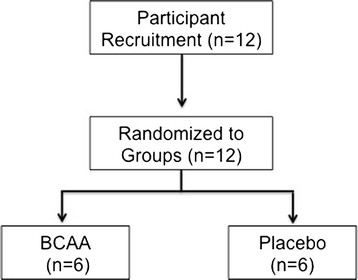
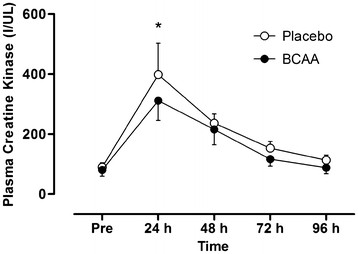
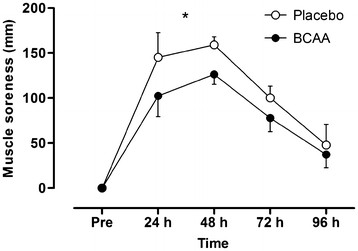
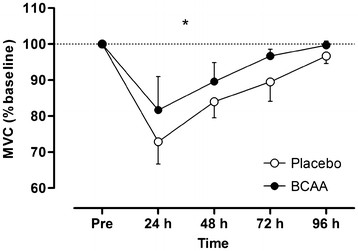
BACKGROUND: It is well documented that exercise-induced muscle damage (EIMD) decreases muscle function and causes soreness and discomfort. Branched-chain amino acid (BCAA) supplementation has been shown to increase protein synthesis and decrease muscle protein breakdown, however, the effects of BCAAs on recovery from damaging resistance training are unclear. Therefore, the aim of this study was to examine the effects of a BCAA supplementation on markers of muscle damage elicited via a sport specific bout of damaging exercise in trained volunteers. METHODS: Twelve males (mean ± SD age, 23 ± 2 y; stature, 178.3 ± 3.6 cm and body mass, 79.6 ± 8.4 kg) were randomly assigned to a supplement (n = 6) or placebo (n = 6) group. The damaging exercise consisted of 100 consecutive drop-jumps. Creatine kinase (CK), maximal voluntary contraction (MVC), muscle soreness (DOMS), vertical jump (VJ), thigh circumference (TC) and calf circumference (CC) were measured as markers of muscle damage. All variables were measured immediately before the damaging exercise and at 24, 48, 72 and 96 h post-exercise. RESULTS: A significant time effect was seen for all variables. There were significant group effects showing a reduction in CK efflux and muscle soreness in the BCAA group compared to the placebo (P<0.05). Furthermore, the recovery of MVC was greater in the BCAA group (P<0.05). The VJ, TC and CC were not different between groups. CONCLUSION: The present study has shown that BCAA administered before and following damaging resistance exercise reduces indices of muscle damage and accelerates recovery in resistance-trained males. It seems likely that BCAA provided greater bioavailablity of substrate to improve protein synthesis and thereby the extent of secondary muscle damage associated with strenuous resistance exercise. CLINICAL TRIAL REGISTRATION NUMBER: NCT01529281.
Overview
The claims and statistics of this paper haven’t been checked yet.
Free: it reads the open-access text and checks the first 5 claims that cite a source we can check. Create a free account to check every claim.
Integrity signals
Registry
Cites
Statistics
Figures
Verification
Claims the paper makes
The claims and statistics of this paper haven’t been checked yet.
Free: it reads the open-access text and checks the first 5 claims that cite a source we can check. Create a free account to check every claim.
Claims other papers make about this one
Each is checked against this paper’s own text: does it say what the citing paper says it does?
The source backs part of the claim, not all of it — or backs it for a different population, condition or comparison.
In the citing paper
“Some researchers have found that BCAA supplementation post-exercise attenuated the decline in myofibrillar protein synthesis, which is vital in preserving lean mass during weight loss [8, 26].”
From In a single-blind, matched group design: Branched-chain amino acid supplementation and resistance training maintains lean body mass during a caloric restricted diet (2016) · cites this paper as [8]
Experimental — accuracy not yet measuredThe cited source says what the claim attributes to it.
In the citing paper
“more recent studies support their ability to favorably promote responses to damaging eccentric muscle contractions [249, 250].”
From ISSN exercise & sports nutrition review update: research & recommendations (2018) · cites this paper as [250]
The cited source says what the claim attributes to it.
In the citing paper
“In this respect, multiple studies have investigated and offered support for BCAA’s ability to promote recovery, mitigate soreness and attenuate losses in force production [249, 250, 537, 538].”
From ISSN exercise & sports nutrition review update: research & recommendations (2018) · cites this paper as [250]
In the citing paper
“However, maintaining an energy deficient diet during a period of intense or unaccustomed resistance training may lead to significant losses in lean mass and decrease work output, thus hindering athletic performance, as well as increasing the risk for acute illness and training-related injury [5, 7, 8].”
In the citing paper
“Resistance training, provision of adequate amounts of dietary protein, and essential amino acids have all been shown to increase muscle protein synthesis in healthy adults [8]”
Self-check
Percentages, sums and reported differences re-computed from the paper’s own numbers.
The self-check needs the paper’s full text.
Citations
Cites
Proske, U., & Morgan, D. L. (2001) · The Journal of Physiology · doi:10.1111/j.1469-7793.2001.00333.x · Cited by 1,399 · cited 1×
“Although the mechanism surrounding muscle soreness following a damaging bout of exercise is not well understood, it seems likely to be related to inflammation, particularly to the connective tissue elements [35] that sensitise nociceptors in muscle and hence increase sensations of pain [36].”
BackgroundJournal of Sports Science and Medicine
Stewart, M. (2014) · Wilderness & Environmental Medicine · doi:10.1016/j.wem.2014.06.007 · Cited by 1,227
McHugh, M. P. (2003) · Scandinavian Journal of Medicine & Science in Sports · doi:10.1034/j.1600-0838.2003.02477.x · Cited by 628 · cited 2×
“The greater conditioning of these participants has almost certainly led to a repeated bout effect [31], whereby, a conditioning bout of exercise (in this case prior training) leads to a decrease in damage indices on subsequent bouts [4,31,32].”
BackgroundThe Prevention and Treatment of Exercise-Induced Muscle Damage
Howatson, G., & van Someren, K. A. (2008) · Sports Medicine · doi:10.2165/00007256-200838060-00004 · Cited by 530 · cited 6×
“The RBE refers to a protective effect or attenuation of damage indices when the exercise is repeated [4,31,32].”
BackgroundInfluentialSelf-citationHigbie, E. J., Cureton, K. J., Warren, G. L., & Prior, B. M. (1996) · Journal of Applied Physiology · doi:10.1152/jappl.1996.81.5.2173 · Cited by 481 · cited 1×
“Although many resistance exercises require both shortening and lengthening contractions, it has been well documented that exercise biased by lengthening contractions are a more powerful stimulus for neuromuscular adaptation compared to shortening contractions [1-3].”
BackgroundAdaptive responses to muscle lengthening and shortening in humans
Hortobagyi, T., Hill, J. P., Houmard, J. A., Fraser, D. D., Lambert, N. J., & Israel, R. G. (1996) · Journal of Applied Physiology · doi:10.1152/jappl.1996.80.3.765 · Cited by 440 · cited 1×
“Although many resistance exercises require both shortening and lengthening contractions, it has been well documented that exercise biased by lengthening contractions are a more powerful stimulus for neuromuscular adaptation compared to shortening contractions [1-3].”
BackgroundHowatson, G., McHugh, M. P., Hill, J. A., Brouner, J., Jewell, A. P., Van Someren, K. A., Shave, R. E., & Howatson, S. A. (2010) · Scandinavian Journal of Medicine & Science in Sports · doi:10.1111/j.1600-0838.2009.01005.x · Cited by 394 · cited 3×
“Although we attempted to control this by asking participants to record food intake during the loading phase and replicate this following the damaging exercise, an approach that has been previous used [11,21], there was no specific control between groups.”
BackgroundResultSelf-citationCold water immersion and recovery from strenuous exercise: a meta-analysis
Leeder, J., Gissane, C., van Someren, K., Gregson, W., & Howatson, G. (2012) · British Journal of Sports Medicine · doi:10.1136/bjsports-2011-090061 · Cited by 321 · cited 1×
“In an attempt to reduce the negative effects of EIMD a number of interventions have been explored; these include cold water immersions [7], antioxidant supplementation [8,9], ergogenic aids [5], non-steroidal anti-inflammatory drugs [10] and nutritional interventions [11].”
BackgroundSelf-citationHow long does the protective effect on eccentric exercise-induced muscle damage last?
NOSAKA, K., SAKAMOTO, K., NEWTON, M., & SACCO, P. (2001) · Medicine & Science in Sports & Exercise · doi:10.1097/00005768-200109000-00011 · Cited by 312 · cited 1×
“Although up to 11 weeks was given between damaging bouts, the RBE has been previously shown to accelerate the recovery of muscle function for between 6 and 9 months following the initial damaging bout [38].”
BackgroundNutraceutical Effects of Branched-Chain Amino Acids on Skeletal Muscle
Shimomura, Y., Yamamoto, Y., Bajotto, G., Sato, J., Murakami, T., Shimomura, N., Kobayashi, H., & Mawatari, K. (2006) · The Journal of Nutrition · doi:10.1093/jn/136.2.529s · Cited by 288 · cited 2×
“Historically, previous literature [21,34] examining”
ResultByrne, C., & Eston, R. (2002) · Journal of Sports Sciences · doi:10.1080/026404102317366672 · Cited by 270 · cited 1×
“Participants performed a counter movement jump in which, on command from a standing position, they descended rapidly (to approximately a 90° knee angle) and performed a maximal vertical jump, tapping the device with the dominant arm [30].”
MethodBørsheim, E., Cree, M. G., Tipton, K. D., Elliott, T. A., Aarsland, A., & Wolfe, R. R. (2004) · Journal of Applied Physiology · doi:10.1152/japplphysiol.00333.2003 · Cited by 231 · cited 2×
“[21] examined BCAA supplementation in untrained females and whilst these authors demonstrated some efficacy in reducing indices of damage in the BCAA group, the placebo control consumed carbohydrate, which has been shown to facilitate protein uptake [12,22], thus having a synergistic effect to any exogenous protein co…”
Background(2000) · PubMed · Cited by 187
The effects of multiple cold water immersions on indices of muscle damage.
Goodall, S., & Howatson, G. (2008) · Europe PMC (PubMed Central) · Cited by 187
Self-citationBranched-Chain Amino Acid Ingestion Can Ameliorate Soreness from Eccentric Exercise
JACKMAN, S. R., WITARD, O. C., JEUKENDRUP, A. E., & TIPTON, K. D. (2010) · Medicine & Science in Sports & Exercise · doi:10.1249/mss.0b013e3181c1b798 · Cited by 179 · cited 10×
“Additionally, in a recent well-controlled example [20], muscle soreness was reduced with BCAA; however, changes in blood indices or recovery of muscle function were absent.”
BackgroundResultInfluentialBranched-Chain Amino Acid Supplementation Before Squat Exercise and Delayed-Onset Muscle Soreness
Shimomura, Y., Inaguma, A., Watanabe, S., Yamamoto, Y., Muramatsu, Y., Bajotto, G., Sato, J., Shimomura, N., Kobayashi, H., & Mawatari, K. (2010) · International Journal of Sport Nutrition and Exercise Metabolism · doi:10.1123/ijsnem.20.3.236 · Cited by 166 · cited 9×
“[21] examined BCAA supplementation in untrained females and whilst these authors demonstrated some efficacy in reducing indices of damage in the BCAA group, the placebo control consumed carbohydrate, which has been shown to facilitate protein uptake [12,22], thus having a synergistic effect to any exogenous protein co…”
BackgroundMethodResultInfluentialClose, G. L., Ashton, T., Cable, T., Doran, D., Holloway, C., McArdle, F., & MacLaren, D. P. M. (2006) · British Journal of Nutrition · doi:10.1079/bjn20061732 · Cited by 148 · cited 1×
“In an attempt to reduce the negative effects of EIMD a number of interventions have been explored; these include cold water immersions [7], antioxidant supplementation [8,9], ergogenic aids [5], non-steroidal anti-inflammatory drugs [10] and nutritional interventions [11].”
BackgroundExercise‐induced muscle damage and inflammation: fact or fiction?
Malm, C. (2001) · Acta Physiologica Scandinavica · doi:10.1046/j.1365-201x.2001.00825.x · Cited by 146 · cited 1×
“Although the mechanism surrounding muscle soreness following a damaging bout of exercise is not well understood, it seems likely to be related to inflammation, particularly to the connective tissue elements [35] that sensitise nociceptors in muscle and hence increase sensations of pain [36].”
BackgroundINFLUENCE OF SURFACE ON MUSCLE DAMAGE AND SORENESS INDUCED BY CONSECUTIVE DROP JUMPS
MIYAMA, M., & NOSAKA, K. (2004) · Journal of Strength and Conditioning Research · doi:10.1519/00124278-200405000-00002 · Cited by 143 · cited 2×
“This supports the efficacy of the protocol as a model to induce muscle damage in a sport specific manner [27,28].”
BackgroundMethodBreen, L., Philp, A., Witard, O. C., Jackman, S. R., Selby, A., Smith, K., Baar, K., & Tipton, K. D. (2011) · The Journal of Physiology · doi:10.1113/jphysiol.2011.211888 · Cited by 143 · cited 2×
“BCAA are a group of essential amino acids that are a key substrate for protein synthesis and recovery [12].”
BackgroundEffects of Amino Acid Supplementation on Muscle Soreness and Damage
Nosaka, K., Sacco, P. ▀., & Mawatari, K. ▀. (2006) · International Journal of Sport Nutrition and Exercise Metabolism · doi:10.1123/ijsnem.16.6.620 · Cited by 138 · cited 4×
“This protocol has been previously shown to cause significant elevations in muscle damage indices [19,27,28].”
BackgroundResultInfluentialBranched-Chain Amino Acid Supplementation and Indicators of Muscle Damage after Endurance Exercise
Greer, B. K., Woodard, J. L., White, J. P., Arguello, E. M., & Haymes, E. M. (2007) · International Journal of Sport Nutrition and Exercise Metabolism · doi:10.1123/ijsnem.17.6.595 · Cited by 131 · cited 2×
“Additionally, the data presented here support previous literature suggesting BCAA as an effective intervention to reduce the negative effects of damaging exercise [15-18] and more specifically from damaging resistance exercise [14,20,21].”
BackgroundResultAdams, G. R., Cheng, D. C., Haddad, F., & Baldwin, K. M. (2004) · Journal of Applied Physiology · doi:10.1152/japplphysiol.01162.2003 · Cited by 123 · cited 1×
“Although many resistance exercises require both shortening and lengthening contractions, it has been well documented that exercise biased by lengthening contractions are a more powerful stimulus for neuromuscular adaptation compared to shortening contractions [1-3].”
BackgroundRepeated Bout Effect after Maximal Eccentric Exercise
Howatson, G., Van Someren, K., & Hortobágyi, T. (2007) · International Journal of Sports Medicine · doi:10.1055/s-2007-964866 · Cited by 121 · cited 3×
“Our data concur with previous studies that show a peak in soreness at 48 h post-exercise [27,32].”
BackgroundResultSelf-citationEvidence of a contralateral repeated bout effect after maximal eccentric contractions
Howatson, G., & van Someren, K. A. (2007) · European Journal of Applied Physiology · doi:10.1007/s00421-007-0489-5 · Cited by 115 · cited 1×
“Participants were asked to perform and hold a squat (90° knee angle) whilst they rated their perceived muscle soreness on a 200 mm visual analogue scale [5,27,29].”
MethodSelf-citationUse of Nonsteroidal Anti-Inflammatory Drugs Following Exercise-Induced Muscle Injury
Lanier, A. B. (2003) · Sports Medicine · doi:10.2165/00007256-200333030-00002 · Cited by 111 · cited 1×
“In an attempt to reduce the negative effects of EIMD a number of interventions have been explored; these include cold water immersions [7], antioxidant supplementation [8,9], ergogenic aids [5], non-steroidal anti-inflammatory drugs [10] and nutritional interventions [11].”
Backgroundvan Someren, K. A., Edwards, A. J., & Howatson, G. (2005) · International Journal of Sport Nutrition and Exercise Metabolism · doi:10.1123/ijsnem.15.4.413 · Cited by 109 · cited 1×
“The sample size was based on previous research examining supplementation and EIMD that had shown a significant effect [21,25].”
MethodSelf-citationAmino Acid Supplements and Recovery from High-Intensity Resistance Training
Sharp, C. P. M., & Pearson, D. R. (2010) · Journal of Strength and Conditioning Research · doi:10.1519/jsc.0b013e3181c7c655 · Cited by 106 · cited 2×
“Sharp CP, Pearson DR: Amino acid supplements and recovery from high-intensity resistance training.”
BackgroundCockburn, E., Stevenson, E., Hayes, P. R., Robson-Ansley, P., & Howatson, G. (2010) · Applied Physiology, Nutrition, and Metabolism · doi:10.1139/h10-017 · Cited by 94 · cited 1×
“Previous work [39] has shown that timing of a protein based recovery strategy is important and immediately following a damaging bout of exercise can be most beneficial in accelerating recovery.”
BackgroundSelf-citationMatsumoto, K., Koba, T., Hamada, K., Sakurai, M., Higuchi, T., & Miyata, H. (2009) · PubMed · Cited by 86
BLOMSTRAND, E., ANDERSSON, S., HASSMEN, P., EKBLOM, B., & NEWSHOLME, E. A. (1995) · Acta Physiologica Scandinavica · doi:10.1111/j.1748-1716.1995.tb09839.x · Cited by 85 · cited 2×
“We based our supplementation regimen on previous work that showed a positive effect [16,26] and propose that positive effects beyond attenuation of muscle soreness (i.”
MethodThe effect of eccentric exercise on position sense and joint reaction angle of the lower limbs
Paschalis, V., Nikolaidis, M. G., Giakas, G., Jamurtas, A. Z., Pappas, A., & Koutedakis, Y. (2007) · Muscle & Nerve · doi:10.1002/mus.20723 · Cited by 84
The effects of vitamin C supplementation on symptoms of delayed onset muscle soreness.
Connolly, D. A. J., Lauzon, C. D., Agnew, J., Dunn, M., & Reed, B. V. (2006) · PubMed · Cited by 68
Trekking Poles Reduce Exercise-Induced Muscle Injury during Mountain Walking
Howatson, G., Hough, P., PATTISON, J., Hill, J., Blagrove, R. C., Glaister, M., & Thompson, K. (2010) · Medicine & Science in Sports & Exercise · doi:10.1249/mss.0b013e3181e4b649 · Cited by 48 · cited 4×
“Similarly to previous work [5,11,27], participants were seated on a plinth where the strain gauge was assembled.”
BackgroundMethodResultInfluentialSelf-citationStock, M. S., Young, J. C., Golding, L. A., Kruskall, L. J., Tandy, R. D., Conway-Klaassen, J. M., & Beck, T. W. (2010) · The Journal of Strength and Conditioning Research · doi:10.1519/jsc.0b013e3181dc3a10 · Cited by 48 · cited 1×
“[23] showed that in a mixed sex group of trained participants there were no differences in damage indices between a carbohydrate versus a carbohydrate + leucine supplement.”
BackgroundUpdate on nutritional supplementation with branched-chain amino acids
Bianchi, G. P., Marzocchi, R., Agostini, F., & Marchesini, G. (2004) · Current Opinion in Clinical Nutrition & Metabolic Care · doi:10.1097/00075197-200501000-00013 · Cited by 44 · cited 1×
“acterised by protein loss and catabolism [13] and a recent review has proposed BCAA to provide a therapeutic effect following damaging resistance exercise [14].”
Backgroundda Luz, C. R., Nicastro, H., Zanchi, N. E., Chaves, D. F., & Lancha, A. H. (2011) · Journal of the International Society of Sports Nutrition · doi:10.1186/1550-2783-8-23 · Cited by 44 · cited 3×
“The subsequent inflammatory response increases protein uptake necessary for use as an energy source and/or pathways responsible for cell signaling and subsequent muscle remodeling [14,33].”
BackgroundResultShimomura, Y., Murakami, T., Nakai, N., Nagasaki, M., Obayashi, M., Zhihao, L. I., Xu, M. Q., Sato, Y., Kato, T., Shimomura, N., et al. (2000) · Journal of Nutritional Science and Vitaminology · doi:10.3177/jnsv.46.71 · Cited by 42 · cited 1×
“Previous work [40] showed BCAA to rise in plasma within 15 min and peak 30 min after ingestion, which means the bioavailability of BCAA post-exercise in our investigation was at least 1 h earlier than that of Jackman et al.”
ResultSHIMOMURA, Y., KOBAYASHI, H., MAWATARI, K., AKITA, K., INAGUMA, A., WATANABE, S., BAJOTTO, G., & SATO, J. (2009) · Journal of Nutritional Science and Vitaminology · doi:10.3177/jnsv.55.288 · Cited by 36 · cited 1×
“The subsequent inflammatory response increases protein uptake necessary for use as an energy source and/or pathways responsible for cell signaling and subsequent muscle remodeling [14,33].”
BackgroundKoba, T., Hamada, K., SAKURAI, M., Matsumoto, K., Hayase, H., Imaizumi, K., Tsujimoto, H., & Mitsuzono, R. (2007) · PubMed · Cited by 32
SUGITA, M., OHTANI, M., ISHII, N., MARUYAMA, K., & KOBAYASHI, K. (2003) · Bioscience, Biotechnology, and Biochemistry · doi:10.1271/bbb.67.372 · Cited by 26 · cited 2×
“Interestingly, other studies [21,37] using non-resistancetrained student populations have shown some benefit in the recovery of muscle function.”
BackgroundResult
Cited by
ISSN exercise & sports nutrition review update: research & recommendations
Kerksick, C. M., Wilborn, C. D., Roberts, M. D., Smith-Ryan, A., Kleiner, S. M., Jäger, R., Collins, R., Cooke, M., Davis, J. N., Galvan, E., et al. (2018) · Journal of the International Society of Sports Nutrition · doi:10.1186/s12970-018-0242-y · Cited by 945
Ahnan‐Winarno, A. D., Cordeiro, L., Winarno, F. G., Gibbons, J., & Xiao, H. (2021) · Comprehensive Reviews in Food Science and Food Safety · doi:10.1111/1541-4337.12710 · Cited by 269
International Society of Sports Nutrition Position Stand: beta-hydroxy-beta-methylbutyrate (HMB)
Wilson, J. M., Fitschen, P. J., Campbell, B., Wilson, G. J., Zanchi, N., Taylor, L., Wilborn, C., Kalman, D. S., Stout, J. R., Hoffman, J. R., et al. (2013) · Journal of the International Society of Sports Nutrition · doi:10.1186/1550-2783-10-6 · Cited by 196
Functional food relevance of whey protein: A review of recent findings and scopes ahead
Patel, S. (2015) · Journal of Functional Foods · doi:10.1016/j.jff.2015.09.040 · Cited by 169
Heaton, L. E., Davis, J. K., Rawson, E. S., Nuccio, R. P., Witard, O. C., Stein, K. W., Baar, K., Carter, J. M., & Baker, L. B. (2017) · Sports Medicine · doi:10.1007/s40279-017-0759-2 · Cited by 158
Metadata
- Authors
- Howatson, G., Hoad, M., Goodall, S., Tallent, J., Bell, P. G., & French, D. N.
- Affiliations
- North-West University (ZA)
- St Mary's University Twickenham London (GB)
- Northumbria University (GB)
- Corresponding author
- Howatson, Glyn
- Venue
- Journal of the International Society of Sports Nutrition
- Publisher
- Informa UK Limited
- Published
- 2012-02-06
- Volume
- 9
- Issue
- 1
- Pages
- 20-20
- ISSN
- 1550-2783 (ISSN-L)
- PMC
- PMC3395580
- OpenAlex
- W2150419981
- Cited by
- 220
- References
- 41
- Citations by year
- 2026: 9 · 2025: 12 · 2024: 12 · 2023: 14 · 2022: 19 · 2021: 22 · 2020: 19 · 2019: 14 · 2018: 25 · 2017: 18 · 2016: 21 · 2015: 14 · 2014: 9 · 2013: 11 · 2012: 1
- FWCI
- 11.85
- Type
- journal article
- Language
- en
- Open access
- gold
- doi.org
- Licence
- Locations
- Journal of the International Society of Sports Nutrition (publishedVersion, cc-by)
- Europe PMC (PubMed Central) (publishedVersion, cc-by)
- PubMed Central (publishedVersion, cc-by)
- PubMed (publishedVersion)
- Northumbria Research Link (Northumbria University) (acceptedVersion)
- DOAJ (DOAJ: Directory of Open Access Journals) (submittedVersion, cc-by-sa)
- Nottingham Trent University's Institutional Repository (Nottingham Trent Repository) (submittedVersion)
- Topics
- Health Sciences › Medicine › Physiology (medical) › Exercise and Physiological Responses
- Health Sciences › Nursing › Nutrition and Dietetics › Muscle metabolism and nutrition
- Health Sciences › Medicine › Orthopedics and Sports Medicine › Sports Performance and Training
- Keywords
- exercise-induced muscle damage, branched-chain amino acids, amino acid supplementation, resistance training, creatine kinase, delayed onset muscle soreness, muscle recovery, maximal voluntary contraction, drop jump, resistance-trained men
About these checks
Registry, retraction, Cites and statistics results are computed, not judged, with one exception: a printed reference that no index lists is read once by a model before it counts as a citation error. Claims are extracted by a model and kept only when their quote appears verbatim in the text; each cited source is then checked, with a model’s help, for whether it says what the claim relies on. Those verdicts can be wrong — read the claim’s quote and the cited source before relying on one.
Statistics and arithmetic are recomputed, not judged.
Confidence bands are shown only for fields calibrated on our annotated test set. None is calibrated yet, so no band is shown.
What counts as a claim ›How we measure confidence ›How we check this ›
Are you an author, or do you see a problem with this page? Request a review
Data sources
Bibliographic data: Semantic Scholar, OpenAlex, Crossref.
Contains information from the Semantic Scholar Academic Graph Datasets, made available under the ODC Attribution License (ODC-BY 1.0).
Semantic Scholar’s data is described in: Kinney, R., et al. (2023). The Semantic Scholar Open Data Platform. arXiv:2301.10140.
