

Severe depression is associated with increased microglial quinolinic acid in subregions of the anterior cingulate gyrus: Evidence for an immune-modulated glutamatergic neurotransmission?
Open accessThe DOI matches its Crossref record; 53 of the 53 references it cites were found in a registry or an index.
Abstract
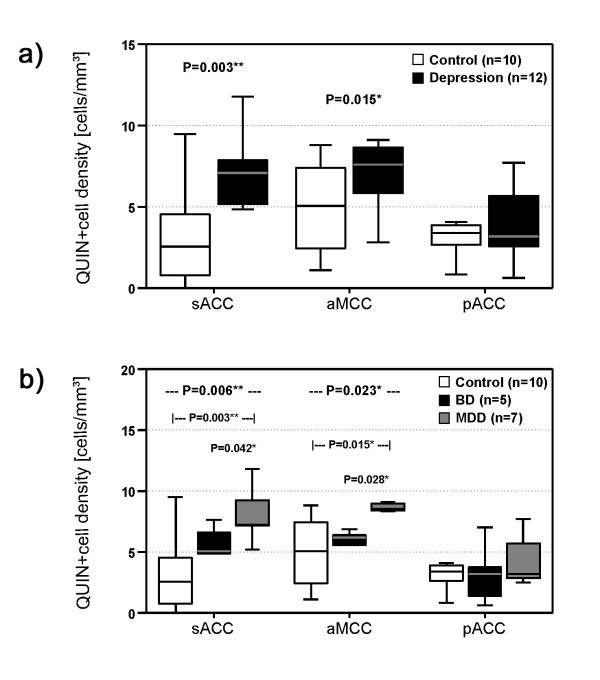
BACKGROUND: Immune dysfunction, including monocytosis and increased blood levels of interleukin-1, interleukin-6 and tumour necrosis factor α has been observed during acute episodes of major depression. These peripheral immune processes may be accompanied by microglial activation in subregions of the anterior cingulate cortex where depression-associated alterations of glutamatergic neurotransmission have been described. METHODS: Microglial immunoreactivity of the N-methyl-D-aspartate (NMDA) glutamate receptor agonist quinolinic acid (QUIN) in the subgenual anterior cingulate cortex (sACC), anterior midcingulate cortex (aMCC) and pregenual anterior cingulate cortex (pACC) of 12 acutely depressed suicidal patients (major depressive disorder/MDD, n = 7; bipolar disorder/BD, n = 5) was analyzed using immunohistochemistry and compared with its expression in 10 healthy control subjects. RESULTS: Depressed patients had a significantly increased density of QUIN-positive cells in the sACC (P = 0.003) and the aMCC (P = 0.015) compared to controls. In contrast, counts of QUIN-positive cells in the pACC did not differ between the groups (P = 0.558). Post-hoc tests showed that significant findings were attributed to MDD and were absent in BD. CONCLUSIONS: These results add a novel link to the immune hypothesis of depression by providing evidence for an upregulation of microglial QUIN in brain regions known to be responsive to infusion of NMDA antagonists such as ketamine. Further work in this area could lead to a greater understanding of the pathophysiology of depressive disorders and pave the way for novel NMDA receptor therapies or immune-modulating strategies.
Overview
The claims and statistics of this paper haven’t been checked yet.
Free: it reads the open-access text and checks the first 5 claims that cite a source we can check. Create a free account to check every claim.
Integrity signals
Registry
Cites
Statistics
Figures
Verification
Claims the paper makes
The claims and statistics of this paper haven’t been checked yet.
Free: it reads the open-access text and checks the first 5 claims that cite a source we can check. Create a free account to check every claim.
Claims other papers make about this one
Each is checked against this paper’s own text: does it say what the citing paper says it does?
The cited source says what the claim attributes to it.
In the citing paper
“Of note, increased levels of quinolinic acid have been found in microglia in the ACC of suicide victims who suffered from depression77.”
From The role of inflammation in depression: from evolutionary imperative to modern treatment target (2016) · cites this paper as [77]
In the citing paper
“Studies have revealed microglial activation in depressed patients, with a greater magnitude of activation in individuals who completed suicide (181–183)”
From Microglia Function in the Central Nervous System During Health and Neurodegeneration (2017) · cites this paper as [182]
In the citing paper
“Substances not measured in the present study are neurotoxic kynurenine-pathway metabolites such as 3-hydroxykynurenine and quinolinic acid that have been suggested to be important for further understanding of imbalance of tryptophan-kynurenine pathway in MDD (Dantzer et al., 2011;Halaris et al., 2015;Steiner et al., 2011).”
From Tryptophan-kynurenine and lipid related metabolites as blood biomarkers for first-episode drug-naïve patients with major depressive disorder: An exploratory pilot case-control study (2018) · cites this paper as Steiner et al., 2011
Self-check
Percentages, sums and reported differences re-computed from the paper’s own numbers.
The self-check needs the paper’s full text.
Citations
Cites
From inflammation to sickness and depression: when the immune system subjugates the brain
Dantzer, R., O'Connor, J. C., Freund, G. G., Johnson, R. W., & Kelley, K. W. (2008) · Nature Reviews Neuroscience · doi:10.1038/nrn2297 · Cited by 7,395 · cited 6×
“Increased levels of QUIN, which is also produced by macrophages and monocytes, have already been found in the blood and cerebrospinal fluid of subjects with cytokine-induced depression or MDD [1,21,22].”
BackgroundInfluentialInflammation and Its Discontents: The Role of Cytokines in the Pathophysiology of Major Depression
Miller, A. H., Maletic, V., & Raison, C. L. (2009) · Biological Psychiatry · doi:10.1016/j.biopsych.2008.11.029 · Cited by 3,848 · cited 2×
“Thus, our result of increased microglial QUIN expression in suicidal MDD patients is in line with the hypothesis of a systemic MPS activation during acute disease phases of depression [2-9,14].”
BackgroundResultA randomized trial of an N-methyl-D-aspartate antagonist in treatment-resistant major depression.
Zarate, C. A., Singh, J. B., Carlson, P. J., Brutsche, N. E., Ameli, R., Luckenbaugh, D. A., Charney, D. S., & Manji, H. K. (2006) · Archives of General Psychiatry · doi:10.1001/archpsyc.63.8.856 · Cited by 3,766
Jeurgen, K., Assheuer, J., & Paxinos, G. (1997) · Medical Entomology and Zoology · Cited by 1,403
Targeting abnormal neural circuits in mood and anxiety disorders: from the laboratory to the clinic
Ressler, K. J., & Mayberg, H. S. (2007) · Nature Neuroscience · doi:10.1038/nn1944 · Cited by 1,007 · cited 1×
“Importantly, the metabolic activity after deep brain stimulation in the sACC, as measured by positron emission tomography, shows a reduction in hyperactivity similar to a region bordering the aMCC and the pACC [53].”
MethodThe Relationship of Depression and Stressors to Immunological Assays: A Meta-Analytic Review
Zorrilla, E. P., Luborsky, L., McKay, J. R., Rosenthal, R., Houldin, A., Tax, A., McCorkle, R., Seligman, D. A., & Schmidt, K. (2001) · Brain, Behavior, and Immunity · doi:10.1006/brbi.2000.0597 · Cited by 995 · cited 2×
“Thus, our result of increased microglial QUIN expression in suicidal MDD patients is in line with the hypothesis of a systemic MPS activation during acute disease phases of depression [2-9,14].”
BackgroundResultDiazgranados, N., Ibrahim, L., Brutsche, N. E., Newberg, A., Kronstein, P., Khalife, S., Kammerer, W. A., Quezado, Z., Luckenbaugh, D. A., Salvadore, G., et al. (2010) · Archives of General Psychiatry · doi:10.1001/archgenpsychiatry.2010.90 · Cited by 963
Targeting the glutamatergic system to develop novel, improved therapeutics for mood disorders
Sanacora, G., Zarate, C. A., Krystal, J. H., & Manji, H. K. (2008) · Nature Reviews Drug Discovery · doi:10.1038/nrd2462 · Cited by 894
Steiner, J., Bielau, H., Brisch, R., Danos, P., Ullrich, O., Mawrin, C., Bernstein, H.-G., & Bogerts, B. (2008) · Journal of Psychiatric Research · doi:10.1016/j.jpsychires.2006.10.013 · Cited by 791 · cited 3×
“Indeed, an increased density of microglia expressing human leukocyte antigen (HLA)-DR has recently been observed in the anterior midcingulate cortex (aMCC), the dorsolateral prefrontal cortex and the mediodorsal thalamus of suicidal patients with affective disorders [14].”
BackgroundMethodResultSelf-citationThe neurobiology of psychedelic drugs: implications for the treatment of mood disorders
Vollenweider, F. X., & Kometer, M. (2010) · Nature Reviews Neuroscience · doi:10.1038/nrn2884 · Cited by 723 · cited 3×
“Here we present the first study providing evidence that supports a disease-related upregulation of microglial QUIN in depressive disorders, particularly in brain regions known to be responsive to infusion of NMDA antagonists such as ketamine [55].”
BackgroundInfluential
Cited by
Items 301–400 of 578
SCI and depression: Does inflammation commandeer the brain?
Brakel, K., & Hook, M. A. (2019) · Experimental Neurology · doi:10.1016/j.expneurol.2019.112977 · Cited by 36
Immunoregulation and antidepressant effect of ketamine
Zhang, N., Yao, L., Wang, P., & Liu, Z. (2021) · Translational Neuroscience · doi:10.1515/tnsci-2020-0167 · Cited by 36
“Autopsy revealed an increase in the density of microglial cells producing quin in the anterior cingulate gyrus of depressed suicidal patients [95].”
BackgroundPain, Depression and Inflammation: Are Interconnected Causative Factors Involved?
Leonard, B. E. (2015) · Modern trends in psychiatry · doi:10.1159/000435930 · Cited by 37
Statins: Neurobiological underpinnings and mechanisms in mood disorders
Walker, A. J., Kim, Y., Borissiouk, I., Rehder, R., Dodd, S., Morris, G., Nierenberg, A. A., Maes, M., Fernandes, B. S., Dean, O. M., et al. (2021) · Neuroscience & Biobehavioral Reviews · doi:10.1016/j.neubiorev.2021.07.012 · Cited by 33
Psychiatric Comorbidities of Inflammatory Bowel Disease: It Is a Matter of Microglia’s Gut Feeling
Fakhfouri, G., Mijailović, N. R., & Rahimian, R. (2024) · Cells · doi:10.3390/cells13020177 · Cited by 33
“Both increased [128] and decreased expressions of microglial QUIN [127,129] and reduced KP metabolism and cytokine expression [130] have been reported in individuals with depression.”
BackgroundFilho, A. J. M. C., Eyres, C., Blöbaum, L., Landwehr, A., & Tremblay, M. (2024) · Journal of Neurochemistry · doi:10.1111/jnc.16098 · Cited by 35
Effective factors in the pathogenesis of Toxoplasma gondii
Nayeri, T., Sarvi, S., & Daryani, A. (2024) · Heliyon · doi:10.1016/j.heliyon.2024.e31558 · Cited by 36
“QA upregulation has been reported in mental disorders such as Alzheimer ’ s disease [387], depression [388], Huntington ’ s disease [389,390], autism [391], and suicide [392].”
BackgroundThe central role of microglia in major depressive disorder and its potential as a therapeutic target
Xia, X., Li, K., Zou, W., & Wang, L. (2025) · Frontiers in Behavioral Neuroscience · doi:10.3389/fnbeh.2025.1598178 · Cited by 32
Schubert, J. J., Veronese, M., Fryer, T. D., Manavaki, R., Kitzbichler, M. G., Nettis, M. A., Mondelli, V., Pariante, C. M., Bullmore, E. T., Wlazly, D., et al. (2021) · Biological Psychiatry Cognitive Neuroscience and Neuroimaging · doi:10.1016/j.bpsc.2020.12.017 · Cited by 38
Zheng, H., Teague, T. K., Yeh, F.-C. F., Burrows, K., Figueroa‐Hall, L. K., Aupperle, R. L., Khalsa, S. S., Paulus, M. P., & Savitz, J. B. (2022) · Brain Behavior and Immunity · doi:10.1016/j.bbi.2022.07.011 · Cited by 36
Targeting autophagy to counteract neuroinflammation: A novel antidepressant strategy
Gan, H. T., Ma, Q., Hao, W., Yang, N., Chen, Z., Deng, L., & Chen, J. (2024) · Pharmacological Research · doi:10.1016/j.phrs.2024.107112 · Cited by 32
Chenet, A. L., Duarte, A. R., de Almeida, F. J. S., Andrade, C. M. B., & de Oliveira, M. R. (2019) · Neurochemical Research · doi:10.1007/s11064-019-02724-5 · Cited by 36
Han, K., Choi, K. W., Kim, A., Kang, W., Kang, Y., Tae, W., Han, M.-R., & Ham, B. (2022) · International Journal of Molecular Sciences · doi:10.3390/ijms23105768 · Cited by 32
“Another postmortem evaluation of brain tissue revealed that microglia exhibit a reactive morphology that was associated with a higher expression of NLRP3 inflammasome-related neurotoxic metabolite—quinolinic acid—in the subgenual anterior cingulate cortex and the anterior midcingulate cortex in MDD patients [36].”
BackgroundDepression Pathophysiology: Astrocyte Mitochondrial Melatonergic Pathway as Crucial Hub
Anderson, G. (2022) · International Journal of Molecular Sciences · doi:10.3390/ijms24010350 · Cited by 33
“Kynurenine metabolism may be differentially regulated at different CNS sites, with an increase in the KYNA/QUIN evident in the anterior cingulate in MDD patients, coupled to heightened levels of EAAT2, indicating significant changes in astrocyte regulation of glutamatergic transmission in particular CNS subregions [77…”
BackgroundAlmulla, A. F., Thipakorn, Y., Vasupanrajit, A., Tunvirachaisakul, C., Oxenkrug, G., Al-Hakeim, H. K., & Maes, M. (2022) · Cells · doi:10.3390/cells11193112 · Cited by 31
“While some prior studies are in line with our findings and showed neither significant changes in KYN/TRP ratio nor KYN level in suicidal patients [76,80], Messaoud et al.”
ResultTricklebank, M. D., Robbins, T. W., Simmons, C., & Wong, E. H. F. (2021) · Psychopharmacology · doi:10.1007/s00213-021-05787-x · Cited by 35
From “Leaky Gut” to Impaired Glia-Neuron Communication in Depression
Rudzki, L., & Maes, M. H. J. (2021) · Advances in experimental medicine and biology · doi:10.1007/978-981-33-6044-0_9 · Cited by 33
Psychopharmacological Agents and Suicide Risk Reduction: Ketamine and Other Approaches
Jurdi, R. K. A., Swann, A. C., & Mathew, S. J. (2015) · Current Psychiatry Reports · doi:10.1007/s11920-015-0614-9 · Cited by 36
Kynurenine and depressive symptoms in a poststroke population
Lanctôt, K. L., Bensimon, K., Herrmann, N., Swardfager, W., Black, S. E., Gao, F., Snaiderman, A., & Yi, H. (2014) · Neuropsychiatric Disease and Treatment · doi:10.2147/ndt.s65740 · Cited by 33
“The further metabolism of KYN into excitotoxic metabolites, which are elevated centrally in MDD postmortem, has been suggested to contribute to neurodegeneration in ischemia and depressive disorders.(12,14) A peripheral inflammatory response is observed poststroke, due to a complex cascade of cytokine signals released…”
Association between high sensitivity CRP and suicidal ideation in the Korean general population
Park, R. J., & Kim, Y. (2017) · European Neuropsychopharmacology · doi:10.1016/j.euroneuro.2017.06.010 · Cited by 31
“Inflammatory cytokines activate the kynurenine pathway of tryptophan catabolism, which results in serotonin depletion and excessive NMDA receptor stimulation, both associated with suicidal behaviors (Erhardt et al., 2013; Miller, 2013; Steiner et al., 2011).”
BackgroundNeuroprogression and Immune Activation in Major Depressive Disorder
Meyer, J. H. (2017) · Modern trends in psychiatry · doi:10.1159/000470804 · Cited by 30
Hai-Na, Z., Xu-Ben, Y., Cong-Rong, T., Yan-Cheng, C., Fan, Y., Lei-Mei, X., Ruo-Lan, S., Ye-Zi, Ye-Xuan, W., & Jing, L. (2020) · Psychopharmacology · doi:10.1007/s00213-019-05406-w · Cited by 29
Neuroimaging of bipolar disorder
Phillips, M. L., & Drevets, W. C. (2020) · doi:10.1093/med/9780198713005.003.0071 · Cited by 29
Neuroimmune nexus of depression and dementia: Shared mechanisms and therapeutic targets
Herman, F. J., Simkovic, S. J., & Pasinetti, G. M. (2019) · British Journal of Pharmacology · doi:10.1111/bph.14569 · Cited by 30
“Moreover, quinolinic acid is also up‐ regulated in the microglia (Bonda et al., 2010; Steiner et al., 2011) in AD and MDD patients, and in the plasma of AD patients (Gulaj, Pawlak, Bien, & Pawlak, 2010).”
BackgroundPhysical exercise prevents mice from L-Kynurenine-induced depression-like behavior
Su, C.-H., Chuang, H.-C., & Hong, C. (2019) · Asian Journal of Psychiatry · doi:10.1016/j.ajp.2019.101894 · Cited by 32
Investigating the Convergent Mechanisms between Major Depressive Disorder and Parkinson’s Disease
Tran, A. A., Smet, M. D., Grant, G. D., Khoo, T. K., & Pountney, D. L. (2020) · Complex Psychiatry · doi:10.1159/000512657 · Cited by 29
Francis, H., Stevenson, R. J., Tan, L. S. Y., Ehrenfeld, L., Byeon, S., Attuquayefio, T., Gupta, D., & Lim, C. K. (2022) · Frontiers in Nutrition · doi:10.3389/fnut.2022.945538 · Cited by 33
VanderZwaag, J., Halvorson, T., Dolhan, K., Šimončičová, E., Ben‐Azu, B., & Tremblay, M. (2022) · Neurochemical Research · doi:10.1007/s11064-022-03772-0 · Cited by 30
Neuroimmune Mechanisms and Sex/Gender-Dependent Effects in the Pathophysiology of Mental Disorders
Kokkosis, A. G., & Tsirka, S. E. (2020) · Journal of Pharmacology and Experimental Therapeutics · doi:10.1124/jpet.120.266163 · Cited by 34
Neuropathology of Kynurenine Pathway of Tryptophan Metabolism
Tutakhail, A., Boulet, L., Khabil, S., Nazari, Q. A., Hamid, H., & Coudoré, F. (2020) · Current Pharmacology Reports · doi:10.1007/s40495-019-00208-2 · Cited by 28
Inflammation as a Mechanism of Bipolar Disorder Neuroprogression
Barichello, T., Giridharan, V. V., Bhatti, G. S., Sayana, P., Doifode, T., Macêdo, D. S., & Quevedo, J. (2020) · Current topics in behavioral neurosciences · doi:10.1007/7854_2020_173 · Cited by 28
The acute‐phase mediator serum amyloid A is associated with symptoms of depression and fatigue
Bryleva, E. Y., Keaton, S. A., Grit, J. L., Madaj, Z. B., Sauro‐Nagendra, A., Smart, L., Halstead, S. B., Achtyes, E. D., & Brundin, L. (2017) · Acta Psychiatrica Scandinavica · doi:10.1111/acps.12730 · Cited by 29
Baranyi, A., Amouzadeh-Ghadikolai, O., von Lewinski, D., Breitenecker, R. J., Rothenhäusler, H., Robier, C., Baranyi, M., Theokas, S., & Meinitzer, A. (2017) · PeerJ · doi:10.7717/peerj.3968 · Cited by 30
Liang, W., Liu, Y., Zhou, K., Jian, P., Zhang, Q., Chang, Z., Wu, L., Hong-sheng, C., & Zhang, L. (2021) · Journal of Ethnopharmacology · doi:10.1016/j.jep.2021.114655 · Cited by 27
Murphy, N., Ramakrishnan, N., Vo-Le, B., Vo‐Le, B., Smith, M. A., Iqbal, T., Swann, A. C., Mathew, S. J., & Lijffijt, M. (2020) · Neuropsychopharmacology · doi:10.1038/s41386-020-00917-z · Cited by 26
Guo, J., Qiu, T., Wang, L., Shi, L., Ai, M., Xia, Z., Peng, Z., Zheng, A., Li, X., & Kuang, L. (2022) · Frontiers in Cellular Neuroscience · doi:10.3389/fncel.2022.802192 · Cited by 28
Xu, D., Xu, Y., Gao, X., Yan, M., Zhang, C., Wu, X., Xia, Q., & Ge, J. (2023) · International Immunopharmacology · doi:10.1016/j.intimp.2023.110903 · Cited by 28
Biomarkers of Postpartum Depression: A Narrative Review
Modzelewski, S., Oracz, A. J., Iłendo, K., Sokół, A., & Waszkiewicz, N. (2023) · Journal of Clinical Medicine · doi:10.3390/jcm12206519 · Cited by 32
“Astrocytes and microglia convert the peripherally delivered kynurenic acid in the CNS to products of the kynurenine pathway including cytotoxic quinolinic acid (QUIN) [7,13].”
BackgroundThe roles of the kynurenine pathway in COVID-19 neuropathogenesis
Dehhaghi, M., Heydari, M., Panahi, H. K. S., Lewin, S. R., Heng, B., Brew, B. J., & Guillemin, G. J. (2024) · Infection · doi:10.1007/s15010-024-02293-y · Cited by 27
“It has been found that high concentrations of QUIN in blood and CSF are associated with major depressive disorder (MDD) and cytokine-induced depression [160, 162, 163].”
BackgroundSelf-citationDepression and HIV: a scoping review in search of neuroimmune biomarkers
Mudra Rakshasa-Loots, A. (2023) · Brain Communications · doi:10.1093/braincomms/fcad231 · Cited by 25
“The ratio of kynurenine to tryptophan (Kyn:Trp) is an index of IDO-1 activity, which is triggered by key neuroinflammatory cytokines such as IL-6, TNF-α, IL-1β and IFN-α.(77,78)”
BackgroundBrown, S. J., Brown, A. M., Purves-Tyson, T. D., Huang, X., Weickert, C. S., & Newell, K. A. (2021) · Journal of Psychiatric Research · doi:10.1016/j.jpsychires.2021.12.039 · Cited by 26
Bansal, Y., Singh, R., Sodhi, R. K., Khare, P., Dhingra, R., Dhingra, N., Bishnoi, M., Kondepudi, K. K., & Kuhad, A. (2022) · Neuropharmacology · doi:10.1016/j.neuropharm.2022.109169 · Cited by 27
Escelsior, A., Sterlini, B., Murri, M. B., Valente, P., Amerio, A., di Brozolo, M. R., da Silva, B. P., & Amore, M. (2020) · Psychiatric Genetics · doi:10.1097/ypg.0000000000000249 · Cited by 26
Yang, S., Han, J., Ye, Z., Zhou, H., Yan, Y., Han, D., Chen, S., Wang, L., Feng, Q., Zhao, X., et al. (2024) · European Child & Adolescent Psychiatry · doi:10.1007/s00787-024-02579-4 · Cited by 24
“Findings from postmortem studies indicate that suicide victims who had depression demonstrated elevated inflammatory cytokines in brain tissues [27, 28], as well as increased density of QA-reactive microglia in some regions of the postmortem brains [29, 30].”
Toxoplasmosis: Targeting neurotransmitter systems in psychiatric disorders
Nayeri, T., Sarvi, S., & Daryani, A. (2021) · Metabolic Brain Disease · doi:10.1007/s11011-021-00824-2 · Cited by 26
Depression: A Modifiable Risk Factor for Poor Outcomes in Fibromyalgia
Munipalli, B., Allman, M. E., Chauhan, M., Niazi, S. K., Rivera, F., Abril, A., Wang, B., Wieczorek, M. A., Hodge, D. O., Knight, D. R. T., et al. (2022) · Journal of Primary Care & Community Health · doi:10.1177/21501319221120738 · Cited by 25
Neuroimmune modulation by tryptophan derivatives in neurological and inflammatory disorders
Kondo, T., Okada, Y., Saika, S., Yamaguchi, N., Hatakeyama, S., & Maruyama, K. (2024) · European Journal of Cell Biology · doi:10.1016/j.ejcb.2024.151418 · Cited by 25
Ghanizadeh, A. J., Singh, A., Berk, M., & Nami, M. (2015) · Expert Opinion on Therapeutic Targets · doi:10.1517/14728222.2015.1019866 · Cited by 26
“Activation of IDO through the effect of pro-inflammatory cytokines would in turn result in the accumulation of quinolinic acid and this would facilitate neurodegeneration over neuroprotection, affecting neuroprogression in mood disorders [45].”
BackgroundProbable involvement of p11 with interferon alpha induced depression
Guo, J., Zhang, W., Zhang, L., Ding, H., Zhang, J., Song, C., Zhang, Y., Xia, N., Li, M., Liang, Y., et al. (2016) · Scientific Reports · doi:10.1038/srep17029 · Cited by 26
Mello, B. S. F., Filho, A. J. M. C., Custódio, C. S., Rodrigues, P. D. A., Carletti, J. V., Vasconcelos, S. M. M., de Sousa, F. C. F., Sanders, L. L. O., & Macêdo, D. S. (2021) · Journal of Affective Disorders · doi:10.1016/j.jad.2021.05.083 · Cited by 27
Role of Kynurenine and Its Derivatives in the Neuroimmune System
Fujikawa, M., Ueda, M., & Maruyama, K. (2024) · International Journal of Molecular Sciences · doi:10.3390/ijms25137144 · Cited by 26
“…and its mouse model Increased KYN/TRP ratio in the plasma of patients [25,108] Increased QUIN in the anterior cingulate gyrus of patients [109] Increased IDO expressions in the brains and lungs of mice [110] Schizophrenia Increased KYNA in the cortical brain regions of patients [111]…”
BackgroundNikkheslat, N., Zajkowska, Z., Legido‐Quigley, C., Xu, J., Manfro, P. H., Souza, L., Pereira, R. B., Rohrsetzer, F., Piccin, J., Viduani, A. C., et al. (2025) · Biological Psychiatry · doi:10.1016/j.biopsych.2024.11.020 · Cited by 24
Immunology primer for neurosurgeons and neurologists part 2: Innate brain immunity
Blaylock, R. L. (2013) · Surgical Neurology International · doi:10.4103/2152-7806.118349 · Cited by 29
“[38] This would explain the ability of systemic immune activation to produce differing patterns of behavioral and neurological effects, such as obsessive– compulsive disorder, depression or schizophrenia.[33,67,147,168] The final clinical presentation would depend on the activating principle and other associated facto…”
BackgroundNajjar, S., Pearlman, D. M., Hirsch, S., Friedman, K., Strange, J., Reidy, J., Khoukaz, M., Ferrell, R. B., Devinsky, O., Najjar, A., et al. (2013) · Biological Psychiatry · doi:10.1016/j.biopsych.2013.07.041 · Cited by 24
Hall, S., Arora, D. S., Anoopkumar‐Dukie, S., & Grant, G. D. (2016) · Journal of Agricultural and Food Chemistry · doi:10.1021/acs.jafc.6b03568 · Cited by 23
Vohra, M., Lemieux, G. A., Lin, L., & Ashrafi, K. (2017) · PLoS Biology · doi:10.1371/journal.pbio.2002032 · Cited by 25
Li, P., Zheng, J., Bai, Y., Wang, D., Cui, Z., Li, Y., Zhang, J., & Wang, Y. (2020) · European Journal of Histochemistry · doi:10.4081/ejh.2020.3132 · Cited by 23
The Netherlands Brain Bank for Psychiatry
(2018) · Handbook of Clinical Neurology · doi:10.1016/b978-0-444-63639-3.00001-3 · Cited by 22
Inflammation Effects on Glutamate as a Pathway to Neuroprogression in Mood Disorders
Haroon, E., & Miller, A. H. (2017) · Modern trends in psychiatry · doi:10.1159/000470805 · Cited by 22
Microglia as a Hub for Suicide Neuropathology: Future Investigation and Prevention Targets
de Andrade, E. G., Ibáñez, F. G., & Tremblay, M. (2022) · Frontiers in Cellular Neuroscience · doi:10.3389/fncel.2022.839396 · Cited by 22
“Cx3cr1 transcripts are increased in the ACC but not in the DLPFC of individuals with SCZ who died by suicide compared to individuals with SCZ who died by other causes (Zhang L. et al., 2021; Supplementary Table 1).”
BackgroundInfluentialThe NLRP3 Inflammasome in Stress Response: Another Target for the Promiscuous Cannabidiol
dos Santos, A. H., Vila-Verde, C., Guimarães, F. S., Joca, S. R. L., & Lisboa, S. F. D. S. (2022) · Current Neuropharmacology · doi:10.2174/1570159x20666220411101217 · Cited by 23
“For example, increased quinolinic acid (QUINA) levels were found in the subgenual and supracallosal parts of the anterior cingulate cortex of depressed patients who committed suicide [41, 42].”
Nettis, M. A., Lombardo, G., Hastings, C. N. M., Zajkowska, Z., Mariani, N., Nikkheslat, N., Sforzini, L., Worrell, C., Begum, A., Brown, M., et al. (2023) · Journal of Psychopharmacology · doi:10.1177/02698811231173588 · Cited by 23
“Indeed, Steiner and colleagues found an increase in microglial QUIN in the anterior cingulate cortex and anterior midcingulate cortex in post-mortem depressed patients who died of suicide (Steiner et al., 2011).”
BackgroundHaniff, Z. R., Bocharova, M., Mantingh, T., Rucker, J., Velayudhan, L., Taylor, D. M., Young, A. H., Aarsland, D., Vernon, A. C., & Thuret, S. (2024) · Pharmacology & Therapeutics · doi:10.1016/j.pharmthera.2024.108641 · Cited by 22
“…Molecular Patterns (PAMPs) or endogenous Damage-Associated Molecular Patterns (DAMPs) and secrete mediators, such as neurotoxic quinolinic acid (Steiner et al., 2011; Verdonk et al., 2019), and cytokines that lead to further recruitment of immune cells that may impact synaptic…”
Baranyi, A., Amouzadeh-Ghadikolai, O., von Lewinski, D., Breitenecker, R. J., Stojaković, T., März, W., Robier, C., Rothenhäusler, H., Mangge, H., & Meinitzer, A. (2017) · Scientific Reports · doi:10.1038/srep43642 · Cited by 24
Clinical Phenotype of Depression Affects Interleukin-6 Synthesis
Zadka, Ł., Dzięgiel, P., Kulus, M., & Olajossy, M. (2017) · Journal of Interferon & Cytokine Research · doi:10.1089/jir.2016.0074 · Cited by 20
Modzelewski, S., Naumowicz, M., Suprunowicz, M., Oracz, A. J., & Waszkiewicz, N. (2025) · Journal of Clinical Medicine · doi:10.3390/jcm14041119 · Cited by 25
Brás, J. P., Pinto, S., Almeida, M. I., Prata, J., von Doellinger, O., Coelho, R. C., Barbosa, M. A., & Santos, S. G. (2019) · Methods in molecular biology · doi:10.1007/978-1-4939-9554-7_28 · Cited by 20
The pathophysiology and management of depression in cardiac surgery patients
Vu, T., & Smith, J. A. (2023) · Frontiers in Psychiatry · doi:10.3389/fpsyt.2023.1195028 · Cited by 23
Inhibiting the kynurenine pathway in spinal cord injury: multiple therapeutic potentials?
Jacobs, K. R., & Lovejoy, D. B. (2018) · Neural Regeneration Research · doi:10.4103/1673-5374.241446 · Cited by 20
“Influential studies include those by Steiner et al. (2011), who showed that depressed patients had significantly increased immunoreactive QUIN-positive microglia in the subgenual anterior cingulate and cortex anterior midcingulate cortex compared to controls.”
Liu, Q., Li, R., Qu, W., Li, B., Yang, W., & Cui, R. (2019) · European Journal of Pharmacology · doi:10.1016/j.ejphar.2019.172775 · Cited by 19
Peng, F., Fan, J., Ge, T., Liu, Q. Q., & Li, B. J. (2020) · Cell Proliferation · doi:10.1111/cpr.12804 · Cited by 20
Myint, A.-M., & Halaris, A. E. (2022) · Frontiers in Psychiatry · doi:10.3389/fpsyt.2022.913303 · Cited by 19
Self-citationKnowles, E. E. M., Curran, J. E., Göring, H. H. H., Mathias, S. R., Mollon, J., Rodrigue, A., Olvera, R. L., Leandro, A. C., Duggirala, R., Almasy, L. A., et al. (2019) · Brain Behavior and Immunity · doi:10.1016/j.bbi.2019.04.004 · Cited by 20
Pearlman, D. M., Brown, J. R., MacKenzie, T. A., Hernandez, F., & Najjar, S. (2014) · PLoS ONE · doi:10.1371/journal.pone.0111110 · Cited by 19
“Crosssectional and retrospective studies of depression have documented microglial activation and proliferation [3,4,14] as well as astroglial loss in biopsied and post-mortem brain tissue [15–18], and increased Th1 proinflammatory cytokines in cerebrospinal fluid (CSF) and blood samples [6–12] (recently reviewed in [1…”
BackgroundGao, Y., Pan, K., Zhang, Y.-M., Qi, Y., Chen, W.-G., Zhou, T. J., Zong, H.-C., Guo, H., Zhao, J.-W., Liu, X., et al. (2024) · Acta Pharmacologica Sinica · doi:10.1038/s41401-024-01384-8 · Cited by 20
“This fi nding is in accordance with the notion that microgliosis in the hippocampus is strongly associated with the progression of depression in humans [9, 64].”
Inflammation, Neurotoxins and Psychiatric Disorders
Myint, A.-M. (2013) · Modern trends in psychiatry · doi:10.1159/000343968 · Cited by 19
Self-citationCharacterising acute coronary syndrome-associated depression: Let the data speak
Vollmer-Conna, U. S., Cvejic, E., Smith, I. G., Hadži-Pavlović, D., & Parker, G. B. (2015) · Brain Behavior and Immunity · doi:10.1016/j.bbi.2015.03.001 · Cited by 19
Neuroinflammation in bipolar disorders
Kotzalidis, G. D., Ambrosi, E., Simonetti, A., Cuomo, I., CASALE, A. D., Caloro, M., Savoja, V., & Rapinesi, C. (2015) · Neuroimmunology and Neuroinflammation · doi:10.4103/2347-8659.167309 · Cited by 21
Shahar, G., Rogers, M. L., Shalev, H., & Joiner, T. E. (2018) · Journal of Personality · doi:10.1111/jopy.12446 · Cited by 19
Masih, J., & Verbeke, W. J. M. I. (2018) · Journal of Depression & Anxiety · doi:10.4172/2167-1044.1000325 · Cited by 20
“In a nutshell, this study shows that when studying how depression relates to immune system functioning, researchers need to distinguish between acute and chronic depression [3,5,40].”
BackgroundThe role of microglia in chronic pain and depression: innocent bystander or culprit?
Yin, N., Yan, E., Duan, W., Mao, C., Qin, F., Yang, C., Hu, Y., & Xu, X. (2021) · Psychopharmacology · doi:10.1007/s00213-021-05780-4 · Cited by 18
Gagne, C., Piot, A., & Brake, W. G. (2022) · Frontiers in Psychiatry · doi:10.3389/fpsyt.2021.797577 · Cited by 23
“Furthermore, QUIN was increased specifically in microglia in the post-mortem brains of severely depressed individuals (171).”
BackgroundRahman, A., Al-Qenaie, S., Rao, M. S. R., Khan, K. M., & Guillemin, G. J. (2019) · Chemical Research in Toxicology · doi:10.1021/acs.chemrestox.8b00421 · Cited by 20
Self-citationPaul, E. R., Östman, L., Heilig, M. A., Mayberg, H. S., & Hamilton, J. P. (2023) · Translational Psychiatry · doi:10.1038/s41398-023-02466-7 · Cited by 19
“In subsequent kynurenine pathway steps, these acids can either convert in microglia [48] to quinolinic acid (QUIN)—which can then become nicotinamide—or to picolinic acid (PIC).”
BackgroundGlial Markers of Suicidal Behavior in the Human Brain—A Systematic Review of Postmortem Studies
Yamamoto, M., Sakai, M., Yu, Z., Nakanishi, M., & Yoshii, H. (2024) · International Journal of Molecular Sciences · doi:10.3390/ijms25115750 · Cited by 20
“QUIN protein, an endogenous modulator with agonistic properties on NMDA, which is produced by microglial cells, was significantly increased in the sACC and AmCC but not in the pACC in depressed suicidal patients compared to non-suicidal psychiatrically normal controls [52].”
BackgroundResultGalantamine-Memantine Combination in the Treatment of Parkinson’s Disease Dementia
Frost, E. D., Shi, S. X., Byroju, V. V., Rissardo, J. P., Donlon, J., Vigilante, N. F., Murray, B. P., Walker, I. M., McGarry, A. J., Ferraro, T. N., et al. (2024) · Brain Sciences · doi:10.3390/brainsci14121163 · Cited by 18
Castillo, M. F. R., Murata, S., Schwarz, M., Schütze, G. A., Moll, N., Martin, B., Burger, B., Weidinger, E., Mueller, N., & Halaris, A. E. (2019) · Neurology Psychiatry and Brain Research · doi:10.1016/j.npbr.2019.03.005 · Cited by 17
de Souza-Júnior, F. J. C., Cunha, L. C., & Lisboa, S. F. D. S. (2022) · Exploration of Neuroprotective Therapy · doi:10.37349/ent.2022.00028 · Cited by 16
Costanza, A., Radomska, M., Bondolfi, G., Zenga, F., Amerio, A., Aguglia, A., Serafini, G., Amore, M., Berardelli, I., Pompili, M., et al. (2021) · Frontiers in Integrative Neuroscience · doi:10.3389/fnint.2021.632249 · Cited by 16
What does immunology have to do with brain development and neuropsychiatric disorders?
Leckman, J. F., de Alvarenga, P. G., Salto, A. B. R., & Johnson, I. N. S. (2019) · Revista de Medicina · doi:10.11606/issn.1679-9836.v98i4p241-253 · Cited by 23
Systemic long-term metabolic effects of acute non-severe paediatric burn injury
Begum, S., Johnson, B. Z., Morillon, A.-C., Yang, R., Bong, S.-H., Whiley, L., Gray, N., Fear, V. S., Cuttle, L., Holland, A. J. A., et al. (2022) · Scientific Reports · doi:10.1038/s41598-022-16886-w · Cited by 16
Ma, X., Wang, J., Quan, Q., Zhang, H., Tian, Y., Wang, L., & Liu, L. (2023) · Neuroreport · doi:10.1097/wnr.0000000000001988 · Cited by 15
“The correlation between depression and neuroinflammation has been widely acknowledged, accompanied with the highly activated microglia in depression-linked brain regions [2,13,14].”
BackgroundYates, J. R. (2024) · Progress in Neuro-Psychopharmacology and Biological Psychiatry · doi:10.1016/j.pnpbp.2024.111107 · Cited by 16
Formisano, S., Hornig, M., Yaddanapudi, K., Vasishtha, M., Parsons, L. H., Briese, T., Lipkin, W. I., & Williams, B. L. (2017) · Journal of Virology · doi:10.1128/jvi.00673-17 · Cited by 17
“KMO inhibition has been shown to ameliorate the outcome of several neurological disorders (31, 80), and increased levels of QUIN are reported in suicidal patients and patients with severe depression (81, 82).”
BackgroundNeurodegeneration, Neuroregeneration, and Neuroprotection in Psychiatric Disorders
Tang, S. W., Helmeste, D. M., & Leonard, B. E. (2017) · Modern trends in psychiatry · doi:10.1159/000470811 · Cited by 15
Do patterns of synaptic pruning underlie psychoses, autism and ADHD?
de Silva, P. N. (2018) · BJPsych Advances · doi:10.1192/bja.2017.27 · Cited by 14
Dellink, A., Hebbrecht, K., Zeeuws, D., Baeken, C., Fré, G. D., Bervoets, C., Witte, S. D., Sabbe, B., Morrens, M., & Coppens, V. (2024) · Journal of Affective Disorders · doi:10.1016/j.jad.2024.06.078 · Cited by 14
de Maricourt, P., Jay, T. M., GONCALVES, P. S., Löo, H., & Gaillard, R. (2014) · L Encéphale · doi:10.1016/j.encep.2013.09.002 · Cited by 15
Tan, L. S. Y., Francis, H., & Lim, C. K. (2021) · Brain Behavior & Immunity - Health · doi:10.1016/j.bbih.2021.100201 · Cited by 14
Pedroso, I., Kumbhare, S. V., Joshi, B., Saravanan, S. K., Mongad, D., Singh-Rambiritch, S., Uday, T., Muthukumar, K., Irudayanathan, C., Reddy-Sinha, C., et al. (2022) · Journal of Personalized Medicine · doi:10.3390/jpm12081237 · Cited by 15
“Previous studies have reported higher levels of plasma kynurenine to be associated with anxiety [49] and higher plasma levels of quinolinic acid to be associated with depression [50,51].”
Background
Metadata
- Authors
- Steiner, J., Walter, M., Gos, T., Guillemin, G. J., Bernstein, H.-G., Sarnyai, Z., Mawrin, C., Brisch, R., Bielau, H., zu Schwabedissen, L., Bogerts, B., & Myint, A.-M.
- Affiliations
- Otto-von-Guericke-Universität Magdeburg (DE)
- Gdańsk Medical University (PL)
- UNSW Sydney (AU)
- Ludwig-Maximilians-Universität München (DE)
- Venue
- Journal of Neuroinflammation
- Published
- 2011
- Volume
- 8
- Issue
- 1
- Pages
- 94
- ISSN
- 1742-2094 (ISSN-L)
- PMC
- PMC3177898
- OpenAlex
- W2146758523
- Cited by
- 568
- References
- 53
- Citations by year
- 2026: 20 · 2025: 18 · 2024: 36 · 2023: 27 · 2022: 58 · 2021: 42 · 2020: 42 · 2019: 48 · 2018: 49 · 2017: 44 · 2016: 43 · 2015: 53 · 2014: 35 · 2013: 27 · 2012: 24
- FWCI
- 8.07
- Type
- journal article
- Language
- en
- Open access
- gold
- doi.org
- Licence
- cc-by
- Locations
- Journal of Neuroinflammation (publishedVersion, cc-by)
- PubMed Central (publishedVersion, cc-by)
- PubMed (publishedVersion)
- Apollo (University of Cambridge) (submittedVersion, cc-by)
- DOAJ (DOAJ: Directory of Open Access Journals) (submittedVersion)
- Open access LMU (Ludwid Maxmilian's Universitat Munchen) (submittedVersion)
- Funders
- Deutsche Forschungsgemeinschaft (SFB 779)
- Topics
- Life Sciences › Neuroscience › Biological Psychiatry › Tryptophan and brain disorders
- Life Sciences › Neuroscience › Neurology › Neuroinflammation and Neurodegeneration Mechanisms
- Health Sciences › Medicine › Pharmacology (medical) › Treatment of Major Depression
- Keywords
- major depressive disorder, bipolar disorder, microglial activation, quinolinic acid, subgenual anterior cingulate cortex, anterior midcingulate cortex, pregenual anterior cingulate cortex, NMDA receptor, glutamatergic neurotransmission, neuroinflammation, suicidal depression, ketamine
- MeSH terms
- Adult, Aged, Major Depressive Disorder, Female, Gyrus Cinguli, Humans, Male, Middle Aged, Synaptic Transmission, Serotonin, Tryptophan, Quinolinic Acid, Microglia, Glutamic Acid
About these checks
Registry, retraction, Cites and statistics results are computed, not judged, with one exception: a printed reference that no index lists is read once by a model before it counts as a citation error. Claims are extracted by a model and kept only when their quote appears verbatim in the text; each cited source is then checked, with a model’s help, for whether it says what the claim relies on. Those verdicts can be wrong — read the claim’s quote and the cited source before relying on one.
Statistics and arithmetic are recomputed, not judged.
Confidence bands are shown only for fields calibrated on our annotated test set. None is calibrated yet, so no band is shown.
What counts as a claim ›How we measure confidence ›How we check this ›
Are you an author, or do you see a problem with this page? Request a review
Data sources
Bibliographic data: Semantic Scholar, OpenAlex, Crossref.
Contains information from the Semantic Scholar Academic Graph Datasets, made available under the ODC Attribution License (ODC-BY 1.0).
Semantic Scholar’s data is described in: Kinney, R., et al. (2023). The Semantic Scholar Open Data Platform. arXiv:2301.10140.
