

Severe depression is associated with increased microglial quinolinic acid in subregions of the anterior cingulate gyrus: Evidence for an immune-modulated glutamatergic neurotransmission?
Open accessThe DOI matches its Crossref record; 53 of the 53 references it cites were found in a registry or an index.
Abstract
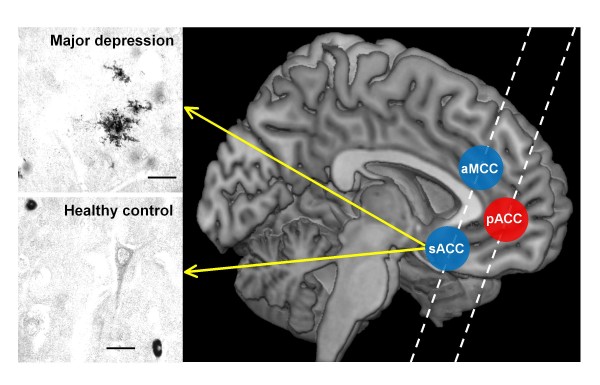
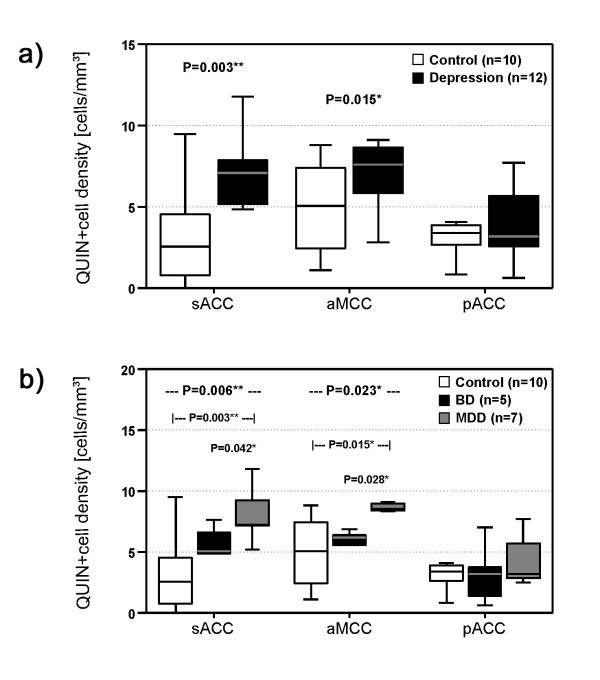
BACKGROUND: Immune dysfunction, including monocytosis and increased blood levels of interleukin-1, interleukin-6 and tumour necrosis factor α has been observed during acute episodes of major depression. These peripheral immune processes may be accompanied by microglial activation in subregions of the anterior cingulate cortex where depression-associated alterations of glutamatergic neurotransmission have been described. METHODS: Microglial immunoreactivity of the N-methyl-D-aspartate (NMDA) glutamate receptor agonist quinolinic acid (QUIN) in the subgenual anterior cingulate cortex (sACC), anterior midcingulate cortex (aMCC) and pregenual anterior cingulate cortex (pACC) of 12 acutely depressed suicidal patients (major depressive disorder/MDD, n = 7; bipolar disorder/BD, n = 5) was analyzed using immunohistochemistry and compared with its expression in 10 healthy control subjects. RESULTS: Depressed patients had a significantly increased density of QUIN-positive cells in the sACC (P = 0.003) and the aMCC (P = 0.015) compared to controls. In contrast, counts of QUIN-positive cells in the pACC did not differ between the groups (P = 0.558). Post-hoc tests showed that significant findings were attributed to MDD and were absent in BD. CONCLUSIONS: These results add a novel link to the immune hypothesis of depression by providing evidence for an upregulation of microglial QUIN in brain regions known to be responsive to infusion of NMDA antagonists such as ketamine. Further work in this area could lead to a greater understanding of the pathophysiology of depressive disorders and pave the way for novel NMDA receptor therapies or immune-modulating strategies.
Overview
The claims and statistics of this paper haven’t been checked yet.
Free: it reads the open-access text and checks the first 5 claims that cite a source we can check. Create a free account to check every claim.
Integrity signals
Registry
Cites
Statistics
Figures
Verification
Claims the paper makes
The claims and statistics of this paper haven’t been checked yet.
Free: it reads the open-access text and checks the first 5 claims that cite a source we can check. Create a free account to check every claim.
Claims other papers make about this one
Each is checked against this paper’s own text: does it say what the citing paper says it does?
The cited source says what the claim attributes to it.
In the citing paper
“Of note, increased levels of quinolinic acid have been found in microglia in the ACC of suicide victims who suffered from depression77.”
From The role of inflammation in depression: from evolutionary imperative to modern treatment target (2016) · cites this paper as [77]
In the citing paper
“Studies have revealed microglial activation in depressed patients, with a greater magnitude of activation in individuals who completed suicide (181–183)”
From Microglia Function in the Central Nervous System During Health and Neurodegeneration (2017) · cites this paper as [182]
In the citing paper
“Substances not measured in the present study are neurotoxic kynurenine-pathway metabolites such as 3-hydroxykynurenine and quinolinic acid that have been suggested to be important for further understanding of imbalance of tryptophan-kynurenine pathway in MDD (Dantzer et al., 2011;Halaris et al., 2015;Steiner et al., 2011).”
From Tryptophan-kynurenine and lipid related metabolites as blood biomarkers for first-episode drug-naïve patients with major depressive disorder: An exploratory pilot case-control study (2018) · cites this paper as Steiner et al., 2011
Self-check
Percentages, sums and reported differences re-computed from the paper’s own numbers.
The self-check needs the paper’s full text.
Citations
Cites
From inflammation to sickness and depression: when the immune system subjugates the brain
Dantzer, R., O'Connor, J. C., Freund, G. G., Johnson, R. W., & Kelley, K. W. (2008) · Nature Reviews Neuroscience · doi:10.1038/nrn2297 · Cited by 7,395 · cited 6×
“Increased levels of QUIN, which is also produced by macrophages and monocytes, have already been found in the blood and cerebrospinal fluid of subjects with cytokine-induced depression or MDD [1,21,22].”
BackgroundInfluentialInflammation and Its Discontents: The Role of Cytokines in the Pathophysiology of Major Depression
Miller, A. H., Maletic, V., & Raison, C. L. (2009) · Biological Psychiatry · doi:10.1016/j.biopsych.2008.11.029 · Cited by 3,848 · cited 2×
“Thus, our result of increased microglial QUIN expression in suicidal MDD patients is in line with the hypothesis of a systemic MPS activation during acute disease phases of depression [2-9,14].”
BackgroundResultA randomized trial of an N-methyl-D-aspartate antagonist in treatment-resistant major depression.
Zarate, C. A., Singh, J. B., Carlson, P. J., Brutsche, N. E., Ameli, R., Luckenbaugh, D. A., Charney, D. S., & Manji, H. K. (2006) · Archives of General Psychiatry · doi:10.1001/archpsyc.63.8.856 · Cited by 3,766
Jeurgen, K., Assheuer, J., & Paxinos, G. (1997) · Medical Entomology and Zoology · Cited by 1,403
Targeting abnormal neural circuits in mood and anxiety disorders: from the laboratory to the clinic
Ressler, K. J., & Mayberg, H. S. (2007) · Nature Neuroscience · doi:10.1038/nn1944 · Cited by 1,007 · cited 1×
“Importantly, the metabolic activity after deep brain stimulation in the sACC, as measured by positron emission tomography, shows a reduction in hyperactivity similar to a region bordering the aMCC and the pACC [53].”
MethodThe Relationship of Depression and Stressors to Immunological Assays: A Meta-Analytic Review
Zorrilla, E. P., Luborsky, L., McKay, J. R., Rosenthal, R., Houldin, A., Tax, A., McCorkle, R., Seligman, D. A., & Schmidt, K. (2001) · Brain, Behavior, and Immunity · doi:10.1006/brbi.2000.0597 · Cited by 995 · cited 2×
“Thus, our result of increased microglial QUIN expression in suicidal MDD patients is in line with the hypothesis of a systemic MPS activation during acute disease phases of depression [2-9,14].”
BackgroundResultDiazgranados, N., Ibrahim, L., Brutsche, N. E., Newberg, A., Kronstein, P., Khalife, S., Kammerer, W. A., Quezado, Z., Luckenbaugh, D. A., Salvadore, G., et al. (2010) · Archives of General Psychiatry · doi:10.1001/archgenpsychiatry.2010.90 · Cited by 963
Targeting the glutamatergic system to develop novel, improved therapeutics for mood disorders
Sanacora, G., Zarate, C. A., Krystal, J. H., & Manji, H. K. (2008) · Nature Reviews Drug Discovery · doi:10.1038/nrd2462 · Cited by 894
Steiner, J., Bielau, H., Brisch, R., Danos, P., Ullrich, O., Mawrin, C., Bernstein, H.-G., & Bogerts, B. (2008) · Journal of Psychiatric Research · doi:10.1016/j.jpsychires.2006.10.013 · Cited by 791 · cited 3×
“Indeed, an increased density of microglia expressing human leukocyte antigen (HLA)-DR has recently been observed in the anterior midcingulate cortex (aMCC), the dorsolateral prefrontal cortex and the mediodorsal thalamus of suicidal patients with affective disorders [14].”
BackgroundMethodResultSelf-citationThe neurobiology of psychedelic drugs: implications for the treatment of mood disorders
Vollenweider, F. X., & Kometer, M. (2010) · Nature Reviews Neuroscience · doi:10.1038/nrn2884 · Cited by 723 · cited 3×
“Here we present the first study providing evidence that supports a disease-related upregulation of microglial QUIN in depressive disorders, particularly in brain regions known to be responsive to infusion of NMDA antagonists such as ketamine [55].”
BackgroundInfluential
Cited by
Items 101–200 of 578
Neuroimmune, metabolic and oxidative stress pathways in major depressive disorder
Maes, M. H. J., Almulla, A. F., You, Z., & Zhang, Y. (2025) · Nature Reviews Neurology · doi:10.1038/s41582-025-01116-4 · Cited by 159
“Another study found that people with MDD who completed suicide had a higher concentration of microglia that tested positive for quinolinic acid, a neurotoxic compound, compared with control individuals, indicating IRS activation 102 .”
Hu, P., Lü, Y., Pan, B., & Zhang, W. (2022) · International Journal of Molecular Sciences · doi:10.3390/ijms231911076 · Cited by 152
“On the other hand, in patients with severe depression, microglia activation was observed in the cerebral cortex, prefrontal cortex, and the anterior cingulate cortex as well as the insula cortex, and the activation of microglia in the insula cortex was highly correlated with the severity of depression [55,56].”
BackgroundGanguly, P., & Brenhouse, H. C. (2015) · Developmental Cognitive Neuroscience · doi:10.1016/j.dcn.2014.07.001 · Cited by 136
“In activated microglia, tryptophan is metabolized by indoleamine to the NMDA agonist quinolinic acid instead of serotonin (Steiner et al., 2011).”
BackgroundInfluentialFuertig, R., Azzinnari, D., Bergamini, G., Cathomas, F., Sigrist, H., Seifritz, E., Vavassori, S., Luippold, A., Hengerer, B., Ceci, A., et al. (2016) · Brain, Behavior, and Immunity · doi:10.1016/j.bbi.2015.12.020 · Cited by 135
“…al., 2012; Sublette et al., 2011), and the density of QUIN‐positive microglia was increased in anterior cingulate cortex in MDD patients (Steiner et al., 2011) (for review: (Reus et al., 2015)).”
Inflammation-induced depression: Its pathophysiology and therapeutic implications
Jeon, S. W., & Kim, Y.-K. (2017) · Journal of Neuroimmunology · doi:10.1016/j.jneuroim.2017.10.016 · Cited by 134
Liver–brain interactions in inflammatory liver diseases: Implications for fatigue and mood disorders
D’Mello, C., & Swain, M. G. (2013) · Brain Behavior and Immunity · doi:10.1016/j.bbi.2013.10.009 · Cited by 145
“Increased density of quinolic acid positive microglia has been observed in the anterior cingulate cortex of depressed patients (Steiner et al., 2011).”
Inflammation‐driven brain and gut barrier dysfunction in stress and mood disorders
Doney, E., Cadoret, A., Dion‐Albert, L., Lebel, M., & Ménard, C. (2021) · European Journal of Neuroscience · doi:10.1111/ejn.15239 · Cited by 151
Savitz, J., Dantzer, R., Wurfel, B. E., Victor, T. A., Ford, B. N., Bodurka, J., Bellgowan, P. S. F., Teague, T. K., & Drevets, W. C. (2015) · Psychoneuroendocrinology · doi:10.1016/j.psyneuen.2014.11.015 · Cited by 133
Novel neuroimmunologic therapeutics in depression: A clinical perspective on what we know so far
Roman, M., & Irwin, M. R. (2020) · Brain, Behavior, and Immunity · doi:10.1016/j.bbi.2019.09.016 · Cited by 132
Setoyama, D., Kato, T. A., Hashimoto, R., Kunugi, H., Hattori, K., Hayakawa, K., Sato-Kasai, M., Shimokawa, N., Kaneko, S., Yoshida, S., et al. (2016) · PLOS ONE · doi:10.1371/journal.pone.0165267 · Cited by 125
The Gut-Microglia Connection: Implications for Central Nervous System Diseases
Wang, Y., Wang, Z., Wang, Y., Li, F., Jia, J., Song, X., Qin, S., Wang, R., Jin, F., Kitazato, K., et al. (2018) · Frontiers in Immunology · doi:10.3389/fimmu.2018.02325 · Cited by 125
Postmortem evidence of brain inflammatory markers in bipolar disorder: a systematic review
Giridharan, V. V., Sayana, P., Pinjari, O. F., Ahmad, N., da Rosa, M. I., Quevedo, J., & Barichello, T. (2019) · Molecular Psychiatry · doi:10.1038/s41380-019-0448-7 · Cited by 133
“An increase in QUIN expression and QUIN-immunopositive microglia has been observed in the subgenual and supracallosal ACC in depressed patients [103].”
BackgroundImbalanced Kynurenine Pathway in Schizophrenia
Kegel, M. E., Bhat, M., Skogh, E., Samuelsson, M., Lundberg, K., Dahl, M.-L., Sellgren, C., Schwieler, L., Engberg, G., Schuppe-Koistinen, I., et al. (2014) · International Journal of Tryptophan Research · doi:10.4137/ijtr.s16800 · Cited by 121
The kynurenine pathway in major depression: What we know and where to next
Brown, S. J., Huang, X.-F., & Newell, K. A. (2021) · Neuroscience & Biobehavioral Reviews · doi:10.1016/j.neubiorev.2021.05.018 · Cited by 113
Hoyo-Becerra, C., Schlaak, J., & Hermann, D. M. (2014) · Brain Behavior and Immunity · doi:10.1016/j.bbi.2014.06.200 · Cited by 131
A meta-analysis of cytokines in suicidal behavior
Ducasse, D., Olié, E., Guillaume, S., Artéro, S., & Courtet, P. (2015) · Brain, Behavior, and Immunity · doi:10.1016/j.bbi.2015.02.004 · Cited by 119
Microglia: A Central Player in Depression
Deng, S.-L., Chen, J.-G., & Wang, F. (2020) · Current Medical Science · doi:10.1007/s11596-020-2193-1 · Cited by 119
Inflammatory Mediators in Mood Disorders: Therapeutic Opportunities
Pfau, M. L., Ménard, C., & Russo, S. J. (2018) · Annual Review of Pharmacology and Toxicology · doi:10.1146/annurev-pharmtox-010617-052823 · Cited by 115
“Furthermore, immunohistochemical analyses of subgenual ACC and anterior midcingulate cortex in depressed suicide completers revealed increased levels of microglial cells positive for quinolinic acid, a metabolite thought to be released by microglia in response to cytokine signaling (43).”
BackgroundRusso, E., Citraro, R., Donato, G., Camastra, C., Iuliano, R., Cuzzocrea, S., Constanti, A., & Sarro, G. D. (2012) · Neuropharmacology · doi:10.1016/j.neuropharm.2012.09.019 · Cited by 123
“Since the etiology of depression has recently been linked with neuroinflammation and microglial activation (Hashioka, 2011; Steiner et al., 2011), as well as dysregulation of mTOR signaling (Jernigan et al.”
Tryptophan metabolites in depression: Modulation by gut microbiota
Lukić, I., Ivković, S., Mitić, M., & Adžić, M. (2022) · Frontiers in Behavioral Neuroscience · doi:10.3389/fnbeh.2022.987697 · Cited by 132
Neuroinflammation: A Modifiable Pathway Linking Obesity, Alzheimer's disease, and Depression
Ly, M., Yu, G. Z., Mian, A., Cramer, A., Meysami, S., Merrill, D. A., Samara, A., Eisenstein, S. A., Hershey, T., Babulal, G. M., et al. (2023) · The American Journal of Geriatric Psychiatry · doi:10.1016/j.jagp.2023.06.001 · Cited by 108
Crider, A., Feng, T., Pandya, C. D., Davis, T., Nair, A., Ahmed, A. O., Baban, B., Turecki, G., & Pillai, A. (2018) · Brain, Behavior, and Immunity · doi:10.1016/j.bbi.2018.03.004 · Cited by 112
Toxoplasmosis: A pathway to neuropsychiatric disorders
Tyebji, S., Seizova, S., Hannan, A. J., & Tonkin, C. J. (2018) · Neuroscience & Biobehavioral Reviews · doi:10.1016/j.neubiorev.2018.11.012 · Cited by 118
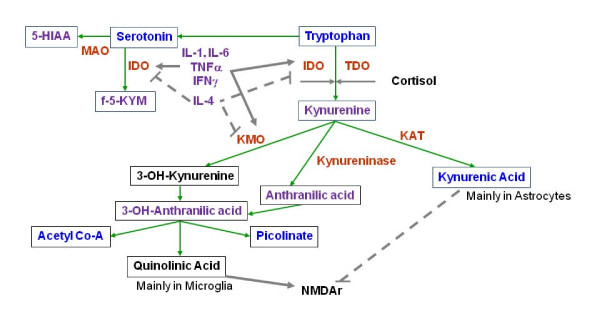
“IDO can cleave the indole ring of serotonin to form its breakdown product formyl-5-hydroxykynurenamine (Steiner et al., 2011).”
BackgroundAnderson, G., Berk, M., & Maes, M. (2014) · Acta Psychiatrica Scandinavica · doi:10.1111/acps.12182 · Cited by 110
Accelerated immunosenescence in rheumatoid arthritis: impact on clinical progression
Bauer, M. E. (2020) · Immunity & Ageing · doi:10.1186/s12979-020-00178-w · Cited by 124
“Increased levels of QA have been found in the brain of suicide victims with depression [103].”
BackgroundThe Gut Microbiota Links Dietary Polyphenols With Management of Psychiatric Mood Disorders
Westfall, S., & Pasinetti, G. M. (2019) · Frontiers in Neuroscience · doi:10.3389/fnins.2019.01196 · Cited by 113
Filho, A. J. M. C., Lima, C. N. D. C., Vasconcelos, S. M. M., de Lucena, D. F., Maes, M. H. J., & Macêdo, D. S. (2017) · Progress in Neuro-Psychopharmacology and Biological Psychiatry · doi:10.1016/j.pnpbp.2017.04.035 · Cited by 116
“QUIN can cause the destruction of postsynaptic neural elements and the death of hippocampal and granular progenitor cells (Khaspekov et al., 1989; Santamaría et al., 2001; Steiner et al., 2011; Lugo-Huitrón et al., 2013; Meier et al., 2016).”
BackgroundInfluentialImmune mechanisms of depression in rheumatoid arthritis
Brock, J., Basu, N., Schlachetzki, J. C. M., Schett, G. A., McInnes, I. B., & Cavanagh, J. (2023) · Nature Reviews Rheumatology · doi:10.1038/s41584-023-01037-w · Cited by 114
“Most studies on these metabolites have been conducted in mice, but one human study showed that serum concentrations of quinolinic acid are higher in patients with major depressive disorder who are suicidal than in healthy individuals 97 .”
BackgroundSchwieler, L., Samuelsson, M., Frye, M. A., Bhat, M., Schuppe-Koistinen, I., Jungholm, O., Johansson, A. G., Landén, M., Sellgren, C. M., & Erhardt, S. (2016) · Journal of Neuroinflammation · doi:10.1186/s12974-016-0517-7 · Cited by 106
Medina-Rodriguez, E. M., Lowell, J. A., Worthen, R. J., Syed, S. A., & Beurel, E. (2018) · Frontiers in Neuroscience · doi:10.3389/fnins.2018.00547 · Cited by 101
Gos, T., Schroeter, M. L., Lessel, W., Bernstein, H.-G., Dobrowolny, H., Schiltz, K., Bogerts, B., & Steiner, J. (2013) · Journal of Psychiatric Research · doi:10.1016/j.jpsychires.2013.07.005 · Cited by 106
Self-citationLeclercq, S., Schwarz, M., Delzenne, N. M., Stärkel, P., & de Timary, P. (2021) · Translational Psychiatry · doi:10.1038/s41398-021-01610-5 · Cited by 109
Li, H., Sagar, A. P., & Kéri, S. (2018) · Journal of Affective Disorders · doi:10.1016/j.jad.2018.08.021 · Cited by 102
Lim, C. K., Essa, M. M., de Paula Martins, R., Lovejoy, D. B., Bilgin, A. A., Waly, M. I., Al‐Farsi, Y. M., Al‐Sharbati, M., Al‐Shaffae, M. A., & Guillemin, G. J. (2016) · Autism Research · doi:10.1002/aur.1565 · Cited by 102
“Several previous studies have shown that KP metabolites kynurenic acid (KA) and quinolinic acid (QA) may be involved in several psychiatric disorders including schizophrenia and depression with suicidal ideation [Erhardt et al., 2013; Steiner et al., 2011; Sublette et al., 2011; Zavitsanou et al., 2014].”
BackgroundResultSelf-citationTang, J., Yu, W., Chen, S., Gao, Z., & Xiao, B. (2018) · Neurochemical Research · doi:10.1007/s11064-018-2504-0 · Cited by 104
Vancassel, S., Capuron, L., & Castanon, N. (2018) · Frontiers in Neuroscience · doi:10.3389/fnins.2018.00499 · Cited by 94
Clinical studies of neuroinflammatory mechanisms in schizophrenia
Watkins, C. C., & Andrews, S. R. (2015) · Schizophrenia Research · doi:10.1016/j.schres.2015.07.018 · Cited by 111
Watkins, C. C., Sawa, A., & Pomper, M. G. (2014) · Translational Psychiatry · doi:10.1038/tp.2013.119 · Cited by 100
Verdonk, F., Petit, A.-C., Abdel-Ahad, P., Vinckier, F., Jouvion, G., de Maricourt, P., De Medeiros, G. F., Danckaert, A., Van Steenwinckel, J., Blatzer, M., et al. (2019) · Brain, Behavior, and Immunity · doi:10.1016/j.bbi.2019.06.033 · Cited by 99
“Moreover, in a post-mortem study, the density of microglial cells producing quinolinic acid appears to be increased in anterior cingulate gyrus of depressed suicidal patients (Steiner et al., 2011).”
Role of Kynurenine Metabolism Pathway Activation in Major Depressive Disorders
Savitz, J. B. (2016) · Current topics in behavioral neurosciences · doi:10.1007/7854_2016_12 · Cited by 108
Modulation of microglial activation by antidepressants
Mariani, N., Everson, J., Pariante, C. M., & Borsini, A. (2022) · Journal of Psychopharmacology · doi:10.1177/02698811211069110 · Cited by 89
“…Wang et al., 2018b) and clinical studies in depression, including neuroimaging (Holmes et al., 2018) and post-mortem studies (Schnieder et al., 2014; Steiner et al., 2008, 2011), have shown an increase in the numbers of activated microglia, in particular, in individuals with suicidal ideation.”
BackgroundToxoplasma gondii Immunoglobulin G Antibodies and Nonfatal Suicidal Self-Directed Violence
Zhang, Y., Träskman-Bendz, L., Janelidze, S., Langenberg, P., Saleh, A., Constantine, N., Okusaga, O., Bay-Richter, C., Brundin, L., & Postolache, T. T. (2012) · The Journal of Clinical Psychiatry · doi:10.4088/jcp.11m07532 · Cited by 97
The emerging tale of microglia in psychiatric disorders
Rahimian, R., Wakid, M., O’Leary, L. A., & Mechawar, N. (2021) · Neuroscience & Biobehavioral Reviews · doi:10.1016/j.neubiorev.2021.09.023 · Cited by 102
Brand, S., Moller, M., & Harvey, B. (2015) · Current Neuropharmacology · doi:10.2174/1570159x13666150307004545 · Cited by 95
“In a post-mortem morphological study, an increase in QA positive microglia has been observed in the subgenual anterior cingulate cortex of BPD patients, commensurate with increased glutamatergic activity [211].”
BackgroundRole of Inflammation in the Development of Neuropsychiatric Symptom Domains: Evidence and Mechanisms
Capuron, L., & Castanon, N. (2016) · Current topics in behavioral neurosciences · doi:10.1007/7854_2016_14 · Cited by 102
Fenn, A. M., Skendelas, J. P., Moussa, D. N., Muccigrosso, M. M., Popovich, P. G., Lifshitz, J., Eiferman, D. S., & Godbout, J. P. (2015) · Journal of Neurotrauma · doi:10.1089/neu.2014.3514 · Cited by 96
Clark, S. M., Pocivavsek, A., Nicholson, J. D., Notarangelo, F. M., Langenberg, P., McMahon, R. P., Kleinman, J. E., Hyde, T. M., Stiller, J., Postolache, T. T., et al. (2016) · Journal of Psychiatry and Neuroscience · doi:10.1503/jpn.150226 · Cited by 94
Role of Inflammation in Depression and Treatment Implications
Felger, J. C. (2018) · Handbook of experimental pharmacology · doi:10.1007/164_2018_166 · Cited by 103
Kadriu, B., Farmer, C. A., Yuan, P., Park, L. T., Deng, Z.-D., Moaddel, R., Henter, I. D., Shovestul, B., Ballard, E. D., Kraus, C., et al. (2021) · Molecular Psychiatry · doi:10.1038/s41380-019-0589-8 · Cited by 92
Neuroplasticity and the next wave of antidepressant strategies
Hayley, S., & Litteljohn, D. (2013) · Frontiers in Cellular Neuroscience · doi:10.3389/fncel.2013.00218 · Cited by 92
Donoso, F., Egerton, S., Bastiaanssen, T. F. S., Fitzgerald, P., Gite, S., Fouhy, F., Ross, R. P., Stanton, C., Dinan, T. G., & Cryan, J. F. (2020) · Psychoneuroendocrinology · doi:10.1016/j.psyneuen.2020.104673 · Cited by 100
Welcome, M. O. (2020) · Inflammopharmacology · doi:10.1007/s10787-020-00712-8 · Cited by 96
Böttcher, C., Fernández-Zapata, C., Snijders, G. J. L., Schlickeiser, S., Sneeboer, M. A. M., Kunkel, D., De Witte, L. D., & Priller, J. (2020) · Translational Psychiatry · doi:10.1038/s41398-020-00992-2 · Cited by 90
Exploring the role of inflammation in major depressive disorder: beyond the monoamine hypothesis
Pastis, I., Santos, M. G., & Paruchuri, A. (2024) · Frontiers in Behavioral Neuroscience · doi:10.3389/fnbeh.2023.1282242 · Cited by 103
Serum kynurenic acid is reduced in affective psychosis
Wurfel, B. E., Drevets, W. C., Bliss, S. A., McMillin, J. R., Suzuki, H., Ford, B. N., Morris, H. M., Teague, T. K., Dantzer, R., & Savitz, J. B. (2017) · Translational Psychiatry · doi:10.1038/tp.2017.88 · Cited by 92
Joyce, M. K. P., Uchendu, S., & Arnsten, A. F. T. (2024) · Biological Psychiatry · doi:10.1016/j.biopsych.2024.06.016 · Cited by 102
Mast cells' involvement in inflammation pathways linked to depression: evidence in mastocytosis
Georgin‐Lavialle, S., Moura, D. S., Salvador, A., Chauvet‐Gélinier, J., Launay, J., Damaj, G. L., Côté, F., Soucie, E. L., Chandesris, M., Barète, S., et al. (2016) · Molecular Psychiatry · doi:10.1038/mp.2015.216 · Cited by 97
Sethi, R., Gómez‐Coronado, N., Walker, A. J., Robertson, O. D., Agustini, B., Berk, M., & Dodd, S. (2019) · Frontiers in Psychiatry · doi:10.3389/fpsyt.2019.00605 · Cited by 103
“These metabolites have been presented as inducers of depressive and anxiety symptoms (154).”
BackgroundUpdate on the Relationship Between Depression and Neuroendocrine Metabolism
Qiu, W., Cai, X., Zheng, C., Qiu, S., Ke, H., & Huang, Y. (2021) · Frontiers in Neuroscience · doi:10.3389/fnins.2021.728810 · Cited by 100
Doolin, K., Allers, K. A., Pleiner, S., Liesener, A., Farrell, C., Tozzi, L., O’Hanlon, E., Roddy, D., Frodl, T., Harkin, A., et al. (2018) · Psychoneuroendocrinology · doi:10.1016/j.psyneuen.2018.05.019 · Cited by 89
Strasburger, S. E., Bhimani, P. M., Kaabe, J. H., Krysiak, J. T., Nanchanatt, D. L., Nguyen, T. N., Pough, K. A., Prince, T. A., Ramsey, N. S., Savsani, K. H., et al. (2017) · Journal of Clinical Pharmacy and Therapeutics · doi:10.1111/jcpt.12497 · Cited by 84
“Ketamine reduces IL-6 and TNF-alpha levels, slowing down cytokine-mediated deactivation of 5-HT and cytokine-mediated conversion of kynurenine into quinolinic acid.(63)”
BackgroundAlmulla, A. F., Thipakorn, Y., Vasupanrajit, A., Algon, A. A. A., Tunvirachaisakul, C., Aljanabi, A. A. H., Oxenkrug, G. F., Al‐Hakeim, H. K., & Maes, M. H. J. (2022) · Brain Behavior & Immunity - Health · doi:10.1016/j.bbih.2022.100537 · Cited by 96
Anderson, G., Maes, M. H. J., & Berk, M. (2012) · Progress in Neuro-Psychopharmacology and Biological Psychiatry · doi:10.1016/j.pnpbp.2012.07.016 · Cited by 100
“Increased QUIN in microglia of the anterior cingulate in depressed suicide patients, an important area in emotional processing, has recently been shown (Steiner et al., 2011).”
BackgroundA survey of neuroimmune changes in pregnant and postpartum female rats
Haim, A., Julian, D. L., Albin-Brooks, C., Brothers, H. M., Lenz, K. M., & Leuner, B. (2016) · Brain Behavior and Immunity · doi:10.1016/j.bbi.2016.09.026 · Cited by 92
“…fluid of patients with major depressive disorder (Hodes et al., 2014; Young et al., 2014; Martin et al., 2015) and changes in microglial density and activity have been noted in postmortem studies of brain tissue from patients with major depressive disorder (Steiner et al., 2008, 2011).”
Biological bases of suicidal behaviours: a narrative review
Lengvenyte, A., Conejero, I., Courtet, P., & Olié, E. (2021) · European Journal of Neuroscience · doi:10.1111/ejn.14635 · Cited by 87
“Concerning basal T A B L E 2 Neuroendocrine and immune alterations associated with suicidal behaviours System Putative biomarker Observed change Author, date HPA axis Cortisol in saliva ↓ basal level ↓ evening secretion ↓ in <40 years old ↑ in >40 years old Keilp et al. (2016) Lindqvist et al. (2008) O’Connor et al. (…”
BackgroundInfluentialKozłowska, U., Nichols, C. D., Wiatr, K., & Figiel, M. (2021) · Journal of Neurochemistry · doi:10.1111/jnc.15509 · Cited by 89
“The involvement of QUIN and KYNA in the development of MDD has recently been investigated (Liu et al., 2018; Steiner et al., 2011).”
BackgroundImplications of Systemic Inflammation and Periodontitis for Major Depression
Hashioka, S., Inoue, K., Hayashida, M., Wake, R., Oh‐Nishi, A., & Miyaoka, T. (2018) · Frontiers in Neuroscience · doi:10.3389/fnins.2018.00483 · Cited by 97
“Postmortem studies also indicate that activated microglia are involved in the brain of patients with major depression (Bayer et al., 1999; Steiner et al., 2011).”
BackgroundAnimal models to improve our understanding and treatment of suicidal behavior
Gould, T. D., Georgiou, P., Brenner, L. A., Brundin, L., Can, A., Courtet, P., Donaldson, Z. R., Dwivedi, Y., Guillaume, S., Gottesman, I. I., et al. (2017) · Translational Psychiatry · doi:10.1038/tp.2017.50 · Cited by 80
“132 showed increased expression of QUIN-reactive microglia cells in the brains of depressed patients who died by suicide.”
BackgroundGSK3β: a master player in depressive disorder pathogenesis and treatment responsiveness
Duda, P., Hajka, D., Wójcicka, O., Rakus, D., & Gizak, A. (2020) · Cells · doi:10.3390/cells9030727 · Cited by 84
“Elevated cytokine levels are accompanied by microglia activation/hyper-reactivity in PFC, cingulate cortex, and insula of depressed patients [137,138].”
BackgroundSchwarcz, R. (2016) · Advances in Pharmacology · doi:10.1016/bs.apha.2016.01.005 · Cited by 81
Is depression the missing link between inflammatory mediators and cancer?
Polityńska, B., Pokorska, O., Wojtukiewicz, A. M., Sawicka, M., Mysliwiec, M., Honn, K. V., Tucker, S. C., & Wojtukiewicz, M. Z. (2022) · Pharmacology & Therapeutics · doi:10.1016/j.pharmthera.2022.108293 · Cited by 89
Busse, M., Busse, S., Myint, A.-M., Gos, T., Dobrowolny, H., Müller, U., Bogerts, B., Bernstein, H., & Steiner, J. (2014) · European Archives of Psychiatry and Clinical Neuroscience · doi:10.1007/s00406-014-0562-0 · Cited by 86
Self-citationNeuroinflammatory basis of depression: learning from experimental models
Afridi, R., & Suk, K. (2021) · Frontiers in Cellular Neuroscience · doi:10.3389/fncel.2021.691067 · Cited by 82
The Kynurenine Pathway in Traumatic Brain Injury: Implications for Psychiatric Outcomes
Meier, T. B., & Savitz, J. B. (2021) · Biological Psychiatry · doi:10.1016/j.biopsych.2021.05.021 · Cited by 83
Fibromyalgia and Depression: A Literature Review of Their Shared Aspects
Yepez, D., Grandes, X. A., Manjunatha, R. T., Habib, S., & Sangaraju, S. L. (2022) · Cureus · doi:10.7759/cureus.24909 · Cited by 104
“Microglial activation, therefore, neuroinflammation in CNS, has been found in both FM and depression [39,40].”
BackgroundFluoxetine and S-citalopram inhibit M1 activation and promote M2 activation of microglia in vitro
Su, F., Yi, H., Xu, L., & Zhang, Z. (2015) · Neuroscience · doi:10.1016/j.neuroscience.2015.02.028 · Cited by 87
The neuroinflammatory component of negative affect in patients with chronic pain
Albrecht, D., Kim, M., Akeju, O., Torrado-Carvajal, Á., Edwards, R. R., Zhang, Y., Bergan, C., Protsenko, E., Kucyi, A., Wasan, A. D., et al. (2019) · Molecular Psychiatry · doi:10.1038/s41380-019-0433-1 · Cited by 86
Visentin, A. P. V., Colombo, R., Scotton, E., Fracasso, D. S., Rosa, A. R., Branco, C. S., & Salvador, M. M. (2020) · Oxidative Medicine and Cellular Longevity · doi:10.1155/2020/2972968 · Cited by 88
“In fact, an increase in QA concentration in the brain and cerebrospinal fluid of depressive individuals suffering from suicide was already found [48, 49].”
BackgroundRahimian, R., Belliveau, C., Chen, R., & Mechawar, N. (2022) · Frontiers in Psychiatry · doi:10.3389/fpsyt.2022.871997 · Cited by 88
Glia in the cytokine-mediated onset of depression: fine tuning the immune response
Jo, W. K., Zhang, Y., Emrich, H. M., & Dietrich, D. E. (2015) · Frontiers in Cellular Neuroscience · doi:10.3389/fncel.2015.00268 · Cited by 77
Absence of gut microbiota influences lipopolysaccharide-induced behavioral changes in mice
Campos, A. C., Rocha, N. P., Nicoli, J. R., Vieira, L. Q., Teixeira, M. M., & Teixeira, A. L. (2016) · Behavioural Brain Research · doi:10.1016/j.bbr.2016.06.027 · Cited by 77
“Different studies have demonstrated that microglia activation is associated with inflammatory response that might contribute to CNS dysfunction leading to behavioral and cognitive changes (Steiner et al., 2011; Naseribafrouei et al., 2014).”
Martín-Hernández, D., Caso, J. R., Javier Meana, J., Callado, L. F., Madrigal, J. L. M., García-Bueno, B., & Leza, J. C. (2018) · Journal of Neuroinflammation · doi:10.1186/s12974-018-1294-2 · Cited by 80
Postpartum depression: psychoneuroimmunological underpinnings and treatment
Anderson, G., & Maes, M. H. J. (2013) · Neuropsychiatric Disease and Treatment · doi:10.2147/ndt.s25320 · Cited by 88
“Increased QUIN in the anterior cingulate is evident in severe depression, an area of the central nervous system linked to emotional processing.(41) QUIN is excitatory via the N-methyl-D-aspartate receptor, being excitotoxic at higher concentrations.”
Kynurenic Acid Is a Nutritional Cue that Enables Behavioral Plasticity
Lemieux, G. A., Cunningham, K. A., Lin, L., Mayer, F., Werb, Z., & Ashrafi, K. (2015) · Cell · doi:10.1016/j.cell.2014.12.028 · Cited by 80
“…or cerebrospinal fluid levels of kynurenic acid (KynA) and/or quinolinic acid are associated with schizophrenia (Erhardt et al., 2001; Schwarcz et al., 2001), Alzheimer’s, and Huntington’s diseases (Beal et al., 1992; Heyes et al., 1992) and depression (Steiner et al., 2011; Erhardt et al., 2013).”
BackgroundMicroglial glutaminase 1 deficiency mitigates neuroinflammation associated depression
Ji, C., Tang, Y., Zhang, Y., Li, C., Liang, H., Ding, L., Xia, X., Xiong, L., Qi, X., & Zheng, J. (2021) · Brain Behavior and Immunity · doi:10.1016/j.bbi.2021.10.009 · Cited by 80
“, 2021), as highly activated microglia have been reported in depression-related brain regions such as prefrontal cortex, anterior cingulate cortex and insula during major depressive episode (Setiawan et al., 2015; Steiner et al., 2011).”
BackgroundThe pathobiological basis of depression in Parkinson disease: challenges and outlooks
Jellinger, K. A. (2022) · Journal of Neural Transmission · doi:10.1007/s00702-022-02559-5 · Cited by 86
“Furthermore, peripheral cytokines and hormones can interface on resident microglia in the CNS to affect depression, as shown from postmortem findings in patients with depression (Steiner et al. 2011).”
BackgroundIDO and TDO as a potential therapeutic target in different types of depression
Qin, Y., Wang, N., Zhang, X., Han, X., Zhai, X., & Lu, Y. (2018) · Metabolic Brain Disease · doi:10.1007/s11011-018-0290-7 · Cited by 81
Sleep disturbance and kynurenine metabolism in depression
Cho, H. J., Savitz, J. B., Dantzer, R., Teague, T. K., Drevets, W. C., & Irwin, M. R. (2017) · Journal of Psychosomatic Research · doi:10.1016/j.jpsychores.2017.05.016 · Cited by 81
Neural Correlates of Suicidal Ideation and Its Reduction in Depression
Ballard, E. D., Lally, N., Nugent, A. C., Furey, M. L., Luckenbaugh, D. A., & Zarate, C. A. (2015) · International Journal of Neuropsychopharmacology · doi:10.1093/ijnp/pyu069 · Cited by 73
Miller, A. H. (2013) · Neuropsychopharmacology · doi:10.1038/npp.2013.140 · Cited by 83
“…(Erhardt et al, 2013), and increased immunoreactivity of quinolinic acid has been found in microglia in multiple brain regions of severely depressed patients including the subgenual cingulate cortex, a brain region well known to be implicated in treatment-resistant depression (Steiner et al, 2011).”
BackgroundBergamini, G., Mechtersheimer, J., Azzinnari, D., Sigrist, H., Buerge, M., Dallmann, R., Freije, R., Kouraki, A., Opacka-Juffry, J., Seifritz, E., et al. (2018) · Neurobiology of Stress · doi:10.1016/j.ynstr.2018.01.004 · Cited by 75
“, 2012), for which there is also evidence in depression (Savitz et al., 2015a, 2015b; Steiner et al., 2011; Sublette et al., 2011).”
BackgroundNeuroinflammation in HIV-associated depression: evidence and future perspectives
Rakshasa-Loots, A. M., Whalley, H. C., Vera, J. H., & Cox, S. R. (2022) · Molecular Psychiatry · doi:10.1038/s41380-022-01619-2 · Cited by 83
“There are significant overlaps between these various hypothesised mechanisms behind HIV-associated depression, for instance, as inflammatory cytokines may induce glial cell activation and an increase in tryptophan metabolism, which may further cause serotonin depletion and elicit overexpression of metabolites such as…”
Sublette, M. E., & Postolache, T. T. (2012) · Psychosomatic Medicine · doi:10.1097/psy.0b013e318268de9f · Cited by 72
“as the subgenual prefrontal cortex and anterior midcingulate cortex (36).”
BackgroundBhattacharya, A., & Drevets, W. C. (2016) · Current topics in behavioral neurosciences · doi:10.1007/7854_2016_43 · Cited by 77
Beydoun, M. A., Obhi, H. K., Weiss, J., Canas, J. A., Beydoun, H. A., Evans, M. K., & Zonderman, A. B. (2019) · Molecular Psychiatry · doi:10.1038/s41380-019-0408-2 · Cited by 78
The inflammatory underpinning of depression: An historical perspective
Yirmiya, R. (2024) · Brain Behavior and Immunity · doi:10.1016/j.bbi.2024.08.048 · Cited by 87
“…upon these findings, a subsequent study found increased densities of QUIN-labeled microglia, which are the main cell type that produces this kynurenine metabolite, in the ACC of depressed patients who died by suicide as opposed to those with bipolar disorder and controls (Steiner et al., 2011).”
Morris, G., Reiche, E. M. V., Murru, A., Carvalho, A. F., Maes, M. H. J., Berk, M., & Puri, B. K. (2018) · Molecular Neurobiology · doi:10.1007/s12035-017-0843-5 · Cited by 79
The role of microglia in neuropsychiatric disorders and suicide
Brisch, R., Wojtylak, S., Saniotis, A., Steiner, J., Gos, T., Kumaratilake, J., Henneberg, M., & Wolf, R. J. (2021) · European Archives of Psychiatry and Clinical Neuroscience · doi:10.1007/s00406-021-01334-z · Cited by 78
“[174] reported an increase in the level of quinolinic acid, which is produced by microglial cells, in subregions of the anterior cingulate gyrus in depressed patients.”
BackgroundSelf-citationThe role and mechanism of tryptophan – kynurenine metabolic pathway in depression
Gong, X., Chang, R., Zou, J., Tan, S., & Huang, Z. (2022) · Reviews in the Neurosciences · doi:10.1515/revneuro-2022-0047 · Cited by 78
Colpo, G. D., Venna, V. R., McCullough, L. D., & Teixeira, A. L. (2019) · Frontiers in Neurology · doi:10.3389/fneur.2019.00778 · Cited by 76
Metadata
- Authors
- Steiner, J., Walter, M., Gos, T., Guillemin, G. J., Bernstein, H.-G., Sarnyai, Z., Mawrin, C., Brisch, R., Bielau, H., zu Schwabedissen, L., Bogerts, B., & Myint, A.-M.
- Affiliations
- Otto-von-Guericke-Universität Magdeburg (DE)
- Gdańsk Medical University (PL)
- UNSW Sydney (AU)
- Ludwig-Maximilians-Universität München (DE)
- Venue
- Journal of Neuroinflammation
- Published
- 2011
- Volume
- 8
- Issue
- 1
- Pages
- 94
- ISSN
- 1742-2094 (ISSN-L)
- PMC
- PMC3177898
- OpenAlex
- W2146758523
- Cited by
- 568
- References
- 53
- Citations by year
- 2026: 20 · 2025: 18 · 2024: 36 · 2023: 27 · 2022: 58 · 2021: 42 · 2020: 42 · 2019: 48 · 2018: 49 · 2017: 44 · 2016: 43 · 2015: 53 · 2014: 35 · 2013: 27 · 2012: 24
- FWCI
- 8.07
- Type
- journal article
- Language
- en
- Open access
- gold
- doi.org
- Licence
- cc-by
- Locations
- Journal of Neuroinflammation (publishedVersion, cc-by)
- PubMed Central (publishedVersion, cc-by)
- PubMed (publishedVersion)
- Apollo (University of Cambridge) (submittedVersion, cc-by)
- DOAJ (DOAJ: Directory of Open Access Journals) (submittedVersion)
- Open access LMU (Ludwid Maxmilian's Universitat Munchen) (submittedVersion)
- Funders
- Deutsche Forschungsgemeinschaft (SFB 779)
- Topics
- Life Sciences › Neuroscience › Biological Psychiatry › Tryptophan and brain disorders
- Life Sciences › Neuroscience › Neurology › Neuroinflammation and Neurodegeneration Mechanisms
- Health Sciences › Medicine › Pharmacology (medical) › Treatment of Major Depression
- Keywords
- major depressive disorder, bipolar disorder, microglial activation, quinolinic acid, subgenual anterior cingulate cortex, anterior midcingulate cortex, pregenual anterior cingulate cortex, NMDA receptor, glutamatergic neurotransmission, neuroinflammation, suicidal depression, ketamine
- MeSH terms
- Adult, Aged, Major Depressive Disorder, Female, Gyrus Cinguli, Humans, Male, Middle Aged, Synaptic Transmission, Serotonin, Tryptophan, Quinolinic Acid, Microglia, Glutamic Acid
About these checks
Registry, retraction, Cites and statistics results are computed, not judged, with one exception: a printed reference that no index lists is read once by a model before it counts as a citation error. Claims are extracted by a model and kept only when their quote appears verbatim in the text; each cited source is then checked, with a model’s help, for whether it says what the claim relies on. Those verdicts can be wrong — read the claim’s quote and the cited source before relying on one.
Statistics and arithmetic are recomputed, not judged.
Confidence bands are shown only for fields calibrated on our annotated test set. None is calibrated yet, so no band is shown.
What counts as a claim ›How we measure confidence ›How we check this ›
Are you an author, or do you see a problem with this page? Request a review
Data sources
Bibliographic data: Semantic Scholar, OpenAlex, Crossref.
Contains information from the Semantic Scholar Academic Graph Datasets, made available under the ODC Attribution License (ODC-BY 1.0).
Semantic Scholar’s data is described in: Kinney, R., et al. (2023). The Semantic Scholar Open Data Platform. arXiv:2301.10140.
