

Severe depression is associated with increased microglial quinolinic acid in subregions of the anterior cingulate gyrus: Evidence for an immune-modulated glutamatergic neurotransmission?
Open accessThe DOI matches its Crossref record; 53 of the 53 references it cites were found in a registry or an index.
Abstract
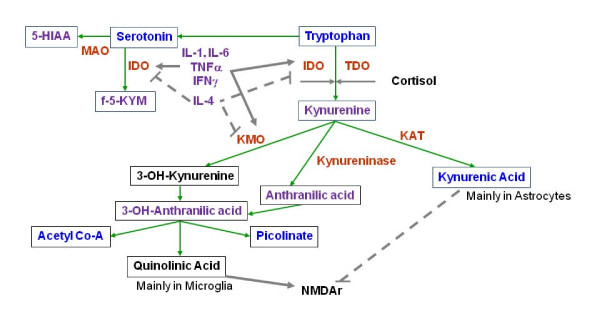
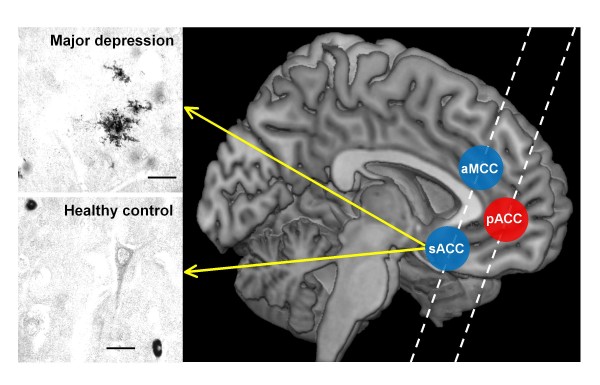
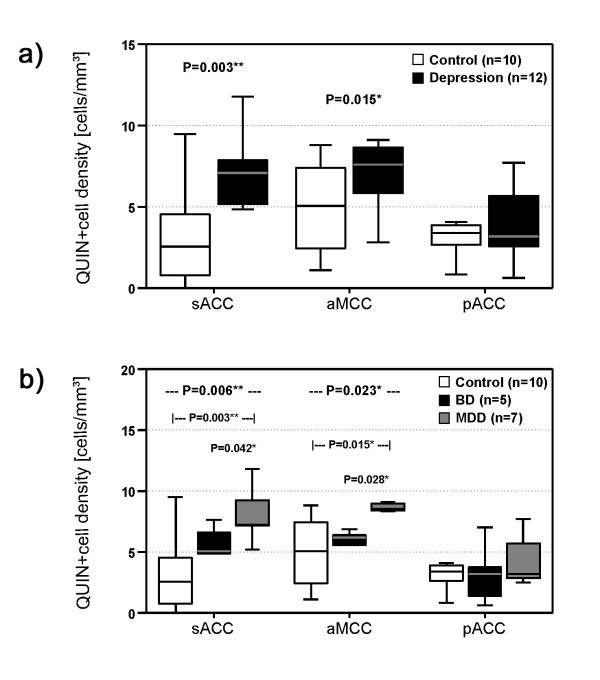
BACKGROUND: Immune dysfunction, including monocytosis and increased blood levels of interleukin-1, interleukin-6 and tumour necrosis factor α has been observed during acute episodes of major depression. These peripheral immune processes may be accompanied by microglial activation in subregions of the anterior cingulate cortex where depression-associated alterations of glutamatergic neurotransmission have been described. METHODS: Microglial immunoreactivity of the N-methyl-D-aspartate (NMDA) glutamate receptor agonist quinolinic acid (QUIN) in the subgenual anterior cingulate cortex (sACC), anterior midcingulate cortex (aMCC) and pregenual anterior cingulate cortex (pACC) of 12 acutely depressed suicidal patients (major depressive disorder/MDD, n = 7; bipolar disorder/BD, n = 5) was analyzed using immunohistochemistry and compared with its expression in 10 healthy control subjects. RESULTS: Depressed patients had a significantly increased density of QUIN-positive cells in the sACC (P = 0.003) and the aMCC (P = 0.015) compared to controls. In contrast, counts of QUIN-positive cells in the pACC did not differ between the groups (P = 0.558). Post-hoc tests showed that significant findings were attributed to MDD and were absent in BD. CONCLUSIONS: These results add a novel link to the immune hypothesis of depression by providing evidence for an upregulation of microglial QUIN in brain regions known to be responsive to infusion of NMDA antagonists such as ketamine. Further work in this area could lead to a greater understanding of the pathophysiology of depressive disorders and pave the way for novel NMDA receptor therapies or immune-modulating strategies.
Overview
The claims and statistics of this paper haven’t been checked yet.
Free: it reads the open-access text and checks the first 5 claims that cite a source we can check. Create a free account to check every claim.
Integrity signals
Registry
Cites
Statistics
Figures
Verification
Claims the paper makes
The claims and statistics of this paper haven’t been checked yet.
Free: it reads the open-access text and checks the first 5 claims that cite a source we can check. Create a free account to check every claim.
Claims other papers make about this one
Each is checked against this paper’s own text: does it say what the citing paper says it does?
The cited source says what the claim attributes to it.
In the citing paper
“Of note, increased levels of quinolinic acid have been found in microglia in the ACC of suicide victims who suffered from depression77.”
From The role of inflammation in depression: from evolutionary imperative to modern treatment target (2016) · cites this paper as [77]
In the citing paper
“Studies have revealed microglial activation in depressed patients, with a greater magnitude of activation in individuals who completed suicide (181–183)”
From Microglia Function in the Central Nervous System During Health and Neurodegeneration (2017) · cites this paper as [182]
In the citing paper
“Substances not measured in the present study are neurotoxic kynurenine-pathway metabolites such as 3-hydroxykynurenine and quinolinic acid that have been suggested to be important for further understanding of imbalance of tryptophan-kynurenine pathway in MDD (Dantzer et al., 2011;Halaris et al., 2015;Steiner et al., 2011).”
From Tryptophan-kynurenine and lipid related metabolites as blood biomarkers for first-episode drug-naïve patients with major depressive disorder: An exploratory pilot case-control study (2018) · cites this paper as Steiner et al., 2011
Self-check
Percentages, sums and reported differences re-computed from the paper’s own numbers.
The self-check needs the paper’s full text.
Citations
Cites
From inflammation to sickness and depression: when the immune system subjugates the brain
Dantzer, R., O'Connor, J. C., Freund, G. G., Johnson, R. W., & Kelley, K. W. (2008) · Nature Reviews Neuroscience · doi:10.1038/nrn2297 · Cited by 7,395 · cited 6×
“Increased levels of QUIN, which is also produced by macrophages and monocytes, have already been found in the blood and cerebrospinal fluid of subjects with cytokine-induced depression or MDD [1,21,22].”
BackgroundInfluentialInflammation and Its Discontents: The Role of Cytokines in the Pathophysiology of Major Depression
Miller, A. H., Maletic, V., & Raison, C. L. (2009) · Biological Psychiatry · doi:10.1016/j.biopsych.2008.11.029 · Cited by 3,848 · cited 2×
“Thus, our result of increased microglial QUIN expression in suicidal MDD patients is in line with the hypothesis of a systemic MPS activation during acute disease phases of depression [2-9,14].”
BackgroundResultA randomized trial of an N-methyl-D-aspartate antagonist in treatment-resistant major depression.
Zarate, C. A., Singh, J. B., Carlson, P. J., Brutsche, N. E., Ameli, R., Luckenbaugh, D. A., Charney, D. S., & Manji, H. K. (2006) · Archives of General Psychiatry · doi:10.1001/archpsyc.63.8.856 · Cited by 3,766
Jeurgen, K., Assheuer, J., & Paxinos, G. (1997) · Medical Entomology and Zoology · Cited by 1,403
Targeting abnormal neural circuits in mood and anxiety disorders: from the laboratory to the clinic
Ressler, K. J., & Mayberg, H. S. (2007) · Nature Neuroscience · doi:10.1038/nn1944 · Cited by 1,007 · cited 1×
“Importantly, the metabolic activity after deep brain stimulation in the sACC, as measured by positron emission tomography, shows a reduction in hyperactivity similar to a region bordering the aMCC and the pACC [53].”
MethodThe Relationship of Depression and Stressors to Immunological Assays: A Meta-Analytic Review
Zorrilla, E. P., Luborsky, L., McKay, J. R., Rosenthal, R., Houldin, A., Tax, A., McCorkle, R., Seligman, D. A., & Schmidt, K. (2001) · Brain, Behavior, and Immunity · doi:10.1006/brbi.2000.0597 · Cited by 995 · cited 2×
“Thus, our result of increased microglial QUIN expression in suicidal MDD patients is in line with the hypothesis of a systemic MPS activation during acute disease phases of depression [2-9,14].”
BackgroundResultDiazgranados, N., Ibrahim, L., Brutsche, N. E., Newberg, A., Kronstein, P., Khalife, S., Kammerer, W. A., Quezado, Z., Luckenbaugh, D. A., Salvadore, G., et al. (2010) · Archives of General Psychiatry · doi:10.1001/archgenpsychiatry.2010.90 · Cited by 963
Targeting the glutamatergic system to develop novel, improved therapeutics for mood disorders
Sanacora, G., Zarate, C. A., Krystal, J. H., & Manji, H. K. (2008) · Nature Reviews Drug Discovery · doi:10.1038/nrd2462 · Cited by 894
Steiner, J., Bielau, H., Brisch, R., Danos, P., Ullrich, O., Mawrin, C., Bernstein, H.-G., & Bogerts, B. (2008) · Journal of Psychiatric Research · doi:10.1016/j.jpsychires.2006.10.013 · Cited by 791 · cited 3×
“Indeed, an increased density of microglia expressing human leukocyte antigen (HLA)-DR has recently been observed in the anterior midcingulate cortex (aMCC), the dorsolateral prefrontal cortex and the mediodorsal thalamus of suicidal patients with affective disorders [14].”
BackgroundMethodResultSelf-citationThe neurobiology of psychedelic drugs: implications for the treatment of mood disorders
Vollenweider, F. X., & Kometer, M. (2010) · Nature Reviews Neuroscience · doi:10.1038/nrn2884 · Cited by 723 · cited 3×
“Here we present the first study providing evidence that supports a disease-related upregulation of microglial QUIN in depressive disorders, particularly in brain regions known to be responsive to infusion of NMDA antagonists such as ketamine [55].”
BackgroundInfluential
Cited by
Items 401–500 of 578
Future Directions of Cytokine Hypothesis in Depression: ‘NLRP3 inflamazomu’
Şahin, C., & Arıcıoğlu, F. (2013) · Klinik Psikofarmakoloji Bülteni-Bulletin of Clinical Psychopharmacology · doi:10.5455/bcp.20130927070724 · Cited by 19
Yun, Y., Zhang, Q., Zhao, W., Ma, T., Fan, H., Bai, L., Ma, B., Qi, S., Wang, Z., An, H., et al. (2022) · Journal of Psychosomatic Research · doi:10.1016/j.jpsychores.2022.111069 · Cited by 13
O’Regan, G., Plummer, Z., Christie, B. R., Shultz, S. R., & Allen, J. (2026) · Journal of Neuroinflammation · doi:10.1186/s12974-026-03717-2 · Cited by 15
“Another study found that suicidal MDD patients had higher densities of QA-immunoreactive microglia in the subgenual anterior cingulate and anterior midcingu-late cortices compared to healthy controls [62].”
Nakatani, Y., Yaguchi, M., Ogino, K., Noguchi, R., Yamamoto, N., & Amano, T. (2022) · Psychopharmacology · doi:10.1007/s00213-022-06194-6 · Cited by 12
Stress and Kynurenine-Inflammation Pathway in Major Depressive Disorder
Mingoti, M. E. D., Bertollo, A. G., de Oliveira, T., & Ignácio, Z. M. (2023) · Advances in experimental medicine and biology · doi:10.1007/978-981-19-7376-5_8 · Cited by 16
Systemic neuro-dysregulation in depression: Evidence from genome-wide association
Tubbs, J. D., Ding, J., Baum, L., & Sham, P. C. (2020) · European Neuropsychopharmacology · doi:10.1016/j.euroneuro.2020.08.007 · Cited by 12
Towards Novel Potential Molecular Targets for Antidepressant and Antipsychotic Pharmacotherapies
Kositsyn, Y. M., de Abreu, M. S., Kolesnikova, T. O., Lagunin, A. A., Poroikov, V., Harutyunyan, H. S., Yenkoyan, K. B., & Kalueff, A. V. (2023) · International Journal of Molecular Sciences · doi:10.3390/ijms24119482 · Cited by 12
Mechanism of N6-Methyladenosine Modification in the Pathogenesis of Depression
Xian, Z., Tian, L., Yao, Z., Cao, L., Jia, Z., & Li, G. (2024) · Molecular Neurobiology · doi:10.1007/s12035-024-04614-6 · Cited by 11
“Moreover, this process is closely related to suicide behaviors in patients with depression [37].”
Schiweck, C., Aichholzer, M., Reif, A., & Thanarajah, S. E. (2022) · Journal of Affective Disorders Reports · doi:10.1016/j.jadr.2022.100454 · Cited by 13
Heilman, P. L., Hill, M. N., Coussons‐Read, M. E., Brundin, L., & Coccaro, E. F. (2019) · Psychoneuroendocrinology · doi:10.1016/j.psyneuen.2019.104434 · Cited by 11
Evidence for the contribution of vasopressin V1B receptors in the pathophysiology of depression
Guan, W., Wang, Q., & Sheng, X.-M. (2024) · Biochemical Pharmacology · doi:10.1016/j.bcp.2024.116672 · Cited by 10
Lyamtsev, A. S., Sentyabreva, A. V., & Kosyreva, A. M. (2025) · International Journal of Molecular Sciences · doi:10.3390/ijms26189250 · Cited by 12
“A large number of studies show that abnormalities in the morphology and function of microglia in the developing brain are associated with the development of depressive disorders [181–183].”
Myint, K., Jacobs, K. R., Myint, A.-M., Lam, S. K., Lim, Y. A. L., Boey, C. C. M., Hoe, S.-Z., & Guillemin, G. J. (2021) · Frontiers in Immunology · doi:10.3389/fimmu.2021.702301 · Cited by 11
“As we previously published, QUIN has been identified as a key player in depression (73) and suicide (72).”
BackgroundSelf-citationMu, J., Liu, X., Dong, Y.-H., Fang, Y.-Y., Qiu, S.-D., Zhang, F., & Liu, K. (2022) · Frontiers in Medicine · doi:10.3389/fmed.2022.998397 · Cited by 11
“IDO-1 is a rate-limiting metabolic enzyme of the kynurenine pathway composed of several neuroactive metabolites including QUIN, an endogenous N-methyl-Daspartate receptor (NMDAR) agonist implicated in depression and cognitive deficits (6, 40).”
BackgroundChoi, K., Lee, J., Kim, G., Lim, Y., & Kang, H. J. (2024) · Frontiers in Cellular Neuroscience · doi:10.3389/fncel.2024.1369951 · Cited by 10
Khantakova, J. N., Bondar, N. P., Antontseva, E. V., & Reshetnikov, V. V. (2022) · Frontiers in Cellular Neuroscience · doi:10.3389/fncel.2022.1066794 · Cited by 10
“, 2014) and density (Steiner et al., 2011) of microglial cells producing quinolinic acid: one of the products of the inflammatory kynurenine pathway of tryptophan metabolism (Myint and Kim, 2014), indicating an enhanced microglial response to cytokine signals.”
BackgroundThe kynurenine pathway in traumatic brain injuries and concussion
Dehhaghi, M., Heng, B., & Guillemin, G. J. (2023) · Frontiers in Neurology · doi:10.3389/fneur.2023.1210453 · Cited by 10
Self-citationThe Application of Ultrasound‐Induced Blood–Brain Barrier Opening in Neurology and Immunology
Jiang, A., Wang, Z., Song, D., Zhang, X., Guan, M., Li, X., Tan, J., He, Y., Han, W., Ding, X., et al. (2025) · Small · doi:10.1002/smll.202502699 · Cited by 12
Gonda, X., Serafini, G., & Döme, P. (2023) · Journal of Personalized Medicine · doi:10.3390/jpm13071078 · Cited by 9
Regulation of GSK-3 Activity as A Shared Mechanism in Psychiatric Disorders
Şahin, C., Ünal, G., & Arıcıoğlu, F. (2014) · Klinik Psikofarmakoloji Bülteni-Bulletin of Clinical Psychopharmacology · doi:10.5455/bcp.20140317063255 · Cited by 12
Obesity and Depression: Shared Pathophysiology and Translational Implications
Huet, L., Delgado, I., Aouizerate, B., Castanon, N., & Capuron, L. (2019) · Elsevier eBooks · doi:10.1016/b978-0-12-813333-0.00016-0 · Cited by 13
The major biogenic amine metabolites in mood disorders
Yang, H. J., Yuan, M., & Zhang, W. (2024) · Frontiers in Psychiatry · doi:10.3389/fpsyt.2024.1460631 · Cited by 8
Valizadeh, P., Jannatdoust, P., Ghadimi, D. J., Tahamtan, M., Darmiani, K., Shahsavarhaghighi, S., Rezaei, S., Aarabi, M. H., Cattarinussi, G., Sambataro, F., et al. (2025) · Journal of Affective Disorders · doi:10.1016/j.jad.2025.03.175 · Cited by 8
Zdanowicz, N., Reynaert, C., Jacques, D., Tordeurs, D., Lepièce, B., & Maury, J. (2015) · PubMed · Cited by 8
Chen, X., Zhang, B., Yuan, S., Luo, X., Wang, M., Hu, Y., Zhou, Y., & Ning, Y. (2023) · European Psychiatry · doi:10.1192/j.eurpsy.2023.19 · Cited by 8
“Moreover, quinolinic acid (QUIN) concentration has been shown to increase specifically in the aMCC of suicidal MDD patients [42].”
BackgroundRahman, A., & Guillemin, G. J. (2021) · Springer eBooks · doi:10.1007/978-3-030-71519-9_142-1 · Cited by 10
Self-citationCheng, S., Li, J., Chen, D. T.-L., Chien, Y.-C., Chang, J. P., Huang, S., Gałecki, P., & Su, K. (2021) · Journal of Personalized Medicine · doi:10.3390/jpm11030192 · Cited by 9
“As previous studies showed an upregulation of neurotoxic QUIN in the brain [49] and lower plasma concentration of neuroprotective KYNA [50] in depressed patients, it may be the relative levels of QUIN and KYNA that determine the overall effects of KYN metabolites on depression.”
BackgroundInflammation in Suicidality: Implications for Novel Treatment Options
Janelidze, S., & Brundin, L. (2013) · Modern trends in psychiatry · doi:10.1159/000346085 · Cited by 8
Yu, Q., Liu, M., Dai, W., Xiong, Y., Mu, X., Xia, M., Li, Y., Ma, S., Su, Y., Wu, J., et al. (2023) · Frontiers in Pharmacology · doi:10.3389/fphar.2023.974905 · Cited by 8
Du, Y., Yang, J., Li, F. R., Wang, L., Tian, Y., Yang, L., & Luo, L. (2025) · ACS Omega · doi:10.1021/acsomega.5c02585 · Cited by 7
Inflammatory pathology in depression and suicide: a mechanistic distillation of clinical correlates
Costanza, A., Amerio, A., Aguglia, A., Magnani, L., Parise, A., Nguyen, K. D., Berardelli, I., Pompili, M., Amore, M., & Serafini, G. (2024) · Frontiers in Immunology · doi:10.3389/fimmu.2024.1479471 · Cited by 7
Gos, T., Steiner, J., Krell, D., Bielau, H., Mawrin, C., Krzyżanowski, M., Brisch, R., Pieśniak, D., Bernstein, H., Jankowski, Z., et al. (2013) · Psychiatry Research · doi:10.1016/j.psychres.2013.02.017 · Cited by 7
“…cells has recently been found in the right ACd of suicidal patients with depression (predominantly MDD; (Hercher et al., 2010) paralleled by the hypertrophy of fibrous astrocytes (Torres-Platas et al., 2011) and microglia activation in the adjacent subcortical white matter (Steiner et al., 2011).”
Self-citationQuinolinic acid-immunoreactivity in the naïve mouse brain
Lopez, Y. P., Kenis, G., Rutten, B. P. F., Myint, A.-M., Steinbusch, H. W. M., & van den Hove, D. (2015) · Journal of Chemical Neuroanatomy · doi:10.1016/j.jchemneu.2015.10.010 · Cited by 7
Self-citationKrzyżanowska, M., Rębała, K., Steiner, J., Kaliszan, M., Pieśniak, D., Karnecki, K., Wiergowski, M., Brisch, R., Braun, K., Jankowski, Z., et al. (2021) · European Archives of Psychiatry and Clinical Neuroscience · doi:10.1007/s00406-021-01232-4 · Cited by 7
Self-citationMcGuinness, B. W., & Harkin, A. (2015) · Current topics in neurotoxicity · doi:10.1007/978-3-319-13602-8_3 · Cited by 7
Savitz, J. B., Ford, B. N., Kuplicki, R., Khalsa, S. S., Teague, T. K., & Paulus, M. P. (2022) · Psychopharmacology · doi:10.1007/s00213-022-06263-w · Cited by 7
Koutsouleris, N., Vetter, C. S., Buciuman, M.-O., Neuner, L., Weyer, C., Urquijo-Castro, M. F., Penzel, N., Popovic, D., Hahn, L., Haas, S. S., et al. (2026) · Brain · doi:10.1093/brain/awag100 · Cited by 6
Farinha‐Ferreira, M., Magalhães, D. M., Neuparth‐Sottomayor, M., Rafael, H., Miranda‐Lourenço, C., & Sebastião, A. M. (2024) · Journal of Neurochemistry · doi:10.1111/jnc.16083 · Cited by 6
“There are also reports of increased levels of both active microglia and microglial density in the brains of MDD patients (Clark et al., 2016; Steiner et al., 2011; Torres-Platas et al., 2014).”
Is the acquired hypothyroidism a risk factor for developing psychiatric disorders?
Brizuela, N. O., Peraza, A. V., Ángel, D. S.-D., García-Martínez, Y., Pacheco-Rosado, J., Pérez‐Sánchez, G., & Sánchez-Huerta, K. (2024) · Frontiers in Psychiatry · doi:10.3389/fpsyt.2024.1429255 · Cited by 7
Neuroinflammation. Contemporary anti-inflammatory treatment approaches
Al-Amin, M. M., & Reza, H. M. (2014) · Neurosciences · doi:10.17712/1658-3183.2066 · Cited by 6
Lam, C. S., Tipoe, G. L., Wong, J. K.-C., Youdim, M. B. H., & Fung, M. (2016) · PLoS ONE · doi:10.1371/journal.pone.0166966 · Cited by 6
Immunity, coping and depression.
Manceaux, P., & Zdanowicz, N. (2016) · PubMed · Cited by 7
Exacerbated immune response of the brain to peripheral immune challenge in post-septic mice
Salmani, H., Hosseini, M., Nabi, M. M., Noshahr, Z. S., Baghcheghi, Y., & Sadeghi, M. (2022) · Brain Research Bulletin · doi:10.1016/j.brainresbull.2022.04.013 · Cited by 7
Tang, H., Zhang, Y., Zhao, S., & Song, C. (2023) · Journal of Affective Disorders Reports · doi:10.1016/j.jadr.2023.100580 · Cited by 8
Tomasović, S., Sremec, J., Košćak, J., Klepac, N., Draganić, P., & Bielen, I. (2016) · PubMed · Cited by 6
Ribosomal DNA transcription in prefrontal pyramidal neurons is decreased in suicide
Krzyżanowska, M., Steiner, J., Pieśniak, D., Karnecki, K., Kaliszan, M., Wiergowski, M., Rębała, K., Brisch, R., Braun, K., Jankowski, Z., et al. (2019) · European Archives of Psychiatry and Clinical Neuroscience · doi:10.1007/s00406-019-00996-0 · Cited by 6
“This effect could be related to the outstanding role played by the ventral AC in the regulation of emotionally influenced behaviour [38], which is profoundly disturbed in processes associated with suicide [13, 39].”
BackgroundSelf-citationIs there a place for cellular therapy in depression?
do Prado‐Lima, P. A. S., Costa‐Ferro, Z. S. M., Souza, B. S. D. F., da Cruz, I. B. M., & Lab, B. (2021) · World Journal of Psychiatry · doi:10.5498/wjp.v11.i9.553 · Cited by 6
Proteomics and Metabolomics in Psychiatry
Martins‐de‐Souza, D. (2014) · Advances in biological psychiatry · doi:10.1159/isbn.978-3-318-02600-9 · Cited by 7
Myers, M. G., & Toal, C. B. (1995) · PubMed · Cited by 7
Yao, L., Yan, R., & Sun, C. (2026) · Frontiers in Neuroscience · doi:10.3389/fnins.2026.1819436 · Cited by 5
“Furthermore, activation of the kynurenine pathway promotes the production of quinolinic acid, an excitotoxic compound that promotes glutamate release and blocks glutamate reuptake (Steiner et al., 2011; Tavares et al., 2002).”
Inflammation and treatment strategies for suicidal behavior
Behera, C., Gupta, S., Shelton, R. C., & Dwivedi, Y. (2026) · The World Journal of Biological Psychiatry · doi:10.1080/15622975.2026.2659772 · Cited by 5
“Post-mortem analyses further demonstrate increased QUIN concentrations in the subgenual anterior cingulate cortex and anterior midcingulate cortex of depressed individuals who died by suicide (Steiner et al. 2011).”
Karati, D., Mukherjee, S., & Roy, S. (2023) · Molecular Neurobiology · doi:10.1007/s12035-023-03632-0 · Cited by 6
“IFN injection increased the levels of kynurenine path metabolites such as kynurenine congeners and quinolinic acid in the CSF, resulting in inflammation (QUIN) [46].”
Wróbel, J., Iwaniak, P., Dobrowolski, P., Chwil, M., Sadok, I., Kluz, T., Wdowiak, A., Bojar, I., Poleszak, E., Misiek, M., et al. (2024) · International Journal of Molecular Sciences · doi:10.3390/ijms252312630 · Cited by 6
“Elevated QA was reported in the cingulate cortex of suicide victims with depression [105].”
Neurological Disorders, Depression and Inflammation: Is there a Common Link?
Halaris, A. E. (2015) · Future Neurology · doi:10.2217/fnl.15.18 · Cited by 6
Inflammation, Sickness Behaviour and Depression
Khandaker, G. M., Colasanti, A., & Harrison, N. A. (2021) · Cambridge University Press eBooks · doi:10.1017/9781108539623.008 · Cited by 5
Kynurenine pathway: the link between depressive disorders and inflammation
Kubacka, J., Stefańska, A., & Sypniewska, G. (2020) · Postępy Higieny i Medycyny Doświadczalnej · doi:10.5604/01.3001.0014.3454 · Cited by 5
The next psychoactive drugs: From imipramine to ketamine
Carrillo, P., Petit, A., Gaillard, R., & Vinckier, F. (2020) · Bulletin de l Académie Nationale de Médecine · doi:10.1016/j.banm.2020.09.039 · Cited by 5
Towards better understanding of the link between inflammation and suicidal ideation and behaviors
Lengvenytė, A., Sebti, E., & Courtet, P. (2022) · Minerva Psychiatry · doi:10.23736/s2724-6612.22.02369-7 · Cited by 7
Cheng, J., Gao, Y., Liu, P., Zhang, J., & Zhou, J. (2025) · International Immunopharmacology · doi:10.1016/j.intimp.2025.115351 · Cited by 5
Inflammatory Biomarkers in Acute Suicidal Behaviors
Lewandowska, M., Leszczyński-Czeczatka, J., & Siemiński, M. (2026) · International Journal of Molecular Sciences · doi:10.3390/ijms27041691 · Cited by 4
“…cytokines can activate indoleamine-2,3-dioxygenase (IDO), thereby shifting tryptophan metabolism toward the kynurenine pathway and increasing the production of neuroactive metabolites such as quinolinic acid, an NMDA receptor agonist that contributes to glutamatergic excitotoxicity [40,42].”
Pecsok, M. K., Mordy, A. E., Cristancho, M. A., Oathes, D. J., & Roalf, D. R. (2024) · Psychopathology · doi:10.1159/000538690 · Cited by 7
Kaushik, R., Nayak, B., Satapathy, S. S., Bharti, D. R., Pandey, S., & Behera, C. (2024) · Psychoneuroendocrinology · doi:10.1016/j.psyneuen.2024.107268 · Cited by 4
Anti-inflammatory Drugs in the Treatment of Depression
Cavanagh, J. (2023) · Current topics in behavioral neurosciences · doi:10.1007/7854_2023_459 · Cited by 6
Canday, M., & Salman, S. (2023) · Gynecology Obstetrics and Reproductive Medicine · doi:10.21613/gorm.2023.1453 · Cited by 6
Li, G., Hu, L., Gu, X., Zhu, W., Zhen, X., & Sun, X. (2024) · Neurochemical Research · doi:10.1007/s11064-024-04111-1 · Cited by 4
“Post-mortem studies have also found evidence of activated microglia and enhanced neuroinflammation in the brains of patients suffering from depression [12–15].”
Neurodevelopmental and Neuropsychiatric Disorders
Traetta, M. E., Filho, A. M. C., Akinluyi, E. T., & Tremblay, M. (2024) · Advances in neurobiology · doi:10.1007/978-3-031-55529-9_26 · Cited by 4
Curcumin as an ajuvant treatment of depression: mechanisms of action and application prospects
Ab, K. (2020) · S S Korsakov Journal of Neurology and Psychiatry · doi:10.17116/jnevro2020120021125 · Cited by 4
“При депресии был обнаружен повышенный уровень ХК, что сопровождалось дегенеративными изменениям в ЦНС [6].”
A Possible Link between Microglial Process Dysfunction and Neuropsychiatric Disorders
Hayashi, Y., Wu, Z., & Nakanishi, H. (2014) · Cited by 4
Rigotti, M., Finger, L. F., Scariot, F. J., Machado, A. K., Silva, S. D. Á. E., Salvador, M. M., & Branco, C. S. (2025) · Molecular Neurobiology · doi:10.1007/s12035-025-04730-x · Cited by 3
“Severe depression is associated with increased microglial QA [13], supporting the hypothesis that the immune system is implicated in depression.”
Kontogianni, A., Yang, H., & Chen, W. (2025) · Neural Regeneration Research · doi:10.4103/nrr.nrr-d-25-00281 · Cited by 3
“…studies of individuals with depression, particularly those who died by suicide, have revealed increased neuroinflammation, including elevated microglial density and higher levels of pro-inflammatory cytokines and quinolinic acid in brain regions critical for mood regulation (Steiner et al., 2011).”
Microglia associated research in depression: an exploratory trends analysis
Chen, Y.-J., Zhu, Q.-Q., Xie, M.-R., Zhang, D., SHUAI, Y.-F., Li, Y. H., Zhang, N., He, W., Liao, Y., Zeng, Q.-J., et al. (2026) · Frontiers in Aging Neuroscience · doi:10.3389/fnagi.2026.1757943 · Cited by 4
Nussbaumer, M., Guest, P. C., Schiltz, K., Dudeck, L., Asl, L. S., Meyer-Lotz, G., Dobrowolny, H., Leucht, S., Bernstein, H., Nickl‐Jockschat, T., et al. (2026) · Molecular Psychiatry · doi:10.1038/s41380-026-03614-3 · Cited by 6
“Although Steiner et al. reported increased QUIN ‑ immunoreactive microglia in the sACC and aMCC when analysing all depressed cases together (see above, MDD + BD vs controls), post ‑ hoc analyses did not show a signi fi cant difference between the BD subgroup and controls [74].”
InfluentialSelf-citationClinical Trials of Anti-Inflammatory Treatments of Major Depression
Müller, N. (2018) · Elsevier eBooks · doi:10.1016/b978-0-12-811073-7.00028-3 · Cited by 3
Joyce, M. K. P., Datta, D., Arellano, J. I., Duque, A., Morozov, Y. M., Morrison, J. H., & Arnsten, A. F. T. (2025) · Frontiers in Neuroanatomy · doi:10.3389/fnana.2025.1553056 · Cited by 3
A computational account of joint SSRI and anti-inflammatory treatment
Reneaux, M., Mayberg, H. S., Friston, K. J., & Pinotsis, D. A. (2025) · Frontiers in Immunology · doi:10.3389/fimmu.2025.1472732 · Cited by 6
“Therefore, anti-in fl ammatory”
Inflammation and Suicidal Behavior
Postolache, T. T., Manalai, P., Brenner, L. A., & Brundin, L. (2015) · Advances in biological psychiatry · doi:10.1159/000434746 · Cited by 4
The Role of Kynurenine Pathway Metabolites in Neuropsychiatric Disorders
Campbell, B. M., Pocivavsek, A., Notarangelo, F. M., & Parachikova, A. I. (2015) · Springer eBooks · doi:10.1007/978-3-319-11870-3_19 · Cited by 3
Inflammation and treatment resistance in major depression: A perfect storm
Miller, A. H. (2011) · Brain Behavior and Immunity · doi:10.1016/j.bbi.2011.07.214 · Cited by 3
Anti-Inflammatory and Immune-Modulatory Therapeutic Approaches in Major Depression
Müller, N. (2016) · Elsevier eBooks · doi:10.1016/b978-0-12-802456-0.00004-2 · Cited by 4
Beasley, V. E., & Dowse, H. B. (2016) · Journal of Experimental Zoology Part A Ecological Genetics and Physiology · doi:10.1002/jez.2057 · Cited by 4
Novel Phenotypes Detectable with PET in Mood Disorders
Meyer, J. H. (2017) · PET Clinics · doi:10.1016/j.cpet.2017.02.008 · Cited by 5
Syed, S. A., Cranshaw, M., & Nemeroff, C. B. (2019) · Elsevier eBooks · doi:10.1016/b978-0-12-813983-7.00013-6 · Cited by 3
Psychotropes du futur : de l’imipramine à la kétamine
Carrillo, P., Petit, A., Gaillard, R., & Vinckier, F. (2020) · Bulletin de l Académie Nationale de Médecine · doi:10.1016/j.banm.2020.09.038 · Cited by 6
Kynurenine pathway dysregulation in postpartum depression
Badawy, A. A. ‐. (2020) · Brain Behavior and Immunity · doi:10.1016/j.bbi.2020.10.002 · Cited by 3
Du, J., Li, J., Liu, P., Zhang, Y., Dong, Q., Yang, N., & Liu, X. (2025) · PubMed Central · doi:10.11817/j.issn.1672-7347.2025.250163 · Cited by 4
“KYN 通路,导致 5-HT 生成减少 [33] 。并且脑脊液中 KYN 途径代谢物的不平衡,大脑神经毒性代谢物 (QUIN) 增加,神经保护性代谢物 (KYNA) 下降 [34-35] , 抑郁障碍不仅与 5-HT 合成不足有关 [36] ,而且与谷氨 酸能途径的紊乱有关 [37-38] 。在抑郁障碍中发现海马萎 缩,其也可能与神经毒性 / 神经保护化合物的失衡 有关 [39] 。”
Williams, M. E., Schutte, L., Asia, L. K., Wissing, M. P., & van Vuren, E. J. (2026) · Journal of Neuroimmune Pharmacology · doi:10.1007/s11481-025-10278-3 · Cited by 3
“Our results align with previous studies implicating the Trp-Kyn pathway in depression, particularly in the context of HIV-related neuroinflammation (Steiner et al. 2011; Keegan et al. 2016 ).”
In Search of Academic Excellence
Gromkowska-Melosik, A., Hordecki, B. M., & Szymczyński, T. R. (2022) · Peter Lang eBooks · doi:10.3726/b19187 · Cited by 2
Santos, J. M., Pereira, L. C. A., & Branco, C. S. (2024) · Studies in natural products chemistry · doi:10.1016/b978-0-443-15756-1.00019-7 · Cited by 3
Rakshasa-Loots, A. M., Diteko, G., Dowell, N. G., Ronen, I., & Vera, J. H. (2025) · Brain and Neuroscience Advances · doi:10.1177/23982128251335792 · Cited by 3
“We focused on the ACC, as inflammation in this region has previously been associated with depression in the general population (Holmes et al., 2018; Steiner et al., 2011).”
Gos, T., Handerer, I., Bernstein, H., Bogerts, B., & Steiner, J. (2014) · Nervenheilkunde · doi:10.1055/s-0038-1627742 · Cited by 2
“Weil Chinolinsäure ein NMDA-Rezeptoragonist ist, kann diese Substanz ebenfalls die glutamaterge Neurotransmission stören, insbesondere in verschiedenen Teilbereichen des anterioren Zingulum suizidaler Patienten, die unter schweren Depressionen leiden (6).”
BackgroundInfluentialSelf-citationPreskorn, S. (2016) · Journal of Psychiatric Practice · doi:10.1097/pra.0000000000000183 · Cited by 2
The Link Between Obesity and Depression: Exploring Shared Mechanisms
Woo, Y. S., & Bahk, W. (2017) · Springer eBooks · doi:10.1007/978-981-10-6577-4_15 · Cited by 3
Ota, M., Ogura, J., Ogawa, S., Kato, K., Matsuda, H., & Kunugi, H. (2018) · Nuclear Medicine and Molecular Imaging · doi:10.1007/s13139-017-0510-9 · Cited by 2
“Many PET studies in humans have evaluated the relationships between TSPO and mental disorders, such as MDD [16–18], bipolar disorder [19] and schizophrenia [20].”
ResultInfluentialPahlajani, S. S., & Najjar, S. (2018) · Elsevier eBooks · doi:10.1016/b978-0-12-811073-7.00004-0 · Cited by 2
Probióticos na redução de sintomas de ansiedade e depressão: uma revisão integrativa
Costa, B. C., Azevedo, G. S. D. S., Ferreira, P. H. A., & Almeida, L. M. R. (2020) · REVISTA CIÊNCIAS EM SAÚDE · doi:10.21876/rcshci.v10i4.1014 · Cited by 7
Neuroimaging Studies of Bipolar Depression: Therapeutic Implications
Savitz, J. B., Morris, H. M., & Drevets, W. C. (2016) · Milestones in drug therapy · doi:10.1007/978-3-319-31689-5_8 · Cited by 2
Hemochromatosis and bipolar disorder
Anderson, G. (2012) · General Hospital Psychiatry · doi:10.1016/j.genhosppsych.2012.04.005 · Cited by 2
Steiner, J., Walter, M., Gos, T., Guillemin, G. J., Bernstein, H., Sarnyai, Z., Mawrin, C., Brisch, R., Bielau, H., zu Schwabedissen, L. M., et al. (2013) · Journal of Neuroinflammation · doi:10.1186/1742-2094-10-34 · Cited by 2
Self-citationMorphofunctional changes in the neuronal environment in suicide
Кислов, М. А., Trusova, D. S., Николаевич, К. К., Zhiganova, M. S., & Maksimov, A. V. (2023) · Russian Journal of Forensic Medicine · doi:10.17816/fm723 · Cited by 2
Physiology of the kynurenine pathway and its implications in CNS disorders
Zhang, Q., Tang, Y.-H., & Tang, X.-Q. (2026) · Reviews in the Neurosciences · doi:10.1515/revneuro-2025-0130 · Cited by 1
“However, alterations in BBB integrity, as observed in germ-free animals or in fl ammatory states, may increase central exposure to peripheral metabolites and modify CNS KP dynamics (Braniste et al. 2014).”
Influential
Metadata
- Authors
- Steiner, J., Walter, M., Gos, T., Guillemin, G. J., Bernstein, H.-G., Sarnyai, Z., Mawrin, C., Brisch, R., Bielau, H., zu Schwabedissen, L., Bogerts, B., & Myint, A.-M.
- Affiliations
- Otto-von-Guericke-Universität Magdeburg (DE)
- Gdańsk Medical University (PL)
- UNSW Sydney (AU)
- Ludwig-Maximilians-Universität München (DE)
- Venue
- Journal of Neuroinflammation
- Published
- 2011
- Volume
- 8
- Issue
- 1
- Pages
- 94
- ISSN
- 1742-2094 (ISSN-L)
- PMC
- PMC3177898
- OpenAlex
- W2146758523
- Cited by
- 568
- References
- 53
- Citations by year
- 2026: 20 · 2025: 18 · 2024: 36 · 2023: 27 · 2022: 58 · 2021: 42 · 2020: 42 · 2019: 48 · 2018: 49 · 2017: 44 · 2016: 43 · 2015: 53 · 2014: 35 · 2013: 27 · 2012: 24
- FWCI
- 8.07
- Type
- journal article
- Language
- en
- Open access
- gold
- doi.org
- Licence
- cc-by
- Locations
- Journal of Neuroinflammation (publishedVersion, cc-by)
- PubMed Central (publishedVersion, cc-by)
- PubMed (publishedVersion)
- Apollo (University of Cambridge) (submittedVersion, cc-by)
- DOAJ (DOAJ: Directory of Open Access Journals) (submittedVersion)
- Open access LMU (Ludwid Maxmilian's Universitat Munchen) (submittedVersion)
- Funders
- Deutsche Forschungsgemeinschaft (SFB 779)
- Topics
- Life Sciences › Neuroscience › Biological Psychiatry › Tryptophan and brain disorders
- Life Sciences › Neuroscience › Neurology › Neuroinflammation and Neurodegeneration Mechanisms
- Health Sciences › Medicine › Pharmacology (medical) › Treatment of Major Depression
- Keywords
- major depressive disorder, bipolar disorder, microglial activation, quinolinic acid, subgenual anterior cingulate cortex, anterior midcingulate cortex, pregenual anterior cingulate cortex, NMDA receptor, glutamatergic neurotransmission, neuroinflammation, suicidal depression, ketamine
- MeSH terms
- Adult, Aged, Major Depressive Disorder, Female, Gyrus Cinguli, Humans, Male, Middle Aged, Synaptic Transmission, Serotonin, Tryptophan, Quinolinic Acid, Microglia, Glutamic Acid
About these checks
Registry, retraction, Cites and statistics results are computed, not judged, with one exception: a printed reference that no index lists is read once by a model before it counts as a citation error. Claims are extracted by a model and kept only when their quote appears verbatim in the text; each cited source is then checked, with a model’s help, for whether it says what the claim relies on. Those verdicts can be wrong — read the claim’s quote and the cited source before relying on one.
Statistics and arithmetic are recomputed, not judged.
Confidence bands are shown only for fields calibrated on our annotated test set. None is calibrated yet, so no band is shown.
What counts as a claim ›How we measure confidence ›How we check this ›
Are you an author, or do you see a problem with this page? Request a review
Data sources
Bibliographic data: Semantic Scholar, OpenAlex, Crossref.
Contains information from the Semantic Scholar Academic Graph Datasets, made available under the ODC Attribution License (ODC-BY 1.0).
Semantic Scholar’s data is described in: Kinney, R., et al. (2023). The Semantic Scholar Open Data Platform. arXiv:2301.10140.
