

Severe depression is associated with increased microglial quinolinic acid in subregions of the anterior cingulate gyrus: Evidence for an immune-modulated glutamatergic neurotransmission?
Open accessThe DOI matches its Crossref record; 53 of the 53 references it cites were found in a registry or an index.
Abstract
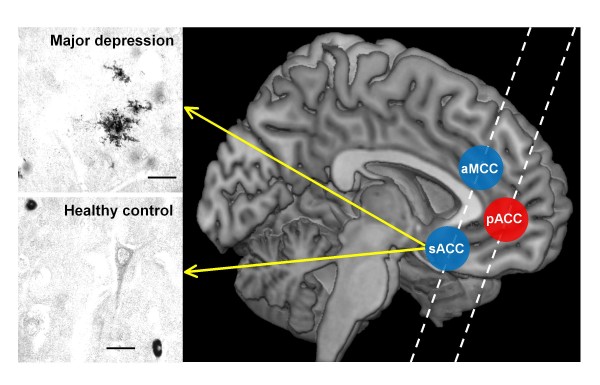
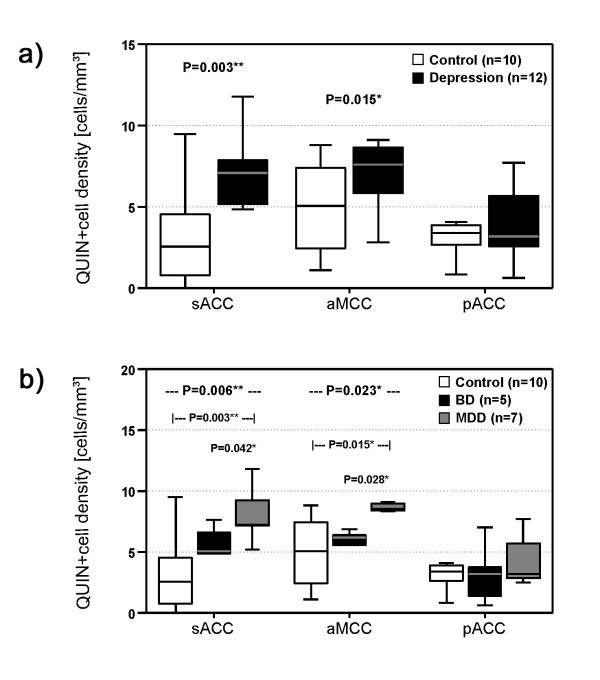
BACKGROUND: Immune dysfunction, including monocytosis and increased blood levels of interleukin-1, interleukin-6 and tumour necrosis factor α has been observed during acute episodes of major depression. These peripheral immune processes may be accompanied by microglial activation in subregions of the anterior cingulate cortex where depression-associated alterations of glutamatergic neurotransmission have been described. METHODS: Microglial immunoreactivity of the N-methyl-D-aspartate (NMDA) glutamate receptor agonist quinolinic acid (QUIN) in the subgenual anterior cingulate cortex (sACC), anterior midcingulate cortex (aMCC) and pregenual anterior cingulate cortex (pACC) of 12 acutely depressed suicidal patients (major depressive disorder/MDD, n = 7; bipolar disorder/BD, n = 5) was analyzed using immunohistochemistry and compared with its expression in 10 healthy control subjects. RESULTS: Depressed patients had a significantly increased density of QUIN-positive cells in the sACC (P = 0.003) and the aMCC (P = 0.015) compared to controls. In contrast, counts of QUIN-positive cells in the pACC did not differ between the groups (P = 0.558). Post-hoc tests showed that significant findings were attributed to MDD and were absent in BD. CONCLUSIONS: These results add a novel link to the immune hypothesis of depression by providing evidence for an upregulation of microglial QUIN in brain regions known to be responsive to infusion of NMDA antagonists such as ketamine. Further work in this area could lead to a greater understanding of the pathophysiology of depressive disorders and pave the way for novel NMDA receptor therapies or immune-modulating strategies.
Overview
The claims and statistics of this paper haven’t been checked yet.
Free: it reads the open-access text and checks the first 5 claims that cite a source we can check. Create a free account to check every claim.
Integrity signals
Registry
Cites
Statistics
Figures
Verification
Claims the paper makes
The claims and statistics of this paper haven’t been checked yet.
Free: it reads the open-access text and checks the first 5 claims that cite a source we can check. Create a free account to check every claim.
Claims other papers make about this one
Each is checked against this paper’s own text: does it say what the citing paper says it does?
The cited source says what the claim attributes to it.
In the citing paper
“Of note, increased levels of quinolinic acid have been found in microglia in the ACC of suicide victims who suffered from depression77.”
From The role of inflammation in depression: from evolutionary imperative to modern treatment target (2016) · cites this paper as [77]
In the citing paper
“Studies have revealed microglial activation in depressed patients, with a greater magnitude of activation in individuals who completed suicide (181–183)”
From Microglia Function in the Central Nervous System During Health and Neurodegeneration (2017) · cites this paper as [182]
In the citing paper
“Substances not measured in the present study are neurotoxic kynurenine-pathway metabolites such as 3-hydroxykynurenine and quinolinic acid that have been suggested to be important for further understanding of imbalance of tryptophan-kynurenine pathway in MDD (Dantzer et al., 2011;Halaris et al., 2015;Steiner et al., 2011).”
From Tryptophan-kynurenine and lipid related metabolites as blood biomarkers for first-episode drug-naïve patients with major depressive disorder: An exploratory pilot case-control study (2018) · cites this paper as Steiner et al., 2011
Self-check
Percentages, sums and reported differences re-computed from the paper’s own numbers.
The self-check needs the paper’s full text.
Citations
Cites
From inflammation to sickness and depression: when the immune system subjugates the brain
Dantzer, R., O'Connor, J. C., Freund, G. G., Johnson, R. W., & Kelley, K. W. (2008) · Nature Reviews Neuroscience · doi:10.1038/nrn2297 · Cited by 7,395 · cited 6×
“Increased levels of QUIN, which is also produced by macrophages and monocytes, have already been found in the blood and cerebrospinal fluid of subjects with cytokine-induced depression or MDD [1,21,22].”
BackgroundInfluentialInflammation and Its Discontents: The Role of Cytokines in the Pathophysiology of Major Depression
Miller, A. H., Maletic, V., & Raison, C. L. (2009) · Biological Psychiatry · doi:10.1016/j.biopsych.2008.11.029 · Cited by 3,848 · cited 2×
“Thus, our result of increased microglial QUIN expression in suicidal MDD patients is in line with the hypothesis of a systemic MPS activation during acute disease phases of depression [2-9,14].”
BackgroundResultA randomized trial of an N-methyl-D-aspartate antagonist in treatment-resistant major depression.
Zarate, C. A., Singh, J. B., Carlson, P. J., Brutsche, N. E., Ameli, R., Luckenbaugh, D. A., Charney, D. S., & Manji, H. K. (2006) · Archives of General Psychiatry · doi:10.1001/archpsyc.63.8.856 · Cited by 3,766
Jeurgen, K., Assheuer, J., & Paxinos, G. (1997) · Medical Entomology and Zoology · Cited by 1,403
Targeting abnormal neural circuits in mood and anxiety disorders: from the laboratory to the clinic
Ressler, K. J., & Mayberg, H. S. (2007) · Nature Neuroscience · doi:10.1038/nn1944 · Cited by 1,007 · cited 1×
“Importantly, the metabolic activity after deep brain stimulation in the sACC, as measured by positron emission tomography, shows a reduction in hyperactivity similar to a region bordering the aMCC and the pACC [53].”
MethodThe Relationship of Depression and Stressors to Immunological Assays: A Meta-Analytic Review
Zorrilla, E. P., Luborsky, L., McKay, J. R., Rosenthal, R., Houldin, A., Tax, A., McCorkle, R., Seligman, D. A., & Schmidt, K. (2001) · Brain, Behavior, and Immunity · doi:10.1006/brbi.2000.0597 · Cited by 995 · cited 2×
“Thus, our result of increased microglial QUIN expression in suicidal MDD patients is in line with the hypothesis of a systemic MPS activation during acute disease phases of depression [2-9,14].”
BackgroundResultDiazgranados, N., Ibrahim, L., Brutsche, N. E., Newberg, A., Kronstein, P., Khalife, S., Kammerer, W. A., Quezado, Z., Luckenbaugh, D. A., Salvadore, G., et al. (2010) · Archives of General Psychiatry · doi:10.1001/archgenpsychiatry.2010.90 · Cited by 963
Targeting the glutamatergic system to develop novel, improved therapeutics for mood disorders
Sanacora, G., Zarate, C. A., Krystal, J. H., & Manji, H. K. (2008) · Nature Reviews Drug Discovery · doi:10.1038/nrd2462 · Cited by 894
Steiner, J., Bielau, H., Brisch, R., Danos, P., Ullrich, O., Mawrin, C., Bernstein, H.-G., & Bogerts, B. (2008) · Journal of Psychiatric Research · doi:10.1016/j.jpsychires.2006.10.013 · Cited by 791 · cited 3×
“Indeed, an increased density of microglia expressing human leukocyte antigen (HLA)-DR has recently been observed in the anterior midcingulate cortex (aMCC), the dorsolateral prefrontal cortex and the mediodorsal thalamus of suicidal patients with affective disorders [14].”
BackgroundMethodResultSelf-citationThe neurobiology of psychedelic drugs: implications for the treatment of mood disorders
Vollenweider, F. X., & Kometer, M. (2010) · Nature Reviews Neuroscience · doi:10.1038/nrn2884 · Cited by 723 · cited 3×
“Here we present the first study providing evidence that supports a disease-related upregulation of microglial QUIN in depressive disorders, particularly in brain regions known to be responsive to infusion of NMDA antagonists such as ketamine [55].”
BackgroundInfluential
Cited by
Items 201–300 of 578
Mitophagy in depression: Pathophysiology and treatment targets
Tripathi, A., Scaini, G., Barichello, T., Quevedo, J., & Pillai, A. (2021) · Mitochondrion · doi:10.1016/j.mito.2021.08.016 · Cited by 75
Beyond the neuron: Role of non-neuronal cells in stress disorders
Cathomas, F., Holt, L. M., Parise, E. M., Liu, J., Murrough, J. W., Casaccia, P., Nestler, E. J., & Russo, S. J. (2022) · Neuron · doi:10.1016/j.neuron.2022.01.033 · Cited by 76
The Neurobiology of Bipolar Disorder: An Integrated Approach
Muneer, A. (2016) · Chonnam Medical Journal · doi:10.4068/cmj.2016.52.1.18 · Cited by 68
Animal inflammation-based models of depression and their application to drug discovery
Ma, L., Demin, K. A., Kolesnikova, T. O., Kharsko, S. L., Zhu, X., Yuan, X., Song, C., Meshalkina, D. A., Leonard, B. E., Tian, L., et al. (2017) · Expert Opinion on Drug Discovery · doi:10.1080/17460441.2017.1362385 · Cited by 68
“In contrast, activated microglial cells secrete multiple inflammatory mediators which not only induce neuroinflammation [115] and neuronal apoptosis [116], but also interfere with several neurotransmission pathways that causes depressive-like responses, as described above.”
BackgroundA Focus on the Functions of Area 25
Alexander, L., Clarke, H., & Roberts, A. (2019) · Brain Sciences · doi:10.3390/brainsci9060129 · Cited by 65
“Depressed patients also show significantly increased numbers of microglial cells in area 25, suggestive of increased inflammation within area 25 itself [62].”
BackgroundAffective Immunology: The Crosstalk Between Microglia and Astrocytes Plays Key Role?
Yang, L., Zhou, Y., Jia, H., Qi, Y., Tu, S., & Shao, A. (2020) · Frontiers in Immunology · doi:10.3389/fimmu.2020.01818 · Cited by 62
“In addition to ATP pathway, microglia-derived quinolinic acid known as an N-methyl-D-aspartate (NMDA) receptor agonist has been found to be upregulated, thereby contributing to the high-level glutamate in mood disorders (32).”
BackgroundInfluentialInflammation, stress and depression: An exploration of ketamine’s therapeutic profile
Johnston, J. N., Greenwald, M. S., Henter, I. D., Kraus, C., Mkrtchian, A., Clark, N. G., Park, L. T., Gold, P. W., Zarate, C. A., & Kadriu, B. (2023) · Drug Discovery Today · doi:10.1016/j.drudis.2023.103518 · Cited by 80
“In addition, QA elevations were found in the CSF of recent suicide attempters [99], and more QA-positive cells were found in the brain of suicide decedents [100].”
Kuwano, N., Kato, T. A., Setoyama, D., Sato-Kasai, M., Shimokawa, N., Hayakawa, K., Ohgidani, M., Sagata, N., Kubo, H., Kishimoto, J., et al. (2018) · Journal of Affective Disorders · doi:10.1016/j.jad.2018.01.014 · Cited by 69
“study are neurotoxic kynurenine-pathway metabolites such as 3-hydroxykynurenine and quinolinic acid that have been suggested to be important for further understanding of imbalance of tryptophan-kynurenine pathway in MDD (Dantzer et al., 2011; Halaris et al., 2015; Steiner et al., 2011).”
Zhang, H., Ding, L., Shen, T., & Peng, D. (2019) · General Psychiatry · doi:10.1136/gpsych-2019-100084 · Cited by 68
Microglial Cells as a Link between Cannabinoids and the Immune Hypothesis of Psychiatric Disorders
Lisboa, S. F. D. S., Gomes, F. V., Guimarães, F. S., & Campos, A. C. (2016) · Frontiers in Neurology · doi:10.3389/fneur.2016.00005 · Cited by 77
Bansal, Y., Singh, R., Parhar, I., Kuhad, A., & Soga, T. (2019) · Frontiers in Pharmacology · doi:10.3389/fphar.2019.00452 · Cited by 68
Chen, L., Lv, X., Guo, Q., Lv, S., Lü, N., Xu, W., Yu, J. M., & Zhang, Y. (2022) · British Journal of Pharmacology · doi:10.1111/bph.15994 · Cited by 70
Walker, A. J., Kim, Y., Price, J. B., Kale, R. P., McGillivray, J., Berk, M., & Tye, S. J. (2014) · Frontiers in Psychiatry · doi:10.3389/fpsyt.2014.00034 · Cited by 73
Purinergic Signaling and Energy Homeostasis in Psychiatric Disorders
Lindberg, D. M., Shan, D., Ayers-Ringler, J. R., Oliveros, A., Benitez, J. C. A., Prieto, M. L., McCullumsmith, R. E., & Choi, D. (2015) · Current Molecular Medicine · doi:10.2174/1566524015666150330163724 · Cited by 72
Maria, N. I., van Helden-Meeuwsen, C. G., Brkić, Z., Paulissen, S. M. J., Steenwijk, E. C., Dalm, V. A. S. H., van Daele, P. L. A., van Hagen, P. M., Kroese, F. G. M., van Roon, J. A. G., et al. (2016) · Arthritis & Rheumatology · doi:10.1002/art.39629 · Cited by 76
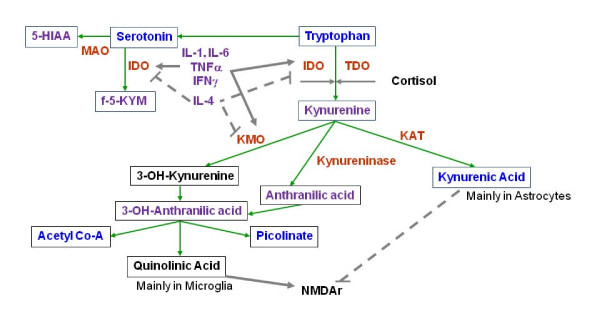
“Similar to IDO, KMO is also driven by proinflammatory cytokines such as type I and type II IFNs (13,16,22,39).”
BackgroundDysfunction of Microglial STAT3 Alleviates Depressive Behavior via Neuron–Microglia Interactions
Kwon, S.-H., Han, J.-K., Choi, M., Kwon, Y.-J., Kim, S. J., Yi, E. H., Shin, J.-C., Cho, I.-H., Kim, B.-H., Jeong Kim, S., et al. (2017) · Neuropsychopharmacology · doi:10.1038/npp.2017.93 · Cited by 66
Kynurenine Pathway in Autism Spectrum Disorders in Children
Bryn, V., Verkerk, R. M., Skjeldal, O. H., Saugstad, O. D., & Ormstad, H. (2017) · Neuropsychobiology · doi:10.1159/000488157 · Cited by 73
Brain-immune crosstalk in the treatment of major depressive disorder
Branchi, I., Poggini, S., Capuron, L., Benedetti, F., Poletti, S., Tamouza, R., Drexhage, H. A., Penninx, B. W. J. H., & Pariante, C. M. (2021) · European Neuropsychopharmacology · doi:10.1016/j.euroneuro.2020.11.016 · Cited by 64
Sen, Z. D., Danyeli, L. V., Woelfer, M., Lamers, F., Wagner, G., Sobanski, T., & Walter, M. (2021) · Brain, Behavior, and Immunity · doi:10.1016/j.bbi.2020.12.020 · Cited by 65
“(2011) showed increased levels of QUIN in the ACC of depressed patients (115).”
BackgroundInfluentialSelf-citationBehl, T., Kaur, I., Sehgal, A., Singh, S., Bhatia, S., Al‐Harrasi, A., Zengin, G., Bumbu, A. G., Andronie-Cioară, F. L., Nechifor, A. C., et al. (2021) · International Journal of Molecular Sciences · doi:10.3390/ijms22136737 · Cited by 68
Clinical Findings Documenting Cellular and Molecular Abnormalities of Glia in Depressive Disorders
Czéh, B., & Nagy, S. A. (2018) · Frontiers in Molecular Neuroscience · doi:10.3389/fnmol.2018.00056 · Cited by 63
Rodrigues, F. T. S., de Souza, M. R. M., Lima, C. N. D. C., da Silva, F. E. R., Costa, D. V. D. S., dos Santos, C. C., Miyajima, F., de Sousa, F. C. F., Vasconcelos, S. M. M., Barichello, T., et al. (2018) · Journal of Psychiatric Research · doi:10.1016/j.jpsychires.2018.10.003 · Cited by 70
Inflammatory and neurodegenerative pathophysiology implicated in postpartum depression
Worthen, R. J., & Beurel, E. (2022) · Neurobiology of Disease · doi:10.1016/j.nbd.2022.105646 · Cited by 70
“…cytokines induce activation of indoleamine-2,3 dioxygenase (IDO), which metabolizes tryptophan, the precursor of serotonin, into kynurenine which, in the context of neuroinflammation is metabolized into neurotoxic quinolinic acid by microglia cells (Jo et al., 2015; Steiner et al., 2011).”
Gypenosides reverses depressive behavior via inhibiting hippocampal neuroinflammation
Dong, S., Zhang, Q., Zhu, J., Chen, M., Li, C., Liu, Q., Geng, D., & Yi, L. (2018) · Biomedicine & Pharmacotherapy · doi:10.1016/j.biopha.2018.07.040 · Cited by 64
A New Outlook on Mental Illnesses: Glial Involvement Beyond the Glue
Elsayed, M., & Magistretti, P. J. (2015) · Frontiers in Cellular Neuroscience · doi:10.3389/fncel.2015.00468 · Cited by 59
Simvastatin prevents and ameliorates depressive behaviors via neuroinflammatory regulation in mice
Yu, X.-B., Zhang, H.-N., Dai, Y., Zhou, Z.-Y., Xu, R.-A., Hu, L.-F., Zhang, C.-H., Xu, H.-Q., An, Y.-Q., Tang, C.-R., et al. (2019) · Journal of Affective Disorders · doi:10.1016/j.jad.2018.11.086 · Cited by 62
Neuroimmune and Inflammatory Signals in Complex Disorders of the Central Nervous System
Liberman, A. C., Trías, E., Chagas, L. D. S., Trindade, P., Pereira, M. D. S., Refojo, D., Hedin‐Pereira, C., & Serfaty, C. A. (2018) · NeuroImmunoModulation · doi:10.1159/000494761 · Cited by 66
COVID-19, Oxidative Stress, and Neuroinflammation in the Depression Route
Mingoti, M. E. D., Bertollo, A. G., Simões, J. L. B., Francisco, G. R., Bagatini, M. D., & Ignácio, Z. M. (2022) · Journal of Molecular Neuroscience · doi:10.1007/s12031-022-02004-y · Cited by 64
Brisch, R., Steiner, J., Mawrin, C., Krzyżanowska, M., Jankowski, Z., & Gos, T. (2017) · European Archives of Psychiatry and Clinical Neuroscience · doi:10.1007/s00406-017-0774-1 · Cited by 60
Self-citationChan, R. F., Turecki, G., Shabalin, A. A., Guintivano, J., Zhao, M., Xie, L. Y., van Grootheest, G., Kaminsky, Z. A., Dean, B., Penninx, B. W. J. H., et al. (2020) · Biological Psychiatry · doi:10.1016/j.biopsych.2019.10.014 · Cited by 55
Kynurenine metabolism and inflammation-induced depressed mood: a human experimental study
Kruse, J. L., Cho, J. H.-J., Olmstead, R., Hwang, L., Faull, K., Eisenberger, N. I., & Irwin, M. R. (2019) · Psychoneuroendocrinology · doi:10.1016/j.psyneuen.2019.104371 · Cited by 59
Fischer, C. W., Eskelund, A., Budac, D. P., Tillmann, S., Liebenberg, N., Elfving, B., & Wegener, G. (2015) · Behavioural Brain Research · doi:10.1016/j.bbr.2015.07.015 · Cited by 62
Glial biomarkers in human central nervous system disease
Garden, G. A., & Campbell, B. M. (2016) · Glia · doi:10.1002/glia.22998 · Cited by 53
“Furthermore, quinolinic acid is elevated in the anterior cingulate cortex of depressed patients, but only in severely depressed individuals (Steiner et al., 2011).”
BackgroundKong, Q., Chen, Q., Mao, X., Wang, G., Zhao, J., Zhang, H., & Chen, W. (2022) · Nutrients · doi:10.3390/nu14081615 · Cited by 59
“highlighted that the microglia activity was associated with elevated the QUIN level in the cingulate cortex subregion of patients with severe depression [44].”
BackgroundTreadway, M. T., Etuk, S., Cooper, J. A., Hossein, S., Hahn, E., Betters, S. A., Liu, S., Arulpragasam, A. R., DeVries, B. A. M., Irfan, N., et al. (2024) · Molecular Psychiatry · doi:10.1038/s41380-024-02751-x · Cited by 66
Blossom, V., Ullal, S. D., D’Souza, M. M., Ranade, A. V., Kumar, N. A., & Rai, R. (2025) · 3 Biotech · doi:10.1007/s13205-025-04468-2 · Cited by 65
“However, in patients suffering from severe depression, microglia activation was observed in the insular cortex, anterior cingulate cortex, and cerebral cortex too (Steiner et al 2011; Schnieder et al 2014).”
Sokolowski, M., Ben-Efraim, Y. J., Wasserman, J., & Wasserman, D. (2012) · Molecular Psychiatry · doi:10.1038/mp.2012.112 · Cited by 64
Yen, Y.-F., Chung, M.-S., Hu, H.-Y., Lai, Y.-J., Huang, L.-Y., Lin, Y.-S., Chou, P., & Deng, C.-Y. (2015) · The Journal of Clinical Psychiatry · doi:10.4088/jcp.14m09403 · Cited by 60
Li, Y., Eskelund, A., Zhou, H., Budac, D., Sánchez, C., & Gulinello, M. (2015) · International Journal of Molecular Sciences · doi:10.3390/ijms160715150 · Cited by 54
“Quinolinic acid has been shown to influence memory impairment [49,51], is associated with depression in patients [53] and associated with NP-SLE [106].”
BackgroundA phase-specific neuroimmune model of clinical depression
Eyre, H. A., Stuart, M. J., & Baune, B. T. (2014) · Progress in Neuro-Psychopharmacology and Biological Psychiatry · doi:10.1016/j.pnpbp.2014.06.011 · Cited by 60
Novel investigational drugs targeting IL-6 signaling for the treatment of depression
Fonseka, T. M., McIntyre, R. S., Soczynska, J. K., & Kennedy, S. H. (2015) · Expert Opinion on Investigational Drugs · doi:10.1517/13543784.2014.998334 · Cited by 54
“QUIN functions as a glutamate NMDA receptor agonist, and may contribute to the increased extracellular glutamate concentrations that are found in depression [92,99].”
BackgroundInflammation-Related Disorders in the Tryptophan Catabolite Pathway in Depression and Somatization
Anderson, G., Maes, M., & Berk, M. (2012) · Advances in Protein Chemistry and Structural Biology · doi:10.1016/b978-0-12-398314-5.00002-7 · Cited by 53
“Increased QA in microglia of the anterior cingulate has recently been shown in depressed suicide patients (Steiner et al., 2011).”
BackgroundInfluentialBaranyi, A., Meinitzer, A., Breitenecker, R. J., Amouzadeh-Ghadikolai, O., Stauber, R. E., & Rothenhäusler, H. (2015) · PLoS ONE · doi:10.1371/journal.pone.0137022 · Cited by 58
“These results might support the immuno- and neurodegeneration hypotheses of depression [30,31].”
BackgroundResultInfluentialLabaka, A., Gómez-Lázaro, E., Vegas, Ó., Pérez-Tejada, J., Arregi, A., & Garmendia, L. (2017) · Behavioural Brain Research · doi:10.1016/j.bbr.2017.08.002 · Cited by 55
Kynurenine Pathway Metabolites as Biomarkers for Amyotrophic Lateral Sclerosis
Tan, V. X., & Guillemin, G. J. (2019) · Frontiers in Neuroscience · doi:10.3389/fnins.2019.01013 · Cited by 57
“, 2017), neuropsychiatric disorders such as depression and stress (Mackay et al., 2009; Gabbay et al., 2010; Olsson et al., 2010; Steiner et al., 2011; Kocki et al., 2012; Erhardt et al., 2013; Comai et al., 2016; Küster et al., 2017; Huang et al., 2018; Kuwano et al., 2018), suicide (Erhardt et al.”
BackgroundMethodSelf-citationSandoval-Talamantes, A. K., Gómez-González, B. A., Uriarte-Mayorga, D. F., Martinez-Guzman, M. A., Hidalgo, K. A. W., & Alvarado‐Navarro, A. (2019) · Neuropeptides · doi:10.1016/j.npep.2019.102004 · Cited by 59
Chronic stress affects the number of GABAergic neurons in the orbitofrontal cortex of rats
Varga, Z., Csabai, D., Miseta, A., Wiborg, O., & Czéh, B. (2016) · Behavioural Brain Research · doi:10.1016/j.bbr.2016.08.030 · Cited by 53
Eskelund, A., Li, Y., Budac, D. P., Müller, H. K., Gulinello, M., Sanchez, C., & Wegener, G. (2017) · Journal of Neurochemistry · doi:10.1111/jnc.14043 · Cited by 52
“QUIN in particular has been under investigation as it has been reported increased in depressed and suicidal patients (Steiner et al. 2011; Erhardt et al. 2013; Bay-Richter et al. 2015) and furthermore, the level of cerebrospinal fluid QUIN correlates with the severity of depression (Raison et al.…”
BackgroundMolecular Mechanisms Underlying the Anti-depressant Effects of Resveratrol: a Review
de Oliveira, M. R., Chenet, A. L., Duarte, A. R., Scaini, G., & Quevedo, J. (2017) · Molecular Neurobiology · doi:10.1007/s12035-017-0680-6 · Cited by 57
“Indeed, increased levels of quinolinic acid, a neuroactive metabolite of the kynurenine pathway, have been found in microglia in the ACC of suicide victims who suffered from depression [66].”
BackgroundAnderson, G., Maes, M., & Berk, M. (2012) · Medical Hypotheses · doi:10.1016/j.mehy.2012.02.023 · Cited by 52
The neurophysiology of ketamine: an integrative review
McMillan, R. L., & Muthukumaraswamy, S. D. (2020) · Reviews in the Neurosciences · doi:10.1515/revneuro-2019-0090 · Cited by 56
Kynurenine pathway and white matter microstructure in bipolar disorder
Poletti, S., Myint, A.-M., Schütze, G. A., Bollettini, I., Mazza, E. B., Grillitsch, D., Locatelli, C., Schwarz, M., Colombo, C., & Benedetti, F. (2016) · European Archives of Psychiatry and Clinical Neuroscience · doi:10.1007/s00406-016-0731-4 · Cited by 53
Self-citationMolecular insights into the therapeutic promise of targeting HMGB1 in depression
Rana, T., Behl, T., Mehta, V., Uddin, M. S., & BUNGAU, S. G. (2020) · Pharmacological Reports · doi:10.1007/s43440-020-00163-6 · Cited by 52
Ciapała, K., Mika, J., & Rojewska, E. (2021) · International Journal of Molecular Sciences · doi:10.3390/ijms222011055 · Cited by 53
“Elevated QUIN levels are observed in Huntington disease [78], Alzheimer’s and Parkinson’s disease [79], depression [80], amyotrophic lateral sclerosis [81], human immunodeficiency virus (HIV) [82], and other conditions [83].”
BackgroundNeuroimmunology of the female brain across the lifespan: Plasticity to psychopathology
Barrientos, R. M., Brunton, P. J., Lenz, K. M., Pyter, L. M., & Spencer, S. J. (2019) · Brain Behavior and Immunity · doi:10.1016/j.bbi.2019.03.010 · Cited by 53
Antidepressant and Antiaging Effects of Açaí (Euterpe oleracea Mart.) in Mice
Monteiro, J. R. S., Arrifano, G. D. P., Queiroz, A. I. D. G., Mello, B. S. F., Custódio, C. S., Macêdo, D. S., Hamoy, M., Paraense, R. S. D. O., Bittencourt, L. O., Lima, R. R., et al. (2019) · Oxidative Medicine and Cellular Longevity · doi:10.1155/2019/3614960 · Cited by 55
“neuroinflammatory alterations and compromising neurotransmission mechanisms [47].”
Gos, T., Myint, A.-M., Schiltz, K., Meyer-Lotz, G., Dobrowolny, H., Busse, S., Müller, U. J., Mawrin, C., Bernstein, H.-G., Bogerts, B., et al. (2014) · Brain, Behavior, and Immunity · doi:10.1016/j.bbi.2014.05.012 · Cited by 49
“…T. Gos et al. / Brain, Behavior, and Immunity xxx (2014) xxx–xxx QUIN-immunoreactivity was observed in anterior cingulate gyrus subregions of severely depressed suicide victims (Steiner et al., 2011).”
BackgroundMethodSelf-citationDehhaghi, M., Panahi, H. K. S., Kavyani, B., Heng, B., Tan, V. X., Braidy, N., & Guillemin, G. J. (2022) · Aging and Disease · doi:10.14336/ad.2021.0824 · Cited by 51
Self-citationNeural plasticity and depression treatment
Wang, Y., Song, N., Ding, Y., & Zhang, L. (2022) · IBRO Neuroscience Reports · doi:10.1016/j.ibneur.2022.09.001 · Cited by 55
The Role of Inflammation in the Pathophysiology of Depression and Suicidal Behavior
Serafini, G., Costanza, A., Aguglia, A., Amerio, A., Trabucco, A., Escelsior, A., Sher, L., & Amore, M. (2022) · Medical Clinics of North America · doi:10.1016/j.mcna.2022.09.001 · Cited by 56
Arauchi, R., Hashioka, S., Tsuchie, K., Miyaoka, T., Tsumori, T., Limoa, E., Azis, I. A., Oh‐Nishi, A., Miura, S., Otsuki, K., et al. (2018) · Brain and Behavior · doi:10.1002/brb3.1028 · Cited by 52
Chen, X., Xu, D. W., Yu, J., Song, X., Li, X., & Cui, Y. (2024) · Nutrients · doi:10.3390/nu16193380 · Cited by 50
“Elevated QA levels can decrease dopamine, choline, and γ -aminobutyric acid (GABA) levels [108–110].”
BackgroundBiomarkers of suicidal behaviors: A comprehensive critical review
Capuzzi, E., Caldiroli, A., Capellazzi, M., Tagliabue, I., Buoli, M., & Clerici, M. (2019) · Advances in clinical chemistry · doi:10.1016/bs.acc.2019.11.005 · Cited by 54
Toxoplasma gondii, Suicidal Behavior, and Intermediate Phenotypes for Suicidal Behavior
Postolache, T. T., Wadhawan, A., Rujescu, D., Hoisington, A. J., Dagdag, A., Baca‐García, E., Lowry, C. A., Okusaga, O. O., & Brenner, L. A. (2021) · Frontiers in Psychiatry · doi:10.3389/fpsyt.2021.665682 · Cited by 51
“Consistently, increased postmortem counts of QUIN-reactive microglial cells in suicide victims was found in the anterior midcingulate cortex (MCC) and subgenual anterior cingulate cortex (sgACC) of suicides (203).”
BackgroundThe role of glia in late-life depression
Paradise, M. B., Naismith, S. L., Norrie, L. M., Graeber, M. B., & Hickie, I. B. (2012) · International Psychogeriatrics · doi:10.1017/s1041610212000828 · Cited by 47
Price, J. B., Bronars, C., Erhardt, S., Cullen, K. R., Schwieler, L., Berk, M., Walder, K., McGee, S. L., Frye, M. A., & Tye, S. J. (2018) · Neuroscience & Biobehavioral Reviews · doi:10.1016/j.neubiorev.2018.04.002 · Cited by 47
“Thus, inflammation and the stress response system work together to promote IDO- and TDO-mediated metabolism of tryptophan (Carlin et al., 1989; Gibney et al., 2014), contributing to an increase in kynurenine (Brundin et al., 2016; Schwieler et al., 2015; Sellgren et al., 2016).”
InfluentialKrause, D., Myint, A.-M., Schuett, C., Musil, R., Dehning, S., Cerovecki, A., Riedel, M. J., Arolt, V., Schwarz, M., & Müller, N. (2017) · Frontiers in Psychiatry · doi:10.3389/fpsyt.2017.00016 · Cited by 46
Self-citationPetrasch‐Parwez, E., Schöbel, A., Benali, A., Moinfar, Z., Förster, E., Brüne, M., & Juckel, G. (2020) · European Archives of Psychiatry and Clinical Neuroscience · doi:10.1007/s00406-020-01107-0 · Cited by 49
Altmaier, E., Emeny, R. T., Krumsiek, J., Lacruz, M. E., Lukaschek, K., Häfner, S., Kastenmüller, G., Römisch‐Margl, W., Prehn, C. P., Mohney, R. P., et al. (2012) · Psychoneuroendocrinology · doi:10.1016/j.psyneuen.2012.11.014 · Cited by 52
Mood symptoms correlate with kynurenine pathway metabolites following sports-related concussion
Singh, R. P., Savitz, J. B., Teague, T. K., Polanski, D. W., Mayer, A. R., Bellgowan, P. S. F., & Meier, T. B. (2015) · Journal of Neurology Neurosurgery & Psychiatry · doi:10.1136/jnnp-2015-311369 · Cited by 45
Brown, S. J., Christofides, K., Weissleder, C., Huang, X.-F., Shannon Weickert, C., Lim, C. K., & Newell, K. A. (2024) · Neuropsychopharmacology · doi:10.1038/s41386-023-01736-8 · Cited by 44
“Lastly, our investigation of the enzymes of the KP was limited to gene expression and it is unclear if these changes would be re fl ected at the protein level.”
BackgroundMissing and Possible Link between Neuroendocrine Factors, Neuropsychiatric Disorders, and Microglia
Kato, T. A., Hayakawa, K., Monji, A., & Kanba, S. (2013) · Frontiers in Integrative Neuroscience · doi:10.3389/fnint.2013.00053 · Cited by 41
“Steiner et al. (2011) have shown pivotal findings that quinolinic acid positive microglia increase in the subgenual anterior cingulate cortex and anterior midcingulate cortex of patients with major depressive disorder (MDD) but not bipolar disorder.”
Stochino-Loi, E., Pontis, A., Cofelice, V., Pirarba, S., Fais, M. F., Daniilidis, A., Melis, I., Paoletti, A. M., & Angioni, S. L. (2019) · International Journal of Women s Health · doi:10.2147/ijwh.s204275 · Cited by 45
“However, recent medical research have demonstrated the link between inflammatory diseases and mood disorders.(42,43) In particular, as regards endometriosis patients, it was detected an immunological shift resulting in the imbalance of pro-(IL-1β, IL-2, IFN-γ) and antiinflammatory (IL-4) cytokine production, correlate…”
BackgroundKrause, D., Riedel, M. J., Müller, N., Weidinger, E., Schwarz, M., & Myint, A.-M. (2012) · Inflammopharmacology · doi:10.1007/s10787-011-0112-6 · Cited by 46
Self-citationDesipramine decreases expression of human and murine indoleamine-2,3-dioxygenases
Brooks, A. K., Janda, T. M., Lawson, M. A., Rytych, J. L., Smith, R. A. J., Ocampo-Solis, C., & McCusker, R. H. (2017) · Brain Behavior and Immunity · doi:10.1016/j.bbi.2017.02.010 · Cited by 42
“KynA antagonizes the action of quinolinic acid and 3-hydroxykynurenine (glutamate receptor agonists), kynurenine metabolites from microglia (Guillemin, 2012; Guillemin et al., 2001, 2005; Steiner et al., 2011).”
BackgroundInfluentialGuerrero‐Vargas, N. N., Zárate‐Mozo, C., Guzmán‐Ruiz, M. A., Cárdenas‐Rivera, A., & Escobar, C. (2020) · Journal of Neuroscience Research · doi:10.1002/jnr.24741 · Cited by 43
“Recent studies indicate that glial activation plays a role in the pathogenesis of major depression in humans (Steiner et al., 2011; Wang et al., 2017) and mediate depressive-like behavior in rodents (Arauchi et al., 2018; Burke et al., 2013; Ghaemi et al., 2018; Saavedra et al., 2017; Takahashi et…”
BackgroundVichaya, E. G., Laumet, G. O., Christian, D. L., Grossberg, A. J., Estrada, D. J., Heijnen, C. J., Kavelaars, A., & Dantzer, R. (2018) · Neuropsychopharmacology · doi:10.1038/s41386-018-0075-z · Cited by 42
Suicide and Lyme and associated diseases
Bransfield, R. C. (2017) · Neuropsychiatric Disease and Treatment · doi:10.2147/ndt.s136137 · Cited by 43
Welcome, M. O. (2020) · PharmaNutrition · doi:10.1016/j.phanu.2020.100176 · Cited by 44
Li, M., Metzger, C. D., Li, W., Safron, A., van Tol, M., Lord, A., Krause, A. L., Borchardt, V., Dou, W., Genz, A., et al. (2014) · Journal of Affective Disorders · doi:10.1016/j.jad.2014.08.001 · Cited by 41
“While the general reduction in CTh in depressed patients might represent a possible trait marker for depression, the loss of a linear relationship between CTh and Glx in this region can be due to pathophysiological changes in glial density or altered Glutamate cycling as previously shown by postmortem studies (Steiner…”
ResultSelf-citationBogerts, B., Winopal, D., Schwarz, S., Schlaaff, K., Dobrowolny, H., Mawrin, C., Frodl, T., & Steiner, J. (2016) · Neurology Psychiatry and Brain Research · doi:10.1016/j.npbr.2016.11.001 · Cited by 48
Self-citationZhu, X., Hu, J., Deng, S., Tan, Y., Qiu, C., Zhang, M., Ni, X., Lu, H., Wang, Z., Li, L., et al. (2021) · Frontiers in Pharmacology · doi:10.3389/fphar.2021.687757 · Cited by 44
Mosebach, J., Keilhoff, G., Gos, T., Schiltz, K., Schoeneck, L., Dobrowolny, H., Mawrin, C., Müller, S., Schroeter, M. L., Bernstein, H., et al. (2013) · Journal of Psychiatric Research · doi:10.1016/j.jpsychires.2013.03.018 · Cited by 44
Self-citationSuicidality and Activation of the Kynurenine Pathway of Tryptophan Metabolism
Bryleva, E. Y., & Brundin, L. (2016) · Current topics in behavioral neurosciences · doi:10.1007/7854_2016_5 · Cited by 43
Microglial Dysregulation and Suicidality: A Stress-Diathesis Perspective
Baharikhoob, P., & Kolla, N. J. (2020) · Frontiers in Psychiatry · doi:10.3389/fpsyt.2020.00781 · Cited by 46
“The authors from this study observed significantly increased density of QUIN-positive cells in the subgenual ACC and anterior midcingulate cortex of suicide victims with MDD (62).”
BackgroundInfluentialIntertwined associations between oxytocin, immune system and major depressive disorder
Jiang, J., Yang, M., Tian, M., Chen, Z., Xiao, L., & Gong, Y. (2023) · Biomedicine & Pharmacotherapy · doi:10.1016/j.biopha.2023.114852 · Cited by 44
“Postmortem studies have also revealed that the density of quinolinic acid-positive microglia in the subgenual anterior cingulate cortex is increased [134].”
BackgroundConejero, I., Jaussent, I., Cazals, A., Thouvenot, E., Mura, T., Le Bars, E., Guillaume, S., Squalli, S., Courtet, P., & Olié, E. (2019) · Psychoneuroendocrinology · doi:10.1016/j.psyneuen.2018.09.041 · Cited by 39
Barone, P. R. (2019) · Behavioural Pharmacology · doi:10.1097/fbp.0000000000000477 · Cited by 39
Borchardt, V., Lord, A., Li, M., van der Meer, J. N., Heinze, H., Bogerts, B., Breakspear, M. J., & Walter, M. (2016) · Human Brain Mapping · doi:10.1002/hbm.23111 · Cited by 41
Self-citationNeurobiological mechanisms in the kynurenine pathway and major depressive disorder
Bertollo, A. G., Mingoti, M. E. D., & Ignácio, Z. M. (2024) · Reviews in the Neurosciences · doi:10.1515/revneuro-2024-0065 · Cited by 45
Barreto, F. S., Filho, A. J. M. C., Araújo, M. C., de Moraes, M. O., de Moraes, M. E. A., Maes, M. H. J., de Lucena, D. F., & Macêdo, D. S. (2018) · Behavioural Pharmacology · doi:10.1097/fbp.0000000000000384 · Cited by 39
Prospective study of the effects of sport-related concussion on serum kynurenine pathway metabolites
Meier, T. B., Nitta, M. E., Teague, T. K., Nelson, L. D., McCrea, M., & Savitz, J. B. (2020) · Brain Behavior and Immunity · doi:10.1016/j.bbi.2020.03.002 · Cited by 38
“Importantly, completed suicide in patients with MDD is associated with increased brain QuinA and decreased KynA postmortem, and QuinA in the cerebrospinal fluid (CSF) is increased up to 18 months following a suicide attempt (Steiner et al., 2011; Bay-Richter et al., 2015).”
BackgroundCentral levels of tryptophan metabolites in subjects with bipolar disorder
Trepci, A., Sellgren, C. M., Pålsson, E., Brundin, L., Khanlarkhani, N., Schwieler, L., Landén, M., & Erhardt, S. (2020) · European Neuropsychopharmacology · doi:10.1016/j.euroneuro.2020.11.018 · Cited by 40
Giménez‐Gómez, P., Pérez‐Hernández, M., Gutiérrez‐López, M. D., Vidal, R., Abuin-Martínez, C., O’Shea, E., & Colado, M. I. (2018) · Neuropharmacology · doi:10.1016/j.neuropharm.2018.04.016 · Cited by 39
Pradhan, A., Koirala, P., Bhandarı, S. S., Dutta, S., Grau, P. G., Sampath, H., & Sharma, I. L. (2022) · Frontiers in Psychiatry · doi:10.3389/fpsyt.2022.869647 · Cited by 38
“agonist again accelerates the development and worsening of depression (32).”
BackgroundNiciu, M. J., Henter, I. D., Sanacora, G., & Zarate, C. A. (2013) · The World Journal of Biological Psychiatry · doi:10.3109/15622975.2013.829585 · Cited by 40
Meier, T. B., Savitz, J. B., Singh, R. P., Teague, T. K., & Bellgowan, P. S. F. (2015) · Journal of Neurotrauma · doi:10.1089/neu.2015.4118 · Cited by 38
“anterior cingulate cortex, suggesting that KYN pathway abnormalities may also affect the ventromedial PFC.(49) Why the current study only found a relationship in HC is unclear.”
BackgroundAn Astroglial Basis of Major Depressive Disorder: Molecular, Cellular, and Circuit Features
Lu, C., Ren, J., & Cao, X. (2024) · Biological Psychiatry · doi:10.1016/j.biopsych.2024.07.017 · Cited by 37
Okusaga, O. O., Duncan, E., LANGENBERG, P. W., Brundin, L., Fuchs, D., Groer, M. E., Giegling, I., Stearns‐Yoder, K. A., Hartmann, A. M., Konte, B., et al. (2015) · Journal of Psychiatric Research · doi:10.1016/j.jpsychires.2015.10.002 · Cited by 37
Etiological classification of depression based on the enzymes of tryptophan metabolism
Fukuda, K. (2014) · BMC Psychiatry · doi:10.1186/s12888-014-0372-y · Cited by 37
Metadata
- Authors
- Steiner, J., Walter, M., Gos, T., Guillemin, G. J., Bernstein, H.-G., Sarnyai, Z., Mawrin, C., Brisch, R., Bielau, H., zu Schwabedissen, L., Bogerts, B., & Myint, A.-M.
- Affiliations
- Otto-von-Guericke-Universität Magdeburg (DE)
- Gdańsk Medical University (PL)
- UNSW Sydney (AU)
- Ludwig-Maximilians-Universität München (DE)
- Venue
- Journal of Neuroinflammation
- Published
- 2011
- Volume
- 8
- Issue
- 1
- Pages
- 94
- ISSN
- 1742-2094 (ISSN-L)
- PMC
- PMC3177898
- OpenAlex
- W2146758523
- Cited by
- 568
- References
- 53
- Citations by year
- 2026: 20 · 2025: 18 · 2024: 36 · 2023: 27 · 2022: 58 · 2021: 42 · 2020: 42 · 2019: 48 · 2018: 49 · 2017: 44 · 2016: 43 · 2015: 53 · 2014: 35 · 2013: 27 · 2012: 24
- FWCI
- 8.07
- Type
- journal article
- Language
- en
- Open access
- gold
- doi.org
- Licence
- cc-by
- Locations
- Journal of Neuroinflammation (publishedVersion, cc-by)
- PubMed Central (publishedVersion, cc-by)
- PubMed (publishedVersion)
- Apollo (University of Cambridge) (submittedVersion, cc-by)
- DOAJ (DOAJ: Directory of Open Access Journals) (submittedVersion)
- Open access LMU (Ludwid Maxmilian's Universitat Munchen) (submittedVersion)
- Funders
- Deutsche Forschungsgemeinschaft (SFB 779)
- Topics
- Life Sciences › Neuroscience › Biological Psychiatry › Tryptophan and brain disorders
- Life Sciences › Neuroscience › Neurology › Neuroinflammation and Neurodegeneration Mechanisms
- Health Sciences › Medicine › Pharmacology (medical) › Treatment of Major Depression
- Keywords
- major depressive disorder, bipolar disorder, microglial activation, quinolinic acid, subgenual anterior cingulate cortex, anterior midcingulate cortex, pregenual anterior cingulate cortex, NMDA receptor, glutamatergic neurotransmission, neuroinflammation, suicidal depression, ketamine
- MeSH terms
- Adult, Aged, Major Depressive Disorder, Female, Gyrus Cinguli, Humans, Male, Middle Aged, Synaptic Transmission, Serotonin, Tryptophan, Quinolinic Acid, Microglia, Glutamic Acid
About these checks
Registry, retraction, Cites and statistics results are computed, not judged, with one exception: a printed reference that no index lists is read once by a model before it counts as a citation error. Claims are extracted by a model and kept only when their quote appears verbatim in the text; each cited source is then checked, with a model’s help, for whether it says what the claim relies on. Those verdicts can be wrong — read the claim’s quote and the cited source before relying on one.
Statistics and arithmetic are recomputed, not judged.
Confidence bands are shown only for fields calibrated on our annotated test set. None is calibrated yet, so no band is shown.
What counts as a claim ›How we measure confidence ›How we check this ›
Are you an author, or do you see a problem with this page? Request a review
Data sources
Bibliographic data: Semantic Scholar, OpenAlex, Crossref.
Contains information from the Semantic Scholar Academic Graph Datasets, made available under the ODC Attribution License (ODC-BY 1.0).
Semantic Scholar’s data is described in: Kinney, R., et al. (2023). The Semantic Scholar Open Data Platform. arXiv:2301.10140.
