

Severe depression is associated with increased microglial quinolinic acid in subregions of the anterior cingulate gyrus: Evidence for an immune-modulated glutamatergic neurotransmission?
Open accessThe DOI matches its Crossref record; 53 of the 53 references it cites were found in a registry or an index.
Abstract
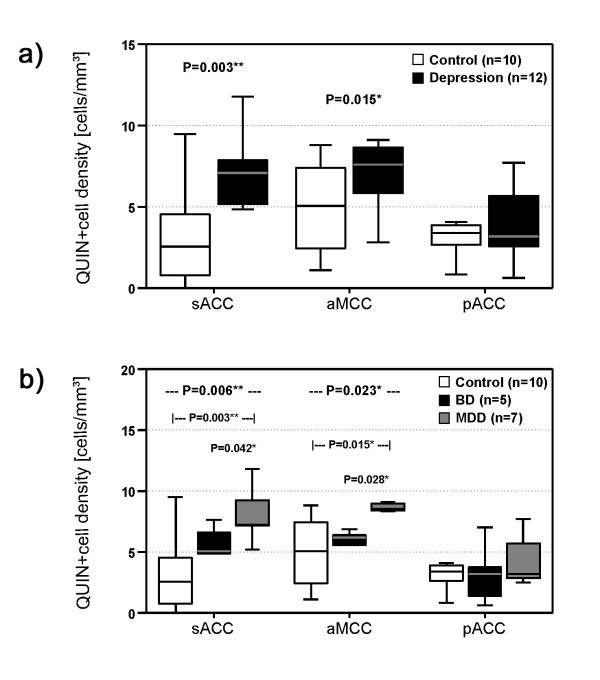
BACKGROUND: Immune dysfunction, including monocytosis and increased blood levels of interleukin-1, interleukin-6 and tumour necrosis factor α has been observed during acute episodes of major depression. These peripheral immune processes may be accompanied by microglial activation in subregions of the anterior cingulate cortex where depression-associated alterations of glutamatergic neurotransmission have been described. METHODS: Microglial immunoreactivity of the N-methyl-D-aspartate (NMDA) glutamate receptor agonist quinolinic acid (QUIN) in the subgenual anterior cingulate cortex (sACC), anterior midcingulate cortex (aMCC) and pregenual anterior cingulate cortex (pACC) of 12 acutely depressed suicidal patients (major depressive disorder/MDD, n = 7; bipolar disorder/BD, n = 5) was analyzed using immunohistochemistry and compared with its expression in 10 healthy control subjects. RESULTS: Depressed patients had a significantly increased density of QUIN-positive cells in the sACC (P = 0.003) and the aMCC (P = 0.015) compared to controls. In contrast, counts of QUIN-positive cells in the pACC did not differ between the groups (P = 0.558). Post-hoc tests showed that significant findings were attributed to MDD and were absent in BD. CONCLUSIONS: These results add a novel link to the immune hypothesis of depression by providing evidence for an upregulation of microglial QUIN in brain regions known to be responsive to infusion of NMDA antagonists such as ketamine. Further work in this area could lead to a greater understanding of the pathophysiology of depressive disorders and pave the way for novel NMDA receptor therapies or immune-modulating strategies.
Overview
The claims and statistics of this paper haven’t been checked yet.
Free: it reads the open-access text and checks the first 5 claims that cite a source we can check. Create a free account to check every claim.
Integrity signals
Registry
Cites
Statistics
Figures
Verification
Claims the paper makes
The claims and statistics of this paper haven’t been checked yet.
Free: it reads the open-access text and checks the first 5 claims that cite a source we can check. Create a free account to check every claim.
Claims other papers make about this one
Each is checked against this paper’s own text: does it say what the citing paper says it does?
The cited source says what the claim attributes to it.
In the citing paper
“Of note, increased levels of quinolinic acid have been found in microglia in the ACC of suicide victims who suffered from depression77.”
From The role of inflammation in depression: from evolutionary imperative to modern treatment target (2016) · cites this paper as [77]
In the citing paper
“Studies have revealed microglial activation in depressed patients, with a greater magnitude of activation in individuals who completed suicide (181–183)”
From Microglia Function in the Central Nervous System During Health and Neurodegeneration (2017) · cites this paper as [182]
In the citing paper
“Substances not measured in the present study are neurotoxic kynurenine-pathway metabolites such as 3-hydroxykynurenine and quinolinic acid that have been suggested to be important for further understanding of imbalance of tryptophan-kynurenine pathway in MDD (Dantzer et al., 2011;Halaris et al., 2015;Steiner et al., 2011).”
From Tryptophan-kynurenine and lipid related metabolites as blood biomarkers for first-episode drug-naïve patients with major depressive disorder: An exploratory pilot case-control study (2018) · cites this paper as Steiner et al., 2011
Self-check
Percentages, sums and reported differences re-computed from the paper’s own numbers.
The self-check needs the paper’s full text.
Citations
Cites
From inflammation to sickness and depression: when the immune system subjugates the brain
Dantzer, R., O'Connor, J. C., Freund, G. G., Johnson, R. W., & Kelley, K. W. (2008) · Nature Reviews Neuroscience · doi:10.1038/nrn2297 · Cited by 7,395 · cited 6×
“Increased levels of QUIN, which is also produced by macrophages and monocytes, have already been found in the blood and cerebrospinal fluid of subjects with cytokine-induced depression or MDD [1,21,22].”
BackgroundInfluentialInflammation and Its Discontents: The Role of Cytokines in the Pathophysiology of Major Depression
Miller, A. H., Maletic, V., & Raison, C. L. (2009) · Biological Psychiatry · doi:10.1016/j.biopsych.2008.11.029 · Cited by 3,848 · cited 2×
“Thus, our result of increased microglial QUIN expression in suicidal MDD patients is in line with the hypothesis of a systemic MPS activation during acute disease phases of depression [2-9,14].”
BackgroundResultA randomized trial of an N-methyl-D-aspartate antagonist in treatment-resistant major depression.
Zarate, C. A., Singh, J. B., Carlson, P. J., Brutsche, N. E., Ameli, R., Luckenbaugh, D. A., Charney, D. S., & Manji, H. K. (2006) · Archives of General Psychiatry · doi:10.1001/archpsyc.63.8.856 · Cited by 3,766
Jeurgen, K., Assheuer, J., & Paxinos, G. (1997) · Medical Entomology and Zoology · Cited by 1,403
Targeting abnormal neural circuits in mood and anxiety disorders: from the laboratory to the clinic
Ressler, K. J., & Mayberg, H. S. (2007) · Nature Neuroscience · doi:10.1038/nn1944 · Cited by 1,007 · cited 1×
“Importantly, the metabolic activity after deep brain stimulation in the sACC, as measured by positron emission tomography, shows a reduction in hyperactivity similar to a region bordering the aMCC and the pACC [53].”
MethodThe Relationship of Depression and Stressors to Immunological Assays: A Meta-Analytic Review
Zorrilla, E. P., Luborsky, L., McKay, J. R., Rosenthal, R., Houldin, A., Tax, A., McCorkle, R., Seligman, D. A., & Schmidt, K. (2001) · Brain, Behavior, and Immunity · doi:10.1006/brbi.2000.0597 · Cited by 995 · cited 2×
“Thus, our result of increased microglial QUIN expression in suicidal MDD patients is in line with the hypothesis of a systemic MPS activation during acute disease phases of depression [2-9,14].”
BackgroundResultDiazgranados, N., Ibrahim, L., Brutsche, N. E., Newberg, A., Kronstein, P., Khalife, S., Kammerer, W. A., Quezado, Z., Luckenbaugh, D. A., Salvadore, G., et al. (2010) · Archives of General Psychiatry · doi:10.1001/archgenpsychiatry.2010.90 · Cited by 963
Targeting the glutamatergic system to develop novel, improved therapeutics for mood disorders
Sanacora, G., Zarate, C. A., Krystal, J. H., & Manji, H. K. (2008) · Nature Reviews Drug Discovery · doi:10.1038/nrd2462 · Cited by 894
Steiner, J., Bielau, H., Brisch, R., Danos, P., Ullrich, O., Mawrin, C., Bernstein, H.-G., & Bogerts, B. (2008) · Journal of Psychiatric Research · doi:10.1016/j.jpsychires.2006.10.013 · Cited by 791 · cited 3×
“Indeed, an increased density of microglia expressing human leukocyte antigen (HLA)-DR has recently been observed in the anterior midcingulate cortex (aMCC), the dorsolateral prefrontal cortex and the mediodorsal thalamus of suicidal patients with affective disorders [14].”
BackgroundMethodResultSelf-citationThe neurobiology of psychedelic drugs: implications for the treatment of mood disorders
Vollenweider, F. X., & Kometer, M. (2010) · Nature Reviews Neuroscience · doi:10.1038/nrn2884 · Cited by 723 · cited 3×
“Here we present the first study providing evidence that supports a disease-related upregulation of microglial QUIN in depressive disorders, particularly in brain regions known to be responsive to infusion of NMDA antagonists such as ketamine [55].”
BackgroundInfluential
Cited by
Items 501–578 of 578
Cong, J., Zhang, H., Li, N., Yang, J., Liu, M., Ma, Q., Zhang, C., & Yan, G. (2026) · Behavioral and Brain Functions · doi:10.1186/s12993-026-00327-z · Cited by 1
Kalkman, H. O., & Smigielski, L. (2026) · Journal of Neurochemistry · doi:10.1111/jnc.70466 · Cited by 2
Kim, O. Y., & Song, J. (2026) · Biomedicine & Pharmacotherapy · doi:10.1016/j.biopha.2026.119527 · Cited by 1
Use of Metabolomics and Proteomics to Reveal Pathophysiological Pathways in Anxiety Disorders
Altmaier, E., & Emeny, R. T. (2014) · Advances in biological psychiatry · doi:10.1159/000358038 · Cited by 1
Ducasse, D., Girod, C., & Courtet, P. (2016) · Springer eBooks · doi:10.1007/978-3-319-26282-6_10 · Cited by 2
Murakami, Y., & Imamura, Y. (2018) · InTech eBooks · doi:10.5772/intechopen.71013 · Cited by 1
“Intriguingly, QUIN levels in CSF have been found to correlate with the severity of depressive pathology [10], and post-mortem studies have shown increased microglia QUIN levels in the frontal cortex of severely depressed patients [11].”
BackgroundWederkerige interacties tussen chronische stress en het neuro-endocriene en immuunsysteem
Moss, S. C., Drexhage, H. A., & Rutten, S. (2021) · Bohn Stafleu van Loghum eBooks · doi:10.1007/978-90-368-2683-9_2 · Cited by 1
Preskorn, S. (2022) · Journal of Psychiatric Practice · doi:10.1097/pra.0000000000000653 · Cited by 1
Karnecki, K., Świerczyński, J., Steiner, J., Krzyżanowska, M., Kaliszan, M., & Gos, T. (2022) · European Archives of Psychiatry and Clinical Neuroscience · doi:10.1007/s00406-022-01509-2 · Cited by 2
Self-citationRahman, A., & Guillemin, G. J. (2022) · Springer eBooks · doi:10.1007/978-3-031-15080-7_142 · Cited by 1
Self-citationLIU, Y., Li, Y., & Xie, J. (2023) · Anais da Academia Brasileira de Ciências · doi:10.1590/0001-3765202320220676 · Cited by 1
Zhang, L., & Swaab, D. F. (2025) · Handbook of clinical neurology · doi:10.1016/b978-0-443-19102-2.00018-1 · Cited by 1
Brundin, L., Achtyes, E. D., & Guillemin, G. J. (2020) · Brain Behavior and Immunity · doi:10.1016/j.bbi.2020.10.001 · Cited by 1
Self-citationMRI analysis of brain connectivity in a mouse model of Alzheimer’s disease
Degiorgis, L. (2019) · theses.fr (ABES) · doi:10.70675/5334d86bz9cc5z451cz865fzcf91895a5400 · Cited by 1
Efectividad de la ketamina en depresión bipolar: revisión sistemática de la literatura
Guerrero, J. E. R., & Ceicedo, A. P. S. (2013) · Repositorio Institucional E-DocUR (Universidad Del Rosario) · doi:10.48713/10336_4840
Dysregulation of the kynurenine pathway in psychotic disorders : immunological aspects
Kegel, M. E. (2014) · Figshare
Serata, D., Kotzalidis, G. D., Lionetto, L., Rapinesi, C., Aimati, L., CASALE, A. D., Curto, M., Pisa, E. D., Simmaco, M., & Girardi, P. (2012) · General Hospital Psychiatry · doi:10.1016/j.genhosppsych.2012.04.006
Myint, A.-M., & Schwarz, M. (2015) · Current topics in neurotoxicity · doi:10.1007/978-3-319-13602-8_10
Self-citationDevelopmental and psychoneuroimmunological mechanisms in depression
Pujol-Lopez, Y. (2015) · Research Publications (Maastricht University) · doi:10.26481/dis.20151030yp
The Toll of too much Interferon
Maria, N. I. (2015) · RePub (Erasmus University Rotterdam)
Quantitative Evaluation of Microglial Activation and Vascularization in Suicide
Schnieder, T. P. (2014) · CUNY Academic Works (City University of New York)
Neurobiological links between depression and drug dependence
Rubio, G., & Irene, I. (2016) · Repositori digital de la UPF (Universitat Pompeu Fabra)
The impact of somatopsychic factors on the incidence, therapy, and outcome of cancer
Wang, Y., & Fan, D. (2017) · Current Opinion in Systems Biology · doi:10.1016/j.coisb.2017.04.013
Fertan, E. (2017) · DalSpace (Dalhousie University)
The Inflammatory and Neuroanatomical Factors Involved in Post-stroke Depression
Bensimon, K. (2013) · TSpace (University of Toronto)
Rapid Cycling Bipolar Disorder, Pathogenesis to Treatment: A Case Report and Review
Shah, S. K., & Shah, P. (2017) · Zenodo (CERN European Organization for Nuclear Research) · doi:10.5281/zenodo.2530397
Expression and regulation of the rate-limiting enzymes of the kynurenine pathway in the mouse brain
Brooks, A. K. (2017) · Illinois Digital Environment for Access to Learning and Scholarship (University of Illinois at Urbana-Champaign)
Rahmani, N., Naiberg, M. R., Hatch, J. K., Fıksenbaum, L., Dickstein, D. P., Andreazza, A. C., Bowie, C. R., & Goldstein, B. I. (2018) · Biological Psychiatry · doi:10.1016/j.biopsych.2018.02.449
Stress, Maltreatment, Inflammation, and Functional Brain Changes in Depression
Doolin, K., Tozzi, L., Steiner, J., & Frodl, T. (2018) · Elsevier eBooks · doi:10.1016/b978-0-12-811073-7.00015-5 · Cited by 1
Self-citationThe two sides of the coin of psychosocial stress: evaluation by positron emission tomography
Feltes, P. K. (2018) · University of Groningen research database (University of Groningen / Centre for Information Technology)
Marcadores inflamatorios en depresión
Uranga, S. A. (2018) · Communities in ADDI (Universidad del Pais Vasco) · Cited by 1
L’immunopsychiatrie existe-t-elle ?
Fond, G. B. (2018) · Phytothérapie · doi:10.3166/phyto-2018-0092
Role of Interferon-Gamma and Leucine-Rich Repeat Kinase 2 in Stress-Related Pathology
Litteljohn, D. (2016) · Carleton University's Institutional Repository (MacOdrum Library, Carleton University) · doi:10.22215/etd/2016-11660
Fractalkine signaling in psychiatric disorder : observations in the postmortem brain
Hill, S. L. (2019) · cIRcle (University of British Columbia) · doi:10.14288/1.0384590
Chatterjee, D. (2019) · TSpace (University of Toronto) · Cited by 1
Zhang, X., Wu, D., Li, D., Liu, J., Lei, C., Li, Y., Liu, L., Huang, D., Ge, J., & Wang, Y. (2021) · Research Square · doi:10.21203/rs.3.rs-335174/v1
“, 2014); moreover, it promotes Glu release from astrocytes, which results in excitatory poisoning of the central nervous system by binding to NMDA receptors (Steiner et al., 2011).”
BackgroundInflammatory Bases of Neuropsychiatric Symptom Domains: Mechanisms and Specificity
Aouizerate, B., Vancassel, S., Castanon, N., & Capuron, L. (2021) · Springer eBooks · doi:10.1007/978-3-030-71229-7_20 · Cited by 3
Suicide as a Systemic Disorder
Lengvenytė, A., Olié, É., & Courtet, P. (2021) · Springer eBooks · doi:10.1007/978-3-030-71229-7_19
Cakmak, J. D. (2021) · Scholarship@Western (Western University)
Funktionell-neuroanatomische und neuropathologische Grundlagen psychischer Erkrankungen
Bogerts, B., & Walter, M. (2016) · Springer eBooks · doi:10.1007/978-3-642-45028-0_6-1
Self-citationFunktionell-neuroanatomische und neuropathologische Grundlagen psychischer Erkrankungen
Bogerts, B., & Walter, M. (2017) · Springer eBooks · doi:10.1007/978-3-662-49295-6_6
Self-citationPriller, J. (2012) · Oxford University Press eBooks · doi:10.1093/med/9780199794591.003.0071
Gładka, A., Zatoński, T., & Rymaszewska, J. (2022) · Psiquiatría Biológica · doi:10.1016/j.psiq.2022.100367 · Cited by 1
Linking major depressive disorder pathogenesis with kynurenine pathway - a literature review
SZAWICA, D., Kuźniar, A., Fularska, K., Oleszko, M., & WĄSIEWICZ, E. (2023) · Journal of Education Health and Sport · doi:10.12775/jehs.2023.15.01.003
Purinergic Signaling in Depression
Ribeiro, D. E., Kaster, M. P., Ulrich, H., Lisboa, S. F. D. S., & Joca, S. R. L. (2023) · Springer eBooks · doi:10.1007/978-3-031-26945-5_7
Immunological Changes and Brain Function over a Psychotic-Depressive Spectrum
Paul, E. R. (2023) · Linköping University medical dissertations · doi:10.3384/9789180753098
Sun pain and solar dysesthesia: A new challenge in clinical practice
Calzavara‐Pinton, P., Tonon, F., & Calzavara‐Pinton, I. (2024) · Photodermatology Photoimmunology & Photomedicine · doi:10.1111/phpp.12955
“20,21 Moreover, it also appears that both fibromyalgia and MDD are often susceptible to precipitating stressful events and both show abnormal patterns of information processing (central sensitization in fibromy-algia and kindling in MDD).”
BackgroundCommunity Series in Psychocardiology: Exploring the Brain-Heart Interface, volume II
(2024) · Frontiers research topics · doi:10.3389/978-2-8325-5067-0
Kozlov, V. A., Голенков, А. В., & Zotov, P. B. (2024) · Суицидология · doi:10.32878/suiciderus.24-15-02(55)-29-56
Terczynska, M., Bargieł, W., Grabarczyk, M., Kozlowski, T., Zakowicz, P. T., Bojarski, D., Wasicka-Przewoźna, K., Kapelski, P., Rajewska‐Rager, A., & Skibińska, M. (2025) · Brain Sciences · doi:10.3390/brainsci15020121 · Cited by 2
“Cytokines activate the ACC [44] by increasing the concentration of glutamate [45,46].”
Neykhonji, M., Al-Asady, A. M., Avan, A., Khazaei, M., & Hassanian, S. M. (2025) · Current Pharmaceutical Design · doi:10.2174/0113816128354055250312014359
Regulation of Mouse Learning and Mood by the Anti-Inflammatory Cytokine Interleukin-10Preprint
Worthen, R. J. (2020) · arXiv (Cornell University) · doi:10.13140/rg.2.2.20360.34567/1
Wang, H., He, Y., Sun, Z., Ren, S., Liu, M., Wang, G., & Yang, J. (2022) · Figshare · doi:10.6084/m9.figshare.20012331
The kynurenine pathway in major depressive disorder
Brown, S. J. (2023) · Research Online (University of Wollongong)
Bear, T. (2023) · Massey Research Online (Massey University) · Cited by 6
Giménez‐Gómez, P. (2020) · Docta Complutense (Universidad Complutense de Madrid)
Potential muscular doping effects of anti-depressants
Tutakhail, A. (2019) · theses.fr (ABES) · doi:10.70675/f3cbba2dza035z4ef0zaebbz68fe16432b48
Mécanismes de chronicisation de la douleur post-opératoire
Tassou, A. (2020) · theses.fr (ABES) · doi:10.70675/ca784204zd9abz41a2zbb2ezf5abac616807 · Cited by 3
Etude de la voie de la kynurénine dans la symptomatologie du sujet obèse
Huet, L. (2019) · theses.fr (ABES) · doi:10.70675/ff26d7c8z4c5fz4c86z9e6ezd8d843268447 · Cited by 2
Conejero, I. (2020) · theses.fr (ABES) · doi:10.70675/e0cb59ecz80a8z4338za3ddz2ea8e8d0334d
Study of the involvement of brain tryptophan metabolism in obesity-induced memory deficits
Mezo‐González, C. E. (2022) · theses.fr (ABES) · doi:10.70675/d788c1bfz3965z4981za000z9c3f9f464001
Exploration of Hurtful Events Among Ghanaian Couples
Quaye, R. A., Tutu, A. O., & Anum, A. (2026) · Marriage & Family Review · doi:10.1080/01494929.2026.2659143
“We also examined hurtful events among different age groups using the age categorization scheme proposed by Steiner et al. (2011).”
InfluentialCognitive Dysfunction and Suicide
Sunzeri, F. (2026) · Springer eBooks · doi:10.1007/978-3-032-14465-2_19
Kynurenic Acid Offers Added Value in Predicting ECT Outcomes in Depression
Dellink, A., Belge, J.-B., Sienaert, P. A., Lambrichts, S., Schrijvers, D. L., van Diermen, L., Morrens, M., & Coppens, V. (2026) · Neuropsychobiology · doi:10.1159/000552240
Research progress of depression and pain comorbidity: Animal model, mechanism, treatment strategy
Li, Q., Ren, L., Tu, K., Zhang, Z., Yang, X., Li, M., Jiang, L., Wang, S., & Zhou, J. (2026) · Brain Research Bulletin · doi:10.1016/j.brainresbull.2026.112023
The Kynurenine Pathway: Unraveling Its Role in Neurological Disorders via Mammalian Cellular Models
Podshivalova, E. S., Kutsev, S. I., & Shestopalov, A. V. (2026) · International Journal of Molecular Sciences · doi:10.3390/ijms27146337
“[248] Schizophrenia iNeurons Upregulated KAT III expression in patient-derived models harboring heterozygous deletions in the NRXN1 gene.”
Nahmoud, I., Monahan, K., Woodcock, E. A., & Conti, A. C. (2026) · Brain Behavior & Immunity - Health · doi:10.1016/j.bbih.2026.101314
“…disorders, including MDD, and neurological disorders, including TBI, pain, cancer, epilepsy, Hun-tington's Disease, Multiple Sclerosis, meningitis and more (Steiner et al., 2011; Meier et al., 2016, 2020; Yan et al., 2015; Sugisawa et al., 2022; Barjandi et al., 2020; Chugani et al., 2011).”
Sun, Y., Su, M., Kang, Z., Zhao, G., Bai, X., Guo, J., Wang, Y., Lu, Z., Zhang, Y., Feng, X., et al. (2026) · Psychological Medicine · doi:10.1017/s0033291726105509
“QA is a potent NMDA receptor agonist and has been implicated in glutamatergic excitotoxicity, microglial activation, and neurodegeneration – mechanisms strongly linked to depressive symptom severity and treatment resistance (Steiner et al., 2011).”
Bogdon, R., Roark, K. L., & Busbee, P. B. (2026) · Frontiers in Neuroscience · doi:10.3389/fnins.2026.1851943
“Created with Biorender.com. elevated levels of IL-6 and increased suicidal intent (Erhardt et al., 2013), and in autopsy studies of suicide victims (Steiner et al., 2011).”
Giollabhui, N. M., Kingan, R. J., McLain, S. R., Hartman, C. A., & Liu, R. T. (2026) · Brain Behavior and Immunity · doi:10.1016/j.bbi.2026.107040
Teixeira, A. L., de Carvalho, R. T., Barbosa, I. G., Daray, F. M., Bauer, M. E., & de Miranda, A. S. (2026) · Brain Behavior and Immunity Integrative · doi:10.1016/j.bbii.2026.100203
Gut microbial metabolites: linking gut–immune–brain crosstalk to mental and neuropsychiatric health
Wu, Y., Xie, X., Lyu, W., Xu, J.-E., Fan, F., Mao, R., Pan, S., Zhang, L., & Fu, M. (2026) · Frontiers in Immunology · doi:10.3389/fimmu.2026.1993237
Chen, Z.-X., Sa, R., Wen, Z., Ma, R., & Tong, L.-J. (2026) · World Journal of Psychiatry · doi:10.5498/wjp.125825
Metadata
- Authors
- Steiner, J., Walter, M., Gos, T., Guillemin, G. J., Bernstein, H.-G., Sarnyai, Z., Mawrin, C., Brisch, R., Bielau, H., zu Schwabedissen, L., Bogerts, B., & Myint, A.-M.
- Affiliations
- Otto-von-Guericke-Universität Magdeburg (DE)
- Gdańsk Medical University (PL)
- UNSW Sydney (AU)
- Ludwig-Maximilians-Universität München (DE)
- Venue
- Journal of Neuroinflammation
- Published
- 2011
- Volume
- 8
- Issue
- 1
- Pages
- 94
- ISSN
- 1742-2094 (ISSN-L)
- PMC
- PMC3177898
- OpenAlex
- W2146758523
- Cited by
- 568
- References
- 53
- Citations by year
- 2026: 20 · 2025: 18 · 2024: 36 · 2023: 27 · 2022: 58 · 2021: 42 · 2020: 42 · 2019: 48 · 2018: 49 · 2017: 44 · 2016: 43 · 2015: 53 · 2014: 35 · 2013: 27 · 2012: 24
- FWCI
- 8.07
- Type
- journal article
- Language
- en
- Open access
- gold
- doi.org
- Licence
- cc-by
- Locations
- Journal of Neuroinflammation (publishedVersion, cc-by)
- PubMed Central (publishedVersion, cc-by)
- PubMed (publishedVersion)
- Apollo (University of Cambridge) (submittedVersion, cc-by)
- DOAJ (DOAJ: Directory of Open Access Journals) (submittedVersion)
- Open access LMU (Ludwid Maxmilian's Universitat Munchen) (submittedVersion)
- Funders
- Deutsche Forschungsgemeinschaft (SFB 779)
- Topics
- Life Sciences › Neuroscience › Biological Psychiatry › Tryptophan and brain disorders
- Life Sciences › Neuroscience › Neurology › Neuroinflammation and Neurodegeneration Mechanisms
- Health Sciences › Medicine › Pharmacology (medical) › Treatment of Major Depression
- Keywords
- major depressive disorder, bipolar disorder, microglial activation, quinolinic acid, subgenual anterior cingulate cortex, anterior midcingulate cortex, pregenual anterior cingulate cortex, NMDA receptor, glutamatergic neurotransmission, neuroinflammation, suicidal depression, ketamine
- MeSH terms
- Adult, Aged, Major Depressive Disorder, Female, Gyrus Cinguli, Humans, Male, Middle Aged, Synaptic Transmission, Serotonin, Tryptophan, Quinolinic Acid, Microglia, Glutamic Acid
About these checks
Registry, retraction, Cites and statistics results are computed, not judged, with one exception: a printed reference that no index lists is read once by a model before it counts as a citation error. Claims are extracted by a model and kept only when their quote appears verbatim in the text; each cited source is then checked, with a model’s help, for whether it says what the claim relies on. Those verdicts can be wrong — read the claim’s quote and the cited source before relying on one.
Statistics and arithmetic are recomputed, not judged.
Confidence bands are shown only for fields calibrated on our annotated test set. None is calibrated yet, so no band is shown.
What counts as a claim ›How we measure confidence ›How we check this ›
Are you an author, or do you see a problem with this page? Request a review
Data sources
Bibliographic data: Semantic Scholar, OpenAlex, Crossref.
Contains information from the Semantic Scholar Academic Graph Datasets, made available under the ODC Attribution License (ODC-BY 1.0).
Semantic Scholar’s data is described in: Kinney, R., et al. (2023). The Semantic Scholar Open Data Platform. arXiv:2301.10140.
