

Dietary Guidelines should reflect new understandings about adult protein needs
Open accessThe DOI matches its Crossref record; 41 of the 43 references it cites were found in a registry or an index.
Abstract
Dietary Guidelines for Americans provide nutrition advice aimed at promoting healthy dietary choices for life-long health and reducing risk of chronic diseases. With the advancing age of the population, the 2010 Dietary Guidelines confront increasing risks for age-related problems of obesity, osteoporosis, type 2 diabetes, Metabolic Syndrome, heart disease, and sarcopenia. New research demonstrates that the meal distribution and amount of protein are important in maintaining body composition, bone health and glucose homeostasis. This editorial reviews the benefits of dietary protein for adult health, addresses omissions in current nutrition guidelines, and offers concepts for improving the Dietary Guidelines.
Overview
The claims and statistics of this paper haven’t been checked yet.
Free: it reads the open-access text and checks the first 5 claims that cite a source we can check. Create a free account to check every claim.
Integrity signals
Registry
Cites
Statistics
Figures
Verification
Claims the paper makes
The claims and statistics of this paper haven’t been checked yet.
Free: it reads the open-access text and checks the first 5 claims that cite a source we can check. Create a free account to check every claim.
Claims other papers make about this one
Each is checked against this paper’s own text: does it say what the citing paper says it does?
The cited source says what the claim attributes to it.
In the citing paper
“Finally, it is likely that adding protein to one’s habitual intake is most beneficial when added to previously protein poor meals, as opposed to adding to meals already highin protein [51,52].”
From Dietary protein to maximize resistance training: a review and examination of protein spread and change theories (2012) · cites this paper as [52]
Self-check
Percentages, sums and reported differences re-computed from the paper’s own numbers.
The self-check needs the paper’s full text.
Citations
Cites
Trumbo, P., Schlicker, S., Yates, A. A., & Poos, M. (2002) · Journal of the American Dietetic Association · doi:10.1016/s0002-8223(02)90346-9 · Cited by 5,993
Cardiovascular Morbidity and Mortality Associated With the Metabolic Syndrome
Isomaa, B., Almgren, P., Tuomi, T., Forsén, B., Lahti, K., Nissén, M., Taskinen, M.-R., & Groop, L. (2001) · Diabetes Care · doi:10.2337/diacare.24.4.683 · Cited by 4,760 · cited 1×
“These conditions are 4-times more important for heart disease and all cause mortality than elevated cholesterol or LDL concentration [38].”
BackgroundModern Nutrition in Health and Disease.
(1988) · Annals of Internal Medicine · doi:10.7326/0003-4819-108-3-508_7 · Cited by 3,379
The underappreciated role of muscle in health and disease
Wolfe, R. R. (2006) · The American Journal of Clinical Nutrition · doi:10.1093/ajcn/84.3.475 · Cited by 1,537 · cited 2×
“Another error of omission in the Dietary Guidelines relates to recognition that the efficiency of protein utilization decreases throughout adult life [6].”
BackgroundHouston, D. K., Nicklas, B. J., Ding, J., Harris, T. B., Tylavsky, F. A., Newman, A. B., Lee, J. S., Sahyoun, N. R., Visser, M., & Kritchevsky, S. B. (2008) · The American Journal of Clinical Nutrition · doi:10.1093/ajcn/87.1.150 · Cited by 1,214 · cited 1×
“However cross-sectional studies support the idea that elderly in higher percentiles of protein intake have less agerelated decline in lean tissue mass [35].”
BackgroundDietary protein recommendations and the prevention of sarcopenia
Paddon-Jones, D., & Rasmussen, B. B. (2009) · Current Opinion in Clinical Nutrition & Metabolic Care · doi:10.1097/mco.0b013e32831cef8b · Cited by 823 · cited 2×
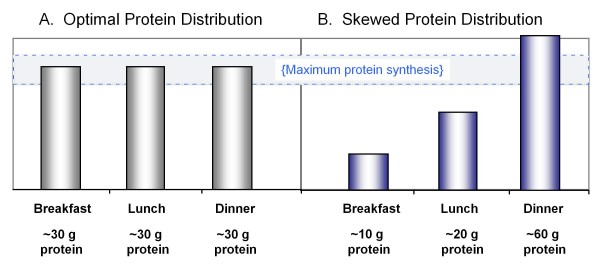
“Adults require a minimum of 15 g of EAA or at least 30 g of total protein to fully stimulate skeletal muscle protein synthesis [21,25].”
BackgroundWeigle, D. S., Breen, P. A., Matthys, C. C., Callahan, H. S., Meeuws, K. E., Burden, V. R., & Purnell, J. Q. (2005) · The American Journal of Clinical Nutrition · doi:10.1093/ajcn/82.1.41 · Cited by 774 · cited 2×
“The meal content of protein is also a key factor for satiety and appetite regulation [9,10].”
BackgroundProtein, weight management, and satiety
Paddon-Jones, D., Westman, E., Mattes, R. D., Wolfe, R. R., Astrup, A., & Westerterp-Plantenga, M. (2008) · The American Journal of Clinical Nutrition · doi:10.1093/ajcn/87.5.1558s · Cited by 549 · cited 3×
“The most unequivocal evidence for the benefit of increased dietary protein is derived from studies of weight management [1,28,29].”
BackgroundLayman, D. K., Boileau, R. A., Erickson, D. J., Painter, J. E., Shiue, H., Sather, C., & Christou, D. D. (2003) · The Journal of Nutrition · doi:10.1093/jn/133.2.411 · Cited by 541
Self-citationThe metabolic syndrome: is this diagnosis necessary?1,2
Reaven, G. M. (2006) · The American Journal of Clinical Nutrition · doi:10.1093/ajcn/83.6.1237 · Cited by 524 · cited 1×
“Early research with MetS evaluated reducing dietary carbohydrates with fats [36].”
Background
Research works printed but not linked: 1
- Reaven GM: The metabolic syndrome: is this diagnosis neces- sary? Am J Clin Nutr 2006, 83:1237-47.
Cited by
Items 101–144 of 144
Protein intake by Māori of advanced age
Bennett, B., Wham, C. A., Teh, R., Moyes, S. A., Kēpa, M., Maxted, E., & Kerse, N. M. (2017) · MAI Journal A New Zealand Journal of Indigenous Scholarship · doi:10.20507/maijournal.2017.6.2.1 · Cited by 3
Guo, J., Dai, Y., Peng, Y., Zhang, L., & Jia, H. (2024) · Nutrients · doi:10.3390/nu16234180 · Cited by 2
The impact of breakfast in metabolic and digestive health.
Kamada, I., Truman, L., Bold, J., & Mortimore, D. (2011) · Gastroenterology and hepatology from bed to bench. · Cited by 10
Norton, L. E. (2010) · Illinois Digital Environment for Access to Learning and Scholarship (University of Illinois at Urbana-Champaign) · Cited by 2
Dietary Determinants of Fat Mass and Body Composition
Zulet, M. Á., Moreno-Aliaga, M. J., & Martínez, J. A. (2011) · Springer eBooks · doi:10.1007/978-1-4614-0965-6_9 · Cited by 3
Dioguardi, F. S. (2018) · Journal of Nutritional Biology · doi:10.18314/jnb.v4i2.1285 · Cited by 2
“On the contrary of NEAA, since EAA are the main promoters of protein syntheses and still antagonize cancer development in vitro [15], their sufficiently large availability condition evaluation of adequate nutritional supply [16] and only achieving a persistent success in normalizing liver syntheses of short lived circ…”
BackgroundPROTEIN AND PHYSICAL ACTIVITY IN PREVENTION AND TREATMENT OF SARCOPENIA
Turżańska, K., Drelich, M., & Posturzyńska, A. (2019) · Wiadomości Lekarskie · doi:10.36740/wlek201909110 · Cited by 5
Protein Requirements in Inherited Metabolic Diseases
Yannicelli, S. (2015) · Springer eBooks · doi:10.1007/978-3-319-14621-8_7 · Cited by 2
Acheson, K. J. (2012) · Elsevier eBooks · doi:10.1016/b978-0-12-385083-6.00007-3 · Cited by 2
Starck, C. S., Wolfe, R. R., & Moughan, P. J. (2026) · Journal of Nutrition · doi:10.1016/j.tjnut.2026.101417 · Cited by 1
“…turnover; RDA, recommended daily allowance; SAA, sulfur amino acid; TID, true ileal digestibility; TOL, total oxidative loss; UFAAP, urinary free amino acids and peptides. incompletely understood, leading to criticism of these current protein and IAA requirement estimates for being too low [3 – 5].”
Zhu, W., Chen, Q., Li, D., & Yi, L. (2026) · European journal of medical research · doi:10.1186/s40001-026-04126-0 · Cited by 2
Evaluation of diet quality of Egyptian adolescents using healthy eating index
Ella, N. A. R. A., Ismail, M. A., Saleh, W. M. A. E. M., & Abdulla, A. M. (2009) · International Journal of Food Safety Nutrition and Public Health · doi:10.1504/ijfsnph.2009.029280 · Cited by 1
Filho, M., & Araraquara, C. D. (2009) · Cited by 1
Leucine dense whey proteins: To optimize anabolic responses in skeletal muscle
Wilson, G. J., Layman, D. K., Norton, L. E., & Wilson, J. M. (2011) · Nutrafoods · doi:10.1007/bf03223383 · Cited by 1
Self-citationInteraction Between Diet and Physical Activity in Older People
Beals, J. W., Shy, E. L., & Burd, N. A. (2016) · Elsevier eBooks · doi:10.1016/b978-0-08-100348-0.00009-3 · Cited by 1
Zhang, Y., Spitzer, L., Rui, X., Fernandes, S. C. M., Vaugeois, R., & Simpson, B. K. (2022) · Marine Drugs · doi:10.3390/md20030204 · Cited by 1
Vega, M. R., García-Melo, J. A., & Sánchez, E. H. (2024) · Revista de Técnicas de Enfermería y Salud · doi:10.35429/jnt.2024.8.19.1.11 · Cited by 1
Zhu, Y., Bailey, D. A., Childress, A., Dawson, J., Binks, M., & Dhurandhar, N. V. (2022) · International Journal of Food Sciences and Nutrition · doi:10.1080/09637486.2022.2133097 · Cited by 1
Corsetti, G., Pasini, E., Romano, C., Calvani, R., Picca, A., Marzetti, E., Flati, V., & Dioguardi, F. S. (2018) · Preprints.org · doi:10.20944/preprints201802.0048.v1 · Cited by 1
Anti-Inflammatorische Ernährung - Zur wissenschaftlichen Basis der Zone-Diät
Stulnig, T. M. (2011) · Journal für Kardiologie (Krause & Pachernegg GmbH)
Marx, T., Clewell, A. E., & Barnes, M. (2012) · Elsevier eBooks · doi:10.1016/b978-0-12-397153-1.00206-7 · Cited by 1
Vianna, D. (2009) · Digital Library of Theses and Dissertations (Universidade de São Paulo) · doi:10.11606/d.9.2009.tde-11012010-154329
Patterson, K. M. (2014) · Holmes Museum Of Anthropology (Wichita State University)
Laakso, M. (2015) · Jyväskylä University Digital Archive (University of Jyväskylä) · Cited by 1
Medical Nutrition Therapy for Eating Disorders
Graves, L., & Scribner, C. (2015) · Wiley eBooks · doi:10.1002/9781118574089.ch61
Richardson, B. (2014) · Digital Archive @ GSU · doi:10.57709/5801100
Pasini, E. (2012) · Journal of Medicine and the Person · doi:10.1007/s12682-012-0140-z
“cans has to consider the results of new research and should contain the following new concepts [13].”
BackgroundNutrition Update: Dietary Protein
Fruh, S., & Greenblum, M. D. (2014) · The Journal for Nurse Practitioners · doi:10.1016/j.nurpra.2014.02.003
“Because the quality and quantity of protein consumed at each meal is important for older adults to maintain muscle mass, it is critical to encourage them to have adequate protein at every meal.(5,6)”
BackgroundConsumo alimentar e metabolismo mineral e ósseo em mulheres idosas com sarcopenia
Genaro, P. D. S. (2010) · Digital Library of Theses and Dissertations (Universidade de São Paulo) · doi:10.11606/t.6.2010.tde-24052010-095200
Dietary Protein Distribution Positively Influences 24-h Muscle Protein Synthesis in
Mamerow, M. M., Mettler, J. A., English, K. L., Casperson, S. L., Arentson‐Lantz, E. J., Sheffield‐Moore, M., Layman, D. K., & Paddon‐Jones, D. (2014)
Self-citationNo, J. K. (2013) · Korean Journal of Human Ecology · doi:10.5934/kjhe.2013.22.1.181
Nutrition Management, Pre- and Postsurgery
Cummings, S. (2014) · CRC Press eBooks · doi:10.1201/b17281-4
Leistungsfähiger, erfolgreicher und glücklicher durch intelligente Ernährung
Walle, H. (2017) · Springer eBooks · doi:10.1007/978-3-658-16580-2_14
Impact of Sarcopenia in Healthy Aging and Suggested Interventions
Erdoğan, T., Bahat, G., & Karan, M. A. (2018) · Springer eBooks · doi:10.1007/978-981-13-1699-9_20
valuation of Diet Quality of Egyptian Children and Adolescents using Healthy Eating Index
Esmail, M. A., Saleh, W. M. A. E. M., Ella, N. A. R. A., & Allah, A. M. A. (2009) · The Egyptian Journal of Hospital Medicine · doi:10.21608/ejhm.2009.17475
Setiawan, B., Ernawati, E., & Suprapti, H. (2017) · Jurnal Ilmiah Kedokteran Wijaya Kusuma · doi:10.30742/jikw.v3i2.18
Getting Whey-Hearted: A Review Responding to Myths about Protein, Specifically Whey
Manoj, S., & Shabaraya, A. R. (2021) · International Journal of Research and Review · doi:10.52403/ijrr.20210560 · Cited by 1
Sarkopenie: ein geriatrisches Syndrom mit Bedeutung für die Urologie
Heppner, H. J., & Hag, H. (2021) · Der Urologe · doi:10.1007/s00120-021-01703-5
Optimizing protein delivery to promote skeletal muscle protein synthesis
Areta, J. L. (2014) · RMIT Research Repository (RMIT University Library) · doi:10.25439/rmt.27351192
Protein Requirements in Inherited Metabolic Diseases
Yannicelli, S. (2022) · Springer eBooks · doi:10.1007/978-3-030-94510-7_6 · Cited by 2
Dietary Impact on the Prevention and Management of Obesity
Deakin, T. (2022) · In clinical practice · doi:10.1007/978-3-030-83399-2_16
Schneider, M. M., & Bauer, S. (2026) · Obere Extremität · doi:10.1007/s11678-025-00894-z
Michalchenko, S., Korkh, I., Paliy, А., Rodionova, K., Boiko, N., Кhimych, M., Богатко, А. Ф., & Vyrvykyshka, S. (2026) · Scifood. · doi:10.5219/scifood.191
Metadata
- Authors
- Layman, D. K.
- Affiliations
- University of Illinois Urbana-Champaign (US)
- Corresponding author
- Layman, Donald K
- ORCID
- Layman, Donald K
- Venue
- Nutrition & Metabolism
- Published
- 2009
- Volume
- 6
- Issue
- 1
- Pages
- 12
- ISSN
- 1743-7075 (ISSN-L)
- PMC
- PMC2666737
- OpenAlex
- W2017726641
- Cited by
- 146
- References
- 43
- Citations by year
- 2026: 5 · 2025: 3 · 2024: 14 · 2023: 2 · 2022: 8 · 2021: 7 · 2020: 8 · 2019: 2 · 2018: 9 · 2017: 7 · 2016: 5 · 2015: 12 · 2014: 11 · 2013: 12 · 2012: 16
- Type
- journal article
- Language
- en
- Open access
- gold
- doi.org
- Licence
- cc-by
- Locations
- Nutrition & Metabolism (publishedVersion, cc-by)
- PubMed Central (publishedVersion, cc-by)
- PubMed (publishedVersion)
- DOAJ (DOAJ: Directory of Open Access Journals) (submittedVersion)
- Topics
- Health Sciences › Nursing › Nutrition and Dietetics › Muscle metabolism and nutrition
- Health Sciences › Medicine › Physiology (medical) › Nutrition and Health in Aging
- Life Sciences › Agricultural and Biological Sciences › Food Science › Nutrition, Health, and Society Studies
- Keywords
- dietary protein, protein requirements, Dietary Guidelines for Americans, meal distribution, body composition, bone health, glucose homeostasis, sarcopenia, metabolic syndrome, type 2 diabetes, obesity, aging, nutrition policy
About these checks
Registry, retraction, Cites and statistics results are computed, not judged, with one exception: a printed reference that no index lists is read once by a model before it counts as a citation error. Claims are extracted by a model and kept only when their quote appears verbatim in the text; each cited source is then checked, with a model’s help, for whether it says what the claim relies on. Those verdicts can be wrong — read the claim’s quote and the cited source before relying on one.
Statistics and arithmetic are recomputed, not judged.
Confidence bands are shown only for fields calibrated on our annotated test set. None is calibrated yet, so no band is shown.
What counts as a claim ›How we measure confidence ›How we check this ›
Are you an author, or do you see a problem with this page? Request a review
Data sources
Bibliographic data: Semantic Scholar, OpenAlex, Crossref.
Contains information from the Semantic Scholar Academic Graph Datasets, made available under the ODC Attribution License (ODC-BY 1.0).
Semantic Scholar’s data is described in: Kinney, R., et al. (2023). The Semantic Scholar Open Data Platform. arXiv:2301.10140.
