

Dietary protein in weight management: a review proposing protein spread and change theories
Open accessThe DOI matches its Crossref record; 82 of the 82 references it cites were found in a registry or an index.
Abstract
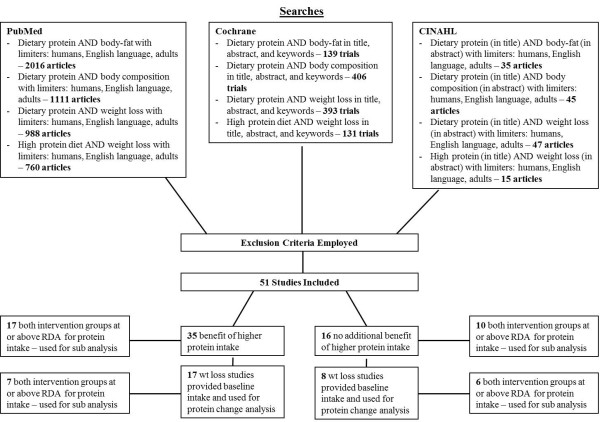
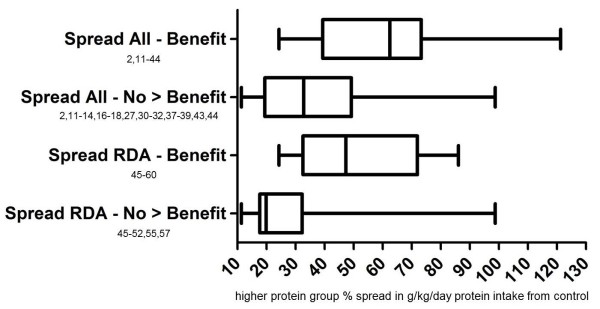
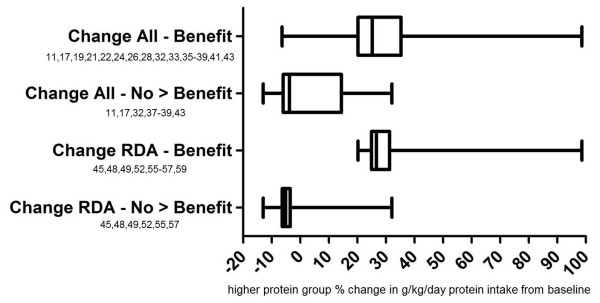
A large volume of human clinical data supports increased dietary protein for favorable changes to body composition, but not all data are conclusive. The aim of this review is to propose two theories, "protein spread theory" and "protein change theory" in an effort to explain discrepancies in the literature. Protein spread theory proposed that there must have been a sufficient spread or % difference in g/kg/day protein intake between groups during a protein intervention to see body composition and anthropometric differences. Protein change theory postulated that for the higher protein group, there must be a sufficient change from baseline g/kg/day protein intake to during study g/kg/day protein intake to see body composition and anthropometric benefits. Fifty-one studies met inclusion criteria. In studies where a higher protein intervention was deemed successful there was, on average, a 58.4% g/kg/day between group protein intake spread versus a 38.8% g/kg/day spread in studies where a higher protein diet was no more effective than control. The average change in habitual protein intake in studies showing higher protein to be more effective than control was +28.6% compared to +4.9% when additional protein was no more effective than control. Providing a sufficient deviation from habitual intake appears to be an important factor in determining the success of additional protein in weight management interventions. A modest increase in dietary protein favorably effects body composition during weight management interventions.
Overview
The claims and statistics of this paper haven’t been checked yet.
Free: it reads the open-access text and checks the first 5 claims that cite a source we can check. Create a free account to check every claim.
Integrity signals
Registry
Cites
Statistics
Figures
Verification
Claims the paper makes
The claims and statistics of this paper haven’t been checked yet.
Free: it reads the open-access text and checks the first 5 claims that cite a source we can check. Create a free account to check every claim.
Claims other papers make about this one
Each is checked against this paper’s own text: does it say what the citing paper says it does?
The source backs part of the claim, not all of it — or backs it for a different population, condition or comparison.
In the citing paper
“This review supports our protein spread and change theories [11] as possible explanations for discrepancies in the protein and resistance training literature.”
From Dietary protein to maximize resistance training: a review and examination of protein spread and change theories (2012) · cites this paper as [11]
Experimental — accuracy not yet measuredIn the citing paper
“In our previous review, we demonstrated that spread and change in study protein intakes may be important factors predicting potential to benefit from increased protein during a weight management intervention.”
From Dietary protein to maximize resistance training: a review and examination of protein spread and change theories (2012) · cites this paper as [11]
In the citing paper
“The magnitudes of difference between the mean spreads and changes of the present review are similar to our previous review on these theories in a weight management context.”
From Dietary protein to maximize resistance training: a review and examination of protein spread and change theories (2012) · cites this paper as [11]
In the citing paper
“In the same respective order, the four means from our weight management review on these theories were 58.4%, 38.8%, 28.6%, and 4.9% [11].”
From Dietary protein to maximize resistance training: a review and examination of protein spread and change theories (2012) · cites this paper as [11]
Self-check
Percentages, sums and reported differences re-computed from the paper’s own numbers.
The self-check needs the paper’s full text.
Citations
Cites
Finkelstein, E. A., Trogdon, J. G., Cohen, J. W., & Dietz, W. (2009) · Health Affairs · doi:10.1377/hlthaff.28.5.w822 · Cited by 2,957 · cited 1×
“Introduction Annual healthcare costs relating to obesity approximate $150 billion in the US alone [1].”
BackgroundComparison of Weight-Loss Diets with Different Compositions of Fat, Protein, and Carbohydrates
Sacks, F. M., Bray, G. A., Carey, V. J., Smith, S. R., Ryan, D. H., Anton, S. D., McManus, K., Champagne, C. M., Bishop, L. M., Laranjo, N., et al. (2009) · New England Journal of Medicine · doi:10.1056/nejmoa0804748 · Cited by 1,966 · cited 6×
“Additionally, protein intake spread between groups was often less than designed [45,46,48,57,61], a problem noted in a recent editorial [62].”
BackgroundMethodInfluentialDansinger, M. L., Gleason, J. A., Griffith, J. L., Selker, H. P., & Schaefer, E. J. (2005) · JAMA · doi:10.1001/jama.293.1.43 · Cited by 1,726 · cited 1×
“should be assessed whenever possible as long term adherence to a weight loss diet is typically poor [77] and dietary recalls are prone to underreporting, although to a lesser extent than FFQs [78].”
BackgroundAnthropometric Reference Data for Children and Adults: United States, 2003-2006: (623932009-001)
McDowell, M. A., Fryar, C. D., Ogden, C. L., & Flegal, K. M. (2008) · PsycEXTRA Dataset · doi:10.1037/e623932009-001 · Cited by 1,378
Subar, A. F. (2003) · American Journal of Epidemiology · doi:10.1093/aje/kwg092 · Cited by 1,070 · cited 4×
“should be assessed whenever possible as long term adherence to a weight loss diet is typically poor [77] and dietary recalls are prone to underreporting, although to a lesser extent than FFQs [78].”
BackgroundInfluentialDiets with high or low protein content and glycemic index for weight-loss maintenance
Larsen, T. M., Dalskov, S.-M., van Baak, M., Jebb, S. A., Papadaki, A., Pfeiffer, A. F. H., Martinez, J. A., Handjieva-Darlenska, T., Kunešová, M., Pihlsgård, M., et al. (2010) · New England Journal of Medicine · doi:10.1056/nejmoa1007137 · Cited by 843 · cited 3×
“Higher protein participants did have greater diet satisfaction and less hunger [72] which influences long-term dietary success [25,29].”
BackgroundDietary protein recommendations and the prevention of sarcopenia
Paddon-Jones, D., & Rasmussen, B. B. (2009) · Current Opinion in Clinical Nutrition & Metabolic Care · doi:10.1097/mco.0b013e32831cef8b · Cited by 823 · cited 1×
“Two leading protein metabolism research groups have recently discussed the importance of spacing protein evenly throughout the day to optimize body composition endpoints [75,76].”
BackgroundSkov, A., Toubro, S., Rønn, B., Holm, L., & Astrup, A. (1999) · International Journal of Obesity · doi:10.1038/sj.ijo.0800867 · Cited by 743 · cited 3×
“Evidence weighs heavily toward studies showing anthropometric benefits of increased protein intake [2,11-44].”
BackgroundLayman, D. K., Boileau, R. A., Erickson, D. J., Painter, J. E., Shiue, H., Sather, C., & Christou, D. D. (2003) · The Journal of Nutrition · doi:10.1093/jn/133.2.411 · Cited by 541 · cited 3×
“reported body composition changes as a ratio of fat lost/ lean mass lost [21,27].”
BackgroundNoakes, M., Keogh, J. B., Foster, P. R., & Clifton, P. M. (2005) · The American Journal of Clinical Nutrition · doi:10.1093/ajcn/81.6.1298 · Cited by 483 · cited 3×
“Noakes, 2005 [40] 33 ± 4 NR NR NR F 12 0.”
Background
Cited by
The role of protein in weight loss and maintenance
Leidy, H. J., Clifton, P. M., Astrup, A., Wycherley, T. P., Westerterp-Plantenga, M. S., Luscombe-Marsh, N. D., Woods, S. C., & Mattes, R. D. (2015) · The American Journal of Clinical Nutrition · doi:10.3945/ajcn.114.084038 · Cited by 475
“To further support a specific protein quantity that is required to elicit improvements in weight management, Bosse and Dixon (90) categorized 25 higher-protein weight-loss studies on the basis of those who showed successful weight loss compared with those who did not.”
BackgroundInfluentialVerreijen, A. M., Verlaan, S., Engberink, M. F., Swinkels, S., de Vogel-van den Bosch, J., & Weijs, P. J. (2015) · The American Journal of Clinical Nutrition · doi:10.3945/ajcn.114.090290 · Cited by 237
“High dietary protein intake, strategically timed at each meal, has also been shown to stimulate muscle protein synthesis and is another potent strategy to overcome the well-known muscle anabolic resistance in older individuals (1, 11, 12).”
Protein leverage and energy intake
Gosby, A. K., Conigrave, A. D., Raubenheimer, D., & Simpson, S. J. (2014) · Obesity Reviews · doi:10.1111/obr.12131 · Cited by 196
Clifton, P. M., Condo, D., & Keogh, J. B. (2014) · Nutrition, Metabolism and Cardiovascular Diseases · doi:10.1016/j.numecd.2013.11.006 · Cited by 157
Verreijen, A. M., Engberink, M. F., Memelink, R. G., van der Plas, S. E., Visser, M., & Weijs, P. J. M. (2017) · Nutrition Journal · doi:10.1186/s12937-017-0229-6 · Cited by 121
Bioactive properties of milk proteins in humans: A review
Nongonierma, A. B., & FitzGerald, R. J. (2015) · Peptides · doi:10.1016/j.peptides.2015.08.009 · Cited by 116
“8% 38 (g/kg/day) between the test and control groups [14].”
A Brief Review of Higher Dietary Protein Diets in Weight Loss: A Focus on Athletes
Phillips, S. M. (2014) · Sports Medicine · doi:10.1007/s40279-014-0254-y · Cited by 81
“Others, based on collective examination of data, have also hypothesized that much higher protein intakes are required to see preservation of lean mass and greater fat mass losses [37].”
BackgroundThe effects of whey protein with or without carbohydrates on resistance training adaptations
Hulmi, J. J., Laakso, M., Mero, A. A., Häkkinen, K., Ahtiainen, J. P., & Peltonen, H. (2015) · Journal of the International Society of Sports Nutrition · doi:10.1186/s12970-015-0109-4 · Cited by 61
“In addition to RT, many studies support replacing dietary carbohydrates or fats with dietary protein for favorable changes on decreasing fat mass [38, 39].”
BackgroundKehlet, U., Pagter, M., Aaslyng, M. D., & Raben, A. (2016) · Meat Science · doi:10.1016/j.meatsci.2016.11.007 · Cited by 67
Remodeling of lipid metabolism by dietary restriction of essential amino acids
Anthony, T. G., Morrison, C. D., & Gettys, T. W. (2013) · Diabetes · doi:10.2337/db12-1613 · Cited by 52
“A consensus is emerging to support the view that protein intake is monitored through nutrient-sensing mechanisms that detect changes in EAAs and provide regulatory input to both energy balance and the integration of carbohydrate and lipid metabolism (5,6,11,12).”
BackgroundKjølbæk, L., Sørensen, L. B., Søndertoft, N. B., Rasmussen, C. K., Lorenzen, J. K., Serena, A., Astrup, A., & Larsen, L. H. (2017) · The American Journal of Clinical Nutrition · doi:10.3945/ajcn.115.129528 · Cited by 48
Bosse, J. D., & Dixon, B. M. (2012) · Journal of the International Society of Sports Nutrition · doi:10.1186/1550-2783-9-42 · Cited by 42
“Discussion This review supports our protein spread and change theories [11] as possible explanations for discrepancies in”
BackgroundResultSelf-citationEffects of Resistance Training and Protein Supplementation in Breast Cancer Survivors
Madzima, T. A., Ormsbee, M. J., Schleicher, E. A., Moffatt, R. J., & Panton, L. B. (2017) · Medicine & Science in Sports & Exercise · doi:10.1249/mss.0000000000001250 · Cited by 40
“Protein change, which is the change in habitual protein intake (gIkgId) of each group, and protein spread, which is the percent difference in protein intake during the study between experimental (RT + protein) and control (RT) group, were determined according to the calculations of Bosse and Dixon (4) as follows: prot…”
MethodInfluentialBray, G. A., Ryan, D. H., Johnson, W., Champagne, C. M., Johnson, C. M., Rood, J., Williamson, D. A., & Sacks, F. M. (2017) · Clinical Obesity · doi:10.1111/cob.12188 · Cited by 30
“This is consistent with the ‘protein spread hypothesis’ of Bosse and Dixon (27).”
BackgroundMethodResultInfluentialForney, L. A., Stone, K. P., Wanders, D., & Gettys, T. W. (2017) · Frontiers in Neuroendocrinology · doi:10.1016/j.yfrne.2017.12.002 · Cited by 29
“…support an emerging consensus that dietary protein intake is monitored through nutrient sensing mechanisms that detect changes in the essential amino acid (EAA) composition of the consumed protein (Simpson & Raubenheimer, 1997; Morrison et al., 2012; Gosby et al., 2011; Bosse and Dixon, 2012).”
BackgroundNutritional support and dietary interventions for women with polycystic ovary syndrome
Papavasiliou, K., & Papakonstantinou, E. (2017) · Nutrition and Dietary Supplements · doi:10.2147/nds.s119738 · Cited by 30
“Moreover, a meta-analysis of RCTs reported that the majority of RCTs (35 out of 51) demonstrated a benefit of fat-free mass preservation with higher protein diets.(104) In conclusion, although some studies support that higher protein diets may result in several positive health outcomes, including lean mass preservatio…”
Glynn, E. L., Fleming, S. A., Edwards, C., Wilson, M. J., Evans, M., & Leidy, H. J. (2022) · Journal of Nutrition · doi:10.1093/jn/nxac038 · Cited by 22
“Additionally, due to dosage and timing limitations of protein absorption, an intake of ∼25–30 g protein at each meal may be ideal for eliciting protein-related health benefits (25).”
BackgroundHigher-protein intake improves body composition index in female collegiate dancers
Brown, A. F., Welsh, T., Panton, L. B., Moffatt, R. J., & Ormsbee, M. J. (2019) · Applied Physiology, Nutrition, and Metabolism · doi:10.1139/apnm-2019-0517 · Cited by 16
“4%) (Bosse and Dixon 2012) between groups to be effective for body composition improvements based upon pilot data showing habitual protein intake in a dancer population to be 1.”
BackgroundInfluentialDietary protein and urinary nitrogen in relation to 6-year changes in fat mass and fat-free mass
Ankarfeldt, M. Z., Gottliebsen, K., Ängquist, L. H., Astrup, A. V., Heitmann, B. L., & Sørensen, T. I. A. (2014) · International Journal of Obesity · doi:10.1038/ijo.2014.80 · Cited by 16
Fabre, M., Hausswirth, C., Tiollier, E., Molle, O., Louis, J. B., Durguerian, A., Neveux, N., & Bigard, X. A. (2017) · International Journal of Sport Nutrition and Exercise Metabolism · doi:10.1123/ijsnem.2016-0333 · Cited by 15
“Moreover, the protein change theory postulated that there must be a sufficient change from baseline protein intake to observe lean mass gain and strength gain in response to protein supplementation (Bosse and Dixon, 2012).”
BackgroundInfluentialLim, J. J., Liu, Y., Lu, L. W., Barnett, D., Sequeira, I. R., & Poppitt, S. D. (2022) · Nutrients · doi:10.3390/nu14030538 · Cited by 15
“2 g/kg BW has been proposed to improve BW loss outcomes [13,14], due in part to beneficial effects reported for appetite regulation [15], retention of fat-free mass (FFM) [16], and enhanced diet-induced thermogenesis [6,17].”
BackgroundLow Fat vs. Low Carbohydrate Diet Strategies for Weight Reduction: A Meta-Analysis
Boaz, M., & Raz, O. (2015) · Journal of Obesity & Weight loss Therapy · doi:10.4172/2165-7904.1000273 · Cited by 12
“These findings were supported in meta-analyses concluding that a between-group difference of 5% or more protein intake is associated with improved weight loss, but only in studies in which macronutrient intake complied with study recommendations [27,28].”
ResultNutritive and Therapeutic Aspects of Whey Proteins
Lagrange, V., & Clark, D. C. (2018) · Elsevier eBooks · doi:10.1016/b978-0-12-812124-5.00016-3 · Cited by 13
Agnoli, C., Sieri, S., Ricceri, F., Macciotta, A., Masala, G., Bendinelli, B., Panico, S., Mattiello, A., Tumino, R., Frasca, G., et al. (2020) · Nutrition Metabolism and Cardiovascular Diseases · doi:10.1016/j.numecd.2020.08.007 · Cited by 8
Food deprivation among adults in India: an analysis of specific food categories, 2016–2021
Jain, A., Sharma, S., Kim, R., & Subramanian, S. V. (2023) · EClinicalMedicine · doi:10.1016/j.eclinm.2023.102313 · Cited by 11
Muscle Dysmorphia in Fitness Center Members: Its Affecting Factors and Impacts
Fitranti, D. Y., Widyastuti, N., Noer, E. R., Rahadiyanti, A., Dieny, F. F., Purwanti, R., Sandi, D. K., & Destikasari, W. (2022) · Kesmas National Public Health Journal · doi:10.21109/kesmas.v17i2.5705 · Cited by 3
“8 An excessive consumption of supplements is harmful and may cause adverse effects such as kidney damage and other diseases.”
The Role of Meat in a Healthful Dietary Pattern: Evidence from Menu Modeling
Cochran, B. H. N. (2015) · Journal of Nutrition & Food Sciences · doi:10.4172/2155-9600.1000404 · Cited by 2
“6 g/kg/d) resulted in greater losses in body weight and body fat, preservation of lean body mass, and reductions in triglycerides, blood pressure, and waist circumference [25,30,31].”
BackgroundCancello, R., Lucchetti, E., Gobbi, M., & Brunani, A. (2020) · Springer eBooks · doi:10.1007/978-3-030-32274-8_4 · Cited by 4
Ulian, M. D. (2018) · Digital Library of Theses and Dissertations (Universidade de São Paulo) · doi:10.11606/t.6.2018.tde-17102018-124602 · Cited by 3
Brun, J. ‐., Varlet‐Marie, E., Fidani, T., Mercier, J. G., & de Mauverger, É. R. (2018) · Integrative Obesity and Diabetes · doi:10.15761/iod.1000215 · Cited by 1
Metadata
- Authors
- Bosse, J. D., & Dixon, B. M.
- Affiliations
- University of Utah (US)
- USANA Health Sciences, Inc. (United States) (US)
- Corresponding author
- Bosse, John D
- Venue
- Nutrition & Metabolism
- Published
- 2012
- Volume
- 9
- Issue
- 1
- Pages
- 81
- ISSN
- 1743-7075 (ISSN-L)
- PMC
- PMC3509388
- OpenAlex
- W2128158309
- Cited by
- 31
- References
- 81
- Citations by year
- 2023: 1 · 2022: 3 · 2020: 2 · 2019: 1 · 2018: 3 · 2017: 7 · 2016: 1 · 2015: 5 · 2014: 3 · 2013: 4 · 2012: 1
- FWCI
- 1.97
- Type
- journal article
- Language
- en
- Open access
- gold
- doi.org
- Licence
- cc-by
- Locations
- Nutrition & Metabolism (publishedVersion, cc-by)
- PubMed Central (publishedVersion, cc-by)
- PubMed (publishedVersion)
- DOAJ (DOAJ: Directory of Open Access Journals) (submittedVersion, cc-by-sa)
- Topics
- Health Sciences › Nursing › Nutrition and Dietetics › Muscle metabolism and nutrition
- Health Sciences › Medicine › Physiology (medical) › Diet and metabolism studies
- Life Sciences › Neuroscience › Endocrine and Autonomic Systems › Regulation of Appetite and Obesity
- Keywords
- dietary protein, weight management, body composition, weight loss interventions, anthropometric outcomes, high-protein diet
About these checks
Registry, retraction, Cites and statistics results are computed, not judged, with one exception: a printed reference that no index lists is read once by a model before it counts as a citation error. Claims are extracted by a model and kept only when their quote appears verbatim in the text; each cited source is then checked, with a model’s help, for whether it says what the claim relies on. Those verdicts can be wrong — read the claim’s quote and the cited source before relying on one.
Statistics and arithmetic are recomputed, not judged.
Confidence bands are shown only for fields calibrated on our annotated test set. None is calibrated yet, so no band is shown.
What counts as a claim ›How we measure confidence ›How we check this ›
Are you an author, or do you see a problem with this page? Request a review
Data sources
Bibliographic data: Semantic Scholar, OpenAlex, Crossref.
Contains information from the Semantic Scholar Academic Graph Datasets, made available under the ODC Attribution License (ODC-BY 1.0).
Semantic Scholar’s data is described in: Kinney, R., et al. (2023). The Semantic Scholar Open Data Platform. arXiv:2301.10140.
