

Daytime pattern of post-exercise protein intake affects whole-body protein turnover in resistance-trained males
Open accessThe DOI matches its Crossref record; 21 of the 21 references it cites were found in a registry or an index.
Abstract
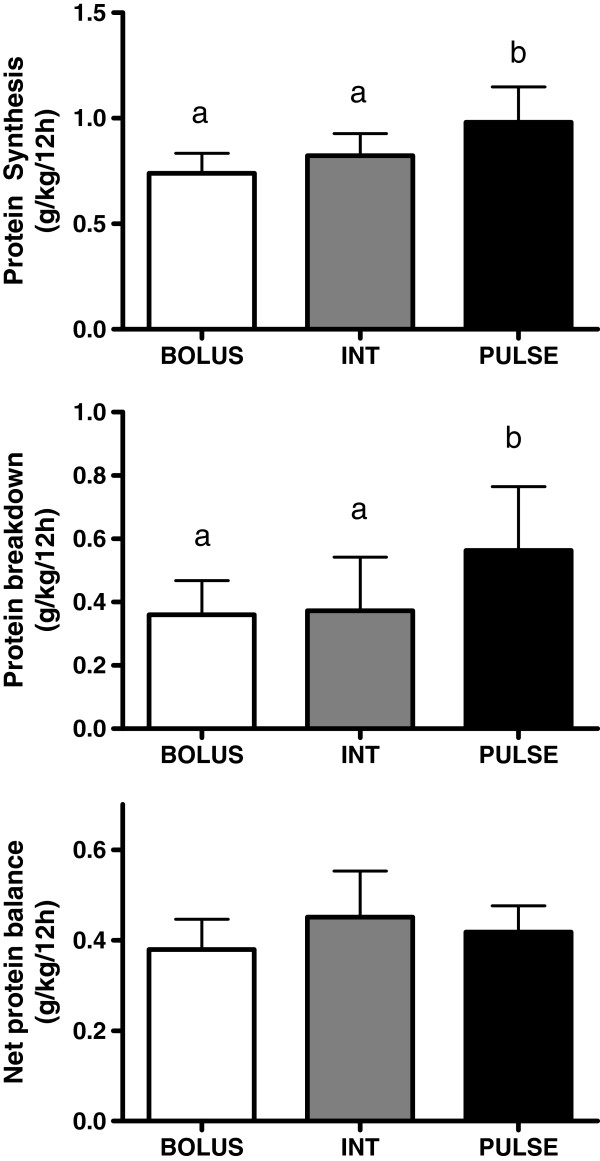
BACKGROUND: The pattern of protein intake following exercise may impact whole-body protein turnover and net protein retention. We determined the effects of different protein feeding strategies on protein metabolism in resistance-trained young men. METHODS: Participants were randomly assigned to ingest either 80g of whey protein as 8x10g every 1.5h (PULSE; n=8), 4x20g every 3h (intermediate, INT; n=7), or 2x40g every 6h (BOLUS; n=8) after an acute bout of bilateral knee extension exercise (4x10 repetitions at 80% maximal strength). Whole-body protein turnover (Q), synthesis (S), breakdown (B), and net balance (NB) were measured throughout 12h of recovery by a bolus ingestion of [15N]glycine with urinary [15N]ammonia enrichment as the collected end-product. RESULTS: PULSE Q rates were greater than BOLUS (~19%, P<0.05) with a trend towards being greater than INT (~9%, P=0.08). Rates of S were 32% and 19% greater and rates of B were 51% and 57% greater for PULSE as compared to INT and BOLUS, respectively (P<0.05), with no difference between INT and BOLUS. There were no statistical differences in NB between groups (P=0.23); however, magnitude-based inferential statistics revealed likely small (mean effect±90%CI; 0.59±0.87) and moderate (0.80±0.91) increases in NB for PULSE and INT compared to BOLUS and possible small increase (0.42±1.00) for INT vs. PULSE. CONCLUSION: We conclude that the pattern of ingested protein, and not only the total daily amount, can impact whole-body protein metabolism. Individuals aiming to maximize NB would likely benefit from repeated ingestion of moderate amounts of protein (~20g) at regular intervals (~3h) throughout the day.
Overview
The claims and statistics of this paper haven’t been checked yet.
Free: it reads the open-access text and checks the first 5 claims that cite a source we can check. Create a free account to check every claim.
Integrity signals
Registry
Cites
Statistics
Figures
Verification
Claims the paper makes
The claims and statistics of this paper haven’t been checked yet.
Free: it reads the open-access text and checks the first 5 claims that cite a source we can check. Create a free account to check every claim.
Claims other papers make about this one
Each is checked against this paper’s own text: does it say what the citing paper says it does?
The cited source doesn’t support the claim as written.
In the citing paper
“In combining the results of both studies, one can conclude that ingestion of intermediate protein doses (20 g) consumed every 3 h creates more favorable changes in both whole-body as well as myofibrillar protein synthesis [149, 150].”
From International society of sports nutrition position stand: nutrient timing (2017) · cites this paper as [149]
Checked by a reasoning model — may be wrong.
Experimental — accuracy not yet measuredThe cited source doesn’t support the claim as written.
In the citing paper
“the authors concluded that protein turnover and synthesis rates were greatest when intermediate-sized (20-g) doses of whey protein isolate were consumed every 3 h.”
From International society of sports nutrition position stand: nutrient timing (2017) · cites this paper as [149]
Checked by a reasoning model — may be wrong.
Experimental — accuracy not yet measuredIn the citing paper
“Incidentally, consuming four moderate (i.e. ~ 0.25 g/kg) whey protein doses supports greater rates of MyoPS [92] and whole body anabolism [93] than the same quantity of protein as two large (i.e. ~ 0.50 g/kg) or eight small (i.e. ~ 0.13 g/kg) meals during a prolonged 12 h post-exercise recovery period in young trained males.”
From Protein Requirements for Master Athletes: Just Older Versions of Their Younger Selves (2021) · cites this paper as [93]
Self-check
Percentages, sums and reported differences re-computed from the paper’s own numbers.
The self-check needs the paper’s full text.
Citations
Cites
Making Meaningful Inferences About Magnitudes
Batterham, A. M., & Hopkins, W. G. (2006) · International Journal of Sports Physiology and Performance · doi:10.1123/ijspp.1.1.50 · Cited by 2,183 · cited 2×
“Quantitative chances of benefit and harm were assessed according to previously published cut-points using the smallest standardized change in the mean, as described in detail elsewhere [18,19].”
MethodAnabolic signaling deficits underlie amino acid resistance of wasting, aging muscle
Cuthbertson, D., Smith, K., Babraj, J., Leese, G., Waddell, T., Atherton, P., Wackerhage, H., Taylor, P. M., & Rennie, M. J. (2005) · The FASEB Journal · doi:10.1096/fj.04-2640fje · Cited by 1,211 · cited 2×
“Based on previous findings [10,11] and that skeletal muscle is the major storage reservoir for body amino acids, we hypothesized that whole-body net protein balance would be greatest with repeated feedings of 20g of protein.”
BackgroundNutrition and Athletic Performance
(2009) · Medicine & Science in Sports & Exercise · doi:10.1249/mss.0b013e31890eb86 · Cited by 1,084 · cited 1×
“Background Recommendations for dietary protein intake for healthy adults currently provide guidelines according to the total daily quantity of protein intake [1,2], while new guidelines for athletes also note the importance of protein intake immediately after a resistance training session [3].”
BackgroundMoore, D. R., Robinson, M. J., Fry, J. L., Tang, J. E., Glover, E. I., Wilkinson, S. B., Prior, T., Tarnopolsky, M. A., & Phillips, S. M. (2009) · The American Journal of Clinical Nutrition · doi:10.3945/ajcn.2008.26401 · Cited by 973 · cited 4×
“In contrast, the possibly greater protein balance with the 20g as compared to the 10g feedings may be related to a more efficient stimulation of protein synthesis in both rested and exercised skeletal muscle and hence deposition of dietary amino acids within that tissue [11,22,23].”
BackgroundInfluentialSelf-citationDietary protein for athletes: From requirements to optimum adaptation
Phillips, S. M., & Van Loon, L. J. C. (2011) · Journal of Sports Sciences · doi:10.1080/02640414.2011.619204 · Cited by 530 · cited 2×
“This concept has been raised previously for athletes [3], may have preliminary support in general populations [24], and represents, we propose, a fruitful area of further study.”
BackgroundSelf-citationBurd, N. A., Tang, J. E., Moore, D. R., & Phillips, S. M. (2009) · Journal of Applied Physiology · doi:10.1152/japplphysiol.91351.2008 · Cited by 390 · cited 1×
“Given the known effect of dietary protein on the enhancement of muscle and whole-body protein synthesis [9] and the apparent advantage to balanced protein”
BackgroundSelf-citationMoore, D. R., Tang, J. E., Burd, N. A., Rerecich, T., Tarnopolsky, M. A., & Phillips, S. M. (2009) · The Journal of Physiology · doi:10.1113/jphysiol.2008.164087 · Cited by 324 · cited 1×
“In contrast, the possibly greater protein balance with the 20g as compared to the 10g feedings may be related to a more efficient stimulation of protein synthesis in both rested and exercised skeletal muscle and hence deposition of dietary amino acids within that tissue [11,22,23].”
BackgroundSelf-citationEvaluation of protein requirements for trained strength athletes
Tarnopolsky, M. A., Atkinson, S. A., MacDougall, J. D., Chesley, A., Phillips, S., & Schwarcz, H. P. (1992) · Journal of Applied Physiology · doi:10.1152/jappl.1992.73.5.1986 · Cited by 289 · cited 1×
“Whole-body protein turnover (Q) was calculated using the [(15)N]ammonia end-product method as described previously [15], which provides consistent rates over 12h [16].”
MethodSelf-citationNANA, A., SLATER, G. J., HOPKINS, W. G., & BURKE, L. M. (2012) · Medicine & Science in Sports & Exercise · doi:10.1249/mss.0b013e318228b60e · Cited by 197 · cited 1×
“After reporting to the laboratory to undergo a wholebody DEXA scan [13] and to determine one-repetition maximum (1-RM) bilateral knee extensor strength, subjects were provided with a standardized diet for the 72h prior to the trial that provided an energy availability of 45 kcal/kg fat-free mass with a macronutrient c…”
MethodSelf-citationTipton, K. D., Borsheim, E., Wolf, S. E., Sanford, A. P., & Wolfe, R. R. (2003) · American Journal of Physiology-Endocrinology and Metabolism · doi:10.1152/ajpendo.00234.2002 · Cited by 193 · cited 1×
“In contrast, the possibly greater protein balance with the 20g as compared to the 10g feedings may be related to a more efficient stimulation of protein synthesis in both rested and exercised skeletal muscle and hence deposition of dietary amino acids within that tissue [11,22,23].”
Background
Research works printed but not linked: 1
- Tessari P Garibotto G Inchiostro S Robaudo C Saffioti S Vettore M Zanetti M Russo R Deferrari G Kidney, splanchnic, and leg protein turnover in humans Insight from leucine and phenylalanine kinetics. J Clin Invest 1996 98 1481 1492 PMC507576 8823315
Cited by
International society of sports nutrition position stand: nutrient timing
Kerksick, C. M., Arent, S., Schoenfeld, B. J., Stout, J. R., Campbell, B., Wilborn, C. D., Taylor, L., Kalman, D., Smith-Ryan, A. E., Kreider, R. B., et al. (2017) · Journal of the International Society of Sports Nutrition · doi:10.1186/s12970-017-0189-4 · Cited by 622
“Moore and colleagues [149] examined the differences in protein turnover and synthesis rates when participants ingested different patterns, in a randomized order, of an 80-g total dose of protein over a 12-h measurement period following a bout of lower body resistance exercise.”
BackgroundResultWitard, O. C., Jackman, S. R., Breen, L., Smith, K., Selby, A., & Tipton, K. D. (2014) · The American Journal of Clinical Nutrition · doi:10.3945/ajcn.112.055517 · Cited by 517
Helms, E. R., Aragon, A. A., & Fitschen, P. J. (2014) · Journal of the International Society of Sports Nutrition · doi:10.1186/1550-2783-11-20 · Cited by 178
“[124] compared evenly spaced distributions of two, four, and eight meals consumed after a fasted, acute bout of bilateral knee extension.”
BackgroundTraylor, D. A., Gorissen, S. H. M., & Phillips, S. M. (2018) · Advances in Nutrition · doi:10.1093/advances/nmy003 · Cited by 225
Self-citationRole of nutrition in performance enhancement and postexercise recovery
Beck, K., Thomson, J. S., Swift, R. J., & von Hurst, P. R. (2015) · Open Access Journal of Sports Medicine · doi:10.2147/oajsm.s33605 · Cited by 223
Whey protein supplementation during resistance training augments lean body mass
Volek, J. S., Volk, B. M., Gómez, A. L., Kunces, L. J., Kupchak, B. R., Freidenreich, D. J., Aristizabal, J. C., Saenz, C., Dunn-Lewis, C., Ballard, K. D., et al. (2013) · Journal of the American College of Nutrition · doi:10.1080/07315724.2013.793580 · Cited by 181
“Better nitrogen retention was observed when resistance-trained men consumed whey protein in doses of 10– 20 g per serving postexercise compared to larger doses given in bolus [30].”
Beyond muscle hypertrophy: why dietary protein is important for endurance athletes
Moore, D. R., Camera, D. M., Areta, J. L., & Hawley, J. A. (2014) · Applied Physiology, Nutrition, and Metabolism · doi:10.1139/apnm-2013-0591 · Cited by 138
Self-citationEffects of meal frequency on weight loss and body composition: a meta-analysis
Jon Schoenfeld, B., Albert Aragon, A., & Krieger, J. W. (2015) · Nutrition Reviews · doi:10.1093/nutrit/nuu017 · Cited by 127
Schoenfeld, B. J., & Aragon, A. A. (2018) · Journal of the International Society of Sports Nutrition · doi:10.1186/s12970-018-0215-1 · Cited by 111
Schoenfeld, B. J., Ogborn, D. I., Vigotsky, A. D., Franchi, M. V., & Krieger, J. W. (2017) · Journal of Strength and Conditioning Research · doi:10.1519/jsc.0000000000001983 · Cited by 122
West, D., Abou Sawan, S., Mazzulla, M., Williamson, E., & Moore, D. (2017) · Nutrients · doi:10.3390/nu9070735 · Cited by 112
“[9] for a review of the method) generally align with the rates of myofibrillar protein synthesis over 12 h of recovery [14,15], and qualitatively predict training-induced increases in lean body mass when measured over 24 h [12].”
BackgroundMethodSelf-citationAnabolic Resistance of Muscle Protein Turnover Comes in Various Shapes and Sizes
Paulussen, K. J. M., McKenna, C. F., Beals, J. W., Wilund, K. R., Salvador, A. F., & Burd, N. A. (2021) · Frontiers in Nutrition · doi:10.3389/fnut.2021.615849 · Cited by 107
“The latter is believed to modulate daily net whole body (32) and muscle protein accretion (33).”
BackgroundDIETARY PROTEIN TO MAINTAIN MUSCLE MASS IN AGING: A CASE FOR PER-MEAL PROTEIN RECOMMENDATIONS
MURPHY, C. H., OIKAWA, S. Y., & PHILLIPS, S. M. (2016) · The Journal of Frailty & Aging · doi:10.14283/jfa.2016.80 · Cited by 14
Self-citationMaximizing Post-exercise Anabolism: The Case for Relative Protein Intakes
Moore, D. R. (2019) · Frontiers in Nutrition · doi:10.3389/fnut.2019.00147 · Cited by 86
“Outside of the response after a single meal, the pattern and distribution of dietary protein ingestion has been shown to influence muscle protein synthesis over 12–24 h both at rest (116) and after resistance exercise (28, 117, 118).”
BackgroundSelf-citationThe muscle protein synthetic response to food ingestion
Gorissen, S. H. M., Rémond, D., & van Loon, L. J. C. (2015) · Meat Science · doi:10.1016/j.meatsci.2015.05.009 · Cited by 105
Arciero, P. J., Baur, D., Connelly, S., & Ormsbee, M. J. (2014) · Journal of Applied Physiology · doi:10.1152/japplphysiol.00152.2014 · Cited by 65
Ely, I. A., Phillips, B. E., Smith, K., Wilkinson, D. J., Piasecki, M., Breen, L., Larsen, M. S., & Atherton, P. J. (2023) · Clinical Nutrition · doi:10.1016/j.clnu.2023.08.010 · Cited by 64
Poulios, A., Fatouros, I. G., Mohr, M., Draganidis, D., Deli, C. K., Papanikolaou, K., Sovatzidis, A., Nakopoulou, T., Ermidis, G., Tzatzakis, T., et al. (2018) · Nutrients · doi:10.3390/nu10040494 · Cited by 63
“This amount of post-exercise protein intake (80 g) using an intermediate feeding pattern is effective to stimulate protein synthesis [49,50].”
MethodBandegan, A., Courtney-Martin, G., Rafii, M., Pencharz, P. B., & Lemon, P. W. (2017) · The Journal of Nutrition · doi:10.3945/jn.116.236331 · Cited by 60
Nutritional strategies to support concurrent training
Perez‐Schindler, J., Hamilton, D. L., Moore, D. R., Baar, K., & Philp, A. (2015) · European Journal of Sport Science · doi:10.1080/17461391.2014.950345 · Cited by 57
“…greater rates of myofibrillar protein synthesis and induced a more positive whole-body protein balance after a bout of resistance exercise than the identical amount (i.e. 80 g) of protein ingested as 10 g feedings every 1.5 h or 40 g feedings every 6 h (Areta et al., 2013; Moore et al., 2012).”
BackgroundInfluentialSelf-citationBettonviel, A. E. O., Brinkmans, N. Y. J., Russcher, K., Wardenaar, F. C., & Witard, O. C. (2016) · International Journal of Sport Nutrition and Exercise Metabolism · doi:10.1123/ijsnem.2015-0218 · Cited by 56
“In addition, recent work has investigated the optimal protein meal pattern to maximise the daytime response of whole-body protein metabolism (Moore et al., 2012) and muscle protein synthesis (MPS) (Areta et al., 2013; Mamerow et al., 2014) in young individuals.”
BackgroundResultLynch, H. M., Buman, M. P., Dickinson, J. M., Ransdell, L. B., Johnston, C. S., & Wharton, C. M. (2020) · International Journal of Environmental Research and Public Health · doi:10.3390/ijerph17113871 · Cited by 56
“On non-workout days, participants were instructed to consume the protein supplement between meals to ensure timing of consumption would help to ensure high 24 h muscle protein synthesis rates [33,34].”
MethodMitchell, W. K., Phillips, B. E., Williams, J. P., Rankin, D., Lund, J. N., Wilkinson, D. J., Smith, K., & Atherton, P. J. (2015) · American Journal of Physiology-Endocrinology and Metabolism · doi:10.1152/ajpendo.00112.2015 · Cited by 54
Nutritional implications for ultra-endurance walking and running events
Williamson, E. (2016) · Extreme Physiology & Medicine · doi:10.1186/s13728-016-0054-0 · Cited by 53
“To maximize protein synthesis, and thus muscle remodeling and recovery [89], it is suggested that endurance athletes consume a minimum of 20 g of protein at 3–4 h intervals to maximize muscle protein synthesis [75, 90].”
BackgroundConsiderations for protein intake in managing weight loss in athletes
Murphy, C. H., Hector, A. J., & Phillips, S. M. (2015) · European Journal of Sport Science · doi:10.1080/17461391.2014.936325 · Cited by 52
“Providing some support for this hypothesis, it was observed that both whole body (Moore et al., 2012) and muscle (Areta et al., 2013) protein synthesis tended to be greater when 80 g of whey protein was consumed as 4 g × 20 g doses every 3 h compared to the same amount consumed as either two large…”
BackgroundSelf-citationDraganidis, D., Chondrogianni, N., Chatzinikolaou, A., Terzis, G., Karagounis, L. G., Sovatzidis, A., Avloniti, A., Lefaki, M., Protopapa, M., Deli, C. K., et al. (2017) · British Journal of Nutrition · doi:10.1017/s0007114517001829 · Cited by 50
“According to previous reports (31,32) , distributing 80g of protein in 4 × 20g doses every 3h is superior to either pulse (8 × 10g every 1.5h) or bolus (2 × 40g every 6h) feeding in stimulating MPS and max-imising whole-body protein balance over a 12-h post-exercise period.”
MethodAshtary-Larky, D., Bagheri, R., Tinsley, G. M., Asbaghi, O., Paoli, A., & Moro, T. (2021) · Physiology & Behavior · doi:10.1016/j.physbeh.2021.113453 · Cited by 47
Naderi, A., Rothschild, J. A., Santos, H. O., Hamidvand, A., Koozehchian, M. S., Ghazzagh, A., Berjisian, E., & Podlogar, T. (2025) · Sports Medicine · doi:10.1007/s40279-025-02213-6 · Cited by 77
“Following the initial protein-based meal after exercise, it is advised that subsequent protein-rich meals follow at 3–4 h intervals [55, 66, 67].”
Systematic review of the use of “magnitude-based inference” in sports science and medicine
Lohse, K. R., Sainani, K. L., Taylor, J. A., Butson, M. L., Knight, E., & Vickers, A. J. (2020) · PLoS ONE · doi:10.1371/journal.pone.0235318 · Cited by 54
“(Moore et al. [46]) In these instances, and others, the authors emphasized the more favorable MBI results in their conclusions, ignoring that the observed effects could easily have arisen due to sampling variability.”
Williamson, E., & Moore, D. R. (2021) · Frontiers in Nutrition · doi:10.3389/fnut.2021.640621 · Cited by 38
“3 g/kg per meal) supports greater rates of myofibrillar and mixed muscle protein synthesis (65, 66) as well as whole body net balance (67) at rest and during recovery from resistance exercise in energy balance as compared to larger less frequent meals or in a skewed distribution (i.”
BackgroundSelf-citationProtein-Based Supplementation to Enhance Recovery in Team Sports: What is the Evidence?
Poulios, A., Georgakouli, K., Draganidis, D., Deli, C. K., Tsimeas, P. D., Chatzinikolaou, A., Παπανικολάου, Κ., Batrakoulis, A., Mohr, M., Jamurtas, A. Z., et al. (2019) · University of Southern Denmark Research Portal (University of Southern Denmark) · Cited by 56
Shamim, B., Devlin, B. L., Timmins, R. G., Tofari, P., Lee Dow, C., Coffey, V. G., Hawley, J. A., & Camera, D. M. (2018) · Sports Medicine · doi:10.1007/s40279-018-0999-9 · Cited by 32
Self-citationProtein Requirements for Master Athletes: Just Older Versions of Their Younger Selves
Moore, D. R. (2021) · Sports Medicine · doi:10.1007/s40279-021-01510-0 · Cited by 33
Self-citationMazzulla, M., Abou Sawan, S., Williamson, E., Hannaian, S. J., Volterman, K. A., West, D. W. D., & Moore, D. R. (2020) · The Journal of Nutrition · doi:10.1093/jn/nxz249 · Cited by 32
Self-citationSakashita, M., Nakamura, U., Noriko, H., Yokoyama, Y., Kim, M., & Fujita, S. (2019) · Journal of Clinical Medicine Research · doi:10.14740/jocmr3817 · Cited by 36
“Therefore, 10-g dosage is considered insufficient for maximal anabolic response [5, 41].”
BackgroundDiurnal Regulation of Peripheral Glucose Metabolism: Potential Effects of Exercise Timing
Mancilla, R., Krook, A., Schrauwen, P., & Hesselink, M. K. C. (2020) · Obesity · doi:10.1002/oby.22811 · Cited by 35
“of exercise to promote or maintain muscle mass (81-83).”
BackgroundEscobar, K. A., VanDusseldorp, T. A., & Kerksick, C. M. (2016) · British Journal of Nutrition · doi:10.1017/s0007114516003949 · Cited by 29
“of protein in skeletal muscle and promotes overall positive balance of protein in the body((98,116)).”
BackgroundWalker, S., Santolamazza, F., Kraemer, W. H., & Häkkinen, K. (2014) · Journal of Aging and Physical Activity · doi:10.1123/japa.2013-0029 · Cited by 35
Fueling for the Field: Nutrition for Jumps, Throws, and Combined Events
Sygo, J., Glass, A. K., Killer, S. C., & Stellingwerff, T. (2019) · International Journal of Sport Nutrition and Exercise Metabolism · doi:10.1123/ijsnem.2018-0272 · Cited by 39
“…on the current state of knowledge in PROmetabolism to optimize MPS, a diet high in PRO appears to be appropriate for both male and female throwers (Table 2), including ∼0.3–0.4 g PRO·kg−1·dose−1, a threshold that has been associated with maximal MPS (Moore et al., 2009, 2012; Stokes et al., 2018).”
BackgroundInfluentialSelf-citationPostexercise protein ingestion increases whole body net protein balance in healthy children
Moore, D. R., Volterman, K. A., Obeid, J., Offord, E. A., & Timmons, B. W. (2014) · Journal of Applied Physiology · doi:10.1152/japplphysiol.00224.2014 · Cited by 24
Self-citationSpillane, M., & Willoughby, D. S. (2016) · PubMed Central · Cited by 25
Effects of pre-sleep protein consumption on muscle-related outcomes — A systematic review
Reis, C. E. G., Loureiro, L. M. R., Roschel, H., & da Costa, T. H. M. (2021) · Journal of Science and Medicine in Sport · doi:10.1016/j.jsams.2020.07.016 · Cited by 19
Nutritional interventions for improving the endurance performance in athletes
Veeranna, R. P., Janhavi, P., Divyashree, S., & Peddha, M. S. (2020) · Archives of Physiology and Biochemistry · doi:10.1080/13813455.2020.1733025 · Cited by 33
“The consumption of upto 20 g of protein within 30–60min post-endurance exercise has been shown to help in stimulating protein synthesis as well as to attenuate any existing breakdown as well as supports the quick recovery from the bout of endurance exercise (Moore et al. 2012).”
BackgroundMethodVolterman, K. A., Moore, D. R., Breithaupt, P., Grathwohl, D., Offord, E. A., Karagounis, L. G., & Timmons, B. W. (2017) · Applied Physiology, Nutrition, and Metabolism · doi:10.1139/apnm-2017-0185 · Cited by 16
“1972) or in adults at rest (Leverton and Gram 1949) or after exercise (Moore et al. 2012).”
BackgroundInfluentialSelf-citationMcGlory, C., & Phillips, S. M. (2014) · Current Opinion in Clinical Nutrition and Metabolic Care · doi:10.1097/mco.0000000000000083 · Cited by 15
Self-citationFullerton, B. S., Sparks, E. A., Khan, F. A., Fisher, J. G., Anzaldi, R., Scoville, M., Yu, Y., Wagner, D. A., Jaksic, T., & Mehta, N. M. (2016) · Journal of Parenteral and Enteral Nutrition · doi:10.1177/0148607116678831 · Cited by 14
Systematic Review of the use of “Magnitude-Based Inference” in Sports Science and MedicinePreprint
Lohse, K. R., Sainani, K. L., Taylor, J. A., Butson, M. L., Knight, E., & Vickers, A. J. (2020) · SportRxiv (OSF Preprints) · doi:10.31236/osf.io/wugcr · Cited by 16
Witard, O. C., & Mettler, S. (2024) · International Journal of Sport Nutrition and Exercise Metabolism · doi:10.1123/ijsnem.2024-0041 · Cited by 10
Kouw, I. W. K., Parr, E. B., Wheeler, M. J., Radford, B. E., Hall, R. C., Senden, J. M., Goessens, J. P. B., van Loon, L. J. C., & Hawley, J. A. (2024) · Clinical Nutrition · doi:10.1016/j.clnu.2024.09.034 · Cited by 14
Self-citationWhey Protein Nutrition in Sports: Action Mechanisms and Gaps in Research
Pan, D., Zhang, Z., Liu, N., & Ashaolu, T. J. (2025) · Current Nutrition Reports · doi:10.1007/s13668-025-00673-w · Cited by 11
“We can combine this study with that of Moore et al. [75] to establish that 20 g of WPI ingested every 3 h in 12 h can greatly improve MPS and the overall balance of protein in the body of healthy subjects participating in a single bout of resistance exercise.”
Valoración bioquímica del entrenamiento: herramienta para el dietista-nutricionista deportivo
Urdampilleta, A., Martínez-Sanz, J. M., & López-Grueso, R. (2013) · Revista Española de Nutrición Humana y Dietética · doi:10.14306/renhyd.17.2.14 · Cited by 37
Tinsley, G. M., Gann, J. G., & Bounty, P. M. L. (2015) · Strength and conditioning journal · doi:10.1519/ssc.0000000000000160 · Cited by 12
Measuring Protein Turnover in the Field: Implications for Military Research
Hinde, K., O’Leary, T. J., Greeves, J. P., & Wardle, S. L. (2020) · Advances in Nutrition · doi:10.1093/advances/nmaa123 · Cited by 12
Protein Metabolism in Active Youth: Not Just Little Adults
Moore, D. R. (2018) · Exercise and Sport Sciences Reviews · doi:10.1249/jes.0000000000000170 · Cited by 16
Self-citationThe Impact of Protein in Post-Menopausal Women on Muscle Mass and Strength: A Narrative Review
Black, K. E., & Matkin-Hussey, P. A. (2024) · Physiologia · doi:10.3390/physiologia4030016 · Cited by 13
Salagaras, B. S., MacKenzie‐Shalders, K. L., Slater, G., McLellan, C., & Coffey, V. G. (2021) · Applied Physiology, Nutrition, and Metabolism · doi:10.1139/apnm-2021-0316 · Cited by 9
Self-citationProtein Intake by Korean Adults through Meals
Kim, K. W., Park, H. A., Cho, Y. G., & Bong, A. R. (2021) · Daehan imsang geon-gang jeungjin hakoeji/Daehan imsang geon'gang jeungjin haghoeji · doi:10.15384/kjhp.2021.21.2.63 · Cited by 7
Mazzulla, M., Hodson, N. W., West, D. W. D., Kumbhare, D. A., & Moore, D. R. (2022) · Applied Physiology, Nutrition, and Metabolism · doi:10.1139/apnm-2021-0808 · Cited by 10
Self-citationProtein status of people with phenylketonuria: a scoping review protocol
Firman, S. J., Ramachandran, R., Whelan, K., Witard, O. C., & O'Keeffe, M. M. (2021) · BMJ Open · doi:10.1136/bmjopen-2021-049883 · Cited by 6
Karagounis, L. G., Beaumont, M., Donato, L., Godin, J., Kapp, A.-F., Draganidis, D., Pinaud, S., Vuichoud, J., Shevlyakova, M., Rade-Kukic, K., et al. (2019) · Frontiers in Nutrition · doi:10.3389/fnut.2019.00181 · Cited by 7
“Whole Body Protein Balance Whole body protein turnover was calculated using the endproduct method as described previously (20).”
MethodSelf-citationMurray, M., Vlietstra, L., Best, A., Sims, S. T., Loehr, J. A., & Rehrer, N. J. (2025) · Nutrients · doi:10.3390/nu17122033 · Cited by 7
Escobar, K. A., McLain, T. A., & Kerksick, C. M. (2015) · Strength and conditioning journal · doi:10.1519/ssc.0000000000000138 · Cited by 6
Pantazis, D., Avloniti, A. A., Draganidis, D., Stampoulis, T., Protopapa, M., Kokkotis, C., Balampanos, D., Arsenis, S., Poulios, A., Παπανικολάου, Κ., et al. (2024) · Nutrients · doi:10.3390/nu17010128 · Cited by 6
Soh, B. X. P., Vignes, M., Smith, N. W., von Hurst, P. R., & McNabb, W. C. (2025) · Nutrients · doi:10.3390/nu17111806 · Cited by 5
“…recommendation by a few experts for absolute protein intake per meal in a three-meal-per-day scenario is between 20 and 30 g to achieve metabolic benefits [19–21], but the target population in these studies varies, so it is unclear if this recommendation applies to the general adult population.”
(2019) · Rural Environment. Education. Personality · doi:10.22616/reep.2019 · Cited by 4
Growth and Development in Gymnastics
Ritchie, L. K., Ronshaugen, N., & Sygo, J. (2019) · Springer eBooks · doi:10.1007/978-3-030-26288-4_4 · Cited by 3
Haakonssen, E., Hogan, K., Stanley, J., O’Bryan, K. R., & Leckey, J. J. (2025) · International Journal of Sport Nutrition and Exercise Metabolism · doi:10.1123/ijsnem.2025-0087 · Cited by 2
How to Increase Muscle Mass: What Does Science Tell Us?
Volpe, S. L. (2013) · ACSMʼs Health & Fitness Journal · doi:10.1249/fit.0b013e3182a05fe7 · Cited by 1
“(4) also established that the timing and amount (20 g of protein every 3 hours) was the most beneficial for muscle protein synthesis in trained men.”
BackgroundDairy foods and maintenance of muscle mass in the elderly
Breen, L., & Smeuninx, B. (2020) · Elsevier eBooks · doi:10.1016/b978-0-12-815603-2.00014-0 · Cited by 3
Kerksick, C. M., & Cole, N. H. (2015) · Springer eBooks · doi:10.1007/978-3-319-18230-8_13 · Cited by 2
Recovery Strategies to Optimise Adaptations to Concurrent Aerobic and Strength Training
Allen, N. G., Higham, S. M., & Duffield, R. (2018) · Springer eBooks · doi:10.1007/978-3-319-75547-2_15 · Cited by 1
Importance of Dietary Habits for Military Personnel
Pļaviņa, L., & Gegere, S. (2019) · Rural Environment. Education. Personality · doi:10.22616/reep.2019.037 · Cited by 4
“There is no exact window of time for protein consumption, the athletes should maintain protein balance throughout the day (Hartman et al., 2007; Moore et al., 2012; Tang et al., 2009) The essential part of physical performance is the individual and collective skills, weather conditions, surrounding…”
BackgroundJunghans, P., Voigt, J., Jentsch, W., & Derno, M. (2019) · Isotopes in Environmental and Health Studies · doi:10.1080/10256016.2019.1681990 · Cited by 1
Mete, R., Georgousopoulou, E. N., Mellor, D. D., Khoo, J. J. C., Cheong, M., Leeds, A., Allan, K., Avery, A., Hart, K., Muir, A., et al. (2017) · Wiley eBooks · doi:10.1002/9781118857991.ch4 · Cited by 2
Dietary Supplements for Endurance Athletes
Williams, M. H. (2015) · CRC Press eBooks · doi:10.1201/b18866-4
“Providing some support for this hypothesis, it was observed that both whole body (Moore et al. 2012) and muscle (Areta et al.”
MethodNutritional interventions to preserve skeletal muscle mass
Backx, E. M. P. (2016) · doi:10.18174/389376
Dietary factors modulating postprandial protein handling
Gorissen, S. H. M. (2016) · Research Publications (Maastricht University) · doi:10.26481/dis.20160623sg · Cited by 1
Brooks, J. (2017) · TSpace (University of Toronto) · Cited by 1
Modern views of brainstem and spinal cord leukoencephalopathy with increased lactate content
Ryabchenko, A. Y., & Gubina, A. E. (2020) · Кубанский научный медицинский вестник · doi:10.25207/1608-6228-2020-27-4-149-160 · Cited by 1
Takai, F. Y., Andrade, G. M., Oliveira, L. C. D., & de Abreu, W. C. (2021) · Saúde e Desenvolvimento Humano · doi:10.18316/sdh.v9i1.6202 · Cited by 4
Novel aspects of exercise training to promote human metabolic health
Mancilla, R. (2022) · Research Publications (Maastricht University) · doi:10.26481/dis.20220210rm
Nutrition for Strength Power Athletes
Murphy, C. H., & Phillips, S. M. (2015) · CRC Press eBooks · doi:10.1201/b18866-5 · Cited by 1
Self-citationRegenerationsstrategien zur Optimierung der Anpassungen an kombiniertes Ausdauer- und Krafttraining
Allen, N. G., Higham, S. M., & Duffield, R. (2023) · Springer eBooks · doi:10.1007/978-3-031-36310-8_15
Dietary Protein as an Anabolic Stimulus
Toigo, M. (2023) · Springer eBooks · doi:10.1007/978-3-662-68048-3_12
Metadata
- Authors
- Moore, D. R., Areta, J., Coffey, V. G., Stellingwerff, T., Phillips, S. M., Burke, L. M., Cléroux, M., Godin, J.-P., & Hawley, J. A.
- Affiliations
- Nestec (Switzerland) (CH)
- RMIT University (AU)
- Canadian Sport Centre Pacific (CA)
- McMaster University (CA)
- Corresponding author
- Moore, Daniel R
- ORCID
- Venue
- Nutrition & Metabolism
- Published
- 2012
- Volume
- 9
- Issue
- 1
- Pages
- 91
- ISSN
- 1743-7075 (ISSN-L)
- PMC
- PMC3514209
- OpenAlex
- W1502322928
- Cited by
- 85
- References
- 8
- Citations by year
- 2025: 5 · 2024: 4 · 2023: 3 · 2022: 2 · 2021: 8 · 2020: 9 · 2019: 10 · 2018: 6 · 2017: 8 · 2016: 7 · 2015: 11 · 2014: 8 · 2013: 4
- FWCI
- 3.49
- Type
- journal article
- Language
- en
- Open access
- gold
- doi.org
- Licence
- cc-by
- Locations
- Nutrition & Metabolism (publishedVersion, cc-by)
- PubMed Central (publishedVersion, cc-by)
- PubMed (publishedVersion)
- QUT ePrints (Queensland University of Technology) (submittedVersion)
- Research Bank (Australian Catholic University) (submittedVersion, cc-by)
- RMIT Research Repository (RMIT University Library) (submittedVersion)
- DOAJ (DOAJ: Directory of Open Access Journals) (submittedVersion)
- Figshare (submittedVersion, cc-by)
- Funders
- McMaster University
- RMIT University
- Nestec
- Australian Institute of Sport
- Topics
- Health Sciences › Nursing › Nutrition and Dietetics › Muscle metabolism and nutrition
- Health Sciences › Medicine › Orthopedics and Sports Medicine › Sports Performance and Training
- Health Sciences › Medicine › Physiology (medical) › Cardiovascular and exercise physiology
- Keywords
- whole-body protein turnover, net protein balance, whey protein, resistance-trained men, protein synthesis, protein degradation, 15N-glycine tracer, urinary ammonia, post-exercise recovery
About these checks
Registry, retraction, Cites and statistics results are computed, not judged, with one exception: a printed reference that no index lists is read once by a model before it counts as a citation error. Claims are extracted by a model and kept only when their quote appears verbatim in the text; each cited source is then checked, with a model’s help, for whether it says what the claim relies on. Those verdicts can be wrong — read the claim’s quote and the cited source before relying on one.
Statistics and arithmetic are recomputed, not judged.
Confidence bands are shown only for fields calibrated on our annotated test set. None is calibrated yet, so no band is shown.
What counts as a claim ›How we measure confidence ›How we check this ›
Are you an author, or do you see a problem with this page? Request a review
Data sources
Bibliographic data: Semantic Scholar, OpenAlex, Crossref.
Contains information from the Semantic Scholar Academic Graph Datasets, made available under the ODC Attribution License (ODC-BY 1.0).
Semantic Scholar’s data is described in: Kinney, R., et al. (2023). The Semantic Scholar Open Data Platform. arXiv:2301.10140.
