

Development of a framework and coding system for modifications and adaptations of evidence-based interventions
Open accessThe DOI matches its Crossref record; 59 of the 60 references it cites were found in a registry or an index.
Abstract
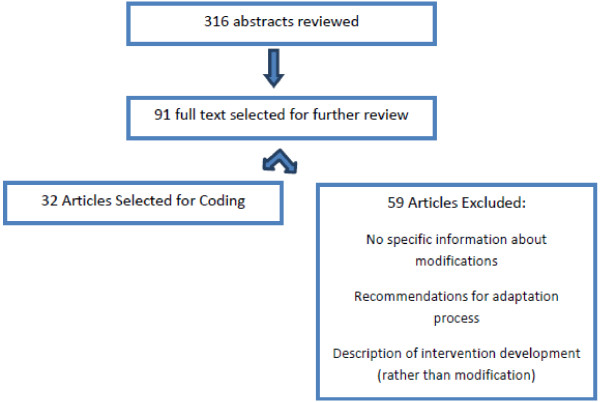
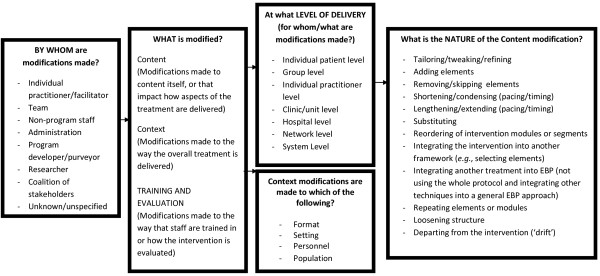
BACKGROUND: Evidence-based interventions are frequently modified or adapted during the implementation process. Changes may be made to protocols to meet the needs of the target population or address differences between the context in which the intervention was originally designed and the one into which it is implemented [Addict Behav 2011, 36(6):630-635]. However, whether modification compromises or enhances the desired benefits of the intervention is not well understood. A challenge to understanding the impact of specific types of modifications is a lack of attention to characterizing the different types of changes that may occur. A system for classifying the types of modifications that are made when interventions and programs are implemented can facilitate efforts to understand the nature of modifications that are made in particular contexts as well as the impact of these modifications on outcomes of interest. METHODS: We developed a system for classifying modifications made to interventions and programs across a variety of fields and settings. We then coded 258 modifications identified in 32 published articles that described interventions implemented in routine care or community settings. RESULTS: We identified modifications made to the content of interventions, as well as to the context in which interventions are delivered. We identified 12 different types of content modifications, and our coding scheme also included ratings for the level at which these modifications were made (ranging from the individual patient level up to a hospital network or community). We identified five types of contextual modifications (changes to the format, setting, or patient population that do not in and of themselves alter the actual content of the intervention). We also developed codes to indicate who made the modifications and identified a smaller subset of modifications made to the ways that training or evaluations occur when evidence-based interventions are implemented. Rater agreement analyses indicated that the coding scheme can be used to reliably classify modifications described in research articles without overly burdensome training. CONCLUSIONS: This coding system can complement research on fidelity and may advance research with the goal of understanding the impact of modifications made when evidence-based interventions are implemented. Such findings can further inform efforts to implement such interventions while preserving desired levels of program or intervention effectiveness.
Overview
The claims and statistics of this paper haven’t been checked yet.
Free: it reads the open-access text and checks the first 5 claims that cite a source we can check. Create a free account to check every claim.
Integrity signals
Registry
Cites
Statistics
Figures
Verification
Claims the paper makes
The claims and statistics of this paper haven’t been checked yet.
Free: it reads the open-access text and checks the first 5 claims that cite a source we can check. Create a free account to check every claim.
Claims other papers make about this one
Each is checked against this paper’s own text: does it say what the citing paper says it does?
The source backs part of the claim, not all of it — or backs it for a different population, condition or comparison.
In the citing paper
“which commonly involve a series of non-systematic adaptations (Stirman, Miller, Toder, & Calloway, 2013).”
From User‐centered design for psychosocial intervention development and implementation. (2016) · cites this paper as Stirman, Miller, Toder, & Calloway, 2013
Experimental — accuracy not yet measuredThe source backs part of the claim, not all of it — or backs it for a different population, condition or comparison.
In the citing paper
“Reported influences on sustainability include characteristics of the innovation and the individuals involved, leadership, capacity, processes, and context [2, 9, 13, 14].”
From Factors influencing sustainability and scale-up of rural primary healthcare memory clinics: perspectives of clinic team members (2022) · cites this paper as [2]
Experimental — accuracy not yet measuredThe source backs part of the claim, not all of it — or backs it for a different population, condition or comparison.
In the citing paper
“For example, while the 2013 and 2017 frameworks [15, 16] laid out distinct forms of modification that could be made to the content or mode of delivery, they did not specify when those modifications were designed to address important differences between the original population and the stakeholders in the current implementation effort (i.e., cultural adaptations).”
From The FRAME: an expanded framework for reporting adaptations and modifications to evidence-based interventions (2019) · cites this paper as [16]
Experimental — accuracy not yet measuredThe cited source says what the claim attributes to it.
In the citing paper
“More work is needed to determine what types of adaptation may specifically enhance sustainability and what types may erode the benefits or delivery of the intervention over time (135, 137).”
From The Sustainability of Evidence-Based Interventions and Practices in Public Health and Health Care (2018) · cites this paper as [137]
The cited source says what the claim attributes to it.
In the citing paper
“However, new approaches to identifying and coding EBI modifications and adaptations are promising in regard to rigorous study of adaptations and their impacts [63].”
From “Scaling-out” evidence-based interventions to new populations or new health care delivery systems (2017) · cites this paper as [63]
4 more claims about this paper
Create a free account to see every claim other papers make about this one.
Self-check
Percentages, sums and reported differences re-computed from the paper’s own numbers.
The self-check needs the paper’s full text.
Citations
Cites
The Measurement of Observer Agreement for Categorical Data
Landis, J. R., & Koch, G. G. (1977) · Biometrics · doi:10.2307/2529310 · Cited by 81,148 · cited 2×
“stantial agreement’ and ‘almost perfect’ agreement for the level and nature of modifications, respectively [52].”
BackgroundThe Discovery of Grounded Theory: Strategies for Qualitative Research.
Wagner, H. R., Glaser, B. G., & Strauss, A. L. (1968) · Social Forces · doi:10.2307/2575405 · Cited by 46,361
The Discovery of Grounded Theory; Strategies for Qualitative Research
Glaser, B. G., Strauss, A. L., & Strutzel, E. (1968) · Nursing Research · doi:10.1097/00006199-196807000-00014 · Cited by 39,449
(1998) · Sage eBooks · Cited by 38,631
(1990) · Cited by 11,110
Weighted kappa: nominal scale agreement provision for scaled disagreement or partial credit
Cohen, J. (1968) · Psychological Bulletin · doi:10.1037/h0026256 · Cited by 8,736 · cited 1×
“The two raters overlapped on 20% of the identified segments, and we computed Cohen’s kappa coefficients [31] to determine interrater reliability for each rating category.”
MethodDusenbury, L. (2003) · Health Education Research · doi:10.1093/her/18.2.237 · Cited by 1,671 · cited 1×
“cessary [4,6-10], few studies have examined the impact”
BackgroundWiltsey Stirman, S., Kimberly, J., Cook, N., Calloway, A., Castro, F., & Charns, M. (2012) · Implementation Science · doi:10.1186/1748-5908-7-17 · Cited by 1,355 · cited 3×
“The tension between modification and fidelity is a critical issue in implementation science [4,54,55].”
BackgroundSelf-citationThe Cultural Adaptation of Prevention Interventions: Resolving Tensions Between Fidelity and Fit
Castro, F. G., Barrera, M., & Martinez, C. R. (2004) · Prevention Science · doi:10.1023/b:prev.0000013980.12412.cd · Cited by 1,228 · cited 4×
“terms of their complexity and comprehensiveness [27].”
BackgroundInfluentialShediac-Rizkallah, M. C., & Bone, L. R. (1998) · Health Education Research · doi:10.1093/her/13.1.87 · Cited by 1,129
Research works printed but not linked: 1
- Schoenwald SK GA Chapman JE Frazier SL Sheidow AJ Southam-Gerow MA Toward the effective and efficient measurement of implementation fidelity Administration Policy Mental Health and Mental Health Serv Res 2011 38 1 32 43 10.1007/s10488-010-0321-0 PMC3045964 20957425 · DOI · Paper page
Cited by
Items 101–200 of 743
Reconciling Adaptation and Fidelity: Implications for Scaling Up High Quality Youth Programs
Anyon, Y., Roscoe, J. N., Bender, K., Kennedy, H., DeChants, J. P., Begun, S., & Gallager, C. (2019) · The Journal of Primary Prevention · doi:10.1007/s10935-019-00535-6 · Cited by 58
Smith, M. Y., & Morrato, E. H. (2014) · Drug Safety · doi:10.1007/s40264-014-0197-0 · Cited by 52
Malti, T., Noam, G. G., Beelmann, A., & Sommer, S. (2016) · Journal of Clinical Child & Adolescent Psychology · doi:10.1080/15374416.2016.1239539 · Cited by 55
Gordon, E. J., Lee, J. J., Kang, R. H., Caicedo, J. C., Holl, J. L., Ladner, D. P., & Shumate, M. (2018) · BMC Health Services Research · doi:10.1186/s12913-018-3151-5 · Cited by 50
“In particular, this research is poised to explain both the factors that led to particular types of modifications to the design and the impact of those modifications on patient outcomes [91].”
MethodGordon, E. J., Uriarte, J. J., Lee, J. J., Kang, R. H., Shumate, M., Ruiz, R. M., Mathur, A. K., Ladner, D. P., & Caicedo, J. C. (2021) · American Journal of Transplantation · doi:10.1111/ajt.16857 · Cited by 49
Mignogna, J., Martin, L. A., Harik, J., Hundt, N. E., Kauth, M., Naik, A. D., Sorocco, K., Benzer, J., & Cully, J. (2018) · Implementation Science · doi:10.1186/s13012-018-0768-z · Cited by 47
“Although implementation strategies such as fidelity monitoring and provider feedback can be used to reduce treatment “drift,” it is important to acknowledge that fidelity measures typically do not provide an exhaustive list of all prohibited and acceptable behaviors; therefore, fidelity monitoring alone is insufficien…”
BackgroundSong, M.-K., Ward, S. E., Hepburn, K., Paul, S., Kim, H., Shah, R. C., Morhardt, D. J., Medders, L., Lah, J. J., & Clevenger, C. C. (2019) · Journal of Palliative Medicine · doi:10.1089/jpm.2019.0088 · Cited by 47
Sripada, R. K., Bohnert, K. M., Ganoczy, D. A., & Pfeiffer, P. N. (2017) · Administration and Policy in Mental Health and Mental Health Services Research · doi:10.1007/s10488-017-0828-8 · Cited by 48
Principles of Precision Prevention Science for Improving Recruitment and Retention of Participants
Supplee, L. H., Parekh, J., & Johnson, M. (2018) · Prevention Science · doi:10.1007/s11121-018-0884-7 · Cited by 49
Just-in-Time Adaptive Interventions: Where Are We Now and What Is Next?
Nahum-Shani, I. B., & Murphy, S. A. (2025) · Annual Review of Psychology · doi:10.1146/annurev-psych-121024-044244 · Cited by 58
A systematic review of adaptations and effectiveness of scaled-up nutrition interventions
Sutherland, R., Jackson, J. K., Lane, C., McCrabb, S., Nathan, N., Yoong, S. L., Lum, M., Byaruhanga, J., McLaughlin, M. J., Brown, A., et al. (2021) · Nutrition Reviews · doi:10.1093/nutrit/nuab096 · Cited by 50
Methods for capturing and analyzing adaptations: implications for implementation research
Holtrop, J. S., Gurfinkel, D., Nederveld, A., Phimphasone‐Brady, P., Hosokawa, P. W., Rubinson, C., Waxmonsky, J. A., & Kwan, B. M. (2022) · Implementation Science · doi:10.1186/s13012-022-01218-3 · Cited by 48
“A key framework examining adaptations in the field of implementation research is the framework for reporting adaptations and modifications to evidence-based interventions (FRAME) [7, 14].”
BackgroundFidelity monitoring in complex interventions: a case study of the WISE intervention
Swindle, T., Selig, J. P., Rutledge, J. M., Whiteside-Mansell, L., & Curran, G. M. (2018) · Archives of Public Health · doi:10.1186/s13690-018-0292-2 · Cited by 49
A pilot study comparing tools for tracking implementation strategies and treatment adaptations
Walsh‐Bailey, C., Palazzo, L. G., Jones, S. M. W., Mettert, K. D., Powell, B. J., Stirman, S. W., Lyon, A. R., Rohde, P., & Lewis, C. C. (2021) · Implementation Research and Practice · doi:10.1177/26334895211016028 · Cited by 50
“The resulting coded data offered a characterization of the reported activities based on alignment with implementation strategy reporting recommendations (10) and the treatment adaptation framework (12) (Table 3).”
BackgroundMethodInfluentialSelf-citationBarriers and Facilitators to Scaling Up Outpatient Palliative Care
Bekelman, D. B., Rabin, B. A., Nowels, C. T., Sahay, A. P., Heidenreich, P. A., Fischer, S. M., & Main, D. S. (2016) · Journal of Palliative Medicine · doi:10.1089/jpm.2015.0280 · Cited by 47
Patient-Centered Outcomes Research
(2017) · doi:10.25302/67.2017.1 · Cited by 45
Bahar, O. S., Byansi, W., Kivumbi, A., Namatovu, P., Kiyingi, J., Ssewamala, F. M., McKay, M. M., & Nyoni, T. (2020) · Family Process · doi:10.1111/famp.12525 · Cited by 44
“…manual, instead of photographs used in the 4Rs and 2Ss curriculum, allowed the team to engage the community, localize the manual, and illustrate the culturally relevant content included in the curriculum (see Figure 4 adapted from Stirman et al., 2013 for modifications made to the intervention).”
MethodKoo, M. M., Unger‐Saldaña, K., Mwaka, A. D., Corbex, M. A., Ginsburg, O., Walter, F. M., Calanzani, N., Moodley, J., Rubin, G. P., & Lyratzopoulos, G. (2021) · JCO Global Oncology · doi:10.1200/go.20.00310 · Cited by 43
“Measuring outcomes specific to implementation can inform how best to adapt an intervention to real-life settings, determine effectiveness, and sustain and scale up efforts.(127,133) The Behaviour Change Wheel(128) and Normalization Process Theory(134) are some of the many theories and frameworks that have been adopted…”
BackgroundQuality improvement studies in nursing homes: a scoping review
Toles, M., Colon-Emeric, C. S., Moreton, E., Frey, L., & Leeman, J. (2021) · BMC Health Services Research · doi:10.1186/s12913-021-06803-8 · Cited by 44
“This information is key to understanding how clinical interventions and QI strategies work and to identify opportunities for further refinement [54, 55].”
BackgroundNaseh, M., Macgowan, M. J., Wagner, E. F., Abtahi, Z., Potocky, M., & Stuart, P. H. (2019) · Routledge eBooks · doi:10.1080/15313204.2019.1570891 · Cited by 45
Magaña, S., Dababnah, S., Xu, Y., Torres, M. G., Rieth, S. R., Corsello, C. M., Rangel, E., Brookman-Frazee, L. I., & Vanegas, S. B. (2021) · International review of research in developmental disabilities · doi:10.1016/bs.irrdd.2021.07.005 · Cited by 47
Gray, S. M., Franke, T., Sims‐Gould, J., & McKay, H. A. (2022) · BMC Public Health · doi:10.1186/s12889-022-13547-5 · Cited by 45
“Adaptation (outcome): planned or purposeful changes to the design or delivery of an intervention; can also include unintentional deviations from the intervention as originally designed [55]”
BackgroundAdapting improvements to context: when, why and how?
Øvretveit, J., Dolan-Branton, L., Marx, M., Reid, A., Reed, J. E., & Agins, B. (2018) · International Journal for Quality in Health Care · doi:10.1093/intqhc/mzy013 · Cited by 46
“using different cleaning material that was used in the original trial because this material is not available locally), or changing a payment or reporting arrangement from the original [10].”
BackgroundMethodBruijniks, S. J. E., Franx, G. C., & Huibers, M. J. H. (2018) · BMC Psychiatry · doi:10.1186/s12888-018-1768-x · Cited by 49
“In addition, the authors distinguish between fidelity-consistent modifications that do not alter core elements of treatment enough to reduce adherence to a protocol and do not reduce ability to differentiate between treatments, and fidelity-inconsistent modifications, such as modifications that reduce or preclude the…”
BackgroundKoh, S., Lee, M., Brotzman, L., & Shelton, R. C. (2018) · Translational Behavioral Medicine · doi:10.1093/tbm/iby095 · Cited by 45
“Empirical evidence on the impact of adaptation is limited; however, recent work toward this goal within the field of D&I includes classification of types of adaptations [39] and a call for an “Adaptome” platform to capture knowledge from different intervention delivery settings and populations [44].”
BackgroundIshikawa, S.-I., Kikuta, K., Sakai, M., Mitamura, T., Motomura, N., & Hudson, J. L. (2019) · Behaviour Research and Therapy · doi:10.1016/j.brat.2019.103432 · Cited by 39
Hasson, H., Sundell, K., Beelmann, A., & von Thiele Schwarz, U. (2014) · BMC Health Services Research · doi:10.1186/1472-6963-14-s2-o32 · Cited by 38
“…(Hodge et al., 2010; Huey & Polo, 2008), thus preventing us from considering all the aspects of adaptation (e.g., dosage, adherence) or levels of modification (e.g., those related to surface vs. deep structure) that have previously been suggested (e.g., Moore et al., 2013; Stirman et al., 2013).”
BackgroundMethodInfluentialBarnett, M. L., Brookman-Frazee, L. I., González, J. C., Zhan, C., Rodríguez, A., Stadnick, N. A., & Lau, A. S. (2018) · Journal of Clinical Child & Adolescent Psychology · doi:10.1080/15374416.2018.1485107 · Cited by 40
“, developing worksheets for all individuals in a particular ethnic group), or provider level (e.g., consistently removing a component of an EBP for all clients due to therapist preference; Baumann et al., 2017; Stirman et al., 2013).”
BackgroundResultInfluentialImplementation Science and Nutrition Education and Behavior: Opportunities for Integration
Swindle, T., Curran, G. M., & Johnson, S. L. (2019) · Journal of Nutrition Education and Behavior · doi:10.1016/j.jneb.2019.03.001 · Cited by 44
Preparing Nursing Contexts for Evidence‐Based Practice Implementation: Where Should We Go From Here?
Cassidy, C. E., Flynn, R., & Shuman, C. J. (2021) · Worldviews on Evidence-Based Nursing · doi:10.1111/wvn.12487 · Cited by 40
Lyon, A. R., & Lewis, C. C. (2016) · Administration and Policy in Mental Health and Mental Health Services Research · doi:10.1007/s10488-015-0704-3 · Cited by 39
“Similar to most psychosocial interventions (Stirman et al. 2013), MFS implementation in a new setting is likely to require a process of adaptation as well as a period during which an Adm Policy Ment Health (2016) 43:344–349 347”
BackgroundHohmeier, K. C., Wheeler, J. S., Turner, K., Vick, J. S., Marchetti, M. L., Crain, J., & Brookhart, A. (2019) · Implementation Science · doi:10.1186/s13012-019-0946-7 · Cited by 36
Patfield, S., Gore, J. M., & Harris, J. (2022) · Teaching and Teacher Education · doi:10.1016/j.tate.2022.103756 · Cited by 40
Understanding adaptations to patient-centered medical home activities: The PCMH adaptations model
Hall, T. L., Holtrop, J. S., Dickinson, L. M., & Glasgow, R. E. (2017) · Translational Behavioral Medicine · doi:10.1007/s13142-017-0511-3 · Cited by 37
“Most studies of adaptation have focused on tightly defined, evidence-based, and typically Bprotocolized or manualized^ interventions [13, 14].”
BackgroundInfluentialKim, J. J., Brookman-Frazee, L. I., Barnett, M. L., Tran, M., Kuckertz, M., Yu, S. H., & Lau, A. S. (2020) · Journal of Community Psychology · doi:10.1002/jcop.22333 · Cited by 36
“When implementing EBPs in real world settings, therapists often report the need to adapt EBPs in order to improve fit for their clients’ particular needs and circumstances (Aarons et al., 2012; Barnett et al., 2018; Lau et al., 2017; Stirman et al., 2013).”
BackgroundMethodSmith, M. J., Smith, J. D., Jordan, N., Sherwood, K. L., McRobert, E., Ross, B., Oulvey, E. A., & Atkins, M. S. (2020) · Journal of Special Education Technology · doi:10.1177/0162643420960093 · Cited by 37
“We also assessed prospective delivery and teacher context and adaptation based on Stirman and colleagues’ adaptation coding taxonomy (Stir-man et al., 2017; Stirman et al., 2013).”
MethodInfluentialAn Integrated Approach to Improve Maternal Mental Health and Well-Being During the COVID-19 Crisis
Shidhaye, R. R., Madhivanan, P., Shidhaye, P., & Krupp, K. (2020) · Frontiers in Psychiatry · doi:10.3389/fpsyt.2020.598746 · Cited by 38
“The evidencebased interventions described above should be adapted for the specific culture and the health system context before they are implemented (51).”
BackgroundWiltsey Stirman, S., Finley, E. P., Shields, N., Cook, J., Haine-Schlagel, R., Burgess, J. F., Dimeff, L., Koerner, K., Suvak, M., Gutner, C. A., et al. (2017) · Implementation Science · doi:10.1186/s13012-017-0544-5 · Cited by 35
Self-citationState of the Science: The Transdiagnostic Intervention for Sleep and Circadian Dysfunction
Harvey, A. G., & Sarfan, L. D. (2024) · Behavior Therapy · doi:10.1016/j.beth.2024.02.007 · Cited by 39
Tan, A. S. L., Mazor, K. M., McDonald, D. A., Lee, S. J., McNeal, D. M., Matlock, D. D., & Glasgow, R. E. (2018) · MDM Policy & Practice · doi:10.1177/2381468318808503 · Cited by 41
“This balance between fidelity to the core components of SDM and appropriate adaptation to local context is another contribution of implementation science to this work as both fidelity and appropriate adaptation to local contexts are needed.(23,42) Participants in the second group addressing educational curricula were…”
BackgroundSwindle, T., Johnson, S. L., Davenport, K., Whiteside-Mansell, L., Thirunavukarasu, T., Sadasavin, G., & Curran, G. M. (2019) · Journal of Nutrition Education and Behavior · doi:10.1016/j.jneb.2019.06.019 · Cited by 36
McCarthy, M. S., Motta, L. U., Nunnery, M. A., Gilmartin, H., Kelley, L. R., Wills, A., Leonard, C., Jones, C. D., & Rabin, B. A. (2021) · Implementation Science · doi:10.1186/s13012-021-01126-y · Cited by 37
“TNP was designed around four core intervention components that remained constant across sites: [15] assess patient discharge readiness at the bedside, [1] engage with primary care providers and PACT clinics to make them aware of their patients’ admission, [2] coordinate a PCP follow-up appointment for the veteran with…”
BackgroundMethodInfluentialUnderstanding the sustainment of population health programmes from a whole-of-system approach
Crane, M. A., Nathan, N., McKay, H. A., Lee, K., Wiggers, J., & Bauman, A. E. (2022) · Health Research Policy and Systems · doi:10.1186/s12961-022-00843-0 · Cited by 39
“Some contend that modifications are necessary [10, 14] and even preferred [53, 54], and while our research concurs, questions remain as to whether PPPs’ “core factors” need to be maintained to retain effectiveness and how to maintain effectiveness in a dynamic, shifting system.”
BackgroundThe Research Network on Youth Mental Health, Park, A. L., Chorpita, B. F., Regan, J., & Weisz, J. R. (2015) · Administration and Policy in Mental Health and Mental Health Services Research · doi:10.1007/s10488-014-0559-z · Cited by 34
Eisman, A. B., Kilbourne, A. M., Greene, D., Walton, M. A., & Cunningham, R. M. (2020) · Prevention Science · doi:10.1007/s11121-020-01120-8 · Cited by 34
“Fidelity-consistent adaptations are modifications that retain the functional effective program elements, but tailor form elements to meet local needs, thereby promoting fit and fidelity in implementation (Stirman et al. 2013).”
BackgroundInfluentialNewhouse, R. P. (2017) · doi:10.25302/67.2017 · Cited by 42
They’re Doing What? A Brief Paper on Service Use and Attitudes in ASD Community-Based Agencies
Pickard, K., Meza, R., Drahota, A., & Brikho, B. (2018) · Journal of Mental Health Research in Intellectual Disabilities · doi:10.1080/19315864.2017.1408725 · Cited by 33
Pestka, D. L., Espersen, C., Sorge, L. A., & Funk, K. A. (2020) · JACCP JOURNAL OF THE AMERICAN COLLEGE OF CLINICAL PHARMACY · doi:10.1002/jac5.1254 · Cited by 33
Pickard, K. E., Mellman, H., Frost, K. M., Reaven, J., & Ingersoll, B. R. (2021) · Journal of Autism and Developmental Disorders · doi:10.1007/s10803-021-04882-4 · Cited by 33
Dickson, K. S., Lind, T., Jobin, A., Kinnear, M., Lok, H., & Brookman-Frazee, L. I. (2021) · Administration and Policy in Mental Health and Mental Health Services Research · doi:10.1007/s10488-021-01133-7 · Cited by 36
Whitmyre, E. D., Esposito-Smythers, C. L., López, R., Goldberg, D. G., Liu, F. F., & Defayette, A. B. (2024) · Clinical Child and Family Psychology Review · doi:10.1007/s10567-024-00498-z · Cited by 36
Classification schemes for knowledge translation interventions: a practical resource for researchers
Slaughter, S. E., Zimmermann, G. L., Nuspl, M., Hanson, H. M., Albrecht, L., Esmail, R., Sauro, K. M., Newton, A. S., Donald, M., Dyson, M. P., et al. (2017) · BMC Medical Research Methodology · doi:10.1186/s12874-017-0441-2 · Cited by 35
Wright, N. J., Abantanga, F. A., Amoah, M., Appeadu‐Mensah, W., Bokhary, Z. M., Bvulani, B., Davies, J. I., Miti, S., Nandi, B., Nimako, B., et al. (2019) · Wellcome Open Research · doi:10.12688/wellcomeopenres.15113.1 · Cited by 36
Georgiadis, C., Peris, T. S., & Comer, J. S. (2020) · Evidence-Based Practice in Child and Adolescent Mental Health · doi:10.1080/23794925.2020.1796550 · Cited by 32
Schwarz, U. V. T., Giannotta, F., Neher, M., Zetterlund, J., & Hasson, H. (2021) · Implementation Science Communications · doi:10.1186/s43058-021-00131-y · Cited by 33
Shepherd‐Banigan, M. E., Kaufman, B. G., Decosimo, K. P., Dadolf, J., Boucher, N. A., Mahanna, E. P., Bruening, R., Sullivan, C., Wang, V., Hastings, S. N., et al. (2019) · Journal of Nursing Scholarship · doi:10.1111/jnu.12511 · Cited by 32
“…are categorized by a combination of Lee’s planned adaptation framework (Lee et al., 2008) and Wiltsey Stirman’s adaptation typology (Wiltsey Stirman et al., 2013). iHI-FIVES = Implementing HI-FIVES; RCT = randomized controlled trial; VAMC, Veterans Administration Medical Center.…”
MethodDickson, K. S., Lind, T., Jobin, A., Kinnear, M., Lok, H., & Brookman-Frazee, L. I. (2021) · Administration and Policy in Mental Health and Mental Health Services Research · doi:10.1007/s10488-021-01144-4 · Cited by 32
Hugh‐Jones, S., Naidu, J., Al‐Janabi, H., Bhola, P., Cooke, P. A., Fazel, M. S., Hudson, K., Khandeparkar, P., Mirzoev, T. N., Venkataraman, S., et al. (2022) · BMJ Open · doi:10.1136/bmjopen-2021-054897 · Cited by 35
Szlamka, Z., Hanlon, C., Tekola, B., Pacione, L. R., Salomone, E., WHO CST Team, Servili, C., & Hoekstra, R. A. (2022) · PLoS ONE · doi:10.1371/journal.pone.0272077 · Cited by 36
“Some studies consider contextual changes to be part of the implementation and not the adaptation process [34, 35].”
BackgroundTümkaya, S. (2012) · Educational Sciences Theory & Practice · Cited by 50
McLaughlin, M. J., Duff, J. S., Sutherland, R., Campbell, E. M., Wolfenden, L., & Wiggers, J. (2020) · Trials · doi:10.1186/s13063-020-4187-5 · Cited by 31
Yoong, S. L., Alderman, K. B., Grady, A., Wyse, R., Sutherland, R., Hodder, R. K., Kingsland, M., Nathan, N., McCrabb, S., Bauman, A. E., et al. (2020) · Health Education Research · doi:10.1093/her/cyaa014 · Cited by 30
Zakumumpa, H., Bennett, S., & Ssengooba, F. (2017) · Implementation Science · doi:10.1186/s13012-017-0578-8 · Cited by 35
“[27]; we adopted the four broad classifications relating to contextual modifications to interventions, namely (i) format (ii) setting (iii) personnel, and (iv) population.”
BackgroundMethodInfluentialValente, J. Y., & Sanchez, Z. M. (2021) · Prevention Science · doi:10.1007/s11121-021-01277-w · Cited by 30
“, 2018), which suggests that areas of further studies should focus on guiding this process to build efforts to assist professionals in culturally adapting interventions (Stirman et al., 2013).”
BackgroundJeong, J., Bliznashka, L., Ahun, M. N., Karuskina‐Drivdale, S., Picolo, M., Lalwani, T., Pinto, J., Frey, M., Velthauz, D., Donco, R., et al. (2021) · Annals of the New York Academy of Sciences · doi:10.1111/nyas.14718 · Cited by 31
Mishu, M. P., Tindall, L., Kerrigan, P., & Gega, L. (2023) · PLOS ONE · doi:10.1371/journal.pone.0290653 · Cited by 28
Ragnarsson, E. H., Reinebo, G., Ingvarsson, S., Lindgren, A., Beckman, M., Alfonsson, S., Hedman‐Lagerlöf, M., Rahm, C., Sahlin, H., Stenfors, T., et al. (2024) · Clinical Psychology & Psychotherapy · doi:10.1002/cpp.3003 · Cited by 30
Stirman, S. W., Shields, N., Deloriea, J., Landy, M. S. H., Belus, J. M., Maslej, M. M., & Monson, C. M. (2013) · Implementation Science · doi:10.1186/1748-5908-8-82 · Cited by 29
Self-citationVilleval, M., Gaborit, É., Bérault, F., Lang, T., & Kelly‐Irving, M. (2019) · Implementation Science · doi:10.1186/s13012-019-0880-8 · Cited by 31
Copeland, L., Littlecott, H., Couturiaux, D., Hoddinott, P., Segrott, J., Murphy, S., Moore, G. F., & Evans, R. (2021) · PLoS ONE · doi:10.1371/journal.pone.0254020 · Cited by 30
“The qualitative analysis further identified key debates and areas of uncertainty for exploration, reflecting some of the findings of recent reviews [1, 2, 16].”
ResultBaker‐Henningham, H. (2018) · Annals of the New York Academy of Sciences · doi:10.1111/nyas.13713 · Cited by 32
Hoekstra, F., Hoekstra, T., van der Schans, C. P., Hettinga, F. J., van der Woude, L. H. V., Dekker, R., & on behalf of ReSpAct-group (2019) · Disability and Rehabilitation · doi:10.1080/09638288.2019.1675188 · Cited by 30
Penney, L., Nahid, M., Leykum, L. K., Lanham, H. J., Noël, P. H., Finley, E. P., & Pugh, J. A. (2018) · BMC Health Services Research · doi:10.1186/s12913-018-3712-7 · Cited by 30
“, [73, 74]) is helping expose the importance of both carefully documenting modifications as they happen and understanding adaptations as important for intervention success.”
BackgroundXu, Y., Chen, F., Mirza, M. P., & Magaña, S. (2022) · Journal of Policy and Practice in Intellectual Disabilities · doi:10.1111/jppi.12432 · Cited by 28
Treichler, E. B. H., Mercado, R., Oakes, D., Perivoliotis, D., Gallegos-Rodriguez, Y., Sosa, E., Cisneros, E., Spaulding, W. D., Granholm, E. L., Light, G. A., et al. (2022) · BMC Health Services Research · doi:10.1186/s12913-022-08833-2 · Cited by 29
“When such adaptations are made using a well-intentioned but ad hoc or reactive approach, it becomes increasingly likely that the changes will ultimately result in decreased fidelity and lessened effectiveness [5].”
BackgroundPilar, M. R., Jost, E., Walsh‐Bailey, C., Powell, B. J., Mazzucca, S., Eyler, A. A., Purtle, J., Allen, P. M., & Brownson, R. C. (2022) · Implementation Research and Practice · doi:10.1177/26334895221141116 · Cited by 30
Ayele, R. A., Lawrence, E. C., McCreight, M. S., Fehling, K. B., Peterson, J., Glasgow, R. E., Rabin, B. A., Burke, R. E., & Battaglia, C. T. (2017) · BMC Health Services Research · doi:10.1186/s12913-017-2048-z · Cited by 29
“For all aims, we will use the Stirman Framework [26] to systematically track adaptations and modifications to both data gathering methods and the formation and adaptation of the intervention and its implementation.”
MethodIsaksen, J., Beeke, S., Pais, A. M., Efstratiadou, E.-A., Pauranik, A., Revkin, S. K., Vandana, V. P., Valencia, F., Vuksanović, J., & Jagoe, C. (2022) · International Journal of Speech-Language Pathology · doi:10.1080/17549507.2022.2145355 · Cited by 29
“training content and materials); develop an in-depth understanding of the cultural context; carefully modify the items, elements and processes regarded as contextually (Stirman et al., 2013) and culturally (Kiran & Krishnan, 2013) irrelevant; and finally, evaluate the adapted intervention and resources.”
BackgroundInfluentialProcess Evaluation of Implementation Strategies
Hulscher, M., & Wensing, M. (2020) · Wiley eBooks · doi:10.1002/9781119488620.ch22 · Cited by 30
Schilling, S., Mebane, A., & Perreira, K. M. (2021) · Family Process · doi:10.1111/famp.12658 · Cited by 29
Orengo‐Aguayo, R., Stewart, R. W., Villalobos, B. T., Rodríguez, J. H., Dueweke, A. R., de Arellano, M. A., & Young, J. N. (2020) · American Psychologist · doi:10.1037/amp0000691 · Cited by 26
Hinton, L., Nguyen, H., Nguyen, H. T., Harvey, D. J., Nichols, L. O., Martindale-Adams, J. L., Nguyen, B. T., Nguyễn, B. T. T., Nguyen, A. N., Nguyen, C. H., et al. (2020) · Alzheimer s & Dementia Translational Research & Clinical Interventions · doi:10.1002/trc2.12063 · Cited by 26
Rabin, B. A., Cain, K. L., & Glasgow, R. E. (2024) · Annual Review of Public Health · doi:10.1146/annurev-publhealth-071321-041652 · Cited by 25
Jäger, C., Steinhäuser, J., Freund, T., Kuse, S., Szécsényi, J., & Wensing, M. (2017) · Implementation Science · doi:10.1186/s13012-017-0559-y · Cited by 25
“It distinguishes the following key questions: By whom is what (content, context or evaluation) at what level of delivery modified and what is the nature of content modifications [17]?”
BackgroundDifferent approaches to making and testing change in healthcare
Ogrinc, G. S., Dolansky, M. A., Berman, A. J., Chambers, D., & Davies, L. (2021) · BMJ · doi:10.1136/bmj.n1010 · Cited by 26
Knox, M. J., Esteban, E. E., Hernandez, E. A., Fleming, M. D., Safaeinili, N., & Brewster, A. L. (2022) · BMJ Open Quality · doi:10.1136/bmjoq-2021-001807 · Cited by 32
Tensions and Paradoxes of Scaling Up: A Critical Reflection on Physical Activity Promotion
Koorts, H., Bauman, A. E., Edwards, N. C., Bellew, W., Brown, W. J., Duncan, M. J., Lubans, D. R., Milat, A., Morgan, P. J., Nathan, N., et al. (2022) · International Journal of Environmental Research and Public Health · doi:10.3390/ijerph192114284 · Cited by 25
A Scoping Study of Cultural Adaptation Frameworks
Leung, J., Sekar, S., Madrigal, L., & Escoffery, C. (2024) · Health Promotion Practice · doi:10.1177/15248399241292317 · Cited by 26
“…components modified, (e) the level of delivery the modification(s) was made, (f) type of context or content-level modifications, (g) the extent to which the modification has fidelity to the original program, and (h) the reasons for the changes (Stirman et al., 2013; Wiltsey Stirman et al., 2019).”
Tabak, R. G., Strickland, J. R., Stein, R. I., Dart, H., Colditz, G. A., Kirk, B., Dale, A. M., & Evanoff, B. (2018) · BMC Public Health · doi:10.1186/s12889-018-6176-0 · Cited by 27
“This framework was developed based on a review of articles describing modifications to evidence-based practices across a variety of interventions and settings [55, 57].”
MethodResultLengnick-Hall, R., Willging, C. E., Hurlburt, M. S., & Aarons, G. A. (2020) · Implementation Science · doi:10.1186/s13012-020-01031-w · Cited by 24
Siu, A. L., Zimbroff, R. M., Federman, A. D., DeCherrie, L. V., Garrido, M. M., Morano, B., Lubetsky, S., Catalan, E., & Leff, B. A. (2019) · BMC Health Services Research · doi:10.1186/s12913-019-4063-8 · Cited by 26
King, P. R., Beehler, G. P., Donnelly, K. T., Funderburk, J. S., & Wray, L. O. (2021) · Professional Psychology Research and Practice · doi:10.1037/pro0000371 · Cited by 27
Eisman, A. B., Palinkas, L. A., Brown, S., Lundahl, L. H., & Kilbourne, A. M. (2022) · Implementation Research and Practice · doi:10.1177/26334895221124962 · Cited by 28
“Peripheral or form elements represent possible activities or methods (e.g., role-playing) to achieve the core functions (e.g., skill building; Stirman et al., 2013).”
BackgroundInfluentialCohen, A. J., Russell, L. E., Elwy, A. R., Mitchell, K. M., Cornell, P. Y., Silva, J. W., Moy, E. M., & Kennedy, M. A. (2023) · Frontiers in Health Services · doi:10.3389/frhs.2022.958969 · Cited by 25
Valenta, S., Ribaut, J., Leppla, L., Mielke, J., Teynor, A., Koehly, K., Gerull, S., Grossmann, F. F., Witzig-Brändli, V., Geest, S. D., et al. (2023) · Frontiers in Health Services · doi:10.3389/frhs.2022.977564 · Cited by 29
“(9) developed a coding system (66) and added additional considerations such as reason for adaptation (e.”
BackgroundVelasco, V., Griffin, K. W., Antichi, M., & Celata, C. (2015) · Evaluation and Program Planning · doi:10.1016/j.evalprogplan.2015.03.002 · Cited by 29
ReSpAct group, Hoekstra, F., Offenbeek, V. M., Dekker, R., Hettinga, F. J., Hoekstra, T., van der Woude, L. H. V., & van der Schans, C. P. (2017) · Implementation Science · doi:10.1186/s13012-017-0667-8 · Cited by 24
“By showing the role of the organization’s change vision in achieving high implementation fidelity, the fidelity-vision tension extends earlier research on the ‘fidelity-adaptability’ tension [5, 6, 17, 48].”
BackgroundGray, S. M., McKay, H. A., Hoy, C. L., Lau, E. Y., Ahn, R., Lusina‐Furst, S., & Sims‐Gould, J. (2020) · Prevention Science · doi:10.1007/s11121-019-01085-3 · Cited by 26
Hill, J., Cuthel, A. M., Lin, P., & Grudzen, C. R. (2020) · Contemporary Clinical Trials Communications · doi:10.1016/j.conctc.2020.100570 · Cited by 28
Irungu, E., Odoyo, J. B., Wamoni, E., Bukusi, E. A., Mugo, N., Ngure, K., Morton, J. F., Mugwanya, K. K., Baeten, J. M., O’Malley, G., et al. (2021) · Journal of the International AIDS Society · doi:10.1002/jia2.25799 · Cited by 25
“Research reporting on the full range of modifications and adaptations made to interventions in routine care settings is limited [14,53].”
Background
Metadata
- Authors
- Stirman, S. W., Miller, C. J., Toder, K., & Calloway, A.
- Affiliations
- National Center for PTSD (US)
- VA Boston Healthcare System (US)
- University of Pennsylvania (US)
- University of Massachusetts Boston (US)
- Corresponding author
- Stirman, Shannon Wiltsey
- Venue
- Implementation Science
- Published
- 2013-06-10
- Volume
- 8
- Issue
- 1
- Pages
- 65-65
- ISSN
- 1748-5908 (ISSN-L)
- PMC
- PMC3686699
- OpenAlex
- W2109880945
- Cited by
- 691
- References
- 59
- Citations by year
- 2026: 49 · 2025: 50 · 2024: 61 · 2023: 79 · 2022: 76 · 2021: 97 · 2020: 72 · 2019: 69 · 2018: 40 · 2017: 40 · 2016: 19 · 2015: 22 · 2014: 12 · 2013: 3
- FWCI
- 33.81
- Type
- journal article
- Language
- en
- Open access
- gold
- doi.org
- Licence
- Locations
- Implementation Science (publishedVersion, cc-by)
- Europe PMC (PubMed Central) (publishedVersion, cc-by)
- PubMed Central (publishedVersion, cc-by)
- PubMed (publishedVersion)
- Funders
- U.S. Department of Veterans Affairs (R25 MH080916-01A2)
- Washington University in St. Louis (R25 MH080916-01A2)
- National Institutes of Health
- Quality Enhancement Research Initiative (R25 MH080916-01A2)
- National Institute of Mental Health (MH080916, R00 MH 01800, R00MH080100, R25MH080916)
- Topics
- Health Sciences › Health Professions › General Health Professions › Health Policy Implementation Science
- Health Sciences › Health Professions › General Health Professions › Health Sciences Research and Education
- Social Sciences › Public Administration › Evaluation and Performance Assessment
- Keywords
- evidence-based interventions, intervention adaptation, coding scheme, implementation fidelity, community settings, rater agreement, intervention effectiveness
- MeSH terms
- Mental Disorders, Behavioral Medicine, Community Mental Health Services, Decision Making, Delivery of Health Care, Humans, Evidence-Based Medicine, Clinical Coding
About these checks
Registry, retraction, Cites and statistics results are computed, not judged, with one exception: a printed reference that no index lists is read once by a model before it counts as a citation error. Claims are extracted by a model and kept only when their quote appears verbatim in the text; each cited source is then checked, with a model’s help, for whether it says what the claim relies on. Those verdicts can be wrong — read the claim’s quote and the cited source before relying on one.
Statistics and arithmetic are recomputed, not judged.
Confidence bands are shown only for fields calibrated on our annotated test set. None is calibrated yet, so no band is shown.
What counts as a claim ›How we measure confidence ›How we check this ›
Are you an author, or do you see a problem with this page? Request a review
Data sources
Bibliographic data: Semantic Scholar, OpenAlex, Crossref.
Contains information from the Semantic Scholar Academic Graph Datasets, made available under the ODC Attribution License (ODC-BY 1.0).
Semantic Scholar’s data is described in: Kinney, R., et al. (2023). The Semantic Scholar Open Data Platform. arXiv:2301.10140.
