

Development of a framework and coding system for modifications and adaptations of evidence-based interventions
Open accessThe DOI matches its Crossref record; 59 of the 60 references it cites were found in a registry or an index.
Abstract
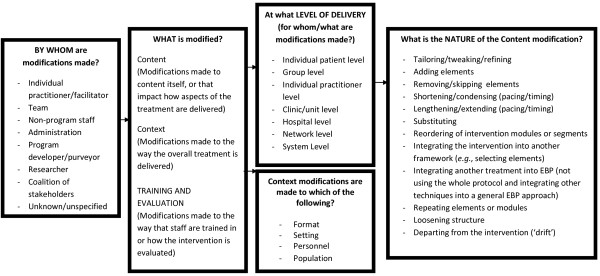
BACKGROUND: Evidence-based interventions are frequently modified or adapted during the implementation process. Changes may be made to protocols to meet the needs of the target population or address differences between the context in which the intervention was originally designed and the one into which it is implemented [Addict Behav 2011, 36(6):630-635]. However, whether modification compromises or enhances the desired benefits of the intervention is not well understood. A challenge to understanding the impact of specific types of modifications is a lack of attention to characterizing the different types of changes that may occur. A system for classifying the types of modifications that are made when interventions and programs are implemented can facilitate efforts to understand the nature of modifications that are made in particular contexts as well as the impact of these modifications on outcomes of interest. METHODS: We developed a system for classifying modifications made to interventions and programs across a variety of fields and settings. We then coded 258 modifications identified in 32 published articles that described interventions implemented in routine care or community settings. RESULTS: We identified modifications made to the content of interventions, as well as to the context in which interventions are delivered. We identified 12 different types of content modifications, and our coding scheme also included ratings for the level at which these modifications were made (ranging from the individual patient level up to a hospital network or community). We identified five types of contextual modifications (changes to the format, setting, or patient population that do not in and of themselves alter the actual content of the intervention). We also developed codes to indicate who made the modifications and identified a smaller subset of modifications made to the ways that training or evaluations occur when evidence-based interventions are implemented. Rater agreement analyses indicated that the coding scheme can be used to reliably classify modifications described in research articles without overly burdensome training. CONCLUSIONS: This coding system can complement research on fidelity and may advance research with the goal of understanding the impact of modifications made when evidence-based interventions are implemented. Such findings can further inform efforts to implement such interventions while preserving desired levels of program or intervention effectiveness.
Overview
The claims and statistics of this paper haven’t been checked yet.
Free: it reads the open-access text and checks the first 5 claims that cite a source we can check. Create a free account to check every claim.
Integrity signals
Registry
Cites
Statistics
Figures
Verification
Claims the paper makes
The claims and statistics of this paper haven’t been checked yet.
Free: it reads the open-access text and checks the first 5 claims that cite a source we can check. Create a free account to check every claim.
Claims other papers make about this one
Each is checked against this paper’s own text: does it say what the citing paper says it does?
The source backs part of the claim, not all of it — or backs it for a different population, condition or comparison.
In the citing paper
“which commonly involve a series of non-systematic adaptations (Stirman, Miller, Toder, & Calloway, 2013).”
From User‐centered design for psychosocial intervention development and implementation. (2016) · cites this paper as Stirman, Miller, Toder, & Calloway, 2013
Experimental — accuracy not yet measuredThe source backs part of the claim, not all of it — or backs it for a different population, condition or comparison.
In the citing paper
“Reported influences on sustainability include characteristics of the innovation and the individuals involved, leadership, capacity, processes, and context [2, 9, 13, 14].”
From Factors influencing sustainability and scale-up of rural primary healthcare memory clinics: perspectives of clinic team members (2022) · cites this paper as [2]
Experimental — accuracy not yet measuredThe source backs part of the claim, not all of it — or backs it for a different population, condition or comparison.
In the citing paper
“For example, while the 2013 and 2017 frameworks [15, 16] laid out distinct forms of modification that could be made to the content or mode of delivery, they did not specify when those modifications were designed to address important differences between the original population and the stakeholders in the current implementation effort (i.e., cultural adaptations).”
From The FRAME: an expanded framework for reporting adaptations and modifications to evidence-based interventions (2019) · cites this paper as [16]
Experimental — accuracy not yet measuredThe cited source says what the claim attributes to it.
In the citing paper
“More work is needed to determine what types of adaptation may specifically enhance sustainability and what types may erode the benefits or delivery of the intervention over time (135, 137).”
From The Sustainability of Evidence-Based Interventions and Practices in Public Health and Health Care (2018) · cites this paper as [137]
The cited source says what the claim attributes to it.
In the citing paper
“However, new approaches to identifying and coding EBI modifications and adaptations are promising in regard to rigorous study of adaptations and their impacts [63].”
From “Scaling-out” evidence-based interventions to new populations or new health care delivery systems (2017) · cites this paper as [63]
4 more claims about this paper
Create a free account to see every claim other papers make about this one.
Self-check
Percentages, sums and reported differences re-computed from the paper’s own numbers.
The self-check needs the paper’s full text.
Citations
Cites
The Measurement of Observer Agreement for Categorical Data
Landis, J. R., & Koch, G. G. (1977) · Biometrics · doi:10.2307/2529310 · Cited by 81,148 · cited 2×
“stantial agreement’ and ‘almost perfect’ agreement for the level and nature of modifications, respectively [52].”
BackgroundThe Discovery of Grounded Theory: Strategies for Qualitative Research.
Wagner, H. R., Glaser, B. G., & Strauss, A. L. (1968) · Social Forces · doi:10.2307/2575405 · Cited by 46,361
The Discovery of Grounded Theory; Strategies for Qualitative Research
Glaser, B. G., Strauss, A. L., & Strutzel, E. (1968) · Nursing Research · doi:10.1097/00006199-196807000-00014 · Cited by 39,449
(1998) · Sage eBooks · Cited by 38,631
(1990) · Cited by 11,110
Weighted kappa: nominal scale agreement provision for scaled disagreement or partial credit
Cohen, J. (1968) · Psychological Bulletin · doi:10.1037/h0026256 · Cited by 8,736 · cited 1×
“The two raters overlapped on 20% of the identified segments, and we computed Cohen’s kappa coefficients [31] to determine interrater reliability for each rating category.”
MethodDusenbury, L. (2003) · Health Education Research · doi:10.1093/her/18.2.237 · Cited by 1,671 · cited 1×
“cessary [4,6-10], few studies have examined the impact”
BackgroundWiltsey Stirman, S., Kimberly, J., Cook, N., Calloway, A., Castro, F., & Charns, M. (2012) · Implementation Science · doi:10.1186/1748-5908-7-17 · Cited by 1,355 · cited 3×
“The tension between modification and fidelity is a critical issue in implementation science [4,54,55].”
BackgroundSelf-citationThe Cultural Adaptation of Prevention Interventions: Resolving Tensions Between Fidelity and Fit
Castro, F. G., Barrera, M., & Martinez, C. R. (2004) · Prevention Science · doi:10.1023/b:prev.0000013980.12412.cd · Cited by 1,228 · cited 4×
“terms of their complexity and comprehensiveness [27].”
BackgroundInfluentialShediac-Rizkallah, M. C., & Bone, L. R. (1998) · Health Education Research · doi:10.1093/her/13.1.87 · Cited by 1,129
Research works printed but not linked: 1
- Schoenwald SK GA Chapman JE Frazier SL Sheidow AJ Southam-Gerow MA Toward the effective and efficient measurement of implementation fidelity Administration Policy Mental Health and Mental Health Serv Res 2011 38 1 32 43 10.1007/s10488-010-0321-0 PMC3045964 20957425 · DOI · Paper page
Cited by
Items 201–300 of 743
Beidas, R. S., Stewart, R. E., Wolk, C. B., Adams, D. R., Marcus, S. C., Evans, A. C., Jackson, K., Neimark, G. B., Hurford, M. O., Erney, J., et al. (2016) · Psychiatric Services · doi:10.1176/appi.ps.201500234 · Cited by 24
Cooper, D. K., Wieling, E. A., Rodríguez, M. M. D., Garcia‐Huidobro, D., Baumann, A. A., Mejía, A., Le, H., Cardemil, E. V., & Acevedo-Polakovich, I. D. (2019) · Family Process · doi:10.1111/famp.12433 · Cited by 25
Holtrop, J. S., Potworowski, G. A., Green, L. A., & Fetters, M. D. (2016) · Journal of Mixed Methods Research · doi:10.1177/1558689816668689 · Cited by 26
(2017) · doi:10.25302/67.2017.3 · Cited by 25
Implementing interventions to start HPV vaccination at age 9: Using the evidence we have
Brandt, H. M., Footman, A. P., Adsul, P., Ramanadhan, S., & Kepka, D. (2023) · Human Vaccines & Immunotherapeutics · doi:10.1080/21645515.2023.2180250 · Cited by 24
“The Framework for Modification and Adaptations was developed to document modifications to evidence-based interventions.(58) This framework assesses and documents by whom modifications are made, what is modified, at what level of delivery (for whom or what modifications made), which context modifications are made, and…”
MethodDanitz, S. B., Stirman, S. W., Grillo, A. R., Dichter, M. E., Driscoll, M., Gerber, M. R., Gregor, K. L., Hamilton, A. B., & Iverson, K. M. (2019) · BMC Women s Health · doi:10.1186/s12905-019-0837-8 · Cited by 22
“This study supports utilization of Wiltsey Stirman and colleagues’ framework when conducting UCD research throughout the treatment development and evaluation for identifying content, context, and training modifications to interventions [38].”
BackgroundMethodInfluentialSelf-citationSmith, M. J., Mitchell, J. A., Blajeski, S., Parham, B., Harrington, M. M., Ross, B., Sinco, B., Brydon, D. M., Johnson, J. E., Cuddeback, G. S., et al. (2020) · Contemporary Clinical Trials Communications · doi:10.1016/j.conctc.2020.100604 · Cited by 12
Madrigal, C. B., Mills, W. L., Keleher, V., Pimentel, C. B., Hartmann, C. W., Snow, A. L., Camp, C. J., & Hilgeman, M. M. (2022) · The Gerontologist · doi:10.1093/geront/gnac133 · Cited by 23
Christie, L., McCluskey, A., & Lovarini, M. (2019) · Australian Occupational Therapy Journal · doi:10.1111/1440-1630.12567 · Cited by 23
Gopalan, G., Bunger, A. C., & Powell, B. J. (2019) · Administration and Policy in Mental Health and Mental Health Services Research · doi:10.1007/s10488-019-00930-5 · Cited by 23
Scaling up improvements more quickly and effectively
Øvretveit, J., Garofalo, L., & Mittman, B. S. (2017) · International Journal for Quality in Health Care · doi:10.1093/intqhc/mzx147 · Cited by 24
“Scale up research needs to assess the fidelity of the implementation of the improvement change made at each site: did they copy the change exactly and, if not, why not? In most cases, sites make adaptations and, if so, these need to be described: there are some frameworks that can guide researcher’s data collection so…”
BackgroundTandon, S. D., McGown, M., Campbell, L., Smith, J. D., Yeh, C., & Brady, C. (2022) · Journal of Affective Disorders · doi:10.1016/j.jad.2022.07.033 · Cited by 21
Kirk, J. W., Nilsen, P., Andersen, O., Stefánsdóttir, N. T., Grønfeldt, B., Brødsgaard, R., Pedersen, B. S., Bandholm, T., Tjørnhøj-Thomsen, T., & Pedersen, M. M. (2021) · BMC Health Services Research · doi:10.1186/s12913-021-07142-4 · Cited by 21
“If an intervention is adapted and not delivered as conceived and planned, it is said to have low fidelity [2].”
BackgroundResultInfluentialTaylor, C., Harris, J., Stenner, K. L., Sevdalis, N., & Green, J. S. A. (2021) · Cancer Medicine · doi:10.1002/cam4.3719 · Cited by 23
Gewali, A., Lopez, A. R., Dachelet, K., Healy, E., Jean-Baptiste, M., Harridan, H., Evans, Y. N., Unger, J. A., Bhat, A. S., Tandon, S. D., et al. (2021) · JMIR Mental Health · doi:10.2196/26188 · Cited by 23
“modified (context, content, or training), the nature of the modification, who made the modification, when in the process of implementation was the modification done, the reason and goal of the modification, and whether the modification was fidelity-consistent [37,38].”
Backgroundde Moel‐Mandel, C., Lynch, C., Issaka, A., Braver, J., Zisis, G., Carrington, M. J., & Oldenburg, B. F. (2023) · BMC Health Services Research · doi:10.1186/s12913-023-10361-6 · Cited by 23
“In our review, we found no available information on adaptations made prior to, during, and after program implementation, even though Stirman et al. [24] highlighted that this information is required to understand how to adapt interventions to different contexts while retaining critical components.”
BackgroundAndersen, L. L., Geisle, N., & Knudsen, B. (2017) · Scandinavian Journal of Work Environment & Health · doi:10.5271/sjweh.3692 · Cited by 21
Fidelity and influencing factors in the Systemic Practice Model of children's social care in Finland
Isokuortti, N., & Aaltio, E. (2020) · Children and Youth Services Review · doi:10.1016/j.childyouth.2020.105647 · Cited by 30
Njuguna, I. N., Beima‐Sofie, K., Mburu, C. W., Mugo, C., Neary, J., Itindi, J., Onyango, A., Richardson, B. A., Means, A. R., Sharma, M., et al. (2020) · BMJ Open · doi:10.1136/bmjopen-2020-039972 · Cited by 25
Ametaj, A., Smith, A. M., & Valentine, S. E. (2021) · Administration and Policy in Mental Health and Mental Health Services Research · doi:10.1007/s10488-021-01129-3 · Cited by 22
Kakeeto, M., Lundmark, R., Hasson, H., & Schwarz, U. V. T. (2017) · Journal of Evaluation in Clinical Practice · doi:10.1111/jep.12726 · Cited by 21
Morgan, D., Kosteniuk, J., O’Connell, M. E., Seitz, D., Elliot, V., Bayly, M., Chow, A. F., & Cameron, C. (2022) · BMC Health Services Research · doi:10.1186/s12913-022-07550-0 · Cited by 20
von Thiele Schwarz, U., Förberg, U., Sundell, K., & Hasson, H. (2018) · BMC Medical Research Methodology · doi:10.1186/s12874-018-0496-8 · Cited by 20
“’s framework, that is, including adaptations in content, procedure, dosage, setting, format or target population [12].”
BackgroundZetterlund, J., Schwarz, U. V. T., Hasson, H., & Neher, M. (2022) · Frontiers in Health Services · doi:10.3389/frhs.2022.883072 · Cited by 20
“Common adaptations include the procedure, content, dosage, and target group of the EBI (1, 3, 8, 10).”
BackgroundGoode, A. D., Frith, M., Hyne, S. A., Burzic, J., & Healy, G. N. (2022) · International Journal of Environmental Research and Public Health · doi:10.3390/ijerph19138096 · Cited by 21
Hasson, H., Rundgren, E. H., Strehlenert, H., Gärdegård, A., Uvhagen, H., Klinga, C., Rundgren, Å. H., & Schwarz, U. V. T. (2023) · Implementation Research and Practice · doi:10.1177/26334895231189198 · Cited by 22
“…incongruences mean that either EBIs end up being used in contexts that differ from where they have been shown to be effective or the content, delivery, and format are adapted to fi t the new context (Aarons et al., 2012; Mosson et al., 2017; Stirman et al., 2013; von Thiele Schwarz et al., 2019).”
McLennon, S. M., Hancock, R. D., Redelman, K., Scarton, L. J., Riley, E., Sweeney, B., Habermann, B., Jessup, N. M., & Bakas, T. (2015) · Clinical Rehabilitation · doi:10.1177/0269215515585134 · Cited by 21
Mackie, T. I., Ramella, L., Schaefer, A. J., Sridhar, M., Carter, A. S., Eisenhower, A., Ibitamuno, G., Petruccelli, M., Hudson, S. V., & Sheldrick, R. C. (2020) · Journal of Clinical and Translational Science · doi:10.1017/cts.2020.14 · Cited by 22
“, format of delivery, setting, personnel, population) [8].”
BackgroundMethodInfluentialMcCluskey, A., Massie, L., Gibson, G. E., Pinkerton, L., & Vandenberg, A. (2020) · Australian Occupational Therapy Journal · doi:10.1111/1440-1630.12647 · Cited by 21
Simione, M., Frost, H. M., Cournoyer, R. N., Mini, F. N., Cassidy, J., Craddock, C., Moreland, J., Wallace, J., Metlay, J. P., Kistin, C. J., et al. (2020) · Implementation Science Communications · doi:10.1186/s43058-020-00047-z · Cited by 21
Abamecha, F., Midaksa, G., Sudhakar, M., Abebe, L., Kebede, Y., Alemayehu, G., & Birhanu, Z. (2021) · BMC Public Health · doi:10.1186/s12889-021-11216-7 · Cited by 22
“dered the sustainment of school-based programs [54, 55] .”
BackgroundCultural adaptation and intervention integrity: a response to Skarstrand, Sundell and Andreasson
Segrott, J., Holliday, J., Rothwell, H., Foxcroft, D., Murphy, S., Scourfield, J., Hood, K., & Moore, L. (2014) · European Journal of Public Health · doi:10.1093/eurpub/cku039 · Cited by 21
What Makes for Successful Registry Implementation: A Qualitative Comparative Analysis
Holtrop, J. S., Hall, T. L., Rubinson, C., Dickinson, L. M., & Glasgow, R. E. (2017) · The Journal of the American Board of Family Medicine · doi:10.3122/jabfm.2017.05.170096 · Cited by 20
Yingling, M. E., Hock, R., Feinberg, M. E., & Holbert, A. A. (2020) · Children and Youth Services Review · doi:10.1016/j.childyouth.2020.104876 · Cited by 21
Cultural adaptation of two school-based smoking prevention programs in Bogotá, Colombia
Sánchez-Franco, S., Arias, L. F., Jaramillo, J., Murray, J., Hunter, R. F., Llorente, B. A., Bauld, L., Good, S., West, J., Kee, F., et al. (2021) · Translational Behavioral Medicine · doi:10.1093/tbm/ibab019 · Cited by 19
Cunningham, C. E., Barwick, M. A., Rimas, H. L., Mielko, S., & Barac, R. (2017) · Administration and Policy in Mental Health and Mental Health Services Research · doi:10.1007/s10488-017-0824-z · Cited by 20
“Adherence varies considerably with administrators, supervisors, or service providers tailoring content to local contexts, altering the delivery process, adding or removing components of the intervention, rearranging the sequencing of sessions, adjusting the duration or pace of a program, or attempting to integrate the…”
BackgroundTurner, K. L., Weinberger, M., Renfro, C. P., Powell, B. J., Ferreri, S. P., Trodgon, J. G., Mark, N., Trygstad, T. K., & Shea, C. M. (2019) · Medical Care Research and Review · doi:10.1177/1077558719841159 · Cited by 20
After the study ends: A qualitative study of factors influencing intervention sustainability.
Bearman, S. K., Bailin, A., Terry, R. L., & Weisz, J. R. (2019) · Professional Psychology Research and Practice · doi:10.1037/pro0000258 · Cited by 20
“Ultimately, further research is needed to measure and characterize clinician-specific adaptations to EBPs in order to more carefully assess their impact on long-term effectiveness (Stirman et al., 2013, 2019).”
BackgroundMarshall, S., Taki, S., Love, P., Laird, Y., Kearney, M., Tam, N., Baur, L. A., Rissel, C., & Wen, L. M. (2021) · BMC Public Health · doi:10.1186/s12889-021-10270-5 · Cited by 19
Pérez, D., Van der Stuyft, P., Zabala, M. D. C., Castro, M., & Lefèvre, P. (2015) · Implementation Science · doi:10.1186/s13012-016-0471-x · Cited by 18
Meroni, C., & Velasco, V. (2023) · Sustainability · doi:10.3390/su15031894 · Cited by 22
Ouchi, K., Joshi, C., Kaithamattam, J., Gale, S. A., Marshall, G. A., Pietras, A., Wang, W., Boyer, E. W., Tulsky, J. A., Block, S. D., et al. (2023) · The Gerontologist · doi:10.1093/geront/gnad020 · Cited by 19
Strehlenert, H., Rundgren, E. H., Sjunnestrand, M., & Hasson, H. (2023) · The British Journal of Social Work · doi:10.1093/bjsw/bcad170 · Cited by 19
“These differences can result in the need to adapt EBIs to better fit a specific setting or target group (Fraser et al. , 2011; Aarons et al. , 2012; Wiltsey Stirman et al. , 2013; von Thiele Schwarz et al. , 2019).”
Freeman, J. A., Desrosiers, A., Schafer, C., Kamara, P., Farrar, J., Akinsulure‐Smith, A. M., & Betancourt, T. S. (2023) · Transcultural Psychiatry · doi:10.1177/13634615231202091 · Cited by 18
“The Framework for Reporting Adaptations and Modi fi cations to Evidence-Based Interventions guided the analysis, which seeks to characterize the adaptation process and results to organize the YRI adaptations (Stirman et al., 2019; Stirman et al., 2013).”
MethodRudrabhatla, A., Hendrix, N. M., Gillespie, S. E., Ulven, K., Jergel, A., Greenfield, E., Guerra, K. A. S., & Pickard, K. E. (2024) · Administration and Policy in Mental Health and Mental Health Services Research · doi:10.1007/s10488-024-01343-9 · Cited by 18
“…serve as a pragmatic method to understand how autism interventions are delivered in the community (e.g., Stadnick et al., 2022), the use of electronic medical records may also include clinician bias and may not mirror findings using more rigorous observational coding schemes (Stirman et al., 2013).”
Moullin, J. C., Sabater‐Hernández, D., Corpas, J. P. G., Kenny, P. M., & Benrimoj, S. I. (2015) · Journal of Evaluation in Clinical Practice · doi:10.1111/jep.12496 · Cited by 19
Informed Adaptations of a Strength-Training Program through a Research–Practice Partnership
Wilson, M. L., Strayer, T. E., Davis, R. A., & Harden, S. M. (2018) · Frontiers in Public Health · doi:10.3389/fpubh.2018.00058 · Cited by 20
“Although health educators were free to change the suggested activities of the program, adaptations were still recorded to ensure they did not deviate from the underlying core components of LIFT and to gather a repository of adaptations that captures for whom, what, how, and when (42) adaptations were deemed necessary…”
BackgroundLocal Adaptations to Implement the Strengthening Families Program in Northeastern Brazil
de Menezes, J. C. L., Nobre-Sandoval, L. D. A., & Murta, S. G. (2020) · International Journal of Mental Health and Addiction · doi:10.1007/s11469-019-00196-w · Cited by 20
En Route to Implementation Science 3.0
Albers, B., Shlonsky, A., & Mildon, R. L. (2020) · Springer eBooks · doi:10.1007/978-3-030-03874-8_1 · Cited by 30
A health promotion intervention to improve oral health of prisoners: results from a pilot study
Evensen, K. B., Bull, V. H., & Ness, L. (2021) · International Journal of Prisoner Health · doi:10.1108/ijph-11-2020-0085 · Cited by 21
Anderson, D. M., Birken, S. A., Bartram, J., & Freeman, M. C. (2022) · Frontiers in Health Services · doi:10.3389/frhs.2022.896234 · Cited by 18
The economics of adaptations to evidence-based practices
Salloum, R. G., Wagner, T. H., Midboe, A. M., Daniels, S. I., Quanbeck, A., & Chambers, D. (2022) · Implementation Science Communications · doi:10.1186/s43058-022-00345-8 · Cited by 18
“Previous research suggests that adaptations are widespread [6, 7], underscoring the importance of understanding the effectiveness and economic implications of various adaptations to public health and health care delivery systems.”
BackgroundStewart, R. E., Beidas, R. S., & Mandell, D. S. (2019) · Psychiatric Services · doi:10.1176/appi.ps.201900031 · Cited by 18
“Efforts have included active strategies to engage frontline providers and to account for the inevitable modifications and adaptations of EBPs in real-world settings (8, 9).”
BackgroundAdapting Diabetes Shared Medical Appointments to Fit Context for Practice-Based Research (PBR)
Kwan, B. M., Rementer, J., Ritchie, N. D., Nederveld, A., Phimphasone‐Brady, P., Sajatovic, M., Nease, D. E., & Waxmonsky, J. A. (2020) · The Journal of the American Board of Family Medicine · doi:10.3122/jabfm.2020.05.200049 · Cited by 19
Adaptação Cultural de Intervenções Preventivas em Saúde Mental Baseadas em Evidências
de Menezes, J. C. L., & Murta, S. G. (2018) · Psico-USF · doi:10.1590/1413-82712018230408 · Cited by 25
Quarells, R. C., Spruill, T. M., Escoffery, C., Shallcross, A. J., Montesdeoca, J., Díaz, L., Payano, L., & Thompson, N. J. (2019) · Epilepsy & Behavior · doi:10.1016/j.yebeh.2019.07.023 · Cited by 19
Community-Engaged Research with Vietnamese Americans to Pilot-Test a Dementia Caregiver Intervention
Meyer, O. L., Sun, M., Do, T., Ho, J., Dinh, B.-T., Nguyen, S. N., & Hinton, L. (2020) · Journal of Cross-Cultural Gerontology · doi:10.1007/s10823-020-09410-y · Cited by 17
Adams, W. E., Rogers, E. S., McKnight, L., & Lynde, D. (2023) · Administration and Policy in Mental Health and Mental Health Services Research · doi:10.1007/s10488-023-01267-w · Cited by 16
Fidelity and Its Relationship to Effectiveness, Adaptation, and Implementation
Shelton, R. C., Adsul, P., Emmons, K. M., Linnan, L. A., & Allen, J. D. (2023) · Oxford University Press eBooks · doi:10.1093/oso/9780197660690.003.0007 · Cited by 16
Gabrielian, S. E., Hamilton, A. B., Gelberg, L., Koosis, E. R., Johnson, A., & Young, A. S. (2019) · Psychiatric Services · doi:10.1176/appi.ps.201800508 · Cited by 16
“Specific content modifications included in this classification system include adding elements (intervention modules), removing elements (removing or skipping intervention modules), and substituting elements (a module is replaced with something different in substance) (28).”
BackgroundMethodInfluentialTabak, R. G., Schwarz, C. D., Kemner, A. L., Schechtman, K. B., Steger-May, K., Byrth, V., & Haire-Joshu, D. L. (2019) · Implementation Science · doi:10.1186/s13012-019-0916-0 · Cited by 17
Coronado, G. D., Schneider, J. L., Green, B. B., Coury, J., Schwartz, M., Kulkarni‐Sharma, Y. R., & Baldwin, L. M. (2020) · Implementation Science · doi:10.1186/s13012-020-01037-4 · Cited by 16
Parisi, K. E., Dopp, A. R., & Quetsch, L. B. (2021) · Internet Interventions · doi:10.1016/j.invent.2021.100470 · Cited by 17
Adaptation in rural water, sanitation, and hygiene programs: A qualitative study in Nepal
Anderson, D. M., Gupta, A. K., Birken, S. A., Sakas, Z., & Freeman, M. C. (2022) · International Journal of Hygiene and Environmental Health · doi:10.1016/j.ijheh.2022.113919 · Cited by 19
Fortney, J. C., Rajan, S., Reisinger, H. S., Moeckli, J. K., Nolan, J. P., Wong, E. S., Rise, P. J., Petrova, V. V., Sayre, G. G., Pyne, J. M., et al. (2022) · General Hospital Psychiatry · doi:10.1016/j.genhosppsych.2022.03.009 · Cited by 16
Drake, C., Lewinski, A. A., Rader, A., Schexnayder, J. K., Bosworth, H. B., Goldstein, K. M., Gierisch, J. M., White‐Clark, C., McCant, F., & Zullig, L. L. (2022) · Current Hypertension Reports · doi:10.1007/s11906-022-01193-6 · Cited by 20
Szefler, S. J., Cicutto, L. C., Brewer, S. E., Gleason, M. C., McFarlane, A. E., DeCamp, L. R., Brinton, J. T., & Huebschmann, A. G. (2022) · Journal of Allergy and Clinical Immunology · doi:10.1016/j.jaci.2022.04.029 · Cited by 16
Kennedy, S. M., Wilkie, D. P., Henry, L. M., Moe-Hartman, J., President, K. F., Townson, K., Anthony, L. G., & Hawks, J. L. (2022) · Cognitive and Behavioral Practice · doi:10.1016/j.cbpra.2022.04.006 · Cited by 16
Lewis, N. V., Gregory, A. C., Feder, G. S., Angill-Williams, A., Bates, S., Glynn, J., Halliwell, G., Hawcroft, C., Kessler, D. S., Lawton, M., et al. (2023) · Pilot and Feasibility Studies · doi:10.1186/s40814-023-01335-w · Cited by 20
“Our initial analytical coding frame was based on the framework for modifications and adaptations of evidence-based interventions [30], and the framework of mindfulness-based programmes fidelity [31].”
BackgroundMethodChen, J. A., Olin, C. C., Stirman, S. W., & Kaysen, D. L. (2016) · Current Opinion in Psychology · doi:10.1016/j.copsyc.2016.11.007 · Cited by 17
Self-citationBess, K., Frerichs, L., Young, T. L., Corbie-Smith, G. M., Dave, G., Davis, K. L., McFarlin, S., Watson, S., Wynn, M. R., & Cené, C. W. (2019) · Progress in community health partnerships · doi:10.1353/cpr.2019.0060 · Cited by 16
Application of the FRAME-IS to a multifaceted implementation strategy
Schoenthaler, A., Calle, F. D. L., León, E. D., Garcia, M., Colella, D., Nay, J., & Dapkins, I. P. (2024) · BMC Health Services Research · doi:10.1186/s12913-024-11139-0 · Cited by 15
“Adaptations are defined as changes or modifications to the design or delivery of interventions to improve their fit within a given practice context and population [2, 3].”
BackgroundBrewster, A. L., Lee, Y. S. H., Linnander, E. L., & Curry, L. A. (2021) · Learning Health Systems · doi:10.1002/lrh2.10283 · Cited by 16
Nederveld, A., Phimphasone‐Brady, P., Gurfinkel, D., Waxmonsky, J. A., Kwan, B. M., & Holtrop, J. S. (2023) · BMC Family Practice · doi:10.1186/s12875-023-02006-8 · Cited by 16
“The FRAME: an expanded framework for reporting adaptations and modifications to evidence‑ based interventions.”
MethodInfluentialJang, Y., Hepburn, K. W., Haley, W. E., Park, J., Park, N. S., Ko, L. K., & Kim, M. T. (2024) · BMC Geriatrics · doi:10.1186/s12877-024-04715-w · Cited by 15
“The Framework for Reporting Adaptations and Modifications–Enhanced (FRAME) [6, 7] constitutes a response to the need for such a tool.”
BackgroundScanlon, E. M., Roman, B. Z., Ibadlit, E., & Chini, J. J. (2019) · International Journal of STEM Education · doi:10.1186/s40594-019-0167-2 · Cited by 15
“These modifications may impact the effectiveness of the RBIS (Henderson & Dancy, 2009; Turpen & Finklestein, 2009).”
BackgroundMould‐Millman, N., Dixon, J. M., Lamp, A., de Vries, S., Beaty, B. L., Finck, L. L., Colborn, K. L., Moodley, K., Skenadore, A., Glasgow, R. E., et al. (2019) · Pilot and Feasibility Studies · doi:10.1186/s40814-019-0536-0 · Cited by 16
Gorman, J. R., Drizin, J. H., Al-Ghadban, F., & Rendle, K. A. S. (2021) · Translational Behavioral Medicine · doi:10.1093/tbm/ibab083 · Cited by 15
Evidence-Based Programs in “Real World” Settings: Finding the Best Fit
Powell, B. J., Bosk, E. A., Wilen, J. S., Danko, C. M., Scoyoc, A. V., & Banman, A. (2015) · Child maltreatment · doi:10.1007/978-3-319-16327-7_7 · Cited by 16
Bromley, A. R. (2023) · Children and Youth Services Review · doi:10.1016/j.childyouth.2023.106908 · Cited by 15
Mangale, D. I., Onyango, A., Mugo, C., Mburu, C. W., Chhun, N., Wamalwa, D. C., Njuguna, I. N., Means, A. R., John-Stewart, G. C., Weiner, B. J., et al. (2023) · Implementation Science Communications · doi:10.1186/s43058-023-00446-y · Cited by 16
“More recently standardized frameworks and language describing ways to develop, document, and describe adaptations have become available [30–34].”
BackgroundFinley, E. P., Chrystal, J. G., Gable, A. R., Fletcher, E. H., Palma, A., Canelo, I. A., Oberman, R. S., Jackson, L., Lesser, R., Moin, T., et al. (2024) · Implementation Science Communications · doi:10.1186/s43058-024-00605-9 · Cited by 15
“Tailoring and adaptation of both interventions and implementation strategies have been recognized as essential for the successful translation of research into routine practice [40–43].”
BackgroundRosa, W. E., Pessin, H., Gilliland, J. L., Behrens, M. R., Foxwell, A. M., McAndrew, N. S., Schlak, A. E., Applebaum, A. J., Lichtenthal, W. G., Saracino, R. M., et al. (2024) · Translational Behavioral Medicine · doi:10.1093/tbm/ibae071 · Cited by 14
Evaluation of mobile health applications using the RE-AIM model: systematic review and meta-analysis
Jorge, E. L. G. D. M., Ferreira, E. D. S., Pereira, M. D., Mingote, A. L. P., Silva, J., Moreira, T. R., & Cotta, R. M. M. (2025) · Frontiers in Public Health · doi:10.3389/fpubh.2025.1611789 · Cited by 15
Eisman, A. B., Hicks, M. R., Kernsmith, P. D., Rupp, L. A., Smith‐Darden, J. P., & Zimmerman, M. A. (2019) · Translational Behavioral Medicine · doi:10.1093/tbm/ibz156 · Cited by 14
“[40], can aid in documenting, evaluating, and understanding the effects of EBI adaptations.”
BackgroundAdapting Interventions for Occupational Therapy Practice: Application of the FRAME Coding Structure
Piller, A., Juckett, L., & Hunter, E. G. (2021) · OTJR Occupational Therapy Journal of Research · doi:10.1177/15394492211011609 · Cited by 14
“This skepticism stems from concern that practitioners may adapt interventions without sufficient fidelity (e.g., adherence) to an intervention’s “core components” or the elements of the intervention that are crucial for effectiveness (Chambers & Norton, 2016; Wiltsey Stirman et al., 2013).”
BackgroundMethodInfluentialCarboni, C., Maroto, I. J., Galindo, M. S., Plessis, L., Lambert, Y., Bardon, T., Vreden, S., Suárez-Mútis, M. C., Miller, J. B., Douine, M., et al. (2024) · Frontiers in Public Health · doi:10.3389/fpubh.2023.1306432 · Cited by 14
“A review by Stirman et al. identified most common reasons for intervention adaptation were to address language, cultural differences, literacy, or situational constraints (48).”
BackgroundDixon, L. E., Ahles, E. M., & Marques, L. M. (2016) · Current Psychiatry Reports · doi:10.1007/s11920-016-0748-4 · Cited by 17
Dissemination and Implementation of Behavioral Treatments for Anxiety in ASD
Drahota, A., Chlebowski, C., Stadnick, N. A., Baker-Ericzén, M. J., & Brookman-Frazee, L. I. (2017) · Elsevier eBooks · doi:10.1016/b978-0-12-805122-1.00012-0 · Cited by 17
Adapting Evidence-Based Psychotherapies While Maintaining Fidelity
Bash, H. A. J. L., Galovski, T. E., & Stirman, S. W. (2019) · Current Treatment Options in Psychiatry · doi:10.1007/s40501-019-00177-9 · Cited by 17
Self-citationHasson, H., Gröndal, H., Rundgren, Å. H., Avby, G., Uvhagen, H., & Schwarz, U. V. T. (2020) · Implementation Science Communications · doi:10.1186/s43058-020-00005-9 · Cited by 17
“These misfits between contexts mean that EBIs often need to be adapted to fit the new context [15, 16].”
BackgroundWerner, P., Clay, O. J., Goldstein, D., Schiffman, I. K., Herz, M. K., Epstein, C., & Mittelman, M. S. (2020) · Aging & Mental Health · doi:10.1080/13607863.2020.1774740 · Cited by 14
Terminology for Dissemination and Implementation Research
Rabin, B. A., Viglione, C., & Brownson, R. C. (2023) · Oxford University Press eBooks · doi:10.1093/oso/9780197660690.003.0002 · Cited by 18
Haynes, V. E., Escoffery, C., Wilkerson, C., Bell, R., & Flowers, L. (2014) · Preventing Chronic Disease · doi:10.5888/pcd11.130271 · Cited by 15
“Many of our program changes fit into the area of context modification (eg, setting, population) and content modification (eg, tailoring, substituting elements) found in a recent review of adaptation of evidence-based interventions (18).”
Reding, M. E. J., Guan, K., Tsai, K. H., Lau, A. S., Palinkas, L. A., & Chorpita, B. F. (2016) · Evidence-Based Practice in Child and Adolescent Mental Health · doi:10.1080/23794925.2016.1227948 · Cited by 14
Sibbald, S. L., Asseldonk, R. V., Cao, P. L., & Law, B. (2021) · BMC Health Services Research · doi:10.1186/s12913-021-06100-4 · Cited by 14
Copeland, L., Littlecott, H., Couturiaux, D., Hoddinott, P., Segrott, J., Murphy, S., Moore, G. F., & Evans, R. (2022) · BMJ Open · doi:10.1136/bmjopen-2022-066451 · Cited by 14
Steinman, L. E., Chadwick, K. A., Santos, É. C., Sravanam, S., Johnson, S. S., Rensema, E., Mayotte, C., Denison, P., & Lorig, K. R. (2024) · JMIR Aging · doi:10.2196/52069 · Cited by 13
“Adapting the format and channels through which an EBP is delivered [67] is considered an appropriate modifiable intervention characteristic to better align with the needs and preferences of participants, as well as organizational and geographic contexts in which a remote option improves program…”
BackgroundPiñeros-Leaño, M., Desrosiers, A., Piñeros-Leaño, N., Moya, A., Canizares-Escobar, C., Tam, L., & Betancourt, T. S. (2024) · Cambridge Prisms Global Mental Health · doi:10.1017/gmh.2024.106 · Cited by 17
Affrunti, N. W., & Creed, T. A. (2019) · Cognitive Therapy and Research · doi:10.1007/s10608-019-09998-7 · Cited by 15
Metadata
- Authors
- Stirman, S. W., Miller, C. J., Toder, K., & Calloway, A.
- Affiliations
- National Center for PTSD (US)
- VA Boston Healthcare System (US)
- University of Pennsylvania (US)
- University of Massachusetts Boston (US)
- Corresponding author
- Stirman, Shannon Wiltsey
- Venue
- Implementation Science
- Published
- 2013-06-10
- Volume
- 8
- Issue
- 1
- Pages
- 65-65
- ISSN
- 1748-5908 (ISSN-L)
- PMC
- PMC3686699
- OpenAlex
- W2109880945
- Cited by
- 691
- References
- 59
- Citations by year
- 2026: 49 · 2025: 50 · 2024: 61 · 2023: 79 · 2022: 76 · 2021: 97 · 2020: 72 · 2019: 69 · 2018: 40 · 2017: 40 · 2016: 19 · 2015: 22 · 2014: 12 · 2013: 3
- FWCI
- 33.81
- Type
- journal article
- Language
- en
- Open access
- gold
- doi.org
- Licence
- Locations
- Implementation Science (publishedVersion, cc-by)
- Europe PMC (PubMed Central) (publishedVersion, cc-by)
- PubMed Central (publishedVersion, cc-by)
- PubMed (publishedVersion)
- Funders
- U.S. Department of Veterans Affairs (R25 MH080916-01A2)
- Washington University in St. Louis (R25 MH080916-01A2)
- National Institutes of Health
- Quality Enhancement Research Initiative (R25 MH080916-01A2)
- National Institute of Mental Health (MH080916, R00 MH 01800, R00MH080100, R25MH080916)
- Topics
- Health Sciences › Health Professions › General Health Professions › Health Policy Implementation Science
- Health Sciences › Health Professions › General Health Professions › Health Sciences Research and Education
- Social Sciences › Public Administration › Evaluation and Performance Assessment
- Keywords
- evidence-based interventions, intervention adaptation, coding scheme, implementation fidelity, community settings, rater agreement, intervention effectiveness
- MeSH terms
- Mental Disorders, Behavioral Medicine, Community Mental Health Services, Decision Making, Delivery of Health Care, Humans, Evidence-Based Medicine, Clinical Coding
About these checks
Registry, retraction, Cites and statistics results are computed, not judged, with one exception: a printed reference that no index lists is read once by a model before it counts as a citation error. Claims are extracted by a model and kept only when their quote appears verbatim in the text; each cited source is then checked, with a model’s help, for whether it says what the claim relies on. Those verdicts can be wrong — read the claim’s quote and the cited source before relying on one.
Statistics and arithmetic are recomputed, not judged.
Confidence bands are shown only for fields calibrated on our annotated test set. None is calibrated yet, so no band is shown.
What counts as a claim ›How we measure confidence ›How we check this ›
Are you an author, or do you see a problem with this page? Request a review
Data sources
Bibliographic data: Semantic Scholar, OpenAlex, Crossref.
Contains information from the Semantic Scholar Academic Graph Datasets, made available under the ODC Attribution License (ODC-BY 1.0).
Semantic Scholar’s data is described in: Kinney, R., et al. (2023). The Semantic Scholar Open Data Platform. arXiv:2301.10140.
