

The implementation leadership scale (ILS): development of a brief measure of unit level implementation leadership
Open accessThe DOI matches its Crossref record; 56 of the 56 references it cites were found in a registry or an index.
Abstract
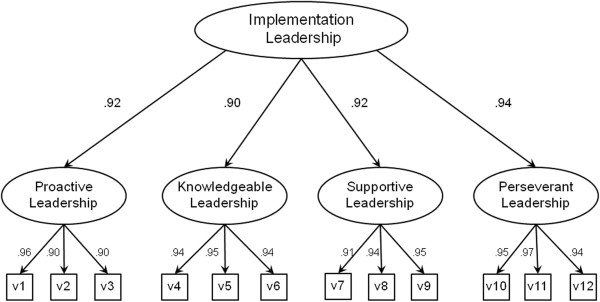
BACKGROUND: In healthcare and allied healthcare settings, leadership that supports effective implementation of evidenced-based practices (EBPs) is a critical concern. However, there are no empirically validated measures to assess implementation leadership. This paper describes the development, factor structure, and initial reliability and convergent and discriminant validity of a very brief measure of implementation leadership: the Implementation Leadership Scale (ILS). METHODS: Participants were 459 mental health clinicians working in 93 different outpatient mental health programs in Southern California, USA. Initial item development was supported as part of a two United States National Institutes of Health (NIH) studies focused on developing implementation leadership training and implementation measure development. Clinician work group/team-level data were randomly assigned to be utilized for an exploratory factor analysis (n = 229; k = 46 teams) or for a confirmatory factor analysis (n = 230; k = 47 teams). The confirmatory factor analysis controlled for the multilevel, nested data structure. Reliability and validity analyses were then conducted with the full sample. RESULTS: The exploratory factor analysis resulted in a 12-item scale with four subscales representing proactive leadership, knowledgeable leadership, supportive leadership, and perseverant leadership. Confirmatory factor analysis supported an a priori higher order factor structure with subscales contributing to a single higher order implementation leadership factor. The scale demonstrated excellent internal consistency reliability as well as convergent and discriminant validity. CONCLUSIONS: The ILS is a brief and efficient measure of unit level leadership for EBP implementation. The availability of the ILS will allow researchers to assess strategic leadership for implementation in order to advance understanding of leadership as a predictor of organizational context for implementation. The ILS also holds promise as a tool for leader and organizational development to improve EBP implementation.
Overview
The claims and statistics of this paper haven’t been checked yet.
Free: it reads the open-access text and checks the first 5 claims that cite a source we can check. Create a free account to check every claim.
Integrity signals
Registry
Cites
Statistics
Figures
Verification
Claims the paper makes
The claims and statistics of this paper haven’t been checked yet.
Free: it reads the open-access text and checks the first 5 claims that cite a source we can check. Create a free account to check every claim.
Claims other papers make about this one
Each is checked against this paper’s own text: does it say what the citing paper says it does?
The source backs part of the claim, not all of it — or backs it for a different population, condition or comparison.
In the citing paper
“Subscale internal consistencies ranged from 0.95 to 0.98.”
From Leading the charge in the education sector: development and validation of the School Implementation Leadership Scale (SILS) (2022) · cites this paper as [9]
Experimental — accuracy not yet measuredThe source backs part of the claim, not all of it — or backs it for a different population, condition or comparison.
In the citing paper
“Our preliminary results also signal a need for new instrumentation targeting non-provider stakeholders such as leaders and external change agents (e.g., implementation practitioners or intermediaries), particularly in light of research identifying the role they play in implementation success (e.g., [25]).”
From The Society for Implementation Research Collaboration Instrument Review Project: A methodology to promote rigorous evaluation (2016) · cites this paper as [25]
Experimental — accuracy not yet measuredThe cited source says what the claim attributes to it.
In the citing paper
“Designed to be brief and pragmatic [29], the original ILS contained 12 items loading onto 4 subscales: Proactive Leadership (anticipating and addressing implementation challenges), Knowledgeable Leadership (deep understanding of EBP and implementation issues), Supportive Leadership (support for EBP adoption/use), and Perseverant Leadership (consistent and responsive to challenges).”
From Leading the charge in the education sector: development and validation of the School Implementation Leadership Scale (SILS) (2022) · cites this paper as [9]
The cited source says what the claim attributes to it.
In the citing paper
“The original ILS [9] and original SILS adaptation [66] are 12-item instruments developed to assess strategic leadership for EBP implementation.”
From Leading the charge in the education sector: development and validation of the School Implementation Leadership Scale (SILS) (2022) · cites this paper as [9]
Self-check
Percentages, sums and reported differences re-computed from the paper’s own numbers.
The self-check needs the paper’s full text.
Citations
Cites
Hu, L., & Bentler, P. M. (1999) · Structural Equation Modeling A Multidisciplinary Journal · doi:10.1080/10705519909540118 · Cited by 108,788 · cited 1×
“08 indicate acceptable model fit [41-44].”
Intraclass correlations: Uses in assessing rater reliability.
Shrout, P. E., & Fleiss, J. L. (1979) · Psychological Bulletin · doi:10.1037/0033-2909.86.2.420 · Cited by 24,532 · cited 1×
“We first examined the amount of dependency among observations within groups using intraclass correlations (ICC, type 1) [46].”
MethodHu, L.-T., & Bentler, P. M. (1998) · Psychological Methods · doi:10.1037/1082-989x.3.4.424 · Cited by 12,298 · cited 1×
“08 indicate acceptable model fit [41-44].”
Organizational Culture and Leadership
Tierney, W. G., & Schein, E. H. (1986) · The Academy of Management Review · doi:10.2307/258322 · Cited by 9,601
Evaluating the use of exploratory factor analysis in psychological research.
Fabrigar, L. R., Wegener, D. T., MacCallum, R. C., & Strahan, E. J. (1999) · Psychological Methods · doi:10.1037/1082-989x.4.3.272 · Cited by 9,587 · cited 1×
“Principal axis factoring was selected for factor extraction because it allows for consideration of both systematic and random error [37] and Promax oblique rotation was utilized for factor rotation as we assumed that derived factors would be correlated.”
MethodProctor, E., Silmere, H., Raghavan, R., Hovmand, P., Aarons, G., Bunger, A., Griffey, R., & Hensley, M. (2011) · Administration and Policy in Mental Health and Mental Health Services Research · doi:10.1007/s10488-010-0319-7 · Cited by 8,721
Self-citationA Rationale and Test for the Number of Factors in Factor Analysis
Horn, J. L. (1965) · Psychometrika · doi:10.1007/bf02289447 · Cited by 8,714 · cited 1×
“Parallel analysis was based on estimation of 1,000 random data matrices with values that correspond to the 95 percentile of the distribution of random data eigenvalues [39,40].”
MethodDETERMINANTS OF INNOVATIVE BEHAVIOR: A PATH MODEL OF INDIVIDUAL INNOVATION IN THE WORKPLACE.
Scott, S. G., & Bruce, R. A. (1994) · Academy of Management Journal · doi:10.2307/256701 · Cited by 6,068 · cited 1×
“Leaders can positively or negatively impact the capacity to foster change and innovation [7-10] and therefore are instrumental in facilitating a positive climate for innovation and positive attitudes toward EBP during implementation”
BackgroundEstimating within-group interrater reliability with and without response bias
James, L. R., Demaree, R. G., & Wolf, G. (1984) · Journal of Applied Psychology · doi:10.1037/0021-9010.69.1.85 · Cited by 4,774 · cited 3×
“We next examined the average agreement within clinical work group for individual items and scales using awg(1) and awg(J), respectively [48-50].”
BackgroundMethodOrganizational culture and leadership
Tohidi, H., & Jabbari, M. M. (2012) · Procedia - Social and Behavioral Sciences · doi:10.1016/j.sbspro.2011.12.156 · Cited by 4,303 · cited 2×
“First, as part of a study focused on developing an intervention to improve leadership for evidencebased practice implementation [18], the investigative team developed items based on review of literature relating leader behaviors to implementation and organizational climate and culture change [32,33].”
Background
Research works printed but not linked: 4
- Massoud M, Nielsen G, Nolan K, Nolan TW, Schall MW, Sevin C: A Framework for Spread: From Local Improvements to System-wide Change. 2006, Cambridge, MA: Institute for Healthcare Improvement
- Dunn G, Everitt B, Pickles A: Modeling Covariances and Latent Variables Using EQS. 1993, London: Chapman & Hall/CRC Press
- Cochran WG: Sampling Techniques. 1977, New York: Wiley and Sons, 3
- Kouzes JM, Posner BZ: The Leadership Challenge. 2007, San Francisco, CA: Jossey-Bass
Cited by
Items 301–400 of 568
Garneau, H. C., Cheng, H. L., Kim, J. P., Magid, M. A., Chin-Purcell, L., & McGovern, M. P. (2025) · Implementation Science Communications · doi:10.1186/s43058-025-00726-9 · Cited by 9
“It also has strong reliability and internal consistency, on par with or superior to other well-established measures of determinants [16, 17, 61, 62].”
Walker, A., Boaz, A., & Hurley, M. (2020) · Disability and Rehabilitation · doi:10.1080/09638288.2020.1803997 · Cited by 6
“Whilst the role of leadership has been identified as critical in implementing and sustaining EBIs in healthcare within implementation theories and frameworks [5,6,12–14], it is rarely examined empirically and is poorly characterised [8,10,15].”
BackgroundStakeholder Preferences on Transdiagnostic Psychosocial Treatment for Trauma-Exposed Veterans
Gutner, C. A., Canale, C. A., Vento, S. A., & Stirman, S. W. (2019) · Administration and Policy in Mental Health and Mental Health Services Research · doi:10.1007/s10488-019-00948-9 · Cited by 6
Tignanelli, C. J., Shah, S., Vock, D. M., Siegel, L. K., Serrano, C., Haut, E. R., Switzer, S., Martin, C. L., Rizvi, R. F., Peta, V., et al. (2024) · Implementation Science · doi:10.1186/s13012-024-01386-4 · Cited by 5
“Outcomes will be calculated based on scoring guides for the following validated scales: Program Sustainability Assessment Tool (PSAT) [45], Clinical Sustainability Assessment Tool (CSAT) [46], Implementation Leadership Scale (ILS) [47], and Evidenced-based Practice Attitude Scale-36 (EBPAS-36) [48].”
MethodCritical success factors for implementing a smart IoT-based decision framework in the water industry
Narang, D., Madaan, J., & Chandra, R. (2024) · Water Policy · doi:10.2166/wp.2024.070 · Cited by 5
Sincere behaviour: Moderating leadership, culture and lecture performance in higher education
Nurtjahjani, F., Ahamed, F., Puspita, A. F., Batubulan, K. S., & Novitasari, A. F. (2025) · SA Journal of Human Resource Management · doi:10.4102/sajhrm.v23i0.2732 · Cited by 10
Shrinking the know–do gap in psychedelic-assisted therapy
Nicol, G. E., Adams, D. R., Lenze, E. J., & Cabassa, L. J. (2025) · Nature Human Behaviour · doi:10.1038/s41562-025-02103-x · Cited by 4
“Implementation science achieves this through partnerships between clinical operations and researchers 30 , developed over time and strengthened through a collaborative process BOX 2 How psychedelics can be used to further human health Linking brain function, perception and behaviour Psychedelic…”
Implementering af elektronisk omsorgsjournal ikommunal setting
Mogensen, F. (2019) · Tidsskrift for omsorgsforskning · doi:10.18261/issn.2387-5984-2019-03-03 · Cited by 4
Helle, A. C., Sher, K. J., Masters, J., Washington, K. T., & Hawley, K. M. (2021) · Implementation Science Communications · doi:10.1186/s43058-021-00249-z · Cited by 5
“Measures focused on Current Suite Evidence-based strategies (those currently implemented at institution) – Acceptability of Intervention Measure (AIM) [21] (4 items)a – Intervention Appropriateness Measure (IAM) [21] (4 items)a – Feasibility of Intervention Measure (FIM) [21] (4 items)a – Selection of Strategies (3 it…”
BackgroundNaar, S., Fernandez, M. I., Todd, L., Green, S. K. S., Henna Budhwani, P., Carcone, A. I., Coyle, K. K., Aarons, G. A., MacDonell, K. K., & Harper, G. W. (2023) · Implementation Research and Practice · doi:10.1177/26334895231164585 · Cited by 4
“Fourth, high-completion clinics reported leadership approaches consistent with those that support a positive implementation climate such as autonomysupportive leadership with buy-in and MI champions at multiple levels of management (Aarons et al., 2014).”
BackgroundSelf-citationSuccess factors for evidence-based healthcare practice adoption
Motsi, L., & Chimbo, B. (2023) · South African journal of information management · doi:10.4102/sajim.v25i1.1622 · Cited by 6
“However, the result is consistent with prior research, which demonstrated that leadership roles influence effective implementations in a variety of situations (Aarons, Ehrhart & Farahnak 2014).”
ResultCastiglione, S. A., Lavoie‐Tremblay, M., Kilpatrick, K., Gifford, W., & Semenic, S. E. (2024) · JMIR Research Protocols · doi:10.2196/54681 · Cited by 5
“IL describes strategic leadership behaviors based on transformational and effective leadership behavior theories whereby leaders are visibly committed, supportive of POC staff, and engaged at the granular level to prepare for and facilitate implementation [6,7].”
Linnerud, S., Bjerk, M., Olsen, N. R., Taraldsen, K., Brovold, T., & Kvæl, L. A. H. (2024) · Frontiers in Health Services · doi:10.3389/frhs.2024.1456028 · Cited by 5
“The initial themes were reviewed and discussed with the other two authors (MB and NRO), drawing inspiration from theory of implementation leadership (40, 41), leadership behavior (21) and the middle manager role theory (28).”
BackgroundDube, S. R., Rishi, S., Corr, C. P., & Panlilio, C. C. (2022) · Child Abuse & Neglect · doi:10.1016/j.chiabu.2022.105777 · Cited by 6
‘Lockdown probation leaders’ and Fundamental Human Needs
Herzog-Evans, M., & Sturgeon, J. (2022) · European Journal of Probation · doi:10.1177/20662203221113822 · Cited by 5
“It reduces turnover (Kovjanic et al., 2012), increases commitment (Bass, 1985) and facilitates acceptance of change (e.g. the implementation of Evidence-Based Practices: Aarons et al., 2014).”
BackgroundNeshteruk, C. D., Skinner, A. C., Counts, J. D., D’Agostino, E., Frerichs, L., Howard, J., Story, M. T., & Armstrong, S. (2023) · Implementation Science · doi:10.1186/s13012-023-01264-5 · Cited by 4
“Implementation Leadership Validated 12-item survey of staff/providers assessing leadership [30]”
BackgroundPedersen, M. S., Landheim, A. S., Møller, M., & Lien, L. (2019) · Archives of Psychiatric Nursing · doi:10.1016/j.apnu.2019.10.009 · Cited by 7
Quality Improvement and Patient Safety: How Leadership Can Create a Culture of Safety
Samora, J. B., Shea, K. G., Chen, A. F., Turner, P., & Frick, S. L. (2019) · Journal of Bone and Joint Surgery · doi:10.2106/jbjs.19.01006 · Cited by 4
Does Conceptual Decision-Making Style Make School Principal an Efficient Reforms PromoterPreprint
Фаильевич, Б. Р., Bycik, N. V., Filinov, N., Исаева, Н. В., & Kasprzhak, A. (2015) · SSRN Electronic Journal · doi:10.2139/ssrn.2566763 · Cited by 4
Moon, D. J., Johnson‐Motoyama, M., Nichols, C. B., Rolock, N., Haran, H., & Bai, R. (2022) · Children and Youth Services Review · doi:10.1016/j.childyouth.2022.106457 · Cited by 3
Evaluating the HELIX4 implementation capacity-building program
Duff, J. S., Meloncelli, N. J. L., Purtell, L., Cameron, A. E., Doubrovsky, A., Barnes, R., Hyam, K., & Xu, H. G. (2025) · International Journal of Evidence-Based Healthcare · doi:10.1097/xeb.0000000000000509 · Cited by 3
Longenecker, C. T., Kiggundu, J. B., Ayebare, F., Muddu, M., Kayima, J., Mutungi, G. N., Ssinabulya, I., Schwartz, J. I., Spiegelman, D. L., Tong, G., et al. (2025) · BMC Health Services Research · doi:10.1186/s12913-025-13281-9 · Cited by 3
“Implementation leadership [21] and Implementation citizenship behavior [22].”
Dykens, J. A., Sougou, N. M., Gassama, O., Dieng, N. M., Peterson, C. E., Patil, C. L., Awadalla, S., Abboud, S., Ndiaye, I., Diongue, F. B., et al. (2025) · International Journal of Women s Health · doi:10.2147/ijwh.s515070 · Cited by 3
Melgarejo, M., Nahmias, A. S., Suhrheinrich, J., Schetter, P. L., Dean, M., Holt, T., Li, J., & Stahmer, A. C. (2022) · Focus on Autism and Other Developmental Disabilities · doi:10.1177/10883576221140149 · Cited by 4
“This study used a combination of the original ICS (Ehrhart et al., 2014) and a version adapted for schools (S-ICS; Thayer et al., 2022) measuring perceptions of the policies, practices, procedures, and behaviors that are expected, rewarded, and supported to facilitate effective EBP implementation.”
InfluentialClark, K., Messineo, E., Bryant-Stephens, T. C., Angela Song, Marx, D., Lieberman, A., Beidas, R. S., & Wolk, C. B. (2024) · Journal of Asthma · doi:10.1080/02770903.2024.2313146 · Cited by 4
Symphony of Success: Leader-Practitioner Reciprocity during Evidence-Based Practice Implementation
Egeland, K. M., Sklar, M., Aarons, G. A., Ehrhart, M. G., Skar, A. S., & Borge, R. H. (2024) · Administration and Policy in Mental Health and Mental Health Services Research · doi:10.1007/s10488-024-01405-y · Cited by 6
“Implementation leadership was measured with the Implementation Leadership Scale (ILS) measuring first-level leadership behaviors thought to impact EBP implementation (Aarons et al., 2014b).”
BackgroundMethodSelf-citationYıldız, A. (2024) · BMC Health Services Research · doi:10.1186/s12913-024-11721-6 · Cited by 6
“ILS assesses the degree to which a leader is proactive, knowledgeable, supportive, and perseverant regarding evidence-based practice [10].”
BackgroundMethodResultInfluentialMarriott, B. R., Hulvershorn, L. A., Oliver, J., Jones, C., O’Reilly, L. M., Wiehe, S. E., Monahan, P. O., Bearman, S. K., Saldana, L., & Aalsma, M. C. (2025) · Contemporary Clinical Trials Communications · doi:10.1016/j.conctc.2025.101518 · Cited by 3
“…for openness) [37]; 2) Implementation Leadership Scale, a 6-item measure of leadership support for EBP, specifically Peds IBH, implementation [38]; and 3) Primary Care Dynamics Survey, an 11-item measure of primary care team dynamics, from which we included two subscales (process for…”
Go, V. F.-L., Giang, L. M., Phan, H. T. T., Chen, J. S., Powell, B. J., Bartels, S. M., Nguyen, M. X., Sripaipan, T., Nong, H. T. T., Dang, L. T. H., et al. (2025) · The Lancet Global Health · doi:10.1016/s2214-109x(25)00331-6 · Cited by 3
Iachini, A. L., Clone, S., DeHART, D. D., Seay, K. D., & Browne, T. A. (2016) · Journal of Social Work Practice in the Addictions · doi:10.1080/1533256x.2016.1231116 · Cited by 3
“Implementation leadership was assessed using two subscales from the Implementation Leadership Scale (ILS) developed by Aarons, Ehrhart, and Farahnak (2014).”
MethodVroom, E. B., Massey, O. T., Akbari, Z., Bristol, S. C., Cook, B., Green, A. L., Levin, B. L., Tyson, D. M., & Johnson, M. E. (2021) · Journal of Community Psychology · doi:10.1002/jcop.22749 · Cited by 4
Proceedings from the Second Annual Conference of the Norwegian Network for Implementation Research
Egeland, K. M., Engell, T., Halvorsen, J., & Varsi, C. (2022) · Global Implementation Research and Applications · doi:10.1007/s43477-022-00069-w · Cited by 4
“, Implementation Leadership Scale (Aarons et al., 2014)].”
Bunders, A. E., de Wit, E. E., Dinkgreve, M. A. H. M., Broerse, J. E. W., & Regeer, B. J. (2023) · Child & Youth Services · doi:10.1080/0145935x.2023.2220959 · Cited by 6
“Scholars like Aarons et al. (2014) and Williams et al. (2020), use the term “ implementation leadership ” to explain that a combination of transform-ational leadership with more strategical leadership styles can be an effective way to ensure transformation in organizations.”
BackgroundResultHelle, A. C., Washington, K. T., Masters, J., Sher, K. J., Aarons, G. A., & Hawley, K. M. (2025) · Journal of Substance Use and Addiction Treatment · doi:10.1016/j.josat.2024.209617 · Cited by 3
Self-citationGetting Things Done, Virtually! - The Role of Virtual Team Leadership in Virtual Team Effectiveness
Jude Ashmi, E. (2017) · Ushus - Journal of Business Management · doi:10.12725/ujbm.39.2 · Cited by 3
Bartley, L., DePanfilis, D., & Bright, C. L. (2021) · Implementation Research and Practice · doi:10.1177/26334895211050864 · Cited by 4
“Although little empirical research has connected supervisor practice to worker fidelity (Aarons et al., 2014), supervisor practice has been associated with child welfare workers’ job satisfaction (Barth et al., 2008) and intention to stay in the field (Johnco et al., 2014; Strolin et al., 2007),…”
BackgroundMethodInfluentialLocke, J. J., Corbin, C. M., Cook, C. R., Ehrhart, M. G., Davis, C. J., & Lyon, A. R. (2023) · Global Implementation Research and Applications · doi:10.1007/s43477-023-00080-9 · Cited by 7
Self-citationUloga vodstva u provedbi organizacijskih inovacija: povratak na klasični model
Skovgaard, T., & Nielsen, J. V. (2023) · Collegium Antropologicum · doi:10.5671/ca.47.1.10 · Cited by 7
Houtven, C. H. V., Decosimo, K. P., Drake, C., Bruening, R., Sperber, N. R., Dadolf, J., Tucker, M., Coffman, C. J., Grubber, J. M., Stechuchak, K. M., et al. (2024) · Health Services Research · doi:10.1111/1475-6773.14361 · Cited by 3
Neher, M. (2016) · Journal of Rheumatic Diseases and Treatment · doi:10.23937/2469-5726/1510039 · Cited by 5
“The 12-item Implementation Leadership Scale measures strategic leadership for implementation [19].”
MethodKey Success Factors for Implementation Code of Conducts and Ethics in Indonesian Public Sector
Dwiputrianti, S. (2020) · doi:10.2991/aebmr.k.200301.009 · Cited by 3
Srinadi, N. L. P., Agung, A. A. G., Yudana, I. M., & Ratnaya, I. G. (2022) · International Journal of Health Sciences · doi:10.53730/ijhs.v6n2.7577 · Cited by 5
“…to transform, develop and disseminate science and technology through education, research, and community service, it can be acquired through the application of the tri dharma of higher education with well-executed training programs, good organizational culture, good leadership (Aarons et al., 2014).”
BackgroundSkjærvø, I., Martinsen, M., Næss, A., Jensen, T. K., Fagermoen, E. M., Skagemo, C. U., Dyrdal, G. M., Knutsen, M., Michaelsen, K., Nymoen, R. C., et al. (2022) · Research Square · doi:10.21203/rs.3.rs-1253190/v1 · Cited by 4
Li, L., Wang, Q., Cao, Y., Liao, L., Yang, B., & Tan, M. (2025) · BMC Nursing · doi:10.1186/s12912-025-03140-7 · Cited by 2
“Implementation Leadership Scale (ILS) was developed by Aarons et al. in 2014 [18], and in 2019, Hu et al. [19] translated it into a scale suitable for Chinese culture and situations for assessing managers’ IL. ILS was divided into the supervisor version and staff version, and this study used the…”
Nielsen, J. V., Koch, S., Henriksen, T., Krølner, R. F., Lund, L., Brautsch, L. A. S., Ulrikkeholm, L. K., Damsgaard, C. T., Larsen, M. N., & Skovgaard, T. (2025) · Frontiers in Sports and Active Living · doi:10.3389/fspor.2025.1534123 · Cited by 3
Keeping Our ACT Team Together: Supervisory Strategies to Promote Workforce Retention
Choy-Brown, M., Carlson, W. C., Williams, N. J., Studer, L. M., & Digari, S. (2025) · Administration and Policy in Mental Health and Mental Health Services Research · doi:10.1007/s10488-025-01458-7 · Cited by 3
“…is consistent with organizational and leadership studies evaluating associations between team-level transformational leadership (Farahnak et al., 2020), team cohesion (Zhu et al., 2017), and imple - mentation leadership (Aarons et al., 2014 ) with both team-level and individual-level outcomes.”
Examining Changes in Coalition Dynamics to Support Opioid Fatality Reduction
Freedman, D. A., Knudsen, H. K., Chahine, R. A., Hunt, T., Oga, E. A., Aldrich, A. M., Roberts, S. M., Glasgow, L., Garner, B. R., Tan, S., et al. (2025) · AJPM Focus · doi:10.1016/j.focus.2025.100394 · Cited by 2
“30 The scale includes items about different leadership styles (i.e., proactive, knowledge based, supportive, perseverant).”
Matson, T. E., Navarro, M. A., Idu, A., Bobb, J. F., Patrick, B. M., Phillips, R., Barrett, T. D., Rossi, F. S., Krawczyk, N., Doud, R., et al. (2025) · Addiction Science & Clinical Practice · doi:10.1186/s13722-025-00605-7 · Cited by 3
“…about the intervention and implementation context using psychometrically valid measures, including: 1) the Feasibility, Appropriate-ness, and Acceptability of Intervention Measures (FAA) [62]; 2) the Implementation Leadership Scale (ILS) [63]; and 3) the Implementation Climate Scale (ICS) [64].”
Stahmer, A. C., Lau, A. S., Roesch, S. C., Rangel, E., Aarons, G. A., & Brookman-Frazee, L. I. (2025) · Implementation Science · doi:10.1186/s13012-025-01466-z · Cited by 3
“The Implementation Leadership Scale (ILS) [49] is a 12-item scale that captures provider perceptions of leader behaviors thought to promote organizational culture and climate for EBP implementation.”
Self-citationGuiding principles for implementing ESCMID clinical practice guidelines
Albers, B., Nagavci, B., Joean, O., Tschudin‐Sutter, S., Tacconelli, E., Paul, M., Langendam, M. W., Kostyanev, T., Molina, J., Stahl, J. ‐., et al. (2026) · Clinical Microbiology and Infection · doi:10.1016/j.cmi.2026.01.012 · Cited by 2
Lafferty, L., Popovic, N., Weiss, E., Hajarizadeh, B., Lloyd, A. R., Altice, F. L., & Kronfli, N. (2026) · International Journal of Drug Policy · doi:10.1016/j.drugpo.2026.105197 · Cited by 3
苗书英, Zhang, Z., & Bao, C. (2026) · Journal of Nursing Management · doi:10.1155/jonm/5288231 · Cited by 3
“Implementation-leadership research emphasises that leaders shape the introduction and sustainment of new practices in healthcare settings [41–43].”
Lyons, M. J., Whitaker, D. J., Self‐Brown, S., & Weeks, E. A. (2024) · Administration and Policy in Mental Health and Mental Health Services Research · doi:10.1007/s10488-023-01336-0 · Cited by 2
“Variables such as implementation leadership (Aarons et al., 2014), organizational climate, and innovation (Hemmelgarn et al., 2006 ), for example, could potentially explain more”
O’Malley, D. M., Crabtree, B. F., Kaloth, S., Ohman‐Strickland, P., Ferrante, J. M., Hudson, S. V., & Kinney, A. Y. (2024) · BMC Family Practice · doi:10.1186/s12875-024-02496-0 · Cited by 2
“The CSQ will also include the Implementation Leadership Scale (ILS), a brief psychometrically strong measure that contains 12-items with four subscales of proactive, knowl-edgeable, supportive, and perseverant leadership [62].”
MethodOrganisational and Leadership Factors for Spiritual Care Implementation
Szilagyi, C. (2024) · Springer eBooks · doi:10.1007/978-3-031-50864-6_43 · Cited by 2
Hsu, J. J., Morgan, M. E., Veliz, P. T., & Shuman, C. J. (2024) · Journal of Advanced Nursing · doi:10.1111/jan.16531 · Cited by 3
“Leadership behaviours for EBP implementation is defined as a specific and strategic approach to leadership characterised by a set of influencing behaviours leading to positive outcomes for the implementation of EBPs (Aarons, Ehrhart, and Farahnak 2014; Shuman et al. 2020).”
Evidence-Based Practice in Practice : Exploring Conditions for Using Research in Physiotherapy
Dannapfel, P. (2015) · Linköping University medical dissertations · doi:10.3384/diss.diva-122172 · Cited by 2
Dorsey, S., Pullmann, M. D., Kerns, S. E. U., Deblinger, E., Lucid, L., Harrison, J. P., Thompson, K., & Berliner, L. (2018) · Implementation Science · doi:10.1186/s13012-018-0715-z · Cited by 2
Zia-ur-Rehman, M., Mahmood, A., & Zia, M. (2021) · Review of Applied Management and Social Sciences · doi:10.47067/ramss.v4i2.151 · Cited by 2
Siegle, A., zu Sayn-Wittgenstein-Hohenstein, F., & Roes, M. (2020) · Implementation Science · doi:10.1186/s13012-020-01033-8 · Cited by 2
McGuier, E. A., Aarons, G. A., Wright, J. D., Fortney, J. C., Powell, B. J., Rothenberger, S. D., Weingart, L. R., Miller, E. A., & Kolko, D. J. (2023) · Implementation Science Communications · doi:10.1186/s43058-023-00437-z · Cited by 2
Self-citationKemp, C. G., Danforth, K., Aldridge, L. R., Murray, L. K., & Haroz, E. E. (2023) · Cambridge Prisms Global Mental Health · doi:10.1017/gmh.2023.63 · Cited by 2
“Other measures reported as used by individual investigators included the Implementation Leadership Scale (Aarons et al., 2014), the Theory of Planned Behavior measures (Ajzen, 2011), the Feelings Thermometer (ALWIN, 1997), the Systems Usability Scale (Lewis, 2018), the Organizational Social Context scale (Glisson et a…”
Akepati, S. K. R., Seetharaman, A., Maddulety, K., & Gururajan, R. (2023) · PEOPLE International Journal of Social Sciences · doi:10.20319/pijss.2023.93.1835 · Cited by 2
Sweetland, A. C., Mann, C. G., Fernandes, M. J., Matsuzaka, C. T., Silva, F. V. S. D. M., Lee, J., McCarty, C., Kritski, A. L., Fortes, S., Cavalcanti, M. D. L. T., et al. (2023) · Current Psychiatry Research and Reviews · doi:10.2174/0126660822243332230921052022 · Cited by 3
Bartels, S. M., Phan, H. T. T., Hutton, H. E., Nhan, D. T., Sripaipan, T., Chen, J. S., Rossi, S. L., Ferguson, O., Nong, H. T. T., Nguyen, N. T. K., et al. (2024) · Implementation Science · doi:10.1186/s13012-024-01368-6 · Cited by 3
“…explore relationships with clinic characteristics (Table 3) (e.g., organizational climate [31], readiness to change [43], implementation leadership [44], implementation climate [45]), clinical staff characteristics (e.g., skills, alcohol norms [27]), level of engagement with facilitation, and, in…”
BackgroundThe role of deans in implementing smoke-free campus policies: the case of medical schools in France
Geindreau, D., Girault, A., & Gallopel‐Morvan, K. (2025) · BMC Health Services Research · doi:10.1186/s12913-025-12415-3 · Cited by 4
“However, as shown by the ILS analysis, this transformational leadership is not sufficient to ensure successful implementation and has to be complemented by proactive, knowledgeable, supportive, and perseverant leadership [21].”
InfluentialOrmhaug, S. M., Jensen, T. K., Porcheret, K., Andreassen, A. L., Byford, S., Fagermoen, E. M., Gurandsrud, P., Haabrekke, K., Knutsen, M., Päivärinne, H. M., et al. (2025) · European Journal of Psychotraumatology · doi:10.1080/20008066.2025.2555047 · Cited by 2
“Implementation leadership: Leader support will be evaluated with the Implementation Leadership Scale (ILS; Aarons et al., 2014) that measures proactive, knowledgeable, supportive and preservative leadership, as assessed by the therapists.”
Pepin, R. L., Hoyt, J. E., Seifert, B., & Bartels, S. J. (2016) · Journal of Evidence-Informed Social Work · doi:10.1080/23761407.2015.1086712 · Cited by 3
Government Policies, Implementation Leadership and Green Management Practices in an Emerging Economy
Kamaşak, R., Yozgat, U., & Yavuz, M. (2016) · International Journal of Trade Economics and Finance · doi:10.18178/ijtef.2016.7.4.506 · Cited by 3
A Qualitative Study of the Implementation of an Evidence-Based Program in a K-12 Setting
McCarthy, T. J. (2017) · Fisher Digital Publications (St. John Fisher College) · Cited by 6
Singh, R. R., Dolcini, M. M., Catania, J. A., & Saldana, L. (2023) · Families in Society The Journal of Contemporary Social Services · doi:10.1177/10443894221147964 · Cited by 3
“Furthermore, congruence across levels of leadership, from the system level down to supervisors, is important in conveying the importance of implementing a new EBP (Aarons et al., 2014), suggesting that misalignment in leadership support can negatively impact implementation.”
BackgroundInfluentialCasaburo, G. M., Asiimwe, R., Yzaguirre, M. M., Fang, M., & Holtrop, K. (2023) · Journal of Child and Family Studies · doi:10.1007/s10826-023-02600-5 · Cited by 3
“This fi nding is in line with research indicating that supportive leadership is an important dimension of EBP implementation (Aarons et al. 2014).”
Sathyanarayana S, N. M. I. (2024) · Journal of Informatics Education and Research · doi:10.52783/jier.v4i1.531 · Cited by 2
Akça, M., & Yavuz, M. (2018) · Anemon Muş Alparslan Üniversitesi Sosyal Bilimler Dergisi · doi:10.18506/anemon.452617 · Cited by 2
Leadership Approaches to Developing an Effective Drug Treatment System
Guerrero, E. G., & Khachikian, T. (2020) · IntechOpen eBooks · doi:10.5772/intechopen.91055 · Cited by 3
Conflict Early Warning System Index as a Preventive Effort
Suyono, H. (2020) · Journal of Educational Health and Community Psychology · doi:10.12928/jehcp.v9i1.15297 · Cited by 2
The Implementation of Integrated Behavioral Health Models
Zerden, L. D. S., Cruden, G., Lombardi, B. M., Grove, L. R., Patel, S. V., & Powell, B. J. (2019) · Wiley eBooks · doi:10.1002/9781119420743.ch9 · Cited by 2
Instruments used for evaluation in substance use disorder: a systematic review
Moreira, D. S., Azeredo, A., & Dias, P. C. (2022) · Journal of Substance Use · doi:10.1080/14659891.2022.2082334 · Cited by 1
“The Implementation Leadership Scale (ILS) is a 12-item scale, with four subscales representing different types of leadership: proactive, knowledgeable, supportive, and perseverant (Aarons et al., 2014, 2016).”
MethodVillas-Boas, F., Lopes, S., Teixeira, M., Rodrigues, C., Teixeira, M. A., Frias‐Bulhosa, J., Teixeira, S., Pinto, M. T., Carvalho, T., Pinheiro, E., et al. (2022) · Preventive Medicine Reports · doi:10.1016/j.pmedr.2022.101926 · Cited by 1
Motamedi, M., Lau, A. S., Byeon, Y. V., Yu, S. H., & Brookman-Frazee, L. I. (2023) · The Journal of Behavioral Health Services & Research · doi:10.1007/s11414-023-09844-5 · Cited by 2
Köberlein–Neu, J., & Söling, S. (2024) · Springer eBooks · doi:10.1007/978-3-658-43860-9_22 · Cited by 1
Locke, J. J., Sridhar, A., Shih, W., Shire, S. Y., Eisman, A. B., Kim, E., Du, A., Espeland, C., & Kasari, C. L. (2025) · Implementation Science · doi:10.1186/s13012-024-01414-3 · Cited by 2
“…(support for RR use), proactive (anticipating and addressing challenges), perseverant (consistent and responsive to challenges), communicative (shares implementation related information with staff), has a vision/mission (oriented towards using RR ), and available in implementing RR [39, 75].”
Bliss, C. M., & Barrett, C. A. (2025) · Psychology in the Schools · doi:10.1002/pits.23490 · Cited by 1
“…research has suggested that molar leadership styles are too broad to be effectively linked with EBP implementation and that strategic implementation climate, or the perceived importance of the innovation in the organization, is a stronger predictor of intervention fidelity (Aarons et al. 2014).”
InfluentialLocke, J. J., Williams, N. J., Sridhar, A., Ehrhart, M. G., Dopp, A. R., Thirion, M., Espeland, C., Riddle, B., Schmitz, K., Hatch, K., et al. (2025) · Implementation Science · doi:10.1186/s13012-025-01429-4 · Cited by 4
“In particular, implementation leadership (i.e., proactive leader behaviors that facilitate EBP use; [20]) and implementation climate (i.e., educator perceptions of whether EBP use is valued, expected, rewarded by the school; [21]) have been repeatedly linked to higher EBP fidelity in elementary…”
Self-citationJones, S. W., Bartkowski, J. P., Belenko, S. R., Becan, J. E., Taxman, F. S., Wasserman, G. A., Aarons, G. A., McReynolds, L. S., Dolbear, C., & Xu, X. (2025) · Health & Justice · doi:10.1186/s40352-025-00349-1 · Cited by 1
Self-citationComparing Two Training Approaches to Scaling Up the Safe Environment for Every Kid (SEEK) Approach
Dubowitz, H., Belanger, R., Magder, L. S., Kim, H., Saldana, L., & Palinkas, L. (2025) · Academic Pediatrics · doi:10.1016/j.acap.2025.103115 · Cited by 1
Purvis, R., Taylor, N., Young, M., James, P. A., & Forrest, L. E. (2025) · Journal of Genetic Counseling · doi:10.1002/jgc4.70084 · Cited by 2
Jolles, M. P., Mack, W. J., Rubio, S., Helmkamp, L. J., Saldana, L., Aarons, G. A., & Lau, A. S. (2025) · Implementation Science Communications · doi:10.1186/s43058-025-00771-4 · Cited by 1
“…as the shared perceptions from individuals that an innovation is rewarded and supported within an organization [39], and c) implementation leadership [40] assessing the degree to which leadership (i.e., managers) is proactive, knowl-edgeable, and supportive, regarding a practice implementation.”
Self-citationValidation of the extended version of the Implementation Leadership Scale (ILS-X)
Ehrhart, M. G., Williams, N. J., Sklar, M., Vega, N. R., Kandah, A., & Aarons, G. A. (2025) · Implementation Science Communications · doi:10.1186/s43058-025-00786-x · Cited by 1
“The most common measure of implementation leadership in the literature is the Implementation Leadership Scale (ILS) [15], which captures four dimensions: proactive (i.e., establishes clear standards and planning for EBP implementation), knowledgeable (i.e., is knowledgeable about EBP), supportive…”
Self-citationLim, N., & Kan, D. D. D. (2026) · Remedial and Special Education · doi:10.1177/07419325261418602 · Cited by 1
Houghtaling, B., Marriott, J. P., Yaroch, A. L., Prickitt, J., Meléndrez, B., Alvarez, K., Knauer, N., & Shanks, C. B. (2026) · Translational Behavioral Medicine · doi:10.1093/tbm/ibag020 · Cited by 1
Steeves, L., Sampalli, S., & Ufcrquhart, R. (2026) · Health Research Policy and Systems · doi:10.1186/s12961-026-01479-0 · Cited by 2
“…e 3 H y p o t h e t i c a l e x a m p l e a pp l y i n g p r o p o s e d I S / P E f r a m e w o r k t o a h e a l t h c a r e s c e n a r i o [ 8 , 12 , 14 , 17 – 19 ] S i t u a t i o n : D u r i n g a p a t i e n t c a r e i n t e r a c t i o n i n a n a m b u l a t o r y c l i n i c a t t h e l…”
Torres-Cortés, B., Antivilo-Bruna, A., & Leiva, L. (2024) · Revista Iberoamericana de Diagnóstico y Evaluación - e Avaliação Psicológica · doi:10.21865/ridep71.1.14 · Cited by 1
“El desarrollo del CI puede ser influido por factores como las normas culturales, el nivel socioeconómico, el tipo de liderazgo y el género (Aarons et al., 2014; Ninsiima et al., 2019).”
BackgroundDryburgh, N. S. J., Wang, L., Repchuck, R., Matte, A. R., Runions, K., & Georgiades, K. (2025) · School Mental Health · doi:10.1007/s12310-025-09742-5 · Cited by 2
“The first approach would be to obtain reports on organizational leadership by other school staff members besides principals (see Aarons et al., 2014 for an example).”
Lee, J., & Moussa, W. S. (2025) · Educational Management Administration & Leadership · doi:10.1177/17411432251341991 · Cited by 2
“The second phase used a semi-structured interview protocol aligned with themes from the ILS to ensure consistency across surveys and interviews.”
InfluentialFutami, A., Noguchi‐Watanabe, M., Hoben, M., Takaoka, M., Estabrooks, C. A., & Yamamoto‐Mitani, N. (2025) · Japan Journal of Nursing Science · doi:10.1111/jjns.70013 · Cited by 1
Saiki, M., Tomotaki, A., Yasuda, E., Nishigaki, M., Yamamoto, T., Matsuoka, C., & Sakai, I. (2025) · Nursing and Health Sciences · doi:10.1111/nhs.70229 · Cited by 1
Jang, H. (2025) · Australasian Journal of Special and Inclusive Education · doi:10.1017/jsi.2025.10008 · Cited by 2
Castro, I., Ruggiero, C. F., Luo, M., Smith, J. D., Perkins, M. E., Liebhart, J. L., Lindros, J., Salmon, J., Biggs, V., Ragunanthan, B., et al. (2025) · Childhood Obesity · doi:10.1177/21532176251386213 · Cited by 1
“Implementation was measured by a 4-item Implementation Leadership Scale (ILS) 27 and 12-item Implementation Climate Scale (ICS) 29 at three time points and the 8-item Organization Readiness to Change Beliefs Scale (ORCBS) 30 at two time points, adapted for pragmatic use.”
Brunissen, L., Diwan, N., Kocher, E. L., Suvada, K., Adly, A., Nderitu, M., Lukorito, J., Maingi, J., Sakr, S. R., Kosgei, R., et al. (2026) · Implementation Science Communications · doi:10.1186/s43058-026-00958-3 · Cited by 1
“Both scales have demonstrated strong internal consistency and validity across healthcare settings inter-nationally [43, 44].”
Metadata
- Authors
- Aarons, G. A., Ehrhart, M. G., & Farahnak, L. R.
- Affiliations
- University of California San Diego (US)
- San Diego State University (US)
- Corresponding author
- Aarons, Gregory A
- Venue
- Implementation Science
- Published
- 2014-04-14
- Volume
- 9
- Issue
- 1
- Pages
- 45-45
- ISSN
- 1748-5908 (ISSN-L)
- PMC
- PMC4022333
- OpenAlex
- W2120503228
- Cited by
- 559
- References
- 56
- Citations by year
- 2026: 40 · 2025: 54 · 2024: 72 · 2023: 72 · 2022: 59 · 2021: 66 · 2020: 40 · 2019: 48 · 2018: 36 · 2017: 23 · 2016: 20 · 2015: 18 · 2014: 10
- FWCI
- 42.75
- Type
- journal article
- Language
- en
- Open access
- gold
- doi.org
- Licence
- Locations
- Implementation Science (publishedVersion, cc-by)
- Europe PMC (PubMed Central) (publishedVersion, cc-by)
- PubMed Central (publishedVersion, cc-by)
- PubMed (publishedVersion)
- Open Scholarship Institutional Repository (Washington University in St. Louis) (submittedVersion)
- eScholarship (California Digital Library) (submittedVersion)
- eScholarship (California Digital Library) (submittedVersion, cc-by)
- Funders
- National Institute of Mental Health (R21MH098124, P30MH074678, R21MH082731, R01MH072961, R25MH080916)
- Topics
- Health Sciences › Health Professions › General Health Professions › Health Policy Implementation Science
- Health Sciences › Health Professions › General Health Professions › Health Sciences Research and Education
- Social Sciences › Education › Innovations in Medical Education
- Keywords
- implementation leadership, scale development, evidence-based practice implementation, mental health professionals, proactive leadership, supportive leadership, organizational context, leader development, organizational development
- MeSH terms
- Adult, Aged, Attitude of Health Personnel, California, Cooperative Behavior, Factor Analysis, Statistical, Female, Humans, Leadership, Male, Middle Aged, Organizational Innovation, Psychometrics, Reproducibility of Results, Young Adult, Translational Research, Biomedical
About these checks
Registry, retraction, Cites and statistics results are computed, not judged, with one exception: a printed reference that no index lists is read once by a model before it counts as a citation error. Claims are extracted by a model and kept only when their quote appears verbatim in the text; each cited source is then checked, with a model’s help, for whether it says what the claim relies on. Those verdicts can be wrong — read the claim’s quote and the cited source before relying on one.
Statistics and arithmetic are recomputed, not judged.
Confidence bands are shown only for fields calibrated on our annotated test set. None is calibrated yet, so no band is shown.
What counts as a claim ›How we measure confidence ›How we check this ›
Are you an author, or do you see a problem with this page? Request a review
Data sources
Bibliographic data: Semantic Scholar, OpenAlex, Crossref.
Contains information from the Semantic Scholar Academic Graph Datasets, made available under the ODC Attribution License (ODC-BY 1.0).
Semantic Scholar’s data is described in: Kinney, R., et al. (2023). The Semantic Scholar Open Data Platform. arXiv:2301.10140.
