

The implementation leadership scale (ILS): development of a brief measure of unit level implementation leadership
Open accessThe DOI matches its Crossref record; 56 of the 56 references it cites were found in a registry or an index.
Abstract
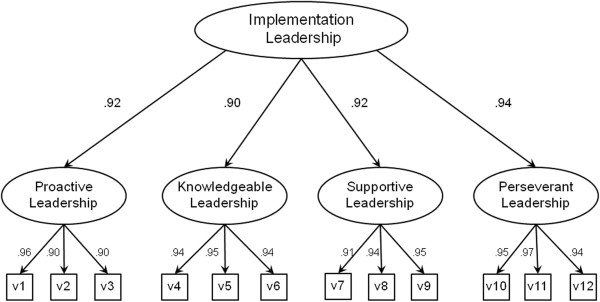
BACKGROUND: In healthcare and allied healthcare settings, leadership that supports effective implementation of evidenced-based practices (EBPs) is a critical concern. However, there are no empirically validated measures to assess implementation leadership. This paper describes the development, factor structure, and initial reliability and convergent and discriminant validity of a very brief measure of implementation leadership: the Implementation Leadership Scale (ILS). METHODS: Participants were 459 mental health clinicians working in 93 different outpatient mental health programs in Southern California, USA. Initial item development was supported as part of a two United States National Institutes of Health (NIH) studies focused on developing implementation leadership training and implementation measure development. Clinician work group/team-level data were randomly assigned to be utilized for an exploratory factor analysis (n = 229; k = 46 teams) or for a confirmatory factor analysis (n = 230; k = 47 teams). The confirmatory factor analysis controlled for the multilevel, nested data structure. Reliability and validity analyses were then conducted with the full sample. RESULTS: The exploratory factor analysis resulted in a 12-item scale with four subscales representing proactive leadership, knowledgeable leadership, supportive leadership, and perseverant leadership. Confirmatory factor analysis supported an a priori higher order factor structure with subscales contributing to a single higher order implementation leadership factor. The scale demonstrated excellent internal consistency reliability as well as convergent and discriminant validity. CONCLUSIONS: The ILS is a brief and efficient measure of unit level leadership for EBP implementation. The availability of the ILS will allow researchers to assess strategic leadership for implementation in order to advance understanding of leadership as a predictor of organizational context for implementation. The ILS also holds promise as a tool for leader and organizational development to improve EBP implementation.
Overview
The claims and statistics of this paper haven’t been checked yet.
Free: it reads the open-access text and checks the first 5 claims that cite a source we can check. Create a free account to check every claim.
Integrity signals
Registry
Cites
Statistics
Figures
Verification
Claims the paper makes
The claims and statistics of this paper haven’t been checked yet.
Free: it reads the open-access text and checks the first 5 claims that cite a source we can check. Create a free account to check every claim.
Claims other papers make about this one
Each is checked against this paper’s own text: does it say what the citing paper says it does?
The source backs part of the claim, not all of it — or backs it for a different population, condition or comparison.
In the citing paper
“Subscale internal consistencies ranged from 0.95 to 0.98.”
From Leading the charge in the education sector: development and validation of the School Implementation Leadership Scale (SILS) (2022) · cites this paper as [9]
Experimental — accuracy not yet measuredThe source backs part of the claim, not all of it — or backs it for a different population, condition or comparison.
In the citing paper
“Our preliminary results also signal a need for new instrumentation targeting non-provider stakeholders such as leaders and external change agents (e.g., implementation practitioners or intermediaries), particularly in light of research identifying the role they play in implementation success (e.g., [25]).”
From The Society for Implementation Research Collaboration Instrument Review Project: A methodology to promote rigorous evaluation (2016) · cites this paper as [25]
Experimental — accuracy not yet measuredThe cited source says what the claim attributes to it.
In the citing paper
“Designed to be brief and pragmatic [29], the original ILS contained 12 items loading onto 4 subscales: Proactive Leadership (anticipating and addressing implementation challenges), Knowledgeable Leadership (deep understanding of EBP and implementation issues), Supportive Leadership (support for EBP adoption/use), and Perseverant Leadership (consistent and responsive to challenges).”
From Leading the charge in the education sector: development and validation of the School Implementation Leadership Scale (SILS) (2022) · cites this paper as [9]
The cited source says what the claim attributes to it.
In the citing paper
“The original ILS [9] and original SILS adaptation [66] are 12-item instruments developed to assess strategic leadership for EBP implementation.”
From Leading the charge in the education sector: development and validation of the School Implementation Leadership Scale (SILS) (2022) · cites this paper as [9]
Self-check
Percentages, sums and reported differences re-computed from the paper’s own numbers.
The self-check needs the paper’s full text.
Citations
Cites
Hu, L., & Bentler, P. M. (1999) · Structural Equation Modeling A Multidisciplinary Journal · doi:10.1080/10705519909540118 · Cited by 108,788 · cited 1×
“08 indicate acceptable model fit [41-44].”
Intraclass correlations: Uses in assessing rater reliability.
Shrout, P. E., & Fleiss, J. L. (1979) · Psychological Bulletin · doi:10.1037/0033-2909.86.2.420 · Cited by 24,532 · cited 1×
“We first examined the amount of dependency among observations within groups using intraclass correlations (ICC, type 1) [46].”
MethodHu, L.-T., & Bentler, P. M. (1998) · Psychological Methods · doi:10.1037/1082-989x.3.4.424 · Cited by 12,298 · cited 1×
“08 indicate acceptable model fit [41-44].”
Organizational Culture and Leadership
Tierney, W. G., & Schein, E. H. (1986) · The Academy of Management Review · doi:10.2307/258322 · Cited by 9,601
Evaluating the use of exploratory factor analysis in psychological research.
Fabrigar, L. R., Wegener, D. T., MacCallum, R. C., & Strahan, E. J. (1999) · Psychological Methods · doi:10.1037/1082-989x.4.3.272 · Cited by 9,587 · cited 1×
“Principal axis factoring was selected for factor extraction because it allows for consideration of both systematic and random error [37] and Promax oblique rotation was utilized for factor rotation as we assumed that derived factors would be correlated.”
MethodProctor, E., Silmere, H., Raghavan, R., Hovmand, P., Aarons, G., Bunger, A., Griffey, R., & Hensley, M. (2011) · Administration and Policy in Mental Health and Mental Health Services Research · doi:10.1007/s10488-010-0319-7 · Cited by 8,721
Self-citationA Rationale and Test for the Number of Factors in Factor Analysis
Horn, J. L. (1965) · Psychometrika · doi:10.1007/bf02289447 · Cited by 8,714 · cited 1×
“Parallel analysis was based on estimation of 1,000 random data matrices with values that correspond to the 95 percentile of the distribution of random data eigenvalues [39,40].”
MethodDETERMINANTS OF INNOVATIVE BEHAVIOR: A PATH MODEL OF INDIVIDUAL INNOVATION IN THE WORKPLACE.
Scott, S. G., & Bruce, R. A. (1994) · Academy of Management Journal · doi:10.2307/256701 · Cited by 6,068 · cited 1×
“Leaders can positively or negatively impact the capacity to foster change and innovation [7-10] and therefore are instrumental in facilitating a positive climate for innovation and positive attitudes toward EBP during implementation”
BackgroundEstimating within-group interrater reliability with and without response bias
James, L. R., Demaree, R. G., & Wolf, G. (1984) · Journal of Applied Psychology · doi:10.1037/0021-9010.69.1.85 · Cited by 4,774 · cited 3×
“We next examined the average agreement within clinical work group for individual items and scales using awg(1) and awg(J), respectively [48-50].”
BackgroundMethodOrganizational culture and leadership
Tohidi, H., & Jabbari, M. M. (2012) · Procedia - Social and Behavioral Sciences · doi:10.1016/j.sbspro.2011.12.156 · Cited by 4,303 · cited 2×
“First, as part of a study focused on developing an intervention to improve leadership for evidencebased practice implementation [18], the investigative team developed items based on review of literature relating leader behaviors to implementation and organizational climate and culture change [32,33].”
Background
Research works printed but not linked: 4
- Massoud M, Nielsen G, Nolan K, Nolan TW, Schall MW, Sevin C: A Framework for Spread: From Local Improvements to System-wide Change. 2006, Cambridge, MA: Institute for Healthcare Improvement
- Dunn G, Everitt B, Pickles A: Modeling Covariances and Latent Variables Using EQS. 1993, London: Chapman & Hall/CRC Press
- Cochran WG: Sampling Techniques. 1977, New York: Wiley and Sons, 3
- Kouzes JM, Posner BZ: The Leadership Challenge. 2007, San Francisco, CA: Jossey-Bass
Cited by
Items 501–568 of 568
Santos, W. J., Hutchinson, A. M., Rader, T., Graham, I. D., Watkins, V., de Cândido, L. K., Greenough, M. J., & Squires, J. E. (2024) · Figshare · doi:10.6084/m9.figshare.26574448
Neshteruk, C. D., Skinner, A. C., Counts, J. D., D’Agostino, E. M., Frerichs, L., Howard, J., Story, M. T., & Armstrong, S. (2024) · Figshare · doi:10.6084/m9.figshare.26571298
Santos, W. J., Hutchinson, A. M., Rader, T., Graham, I. D., Watkins, V. J., de Cândido, L. K., Greenough, M. J., & Squires, J. E. (2024) · Figshare · doi:10.6084/m9.figshare.26574457
O’Malley, D. M., Crabtree, B. F., Kaloth, S., Ohman-Strickland, P., Ferrante, J., Hudson, S. V., & Kinney, A. Y. (2024) · Figshare · doi:10.6084/m9.figshare.26744309
Leslie, H. H., Lippman, S. A., van Heerden, A. C., Manaka, M. N., Joseph, P., Weiner, B. J., & Steward, W. T. (2024) · Figshare · doi:10.6084/m9.figshare.26054822
Lyon, A. R., Corbin, C. M., Brown, E. C., Ehrhart, M. G., Locke, J. J., Davis, C. J., Picozzi, E., Aarons, G. A., & Cook, C. R. (2022) · Figshare · doi:10.6084/m9.figshare.20342346
Self-citationMalone, S., Prewitt, K., Hackett, R., Lin, J. C., McKay, V., Walsh‐Bailey, C., & Luke, D. A. (2021) · Figshare · doi:10.6084/m9.figshare.15000057
Pellecchia, M., Mandell, D. S., Tomczuk, L., Marcus, S. C., Stewart, R. E., Stahmer, A. C., Beidas, R. S., Rieth, S. R., & Lawson, G. M. (2024) · Figshare · doi:10.6084/m9.figshare.26686137
Bartels, S. M., Phan, H. T. T., Hutton, H. E., Nhan, D. T., Sripaipan, T., Chen, J. S., Rossi, S. L., Ferguson, O., Nong, H. T. T., Nguyen, N. T. K., et al. (2024) · Figshare · doi:10.6084/m9.figshare.26027618
Haroz, E. E., Bolton, P. A., Nguyen, A. J., Lee, C., Bogdanov, S., Bass, J., Singh, N. S., Doty, B., & Murray, L. K. (2019) · Figshare · doi:10.6084/m9.figshare.8057678
Additional file 1 of Identifying competencies for integrated knowledge translation: a Delphi study
Yeung, E., Scodras, S., Salbach, N. M., Kothari, A., & Graham, I. D. (2021) · Figshare · doi:10.6084/m9.figshare.16907417
Carlson, M. A., Morris, S., Day, F., Dadich, A., Ryan, A., Fradgley, E. A., & Paul, C. (2021) · Figshare · doi:10.6084/m9.figshare.16530009
Smith, J. D., Rafferty, M. R., Heinemann, A. W., Meachum, M. K., Villamar, J., Lieber, R. L., & Brown, C. H. (2020) · Figshare · doi:10.6084/m9.figshare.12050436
Grüne, E., Popp, J., Carl, J., Semrau, J., & Pfeifer, K. (2022) · Figshare · doi:10.6084/m9.figshare.19607715
Balderson, B. H. K., Gray, S. L., Fujii, M., Nakata, K. G., Williamson, B. D., Cook, A. J., Wellman, R., Theis, M. K., Lewis, C. C., Key, D. L., et al. (2024) · Figshare · doi:10.6084/m9.figshare.26588733
Grüne, E., Popp, J., Carl, J., Semrau, J., & Pfeifer, K. (2022) · Figshare · doi:10.6084/m9.figshare.19607718
Sagatun, Å., Engell, T., Brekke, M., Sjølie, H., Ekornes, S. M., Waldum-Grevbo, K. S., Pape, K., Kvaløy, K., Jeneson, A., Trøan, A. S., et al. (2023) · Figshare · doi:10.6084/m9.figshare.24571708
Shuman, C. J., Ehrhart, M. G., Veliz, P. T., & Titler, M. G. (2023) · Figshare · doi:10.6084/m9.figshare.22610788
Self-citationLlarena, M., Rogers, H. L., Macia, P., Pablo, S., González, M., Montejo, M., Paniagua, N., Benito, J., Rueda, M., Santos, B., et al. (2024) · Figshare · doi:10.6084/m9.figshare.26616964
Peters, N., Borge, R. H., Skar, A. M. S., & Egeland, K. M. (2022) · Figshare · doi:10.6084/m9.figshare.17870358
Barnes, L. A. J., Longman, J. M., Adams, C., Paul, C., Atkins, L., Bonevski, B., Cashmore, A. W., Twyman, L., Bailie, R., Pearce, A., et al. (2024) · Figshare · doi:10.6084/m9.figshare.26552728
Pellecchia, M., Mandell, D. S., Tomczuk, L., Marcus, S. C., Stewart, R. E., Stahmer, A. C., Beidas, R. S., Rieth, S. R., & Lawson, G. M. (2024) · Figshare · doi:10.6084/m9.figshare.26686140
Santos, W. J., Hutchinson, A. M., Rader, T., Graham, I. D., Watkins, V. J., de Cândido, L. K., Greenough, M. J., & Squires, J. E. (2024) · Figshare · doi:10.6084/m9.figshare.26574451
Lyon, A. R., Pullmann, M. D., Dorsey, S., Levin, C., Gaias, L. M., Brewer, S. K., Larson, M. F., Corbin, C. M., Davis, C. J., Muse, I., et al. (2021) · Figshare · doi:10.6084/m9.figshare.13545220
Lindholm, L. H., & Pirkkala, H. (2025) · Kasvun tuki -aikakauslehti · doi:10.61259/kt.163007 · Cited by 2
Development and Validation of a Self‐Perception Tool for Measuring Nurse Managers’ Crisis Leadership
Kim, S. J. (2025) · Journal of Nursing Management · doi:10.1155/jonm/3754050
Pre-implementation Perceptions of Urban School-Based Mental Health Providers
Ringle, V. A. M., Ganss, E., & Creed, T. A. (2025) · School Mental Health · doi:10.1007/s12310-025-09836-0
Overcoming Resistance to Change in the Fire Service
Wheldon, K. (2025) · Springer eBooks · doi:10.1007/978-3-032-02126-7_5
Updated Consolidated Framework for Implementation Research
島津太一, 齋藤, 順., 小田原, 幸., 奥山, 絢., & 安福, 祐. (2025) · Institutional Repositories DataBase (IRDB)
Khalid, A., Rafiq, M., & Din, M. O. (2026) · SSRN Electronic Journal · doi:10.2139/ssrn.6136613
Bentley, L. A., White, S. L. J., Savage, S., & Williams, K. E. (2026) · Early Childhood Education Journal · doi:10.1007/s10643-025-02085-5 · Cited by 1
“Higher leadership endorsement of an intervention may facilitate helpful behaviors such as resource allocations (e.g. space, equipment) which support implementation (Aarons et al., 2014; Ehrhart et al., 2014 ).”
Davis, L., Orlina, E., Mackey, E., McCreary, M. P., Wisdom, J. P., Jackson, L. T., Silva, A., Bojan, E., Fernandez, S., & Bromley, E. (2026) · Community Mental Health Journal · doi:10.1007/s10597-026-01597-7
“Similarly, some investigations of implementation leadership, involving supporting staff and proactively addressing implementation barriers (Aarons et al., 2014 ), have demonstrated a positive relationship to clinicians’ EBP knowledge and use (Powell et al., 2017a, b), yet others have found no…”
Bornheimer, L. A., Lapidos, A., Brdar, N. M., Kelter, A. N., Song, J., Palaniappan, G. S., Miner, C., Campbell, M., Hoener, K., Florence, T., et al. (2026) · Community Mental Health Journal · doi:10.1007/s10597-026-01599-5
“…in any medium or format, strong alignment with the well-established implementation science literature, leadership buy-in, ongoing training, and workflow integration are key determinants of intervention adoption and fidelity in CMH settings (Aarons et al., 2014 ; Williams & Beidas, 2018 ).”
Strategic Management Transformation Through Quantum AI
Agrawal, A., Bhattacharya, D., Mor, R. S., & Mukti, S. K. (2026) · Advances in computational intelligence and robotics book series · doi:10.4018/979-8-3373-4347-1.ch009
Locke, J. J., Williams, N. J., Sridhar, A., Shih, W., Espeland, C., Tagavi, D. M., & Bearss, K. E. (2026) · Implementation Science · doi:10.1186/s13012-026-01497-0
Teran‐Escobar, C. (2022) · theses.fr (ABES) · doi:10.70675/86b417caze021z4cb1zadd2z9019da3d37c7 · Cited by 3
Ragnarsson, E. H., Stenfors, T., Nordgren, L. B., Hellner, C., Lundgren, T., & Ingvarsson, S. (2026) · Frontiers in Health Services · doi:10.3389/frhs.2026.1784462
““Consequences communicate an evaluation of or indicates knowledge of another’s performance, where the indication can range from highly evaluative to neutral” [(34), p 38] and is.”
Validation of the Implementation Climate Scale for Early Intervention (ICS-EI)
Lee, J. D., Joo, S., Terol, A. K., Jung, S., Pickard, K. E., Stone, W., & Locke, J. J. (2026) · Journal of Early Intervention · doi:10.1177/10538151261432562 · Cited by 1
“…measures that have been developed to assess other organizational contexts and implementation determinants in health and mental health settings, including Organizational Readiness for Implementing Change (Shea et al., 2014) and Implementation Leadership Scale (Aarons, Ehrhart, & Farahnak, 2014).”
Staton, M., Annett, J., Carey, P., Yang, Y., Jones, O., Bills, L., Logan, T., Tillson, M. D., Oser, C. B., & Knight, K. (2026) · Trials · doi:10.1186/s13063-026-09715-2
“…be invited to participate in quantitative surveys assessing core implementation constructs, like implementation climate (Implementation Climate Scale [62, 63]), organizational readiness (Organizational Readiness for Change [64]), and leadership engagement (Implementation Leadership Scale [65]).”
Price, O., Altice, F. L., Madden, L. M., Taljaard, M., Stoove, M., Hajarizadeh, B., Lafferty, L., & Kronfli, N. (2026) · Contemporary Clinical Trials Communications · doi:10.1016/j.conctc.2026.101642 · Cited by 1
“…will be used to capture issues relating to PNEP implementation [55]; the Implementation Leadership Scale will assess perspectives on Correctional Service Canada leadership in implementing PNEP [56]; and the Readiness to Change scale will capture staff motivation and organisational climate [57].”
Marriott, J. P., Shanks, C. B., Calloway, E. E., Yaroch, A. L., Prickitt, J., Meléndrez, B., Knauer, N., & Houghtaling, B. (2026) · International Journal of Behavioral Nutrition and Physical Activity · doi:10.1186/s12966-026-01928-7
“Given that ceiling effects were not present in the initial scale validation [4] and food retailers in the present study indicated overwhelming support for both the program and its implementation [16], we believe that the lack of response variation is real and a result of retailers’ positive…”
InfluentialAl-Kubaisi, K. A., Abdel‐Qader, D. H., Mazrouei, N. A., Ibrahim, R. M., & Alhusban, A. (2026) · PLoS ONE · doi:10.1371/journal.pone.0349439
Dahiya, P., Johnson, C. M., AlRasheed, R., Gray, C. L., Meza, R. D., Whetten, K., Okoth, D. A., Nyaboke, O. A., & Dorsey, S. (2026) · PLOS Global Public Health · doi:10.1371/journal.pgph.0006360
Implementering av retningslinjer i skolehelsetjenesten: ledelse og klima
Sagatun, Å., Wentzel‐Larsen, T., & Engell, T. (2026) · Sykepleien Forskning · doi:10.4220/sykepleienf.2026.106822 · Cited by 1
Abourjaily, E., Abuchaibe, V., Dahlen, A., Self‐Brown, S., Jones, R., Kemner, A. L., & Guastaferro, K. (2026) · Frontiers in Public Health · doi:10.3389/fpubh.2026.1819565
“The ILS is a 12-item assessment developed to evaluate organizational-level support of evidence-based practice.”
InfluentialRodríguez, F., Lynch, F. L., González, A., Rozenman, M. S., Dickerson, J., O'Keeffe-Rosetti, M. C., Donald, J., Hatch, B., Barker, G., Henninger, M. L., et al. (2026) · Trials · doi:10.1186/s13063-026-09589-4
“We will use several standardized measures (the Acceptability of Intervention Measure [AIM], Intervention Appropriate-ness Measure [IAM], Feasibility of Intervention Meas-ure [FIM], the Implementation Leadership Survey [ILS]) [113, 114] as part of these surveys.”
Hinrichs‐Kinney, L., Pontiff, M. E., Busboom, M. T., & Stevens‐Lapsley, J. E. (2026) · Research Square · doi:10.21203/rs.3.rs-9611210/v1
Factor selection in configurational comparative analysis – guidance for implementation researchers
Caci, L., Blum, K., Clack, L., & Albers, B. (2026) · Implementation Science Communications · doi:10.1186/s43058-026-00981-4 · Cited by 1
“The Clinical Sustainability Assessment Tool [35] and Implementation Leadership Scale [34] are two examples of quantitative measures that we selected for operationalization.”
The Psychology of High-Performance Sports Organizations: Culture, Safety, and Leadership
Bourque, M. C., & Antony, M. (2026) · Routledge eBooks · doi:10.4324/9781003631217
Cervantes, P. E., Fuss, A. A., Waters, M., Baier, M., Cleek, A. F., Perkins, M. B., Fortran, S., & Horwitz, S. M. (2026) · Evidence-Based Practice in Child and Adolescent Mental Health · doi:10.1080/23794925.2026.2690674
Yıldırım, S. (2026) · SCIENTIFIC WORK · doi:10.36719/2663-4619/128/128-141
Moore, A., Bekemeier, B., Patel, R., Santana, F. N., & Errett, N. A. (2026) · Journal of Public Health Management and Practice · doi:10.1097/phh.0000000000002384
McCormick, K. A., Stanton, M. C., Strohl, K., & Ali, S. (2026) · Journal of the International Association of Providers of AIDS Care (JIAPAC) · doi:10.1177/23259582261470700
“32 There are four subscales: 1) proactive leadership, indicating a leader’s anticipation of and initiative in addressing implementation challenges; 2) knowledgeable leadership, indicating a leader’s deep understanding of the EBP and implementation issues; 3) supportive leadership, indicating a…”
Implantação de bancas de heteroidentificação em inovação aberta
Silva, J. C., & Bueno, L. A. (2026) · Revista Brasileira de Avaliação · doi:10.4322/rbaval.202600082026
Pop, C. T. D., Riti, R. I., Sava, A., & Bacali, L. (2026) · Springer proceedings in business and economics · doi:10.1007/978-3-032-29260-5_9
Kuha, S., Miettunen, J., & Kanste, O. I. (2026) · Worldviews on Evidence-Based Nursing · doi:10.1111/wvn.70163
Supervisory psychological support and graduate student creativity: a serial mediation model
Tao, X., Xu, S., & Li, R. (2026) · Frontiers in Psychology · doi:10.3389/fpsyg.2026.1857534
Assessing Leadership in K–12 Settings: A Systematic Review of Measures and Approaches
Southworth, A., Johnson, S. K., Rubenstein, L. D., Maki, K. E., Scherbakova, A., & Vlaamster, T. (2026) · Roeper Review · doi:10.1080/02783193.2026.2689887
“These scales are often composed similarly to self-rating scales, as they typically include Likert-type items, and they demonstrate similar benefits to self-rating scales given they are easy to score and have demonstrated adequate score reliability (e.g., Aarons et al., 2014).”
(2026) · International Journal of Clinical Nursing and Population Health Sciences (INCLINPHS) · doi:10.63498/inclinphs17
Kiggundu, J. B., Semitala, F. C., Mwaka, S., Muddu, M., Kayima, J., Mutungi, G. N., Spiegelman, D. L., Schwartz, J. I., Abdo, M., Ssinabulya, I., et al. (2026) · Journal of Healthcare Leadership · doi:10.2147/jhl.s626127
“21 Implementation leaders, especially mid-level supervisors, play catalytic roles in shaping the implementation climate by removing obstacles to implementation and supporting strategic actions such as training and feedback loops.”
Nilsén, P., Hald, K., & Neher, M. (2026) · Implementation Science Communications · doi:10.1186/s43058-026-01103-w
“Rather, many EBPs are introduced with a relatively specified eviden-tiary basis, intended user group and core function, even when local adaptation is expected [16, 27, 28].”
Egeland, K. M., Borge, R. H., Ehrhart, M. G., Aarons, G. A., Sklar, M., Braathu, N., Wentzel‐Larsen, T., Peters, N., Bækkelund, H., Endsjø, M., et al. (2026) · Implementation Science · doi:10.1186/s13012-026-01538-8
Self-citationTschida, J. E., Moore, L., Powell, A. C., Willar, K. S., Kalatturu, J., Kingstrom, A., Peeran, I., & Drahota, A. (2026) · Autism · doi:10.1177/13623613261484649
“This is consistent with literature indicating that adoption and implementation of MH-EBPs may be substantially facilitated by organizational decision-makers and climate (Aarons et al., 2014; Lyon et al., 2018; Powell et al., 2020).”
Rose, C., & Harvey, J. (2026) · Journal of Child and Family Studies · doi:10.1007/s10826-026-03378-y
“Despite this challenge, various conduits, including understanding EBI benefits and recognising the EBI’s long-term nature fostered staff buy-in (Leadbeater et al. 2015; Hudson et al. 2020; Garcia et al. 2019; Aarons et al. 2014a, b, c).”
Continuous Improvement and Organisational Excellence in UAE Government Entities
Almessabi, L. (2026) · International Journal of Strategic Management · doi:10.47604/ijsm.3994
Kang, S., Choudhuri, P. G., Sridhar, A., Landa, Y., Kim, E. S., & Locke, J. J. (2026) · Autism · doi:10.1177/13623613261491797
Pokowitz, E. L., & Bilek, E. L. (2026) · Research Square · doi:10.21203/rs.3.rs-11380822/v1
Metadata
- Authors
- Aarons, G. A., Ehrhart, M. G., & Farahnak, L. R.
- Affiliations
- University of California San Diego (US)
- San Diego State University (US)
- Corresponding author
- Aarons, Gregory A
- Venue
- Implementation Science
- Published
- 2014-04-14
- Volume
- 9
- Issue
- 1
- Pages
- 45-45
- ISSN
- 1748-5908 (ISSN-L)
- PMC
- PMC4022333
- OpenAlex
- W2120503228
- Cited by
- 559
- References
- 56
- Citations by year
- 2026: 40 · 2025: 54 · 2024: 72 · 2023: 72 · 2022: 59 · 2021: 66 · 2020: 40 · 2019: 48 · 2018: 36 · 2017: 23 · 2016: 20 · 2015: 18 · 2014: 10
- FWCI
- 42.75
- Type
- journal article
- Language
- en
- Open access
- gold
- doi.org
- Licence
- Locations
- Implementation Science (publishedVersion, cc-by)
- Europe PMC (PubMed Central) (publishedVersion, cc-by)
- PubMed Central (publishedVersion, cc-by)
- PubMed (publishedVersion)
- Open Scholarship Institutional Repository (Washington University in St. Louis) (submittedVersion)
- eScholarship (California Digital Library) (submittedVersion)
- eScholarship (California Digital Library) (submittedVersion, cc-by)
- Funders
- National Institute of Mental Health (R21MH098124, P30MH074678, R21MH082731, R01MH072961, R25MH080916)
- Topics
- Health Sciences › Health Professions › General Health Professions › Health Policy Implementation Science
- Health Sciences › Health Professions › General Health Professions › Health Sciences Research and Education
- Social Sciences › Education › Innovations in Medical Education
- Keywords
- implementation leadership, scale development, evidence-based practice implementation, mental health professionals, proactive leadership, supportive leadership, organizational context, leader development, organizational development
- MeSH terms
- Adult, Aged, Attitude of Health Personnel, California, Cooperative Behavior, Factor Analysis, Statistical, Female, Humans, Leadership, Male, Middle Aged, Organizational Innovation, Psychometrics, Reproducibility of Results, Young Adult, Translational Research, Biomedical
About these checks
Registry, retraction, Cites and statistics results are computed, not judged, with one exception: a printed reference that no index lists is read once by a model before it counts as a citation error. Claims are extracted by a model and kept only when their quote appears verbatim in the text; each cited source is then checked, with a model’s help, for whether it says what the claim relies on. Those verdicts can be wrong — read the claim’s quote and the cited source before relying on one.
Statistics and arithmetic are recomputed, not judged.
Confidence bands are shown only for fields calibrated on our annotated test set. None is calibrated yet, so no band is shown.
What counts as a claim ›How we measure confidence ›How we check this ›
Are you an author, or do you see a problem with this page? Request a review
Data sources
Bibliographic data: Semantic Scholar, OpenAlex, Crossref.
Contains information from the Semantic Scholar Academic Graph Datasets, made available under the ODC Attribution License (ODC-BY 1.0).
Semantic Scholar’s data is described in: Kinney, R., et al. (2023). The Semantic Scholar Open Data Platform. arXiv:2301.10140.
