

The DOI matches its Crossref record; 30 of the 30 references it cites were found in a registry or an index.
On a Cercopithifilaria sp. transmitted by Rhipicephalus sanguineus: a neglected, but widespread filarioid of dogs
Open accessAbstract
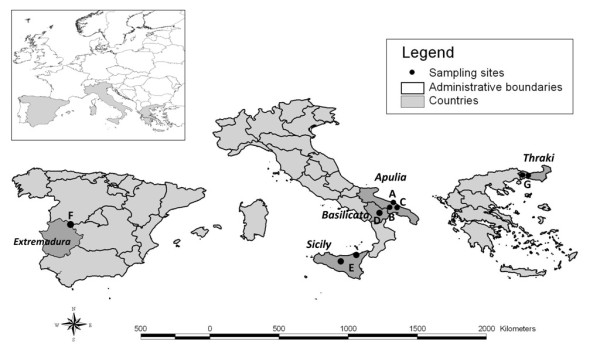
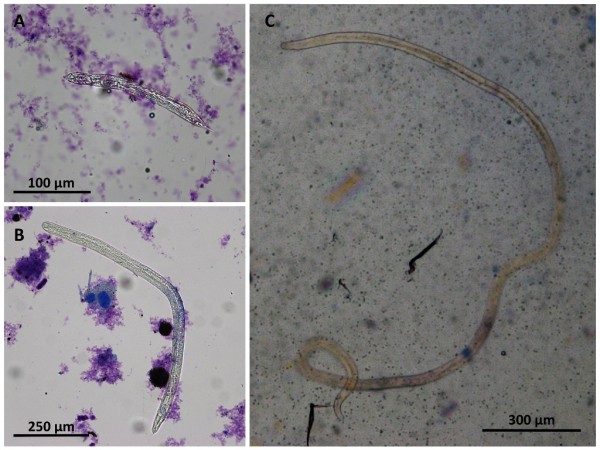
BACKGROUND: This study was aimed at investigating the distribution of a Cercopithifilaria sp. sensu Otranto et al., 2011 with dermal microfilariae recently identified in a dog from Sicily (Italy). A large epidemiological survey was conducted by examining skin samples (n = 917) and ticks (n = 890) collected from dogs at different time points in Italy, central Spain and eastern Greece. RESULTS: The overall prevalence of Cercopithifilaria sp. in the sampled animal populations was 13.9% and 10.5% by microscopy of skin sediments and by PCR on skin samples, respectively. Up to 21.6% and 45.5% of dogs in Spain were positive by microscopical examination and by PCR. Cumulative incidence rates ranging from 7.7% to 13.9% were estimated in dogs from two sites in Italy. A low level of agreement between the two diagnostic tests (microscopical examination and PCR) was recorded in sites where samples were processed in parallel. Infestation rate as determined by tick dissection (from 5.2% to 16.7%) was higher than that detected by PCR (from 0% to 3.9%); tick infestation was significantly associated with Cercopithifilaria sp. infestation in dogs from two out of four sites. Developing larvae found in ticks were morphometrically studied and as many as 1469 larvae were found in a single tick. CONCLUSIONS: Our data suggest that, in addition to the most common species of filarioids known to infest dogs (i.e., Dirofilaria immitis, Dirofilaria repens and Acanthocheilonema reconditum), Cercopithifilaria sp. with dermal microfilariae should be considered due to its widespread distribution in southern Europe and high frequency in tick-exposed dogs.
Overview
The claims and statistics of this paper haven’t been checked yet.
Run the check — free, no account needed. It reads the open-access text and checks the sources it cites.
Integrity signals
Registry
Cites
Statistics
Figures
Verification
Claims the paper makes
The claims and statistics of this paper haven’t been checked yet.
Run the check — free, no account needed. It reads the open-access text and checks the sources it cites.
Claims other papers make about this one
Each is checked against this paper’s own text: does it say what the citing paper says it does?
In the citing paper
“Similarly, tick-transmitted filarioids of the genus Cercopithifilaria infesting the skin of dogs were recently shown to be widespread in Europe.”
From Vector-borne helminths of dogs and humans in Europe (2013) · cites this paper as [6]
Self-check
Percentages, sums and reported differences re-computed from the paper’s own numbers.
The self-check needs the paper’s full text.
Citations
Cites
Clustal W and Clustal X version 2.0
Larkin, M., Blackshields, G., Brown, N. P., Chenna, R., McGettigan, P., McWilliam, H., Valentin, F., Wallace, I. M., Wilm, A., López, R., et al. (2007) · Bioinformatics · doi:10.1093/bioinformatics/btm404 · Cited by 28,598
Biology and ecology of the brown dog tick, Rhipicephalus sanguineus
Dantas‐Torres, F. (2010) · Parasites & Vectors · doi:10.1186/1756-3305-3-26 · Cited by 695
Self-citationHugh‐Jones, M. (1996) · Preventive Veterinary Medicine · doi:10.1016/0167-5877(96)85060-4 · Cited by 680
Dantas‐Torres, F. (2008) · Veterinary Parasitology · doi:10.1016/j.vetpar.2007.12.030 · Cited by 580
Self-citationRickettsial Infection in Animals and Brazilian Spotted Fever Endemicity
Sangioni, L. A., Horta, M. C., Vianna, M. C. B., Gennari, S. M., Soares, R. M., Galvão, M. A. M., Schumaker, T. T. S., Ferreira, F., Vidotto, O., & Labruna, M. B. (2005) · Emerging infectious diseases · doi:10.3201/eid1102.040656 · Cited by 418
Zoonotic helminths affecting the human eye
Otranto, D., & Eberhard, M. L. (2011) · Parasites & Vectors · doi:10.1186/1756-3305-4-41 · Cited by 203
Self-citationTrotz‐William, L. A., & Trees, A. J. (2003) · Veterinary Record · doi:10.1136/vr.152.4.97 · Cited by 129
Bremer, W. G., Schaefer, J. J., Wagner, E. R., Ewing, S. A., Rikihisa, Y., Needham, G. R., Jittapalapong, S., Moore, D. L., & Stich, R. W. (2005) · Veterinary Parasitology · doi:10.1016/j.vetpar.2005.04.030 · Cited by 122
Diagnosis of Canine Vector-Borne Diseases in Young Dogs: a Longitudinal Study
Otranto, D., Testini, G., Dantas‐Torres, F., Latrofa, M. S., Diniz, P. P. V. D. P., de Caprariis, D., Lia, R. P., Mencke, N., Stanneck, D., Capelli, G., et al. (2010) · Journal of Clinical Microbiology · doi:10.1128/jcm.00379-10 · Cited by 120
Self-citationFirst Evidence of Human Zoonotic Infection by Onchocerca lupi (Spirurida, Onchocercidae)
Otranto, D., Sakru, N., Testini, G., Gürlü, V. P., Yakar, K., Lia, R. P., Dantas-Torres, F., & Bain, O. (2011) · The American Society of Tropical Medicine and Hygiene · doi:10.4269/ajtmh.2011.10-0465 · Cited by 110
Self-citationOtranto, D., de Caprariis, D., Lia, R. P., Tarallo, V. D., Lorusso, V., Testini, G., Dantas‐Torres, F., Latrofa, S., Diniz, P. P. V. D. P., Mencke, N., et al. (2010) · Veterinary Parasitology · doi:10.1016/j.vetpar.2010.05.017 · Cited by 96
Self-citationOtranto, D., Paradies, P., Lia, R. P., Latrofa, M. S., Testini, G., Cantacessi, C., Mencke, N., Galli, G., Capelli, G., & Stanneck, D. (2007) · Veterinary Parasitology · doi:10.1016/j.vetpar.2006.09.012 · Cited by 92
Self-citationOnchocercosis: A newly recognized disease in dogs
Sréter, T., & Széll, Z. (2008) · Veterinary Parasitology · doi:10.1016/j.vetpar.2007.09.008 · Cited by 87
Lorusso, V., Dantas‐Torres, F., Lia, R. P., Tarallo, V. D., Mencke, N., Capelli, G., & Otranto, D. (2010) · Medical and Veterinary Entomology · doi:10.1111/j.1365-2915.2010.00885.x · Cited by 83
Self-citationOtranto, D., Brianti, E., Dantas‐Torres, F., Weigl, S., Latrofa, M. S., Gaglio, G., Cauquil, L., Giannetto, S., & Bain, O. (2011) · Veterinary Parasitology · doi:10.1016/j.vetpar.2011.05.043 · Cited by 80
Self-citationSubconjunctival filariasis due to Onchocerca sp. in dogs: report of 23 cases in Greece
Komnenou, A., Eberhard, M. L., Kaldrymidou, E., Tsalie, E., & Dessiris, A. (2002) · Veterinary Ophthalmology · doi:10.1046/j.1463-5224.2002.00235.x · Cited by 67
Brianti, E., Otranto, D., Dantas-Torres, F., Weigl, S., Latrofa, M. S., Gaglio, G., Napoli, E., Brucato, G., Cauquil, L., Giannetto, S., et al. (2012) · Veterinary Parasitology · doi:10.1016/j.vetpar.2011.07.031 · Cited by 64
Self-citationCanine ocular onchocerciasis in the United States: two new cases and a review of the literature
Zarfoss, M. K., Dubielzig, R. R., Eberhard, M. L., & Schmidt, K. S. (2005) · Veterinary Ophthalmology · doi:10.1111/j.1463-5224.2005.00348.x · Cited by 63
Movement of Rhipicephalus sanguineus adults between co-housed dogs during active feeding
Little, S. E., Hostetler, J. A., & Kocan, K. M. (2007) · Veterinary Parasitology · doi:10.1016/j.vetpar.2007.08.029 · Cited by 57
Ocular Onchocerca infections in two dogs in western United States
Eberhard, M. L., Ortega, Y., Dial, S., Schiller, C. A., Sears, A. W., & Greiner, E. (2000) · Veterinary Parasitology · doi:10.1016/s0304-4017(00)00252-1 · Cited by 57
Canine ocular onchocercosis in Hungary
Széll, Z., Erdélyi, I., Sréter, T., Albert, M., & Varga, I. (2001) · Veterinary Parasitology · doi:10.1016/s0304-4017(01)00397-1 · Cited by 55
Onchocerciasis in a California Dog
Orihel, T. C., Ash, L. R., Holshuh, H. J., & Santenelli, S. (1991) · The American Journal of Tropical Medicine and Hygiene · doi:10.4269/ajtmh.1991.44.513 · Cited by 51 · cited 4×
“However, cases of O. lupi causing acute or chronic ocular disease in dogs (i.e., conjunctivitis, photophobia, lacrimation, ocular discharge, exophthalmia) [1] have been reported in the United States [2-4], and Europe [5-8].”
BackgroundInfluentialFirst autochthonous case of canine ocular onchocercosis in Germany
Hermosilla, C., Hetzel, U., Bausch, M., Grübl, J., & Bauer, C. (2005) · Veterinary Record · doi:10.1136/vr.156.14.450 · Cited by 46
Dantas‐Torres, F., Figueredo, L. A., & Otranto, D. (2010) · Parasitology · doi:10.1017/s0031182010001502 · Cited by 40
Self-citationSréter-Lancz, Z., Széll, Z., & Sréter, T. (2007) · Veterinary Parasitology · doi:10.1016/j.vetpar.2007.06.021 · Cited by 35
Bain, O., Aeschlimann, A., & Chatelanat, P. (1982) · Annales de Parasitologie Humaine et Comparée · doi:10.1051/parasite/1982576643 · Cited by 29
Self-citationEberhard, M. L. (1980) · Journal of Parasitology · doi:10.2307/3280762 · Cited by 25
Cercopithifilaria bainae sp. n. parasita de Canis familiaris (L.) (Nematoda, Filarioidea)
de Almeida, G. L. G., & Vicenta, J. J. (1985) · Cited by 25
Brianti, E., Pennisi, M. G., Brucato, G., Risitano, A. L., Gaglio, G., Lombardo, G., Malara, D., Fogliazza, A., & Giannetto, S. (2010) · Veterinary Parasitology · doi:10.1016/j.vetpar.2010.01.033 · Cited by 22
Self-citationde Almeida, G., & Jj, V. (1982) · Cited by 4
Research works printed but not linked: 4
- Bain O, Uni S, Takaoka H: A synthetic look at a twenty years old taxon, Cercopithifilaria its probable evolution. Proceedings of the 10th International Congress of Parasitology (ICOPA): 4-9 August 2002; Vancouver (Canada). Edited by: Monduzzi Editore. 2002, 365-368.
- Noè G: Contribuzioni alla Sistematica e alla Anatomia del Genere Filaria. La Filaria grassii. 1907, Roma, Istituto di Anatomia Comparata della Regia Università di Roma, 236-252.
- Pampiglione S, Canestri Trotti G, Marchetti S: Ritrovamento di Diptalonema grassii (Noè, 1907) in Rhipicephalus sanguineus su cane in Italia e descrizione di alcuni suoi stadi larvali. Parassitologia. 1983, 25: 316-
- Giannetto S, Poglayen G, Gaglio G, Brianti E: Prevalence and epidemiological aspects of microfilaraemia in dogs in Sicily. Abstract book of the 1st European Dirofilaria days. 2007, 5-22-25 February 2007; Zagreb, Croatia. Edit by Albert Marinculic
Cited by
Sorted by citations
Brady, O. J., Johansson, M. A., Guerra, C. A., Bhatt, S., Golding, N., Pigott, D. M., Delatte, H., Grech, M. G., Leisnham, P. T., Maciel‐de‐Freitas, R., et al. (2013) · Parasites & Vectors · doi:10.1186/1756-3305-6-351 · Cited by 514
Vector-borne helminths of dogs and humans in Europe
Otranto, D., Dantas-Torres, F., Brianti, E., Traversa, D., Petrić, D., Genchi, C., & Capelli, G. (2013) · Parasites & Vectors · doi:10.1186/1756-3305-6-16 · Cited by 336
Self-citationMetatranscriptomic census of active protists in soils
Geisen, S., Tveit, A. T., Clark, I. M., Richter, A. A., Svenning, M. M., Bonkowski, M., & Urich, T. (2015) · The ISME Journal · doi:10.1038/ismej.2015.30 · Cited by 320
Dantas‐Torres, F., Latrofa, M. S., Annoscia, G., Giannelli, A., Parisi, A., & Otranto, D. (2013) · Parasites & Vectors · doi:10.1186/1756-3305-6-213 · Cited by 310
Self-citationCouret, J., Dotson, E. M., & Benedict, M. Q. (2014) · PLoS ONE · doi:10.1371/journal.pone.0087468 · Cited by 291
Metadata
- Authors
- Otranto, D., Brianti, E., Latrofa, M. S., Annoscia, G., Weigl, S., Lia, R. P., Gaglio, G., Napoli, E., Giannetto, S., Papadopoulos, E., Mirò, G., Dantas-Torres, F., & Bain, O.
- Affiliations
- University of Bari Aldo Moro (IT)
- University of Messina (IT)
- Aristotle University of Thessaloniki (GR)
- Centre National de la Recherche Scientifique (FR)
- Corresponding author
- Otranto, Domenico
- ORCID
- Venue
- Parasites & Vectors
- Published
- 2012-01-03
- Volume
- 5
- Issue
- 1
- Pages
- 1-1
- ISSN
- 1756-3305 (ISSN-L)
- PMC
- PMC3259067
- OpenAlex
- W2163909168
- Cited by
- 456
- References
- 30
- Citations by year
- 2026: 6 · 2025: 13 · 2024: 14 · 2023: 13 · 2022: 12 · 2021: 89 · 2020: 47 · 2019: 25 · 2018: 25 · 2017: 55 · 2016: 51 · 2015: 37 · 2014: 39 · 2013: 24 · 2012: 5
- FWCI
- 23.19
- Type
- journal article
- Language
- en
- Open access
- gold
- doi.org
- Licence
- Locations
- Parasites & Vectors (publishedVersion, cc-by)
- Europe PMC (PubMed Central) (publishedVersion, cc-by)
- PubMed Central (publishedVersion, cc-by)
- PubMed (publishedVersion)
- DOAJ (DOAJ: Directory of Open Access Journals) (submittedVersion)
- CINECA IRIS Institutional Research Information System (University of Bari Aldo Moro) (submittedVersion)
- Topics
- Health Sciences › Medicine › Infectious Diseases › Parasitic Diseases Research and Treatment
- Life Sciences › Immunology and Microbiology › Parasitology › Helminth infection and control
- Life Sciences › Immunology and Microbiology › Parasitology › Vector-borne infectious diseases
- Keywords
- filarioid nematodes, dogs, Rhipicephalus sanguineus, tick-borne transmission, prevalence, tick infestation, diagnostic test agreement, Southern Europe, Sicily
- MeSH terms
- Animals, Arachnid Vectors, Dog Diseases, Dogs, Female, Filariasis, Filarioidea, Male, Rhipicephalus sanguineus, Neglected Diseases
About these checks
Registry, retraction, Cites and statistics results are computed, not judged, with one exception: a printed reference that no index lists is read once by a model before it counts as a citation error. Claims are extracted by a model and kept only when their quote appears verbatim in the text; each cited source is then checked, with a model’s help, for whether it says what the claim relies on. Those verdicts can be wrong — read the claim’s quote and the cited source before relying on one.
Statistics and arithmetic are recomputed, not judged.
Confidence bands are shown only for fields calibrated on our annotated test set. None is calibrated yet, so no band is shown.
What counts as a claim ›How we measure confidence ›How we check this ›
Are you an author, or do you see a problem with this page? Request a review
