

An improved dual-indexing approach for multiplexed 16S rRNA gene sequencing on the Illumina MiSeq platform
Open accessThe DOI matches its Crossref record; 14 of the 14 references it cites were found in a registry or an index.
Abstract
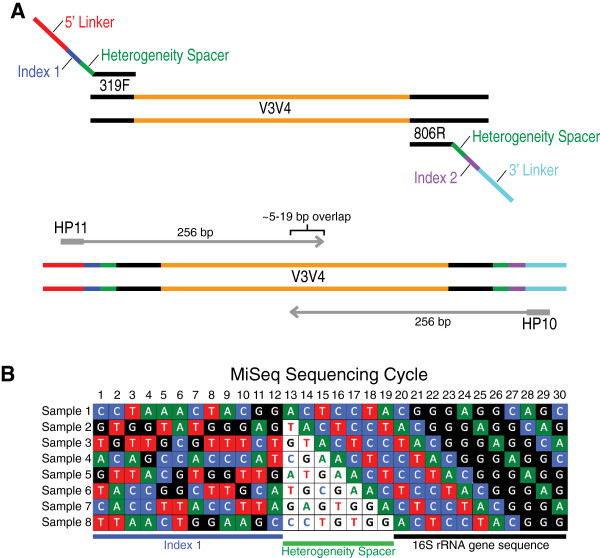
BACKGROUND: To take advantage of affordable high-throughput next-generation sequencing technologies to characterize microbial community composition often requires the development of improved methods to overcome technical limitations inherent to the sequencing platforms. Sequencing low sequence diversity libraries such as 16S rRNA amplicons has been problematic on the Illumina MiSeq platform and often generates sequences of suboptimal quality. RESULTS: Here we present an improved dual-indexing amplification and sequencing approach to assess the composition of microbial communities from clinical samples using the V3-V4 region of the 16S rRNA gene on the Illumina MiSeq platform. We introduced a 0 to 7 bp "heterogeneity spacer" to the index sequence that allows an equal proportion of samples to be sequenced out of phase. CONCLUSIONS: Our approach yields high quality sequence data from 16S rRNA gene amplicons using both 250 bp and 300 bp paired-end MiSeq protocols and provides a flexible and cost-effective sequencing option.
Overview
The claims and statistics of this paper haven’t been checked yet.
Free: it reads the open-access text and checks the first 5 claims that cite a source we can check. Create a free account to check every claim.
Integrity signals
Registry
Cites
Statistics
Figures
Verification
Claims the paper makes
The claims and statistics of this paper haven’t been checked yet.
Free: it reads the open-access text and checks the first 5 claims that cite a source we can check. Create a free account to check every claim.
Claims other papers make about this one
Each is checked against this paper’s own text: does it say what the citing paper says it does?
In the citing paper
“choices of 16S rRNA gene variable region primers may enable improved detection or differentiation of microbes16; for example, Propionibacterium spp. abundant on the skin are often undetected by V4 primers29, and Lactobacillus spp. in the vagina are better differentiated by including V321.”
From Assessment of variation in microbial community amplicon sequencing by the Microbiome Quality Control (MBQC) project consortium (2017) · cites this paper as [21]
Self-check
Percentages, sums and reported differences re-computed from the paper’s own numbers.
The self-check needs the paper’s full text.
Citations
Cites
Fast and accurate short read alignment with Burrows-Wheeler transform
Li, H., & Durbin, R. (2009) · Bioinformatics · doi:10.1093/bioinformatics/btp324 · Cited by 58,607
QIIME allows analysis of high-throughput community sequencing data
Caporaso, J. G., Kuczynski, J., Stombaugh, J., Bittinger, K., Bushman, F. D., Costello, E. K., Fierer, N., Peña, A. G., Goodrich, J. K., Gordon, J. I., et al. (2010) · Nature Methods · doi:10.1038/nmeth.f.303 · Cited by 34,887 · cited 1×
“0,) [10] and included additional quality trimming, demultiplexing, and taxonomic assignments.”
Search and clustering orders of magnitude faster than BLAST
Edgar, R. C. (2010) · Bioinformatics · doi:10.1093/bioinformatics/btq461 · Cited by 20,826
Naïve Bayesian Classifier for Rapid Assignment of rRNA Sequences into the New Bacterial Taxonomy
Wang, Q., Garrity, G. M., Tiedje, J. M., & Cole, J. R. (2007) · Applied and Environmental Microbiology · doi:10.1128/aem.00062-07 · Cited by 19,885 · cited 1×
“2 [15] trained on the Greengenes database”
FLASH: fast length adjustment of short reads to improve genome assemblies
Magoč, T., & Salzberg, S. L. (2011) · Bioinformatics · doi:10.1093/bioinformatics/btr507 · Cited by 15,366 · cited 4×
“The final sequence length after barcode, heterogeneity spacer, and primer removal was 429 ± 7 bp and 429 ± 6.7 bp for PANDAseq and FLASH, respectively, with an average of approximately 11,600 reads per sample.”
InfluentialUCHIME improves sensitivity and speed of chimera detection
Edgar, R. C., Haas, B. J., Clemente, J. C., Quince, C., & Knight, R. (2011) · Bioinformatics · doi:10.1093/bioinformatics/btr381 · Cited by 15,114
Structure, function and diversity of the healthy human microbiome
The Human Microbiome Project Consortium (2012) · Nature · doi:10.1038/nature11234 · Cited by 11,726
Ultra-high-throughput microbial community analysis on the Illumina HiSeq and MiSeq platforms
Caporaso, J. G., Lauber, C. L., Walters, W. A., Berg-Lyons, D., Huntley, J., Fierer, N., Owens, S. M., Betley, J., Fraser, L., Bauer, M., et al. (2012) · The ISME Journal · doi:10.1038/ismej.2012.8 · Cited by 8,839 · cited 3×
“quencing strategies include a single- [2,3] or a recently”
MethodKozich, J. J., Westcott, S. L., Baxter, N. T., Highlander, S. K., & Schloss, P. D. (2013) · Applied and Environmental Microbiology · doi:10.1128/aem.01043-13 · Cited by 7,112 · cited 2×
“developed dual-indexing [4] approach targeting the V4 hypervariable region of the 16S rRNA gene.”
Base-Calling of Automated Sequencer Traces Using Phred. I. Accuracy Assessment
Ewing, B., Hillier, L., Wendl, M. C., & Green, P. (1998) · Genome Research · doi:10.1101/gr.8.3.175 · Cited by 6,967 · cited 1×
“Additional sequence read pre-processing included: 1) removal of primer sequence; 2) truncation of sequence reads not having an average quality of 20 over a 30 bp sliding window based on the phred algorithm [6,7] implemented previously [8,9]; and 3) removal of trimmed reads having less than 75% of their original length…”
Cited by
Items 101–200 of 1,000
Association between Oral Candida and Bacteriome in Children with Severe ECC
Xiao, J., Grier, A., Faustoferri, R. C., Alzoubi, S., Gill, A. L., Feng, C., Liu, Y., Quivey, R. G., Kopycka-Kedzierawski, D. T., Koo, H., et al. (2018) · Journal of Dental Research · doi:10.1177/0022034518790941 · Cited by 146
“Reads were multiplexed using a configuration described previously (Fadrosh et al., 2014).”
MethodBuelow, E., Bayjanov, J. R., Majoor, E. A. M., Willems, R. J. L., Bonten, M. J. M., Schmitt, H., & van Schaik, W. (2018) · FEMS Microbiology Ecology · doi:10.1093/femsec/fiy087 · Cited by 160
Strong succession in arbuscular mycorrhizal fungal communities
Gao, C. D., Montoya, L., Xu, L., Madera, M. A., Hollingsworth, J., Purdom, E. A., Hutmacher, R. B., Dahlberg, J. A., Coleman‐Derr, D., Lemaux, P. G., et al. (2018) · The ISME Journal · doi:10.1038/s41396-018-0264-0 · Cited by 159
Ren, M., Zhang, H., Qi, J., Hu, A., Jiang, Q., Hou, Y., Feng, Q., Ojo, O., & Wang, X. (2020) · Nutrients · doi:10.3390/nu12103036 · Cited by 139
“Purified PCR products were sequenced with the Hiseq2500 PE250 platform [35].”
MethodRegueira‐Iglesias, A., Balsa‐Castro, C., Blanco‐Pintos, T., & Tomás, I. (2023) · Molecular Oral Microbiology · doi:10.1111/omi.12434 · Cited by 155
Effects of subchronic oral toxic metal exposure on the intestinal microbiota of mice
Zhai, Q., Li, T., Yu, L., Xiao, Y., Feng, S., Wu, J., Zhao, J., Zhang, H., & Chen, W. (2017) · 中国科学通报:英文版 · doi:10.1016/j.scib.2017.01.031 · Cited by 150
Jiao, F., Zhang, L., Limbu, S. M., Hong, Y., Xie, Y., Yang, Z., Shang, Z., Kong, L., & Rong, H. (2023) · Ecology and Evolution · doi:10.1002/ece3.10499 · Cited by 156
“To obtain high-quality clean reads, raw reads were demultiplexed and filtered for quality based on the methods developed by Fadrosh et al. ( 2014 ).”
Dieterich, W., Schuppan, D., Schink, M., Schwappacher, R., Wirtz, S., Agaimy, A., Neurath, M. F., & Zopf, Y. (2019) · Clinical Nutrition · doi:10.1016/j.clnu.2018.03.017 · Cited by 131
Drummond, R. A., Desai, J. V., Ricotta, E. E., Swamydas, M., Deming, C., Conlan, S., Quinones, M., Matei-Rascu, V., Sheriff, L., Lecky, D., et al. (2022) · Cell Host & Microbe · doi:10.1016/j.chom.2022.04.013 · Cited by 141
Collection media and delayed freezing effects on microbial composition of human stool
Flores, R., Shi, J., Yu, G., Ma, B., Ravel, J., Goedert, J. J., & Sinha, R. (2015) · Microbiome · doi:10.1186/s40168-015-0092-7 · Cited by 137
Self-citationThe prevalence rate of periodontal pathogens and its association with oral squamous cell carcinoma
Chang, C., Geng, F., Shi, X., Li, Y., Zhang, X., Zhao, X., & Pan, Y. (2018) · Applied Microbiology and Biotechnology · doi:10.1007/s00253-018-9475-6 · Cited by 151
de Muinck, E. J., Trosvik, P., Gilfillan, G. D., Hov, J. R., & Sundaram, A. Y. M. (2017) · Microbiome · doi:10.1186/s40168-017-0279-1 · Cited by 150
“Addition of heterogeneity spacers [4] allowed for PhiX spike-in at low levels while maintaining de Muinck et al.”
BackgroundInfluentialCheong, J. C., Lee, J. T. E., Lim, J. W., Song, S., Tan, J. K. N., Chiam, Z. Y., Yap, K. Y., Lim, E. Y., Zhang, J., Tan, H. T. W., et al. (2020) · Science of The Total Environment · doi:10.1016/j.scitotenv.2020.136789 · Cited by 134
Ishikawa, D., Sasaki, T., Osada, T., Kuwahara-Arai, K., Haga, K., Shibuya, T., Hiramatsu, K., & Watanabe, S. (2017) · Inflammatory Bowel Diseases · doi:10.1097/mib.0000000000000975 · Cited by 136
Wang, Y., Fei, Y., Liu, L., Xiao, Y., Pang, Y., Kang, J., & Wang, Z. (2018) · International Journal of Molecular Sciences · doi:10.3390/ijms19113587 · Cited by 144
“The raw reads were quality-filtered and merged using the following criteria [62]: (1) Raw reads were truncated at any site that gave rise to an average quality score <20.”
MethodClinical, Immune, and Microbiome Traits of Gingivitis and Peri-implant Mucositis
Schincaglia, G. P., Hong, B. Y., Rosania, A., Barasz, J., Thompson, A., Sobue, T., Panagakos, F., Burleson, J. A., Dongari-Bagtzoglou, A., & Diaz, P. I. (2017) · Journal of Dental Research · doi:10.1177/0022034516668847 · Cited by 130
Community structure of the gut microbiota in sympatric species of wild Drosophila
Martinson, V. G., Douglas, A. E., & JAENIKE, J. R. (2017) · Ecology Letters · doi:10.1111/ele.12761 · Cited by 146
“These primers are uniquely barcoded to enable multiplexed amplicon sequencing (File S1af, Fadrosh et al. 2014).”
BackgroundLing, Z., Shao, L., Liu, X., Cheng, Y., Yan, C., Mei, Y., Ji, F., & Liu, X. (2019) · Frontiers in Immunology · doi:10.3389/fimmu.2019.00533 · Cited by 147
An accurate and efficient experimental approach for characterization of the complex oral microbiota
Zheng, W., Tsompana, M., Ruscitto, A., Sharma, A., Genco, R., Sun, Y., & Buck, M. J. (2015) · Microbiome · doi:10.1186/s40168-015-0110-9 · Cited by 128
Hamouda, N., Sano, T., Oikawa, Y., Ozaki, T., Shimakawa, M., Matsumoto, K., Amagase, K., Higuchi, K., & Kato, S. (2017) · Basic & Clinical Pharmacology & Toxicology · doi:10.1111/bcpt.12793 · Cited by 162
Comparison of Illumina versus Nanopore 16S rRNA Gene Sequencing of the Human Nasal Microbiota
Heikema, A. P., Horst-Kreft, D., Boers, S. A., Jansen, R., Hiltemann, S., de Koning, W., Kraaij, R., de Ridder, M. A. J., van Houten, C. B., Bont, L., et al. (2020) · Genes · doi:10.3390/genes11091105 · Cited by 146
“The hypervariable V5 and V6 regions (276 base pairs—bp) of the 16S rRNA gene were amplified using the 785F (5′-GGA TTA GAT ACC CBR GTA GTC-3′) and 1061R (5′-TCA CGR CAC GAG CTG ACG AC-3′) primers [20], and dual indexing [21].”
MethodAdapterama II: universal amplicon sequencing on Illumina platforms (TaggiMatrix)
Glenn, T. C., Pierson, T. W., Bayona‐Vásquez, N. J., Kieran, T. J., Hoffberg, S. L., Thomas, J. C., Lefever, D. E., Finger, J. W., Gao, B., Bian, X., et al. (2019) · PeerJ · doi:10.7717/peerj.7786 · Cited by 132
Zhou, R., Wu, J., Lang, X., Liu, L., Casper, D. P., Wang, C., Zhang, L., & Wei, S. (2020) · Journal of Dairy Science · doi:10.3168/jds.2019-16611 · Cited by 130
Gangadoo, S., Dinev, I., Chapman, J., Hughes, R., Van, T. T. H., Moore, R. J., & Stanley, D. (2017) · Applied Microbiology and Biotechnology · doi:10.1007/s00253-017-8688-4 · Cited by 136
“The primers also contained barcodes, spacesr and Illumina sequencing linkers as previously described (Fadrosh et al. 2014).”
MethodIdentification and Characterization of the Core Rice Seed Microbiome
Eyre, A. W., Wang, M., Oh, Y., & Dean, R. A. (2019) · Phytobiomes Journal · doi:10.1094/pbiomes-01-19-0009-r · Cited by 155
Pjevac, P., Hausmann, B., Schwarz, J., Köhl, G., Herbold, C. W., Loy, A., & Berry, D. (2021) · Frontiers in Microbiology · doi:10.3389/fmicb.2021.669776 · Cited by 135
Prasai, T. P., Walsh, K. B., Bhattarai, S. P., Midmore, D. J., Van, T. T. H., Moore, R. J., & Stanley, D. (2016) · PLOS ONE · doi:10.1371/journal.pone.0154061 · Cited by 129
Derakhshani, H., Tun, H. M., & Khafipour, E. (2016) · Journal of Basic Microbiology · doi:10.1002/jobm.201500420 · Cited by 120
Iroki: automatic customization and visualization of phylogenetic trees
Moore, R. M., Harrison, A. O., McAllister, S. M., Polson, S. W., & Wommack, K. E. (2020) · PeerJ · doi:10.7717/peerj.8584 · Cited by 139
Bias in RNA‐seq Library Preparation: Current Challenges and Solutions
Shi, H., Zhou, Y., Jia, E., Pan, M., Bai, Y., & Ge, Q. (2021) · BioMed Research International · doi:10.1155/2021/6647597 · Cited by 150
“’s [67] study found that MiSeq 16S rRNA gene amplicon sequencing may arise “low sequence diversity” problems in the first several cycles.”
BackgroundDenitrifying Anaerobic Methane Oxidation: A Previously Overlooked Methane Sink in Intertidal Zone
Wang, J., Cai, C., Li, Y., Hua, M., Wang, J., Yang, H., Zheng, P., & Hu, B. (2018) · Environmental Science & Technology · doi:10.1021/acs.est.8b05742 · Cited by 128
High-throughput sequencing of multiple amplicons for barcoding and integrative taxonomy
Cruaud, P., Rasplus, J., Rodriguez, L. J., & Cruaud, A. (2017) · Scientific Reports · doi:10.1038/srep41948 · Cited by 144
“In this step, the primer pairs used contain a standard Illumina sequencing primer, a 0 to 3 bp “heterogeneity spacer” (as suggested in Fadrosh et al. 54 ) and the gene-specific primer (Fig.”
Tang, W., Wang, S., Fonseca-Batista, D., Dehairs, F., Gifford, S., González, A. G., Gallinari, M., Planquette, H. F., Sarthou, G., & Cassar, N. (2019) · Nature Communications · doi:10.1038/s41467-019-08640-0 · Cited by 138
Age-related shifts in gut microbiota contribute to cognitive decline in aged rats
Li, Y., Ning, L., Yin, Y., Wang, R., Zhang, Z., Hao, L., Wang, B., Zhao, X., Yang, X., Yin, L., et al. (2020) · Aging · doi:10.18632/aging.103093 · Cited by 125
van Houdt, R., Ma, B., Bruisten, S. M., Speksnijder, A. G. C. L., Ravel, J., & de Vries, H. J. C. (2017) · Sexually Transmitted Infections · doi:10.1136/sextrans-2017-053133 · Cited by 141
Self-citationWhole transcriptome profiling reveals the RNA content of motor axons
Briese, M., Saal, L., Appenzeller, S., Moradi, M., Baluapuri, A., & Sendtner, M. (2016) · Nucleic Acids Research · doi:10.1093/nar/gkv1027 · Cited by 113
Scaling up DNA metabarcoding for freshwater macrozoobenthos monitoring
Elbrecht, V., & Steinke, D. (2018) · Freshwater Biology · doi:10.1111/fwb.13220 · Cited by 134
“Fusion primers can be used directly in a single PCR approach (Caporaso et al., 2012; Fadrosh et al., 2014; Kozich, Westcott, Baxter, Highlander, & Schloss, 2013), but a two- step PCR setup is less susceptible to PCR F IGURE 2 Overview of the two- step metabarcoding polymerase chain reaction (PCR)…”
MethodMu, C., Yang, Y., Su, Y., Zoetendal, E. G., & Zhu, W. (2017) · Frontiers in Microbiology · doi:10.3389/fmicb.2017.00797 · Cited by 144
“The barcodes were set according to previous report (Fadrosh et al., 2014).”
MethodCheng, M., Zhang, X., Zhu, J., Cheng, L., Cao, J., Wu, Z., Weng, P., & Zheng, X. (2018) · Food & Function · doi:10.1039/c7fo01570d · Cited by 121
Ke, S., Pollock, N. R., Wang, X., Chen, X., Daugherty, K., Lin, Q., Xu, H. J., Garey, K. W., Gonzales-Luna, A. J., Kelly, C. P., et al. (2021) · Gut Microbes · doi:10.1080/19490976.2021.1935186 · Cited by 124
Gao, K., Pi, Y., Mu, C., Peng, Y., Huang, Z., & Zhu, W. (2018) · Journal of Neurochemistry · doi:10.1111/jnc.14333 · Cited by 119
Kim, S. A., Park, S. H., Lee, S. I., Owens, C. M., & Ricke, S. C. (2017) · Scientific Reports · doi:10.1038/srep43354 · Cited by 119
Lowe, P. P., Gyongyosi, B., Satishchandran, A., Iracheta-Vellve, A., Ambade, A., Kodys, K., Catalano, D., Ward, D. V., & Szabo, G. (2017) · PLOS ONE · doi:10.1371/journal.pone.0174544 · Cited by 114
Anti-HIV-1 Activity of Lactic Acid in Human Cervicovaginal Fluid
Tyssen, D. P., Wang, Y., Hayward, J. A., Agius, P. A., DeLong, K., Aldunate, M., Ravel, J., Moench, T. R., Cone, R. A., & Tachedjian, G. (2018) · mSphere · doi:10.1128/msphere.00055-18 · Cited by 131
“The vaginal microbiota composition and structure were characterized as previously published (67) by amplification of the V3-V4 regions of the 16S rRNA gene and by sequencing of the bar-coded amplicons on an Illumina MiSeq instrument using the 300-bp paired-end read protocol as recommended by the…”
Self-citationYao, Z., Wang, A., Li, Y., Cai, Z., Lemaître, B., & Zhang, H. (2015) · The ISME Journal · doi:10.1038/ismej.2015.202 · Cited by 120
“We obtained a clean data of sequence reads by pre-processing the removal of the primer sequence; truncation of sequence reads not having an average quality of 20 over a 30-bp sliding window based on the phred algorithm; and removal of trimmed reads having o75% of their original length, as well as its paired read (Fadr…”
MethodBai, J., Zhu, Y. G., & Dong, Y. (2016) · Journal of Ethnopharmacology · doi:10.1016/j.jep.2016.10.043 · Cited by 126
“The products from different samples were sequenced pair end on the MiSeq Illumina Sequencing Platform (San Diego, CA, USA) with the sequencing strategy PE250 (PE + 251 + 8 + 8 + 251; Miseq Reagent kit) (Fadrosh et al., 2014).”
MethodJung, M. Y., Kim, T.-W., Lee, C.-S., Kim, J. Y., Song, H. S., Kim, Y. B., Ahn, S. W., Kim, J. S., Roh, S. W., & Lee, S. H. (2018) · Food Chemistry · doi:10.1016/j.foodchem.2018.05.093 · Cited by 119
Brooks, B., Olm, M. R., Firek, B., Baker, R. W., Geller‐McGrath, D., Reimer, S. R., Soenjoyo, K. R., Yip, J. S., Dahan, D., Thomas, B. C., et al. (2018) · Microbiome · doi:10.1186/s40168-018-0493-5 · Cited by 122
“Genomic DNA from room samples were subjected to 16S rRNA V3-4 MiSeq library preparation which included dual-barcoded multiplexing with a heterogeneity spacer for higher sequence quality [22].”
MethodLi, X., Chen, H., He, Y., Chen, W., Chen, J., Gao, L., Hu, H., & Wang, J. (2018) · Molecules · doi:10.3390/molecules23123245 · Cited by 121
“To obtain clean reads, the raw data were filtered to eliminate the adapter pollution and low-quality reads by an in-house procedure as following [55]: The clean paired-end reads with overlap were merged to tags using FLASH (fast length adjustment of short reads, v1.”
MethodEvaluating the profound effect of gut microbiome on host appetite in pigs
Yang, H., Yang, M. J., Fang, S., Huang, X., He, M., Ke, S., Gao, J., Wu, J., Zhou, Y., Fu, H., et al. (2018) · BMC Microbiology · doi:10.1186/s12866-018-1364-8 · Cited by 123
Maternal Exposure to Non-nutritive Sweeteners Impacts Progeny’s Metabolism and Microbiome
Olivier-Van Stichelen, S., Rother, K. I., & Hanover, J. A. (2019) · Frontiers in Microbiology · doi:10.3389/fmicb.2019.01360 · Cited by 106
“Each 16S amplicon was then amplified using a unique couple of barcode-containing primers for dual-indexing of samples during the sequencing process (Fadrosh et al., 2014).”
MethodRhizospheric fungi of Panax notoginseng: diversity and antagonism to host phytopathogens
Miao, C., Mi, Q.-L., Qiao, X.-G., Zheng, Y.-K., Chen, Y., Xu, L., Guan, H., & Zhao, L. (2015) · Journal of Ginseng Research · doi:10.1016/j.jgr.2015.06.004 · Cited by 122
Gut microbiota alterations reveal potential gut–brain axis changes in polycystic ovary syndrome
Liang, Z., Di, N., Li, L., & Yang, D. (2021) · Journal of Endocrinological Investigation · doi:10.1007/s40618-020-01481-5 · Cited by 109
“Follicle stimulating hormone (FSH), luteinizing hormone (LH) and testosterone (T) were tested using chemiluminescent immunoassay (UniCel Dxl 800 Access Immunoassay System, Beckman Coulter, Brea, USA), insulin levels were assessed using chemiluminescent immunoassay (Immulite 2000 Analyzer, CPC, CA, USA).”
MethodInfluentialUrban park soil microbiomes are a rich reservoir of natural product biosynthetic diversity
Charlop–Powers, Z., Pregitzer, C. C., Lemetre, C., Ternei, M. A., Maniko, J., Hover, B. M., Calle, P. Y., McGuire, K. L., Garbarino, J., Forgione, H. M., et al. (2016) · Proceedings of the National Academy of Sciences · doi:10.1073/pnas.1615581113 · Cited by 109
Microbiota dysbiosis is associated with HPV‑induced cervical carcinogenesis
Kwaśniewski, W. M., Wołuń-Cholewa, M., Kotarski, J., Warchol, W. J., Kuźma, D., Kwaśniewska, A., & Goździcka‐Józefiak, A. (2018) · Oncology Letters · doi:10.3892/ol.2018.9509 · Cited by 137
Zhang, F., Ma, T., Cui, P., Tamadon, A., He, S., Huo, C., Yierfulati, G., Xu, X., Hu, W., Li, X., et al. (2019) · Frontiers in Microbiology · doi:10.3389/fmicb.2019.00175 · Cited by 106
“Each primer contained 8–13 bp paired-end error-correcting barcodes (Fadrosh et al., 2014).”
DNA Metabarcoding for the Characterization of Terrestrial Microbiota—Pitfalls and Solutions
Francioli, D., Lentendu, G., Lewin, S. A., & Kolb, S. (2021) · Microorganisms · doi:10.3390/microorganisms9020361 · Cited by 120
Pedro, A. R., Allendes, . L., Beltrán, C. A., Chaperon, P. N., Saldarriaga‐Córdoba, M., Silva, A. X., & Grez, A. A. (2020) · Agriculture Ecosystems & Environment · doi:10.1016/j.agee.2020.107063 · Cited by 117
Variations of bacteria and fungi in PM2.5 in Beijing, China
Du, P., Du, R., Ren, W., Lu, Z., Zhang, Y., & Fu, P. (2017) · Atmospheric Environment · doi:10.1016/j.atmosenv.2017.10.048 · Cited by 107
Gao, B., Wang, R., Peng, Y., & Li, X. (2018) · Journal of Ethnopharmacology · doi:10.1016/j.jep.2018.06.006 · Cited by 108
Soil fungal taxonomic and functional community composition as affected by biochar properties
Dai, Z., Enders, A., Rodrigues, J. L. M., Hanley, K. L., Brookes, P. C., Xu, J., & Lehmann, J. (2018) · Soil Biology and Biochemistry · doi:10.1016/j.soilbio.2018.09.001 · Cited by 102
Tam, J., Hoffmann, T. K., Fischer, S., Bornstein, S. R., Gräßler, J., & Noack, B. (2018) · PLoS ONE · doi:10.1371/journal.pone.0204724 · Cited by 114
Franchini, P., Parera, D. M., Kautt, A. F., & Meyer, A. (2017) · Molecular Ecology · doi:10.1111/mec.14077 · Cited by 111
“Illumina sequencing technology requires high level of base variability during the first cycles (the first five cycles/bases are the most critical) for efficient sequence cluster identification and phasing/pre-phasing calibration (Fadrosh et al. 2014).”
MethodAt-hatch administration of probiotic to chickens can introduce beneficial changes in gut microbiota
Baldwin, S. A., Hughes, R., Van, T. T. H., Moore, R. J., & Stanley, D. (2018) · PLoS ONE · doi:10.1371/journal.pone.0194825 · Cited by 113
Yu, H., Ling, N., Wang, T., Zhu, C., Wang, Y., Wang, S., & Gao, Q. (2018) · Soil and Tillage Research · doi:10.1016/j.still.2018.08.017 · Cited by 111
Analysis of 16S rRNA Primer Systems for Profiling of Thermophilic Microbial Communities
Merkel, A. Y., Tarnovetskii, I. Y., Podosokorskaya, O. A., & Toshchakov, S. V. (2019) · Microbiology · doi:10.1134/s0026261719060110 · Cited by 105
“Libraries of 16S rRNA gene fragments were prepared using single-round amplification as described by Fadrosh et al. (2014).”
MethodKorzhenkov, A. A., Toshchakov, S. V., Bargiela, R., Gibbard, H., Ferrer, M., Teplyuk, A. V., Jones, D. L., Kublanov, I. V., Golyshin, P. N., & Golyshina, O. V. (2019) · Microbiome · doi:10.1186/s40168-019-0623-8 · Cited by 101
Park, J., Schwardt, N. H., Jo, J.-H., Zhang, Z., Pillai, V., Phang, S., Brady, S. M., Portillo, J. A., MacGibeny, M. A., Liang, H., et al. (2022) · Journal of Investigative Dermatology · doi:10.1016/j.jid.2021.04.034 · Cited by 93
Brown, R. W., Chadwick, D. R., Thornton, H., Marshall, M. R., Bei, S., Distaso, M. A., Bargiela, R., Marsden, K. A., Clode, P. L., Murphy, D. V., et al. (2021) · Soil Biology and Biochemistry · doi:10.1016/j.soilbio.2021.108496 · Cited by 105
Shannon, B., Gajer, P., Yi, T. J., Ma, B., Humphrys, M. S., Thomas‐Pavanel, J., Chieza, L., Janakiram, P., Saunders, M. A., Tharao, W. E., et al. (2017) · The Journal of Infectious Diseases · doi:10.1093/infdis/jix088 · Cited by 114
“Amplification of the V3-V4 regions of the 16S ribosomal ribonucleic acid (rRNA) gene used a dual-barcode system with fusion primers 338F and 806R [28].”
MethodSelf-citationCorrelation between gut microbiota and personality in adults: A cross-sectional study
Kim, H.-N., Yun, Y., Ryu, S., Chang, Y., Kwon, M.-J., Cho, J., Shin, H., & Kim, H.-L. (2018) · Brain, Behavior, and Immunity · doi:10.1016/j.bbi.2017.12.012 · Cited by 90
Fricke, W. F., Song, Y., Wang, A., Smith, A. D., Grinchuk, V., Pei, C., Ma, B., Lu, N., Urban, J. F., Shea‐Donohue, T., et al. (2015) · Microbiome · doi:10.1186/s40168-015-0103-8 · Cited by 106
Self-citationMei, X., Liu, J., Guo, Z., Li, P., Bi, S., Wang, Y., Yang, Y., Shen, W., Wang, Y., Xiao, Y., et al. (2018) · Journal of Hazardous Materials · doi:10.1016/j.jhazmat.2018.09.072 · Cited by 98
Paganelli, F. L., Luyer, M., Hazelbag, C. M., Uh, H.-W., Rogers, M. R. C., Adriaans, D., Berbers, R.-M., Hendrickx, A. P. A., Viveen, M. C., Groot, J. A., et al. (2019) · Scientific Reports · doi:10.1038/s41598-019-47332-z · Cited by 95
Xu, M., Yang, X., Wu, J., Gu, Y., Yang, G. L., Zhang, X., Peng, H., Yu, X., Xiao, Y., & Li, L. (2019) · Journal of Soils and Sediments · doi:10.1007/s11368-019-02258-x · Cited by 100
Yun, Y., Kim, H.-N., Lee, E., Ryu, S., Chang, Y., Shin, H. C., Kim, H., Kim, T. H., Yoo, K., & Kim, H. Y. (2019) · PLoS ONE · doi:10.1371/journal.pone.0213692 · Cited by 103
Zhu, K., Mao, G., Wu, D., Yu, C., Cheng, H., Xiao, H., Ye, X., Linhardt, R. J., Orfila, C., & Chen, S. (2020) · Journal of Agricultural and Food Chemistry · doi:10.1021/acs.jafc.0c02654 · Cited by 98
Greenfield, L. M., Graf, M., Rengaraj, S., Bargiela, R., Williams, G. B., Golyshin, P. N., Chadwick, D. R., & Jones, D. L. (2022) · Agriculture Ecosystems & Environment · doi:10.1016/j.agee.2022.108023 · Cited by 100
“Primers were designed to contain: the Illumina adaptors and sequencing primers, a 12 bp barcode sequence, a heterogeneity spacer to mitigate the low sequence diversity amplicon issue, and 16S rRNA gene universal primers (Fadrosh et al., 2014).”
Han, L., Jin, H., Zhou, L., Zhang, X., Fan, Z., Dai, M., Lin, Q., Huang, F., Xuan, L., Zhang, H., et al. (2018) · Frontiers in Immunology · doi:10.3389/fimmu.2018.00669 · Cited by 99
PinAPL-Py: A comprehensive web-application for the analysis of CRISPR/Cas9 screens
Spahn, P. N., Bath, T., Weiss, R. J., Kim, J., Esko, J. D., Lewis, N. E., & Harismendy, O. (2017) · Scientific Reports · doi:10.1038/s41598-017-16193-9 · Cited by 98
Qin, H., Xing, X., Tang, Y., Zhu, B., Wei, X., Chen, X., & Liu, Y. (2019) · Biology and Fertility of Soils · doi:10.1007/s00374-019-01403-5 · Cited by 96
Wu, L., Zeng, T., Deligios, M., Milanesi, L., Langille, M. G. I., Zinellu, A., Rubino, S., Carru, C., & Kelvin, D. J. (2020) · mSphere · doi:10.1128/msphere.00558-19 · Cited by 96
Tian, L., Tan, P., Yang, L., Zhu, W., & Xu, D. (2020) · Aquaculture · doi:10.1016/j.aquaculture.2020.735470 · Cited by 96
Kitson, J. J. N., Hahn, C., Sands, R. J. N., Straw, N. A., Evans, D. M., & Lunt, D. H. (2018) · Molecular Ecology · doi:10.1111/mec.14518 · Cited by 97
“…based on mICOIintF and jgHCO2198 modified from Leray et al. (2013) to include standard Illumina MIDs and bridge sequences (see Figure 1 and Table S2 in the GitHub repository associated with this manuscript) along with a variable length sequencing heterogeneity spacer as in Fadrosh et al. (2014).”
MethodLai, K. P., Ng, A. H.-M., Wan, H. T., Wong, A. Y.-M., Leung, C. C. T., Li, R., & Wong, C. K. C. (2018) · Frontiers in Microbiology · doi:10.3389/fmicb.2018.02552 · Cited by 98
Neonatal gut and respiratory microbiota: coordinated development through time and space
Grier, A., McDavid, A., Wang, B., Qiu, X., Java, J., Bandyopadhyay, S., Yang, H., Holden-Wiltse, J., Kessler, H. A., Gill, A. L., et al. (2018) · Microbiome · doi:10.1186/s40168-018-0566-5 · Cited by 97
Jin, Y., Wu, Y., Zeng, Z., Jin, C., Wu, S., Wang, Y., & Fu, Z. (2016) · Toxicological Sciences · doi:10.1093/toxsci/kfw150 · Cited by 99
Towards Quantitative Microbiome Community Profiling Using Internal Standards
Lin, Y., Gifford, S., Ducklow, H. W., Schofield, O., & Cassar, N. (2018) · Applied and Environmental Microbiology · doi:10.1128/aem.02634-18 · Cited by 104
Yu, L., YiLing, T., Wang, Z., Gou, Y., & Wang, J. (2018) · Nutrient Cycling in Agroecosystems · doi:10.1007/s10705-018-9960-4 · Cited by 95
“…included: (1) removal of primer sequence; (2) sequence reads were truncated at any site or received an average quality score\ 20 over a 50 bp sliding window and (3) removal of trimmed reads having less than 75% of their original length, as well as its paired read (Fadrosh et al. 2014).”
Alterations of the Fecal Microbiota in Chinese Patients With Multiple Sclerosis
Ling, Z., Cheng, Y., Yan, X., Shao, L., Liu, X., Zhou, D., Zhang, L., Yu, K., & Zhao, L. (2020) · Frontiers in Immunology · doi:10.3389/fimmu.2020.590783 · Cited by 89
“Amplicon Library Construction and Sequencing Amplicon libraries were constructed with Illumina sequencingcompatible and barcode-indexed bacterial PCR primers 319F/ 806R, which target the V3–V4 regions of 16S rRNA gene (20).”
MethodA framework for inferring biological communities from environmental DNA
Shelton, A. O., O’Donnell, J. L., Samhouri, J. F., Lowell, N. C., Williams, G. D., & Kelly, R. P. (2016) · Ecological Applications · doi:10.1890/15-1733.1 · Cited by 108
Gill, A. C., van de Wijgert, J. H. H. M., Blow, F., & Darby, A. C. (2016) · PLoS ONE · doi:10.1371/journal.pone.0163148 · Cited by 99
Yitbarek, A., Taha-Abdelaziz, K., Hodgins, D. C., Read, L. R., Nagy, É., Weese, J. S., Caswell, J., Parkinson, J., & Sharif, S. (2018) · Scientific Reports · doi:10.1038/s41598-018-31613-0 · Cited by 101
Agricultural Selection of Wheat Has Been Shaped by Plant-Microbe Interactions
Tkacz, A., Pini, F., Turner, T. R., Bestion, E., Simmonds, J., Howell, P., Greenland, A., Cheema, J., Emms, D., Uauy, C., et al. (2020) · Frontiers in Microbiology · doi:10.3389/fmicb.2020.00132 · Cited by 91
Naik, H. B., Jo, J., Paul, M., & Kong, H. H. (2019) · Journal of Investigative Dermatology · doi:10.1016/j.jid.2019.08.445 · Cited by 94
Zimmer, C. L., von Seth, E., Buggert, M., Strauss, O., Hertwig, L., Nguyen, S., Wong, A. Y. W., Zotter, C., Berglin, L., Michaëlsson, J., et al. (2021) · Science Translational Medicine · doi:10.1126/scitranslmed.abb3107 · Cited by 89
Häsler, R., Sheibani-Tezerji, R., Sinha, A., Barann, M., Rehman, A., Esser, D., Aden, K., Knecht, C., Brandt, B., Nikolaus, S., et al. (2017) · Gut · doi:10.1136/gutjnl-2016-311651 · Cited by 91
Tree Leaf Bacterial Community Structure and Diversity Differ along a Gradient of Urban Intensity
Laforest‐Lapointe, I., Messier, C., & Kembel, S. W. (2017) · mSystems · doi:10.1128/msystems.00087-17 · Cited by 93
Responses of broiler chickens to Eimeria challenge when fed a nucleotide-rich yeast extract
Leung, H., Yitbarek, A., Snyder, R. P., Patterson, R., Barta, J. R., Karrow, N. A., & Kiarie, E. G. (2018) · Poultry Science · doi:10.3382/ps/pey533 · Cited by 88
“Centre (Guelph, ON, Canada), as described previously (Fadrosh et al., 2014).”
BackgroundHuang, H., Sun, W., Xiong, G., Shi, L., Jiao, C., Wu, W., Li, X., Qiao, Y., Liao, L., Ding, A., et al. (2020) · LWT · doi:10.1016/j.lwt.2020.109667 · Cited by 88
Metadata
- Authors
- Fadrosh, D. W., Ma, B., Gajer, P., Sengamalay, N., Ott, S., Brotman, R. M., & Ravel, J.
- Affiliations
- University of Maryland, Baltimore (US)
- Corresponding author
- Ravel, Jacques
- Venue
- Microbiome
- Published
- 2014-02-24
- Volume
- 2
- Issue
- 1
- Pages
- 6-6
- ISSN
- 2049-2618 (ISSN-L)
- PMC
- PMC3940169
- OpenAlex
- W2165722876
- Semantic Scholar
- 7f8859a57e35c66164678710187d4374822411d8
- Cited by
- 1,698
- References
- 14
- Citations by year
- 2026: 83 · 2025: 129 · 2024: 148 · 2023: 171 · 2022: 167 · 2021: 235 · 2020: 218 · 2019: 164 · 2018: 169 · 2017: 104 · 2016: 62 · 2015: 37 · 2014: 11
- FWCI
- 29.23
- Type
- journal article
- Language
- en
- Open access
- gold
- doi.org
- Licence
- cc-by
- Locations
- Microbiome (publishedVersion, cc-by)
- Europe PMC (PubMed Central) (publishedVersion, cc-by)
- PubMed Central (publishedVersion, cc-by)
- PubMed (publishedVersion)
- Funders
- National Institutes of Health
- National Institute of Allergy and Infectious Diseases (R01AI089878, U19AI084044, UH2AI083264)
- Topics
- Life Sciences › Biochemistry, Genetics and Molecular Biology › Molecular Biology › Genomics and Phylogenetic Studies
- Physical Sciences › Environmental Science › Ecology › Microbial Community Ecology and Physiology
- Life Sciences › Biochemistry, Genetics and Molecular Biology › Molecular Biology › Gut microbiota and health
- Keywords
- 16S rRNA gene sequencing, multiplexed sequencing, V3-V4 region, microbial community composition, clinical samples, paired-end sequencing, sequencing data quality
About these checks
Registry, retraction, Cites and statistics results are computed, not judged, with one exception: a printed reference that no index lists is read once by a model before it counts as a citation error. Claims are extracted by a model and kept only when their quote appears verbatim in the text; each cited source is then checked, with a model’s help, for whether it says what the claim relies on. Those verdicts can be wrong — read the claim’s quote and the cited source before relying on one.
Statistics and arithmetic are recomputed, not judged.
Confidence bands are shown only for fields calibrated on our annotated test set. None is calibrated yet, so no band is shown.
What counts as a claim ›How we measure confidence ›How we check this ›
Are you an author, or do you see a problem with this page? Request a review
Data sources
Bibliographic data: Semantic Scholar, OpenAlex, Crossref.
Contains information from the Semantic Scholar Academic Graph Datasets, made available under the ODC Attribution License (ODC-BY 1.0).
Semantic Scholar’s data is described in: Kinney, R., et al. (2023). The Semantic Scholar Open Data Platform. arXiv:2301.10140.
