

An improved dual-indexing approach for multiplexed 16S rRNA gene sequencing on the Illumina MiSeq platform
Open accessThe DOI matches its Crossref record; 14 of the 14 references it cites were found in a registry or an index.
Abstract
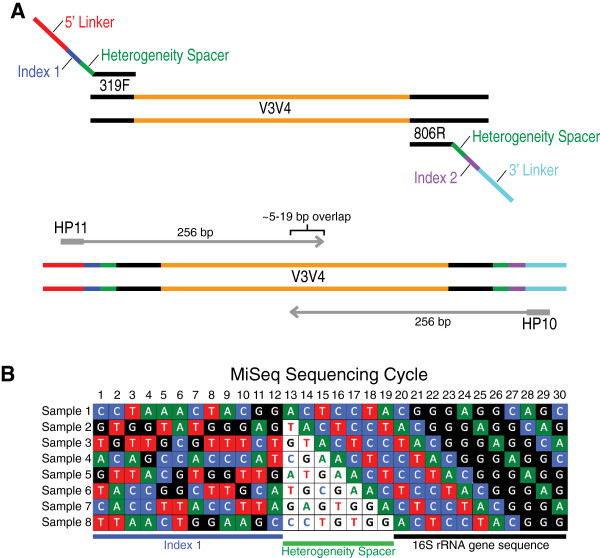
BACKGROUND: To take advantage of affordable high-throughput next-generation sequencing technologies to characterize microbial community composition often requires the development of improved methods to overcome technical limitations inherent to the sequencing platforms. Sequencing low sequence diversity libraries such as 16S rRNA amplicons has been problematic on the Illumina MiSeq platform and often generates sequences of suboptimal quality. RESULTS: Here we present an improved dual-indexing amplification and sequencing approach to assess the composition of microbial communities from clinical samples using the V3-V4 region of the 16S rRNA gene on the Illumina MiSeq platform. We introduced a 0 to 7 bp "heterogeneity spacer" to the index sequence that allows an equal proportion of samples to be sequenced out of phase. CONCLUSIONS: Our approach yields high quality sequence data from 16S rRNA gene amplicons using both 250 bp and 300 bp paired-end MiSeq protocols and provides a flexible and cost-effective sequencing option.
Overview
The claims and statistics of this paper haven’t been checked yet.
Free: it reads the open-access text and checks the first 5 claims that cite a source we can check. Create a free account to check every claim.
Integrity signals
Registry
Cites
Statistics
Figures
Verification
Claims the paper makes
The claims and statistics of this paper haven’t been checked yet.
Free: it reads the open-access text and checks the first 5 claims that cite a source we can check. Create a free account to check every claim.
Claims other papers make about this one
Each is checked against this paper’s own text: does it say what the citing paper says it does?
In the citing paper
“choices of 16S rRNA gene variable region primers may enable improved detection or differentiation of microbes16; for example, Propionibacterium spp. abundant on the skin are often undetected by V4 primers29, and Lactobacillus spp. in the vagina are better differentiated by including V321.”
From Assessment of variation in microbial community amplicon sequencing by the Microbiome Quality Control (MBQC) project consortium (2017) · cites this paper as [21]
Self-check
Percentages, sums and reported differences re-computed from the paper’s own numbers.
The self-check needs the paper’s full text.
Citations
Cites
Fast and accurate short read alignment with Burrows-Wheeler transform
Li, H., & Durbin, R. (2009) · Bioinformatics · doi:10.1093/bioinformatics/btp324 · Cited by 58,607
QIIME allows analysis of high-throughput community sequencing data
Caporaso, J. G., Kuczynski, J., Stombaugh, J., Bittinger, K., Bushman, F. D., Costello, E. K., Fierer, N., Peña, A. G., Goodrich, J. K., Gordon, J. I., et al. (2010) · Nature Methods · doi:10.1038/nmeth.f.303 · Cited by 34,887 · cited 1×
“0,) [10] and included additional quality trimming, demultiplexing, and taxonomic assignments.”
Search and clustering orders of magnitude faster than BLAST
Edgar, R. C. (2010) · Bioinformatics · doi:10.1093/bioinformatics/btq461 · Cited by 20,826
Naïve Bayesian Classifier for Rapid Assignment of rRNA Sequences into the New Bacterial Taxonomy
Wang, Q., Garrity, G. M., Tiedje, J. M., & Cole, J. R. (2007) · Applied and Environmental Microbiology · doi:10.1128/aem.00062-07 · Cited by 19,885 · cited 1×
“2 [15] trained on the Greengenes database”
FLASH: fast length adjustment of short reads to improve genome assemblies
Magoč, T., & Salzberg, S. L. (2011) · Bioinformatics · doi:10.1093/bioinformatics/btr507 · Cited by 15,366 · cited 4×
“The final sequence length after barcode, heterogeneity spacer, and primer removal was 429 ± 7 bp and 429 ± 6.7 bp for PANDAseq and FLASH, respectively, with an average of approximately 11,600 reads per sample.”
InfluentialUCHIME improves sensitivity and speed of chimera detection
Edgar, R. C., Haas, B. J., Clemente, J. C., Quince, C., & Knight, R. (2011) · Bioinformatics · doi:10.1093/bioinformatics/btr381 · Cited by 15,114
Structure, function and diversity of the healthy human microbiome
The Human Microbiome Project Consortium (2012) · Nature · doi:10.1038/nature11234 · Cited by 11,726
Ultra-high-throughput microbial community analysis on the Illumina HiSeq and MiSeq platforms
Caporaso, J. G., Lauber, C. L., Walters, W. A., Berg-Lyons, D., Huntley, J., Fierer, N., Owens, S. M., Betley, J., Fraser, L., Bauer, M., et al. (2012) · The ISME Journal · doi:10.1038/ismej.2012.8 · Cited by 8,839 · cited 3×
“quencing strategies include a single- [2,3] or a recently”
MethodKozich, J. J., Westcott, S. L., Baxter, N. T., Highlander, S. K., & Schloss, P. D. (2013) · Applied and Environmental Microbiology · doi:10.1128/aem.01043-13 · Cited by 7,112 · cited 2×
“developed dual-indexing [4] approach targeting the V4 hypervariable region of the 16S rRNA gene.”
Base-Calling of Automated Sequencer Traces Using Phred. I. Accuracy Assessment
Ewing, B., Hillier, L., Wendl, M. C., & Green, P. (1998) · Genome Research · doi:10.1101/gr.8.3.175 · Cited by 6,967 · cited 1×
“Additional sequence read pre-processing included: 1) removal of primer sequence; 2) truncation of sequence reads not having an average quality of 20 over a 30 bp sliding window based on the phred algorithm [6,7] implemented previously [8,9]; and 3) removal of trimmed reads having less than 75% of their original length…”
Cited by
Items 301–400 of 1,000
Allelopathically inhibitory effects of eucalyptus extracts on the growth of Microcystis aeruginosa
Zhao, W., Zheng, Z., Zhang, J., Saint‐Fort, R., & Luo, X. (2019) · Chemosphere · doi:10.1016/j.chemosphere.2019.03.070 · Cited by 63
Sun, S., Sun, H., Zhang, D., Zhang, J., Cai, Z., Qin, G., & Yumin, S. (2019) · International Journal of Environmental Research and Public Health · doi:10.3390/ijerph16101757 · Cited by 63
“The primers of 5′-CAAGCAGAAGACGGCATACGAGATGTGACTGGAGTTCAGACGTGTGCTCTTCCGATCT (barcode) ACTCCTACGGGAGGCAGCAG-3′ and 5′-AATGATACGGCGACCACCGAGATC TACACTCTTTCCCTACACGACGCTCTTCCGATCT (barcode) GGACTACHVGGGTWTCTAAT-3′ [24] which were the V3–V4 universal primers of bacterial 16S rRNA were used for bacterial PCR, and the prim…”
MethodYu, H., Jiao, N., Zhang, Y., Zhang, F., He, C., Liang, X., Cai, R., Shi, Q., & Tang, K. (2021) · Microbiome · doi:10.1186/s40168-021-01022-z · Cited by 75
Cheng, W., Lam, K., Li, X., Kong, A. P. S., & Cheung, P. C. K. (2021) · Carbohydrate Polymers · doi:10.1016/j.carbpol.2021.118216 · Cited by 65
Jaramillo, A. C., & Castañeda, L. E. (2021) · Frontiers in Microbiology · doi:10.3389/fmicb.2021.654108 · Cited by 67
“Then, a PCR was performed to amplify the bacterial DNA using specific primers for the 16S ribosomal RNA (rRNA) gene: 341F (5CCT ACG GGN GGC WGC AG-3) and 805R (5-GGA CTA CHV GGG TWT CTA AR-3) (Fadrosh et al., 2014).”
MethodCarlson, H. K., Kuehl, J. V., Hazra, A. B., Justice, N. B., Stoeva, M. K., Sczesnak, A., Mullan, M. R., Iavarone, A. T., Engelbrektson, A. L., Price, M. N., et al. (2014) · The ISME Journal · doi:10.1038/ismej.2014.216 · Cited by 67
“4), cultures were harvested by centrifugation, 180 ml supernatant was removed, and genomic DNA was extracted from the remaining pellet and the V3V4 region of the 16S rRNA gene was amplified using unique dual-indexed primers with attached Illumina adaptors, similar to previously published primers (Kozich et al., 2013;…”
MethodTam, J., Hamza, T., Ma, B., Chen, K., Beilhartz, G. L., Ravel, J., Feng, H., & Melnyk, R. A. (2018) · Nature Communications · doi:10.1038/s41467-018-07705-w · Cited by 64
Self-citationOral Microbiome Characterization in Murine Models
Abusleme, L., Hong, B.-Y., Hoare, A., Konkel, J., Diaz, P., & Moutsopoulos, N. (2017) · BIO-PROTOCOL · doi:10.21769/bioprotoc.2655 · Cited by 58
“These modifications are described in detail in the study of Fadrosh et al. (2014).”
BackgroundCharacterization of fungal microbiota on normal ocular surface of humans
Wang, Y., Chen, H., Xia, T., & Huang, Y. (2019) · Clinical Microbiology and Infection · doi:10.1016/j.cmi.2019.05.011 · Cited by 62
Neijat, M., Habtewold, J. Z., Shirley, R. B., Welsher, A., Barton, J., Thiery, P., & Kiarie, E. G. (2019) · Applied and Environmental Microbiology · doi:10.1128/aem.00402-19 · Cited by 68
Exploring the Hospital Microbiome by High-Resolution 16S rRNA Profiling
Rampelotto, P. H., Sereia, A. F. R., de Oliveira, L. F. V., & Margis, R. (2019) · International Journal of Molecular Sciences · doi:10.3390/ijms20123099 · Cited by 64
“This primer set provides ample information for taxonomic classification of microbial communities from specimens associated with human microbiome studies [20].”
BackgroundBrown, S. E., Schwartz, J. A. J., Robinson, C. K., O’Hanlon, D. E., Bradford, L. L., He, X., Mark, K., Bruno, V. M., Ravel, J., & Brotman, R. M. (2019) · Sexually Transmitted Diseases · doi:10.1097/olq.0000000000001066 · Cited by 70
Self-citationChaudhari, D. S., Rangappa, K., Das, A., Layek, J., Basavaraj, S., Kandpal, B. K., Shouche, Y. S., & Rahi, P. (2020) · Frontiers in Microbiology · doi:10.3389/fmicb.2020.00968 · Cited by 65
“The freshly extracted DNA was used as the template for the amplification of the V4 region of the bacterial 16S rRNA gene using universal bacterial primers (Fadrosh et al., 2014).”
MethodJoat, N., Van, T. T. H., Stanley, D., Moore, R. J., & Chousalkar, K. K. (2021) · Applied Microbiology and Biotechnology · doi:10.1007/s00253-021-11333-8 · Cited by 66
“The V3–V4 regions of 16S rRNA genes were amplified (ACTCCTACGGGAGGCAGCAG (forward) and GGACTACHVGGGTWTCTAAT (reverse)), and the Illumina MiSeq system (2 × 300 bp) was used to perform sequencing using a dual indexing variable spacer (Fadrosh et al. 2014).”
MethodLi, H., Luo, Q.-P., Zhao, S., Zhou, Y., Huang, F.-Y., Yang, X., & Su, J. (2022) · Journal of Hazardous Materials · doi:10.1016/j.jhazmat.2022.130288 · Cited by 62
DeBofsky, A., Xie, Y., Grimard, C., Alcaraz, A. J., Brinkmann, M., Hecker, M., & Giesy, J. P. (2020) · Chemosphere · doi:10.1016/j.chemosphere.2020.126461 · Cited by 64
“The V3eV4 hypervariable region of the 16S rRNA gene was amplified by use of dual-tagged primer set: forward primer (Bact-341: 50-CCTACGGGNGGCWGCAG30) (Klindworth et al., 2013) and reverse primer (Bact-806: 50- GGACTACNVGGGTWTCTAAT-30) (Apprill et al., 2015; Fadrosh et al., 2014).”
MethodWheat Consumption Aggravates Colitis in Mice via Amylase Trypsin Inhibitor–mediated Dysbiosis
Pickert, G., Wirtz, S. J., Matzner, J., Ashfaq–Khan, M., Heck, R., Rosigkeit, S., Thies, D., Surabattula, R., Ehmann, D., Wehkamp, J., et al. (2020) · Gastroenterology · doi:10.1053/j.gastro.2020.03.064 · Cited by 64
Min, X., Wang, Y., Chai, L., Yang, Z., & Liao, Q. (2017) · Chemosphere · doi:10.1016/j.chemosphere.2017.05.105 · Cited by 60
“…70 platform, a scalable, ultra-high-throughput, cost-effective and streamlined sequencing 71 platform offers a powerful tool for biodiversity surveillance of soil microbial 72 communities at greater depth and with more detailed sequence information (Caporaso 73 et al., 2012; Fadrosh et al., 2014).”
BackgroundLeight, A. K., Crump, B. C., & Hood, R. R. (2018) · Frontiers in Microbiology · doi:10.3389/fmicb.2018.00384 · Cited by 59
Wallace, J., Laforest‐Lapointe, I., & Kembel, S. W. (2018) · PeerJ · doi:10.7717/peerj.5293 · Cited by 68
“The second stage of the PCR amplification was performed using this first stage PCR product as a template.”
MethodInfluentialWang, C., Zhou, Y., Lv, D., Ge, Y., Li, H., & You, Y. (2018) · MicrobiologyOpen · doi:10.1002/mbo3.727 · Cited by 73
Microbial Community Predicts Functional Stability of Microbial Fuel Cells
Lesnik, K. L., Cai, W., & Liu, H. (2019) · Environmental Science & Technology · doi:10.1021/acs.est.9b03667 · Cited by 60
Yoshihara, T., Oikawa, Y., Kato, T., Kessoku, T., Kobayashi, T., Kato, S., Misawa, N., Ashikari, K., Fuyuki, A., Ohkubo, H., et al. (2020) · Gut Microbes · doi:10.1080/19490976.2020.1758290 · Cited by 61
Xu, B., Yan, Y., Yin, B., Zhang, L., Qin, W., Niu, Y., Tang, Y., Zhou, S., Yan, X., & Ma, L. (2021) · Food & Function · doi:10.1039/d0fo03080e · Cited by 60
Liu, Q., Zhang, Q., Jarvie, S., Yan, Y., Han, P., Liu, T., Guo, K., Ren, L., Yue, K., Wu, H., et al. (2021) · Land Degradation and Development · doi:10.1002/ldr.4112 · Cited by 60
“The V3–V4 region of the bacterial small-subunit (16S) rRNA gene was amplified with slightly modified versions of primers 338F (50-ACTCCTACGGGAGGCAGCAG-30) and 806R (50-GGAC TACHVGGGTWTCTAAT-30) (Fadrosh et al., 2014).”
MethodPhylogenomics of the killer whale indicates ecotype divergence in sympatry
Moura, A. E., Kenny, J. G., Chaudhuri, R. R., Hughes, M. A., Reisinger, R. R., de Bruyn, P. J. N., Dahlheim, M. E., Hall, N., & Hoelzel, A. R. (2014) · Heredity · doi:10.1038/hdy.2014.67 · Cited by 70
Rosuvastatin alters the genetic composition of the human gut microbiome
Kummen, M., Solberg, O. G., Storm-Larsen, C., Holm, K., Ragnarsson, A., Trøseid, M., Vestad, B., Skårdal, R., Yndestad, A., Ueland, T., et al. (2020) · Scientific Reports · doi:10.1038/s41598-020-62261-y · Cited by 61
Shen, L., Tian, M.-H., Cheng, H., Liu, X., Yang, Y., Liu, J., Xu, J., Kong, Y., Li, J., & Liu, Y. (2020) · Environmental Pollution · doi:10.1016/j.envpol.2020.114623 · Cited by 58
Corato, U. D., Patruno, L., Avella, N., Salimbeni, R., Lacolla, G., Cucci, G., & Crecchio, C. (2020) · Applied Soil Ecology · doi:10.1016/j.apsoil.2020.103601 · Cited by 59
van der Houwen, T. B., van Laar, J. A. M., Kappen, J. H., van Hagen, P. M., de Zoete, M. R., van Muijlwijk, G. H., Berbers, R.-M., Fluit, A. C., Rogers, M. R. C., Groot, J. A., et al. (2020) · Frontiers in Immunology · doi:10.3389/fimmu.2020.01192 · Cited by 60
Bao, P., Li, C., Ou, H., Ji, S., Chen, Y., Gao, J., Yue, X., Shen, J. Q., & Ding, D. (2020) · Biomaterials Science · doi:10.1039/d0bm01330g · Cited by 58
Zhao, Z., Wang, B., Mu, L., Wang, H., Luo, J., Yang, Y., Yang, H., Li, M., Zhou, L., & Tao, C. (2020) · Frontiers in Cellular and Infection Microbiology · doi:10.3389/fcimb.2020.00258 · Cited by 57
Osmotic stress induces gut microbiota community shift in fish
Lai, K. P., Lin, X., Tam, N. Y.-K., Ho, J. C. H., Wong, M. K., Gu, J., Chan, T., & Tse, W. K. F. (2020) · Environmental Microbiology · doi:10.1111/1462-2920.15150 · Cited by 65
Yue, Y., Liu, Y., Wang, J., Vukanti, R., & Ge, Y. (2021) · Chemosphere · doi:10.1016/j.chemosphere.2021.130358 · Cited by 58
Goedert, J. J., Gong, Y., Hua, X., Zhong, H., He, Y., Peng, P., Yu, G., Wang, W., Ravel, J., Shi, J., et al. (2015) · EBioMedicine · doi:10.1016/j.ebiom.2015.04.010 · Cited by 59
“For unbiased representation of the fecal microbiota as described previously in detail (Fadrosh et al., 2014), approximately 469 bp of the 16S rRNA gene V3–V4 hypervariable region of the fecal DNAwas amplified with primers that included a linker sequence (suitable for the IlluminaMiSeq 250PE…”
MethodResultSelf-citationMonitoring of microbial communities in anaerobic digestion sludge for biogas optimisation
Lim, J. W., Ge, T., & Tong, Y. W. (2017) · Waste Management · doi:10.1016/j.wasman.2017.10.007 · Cited by 57
Aljumaah, M. R., Alkhulaifi, M. M., Abudabos, A. M., Alabdullatifb, A., El‐Mubarak, A. H., Sulaiman, A. R. A., & Stanley, D. (2020) · PLoS ONE · doi:10.1371/journal.pone.0232831 · Cited by 57
Liu, W., Li, Y., Guo, S., Yin, H., Lei, C., & Wang, X. (2016) · Scientific Reports · doi:10.1038/srep38900 · Cited by 61
Changes in soil microbial community and activity caused by application of dimethachlor and linuron
Medo, J., Maková, J., Medová, J., Lipková, N., Artimová, R., Omelka, R., & Javoreková, S. (2021) · Scientific Reports · doi:10.1038/s41598-021-91755-6 · Cited by 59
Designing specific bacterial 16S primers to sequence and quantitate plant endo-bacteriome
Chen, L., Zhang, M., Liu, D., Sun, H., Wu, J., Huo, Y., Chen, X., Fang, R., & Zhang, L. (2021) · Science China Life Sciences · doi:10.1007/s11427-021-1953-5 · Cited by 58
“Moreover, when endophytes are considerably less abundant than the plant mitochondria, the bacterial 16S cannot be efficiently amplified (Bulgarelli et al., 2013; Ghyselinck et al., 2013).”
BackgroundChanges in Bacterial and Fungal Community of Soil under Treatment of Pesticides
Streletskii, R. A., Astaykina, A. A., Krasnov, G. S., & Gorbatov, V. (2022) · Agronomy · doi:10.3390/agronomy12010124 · Cited by 62
Using hierarchical models to compare the sensitivity of metabarcoding and qPCR for eDNA detection
McColl‐Gausden, E. F., Weeks, A. R., Coleman, R. A., Song, S. V., & Tingley, R. (2023) · Ecological Informatics · doi:10.1016/j.ecoinf.2023.102072 · Cited by 56
Monofluorophosphate Is a Selective Inhibitor of Respiratory Sulfate-Reducing Microorganisms
Carlson, H. K., Stoeva, M. K., Justice, N. B., Sczesnak, A., Mullan, M. R., Mosqueda, L. A., Kuehl, J. V., Deutschbauer, A. M., Arkin, A. P., & Coates, J. D. (2015) · Environmental Science & Technology · doi:10.1021/es505843z · Cited by 60
“alaskensis G20, fluoride ion has an IC50 380 of 34 (21-54) mM (Figure 3A).”
BackgroundGirotra, M., Garg, S., Anand, R., Song, Y., & Dutta, S. (2016) · Digestive Diseases and Sciences · doi:10.1007/s10620-016-4229-8 · Cited by 57
“In brief, hypervariable regions V1–V3 of the bacterial 16S rRNA gene were amplified with primers 27F and 534R [10] and V3–V4 Illumina datasets amplified using primers 319F and 806R [11].”
MethodAmato, V., Papaleo, E., Pasciuta, R., Viganò, P., Ferrarese, R., Clementi, N., Sanchez, A. M., Quaranta, L., Burioni, R., Ambrosi, A., et al. (2019) · Open Forum Infectious Diseases · doi:10.1093/ofid/ofz525 · Cited by 65
“Variable regions 3 and 4 (V3–V4) of 16S ribosomal ribonucleic acid (rRNA) genes were polymerase chain reaction (PCR) amplified as previously reported [19].”
Tyakht, A., Kopeliovich, A., Klimenko, N. S., Efimova, D. A., Dovidchenko, N. V., Odintsova, V. Y., Kleimenov, M., Toshchakov, S. V., Popova, A. A., Khomyakova, M. A., et al. (2020) · Food Microbiology · doi:10.1016/j.fm.2020.103658 · Cited by 57
The Native Microbiome is Crucial for Offspring Generation and Fitness of Aurelia aurita
Weiland‐Bräuer, N., Pinnow, N., Langfeldt, D., Roik, A., Güllert, S., Chibani, C. M., Reusch, T. B. H., & Schmitz, R. A. (2020) · mBio · doi:10.1128/mbio.02336-20 · Cited by 60
Rectal microbiota among HIV-uninfected, untreated HIV, and treated HIV-infected in Nigeria
Nowak, R. G., Bentzen, S. M., Ravel, J., Crowell, T. A., Dauda, W., Ma, B., Liu, H., Blattner, W. A., Baral, S., & Charurat, M. (2017) · AIDS · doi:10.1097/qad.0000000000001409 · Cited by 61
“Dual barcoding information was used to index individual samples [24], and the sequences were demultiplexed by binning sequences with the same barcodes in QIIME, version 1.”
MethodSelf-citationGhrelin receptor deletion reduces binge‐like alcohol drinking in rats
Zallar, L. J., Grant-Beurmann, S., Tunstall, B. J., Fraser, C. M., Koob, G. F., Vendruscolo, L. F., & Leggio, L. (2018) · Journal of Neuroendocrinology · doi:10.1111/jne.12663 · Cited by 56
Milkereit, J., Geisseler, D. J., Lazicki, P. A., Settles, M. L., Durbin-Johnson, B. P., & Hodson, A. K. (2020) · Applied Soil Ecology · doi:10.1016/j.apsoil.2020.103767 · Cited by 59
Yun, Y., Chang, Y., Kim, H., Ryu, S., Kwon, M., Cho, Y. K., Kim, H., Cheong, H. S., & Joo, E. (2019) · Journal of Clinical Medicine · doi:10.3390/jcm8020173 · Cited by 76
“All samples were pooled for sequencing on the Illumina Miseq platform according to the manufacturer’s specifications [15].”
MethodEvaluating the net effect of sulfadimidine on nitrogen removal in an aquatic microcosm environment
Wang, M., Xiong, W., Zou, Y., Lin, M., Zhou, Q., Xie, X., & Sun, Y. (2019) · Environmental Pollution · doi:10.1016/j.envpol.2019.02.048 · Cited by 55
Host determinants of among-species variation in microbiome composition in drosophilid flies
Adair, K. L., Bost, A., Bueno, E., Kaunisto, S., Kortet, R., Peters-Schulze, G., Martinson, V. G., & Douglas, A. E. (2019) · The ISME Journal · doi:10.1038/s41396-019-0532-7 · Cited by 64
Onywera, H., Williamson, A., Cozzuto, L., Bonnin, S., Mbulawa, Z. Z. A., Coetzee, D. J., Ponomarenko, J. V., & Meiring, T. L. (2020) · BMC Microbiology · doi:10.1186/s12866-020-01759-x · Cited by 57
Considerations for mosquito microbiome research from the Mosquito Microbiome Consortium
Dada, N., Jupatanakul, N., Minard, G., Short, S. M., Akorli, J. E. B., & Villegas, L. E. M. (2021) · Microbiome · doi:10.1186/s40168-020-00987-7 · Cited by 60
Shifts of microbiota during cheese production: Impact on production and quality
Nam, J. H., Cho, Y. S., Rackerby, B., Goddik, L., & Park, S. H. (2021) · Applied Microbiology and Biotechnology · doi:10.1007/s00253-021-11201-5 · Cited by 53
Du, C., Li, G., Xia, R., Li, C., Zhu, Q., Li, X., Li, J., Zhao, C., Tian, Z., & Zhang, L. (2022) · Environmental Pollution · doi:10.1016/j.envpol.2022.119781 · Cited by 54
Hole, M. J., Jørgensen, K. K., Holm, K., Braadland, P. R., Meyer‐Myklestad, M. H., Medhus, A. W., Reikvam, D. H., Götz, A., Grzyb, K., Boberg, K. M., et al. (2023) · Hepatology · doi:10.1002/hep.32773 · Cited by 55
“[31] DNA libraries were generated from PCR amplicons targeting the hypervariable regions, V3 and V4, of the 16S ribosomal RNA (rRNA) gene, according to a described protocol.[32] Using a dual‐indexing approach, universal primers 319F (forward) and 806R (reverse) were applied for amplification, along with Phusion High‐F…”
MethodKneis, B., Wirtz, S. J., Weber, K., Denz, A., Gittler, M. M., Geppert, C. I., Brunner, M., Krautz, C., Siebenhüner, A. R., Schierwagen, R., et al. (2023) · International Journal of Molecular Sciences · doi:10.3390/ijms24043265 · Cited by 58
“For bioinformatic processing, the terminal 15 bases of both forward and reverse reads were removed before merging and quality filtering using fastq_mergepairs and fastq_filter_options from Usearch 10 [58].”
MethodGraf, M., Greenfield, L. M., Reay, M. K., Bargiela, R., Williams, G. B., Onyije, C., Lloyd, C. E. M., Bull, I. D., Evershed, R. P., Golyshin, P. N., et al. (2022) · Journal of Hazardous Materials · doi:10.1016/j.jhazmat.2023.131932 · Cited by 53
Polenogova, O. V., Kabilov, M. R., Tyurin, M. V., Rotskaya, U. N., Викторович, К. А., Morozova, V. V., Mozhaitseva, K., Kryukova, N. A., Alikina, T., Kryukov, V. Y., et al. (2019) · Scientific Reports · doi:10.1038/s41598-019-40301-6 · Cited by 58
Forin-Wiart, M.-A., Poulle, M., Piry, S., Cosson, J., Larose, C., & Galan, M. (2018) · Scientific Reports · doi:10.1038/s41598-018-34430-7 · Cited by 63
Gelpi, M., Vestad, B., Hansen, S. H., Holm, K., Drivsholm, N., Goetz, A. E., Kirkby, N. S., Lindegaard, B., Lebech, A., Hoel, H., et al. (2020) · Clinical Infectious Diseases · doi:10.1093/cid/ciz1235 · Cited by 53
Aljumaah, M. R., Alkhulaifi, M. M., Abudabos, A. M., Aljumaah, R. S., Alsaleh, A. N., & Stanley, D. (2020) · PLoS ONE · doi:10.1371/journal.pone.0232781 · Cited by 58
Won, S., Chen, S., Lee, S. Y., Lee, K. E., Park, K. W., & Yoon, J. (2020) · Nutrients · doi:10.3390/nu12123703 · Cited by 55
“The first amplification was performed targeting the V3 to V4 regions of the 16S rRNA gene [20].”
MethodXie, G., Tang, X., Shao, K., Zhu, G., & Gao, G. (2021) · Ecotoxicology and Environmental Safety · doi:10.1016/j.ecoenv.2021.112069 · Cited by 58
Oral delivery of stem-cell-loaded hydrogel microcapsules restores gut inflammation and microbiota
Kim, D. W., Jeong, H., Kim, E., Lee, H., Choi, C., & Lee, S. (2022) · Journal of Controlled Release · doi:10.1016/j.jconrel.2022.05.028 · Cited by 52
A gut reaction: the combined influence of exercise and diet on gastrointestinal microbiota in rats
Batacan, R. B., Fenning, A. S., Dalbo, V. J., Scanlan, A. T., Duncan, M. J., Moore, R. J., & Stanley, D. (2017) · Journal of Applied Microbiology · doi:10.1111/jam.13442 · Cited by 48
Yitbarek, A., Weese, J. S., Alkie, T. N., Parkinson, J., & Sharif, S. (2017) · FEMS Microbiology Ecology · doi:10.1093/femsec/fix165 · Cited by 58
Exploring coral microbiome assemblages in the South China Sea
Cai, L., Tian, R., Zhou, G., Tong, H., Wong, Y. H., Zhang, W., Chui, A. P. Y., Xie, J. Y., Qiu, J., Ang, P. O., et al. (2018) · Scientific Reports · doi:10.1038/s41598-018-20515-w · Cited by 55
Pinoargote, G., Flores, G. E., Cooper, K. K., & Ravishankar, S. (2018) · Aquaculture Research · doi:10.1111/are.13791 · Cited by 56
Ling, Z., Cheng, Y., Chen, F., Yan, X., Liu, X., Shao, L., Jin, G., Zhou, D., Jiang, G., Li, H., et al. (2022) · Frontiers in Immunology · doi:10.3389/fimmu.2022.964910 · Cited by 57
He, C., Yang, Z., Cheng, D., Xie, C., Zhu, Y., Ge, Z., Luo, Z., & Lü, N. (2016) · EBioMedicine · doi:10.1016/j.ebiom.2016.09.010 · Cited by 52
“The raw data were filtered to obtain clean reads by eliminating the adapter pollution and low quality sequences (Fadrosh et al., 2014).”
MethodDysbiosis of urinary microbiota is positively correlated with Type 2 diabetes mellitus
Liu, F., Ling, Z., Xiao, Y., Lv, L., Yang, Q., Wang, B., Lu, H., Li, Z., Jiang, P., Wang, W., et al. (2016) · Oncotarget · doi:10.18632/oncotarget.14028 · Cited by 56
Environmental Controls on Soil Microbial Communities in a Seasonally Dry Tropical Forest
Pajares, S., Campo, J., Bohannan, B., & Etchevers, J. (2018) · Applied and Environmental Microbiology · doi:10.1128/aem.00342-18 · Cited by 38
Pol, W. J. V. D., Kumar, R., Morrow, C. D., Blanchard, E., Taylor, C. M., Martin, D. H., Lefkowitz, E. J., & Muzny, C. A. (2018) · The Journal of Infectious Diseases · doi:10.1093/infdis/jiy508 · Cited by 57
“V1–V3 Commonly used universal 28F [33] 519R [34] 5ʹ-GAGTTTGATCNTGGCTCAG-3ʹ 5ʹ-GTNTCACNGCGGCKKGCTG-3ʹ Vaginal microbiome study Fwd-P1 Fwd-P2 Rev1B [17] 5ʹ-GTTYGATYMTGGCTYAG-3ʹ5ʹ-RTTTGATCYTGGTTCAG-3ʹ 5ʹ-ATTACCGCGGCTGCTGG-3ʹ V3–V4 Commonly used universal 357wF [35] 785R [35] 5ʹ-CCTACGGGNGGCWGCAG-3ʹ 5ʹ-GACTACHVGGGTWTCTAAT…”
MethodNonoptimal Vaginal Microbiota After Azithromycin Treatment for Chlamydia trachomatis Infection
Tamarelle, J., Ma, B., Gajer, P., Humphrys, M., Terplan, M., Mark, K., Thiébaut, A. C. M., Forney, L. J., Brotman, R. M., Delarocque‐Astagneau, E., et al. (2019) · The Journal of Infectious Diseases · doi:10.1093/infdis/jiz499 · Cited by 63
“High-throughput amplification and sequencing of the V3–V4 hypervariable regions of the 16S ribosomal RNA gene were performed using a validated and improved dual-indexing approach [25].”
MethodSelf-citationYuan, Z., Yang, L., Zhang, X., Ji, P., & Wei, Y. (2019) · Biomedicine & Pharmacotherapy · doi:10.1016/j.biopha.2019.109638 · Cited by 52
Capsule robot for gut microbiota sampling using shape memory alloy spring
Rehan, M., Al-Bahadly, I. H., Thomas, D. G., & Avci, E. (2020) · International Journal of Medical Robotics and Computer Assisted Surgery · doi:10.1002/rcs.2140 · Cited by 55
Biodiversity management of organic orchard enhances both ecological and economic profitability
Meng, J., Li, L., Liu, H., Li, Y., Li, C., Wu, G., Yu, X., Guo, L., Da, C., Muminov, M. A., et al. (2016) · PeerJ · doi:10.7717/peerj.2137 · Cited by 57
“Each primer contained 8–13 bp paired-end error-correcting barcodes (Table S1) (Fadrosh et al., 2014).”
BackgroundCertner, R. H., & Vollmer, S. V. (2017) · Environmental Microbiology · doi:10.1111/1462-2920.13991 · Cited by 55
“The V4 hypervariable region of the 16S rRNA gene was amplified and sequenced according to Fadrosh et al. 2014, with a few adjustments (Fadrosh et al., 2014).”
MethodConversion of sulfur compounds and microbial community in anaerobic treatment of fish and pork waste
He, R., Yao, X.-Z., Chen, M., Ma, R.-C., Li, H., Wang, C., & Ding, S.-H. (2018) · Waste Management · doi:10.1016/j.wasman.2018.04.006 · Cited by 50
An Aberrant Microbiota is not Strongly Associated with Incidental Colonic Diverticulosis
Jones, R. B., Fodor, A. A., Peery, A. F., Tsilimigras, M. C. B., Winglee, K., McCoy, A. N., Sioda, M., Sandler, R. S., & Keku, T. O. (2018) · Scientific Reports · doi:10.1038/s41598-018-23023-z · Cited by 54
Jiang, M., Zhou, Y., Wang, N., Xu, L., Zheng, Z., & Zhang, J. (2018) · The Science of The Total Environment · doi:10.1016/j.scitotenv.2018.11.296 · Cited by 50
Willson, N.-L., Van, T. T. H., Bhattarai, S. P., Courtice, J. M., McIntyre, J. R., Prasai, T. P., Moore, R. J., Walsh, K., & Stanley, D. (2019) · PLOS ONE · doi:10.1371/journal.pone.0214471 · Cited by 48
Gavrilov, S. N., Korzhenkov, A. A., Kublanov, I. V., Bargiela, R., Замана, Л. В., Popova, A. A., Toshchakov, S. V., Golyshin, P. N., & Golyshina, O. V. (2019) · Frontiers in Microbiology · doi:10.3389/fmicb.2019.01573 · Cited by 50
“Demultiplexing was performed as described previously (Fadrosh et al., 2014).”
MethodLin, M., Xiong, H. Y., Xiang, X., Zhou, Z., Liang, L., & Mei, Z. (2020) · Frontiers in Microbiology · doi:10.3389/fmicb.2020.01257 · Cited by 54
“After DNA libraries quality control (QC) and quantification, as well as normalization, 300-bp paired-end reads were obtained from MiSeq platform (BGI, China) for the amplicon (16S rRNA and ITS2) analyses, respectively (Fadrosh et al., 2014).”
Microbiological Activity during Co-Composting of Food and Agricultural Waste for Soil Amendment
Миронов, В. В., Вантеева, А. В., & Merkel, A. Y. (2021) · Agronomy · doi:10.3390/agronomy11050928 · Cited by 57
“The following primer system was used to prepare the amplicons: forward (5′-CAAGCAGAAGACGGCATACGA GATGTGACTGGAGTTCAGACGTGTGCTCTTCCGATCT XXXXXX ZZZZ GTGBCAGC MGCCGCGGTAA-3′), containing, respectively, the 5′ Illumina Linker Sequence, Index 1, Heterogeneity Spacer [34], and 515F primer sequence [35]; and the reverse prim…”
MethodReichelt, A. C., Loughman, A., Bernard, A., Raipuria, M., Abbott, K. N., Dachtler, J., Van, T. T. H., & Moore, R. J. (2020) · Nutritional Neuroscience · doi:10.1080/1028415x.2018.1537169 · Cited by 49
“Sequencing was performed on an Illumina MiSeq instrument (2 × 300bp paired-end sequencing), following the method detailed by Fadrosh et al. (2014).”
MethodPark, T., Ma, L., Gao, S., Bu, D., & Yu, Z. (2022) · Journal of Animal Science and Biotechnology/Journal of animal science and biotechnology · doi:10.1186/s40104-022-00717-z · Cited by 49
The effect of antibiotics on the microbiome in acute exacerbations of chronic rhinosinusitis
Merkley, M. A., Bice, T. C., Grier, A., Strohl, A. M., Man, L., & Gill, S. R. (2015) · International Forum of Allergy & Rhinology · doi:10.1002/alr.21591 · Cited by 53
Egan, C., Rummel, A., Kokkoris, V., Klironomos, J. N., Lekberg, Y., & Hart, M. M. (2018) · Fungal ecology · doi:10.1016/j.funeco.2018.01.004 · Cited by 51
Effects of disposable plastics and wooden chopsticks on the anaerobic digestion of food waste
Lim, J. W., Ting, D. W. Q., Loh, K., Ge, T., & Tong, Y. W. (2018) · Waste Management · doi:10.1016/j.wasman.2018.08.033 · Cited by 51
Li, Q., Gu, P., Zhang, H., Luo, X., Zhang, J., & Zheng, Z. (2019) · The Science of The Total Environment · doi:10.1016/j.scitotenv.2019.134325 · Cited by 49
Plummer, E. L., Vodstrcil, L. A., Fairley, C. K., Tabrizi, S. N., Garland, S. M., Law, M. G., Hocking, J. S., Fethers, K. A., Bulach, D., Murray, G. L., et al. (2019) · Scientific Reports · doi:10.1038/s41598-019-55929-7 · Cited by 56
Haberecht, S., Bajagai, Y. S., Moore, R. J., Van, T. T. H., & Stanley, D. (2020) · AMB Express · doi:10.1186/s13568-020-01077-5 · Cited by 58
Shen, S., Kumar, K. P., Wen, S., Shim, R., Wanrooy, B. J., Stanley, D., Moore, R. J., Van, T. T. H., Robert, R., Hickey, M. J., et al. (2021) · Frontiers in Immunology · doi:10.3389/fimmu.2021.619366 · Cited by 55
Feng, J., Zhang, L., Xue Ming, T. A. N. G., Xia, X., Hu, W., & Zhou, P. (2021) · Journal of Food Composition and Analysis · doi:10.1016/j.jfca.2021.103838 · Cited by 51
Yu, L., Yang, H., Cheng, F.-P., Wu, Z., Huang, Q., He, X. J., Yan, W., Zhang, L., & Wu, X. (2021) · Environmental Pollution · doi:10.1016/j.envpol.2021.118107 · Cited by 49
“Illumina sequence was processed to obtain Clean Data (Douglas et al., 2014), Paired-end reads were merged using FLASH to obtain raw tags (Tanja et al., 2011), and merged tags were clustered into OTUs with UCLUST (Edgar, 2013) (v7 0.0.1090).”
MethodInfluentialShen, Z., Xie, G., Zhang, Y., Yu, B., Shao, K., Gao, G., & Tang, X. (2022) · Environmental Pollution · doi:10.1016/j.envpol.2022.120305 · Cited by 49
Metadata
- Authors
- Fadrosh, D. W., Ma, B., Gajer, P., Sengamalay, N., Ott, S., Brotman, R. M., & Ravel, J.
- Affiliations
- University of Maryland, Baltimore (US)
- Corresponding author
- Ravel, Jacques
- Venue
- Microbiome
- Published
- 2014-02-24
- Volume
- 2
- Issue
- 1
- Pages
- 6-6
- ISSN
- 2049-2618 (ISSN-L)
- PMC
- PMC3940169
- OpenAlex
- W2165722876
- Semantic Scholar
- 7f8859a57e35c66164678710187d4374822411d8
- Cited by
- 1,698
- References
- 14
- Citations by year
- 2026: 83 · 2025: 129 · 2024: 148 · 2023: 171 · 2022: 167 · 2021: 235 · 2020: 218 · 2019: 164 · 2018: 169 · 2017: 104 · 2016: 62 · 2015: 37 · 2014: 11
- FWCI
- 29.23
- Type
- journal article
- Language
- en
- Open access
- gold
- doi.org
- Licence
- cc-by
- Locations
- Microbiome (publishedVersion, cc-by)
- Europe PMC (PubMed Central) (publishedVersion, cc-by)
- PubMed Central (publishedVersion, cc-by)
- PubMed (publishedVersion)
- Funders
- National Institutes of Health
- National Institute of Allergy and Infectious Diseases (R01AI089878, U19AI084044, UH2AI083264)
- Topics
- Life Sciences › Biochemistry, Genetics and Molecular Biology › Molecular Biology › Genomics and Phylogenetic Studies
- Physical Sciences › Environmental Science › Ecology › Microbial Community Ecology and Physiology
- Life Sciences › Biochemistry, Genetics and Molecular Biology › Molecular Biology › Gut microbiota and health
- Keywords
- 16S rRNA gene sequencing, multiplexed sequencing, V3-V4 region, microbial community composition, clinical samples, paired-end sequencing, sequencing data quality
About these checks
Registry, retraction, Cites and statistics results are computed, not judged, with one exception: a printed reference that no index lists is read once by a model before it counts as a citation error. Claims are extracted by a model and kept only when their quote appears verbatim in the text; each cited source is then checked, with a model’s help, for whether it says what the claim relies on. Those verdicts can be wrong — read the claim’s quote and the cited source before relying on one.
Statistics and arithmetic are recomputed, not judged.
Confidence bands are shown only for fields calibrated on our annotated test set. None is calibrated yet, so no band is shown.
What counts as a claim ›How we measure confidence ›How we check this ›
Are you an author, or do you see a problem with this page? Request a review
Data sources
Bibliographic data: Semantic Scholar, OpenAlex, Crossref.
Contains information from the Semantic Scholar Academic Graph Datasets, made available under the ODC Attribution License (ODC-BY 1.0).
Semantic Scholar’s data is described in: Kinney, R., et al. (2023). The Semantic Scholar Open Data Platform. arXiv:2301.10140.
