

An improved dual-indexing approach for multiplexed 16S rRNA gene sequencing on the Illumina MiSeq platform
Open accessThe DOI matches its Crossref record; 14 of the 14 references it cites were found in a registry or an index.
Abstract
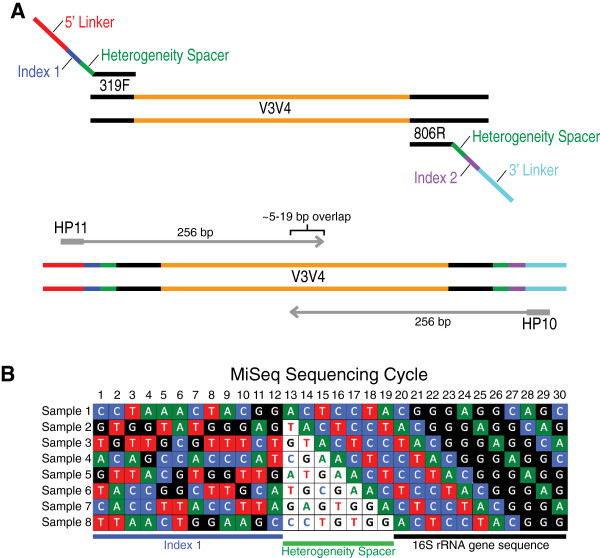
BACKGROUND: To take advantage of affordable high-throughput next-generation sequencing technologies to characterize microbial community composition often requires the development of improved methods to overcome technical limitations inherent to the sequencing platforms. Sequencing low sequence diversity libraries such as 16S rRNA amplicons has been problematic on the Illumina MiSeq platform and often generates sequences of suboptimal quality. RESULTS: Here we present an improved dual-indexing amplification and sequencing approach to assess the composition of microbial communities from clinical samples using the V3-V4 region of the 16S rRNA gene on the Illumina MiSeq platform. We introduced a 0 to 7 bp "heterogeneity spacer" to the index sequence that allows an equal proportion of samples to be sequenced out of phase. CONCLUSIONS: Our approach yields high quality sequence data from 16S rRNA gene amplicons using both 250 bp and 300 bp paired-end MiSeq protocols and provides a flexible and cost-effective sequencing option.
Overview
The claims and statistics of this paper haven’t been checked yet.
Free: it reads the open-access text and checks the first 5 claims that cite a source we can check. Create a free account to check every claim.
Integrity signals
Registry
Cites
Statistics
Figures
Verification
Claims the paper makes
The claims and statistics of this paper haven’t been checked yet.
Free: it reads the open-access text and checks the first 5 claims that cite a source we can check. Create a free account to check every claim.
Claims other papers make about this one
Each is checked against this paper’s own text: does it say what the citing paper says it does?
In the citing paper
“choices of 16S rRNA gene variable region primers may enable improved detection or differentiation of microbes16; for example, Propionibacterium spp. abundant on the skin are often undetected by V4 primers29, and Lactobacillus spp. in the vagina are better differentiated by including V321.”
From Assessment of variation in microbial community amplicon sequencing by the Microbiome Quality Control (MBQC) project consortium (2017) · cites this paper as [21]
Self-check
Percentages, sums and reported differences re-computed from the paper’s own numbers.
The self-check needs the paper’s full text.
Citations
Cites
Fast and accurate short read alignment with Burrows-Wheeler transform
Li, H., & Durbin, R. (2009) · Bioinformatics · doi:10.1093/bioinformatics/btp324 · Cited by 58,607
QIIME allows analysis of high-throughput community sequencing data
Caporaso, J. G., Kuczynski, J., Stombaugh, J., Bittinger, K., Bushman, F. D., Costello, E. K., Fierer, N., Peña, A. G., Goodrich, J. K., Gordon, J. I., et al. (2010) · Nature Methods · doi:10.1038/nmeth.f.303 · Cited by 34,887 · cited 1×
“0,) [10] and included additional quality trimming, demultiplexing, and taxonomic assignments.”
Search and clustering orders of magnitude faster than BLAST
Edgar, R. C. (2010) · Bioinformatics · doi:10.1093/bioinformatics/btq461 · Cited by 20,826
Naïve Bayesian Classifier for Rapid Assignment of rRNA Sequences into the New Bacterial Taxonomy
Wang, Q., Garrity, G. M., Tiedje, J. M., & Cole, J. R. (2007) · Applied and Environmental Microbiology · doi:10.1128/aem.00062-07 · Cited by 19,885 · cited 1×
“2 [15] trained on the Greengenes database”
FLASH: fast length adjustment of short reads to improve genome assemblies
Magoč, T., & Salzberg, S. L. (2011) · Bioinformatics · doi:10.1093/bioinformatics/btr507 · Cited by 15,366 · cited 4×
“The final sequence length after barcode, heterogeneity spacer, and primer removal was 429 ± 7 bp and 429 ± 6.7 bp for PANDAseq and FLASH, respectively, with an average of approximately 11,600 reads per sample.”
InfluentialUCHIME improves sensitivity and speed of chimera detection
Edgar, R. C., Haas, B. J., Clemente, J. C., Quince, C., & Knight, R. (2011) · Bioinformatics · doi:10.1093/bioinformatics/btr381 · Cited by 15,114
Structure, function and diversity of the healthy human microbiome
The Human Microbiome Project Consortium (2012) · Nature · doi:10.1038/nature11234 · Cited by 11,726
Ultra-high-throughput microbial community analysis on the Illumina HiSeq and MiSeq platforms
Caporaso, J. G., Lauber, C. L., Walters, W. A., Berg-Lyons, D., Huntley, J., Fierer, N., Owens, S. M., Betley, J., Fraser, L., Bauer, M., et al. (2012) · The ISME Journal · doi:10.1038/ismej.2012.8 · Cited by 8,839 · cited 3×
“quencing strategies include a single- [2,3] or a recently”
MethodKozich, J. J., Westcott, S. L., Baxter, N. T., Highlander, S. K., & Schloss, P. D. (2013) · Applied and Environmental Microbiology · doi:10.1128/aem.01043-13 · Cited by 7,112 · cited 2×
“developed dual-indexing [4] approach targeting the V4 hypervariable region of the 16S rRNA gene.”
Base-Calling of Automated Sequencer Traces Using Phred. I. Accuracy Assessment
Ewing, B., Hillier, L., Wendl, M. C., & Green, P. (1998) · Genome Research · doi:10.1101/gr.8.3.175 · Cited by 6,967 · cited 1×
“Additional sequence read pre-processing included: 1) removal of primer sequence; 2) truncation of sequence reads not having an average quality of 20 over a 30 bp sliding window based on the phred algorithm [6,7] implemented previously [8,9]; and 3) removal of trimmed reads having less than 75% of their original length…”
Cited by
Items 601–700 of 1,000
Galiwango, R. M., Park, D. E., Huibner, S., Onos, A., Aziz, M., Roach, K., Anok, A., Nnamutete, J., Isabirye, Y., Wasswa, J. B., et al. (2022) · Microbiome · doi:10.1186/s40168-021-01185-9 · Cited by 36
Bhattacharya, S. S., Yadav, B., Rosen, L., Nagpal, R., Yadav, H., & Yadav, J. S. (2022) · Toxicology and Applied Pharmacology · doi:10.1016/j.taap.2022.116066 · Cited by 32
Skin microbiota interact with microbes on office surfaces
Li, H., Zhou, S., Neilson, R., An, X., & Su, J. (2022) · Environment International · doi:10.1016/j.envint.2022.107493 · Cited by 30
“Bacterial (16 s rRNA; 338F/806R, region V3-V4) (Fadrosh et al., 2014) and fungal (ITS; fITS7/ITS4) (Karlsson et al., 2014) primer sets were used to evaluate the composition of microbial communities from different sample types.”
Zheng, J., Liang, S., Zhang, Y., Sun, X., Li, Y., Diao, J., Dong, L., Ni, H., Yin, Y., Ren, J., et al. (2022) · Animals · doi:10.3390/ani12212942 · Cited by 30
“Amplification of V3–V4 hypervariable regions of the 16S rRNA gene was conducted with 341F CCTAYGGGRBGCASCAG and 806R GGACTACNNGGGTATCTAAT primers [21].”
MethodThe gut microbiome and child mental health: A population-based study
Kraaij, R., Schuurmans, I. K., Radjabzadeh, D., Tiemeier, H. W., Dinan, T. G., Uitterlinden, A. G., Hillegers, M. H. J., Jaddoe, V. W. V., Duijts, L., Moll, H. A., et al. (2022) · Brain Behavior and Immunity · doi:10.1016/j.bbi.2022.12.006 · Cited by 31
Yu, B., Xie, G., Shen, Z., Shao, K., & Tang, X. (2023) · Frontiers in Microbiology · doi:10.3389/fmicb.2022.1056147 · Cited by 30
“The V3–V4 regions of the bacterial 16S rRNA gene were amplified using 338F/806R primers (Fadrosh et al., 2014).”
MethodCrisol‐Martínez, E., Moreno-Moyano, L. T., Wilkinson, N., Prasai, T. P., Brown, P. H., Moore, R. J., & Stanley, D. (2016) · PeerJ · doi:10.7717/peerj.2002 · Cited by 36
“Sequencing was performed on an Illumina 167 MiSeq (2 x 300 bp), based on the method detailed by Fadrosh et al. (2014).”
MethodTsavkelova, E. A., Prokudina, L. I., Egorova, M. A., Leontieva, M. R., Malakhova, D. V., & Netrusov, A. I. (2017) · Process Biochemistry · doi:10.1016/j.procbio.2017.12.006 · Cited by 30
Zhang, Y., Brady, A., Jones, C., Song, Y., Darton, T. C., Jones, C., Blohmke, C. J., Pollard, A. J., Magder, L. S., Fasano, A., et al. (2018) · mBio · doi:10.1128/mbio.00686-18 · Cited by 31
Wurm, P., Dörner, E., Kremer, C., Spranger, J., Maddox, C., Halwachs, B., Harrison, U., Blanchard, T. G., Haas, R., Högenauer, C., et al. (2018) · mSystems · doi:10.1128/msystems.00262-18 · Cited by 34
O’Hanlon, D. E., Gajer, P., Brotman, R. M., & Ravel, J. (2020) · Frontiers in Cellular and Infection Microbiology · doi:10.3389/fcimb.2020.00106 · Cited by 36
“…Valencia CA); Metataxonomic analysis (Marchesi and Ravel, 2015): the V3-V4 hypervariable regions of bacterial 16S rRNA genes were amplified and sequenced on an Illumina MiSeq Instrument to obtain the bacterial composition and abundance of each sample as described previously (Fadrosh et al., 2014).”
MethodSelf-citationPioneering gut health improvements in piglets with phytogenic feed additives
Yu, S. J., Morris, A., Kayal, A., Milošević, I., Van, T. T. H., Bajagai, Y. S., & Stanley, D. (2024) · Applied Microbiology and Biotechnology · doi:10.1007/s00253-023-12925-2 · Cited by 34
“…sequencing of the V3-V4 region of the 16S rRNA gene, dual index primer pairs (forward primer pro341F (5 ′ -CCT ACG GGNBGCASCAG-3 ′ ) and reverse primer pro805R (5 ′ -GAC TAC NVGGG TAT CTA ATC C-3 ′ )) with index, heterogeneity spacer, and Illumina sequencing linkers were used (Fadrosh et al. 2014).”
MethodThe gut bacteria across life stages in the synanthropic fly Chrysomya megacephala
Wang, X., Gao, Q., Wang, W., Wang, X., Lei, C., & Zhu, F. (2018) · BMC Microbiology · doi:10.1186/s12866-018-1272-y · Cited by 30
Dong, X., Feng, X., Liu, J., Xu, Y., Pan, Q., Ling, Z., Yu, J., Yang, J., Li, L., & Cao, H. (2019) · Stem Cells International · doi:10.1155/2019/2403793 · Cited by 34
“PCR was performed as described previously [22].”
Thurman, A. R., Schwartz, J. L., Ravel, J., Gajer, P., Marzinke, M. A., Yousefieh, N., Anderson, S. M., & Doncel, G. F. (2019) · PLoS ONE · doi:10.1371/journal.pone.0217229 · Cited by 33
“This second step extends the amplicon with the Illumina required adaptor sequences and the sample specific dual barcode system [23].”
Self-citationOnywera, H., & Meiring, T. L. (2020) · Scientific African · doi:10.1016/j.sciaf.2020.e00278 · Cited by 35
Identification of Enterotype and Its Effects on Intestinal Butyrate Production in Pigs
Xu, E., Yang, H., Ren, M., Wang, Y., Xiao, M., Tang, Q., Zhu, M., & Xiao, Y. (2021) · Animals · doi:10.3390/ani11030730 · Cited by 33
“Cleaned sequencing reads were obtained after removing the primers, barcode sequences, and the low-quality reads from the raw data [35].”
Screening for gene doping transgenes in horses via the use of massively parallel sequencing
Maniego, J., Pesko, B., Habershon‐Butcher, J., Huggett, J. F., Taylor, P. M., Scarth, J. A., & Ryder, E. (2021) · Gene Therapy · doi:10.1038/s41434-021-00279-1 · Cited by 29
“analysis [27] by the use of PCR amplicon sequencing.”
MethodMicrobial Composition in the Duodenum and Ileum of Yellow Broilers With High and Low Feed Efficiency
Lv, H., Huang, Y., Wang, T., Zhai, S., Hou, Z., & Chen, S. (2021) · Frontiers in Microbiology · doi:10.3389/fmicb.2021.689653 · Cited by 31
Gut microbiome and metabolome in a non-human primate model of chronic excessive alcohol drinking
Piacentino, D., Grant-Beurmann, S., Vizioli, C., Li, X., Moore, C. F., Ruiz‐Rodado, V., Lee, M. R., Joseph, P. V., Fraser, C. M., Weerts, E. M., et al. (2021) · Translational Psychiatry · doi:10.1038/s41398-021-01728-6 · Cited by 34
“Hypervariable regions V3 and V4 of the bacterial 16S rRNA gene were amplified with primers 319F and 806R [54].”
MethodDevelopment of a Robotic Capsule for in vivo Sampling of Gut Microbiota
Rehan, M., Al-Bahadly, I. H., Thomas, D. G., & Avci, E. (2022) · IEEE Robotics and Automation Letters · doi:10.1109/lra.2022.3191177 · Cited by 29
Zhao, J., Yao, Y., Dong, M., Xiao, H., Xiong, Y., Yang, S., Li, D., Xie, M., Ni, Q., Zhang, M., et al. (2023) · Frontiers in Microbiology · doi:10.3389/fmicb.2023.1067240 · Cited by 31
Chandwani, S., Dewala, S., Chavan, S. M., Paul, D., Pachaiappan, R., Gopi, M., & Amaresan, N. (2023) · Journal of Applied Microbiology · doi:10.1093/jambio/lxad066 · Cited by 30
Quantification of Human Microbiome Stability Over 6 Months: Implications for Epidemiologic Studies
Sinha, R., Goedert, J. J., Vogtmann, E., Hua, X., Porras, C., Hayes, R. B., Safaeian, M., Yu, G., Sampson, J. N., Ahn, J., et al. (2018) · American Journal of Epidemiology · doi:10.1093/aje/kwy064 · Cited by 30
Jiang, M., Zhou, Y., Ji, X., Li, H., Zheng, Z., & Zhang, J. (2018) · Environmental Pollution · doi:10.1016/j.envpol.2018.12.081 · Cited by 29
The Impact of Pesticides on the Microbial Community of Agrosoddy-Podzolic Soil
Astaykina, A. A., Streletskii, R. A., Maslov, M. N., Belov, A. A., Gorbatov, V., & Stepanov, A. L. (2020) · Eurasian Soil Science · doi:10.1134/s1064229320050038 · Cited by 29
Bossung, V., Lupatsii, M., Dashdorj, L., Tassiello, O., Jonassen, S., Pagel, J., Demmert, M., Wolf, E. A., Rody, A., Waschina, S., et al. (2022) · Gut Microbes · doi:10.1080/19490976.2022.2038855 · Cited by 28
Yu, T., Fang, X., Liu, Y., Zang, H., Zeng, Z., & Yang, Y. (2023) · Agriculture Ecosystems & Environment · doi:10.1016/j.agee.2023.108688 · Cited by 30
Xie, G., Sun, C., Luo, W., Gong, Y., & Tang, X. (2024) · Applied and Environmental Microbiology · doi:10.1128/aem.00714-24 · Cited by 28
“Amplification of the V3–V4 hypervariable regions of bacterial 16S rRNA genes was carried out using primer set 338F and 806R (87), with PCR conditions as outlined by Xie et al. (21).”
MethodXu, Q., Gill, S. R., Xu, L., Gonzalez, E., & Pichichero, M. E. (2019) · Frontiers in Genetics · doi:10.3389/fgene.2019.01176 · Cited by 29
“The V1–V3 region of bacterial 16S rRNA genes were amplified using dual-indexed coded primers (Fadrosh et al., 2014) and Phusion High-Fidelity Polymerase (Thermo Fisher).”
MethodVariations in soil biological properties in poplar plantations along coastal reclamation stages
Xing, W., Cheng, X., Xiong, J., Yuan, H., & Yu, M. (2020) · Applied Soil Ecology · doi:10.1016/j.apsoil.2020.103649 · Cited by 29
The gut bacterial microbiota of sea turtles differs between geographically distinct populations
Scheelings, T. F., Moore, R. J., Van, T., Klaassen, M., & Reina, R. D. (2020) · Endangered Species Research · doi:10.3354/esr01042 · Cited by 29
“The V3-V4 region of 16S rRNA genes were amplified with forward primer 5’ ACT CCT ACG GGA GGC AGC AG 3’ and reverse primer 5’ GGA CTA CHV GGG TWT CTA AT 3’ using Q5 high fidelity polymerase (New England Biolabs) with the barcoding strategy of Fadrosh et al. (2014).”
MethodCraddock, H. A., Chattopadhyay, S., Rjoub, Y., von Rosen, D., Greif, J., Lipchin, C., Mongodin, E. F., & Sapkota, A. R. (2020) · Environmental Research · doi:10.1016/j.envres.2020.109777 · Cited by 28
Li, J., Pokharel, P., Liu, G., & Chen, J. (2020) · Land Degradation and Development · doi:10.1002/ldr.3803 · Cited by 30
“Subsequently, the library was sequenced with an Illumina MiSeq (Illumina, San Diego, CA) using the 300 paired-end protocol (Fadrosh et al., 2014).”
MethodShen, L., Liu, J., Yang, Y., Bai, Y., Yang, W., Tian, M.-H., Liu, X., Jin, J.-H., Han, M.-J., Ren, B., et al. (2021) · Applied Soil Ecology · doi:10.1016/j.apsoil.2021.103987 · Cited by 28
Alatawi, H. A., Mosli, M. H., Saadah, O. I., Annese, V., Al-Hindi, R. R., Alatawy, M., Al-Amrah, H., Alshehri, D., Bahieldin, A., & Edris, S. (2022) · Biomolecules and Biomedicine · doi:10.17305/bjbms.2021.6436 · Cited by 40
“Raw reads were refined using the Illumina MiSeq platform [13].”
MethodYue, H., Zhao, L., Yang, D., Zhang, M., Wu, J., Zhao, Z., Xing, X., Zhang, L., Qin, Y., Guo, F., et al. (2022) · Microbiology Spectrum · doi:10.1128/spectrum.00500-22 · Cited by 28
Zhang, W., Zhao, Y., Lu, Q., Feng, W., Wang, L., & Wei, Z. (2022) · Bioresource Technology · doi:10.1016/j.biortech.2022.128060 · Cited by 28
Endophytic fungi in green manure crops; friends or foe?
Abeywickrama, P. D., Qian, N., Jayawardena, R. S., Li, Y., Zhang, W., Guo, K., Zhang, L., Zhang, G., Yan, J., Li, X., et al. (2023) · Mycosphere · doi:10.5943/mycosphere/14/1/1 · Cited by 34
Intestinal microbiome and metabolome signatures in patients with chronic granulomatous disease
Chandrasekaran, P., Han, Y., Zerbe, C. S., Heller, T., Ravin, S. S. D., Kreuzberg, S. A., Marciano, B. E., Siu, Y., Jones, D. R., Abraham, R. S., et al. (2023) · Journal of Allergy and Clinical Immunology · doi:10.1016/j.jaci.2023.07.022 · Cited by 31
Microbiota Composition and Pulmonary Surfactant Protein Expression as Markers of Death by Drowning
Lee, S. Y., Woo, S., Lee, S., Ha, E., Lim, K.-H., Choi, K., Roh, Y. H., & Eom, Y. (2017) · Journal of Forensic Sciences · doi:10.1111/1556-4029.13347 · Cited by 30
Gut microbiota and physiologic bowel 18F-FDG uptake
Kang, J. Y., Kim, H.-N., Chang, Y., Yun, Y., Ryu, S., Shin, H., & Kim, H. (2017) · EJNMMI Research · doi:10.1186/s13550-017-0318-8 · Cited by 30
“After PCR clean-up and index PCR, sequencing was performed on the Illumina MiSeq platform according to the manufacturer’s specifications [8, 9].”
MethodPark, J., Lee, B., Shi, P., Kwon, H.-J., Jeong, S. M., & Jun, H. (2018) · Bioresource Technology · doi:10.1016/j.biortech.2018.03.009 · Cited by 28
Taha-Abdelaziz, K., Yitbarek, A., Alkie, T. N., Hodgins, D. C., Read, L. R., Weese, J. S., & Sharif, S. (2018) · Scientific Reports · doi:10.1038/s41598-018-30510-w · Cited by 29
Makizaki, Y., Maeda, A., OIKAWA, Y., Tamura, S., Tanaka, Y., Nakajima, S., & YAMAMURA, H. (2018) · Bioscience of Microbiota Food and Health · doi:10.12938/bmfh.18-020 · Cited by 32
Wen, Z., Yang, M., Du, M., Zhong, Z.-Z., Lu, Y.-T., Wang, G.-H., Hua, X.-M., Fazal, A., Mu, C., Yan, S., et al. (2019) · Frontiers in Microbiology · doi:10.3389/fmicb.2019.01335 · Cited by 30
“Amplifying the V3V4 regions has the following advantages: The primer sequence was designed with high coverage, number of known species in the target area is more, and the accuracy rate of species determination in the target area is high (Kozich et al., 2013; Sun et al., 2013; Fadrosh et al., 2014).”
Wang, P.-X., Yang, Y., Wang, X., Zhao, J., Peixoto, L., Zeng, Z., & Zang, H. (2019) · Environmental Science and Pollution Research · doi:10.1007/s11356-019-07464-1 · Cited by 29
Zheng, R., Chen, X., Ren, C., Teng, Y., Shen, Y., Wu, M., Wang, H., & Huang, M. (2020) · Chemosphere · doi:10.1016/j.chemosphere.2020.125925 · Cited by 28
Plant‐bacteria associations are phylogenetically structured in the phyllosphere
Lajoie, G., & Kembel, S. W. (2021) · Molecular Ecology · doi:10.1111/mec.16131 · Cited by 28
Zhao, S., Liu, X., Banerjee, S., Hartmann, M., Peng, B., Elvers, R., Zhao, Z., Zhou, N., Liu, J., Wang, B., et al. (2024) · Applied and Environmental Microbiology · doi:10.1128/aem.02355-23 · Cited by 31
“PCR primer sequences and low-quality reads (length 200 bp and mean quality score 30) were trimmed based on the Phred algorithm (20–22).”
MethodMisawa, N., Higurashi, T., Takatsu, T., Iwaki, M., Kobayashi, T., Yoshihara, T., Ashikari, K., Kessoku, T., Fuyuki, A., Matsuura, T., et al. (2020) · Alimentary Pharmacology & Therapeutics · doi:10.1111/apt.15950 · Cited by 29
Langheinrich, M. C., Wirtz, S. J., Kneis, B., Gittler, M. M., Tyc, O., Schierwagen, R., Brunner, M., Krautz, C., Weber, G. F., Pilarsky, C. P., et al. (2020) · Journal of Clinical Medicine · doi:10.3390/jcm9092785 · Cited by 30
“The V3+4 region of the 16S rRNA gene was amplified using 10 ng of bacterial template DNA with degenerate region-specific primers (341F: 5′-ACTCCTACGGGAGGCAGCAG-3′; 806R: 5′-123 GGACTACHVGGGTWTCTAAT-3′) containing barcodes and Illumina flow cell adaptor sequences [19] in a reaction consisting of 25 (stool) or 35 (tissu…”
MethodPlummer, E. L., Murray, G. L., Bodiyabadu, K., Su, J. P., Garland, S. M., Bradshaw, C. S., Read, T. R. H., Tabrizi, S. N., & Danielewski, J. (2020) · Journal of Microbiological Methods · doi:10.1016/j.mimet.2020.106089 · Cited by 28
Böhmer, M., Ozdín, D., Račko, M., Lichvár, M., Budiš, J., & Szemes, T. (2020) · Applied Sciences · doi:10.3390/app10207367 · Cited by 36
“greater depth and with more detailed sequence information [14,15].”
BackgroundGu, P., Li, Q., Zhang, W., Gao, Y., Sun, K., Zhou, L., & Zheng, Z. (2020) · Journal of Hazardous Materials · doi:10.1016/j.jhazmat.2020.124620 · Cited by 27
Song, J., Kong, Z., Zhang, D., Chen, J., Dai, X., & Li, R. (2021) · International Journal of Molecular Sciences · doi:10.3390/ijms222112065 · Cited by 27
“The raw reads were preprocessed by removing the adapter, ambiguous bases, and those with low complexity to obtain the clean reads [45].”
MethodKleinteich, J., Hanselmann, K. W., Hildebrand, F., Kappler, A. A., & Zarfl, C. (2022) · FEMS Microbiology Ecology · doi:10.1093/femsec/fiac075 · Cited by 29
Li, Z., Zhao, Y., Cheng, J., Xu, L., Wen, X., Sun, Y., Xia, M., & He, Y. (2022) · Frontiers in Pharmacology · doi:10.3389/fphar.2022.906256 · Cited by 40
Buryakov, N. P., Aleshin, D. E., Buryakova, M. A., Zaikina, A. S., Laptev, G., Il'ina, L. A., Petrov, A. S., Kostomakhin, N. M., Sheikh, A. I. E., Sahwan, F. M., et al. (2022) · Veterinary Sciences · doi:10.3390/vetsci9100534 · Cited by 29
“Due to this, we can use primers for sequencing complementary to conservative sites to obtain sequences of hypervariable sites that can classify (intensify) a microorganism to a specific species [42].”
MethodGajski, D., Mifková, T., Košulič, O., Michálek, O., Serbina, L. Š., Michalko, R., & Pekár, S. (2023) · Journal of Pest Science · doi:10.1007/s10340-023-01609-5 · Cited by 27
“Between the overhang adapters and locus-specific sequence, we added heterogeneity spacers to increase the complexity at the beginning of sequencing and improve Illumina’s cluster calling (Fadrosh et al. 2014; Lundberg et al. 2013).”
Variable Region Sequences Influence 16S rRNA Performance
Bose, N., & Moore, S. D. (2023) · Microbiology Spectrum · doi:10.1128/spectrum.01252-23 · Cited by 31
Stüken, A., Haverkamp, T. H. A., Dirven, H. A. A. M., Gilfillan, G. D., Leithaug, M., & Lund, V. (2018) · Environmental Science & Technology · doi:10.1021/acs.est.7b05963 · Cited by 27
Zhang, K., Luo, H., Zhu, Z., Chen, W., Chen, J., & Mo, Y. (2018) · Environmental Science and Pollution Research · doi:10.1007/s11356-018-2692-9 · Cited by 28
“The Illumina sequencing data were treated by combining different programs from the quantitative insights into the microbial ecology (QIIME) pipeline (Fadrosh et al. 2014).”
MethodHot in Cold: Microbial Life in the Hottest Springs in Permafrost
Kochetkova, T. V., Toshchakov, S. V., Zayulina, K. S., Elcheninov, A. G., Zavarzina, D. G., Lavrushin, V. Y., Bonch-Osmolovskaya, E. A., & Kublanov, I. V. (2020) · Microorganisms · doi:10.3390/microorganisms8091308 · Cited by 27
“[16], with a slight modification: the rRNA-annealing part of the forward primer corresponded to Pro341F primer, described by Takahashi et al.”
MethodGebeyew, K., Yang, C., He, Z., & Tan, Z. (2021) · Applied Microbiology and Biotechnology · doi:10.1007/s00253-021-11620-4 · Cited by 32
Ciosi, M., Cumming, S. A., Mubarak, A., Symeonidi, E., Herzyk, P., McGuinness, D., Galbraith, J., Hamilton, G. M., & Monckton, D. G. (2018) · Protocol Exchange · doi:10.1038/protex.2018.089 · Cited by 28
Life-long microbiome rejuvenation improves intestinal barrier function and inflammaging in mice
Sommer, F., Bernardes, J. P., Best, L., Sommer, N., Hamm, J., Messner, B., López-Agudelo, V. A., Fazio, A., Μαρίνος, Γ., Kadibalban, A. S., et al. (2025) · Microbiome · doi:10.1186/s40168-025-02089-8 · Cited by 30
“…16S rRNA gene amplicon profiling and MiSeq sequencing were performed as described earlier [84, 85], with the following modifications: the V3–V4 region of the 16S rRNA gene was amplified using the dual bar-coded primers 319F (ACT CCT ACG GGA GGC AGC AG) and 806R (GGA CTA CHV GGG TWT CTA AT) [86].”
Zhu, J., Kong, Y., Yu, J. Z., Shao, S., Mao, M., Zhao, M., & Yue, S. (2019) · Environmental Pollution · doi:10.1016/j.envpol.2019.02.012 · Cited by 27
Sire, L., Gey, D., Debruyne, R., Noblecourt, T., Soldati, F., Barnouin, T., Parmain, G., Bouget, C., López‐Vaamonde, C., & Rougerie, R. (2019) · Frontiers in Ecology and Evolution · doi:10.3389/fevo.2019.00495 · Cited by 27
“…fragments and to use dual-indexing approaches in the lab to multiplex different samples or amplicons per samples, as well as bioinformatic expertise to separate samples and assemble the produced reads into a single consensus (Fadrosh et al., 2014; Bourlat et al., 2016; Leray et al., 2016).”
BackgroundPlant genotype and seasonality drive fine changes in olive root microbiota
Chialva, M., Rose, S. D., Novero, M., Lanfranco, L., & Bonfante, P. (2021) · Current Plant Biology · doi:10.1016/j.cpb.2021.100219 · Cited by 29
“A 464 bp-long amplicon was obtained using 341F-805R primers pair [35] containing 8 base-long barcodes in a double-multiplexing system [36].”
MethodStø, K., Valeur, J., Ueland, T., Malmstrøm, G. H., Bjerkeli, V., Trøseid, M., Hov, J. R., Holm, K., Vestad, B., Halvorsen, B. L., et al. (2022) · Scientific Reports · doi:10.1038/s41598-022-26759-x · Cited by 28
Jensen, N., Weiland‐Bräuer, N., Joel, S., Chibani, C. M., & Schmitz, R. A. (2023) · Microbiology Spectrum · doi:10.1128/spectrum.00262-23 · Cited by 26
“samples following published methods (76) with an optimized primer design (77).”
Guo, Z., Xiao, S., Chen, G., Zhong, S., Zhong, H., Sun, S., Chen, P., Tang, X., Yang, H., Jia, Y., et al. (2024) · Translational Psychiatry · doi:10.1038/s41398-024-03207-0 · Cited by 32
Abudabos, A. M., Al-Atiyat, R. M., Al-Batshan, H. A., Jassim, R. A. M. A., Aljumaah, M. R., Alkhulaifi, M. M., & Stanley, D. (2017) · Applied Microbiology and Biotechnology · doi:10.1007/s00253-017-8448-5 · Cited by 31
Lu, G., Tang, C., Hua, X.-M., Cheng, J., Wang, G.-H., Zhu, Y., Li-ya, Z., Shou, H., Qi, J., & Yang, Y. (2018) · PLoS ONE · doi:10.1371/journal.pone.0192008 · Cited by 26
Johnson, D. B., Dybowska, A. D., Schofield, P. F., Herrington, R. J., Smith, S. L., & Santos, A. L. (2020) · Hydrometallurgy · doi:10.1016/j.hydromet.2020.105395 · Cited by 26
“PCR products were cleaned up, quantified and the 16S rRNA genes were sequenced using the Illumina MiSeqTM platform (Illumina, San Diego, USA) targeting the V4 hyper variable region for 2× 250-bp paired-end sequencing (Fadrosh et al., 2014), and analysed as described by Korzhenkov et al.”
MethodLiu, Q., Zhao, Q., Jiang, Y., Li, Y., Zhang, C., Li, X., Yu, X., Huang, L., Wang, M., Yang, G., et al. (2021) · Marine Environmental Research · doi:10.1016/j.marenvres.2021.105376 · Cited by 26
Bacteria of the Genus Sphaerochaeta from Low-Temperature Heavy Oil Reservoirs (Russia)
Bidzhieva, S. K., Sokolova, D. S., Tourova, T. P., & Nazina, T. N. (2018) · Microbiology · doi:10.1134/s0026261718060048 · Cited by 26
(2023) · doi:10.1128/aem.01704-22 · Cited by 25
Nagai, T., Shiba, T., Komatsu, K., Watanabe, T., Nemoto, T., Maekawa, S., Ryota, K., Matsumura, S., Ohsugi, Y., Katagiri, S., et al. (2024) · Microbiology Spectrum · doi:10.1128/spectrum.03512-23 · Cited by 28
“…although the sequencing length of 300 bp yields higher confident results than that from the 250 bp when using the primer targeting the V3–V4 region (27), a comparison between the analysis accuracy of the 250 and 300 bp length has not been reported when using primers targeting other regions and a…”
Shift of the microbial communities from exposed sandstone rocks to forest soils during pedogenesis
Liu, Y., Lu, M., Zhang, X., Sun, Q., Liu, R., & Lian, B. (2019) · International Biodeterioration & Biodegradation · doi:10.1016/j.ibiod.2019.03.006 · Cited by 25
Jensen, E., Berryman, D. E., Murphy, E. R., Carroll, R. K., Busken, J., List, E. O., & Broach, W. H. (2019) · BioTechniques · doi:10.2144/btn-2019-0025 · Cited by 28
Voirol, L. R. P., Valsamakis, G., Yu, M., Johnston, P. R., & Hilker, M. (2021) · Journal of Applied Microbiology · doi:10.1111/jam.14919 · Cited by 31
“Furthermore, the V3–V4 region has been targeted in important studies such as the Human Microbiome Project (Huttenhower et al. 2012; Fadrosh et al. 2014).”
BackgroundZhang, L., Zhang, Y., Zhang, Y., & El‐Din, M. G. (2021) · Chemosphere · doi:10.1016/j.chemosphere.2021.130635 · Cited by 25
Li, Z., Zhang, C., Ли, Б., Zhang, S., Haj, F. G., Zhang, G., & Lee, Y. (2021) · Scientific Reports · doi:10.1038/s41598-021-90060-6 · Cited by 25
Tyurin, M. V., Kabilov, M. R., Смирнова, Н. В., Tomilova, O. G., Yaroslavtseva, O. N., Alikina, T., Glupov, V. V., & Kryukov, V. Y. (2021) · Microorganisms · doi:10.3390/microorganisms9071373 · Cited by 25
Zhao, J., Wang, Y., Zhang, M., Yao, Y., Tian, H., Sang, Z., Wang, L., & Xu, H. (2021) · Archives of Microbiology · doi:10.1007/s00203-021-02587-x · Cited by 25
Transkingdom Analysis of the Female Reproductive Tract Reveals Bacteriophages form Communities
Madere, F. S., Sohn, M. B., Winbush, A. K., Barr, B., Grier, A., Palumbo, C. D., Java, J., Meiring, T. L., Williamson, A., Bekker, L., et al. (2022) · Viruses · doi:10.3390/v14020430 · Cited by 26
“The 16S rRNA gene amplicon sequencing was performed with primers specific to the V3-V4 region [28], followed by amplicon pooling, bead-based normalization, and sequencing on the Illumina MiSeq platform at 312 bp paired-end reads (University of Rochester Genomics Research Center, UR GRC).”
MethodInfluentialThe temporal fluctuations and development of faecal microbiota in commercial layer flocks
Joat, N., Bajagai, Y. S., Van, T. T. H., Stanley, D., Chousalkar, K. K., & Moore, R. J. (2023) · Animal nutrition · doi:10.1016/j.aninu.2023.07.006 · Cited by 25
Ethnic/Racial and Genetic Influences on Cerumen Odorant Profiles
Prokop‐Prigge, K. A., Mansfield, C. J., Parker, M. R., Thaler, E. R., Grice, E. A., Wysocki, C. J., & Preti, G. (2014) · Journal of Chemical Ecology · doi:10.1007/s10886-014-0533-y · Cited by 27
“PCR of 16S rRNA genes was performed on a 2 μl sample DNA using barcoded forward primer 27 F and a barcoded reverse primer 534R using a dual indexing strategy described in (Fadrosh et al. 2014).”
Shen, L., Wu, H., Gao, Z.-Q., Li, J., & Liu, X. (2016) · Journal of Applied Microbiology · doi:10.1111/jam.13119 · Cited by 25
Effects of supplement additives on anaerobic biogas production
Kim, M., Li, D., Choi, O., Sang, B., Chiang, P., & Kim, H. (2017) · Korean Journal of Chemical Engineering · doi:10.1007/s11814-017-0175-1 · Cited by 25
Jee, J., Mourya, R., Shivakumar, P., Fei, L., Wagner, M., & Bezerra, J. A. (2017) · PLoS ONE · doi:10.1371/journal.pone.0182089 · Cited by 27
Xu, H., Zhang, X., Yao, W., Sun, Y. J., & Zhang, Y. (2018) · Journal of Clinical Laboratory Analysis · doi:10.1002/jcla.22653 · Cited by 25
Use of RNA and DNA to Identify Mechanisms of Bacterial Community Homogenization
Meyer, K., Petersen, I. A. B., Tobi, E., Körte, L., & Bohannan, B. J. M. (2019) · Frontiers in Microbiology · doi:10.3389/fmicb.2019.02066 · Cited by 27
“Sequencing libraries were prepped using a two-step PCR with dual-indexing approach (Kozich et al., 2013; Fadrosh et al., 2014).”
MethodZhang, L., Zhang, Y., Patterson, J., Arslan, M., Zhang, Y., & El‐Din, M. G. (2020) · The Science of The Total Environment · doi:10.1016/j.scitotenv.2020.137028 · Cited by 25
Changes in colonic microbiotas in rat after long-term exposure to low dose of okadaic acid
Liu, Y., Zheng, J.-W., Peng, X., Li, H., Huang, L., Li, D., Liu, J., & Yang, W. (2020) · Chemosphere · doi:10.1016/j.chemosphere.2020.126874 · Cited by 25
ngsComposer: an automated pipeline for empirically based NGS data quality filtering
Kuster, R. D., Yencho, G. C., & Olukolu, B. A. (2021) · Briefings in Bioinformatics · doi:10.1093/bib/bbab092 · Cited by 26
Diversity and Activity of Sulfate-Reducing Prokaryotes in Kamchatka Hot Springs
Frolov, E. N., Gololobova, A. V., Klyukina, A. A., Bonch-Osmolovskaya, E. A., Пименов, Н. В., Chernyh, N. A., & Merkel, A. Y. (2021) · Microorganisms · doi:10.3390/microorganisms9102072 · Cited by 27
“Libraries of the V3–V4 region of the 16S rRNA gene and of the 1762–2107 region of the dsrB gene were prepared as previously described [45] with some modification.”
MethodZare, N., Bonakdarpour, B., Amoozegar, M. A., Shavandi, M., Fallah, N., Darabi, S., & Taromsary, N. B. (2019) · Process Safety and Environmental Protection · doi:10.1016/j.psep.2019.04.024 · Cited by 24
Metadata
- Authors
- Fadrosh, D. W., Ma, B., Gajer, P., Sengamalay, N., Ott, S., Brotman, R. M., & Ravel, J.
- Affiliations
- University of Maryland, Baltimore (US)
- Corresponding author
- Ravel, Jacques
- Venue
- Microbiome
- Published
- 2014-02-24
- Volume
- 2
- Issue
- 1
- Pages
- 6-6
- ISSN
- 2049-2618 (ISSN-L)
- PMC
- PMC3940169
- OpenAlex
- W2165722876
- Semantic Scholar
- 7f8859a57e35c66164678710187d4374822411d8
- Cited by
- 1,698
- References
- 14
- Citations by year
- 2026: 83 · 2025: 129 · 2024: 148 · 2023: 171 · 2022: 167 · 2021: 235 · 2020: 218 · 2019: 164 · 2018: 169 · 2017: 104 · 2016: 62 · 2015: 37 · 2014: 11
- FWCI
- 29.23
- Type
- journal article
- Language
- en
- Open access
- gold
- doi.org
- Licence
- cc-by
- Locations
- Microbiome (publishedVersion, cc-by)
- Europe PMC (PubMed Central) (publishedVersion, cc-by)
- PubMed Central (publishedVersion, cc-by)
- PubMed (publishedVersion)
- Funders
- National Institutes of Health
- National Institute of Allergy and Infectious Diseases (R01AI089878, U19AI084044, UH2AI083264)
- Topics
- Life Sciences › Biochemistry, Genetics and Molecular Biology › Molecular Biology › Genomics and Phylogenetic Studies
- Physical Sciences › Environmental Science › Ecology › Microbial Community Ecology and Physiology
- Life Sciences › Biochemistry, Genetics and Molecular Biology › Molecular Biology › Gut microbiota and health
- Keywords
- 16S rRNA gene sequencing, multiplexed sequencing, V3-V4 region, microbial community composition, clinical samples, paired-end sequencing, sequencing data quality
About these checks
Registry, retraction, Cites and statistics results are computed, not judged, with one exception: a printed reference that no index lists is read once by a model before it counts as a citation error. Claims are extracted by a model and kept only when their quote appears verbatim in the text; each cited source is then checked, with a model’s help, for whether it says what the claim relies on. Those verdicts can be wrong — read the claim’s quote and the cited source before relying on one.
Statistics and arithmetic are recomputed, not judged.
Confidence bands are shown only for fields calibrated on our annotated test set. None is calibrated yet, so no band is shown.
What counts as a claim ›How we measure confidence ›How we check this ›
Are you an author, or do you see a problem with this page? Request a review
Data sources
Bibliographic data: Semantic Scholar, OpenAlex, Crossref.
Contains information from the Semantic Scholar Academic Graph Datasets, made available under the ODC Attribution License (ODC-BY 1.0).
Semantic Scholar’s data is described in: Kinney, R., et al. (2023). The Semantic Scholar Open Data Platform. arXiv:2301.10140.
