

An improved dual-indexing approach for multiplexed 16S rRNA gene sequencing on the Illumina MiSeq platform
Open accessThe DOI matches its Crossref record; 14 of the 14 references it cites were found in a registry or an index.
Abstract
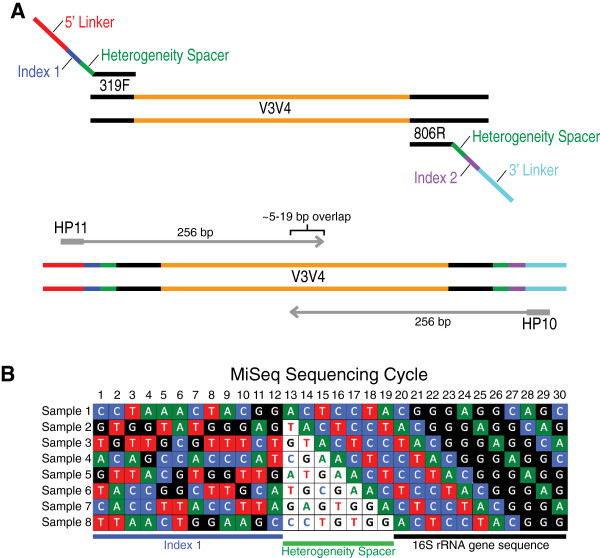
BACKGROUND: To take advantage of affordable high-throughput next-generation sequencing technologies to characterize microbial community composition often requires the development of improved methods to overcome technical limitations inherent to the sequencing platforms. Sequencing low sequence diversity libraries such as 16S rRNA amplicons has been problematic on the Illumina MiSeq platform and often generates sequences of suboptimal quality. RESULTS: Here we present an improved dual-indexing amplification and sequencing approach to assess the composition of microbial communities from clinical samples using the V3-V4 region of the 16S rRNA gene on the Illumina MiSeq platform. We introduced a 0 to 7 bp "heterogeneity spacer" to the index sequence that allows an equal proportion of samples to be sequenced out of phase. CONCLUSIONS: Our approach yields high quality sequence data from 16S rRNA gene amplicons using both 250 bp and 300 bp paired-end MiSeq protocols and provides a flexible and cost-effective sequencing option.
Overview
The claims and statistics of this paper haven’t been checked yet.
Free: it reads the open-access text and checks the first 5 claims that cite a source we can check. Create a free account to check every claim.
Integrity signals
Registry
Cites
Statistics
Figures
Verification
Claims the paper makes
The claims and statistics of this paper haven’t been checked yet.
Free: it reads the open-access text and checks the first 5 claims that cite a source we can check. Create a free account to check every claim.
Claims other papers make about this one
Each is checked against this paper’s own text: does it say what the citing paper says it does?
In the citing paper
“choices of 16S rRNA gene variable region primers may enable improved detection or differentiation of microbes16; for example, Propionibacterium spp. abundant on the skin are often undetected by V4 primers29, and Lactobacillus spp. in the vagina are better differentiated by including V321.”
From Assessment of variation in microbial community amplicon sequencing by the Microbiome Quality Control (MBQC) project consortium (2017) · cites this paper as [21]
Self-check
Percentages, sums and reported differences re-computed from the paper’s own numbers.
The self-check needs the paper’s full text.
Citations
Cites
Fast and accurate short read alignment with Burrows-Wheeler transform
Li, H., & Durbin, R. (2009) · Bioinformatics · doi:10.1093/bioinformatics/btp324 · Cited by 58,607
QIIME allows analysis of high-throughput community sequencing data
Caporaso, J. G., Kuczynski, J., Stombaugh, J., Bittinger, K., Bushman, F. D., Costello, E. K., Fierer, N., Peña, A. G., Goodrich, J. K., Gordon, J. I., et al. (2010) · Nature Methods · doi:10.1038/nmeth.f.303 · Cited by 34,887 · cited 1×
“0,) [10] and included additional quality trimming, demultiplexing, and taxonomic assignments.”
Search and clustering orders of magnitude faster than BLAST
Edgar, R. C. (2010) · Bioinformatics · doi:10.1093/bioinformatics/btq461 · Cited by 20,826
Naïve Bayesian Classifier for Rapid Assignment of rRNA Sequences into the New Bacterial Taxonomy
Wang, Q., Garrity, G. M., Tiedje, J. M., & Cole, J. R. (2007) · Applied and Environmental Microbiology · doi:10.1128/aem.00062-07 · Cited by 19,885 · cited 1×
“2 [15] trained on the Greengenes database”
FLASH: fast length adjustment of short reads to improve genome assemblies
Magoč, T., & Salzberg, S. L. (2011) · Bioinformatics · doi:10.1093/bioinformatics/btr507 · Cited by 15,366 · cited 4×
“The final sequence length after barcode, heterogeneity spacer, and primer removal was 429 ± 7 bp and 429 ± 6.7 bp for PANDAseq and FLASH, respectively, with an average of approximately 11,600 reads per sample.”
InfluentialUCHIME improves sensitivity and speed of chimera detection
Edgar, R. C., Haas, B. J., Clemente, J. C., Quince, C., & Knight, R. (2011) · Bioinformatics · doi:10.1093/bioinformatics/btr381 · Cited by 15,114
Structure, function and diversity of the healthy human microbiome
The Human Microbiome Project Consortium (2012) · Nature · doi:10.1038/nature11234 · Cited by 11,726
Ultra-high-throughput microbial community analysis on the Illumina HiSeq and MiSeq platforms
Caporaso, J. G., Lauber, C. L., Walters, W. A., Berg-Lyons, D., Huntley, J., Fierer, N., Owens, S. M., Betley, J., Fraser, L., Bauer, M., et al. (2012) · The ISME Journal · doi:10.1038/ismej.2012.8 · Cited by 8,839 · cited 3×
“quencing strategies include a single- [2,3] or a recently”
MethodKozich, J. J., Westcott, S. L., Baxter, N. T., Highlander, S. K., & Schloss, P. D. (2013) · Applied and Environmental Microbiology · doi:10.1128/aem.01043-13 · Cited by 7,112 · cited 2×
“developed dual-indexing [4] approach targeting the V4 hypervariable region of the 16S rRNA gene.”
Base-Calling of Automated Sequencer Traces Using Phred. I. Accuracy Assessment
Ewing, B., Hillier, L., Wendl, M. C., & Green, P. (1998) · Genome Research · doi:10.1101/gr.8.3.175 · Cited by 6,967 · cited 1×
“Additional sequence read pre-processing included: 1) removal of primer sequence; 2) truncation of sequence reads not having an average quality of 20 over a 30 bp sliding window based on the phred algorithm [6,7] implemented previously [8,9]; and 3) removal of trimmed reads having less than 75% of their original length…”
Cited by
Items 401–500 of 1,000
Biotechnological potential of Actinobacteria from Canadian and Azorean volcanic caves
Riquelme, C., Dapkevicius, M. D. L. E., Miller, A. Z., Charlop–Powers, Z., Brady, S. F., Mason, C., & Cheeptham, N. (2016) · Applied Microbiology and Biotechnology · doi:10.1007/s00253-016-7932-7 · Cited by 53
“Following the example of a recent paper (Fadrosh et al. 2014), we designed four forward and four reverse primers that contained the MiSeq P5 and P7 sequences, respectively, a 10 bp barcode, a 1–4 bp spacer sequence, and 18 basepairs of homology to the 454 adaptors on the first primer (Supplementary…”
Miyake, S., Soh, M., Azman, M. N., Ngoh, S. Y., Orbán, L., & Seedorf, H. (2020) · Antonie van Leeuwenhoek · doi:10.1007/s10482-020-01391-9 · Cited by 49
“Secondly, a dual-indexing strategy was used as described by Fadrosh et al. (2014) to reduce the number of barcoded primers required.”
MethodBindari, Y. R., Moore, R. J., Van, T. T. H., Hilliar, M., Wu, S., Walkden-Brown, S. W., & Gerber, P. F. (2021) · PLoS ONE · doi:10.1371/journal.pone.0255633 · Cited by 53
Adamo, M., Voyron, S., Chialva, M., Marmeisse, R., & Girlanda, M. (2020) · PLoS ONE · doi:10.1371/journal.pone.0244682 · Cited by 49
Fernandes, K. A., Gee, E. K., Rogers, C. W., Kittelmann, S., Biggs, P. J., Bermingham, E. N., Bolwell, C. F., & Thomas, D. G. (2021) · Animals · doi:10.3390/ani11082300 · Cited by 48
Qi, Y., Liu, H., Zhang, B., Geng, M., Cai, X., Wang, J., & Wang, Y. (2021) · Applied Soil Ecology · doi:10.1016/j.apsoil.2021.104369 · Cited by 50
Bullington, L. S., Lekberg, Y., Sniezko, R. A., & Larkin, B. (2018) · Molecular Plant Pathology · doi:10.1111/mpp.12663 · Cited by 47
“To reduce problems related to low sequence diversity at the conservative regions (Fadrosh et al., 2014), we increased the sequence variability of our amplicon libraries using a heterogeneity spacer region (0–6 nucleotides) between target primers and 22-bp Fluidigm universal tags, CS1 and CS2, which…”
MethodMultiple effects of secondary metabolites on amino acid cycling in white clover rhizosphere
Czaban, W., Rasmussen, J., Laursen, B. B., Vidkjær, N. H., Sapkota, R., Nicolaisen, M., & Fomsgaard, I. S. (2018) · Soil Biology and Biochemistry · doi:10.1016/j.soilbio.2018.04.012 · Cited by 47
Schütte, U. M. E., Henning, J. A., Ye, Y., Bowling, A., Ford, J. B., Genet, H., Waldrop, M. P., Turetsky, M. R., White, J. R., & Bever, J. D. (2019) · Journal of Ecology · doi:10.1111/1365-2745.13139 · Cited by 51
“General fungal communities were described using the primers GITS7 (Ihrmark et al., 2012) and NLC2mod (AGCTGCAWTCCCAAACAAC), barcoded using the approach by Fadrosh et al. (2014).”
MethodAcharya, A., Chen, T., Chan, Y., Watt, R. M., Jin, L.-J., & Mattheos, N. (2019) · Frontiers in Cellular and Infection Microbiology · doi:10.3389/fcimb.2019.00347 · Cited by 52
“16S rRNA V3-4 gene amplification and MiSeq (300 base-paired end) sequencing was performed using the standard Illumina dual-indexing protocol (Fadrosh et al., 2014).”
MethodDNA Metabarcoding as a Tool for Disentangling Food Webs in Agroecosystems
Sow, A., Haran, J., Benoit, L., Galan, M., & Brévault, T. (2020) · Insects · doi:10.3390/insects11050294 · Cited by 47
“In our study, size variation in primers resulted from the addition of heterogeneity spacers in adapters during the library construction to shift the reading frame [42].”
BackgroundYu, L., Luo, S., Gou, Y., Xu, X., & Wang, J. (2021) · Agriculture Ecosystems & Environment · doi:10.1016/j.agee.2021.107413 · Cited by 50
Ryu, J.-A., Kim, E., Yang, S.-M., Lee, S.-Y., Yoon, S., Jang, K., & Kim, H. (2021) · LWT · doi:10.1016/j.lwt.2021.111473 · Cited by 48
Sire, L., Yáñez, P. S., Cai, W., Bézier, A., Courtial, B., Cours, J., Fontaneto, D., Larrieu, L., Bouget, C., Thorn, S., et al. (2022) · Communications Biology · doi:10.1038/s42003-021-02968-4 · Cited by 51
Mezoff, E. A., Hawkins, J., Ollberding, N. J., Karns, R. A., Morrow, A. L., & Helmrath, M. A. (2015) · American Journal of Physiology-Gastrointestinal and Liver Physiology · doi:10.1152/ajpgi.00305.2015 · Cited by 49
Chung, M., Zhao, N., Meier, R. L., Koestler, D. C., Wu, G. G., del Castillo, E., Paster, B. J., Charpentier, K. P., Izard, J., Kelsey, K. T., et al. (2021) · Journal of Oral Microbiology · doi:10.1080/20002297.2021.1887680 · Cited by 47
“ASVs are also referred to as ‘features’ in QIIME2 processing and can be roughly understood as unique identifiers reaching up to the levels of bacterial strains or a group of highly similar strains.”
InfluentialFernandes, K. A., Rogers, C. W., Gee, E. K., Kittelmann, S., Bolwell, C. F., Bermingham, E. N., Biggs, P. J., & Thomas, D. G. (2021) · Animals · doi:10.3390/ani11092611 · Cited by 51
“Keywords: bacterial diversity; dietary transition; faeces; forage; pasture; Illumina MiSeq; intestinal markers; microbial community ecology; microbiota; next generation sequencing; population dynamics; resilience; thoroughbred horse”
MethodInfluentialLing, Z., Jin, G., Yan, X., Cheng, Y., Shao, L., Song, Q., Liu, X., & Zhao, N. (2022) · Frontiers in Cellular and Infection Microbiology · doi:10.3389/fcimb.2022.886872 · Cited by 51
“The details were shown as follows: amplicon libraries were constructed with Illumina sequencingcompatible and barcode-indexed bacterial PCR primers 341F (5’- CCTACGGGNGGCWGCAG-3 ’ ) / 7 85R (5 ’ -ACTAC HVGGGTATCTAATCC-3’), which target the V3-V4 regions of the 16S rRNA gene (Fadrosh et al., 2014).”
MethodXiong, Z., Sogin, J. H., & Worobo, R. W. (2023) · Frontiers in Microbiology · doi:10.3389/fmicb.2022.1099522 · Cited by 51
Nitrogen loss through anaerobic ammonium oxidation in agricultural drainage ditches
Shen, L., Zheng, P.-H., & Ma, S.-J. (2015) · Biology and Fertility of Soils · doi:10.1007/s00374-015-1058-4 · Cited by 46
“Briefly, the V3–V4 region of bacterial 16S rRNA genes was amplified from 10-fold diluted DNA extracts with the primers 319f and 806r as previously described (Fadrosh et al. 2014; Shen et al. 2015b).”
MethodZhang, B., Ren, J., Yang, D., Liu, S., & Gong, X. (2019) · PeerJ · doi:10.7717/peerj.6658 · Cited by 49
“The remaining high-quality reads were used for all subsequent analyses (Fadrosh et al., 2014).”
MethodXu, B., Yan, Y., Huang, J., Yin, B., Pan, Y., & Ma, L. (2019) · Biomedicine & Pharmacotherapy · doi:10.1016/j.biopha.2019.109720 · Cited by 51
McKernan, K. J., Spangler, J., Helbert, Y., Lynch, R. C., Devitt‐Lee, A., Zhang, L., Orphe, W., Warner, J. B., Foss, T., Hudalla, C., et al. (2016) · F1000Research · doi:10.12688/f1000research.9662.1 · Cited by 45
Vertical distribution and activity of anaerobic ammonium-oxidising bacteria in a vegetable field
Shen, L., Wu, H., Liu, X., & Li, J. (2016) · Geoderma · doi:10.1016/j.geoderma.2016.11.007 · Cited by 45
Kuźniar, A., Włodarczyk, K., & Wolińska, A. (2019) · Agronomy · doi:10.3390/agronomy9120779 · Cited by 54
“They differ in the average length of the base pair reading (Roche 454–500 base pairs, Ion Torrent ~200–300 base pairs, Illumina ~120–150 for SR200, and 250–300 base pairs for v2 250PE and v3 300 PE, respectively) [16,18,25].”
BackgroundWang, G., Deng, D., Hu, C., Lou, L., Luo, L., He, J., Tian, D., Xiao, Y., He, Y., Zhang, S., et al. (2020) · International Biodeterioration & Biodegradation · doi:10.1016/j.ibiod.2020.104920 · Cited by 45
Merkel, A. Y., Chernyh, N. A., Пименов, Н. В., Bonch-Osmolovskaya, E. A., & Slobodkin, A. I. (2021) · Life · doi:10.3390/life11090953 · Cited by 48
“The 16S rRNA amplicon libraries were prepared using PCR with universal primers to the V3–V4 region in accordance with the previously described technique [45].”
MethodClinical metagenomics for infectious corneal ulcers: Rags to riches?
Ung, L., Bispo, P. J. M., Doan, T. A., Gelder, R. N. V., Gilmore, M. S., Lietman, T. M., Margolis, T. P., Zegans, M. E., Lee, C. S., & Chodosh, J. (2019) · The Ocular Surface · doi:10.1016/j.jtos.2019.10.007 · Cited by 47
Nakajima, H., Takewaki, F., Hashimoto, Y., Kajiyama, S., Majima, S., Okada, H., Senmaru, T., Ushigome, E., Nakanishi, N., Hamaguchi, M., et al. (2020) · Life · doi:10.3390/life10090195 · Cited by 49
“A meta-analysis of the bacterial 16S rDNA sequences in the feces was performed using a previous method [42] with minor modifications.”
MethodWalia, R., Garg, S., Song, Y., Girotra, M., Cuffari, C., Fricke, W. F., & Dutta, S. (2014) · Journal of Pediatric Gastroenterology and Nutrition · doi:10.1097/mpg.0000000000000495 · Cited by 44
Analysis of Microbial Composition Associated with Freshwater and Seawater
Lee, S. Y., & Eom, Y. (2016) · Journal of Experimental & Biomedical Sciences/Biomedical Science Letters · doi:10.15616/bsl.2016.22.4.150 · Cited by 44
“…sequence indicates the target region primer; 'AGATGTGTATAAGAGACAG' indicates the adaptor sequence) and 805R (5'-GTCTCGTGGGCTCGG-AGATGTGTATAAGAGACAG-GACTACHVGGG -TATCTAATCC-3'; the underlined sequence indicates the target regions; 'GATGTGTATAAGAGACAG' is the adaptor sequence) (Fadrosh et al., 2014).”
BackgroundMicrobial communities in swine lungs and their association with lung lesions
Huang, T., Zhang, M., Tong, X., Chen, J., Yan, G., Fang, S., Guo, Y., Yang, B., Xiao, S., Chen, C., et al. (2018) · Microbial Biotechnology · doi:10.1111/1751-7915.13353 · Cited by 49
MacDonald, A., Brodell, J. D., Daiss, J. L., Schwarz, E. M., & Oh, I. C. (2019) · Journal of Orthopaedic Research® · doi:10.1002/jor.24279 · Cited by 44
Lu, S., Sun, Y., Lu, B., Zheng, D., & Xu, S. (2019) · Chemosphere · doi:10.1016/j.chemosphere.2019.125098 · Cited by 45
Shyntum, D. Y., Nkomo, N. P., Gricia, A. R., Shigange, N. L., Rabelo, D. B., & Moleleki, L. (2019) · Frontiers in Microbiology · doi:10.3389/fmicb.2019.02379 · Cited by 49
“The 16S rRNA PCR was performed to amplify v3–v4 variable regions using primers 419F (ACTCCTACGGGAGGCAGCAG) and 806R (GGACTACHVGGGTWTCTAAT) (Fadrosh et al., 2014).”
MethodChen, K., Longley, R., Bonito, G. M., & Liao, H. (2021) · Agronomy · doi:10.3390/agronomy11071274 · Cited by 44
Kimchi intake alleviates obesity-induced neuroinflammation by modulating the gut-brain axis
Kim, N., Lee, J.-E., Song, H. S., Oh, Y. J., Kwon, M., Yun, M., Lim, S. K., Park, H. K., Jang, Y. S., Lee, S., et al. (2022) · Food Research International · doi:10.1016/j.foodres.2022.111533 · Cited by 46
Zeolite food supplementation reduces abundance of enterobacteria
Prasai, T. P., Walsh, K. B., Bhattarai, S. P., Midmore, D. J., Van, T. T. H., Moore, R. J., & Stanley, D. (2016) · Microbiological Research · doi:10.1016/j.micres.2016.11.006 · Cited by 45
“Fethiere et al. (1990) reported equivalent egg prouction but lowered feed consumption (and thus decreased feed onversion ratio) with use of a zeolite amended diet.”
BackgroundSong, H.-J., Choi, O., Pandey, A., Kim, Y. G., Joo, J. S., & Sang, B. (2019) · Bioresource Technology · doi:10.1016/j.biortech.2019.02.115 · Cited by 43
In vitro growth of gut microbiota with selenium nanoparticles
Gangadoo, S., Bauer, B. W., Bajagai, Y. S., Van, T. T. H., Moore, R. J., & Stanley, D. (2019) · Animal nutrition · doi:10.1016/j.aninu.2019.06.004 · Cited by 44
“The primers contained barcodes, spaces and Illumina sequencing linkers as previously described (Fadrosh et al., 2014).”
MethodComparison of the skin microbiota in acne and rosacea
Thompson, K. G., Rainer, B. M., Antonescu, C. M., Florea, L., Mongodin, E. F., Kang, S., & Chien, A. L.-L. (2020) · Experimental Dermatology · doi:10.1111/exd.14098 · Cited by 49
Allaway, D., Haydock, R., Lonsdale, Z. N., Deusch, O., O’Flynn, C., & Hughes, K. R. (2020) · Applied and Environmental Microbiology · doi:10.1128/aem.00562-20 · Cited by 50
Li, Y., Liu, X., Zhang, L., Xie, Y., Cai, X., Wang, S., & Lian, B. (2020) · Journal of soil science and plant nutrition · doi:10.1007/s42729-020-00274-2 · Cited by 45
“Using the sample total DNA as a template, the V3–V4 region of the bacterial 16S rDNA was amplified using primers 338F 5′-ACTCCTACGGGAGGCAGCAG-3′ and primer 806R 5′-GGACTACHVGGGTWTCTAAT3′ (Fadrosh et al. 2014).”
MethodChanges in the Microbiome of the Inner Surface of Clear Aligners After Different Usage Periods
Yan, D., Liu, Y. F., Che, X., Mi, S., Yao, J., Guo, L., & Li, S. (2021) · Current Microbiology · doi:10.1007/s00284-020-02308-5 · Cited by 48
Manure Application Increases Soil Bacterial and Fungal Network Complexity and Alters Keystone Taxa
Wang, P., Wang, X., Nie, J., Wang, Y., Zang, H., Peixoto, L. E. K., Yang, Y., & Zeng, Z. (2021) · Journal of soil science and plant nutrition · doi:10.1007/s42729-021-00673-z · Cited by 46
“1 (Fadrosh et al. 2014) and with the standards described previously in Yang et al.”
MethodEffects of Three Pesticides on the Earthworm Lumbricus terrestris Gut Microbiota
Astaykina, A. A., Streletskii, R. A., Maslov, M. N., Krasnov, G. S., & Gorbatov, V. (2022) · Frontiers in Microbiology · doi:10.3389/fmicb.2022.853535 · Cited by 48
Coughlin, C. C., Swink, S. M., Horwinski, J., Sfyroera, G., Bugayev, J., Grice, E. A., & Yan, A. C. (2017) · Pediatric Dermatology · doi:10.1111/pde.13261 · Cited by 42
Evidence for anaerobic ammonium oxidation process in freshwater sediments of aquaculture ponds
Shen, L., Wu, H., Gao, Z., Ruan, Y., Xu, X., Li, J., Ma, S.-J., & Zheng, P.-H. (2015) · Environmental Science and Pollution Research · doi:10.1007/s11356-015-5356-z · Cited by 42
Chopyk, J., Chattopadhyay, S., Kulkarni, P., Claye, E., Babik, K. R., Reid, M. C., Smyth, E. M., Hittle, L. E., Paulson, J. N., Cruz‐Cano, R., et al. (2017) · Microbiome · doi:10.1186/s40168-017-0235-0 · Cited by 45
“16S rRNA reads were initially screened for low quality bases and short read lengths [33].”
BackgroundMethodBost, A., Franzenburg, S., Adair, K. L., Martinson, V. G., Loeb, G. M., & Douglas, A. E. (2017) · Molecular Ecology · doi:10.1111/mec.14413 · Cited by 46
“The cycling conditions were modified from Fadrosh et al. (2014): 98°C for 60 s, followed by 35 cycles of 98°C for 15 s, 58°C for 15 s and 72°C for 15 s, and a final elongation of 72°C for 60 s then held at 4°C. Amplicons were cleaned and normalized using the SequalPrep 96-well plate kit (Life…”
MethodZhang, K., Liu, Y., Chen, Q., Luo, H., Zhu, Z., Chen, W., Chen, J., & Mo, Y. (2018) · Ecological Engineering · doi:10.1016/j.ecoleng.2018.02.025 · Cited by 45
Yan, Y., Xu, B., Yin, B., Xu, X., Niu, Y., Tang, Y., Wang, X., Xie, C., Yang, T., Zhou, S., et al. (2020) · Frontiers in Microbiology · doi:10.3389/fmicb.2019.03125 · Cited by 43
“To obtain more accurate and reliable results in subsequent bioinformatics analysis, raw data were cleansed by the in-house procedure (Fadrosh et al., 2014).”
MethodLi, Y., Lu, X.-C., Li, X., Guo, X. L., Sheng, Y., Li, Y., Xu, G., Han, X., An, L., & Du, P. (2020) · Food Science & Nutrition · doi:10.1002/fsn3.1568 · Cited by 43
“The V3-V4 region of the prokaryotic (bacterial and archaeal) smallsubunit (16S) rRNA gene was amplified with slightly modified versions of primers 338F (5′-ACTCCTACGGGAGGCAGCAG-3′) and 806R (5′-GGACTACHVGGGTWTCTAAT-3′) (Fadrosh et al., 2014).”
MethodLajoie, G., & Kembel, S. W. (2020) · Ecological Monographs · doi:10.1002/ecm.1443 · Cited by 44
Seiwert, N., Adam, J., Steinberg, P., Wirtz, S. J., Schwerdtle, T., Adams‐Quack, P., Hövelmeyer, N., Kaina, B., Foersch, S., & Fahrer, J. (2021) · Archives of Toxicology · doi:10.1007/s00204-021-03064-6 · Cited by 44
Zhang, Y., Jiang, D., Jin, Y., Jia, H., Yang, Y., Kim, I. H., Dai, Z., Zhang, J., Ren, F., & Wu, Z. (2021) · Molecular Nutrition & Food Research · doi:10.1002/mnfr.202001065 · Cited by 52
Comparison of the Microbiota of Older Adults Living in Nursing Homes and the Community
Roghmann, M., Lydecker, A. D., Hittle, L. E., DeBoy, R. T., Nowak, R. G., Johnson, J. K., & Mongodin, E. F. (2017) · mSphere · doi:10.1128/msphere.00210-17 · Cited by 43
van der Veer, C., Bruisten, S. M., van Houdt, R., Matser, A. A., Tachedjian, G., van de Wijgert, J. H. H. M., de Vries, H. J. C., & van der Helm, J. J. (2019) · BMC Microbiology · doi:10.1186/s12866-019-1545-0 · Cited by 46
Lomeli, B., Galbraith, H., Schettler, J., Saviolakis, G. A., Elamin, W. F., Osborn, B. L., Ravel, J., Hazleton, K. Z., Lozupone, C., Evans, R. J., et al. (2019) · Antimicrobial Agents and Chemotherapy · doi:10.1128/aac.01395-19 · Cited by 41
Self-citationLi, Y. Q., Xi, Y., Wang, Z. D., Zeng, H., & Han, Z. (2020) · Journal of Animal Science · doi:10.1093/jas/skaa070 · Cited by 46
Stefani, F. O. P., Bencherif, K., Sabourin, S., Sahraoui, A. L., Banchini, C., Séguin, S., & Dalpé, Y. (2020) · Mycorrhiza · doi:10.1007/s00572-020-00946-y · Cited by 41
“A one to three bp “heterogeneity spacer” was introduced between the 3′ end of the adapter and the 5′ end of the primer pair nu-SSU-0595-5′/nu-SSU-0948-3′ to dampen the effect of the low sequence diversity issue of the MiSeq platform (Table S3, Fadrosh et al. 2014).”
BackgroundLitti, Y., Kovalev, D. A., Kovalev, А. A., Merkel, A. Y., Vishnyakova, A., Russkova, Y. I., & Nozhevnikova, A. N. (2021) · International Journal of Hydrogen Energy · doi:10.1016/j.ijhydene.2021.06.174 · Cited by 41
Skin Metagenomic Sequence Analysis of Early Candida auris Outbreaks in U.S. Nursing Homes
Huang, X., Welsh, R. M., Deming, C., Proctor, D. M., Thomas, P. J., Program, N. C. S., Gussin, G. M., Huang, S. S., Kong, H. H., Bentz, M. L., et al. (2021) · mSphere · doi:10.1128/msphere.00287-21 · Cited by 43
Grant-Beurmann, S., Jumare, J., Ndembi, N., Matthew, O., Shutt, A., Omoigberale, A. I., Martin, O. A., Fraser, C. M., & Charurat, M. E. (2022) · Microbiome · doi:10.1186/s40168-022-01230-1 · Cited by 51
“16S rRNA gene sequence analysis Hypervariable regions V3 and V4 of the bacterial 16S rRNA gene were amplified with primers 319F and 806R as previously described by [107, 108].”
MethodGuo, D., Xie, M., Xiao, H., Xu, L., Zhang, S., Chen, X., & Wu, Z. (2022) · Fishes · doi:10.3390/fishes7030094 · Cited by 42
Ocular Surface Microbiota in Naïve Keratoconus: A Multicenter Validation Study
Rocha‐de‐Lossada, C., Mazzotta, C. G., Gabrielli, F., Papa, F. T., Gómez-Huertas, C., García-López, C., Urbinati, F., Rachwani‐Anil, R., Lorente, M. G., Sánchez‐González, J., et al. (2023) · Journal of Clinical Medicine · doi:10.3390/jcm12196354 · Cited by 41
“, 16S rRNA for bacteria [17,18] and 18S rRNA for eukaryotes) [19–21].”
BackgroundOral microbiome dysbiosis among cigarette smokers and smokeless tobacco users compared to non-users
Chattopadhyay, S., Malayil, L., Chopyk, J., Smyth, E. M., Kulkarni, P., Raspanti, G., Thomas, S. B., Sapkota, A., Mongodin, E. F., & Sapkota, A. R. (2024) · Scientific Reports · doi:10.1038/s41598-024-60730-2 · Cited by 49
Hong, Y., Thimmapuram, J., Zhang, J., Collings, C. K., Bhide, K. P., Schmidt, K., & Ebner, P. (2016) · Bacteriophage · doi:10.1080/21597081.2016.1211066 · Cited by 43
Liu, F., Ling, Z., Xiao, Y., Yang, Q., Wang, B., Li, Z., Jiang, P., Li, L., & Wang, W. (2017) · Frontiers in Physiology · doi:10.3389/fphys.2017.00126 · Cited by 42
“The 16S rRNA gene V3-V4 regions were PCR-amplified from microbial genome DNA using primers (forward primer, 5′-ACTCCTACGGGAGGCAGCAG-3′; reverse primer, 5′-GGA CTACHVGGGTWTCTAAT-3′; Fadrosh et al., 2014).”
MethodXiao, X., Shi, W., Huang, Z., Ruan, W., Miao, H., Ren, H., & Zhao, M. (2017) · International Biodeterioration & Biodegradation · doi:10.1016/j.ibiod.2017.03.012 · Cited by 40
Creating a 3D microbial and chemical snapshot of a human habitat
Kapono, C. A., Morton, J. T., Bouslimani, A., Melnik, A. V., Orlinsky, K., Luzzatto‐Knaan, T., Garg, N., Vázquez‐Baeza, Y., Protsyuk, I., Janssen, S., et al. (2018) · Scientific Reports · doi:10.1038/s41598-018-21541-4 · Cited by 43
Mulder, M., Radjabzadeh, D., Hassing, R., Heeringa, J., Uitterlinden, A. G., Kraaij, R., Stricker, B. H. C., & Verbon, A. (2019) · BMC Microbiology · doi:10.1186/s12866-018-1379-1 · Cited by 44
Biehl, L. M., Garzetti, D., Farowski, F., Ring, D., Koeppel, M. B., Rohde, H., Schafhausen, P., Stecher, B., & Vehreschild, M. J. G. T. (2019) · PLoS ONE · doi:10.1371/journal.pone.0215428 · Cited by 42
A Distinct Gut Microbiota Exists Within Crohn's Disease–Related Perianal Fistulae
Haac, B. E., Palmateer, N. C., Seaton, M. E., VanYPeren, R., Fraser, C. M., & Bafford, A. C. (2019) · Journal of Surgical Research · doi:10.1016/j.jss.2019.04.032 · Cited by 42
Impact of Sugarcane–Legume Intercropping on Diazotrophic Microbiome
Solanki, M. K., Wang, F., Li, C., Wang, Z., Lan, T.-J., Singh, R. K., Singh, P., Yang, L., & Li, Y. (2019) · Sugar Tech · doi:10.1007/s12355-019-00755-4 · Cited by 43
Bradley, C. W., Lee, F. F., Rankin, S. C., Kalan, L., Horwinski, J., Morris, D. O., Grice, E. A., & Cain, C. L. (2020) · Veterinary Dermatology · doi:10.1111/vde.12826 · Cited by 48
Berbers, R.-M., Hoesein, F. A. A. M., Ellerbroek, P. M., van Montfrans, J. M., Dalm, V. A. S. H., van Hagen, P. M., Paganelli, F. L., Viveen, M. C., Rogers, M. R. C., de Jong, P. A., et al. (2020) · Frontiers in Immunology · doi:10.3389/fimmu.2020.01245 · Cited by 43
Yang, X., Song, X., Hallerman, E. M., & Huang, Z. (2020) · Aquaculture · doi:10.1016/j.aquaculture.2020.735665 · Cited by 40
Равилевна, М. Э., Katraeva, I. V., Kovalev, А. A., Kovalev, D. A., Nozhevnikova, A. N., Панченко, В., Fiore, U., & Litti, Y. (2021) · Applied Sciences · doi:10.3390/app11020510 · Cited by 40
“Libraries of 16SrRNA fragments were prepared by amplification according to the described methodology [27].”
MethodVieira, F. R., & Pecchia, J. A. (2021) · Microbial Ecology · doi:10.1007/s00248-021-01833-5 · Cited by 40
Dynamic Process of Secondary Pulmonary Infection in Mice With Intracerebral Hemorrhage
Zhang, H., Huang, Y., Li, X., Han, X., Hu, J. S., Wang, B., Zhang, L., Zhuang, P., & Zhang, Y. (2021) · Frontiers in Immunology · doi:10.3389/fimmu.2021.767155 · Cited by 46
Garey, K. W., McPherson, J. K., Dinh, A. Q., Hu, C., Jo, J., Wang, W., Lancaster, C. K., Gonzales-Luna, A. J., Loveall, C., Begum, K., et al. (2022) · Clinical Infectious Diseases · doi:10.1093/cid/ciac096 · Cited by 40
“performed by sequencing the V1-V3 region of the 16S rRNA gene using the MiSeq system (Illumina, San Diego, CA, USA).[16, 17] Each sample was amplified using a barcoded primer, which yielded a unique sequence identifier tagged onto each individual sample”
Bledsoe, J. W., Pietrak, M., Burr, G., Peterson, B. C., & Small, B. C. (2022) · Animal Microbiome · doi:10.1186/s42523-022-00173-0 · Cited by 44
Bui, T. I., Gill, A. L., Mooney, R. A., & Gill, S. R. (2022) · Microbiology Spectrum · doi:10.1128/spectrum.00170-22 · Cited by 40
Gut microbiota trajectory in patients with severe burn: A time series study
Wang, X., Yang, J., Tian, F., Zhang, L., Lei, Q., Jiang, T., Zhou, J., Yuan, S., Wang, J., Feng, Z., et al. (2017) · Journal of Critical Care · doi:10.1016/j.jcrc.2017.08.020 · Cited by 39
Qiu, Z., Li, N., Lu, X., Zheng, Z., Zhang, M., & Qiao, X. (2018) · Food Research International · doi:10.1016/j.foodres.2017.12.081 · Cited by 39
Gueuning, M., Ganser, D., Blaser, S., Albrecht, M., Knop, E., Praz, C. J., & Frey, J. E. (2019) · Molecular Ecology Resources · doi:10.1111/1755-0998.13013 · Cited by 41
“To overcome the inherent limitation of Illumina platforms in sequencing low complexity libraries, we added a “heterogeneity spacer” between the labelled tag and the priming sequence, as recommended in Fadrosh et al. (2014).”
Temporal Dysbiosis of Infant Nasal Microbiota Relative to Respiratory Syncytial Virus Infection
Grier, A., Gill, A. L., Kessler, H. A., Corbett, A. M., Bandyopadhyay, S., Java, J., Holden‐Wiltse, J., Falsey, A. R., Topham, D. J., Mariani, T. J., et al. (2020) · The Journal of Infectious Diseases · doi:10.1093/infdis/jiaa577 · Cited by 39
Sokolova, M., Yang, K., Hansen, S. H., Louwe, M. C., Kummen, M., Hov, J. R., Sjaastad, I., Berge, R. K., Halvorsen, B. L., Aukrust, P., et al. (2020) · Scientific Reports · doi:10.1038/s41598-020-76497-1 · Cited by 41
Ogola, H. J. O., Selvarajan, R., & Tekere, M. (2021) · Frontiers in Microbiology · doi:10.3389/fmicb.2021.592725 · Cited by 40
Yang, B. K., Ding, M., Chen, Y., Han, F., Yang, C., Zhao, J., Malard, P., Stanton, C., Ross, R. P., Zhang, H., et al. (2021) · Gut Microbes · doi:10.1080/19490976.2021.1908100 · Cited by 40
Changes in Gastrointestinal Microbiome Composition in PD: A Pivotal Role of Covariates
Cosma-Grigorov, A., Meixner, H., Mrochen, A., Wirtz, S., Winkler, J., & Marxreiter, F. (2020) · Frontiers in Neurology · doi:10.3389/fneur.2020.01041 · Cited by 38
Brown, B. P., Feng, C., Tanko, R. F., Jaumdally, S. Z., Bunjun, R., Dabee, S., Happel, A., Gasper, M. A., Nyangahu, D. D., Onono, M. A., et al. (2023) · Nature Communications · doi:10.1038/s41467-023-36002-4 · Cited by 44
Yang, J., Ding, C., Dai, X., Lv, T., Xie, T., Zhang, T., Gao, W., Gong, J., Zhu, W., Li, N., et al. (2016) · Journal of Parenteral and Enteral Nutrition · doi:10.1177/0148607116671101 · Cited by 40
Raju, S. C., Lagström, S., Ellonen, P., de Vos, W. M., Eriksson, J. G., Weiderpass, E., & Rounge, T. B. (2018) · Journal of Microbiological Methods · doi:10.1016/j.mimet.2018.03.003 · Cited by 43
Yoon, H., Kim, H., Lee, S. H., Kim, S. J., Chang, Y., Ryu, S., Shin, H., Kim, H.-L., & Lee, J. H. (2018) · Scientific Reports · doi:10.1038/s41598-018-34398-4 · Cited by 41
Allard, S. M., Callahan, M. T., Bui, A. Q., Ferelli, A. M. C., Chopyk, J., Chattopadhyay, S., Mongodin, E. F., Micallef, S. A., & Sapkota, A. R. (2019) · The Science of The Total Environment · doi:10.1016/j.scitotenv.2019.02.179 · Cited by 42
Liu, Y., & Ludewig, U. (2019) · GCB Bioenergy · doi:10.1111/gcbb.12634 · Cited by 41
“The raw data were demultiplexed and quality filtered to get clean data by the procedure described in Fadrosh et al. (2014).”
MethodOregano: A potential prophylactic treatment for the intestinal microbiota
Bauer, B. W., Radovanović, A., Willson, N.-L., Bajagai, Y. S., Van, T. T. H., Moore, R. J., & Stanley, D. (2019) · Heliyon · doi:10.1016/j.heliyon.2019.e02625 · Cited by 42
van de Wijgert, J. H. H. M., Verwijs, M. C., Gill, A. C., Borgdorff, H., van der Veer, C., & Mayaud, P. (2020) · Frontiers in Cellular and Infection Microbiology · doi:10.3389/fcimb.2020.00129 · Cited by 38
“All three studies extracted DNA from vaginal swabs and conducted 16S rRNA gene sequencing of the V3–V4 variable regions on Illumina platforms (SanDiego, CA, USA) as described by Fadrosh et al. (2014).”
Method
Metadata
- Authors
- Fadrosh, D. W., Ma, B., Gajer, P., Sengamalay, N., Ott, S., Brotman, R. M., & Ravel, J.
- Affiliations
- University of Maryland, Baltimore (US)
- Corresponding author
- Ravel, Jacques
- Venue
- Microbiome
- Published
- 2014-02-24
- Volume
- 2
- Issue
- 1
- Pages
- 6-6
- ISSN
- 2049-2618 (ISSN-L)
- PMC
- PMC3940169
- OpenAlex
- W2165722876
- Semantic Scholar
- 7f8859a57e35c66164678710187d4374822411d8
- Cited by
- 1,698
- References
- 14
- Citations by year
- 2026: 83 · 2025: 129 · 2024: 148 · 2023: 171 · 2022: 167 · 2021: 235 · 2020: 218 · 2019: 164 · 2018: 169 · 2017: 104 · 2016: 62 · 2015: 37 · 2014: 11
- FWCI
- 29.23
- Type
- journal article
- Language
- en
- Open access
- gold
- doi.org
- Licence
- cc-by
- Locations
- Microbiome (publishedVersion, cc-by)
- Europe PMC (PubMed Central) (publishedVersion, cc-by)
- PubMed Central (publishedVersion, cc-by)
- PubMed (publishedVersion)
- Funders
- National Institutes of Health
- National Institute of Allergy and Infectious Diseases (R01AI089878, U19AI084044, UH2AI083264)
- Topics
- Life Sciences › Biochemistry, Genetics and Molecular Biology › Molecular Biology › Genomics and Phylogenetic Studies
- Physical Sciences › Environmental Science › Ecology › Microbial Community Ecology and Physiology
- Life Sciences › Biochemistry, Genetics and Molecular Biology › Molecular Biology › Gut microbiota and health
- Keywords
- 16S rRNA gene sequencing, multiplexed sequencing, V3-V4 region, microbial community composition, clinical samples, paired-end sequencing, sequencing data quality
About these checks
Registry, retraction, Cites and statistics results are computed, not judged, with one exception: a printed reference that no index lists is read once by a model before it counts as a citation error. Claims are extracted by a model and kept only when their quote appears verbatim in the text; each cited source is then checked, with a model’s help, for whether it says what the claim relies on. Those verdicts can be wrong — read the claim’s quote and the cited source before relying on one.
Statistics and arithmetic are recomputed, not judged.
Confidence bands are shown only for fields calibrated on our annotated test set. None is calibrated yet, so no band is shown.
What counts as a claim ›How we measure confidence ›How we check this ›
Are you an author, or do you see a problem with this page? Request a review
Data sources
Bibliographic data: Semantic Scholar, OpenAlex, Crossref.
Contains information from the Semantic Scholar Academic Graph Datasets, made available under the ODC Attribution License (ODC-BY 1.0).
Semantic Scholar’s data is described in: Kinney, R., et al. (2023). The Semantic Scholar Open Data Platform. arXiv:2301.10140.
