

An improved dual-indexing approach for multiplexed 16S rRNA gene sequencing on the Illumina MiSeq platform
Open accessThe DOI matches its Crossref record; 14 of the 14 references it cites were found in a registry or an index.
Abstract
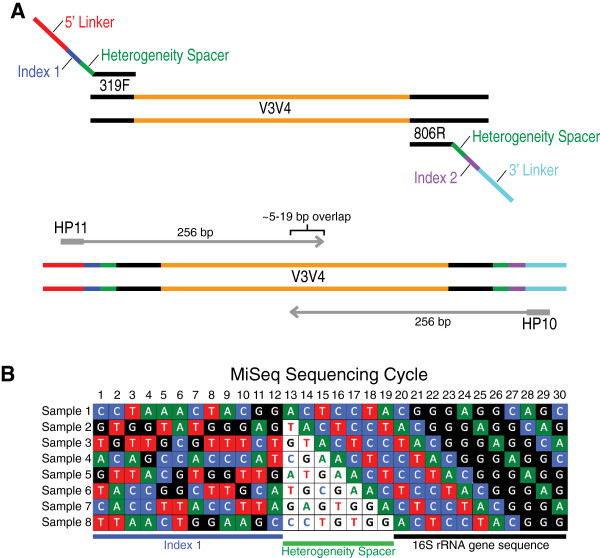
BACKGROUND: To take advantage of affordable high-throughput next-generation sequencing technologies to characterize microbial community composition often requires the development of improved methods to overcome technical limitations inherent to the sequencing platforms. Sequencing low sequence diversity libraries such as 16S rRNA amplicons has been problematic on the Illumina MiSeq platform and often generates sequences of suboptimal quality. RESULTS: Here we present an improved dual-indexing amplification and sequencing approach to assess the composition of microbial communities from clinical samples using the V3-V4 region of the 16S rRNA gene on the Illumina MiSeq platform. We introduced a 0 to 7 bp "heterogeneity spacer" to the index sequence that allows an equal proportion of samples to be sequenced out of phase. CONCLUSIONS: Our approach yields high quality sequence data from 16S rRNA gene amplicons using both 250 bp and 300 bp paired-end MiSeq protocols and provides a flexible and cost-effective sequencing option.
Overview
The claims and statistics of this paper haven’t been checked yet.
Free: it reads the open-access text and checks the first 5 claims that cite a source we can check. Create a free account to check every claim.
Integrity signals
Registry
Cites
Statistics
Figures
Verification
Claims the paper makes
The claims and statistics of this paper haven’t been checked yet.
Free: it reads the open-access text and checks the first 5 claims that cite a source we can check. Create a free account to check every claim.
Claims other papers make about this one
Each is checked against this paper’s own text: does it say what the citing paper says it does?
In the citing paper
“choices of 16S rRNA gene variable region primers may enable improved detection or differentiation of microbes16; for example, Propionibacterium spp. abundant on the skin are often undetected by V4 primers29, and Lactobacillus spp. in the vagina are better differentiated by including V321.”
From Assessment of variation in microbial community amplicon sequencing by the Microbiome Quality Control (MBQC) project consortium (2017) · cites this paper as [21]
Self-check
Percentages, sums and reported differences re-computed from the paper’s own numbers.
The self-check needs the paper’s full text.
Citations
Cites
Fast and accurate short read alignment with Burrows-Wheeler transform
Li, H., & Durbin, R. (2009) · Bioinformatics · doi:10.1093/bioinformatics/btp324 · Cited by 58,607
QIIME allows analysis of high-throughput community sequencing data
Caporaso, J. G., Kuczynski, J., Stombaugh, J., Bittinger, K., Bushman, F. D., Costello, E. K., Fierer, N., Peña, A. G., Goodrich, J. K., Gordon, J. I., et al. (2010) · Nature Methods · doi:10.1038/nmeth.f.303 · Cited by 34,887 · cited 1×
“0,) [10] and included additional quality trimming, demultiplexing, and taxonomic assignments.”
Search and clustering orders of magnitude faster than BLAST
Edgar, R. C. (2010) · Bioinformatics · doi:10.1093/bioinformatics/btq461 · Cited by 20,826
Naïve Bayesian Classifier for Rapid Assignment of rRNA Sequences into the New Bacterial Taxonomy
Wang, Q., Garrity, G. M., Tiedje, J. M., & Cole, J. R. (2007) · Applied and Environmental Microbiology · doi:10.1128/aem.00062-07 · Cited by 19,885 · cited 1×
“2 [15] trained on the Greengenes database”
FLASH: fast length adjustment of short reads to improve genome assemblies
Magoč, T., & Salzberg, S. L. (2011) · Bioinformatics · doi:10.1093/bioinformatics/btr507 · Cited by 15,366 · cited 4×
“The final sequence length after barcode, heterogeneity spacer, and primer removal was 429 ± 7 bp and 429 ± 6.7 bp for PANDAseq and FLASH, respectively, with an average of approximately 11,600 reads per sample.”
InfluentialUCHIME improves sensitivity and speed of chimera detection
Edgar, R. C., Haas, B. J., Clemente, J. C., Quince, C., & Knight, R. (2011) · Bioinformatics · doi:10.1093/bioinformatics/btr381 · Cited by 15,114
Structure, function and diversity of the healthy human microbiome
The Human Microbiome Project Consortium (2012) · Nature · doi:10.1038/nature11234 · Cited by 11,726
Ultra-high-throughput microbial community analysis on the Illumina HiSeq and MiSeq platforms
Caporaso, J. G., Lauber, C. L., Walters, W. A., Berg-Lyons, D., Huntley, J., Fierer, N., Owens, S. M., Betley, J., Fraser, L., Bauer, M., et al. (2012) · The ISME Journal · doi:10.1038/ismej.2012.8 · Cited by 8,839 · cited 3×
“quencing strategies include a single- [2,3] or a recently”
MethodKozich, J. J., Westcott, S. L., Baxter, N. T., Highlander, S. K., & Schloss, P. D. (2013) · Applied and Environmental Microbiology · doi:10.1128/aem.01043-13 · Cited by 7,112 · cited 2×
“developed dual-indexing [4] approach targeting the V4 hypervariable region of the 16S rRNA gene.”
Base-Calling of Automated Sequencer Traces Using Phred. I. Accuracy Assessment
Ewing, B., Hillier, L., Wendl, M. C., & Green, P. (1998) · Genome Research · doi:10.1101/gr.8.3.175 · Cited by 6,967 · cited 1×
“Additional sequence read pre-processing included: 1) removal of primer sequence; 2) truncation of sequence reads not having an average quality of 20 over a 30 bp sliding window based on the phred algorithm [6,7] implemented previously [8,9]; and 3) removal of trimmed reads having less than 75% of their original length…”
Cited by
Items 501–600 of 1,000
Lu, Y., Zhang, E., Hong, M., Yin, X., Cai, H., Yuan, L., Yuan, F., Li, L., Zhao, K., & Lan, X. (2020) · Archives of Microbiology · doi:10.1007/s00203-020-01882-3 · Cited by 50
“Sequence processing and quality filtering, denoising, trimming, and merging of raw paired-end FASTQ files were performed using an improved dual-indexing approach and FLASH software to obtain clean tags (Fadrosh et al. 2014; Magoc and Salzberg 2011).”
MethodLiu, H., Wang, X., Song, X., Leng, P., Li, J., Rodrigues, J. L. M., Hong, Z., Kuzyakov, Y. V., Xu, J. M., & Dai, Z. (2022) · Geoderma · doi:10.1016/j.geoderma.2022.116176 · Cited by 40
“Raw data were pre-processed to remove the low-quality reads by using the procedures described by Fadrosh et al. (2014).”
MethodXie, G., Zhang, Y., Gong, Y., Luo, W., & Tang, X. (2024) · BMC Microbiology · doi:10.1186/s12866-024-03488-x · Cited by 37
“A ) and 806R (5’-GGACTACHVGGGTWTC-TAAT-3’) [38].”
Osama, A., Anwar, A. M., Ezzeldin, S., Ahmed, E., Mahgoub, S., Ibrahim, O., Ibrahim, S., Abdelhamid, I. A., Bakry, U., Diab, A. A., et al. (2025) · Journal of Advanced Research · doi:10.1016/j.jare.2025.01.036 · Cited by 42
“The illumina MiSeqDx platform was used to isolate the V3 and V4 regions of bacterial 16S rRNA [20] (see Supplementary methods).”
Zhang, T., Ding, C., Zhao, M., Dai, X., Yang, J., Li, Y., Gu, L., Wei, Y., Gong, J., Zhu, W., et al. (2016) · Nutrients · doi:10.3390/nu8120728 · Cited by 36
“A dual-index sequencing approach allowed us to generate a large number of high-quality sequences while minimizing the cost of long and customized primers [27].”
MethodTick Microbiome Characterization by Next-Generation 16S rRNA Amplicon Sequencing
Couper, L., & Swei, A. (2018) · Journal of Visualized Experiments · doi:10.3791/58239-v · Cited by 37
Bubeck, A. M., Preiss, L. C., Jung, A., Dörner, E., Podlesny, D., Kulis, M., Maddox, C., Arze, C., Zörb, C., Merkt, N., et al. (2020) · Scientific Reports · doi:10.1038/s41598-020-70535-8 · Cited by 37
Chen, M., Qin, Y., Deng, F., Zhou, H., Wang, R., Li, P., Liu, Y., & Jiang, L. (2021) · Food Research International · doi:10.1016/j.foodres.2021.110234 · Cited by 42
Zhang, J., Liu, M., Ke, S., Huang, X., Fang, S., He, M., Fu, H., Chen, C., & Huang, L. (2021) · Frontiers in Microbiology · doi:10.3389/fmicb.2021.690091 · Cited by 43
“Raw data of 16S rRNA gene sequencing were cleaned by filtering low-quality reads and removing the primers and barcode sequences (Fadrosh et al., 2014).”
MethodCharacteristics associated with Lactobacillus iners-dominated vaginal microbiota
Novak, J., Ravel, J., Ma, B., Ferreira, C. S. T., Tristão, A. D. R., da Silva, M. G., & Marconi, C. (2021) · Sexually Transmitted Infections · doi:10.1136/sextrans-2020-054824 · Cited by 43
Self-citationMaternal regulation of biliary disease in neonates via gut microbial metabolites
Jee, J. J., Yang, L., Shivakumar, P., Xu, P.-P., Mourya, R., Thanekar, U., Yu, P., Zhu, Y., Pan, Y., Wang, H., et al. (2022) · Nature Communications · doi:10.1038/s41467-021-27689-4 · Cited by 39
Bifidobacterium Is Enriched in Gut Microbiome of Kashmiri Women with Polycystic Ovary Syndrome
Hassan, S., Kaakinen, M., Draisma, H. H. M., Zudina, L., Ganie, M. A., Rashid, A., Balkhiyarova, Z., Kiran, G. S., Vogazianos, P., Shammas, C., et al. (2022) · Genes · doi:10.3390/genes13020379 · Cited by 41
Zhang, Y., Yang, Y., Lu, X., Wang, A., Xue, C., Zhao, M., & Zhang, J. (2023) · BMC Microbiology · doi:10.1186/s12866-023-02780-6 · Cited by 37
Dausset, C., Patrier, S., Gajer, P., Thoral, C., Lenglet, Y., Cardot, J., Judlin, P., Ravel, J., & Nivoliez, A. (2018) · European Journal of Clinical Microbiology & Infectious Diseases · doi:10.1007/s10096-018-3321-8 · Cited by 36
Self-citationShen, L., Wu, H., Gao, Z., Liu, X., & Li, J. (2016) · Scientific Reports · doi:10.1038/srep25647 · Cited by 41
Evaluation of Buccal Cell Samples for Studies of Oral Microbiota
Yu, G., Phillips, S., Gail, M. H., Goedert, J. J., Humphrys, M. S., Ravel, J., Ren, Y., & Caporaso, N. E. (2017) · Cancer Epidemiology Biomarkers & Prevention · doi:10.1158/1055-9965.epi-16-0538 · Cited by 39
Self-citationDesneux, N., Asplen, M. K., Brady, C. M., Heimpel, G. E., Hopper, K. R., Luo, C., Monticelli, L. S., Oliver, K. M., & White, J. A. (2017) · Biological Control · doi:10.1016/j.biocontrol.2017.06.007 · Cited by 39
“Next-generation sequencing and indexed barcodes that allow extensive multiplexing have made it simple and relatively inexpensive to quickly screen bacterial diversity from hundreds of insect specimens (Fadrosh et al., 2014; Jousselin et al., 2016; Kozich et al., 2013).”
BackgroundSun, J. G., Huang, T., Chen, C., Cao, T.-T., Cheng, K., Liao, X.-P., & Liu, Y.-H. (2017) · Scientific Reports · doi:10.1038/s41598-017-04672-y · Cited by 39
Tawfik, S. A., Azab, M., Ahmed, A. A. A., & Fayyad, D. M. (2018) · International Journal of Microbiology · doi:10.1155/2018/2837328 · Cited by 36
Wang, L., Singh, L., & Liu, H. (2018) · International Journal of Hydrogen Energy · doi:10.1016/j.ijhydene.2018.05.081 · Cited by 36
Schroeder, H. A., Nunn, K. L., Schaefer, A., Henry, C. E., Lam, F., Pauly, M. H., Whaley, K. J., Zeitlin, L., Humphrys, M. S., Ravel, J., et al. (2018) · Mucosal Immunology · doi:10.1038/s41385-018-0054-z · Cited by 36
Self-citationCharacterization of Microbiota in Bronchiectasis Patients with Different Disease Severities
Lee, S. H., Lee, Y. J., Park, J., Cho, Y., Yoon, H. I., Lee, C., & Lee, J. H. (2018) · Journal of Clinical Medicine · doi:10.3390/jcm7110429 · Cited by 38
“(Seoul, Korea), according to the manufacturer’s instructions [10].”
BackgroundZhang, W., Zhang, Y., Zhang, X., Deng, Z., Liu, J., He, M., & Wang, H. (2020) · Animals · doi:10.3390/ani10020180 · Cited by 38
Byers, A. K., Condron, L. M., Donavan, T., O’Callaghan, M., Patuawa, T., Waipara, N. W., & Black, A. (2020) · FEMS Microbiology Ecology · doi:10.1093/femsec/fiaa047 · Cited by 36
Belowground changes to community structure alter methane-cycling dynamics in Amazonia
Meyer, K., Morris, A. H., Webster, K. D., Klein, A. M., Kroeger, M., Meredith, L., Brændholt, A., Nakamura, F. M., Venturini, A. M., de Souza, L. F., et al. (2020) · Environment International · doi:10.1016/j.envint.2020.106131 · Cited by 40
Competitive interference among rhizobia reduces benefits to hosts
Rahman, A., Manci, M., Nadon, C., Perez, I. A., Farsamin, W. F., Lampe, M. T., Le, T. H., Torres‐Martínez, L., Weisberg, A. J., Chang, J. H., et al. (2023) · Current Biology · doi:10.1016/j.cub.2023.06.081 · Cited by 38
Carvalho, C. O., Gromstad, W., Dunthorn, M., Karlsen, H. E., Schrøder‐Nielsen, A., Ready, J. S., Haugaasen, T., Sørnes, G., de Boer, H., & Mauvisseau, Q. (2024) · Scientific Reports · doi:10.1038/s41598-024-60762-8 · Cited by 37
“PCRs were conducted with already indexed primers following Fadrosh et al. 2014 52 .”
Reshef, N., Gophna, U., Reshef, L., Konikoff, F. M., Gabay, G., Zornitzki, T., Knobler, H., & Maor, Y. (2024) · Nutrients · doi:10.3390/nu16111571 · Cited by 37
“Products were shipped to the NGS center at HyLabs for the incorporation of Illumina adaptors and sample-specific barcodes in a 2nd 8-cycle PCR. Paired-end deep sequencing (2 × 250) of the PCR products was performed on an Illumina MiSeq platform [31].”
MethodYang, M., Song, Y., Ma, H., Li, Z., Ding, J., Yin, T., Niu, K., Sun, S., Qi, J., Lu, G., et al. (2024) · Environmental Microbiome · doi:10.1186/s40793-024-00624-y · Cited by 37
“Co., Ltd (Shanghai, China) [40, 44].”
Gut microbiome and immune checkpoint inhibitor toxicity
Verheijden, R. J., van Eijs, M. J. M., Paganelli, F. L., Viveen, M. C., Rogers, M. R. C., Top, J., May, A. M., van de Wijgert, J. H. H. M., & Suijkerbuijk, K. P. M. (2025) · European Journal of Cancer · doi:10.1016/j.ejca.2025.115221 · Cited by 38
Colonic Microbiota and Metabolites Response to Different Dietary Protein Sources in a Piglet Model
Li, R., Chang, L., Hou, G., Song, Z., Fan, Z., He, X., & Hou, D. (2019) · Frontiers in Nutrition · doi:10.3389/fnut.2019.00151 · Cited by 35
Li, R., Hou, G., Jiang, X., Song, Z., Fan, Z., Hou, D., & He, X. (2019) · Food & Function · doi:10.1039/c9fo01154d · Cited by 36
Kessoku, T., Imajo, K., Kobayashi, T., Ozaki, A., Iwaki, M., Honda, Y., Kato, T., Ogawa, Y., Tomeno, W., Kato, S., et al. (2020) · The Lancet. Gastroenterology & hepatology · doi:10.1016/s2468-1253(20)30216-8 · Cited by 38
Byers, A. K., Condron, L. M., O’Callaghan, M., Waipara, N. W., & Black, A. (2020) · Soil Biology and Biochemistry · doi:10.1016/j.soilbio.2020.108016 · Cited by 41
Bajagai, Y. S., Alsemgeest, J., Moore, R. J., Van, T. T. H., & Stanley, D. (2020) · Applied Microbiology and Biotechnology · doi:10.1007/s00253-020-10998-x · Cited by 38
“The DNA sequencing library was prepared following the manufacturer’s protocol (Illumina Inc., San Diego, CA, USA) using barcodes, spacers, and Illumina sequencing linkers (Fadrosh et al. 2014).”
MethodTurpin, R., Slopen, N. B., Borgogna, J.-L. C., Yeoman, C. J., He, X., Miller, R. S., Klebanoff, M. A., Ravel, J., & Brotman, R. M. (2021) · American Journal of Epidemiology · doi:10.1093/aje/kwab147 · Cited by 43
Self-citationShen, S., Kumar, K. P., Stanley, D., Moore, R. J., Van, T. T. H., Wen, S., Hickey, M. J., & Wong, C. H. Y. (2018) · Frontiers in Immunology · doi:10.3389/fimmu.2018.00999 · Cited by 38
Wilkinson, N., Hughes, R., Bajagai, Y. S., Aspden, W. J., Van, T. T. H., Moore, R. J., & Stanley, D. (2020) · Heliyon · doi:10.1016/j.heliyon.2020.e03213 · Cited by 37
Riedinger, D. J., Fernández‐Juárez, V., Delgado, L. F., Sperlea, T., Hassenrück, C., Herlemann, D. P. R., Pansch, C., Kataržytė, M., Bruck, F., Ahrens, A., et al. (2024) · Communications Earth & Environment · doi:10.1038/s43247-024-01410-x · Cited by 35
“Phased primers 74 were used to increase the complexity of the sequencing libraries.”
Metagenomic analysis reveals a green sulfur bacterium as a potential coral symbiont
Cai, L., Zhou, G., Tian, R., Tong, H., Zhang, W., Sun, J., Ding, W., Wong, Y. H., Xie, J. Y., Qiu, J., et al. (2017) · Scientific Reports · doi:10.1038/s41598-017-09032-4 · Cited by 34
Häsler, R., Kautz, C., Rehman, A., Podschun, R., Gaßling, V., Brzoska, P. M., Sherlock, J. K., Gräsner, J., Hoppenstedt, G., Schubert, S., et al. (2018) · Microbiome · doi:10.1186/s40168-018-0414-7 · Cited by 36
Self-citationArnbjerg, C. J., Vestad, B., Hov, J. R., Pedersen, K. K., Jespersen, S., Johannesen, H. H., Holm, K., Halvorsen, B. L., Fallentin, E., Hansen, A. E., et al. (2018) · JAIDS Journal of Acquired Immune Deficiency Syndromes · doi:10.1097/qai.0000000000001693 · Cited by 34
Soto, D. F., Fuentes, R., Huovinen, P. S., & Gómez, I. (2019) · Algal Research · doi:10.1016/j.algal.2019.101738 · Cited by 34
“Additionally, sequences were complemented with the design described in Fadrosh et al. 2014 containing a linker sequence optimized for sequencing on the Illumina, an index sequence and a heterogeneity spacer [25].”
MethodJin, J. B., Cha, J. W., Shin, I., Jeon, J. Y., Hyun, K., & Pan, C. (2020) · Journal of the Science of Food and Agriculture · doi:10.1002/jsfa.10321 · Cited by 35
Ma, J., Sheng, L., Hong, Y., Xi, C., Gu, Y., Zheng, N., Li, M., Chen, L., Wu, G., Li, Y., et al. (2020) · Frontiers in Microbiology · doi:10.3389/fmicb.2020.00972 · Cited by 38
Sanders, M. G. H., Nijsten, T. E. C., Verlouw, J., Kraaij, R., & Pardo, L. M. (2021) · PLoS ONE · doi:10.1371/journal.pone.0251136 · Cited by 74
“The V1 to V3 variable regions of the 16S rRNA gene were amplified using the 27F-519R primer pair and dual indexing as previously described [14, 15].”
MethodWang, H., Li, Y., Wang, R., Ji, H., Lu, C., & Su, X. (2021) · Food Science and Human Wellness · doi:10.1016/j.fshw.2021.07.007 · Cited by 34
“The primers, 338F (5 ’ -ACTCCTACGGGAGGCAGCAG-3 ’ ) and 806R (5 ’ -GGACTACHVGGGTWTCTAAI-3 ’ ) [28] were designed with a was performed in a total volume of 25 (cid:541)(cid:47) reaction mixture containing 25 ng of template DNA, 12.5 PCR Premix, 2.5 of each primer; PCR-grade water was used to adjust…”
InfluentialConvergent alteration of lung tissue microbiota and tumor cells in lung cancer
Dong, H., Tan, Q., Xu, Y., Zhu, Y., Yao, Y., Wang, Y., Li, C., Li, H., Zhang, G., Xiong, Y., et al. (2021) · iScience · doi:10.1016/j.isci.2021.103638 · Cited by 39
“The V3-V4 fragments of bacterial 16S rRNA gene were amplified using dual-indexing approach as described previously (Fadrosh et al., 2014).”
MethodPan, X., Cai, Y., Kong, L., Xiao, C., Zhu, Q., & Song, Z. (2022) · Frontiers in Nutrition · doi:10.3389/fnut.2022.868093 · Cited by 38
Lin, Y., Cassar, N., Marchetti, A., Moreno, C. M., Ducklow, H. W., & Li, Z. (2017) · Scientific Reports · doi:10.1038/s41598-017-14109-1 · Cited by 38
Graf, M., Greenfield, L. M., Reay, M. K., Bargiela, R., Golyshin, P. N., Evershed, R. P., Lloyd, C. E. M., Williams, G. B., Chadwick, D. R., & Jones, D. L. (2024) · Applied Soil Ecology · doi:10.1016/j.apsoil.2024.105595 · Cited by 34
Zhang, K., Liu, Y., Luo, H., Chen, Q., Zhu, Z., Chen, W., Chen, J., Ji, L., & Mo, Y. (2017) · Geoderma · doi:10.1016/j.geoderma.2017.06.009 · Cited by 33
Agricultural Freshwater Pond Supports Diverse and Dynamic Bacterial and Viral Populations
Chopyk, J., Allard, S. M., Nasko, D. J., Bui, A. Q., Mongodin, E. F., & Sapkota, A. R. (2018) · Frontiers in Microbiology · doi:10.3389/fmicb.2018.00792 · Cited by 42
“…16S rRNA gene was PCR-amplified and sequenced on the Illumina HiSeq (Illumina, San Diego, CA, United States) utilizing a dual-indexing strategy for multiplexed sequencing developed at the Institute for Genome Sciences (Fadrosh et al., 2014), described in detail elsewhere (Chopyk et al., 2017a,b).”
MethodInfluentialGirard, L., Birse, K., Holm, J. B., Gajer, P., Humphrys, M. S., Garber, D. A., Guenthner, P. C., Noël‐Romas, L., Abou, M., McCorrister, S. J., et al. (2018) · Scientific Reports · doi:10.1038/s41598-018-26313-8 · Cited by 33
Self-citationColas, L., Mongodin, E. F., Montassier, E., Chesneau, M., Guérif, P., Hittle, L. L., Giral, M., Bromberg, J. S., & Brouard, S. (2019) · American Journal of Transplantation · doi:10.1111/ajt.15549 · Cited by 35
Menon, R. K., Gomez, A. M., Brandt, B. W., Leung, Y. Y., Gopinath, D., Watt, R. M., Crielaard, W., Nelson, K. E., & Botelho, M. G. (2019) · Scientific Reports · doi:10.1038/s41598-019-55056-3 · Cited by 40
Quan, L., Dong, R., Yang, W., Chen, L., Lang, J., Liu, J., Song, Y., Ma, S., Yang, J., Wang, W., et al. (2019) · Scientific Reports · doi:10.1038/s41598-019-55843-y · Cited by 34
Snyder, M. R., Stepien, C. A., Marshall, N. T., Scheppler, H. B., Black, C. L., & Czajkowski, K. (2020) · Biological Conservation · doi:10.1016/j.biocon.2020.108430 · Cited by 33
Zhang, W., Gu, P., Zheng, X., Wang, N., Wu, H., He, J., Luo, X., Zhou, L., & Zheng, Z. (2020) · Journal of Hazardous Materials · doi:10.1016/j.jhazmat.2020.123372 · Cited by 33
Ratten, L. K., Plummer, E. L., Murray, G. L., Danielewski, J., Fairley, C. K., Garland, S. M., Hocking, J. S., Tachedjian, G., Chow, E., Bradshaw, C. S., et al. (2020) · BJOG An International Journal of Obstetrics & Gynaecology · doi:10.1111/1471-0528.16430 · Cited by 38
Stefani, F. O. P., Dupont, S., Laterrière, M., Knox, R. E., Ruan, Y., Hamel, C., & Hijri, M. (2020) · Frontiers in Plant Science · doi:10.3389/fpls.2020.01206 · Cited by 38
“A one to three bp “heterogeneity spacer” was introduced between the 3′ end of the adapter and the 5′ end of the primer pair nu-SSU-0450-5′/nu-SSU-0899-3′ to dampen the effect of the low sequence diversity issue of the MiSeq platform (Table S6, Fadrosh et al., 2014).”
BackgroundEgge, E., Elferink, S., Vaulot, D., John, U., Bratbak, G., Larsen, A., & Edvardsen, B. (2021) · Earth system science data · doi:10.5194/essd-13-4913-2021 · Cited by 33
Liu, J., Zhong, Y., Luo, X., Ma, Y., Liu, J., & Wang, H. (2021) · Frontiers in Nutrition · doi:10.3389/fnut.2021.784681 · Cited by 34
Li, T., Liu, G., Yuan, H., Chen, J., Lin, X., Li, H., Yu, L., Wang, C., Li, L., Zhuang, Y., et al. (2022) · Environmental Research · doi:10.1016/j.envres.2022.114584 · Cited by 33
Li, Y., Zhang, C.-N., Wang, X., Liao, X., Zhong, Q., Zhou, T., Gu, F., & Zou, H. (2023) · Environmental Pollution · doi:10.1016/j.envpol.2023.121334 · Cited by 34
Evaluation of the use of eucalyptus to control algae bloom and improve water quality
Zhao, W., Zheng, Z., Zhang, J., Saint‐Fort, R., & Luo, X. (2019) · The Science of The Total Environment · doi:10.1016/j.scitotenv.2019.02.276 · Cited by 33
Chemosynthetic ectosymbionts associated with a shallow-water marine nematode
Bellec, L., Cambon‐Bonavita, M., Hourdez, S., Jebbar, M., Tasiemski, A., Durand, L., Gayet, N., & Zeppilli, D. (2019) · Scientific Reports · doi:10.1038/s41598-019-43517-8 · Cited by 33
Reay, M. K., Graf, M., Greenfield, L. M., Bargiela, R., Onyije, C., Lloyd, C. E. M., Bull, I. D., Evershed, R. P., Golyshin, P. N., Chadwick, D. R., et al. (2024) · Environmental Science Advances · doi:10.1039/d4va00311j · Cited by 33
Patra, A. K., Park, T., Braun, H., Geiger, S., Pieper, R., Yu, Z., & Aschenbach, J. R. (2019) · Frontiers in Microbiology · doi:10.3389/fmicb.2019.02038 · Cited by 34
“Briefly, dual index 16S rRNA gene amplicon libraries from both bacteria and archaea were prepared following the Illumina protocol (Fadrosh et al., 2014; Illumina 16S Metagenomic Sequencing Library Preparation guide – Part # 15044223 Rev.”
MethodImmune status, and not HIV infection or exposure, drives the development of the oral microbiota
Coker, M. O., Mongodin, E. F., El‐Kamary, S. S., Akhigbe, P., Obuekwe, O., Omoigberale, A. I., LANGENBERG, P. W., Enwonwu, C. O., Hittle, L. E., Blattner, W. A., et al. (2020) · Scientific Reports · doi:10.1038/s41598-020-67487-4 · Cited by 33
Xie, G., Tang, X., Gong, Y., Shao, K., & Gao, G. (2020) · Frontiers in Microbiology · doi:10.3389/fmicb.2020.593589 · Cited by 34
“The V3-V4 hypervariable regions of the bacterial 16S rRNA genes were amplified using the primer set 338F (5′-ACTCCTACGGGAGGCAGCAG-3′) and 806R (5′- GGACTACHVGGGTWTCTAAT-3′; Fadrosh et al., 2014).”
MethodYing, Z., Chen, H., Gao, J., Zhang, S., Peng, R., You, J., Chen, J., & Zhao, J. (2021) · Chemosphere · doi:10.1016/j.chemosphere.2021.129990 · Cited by 32
Ma, B., Sundararajan, S., Nadimpalli, G., France, M., McComb, E. J., Rutt, L., Lemme‐Dumit, J. M., Janofsky, E., Roskes, L. S., Gajer, P., et al. (2022) · mBio · doi:10.1128/mbio.01299-22 · Cited by 33
Self-citationChen, L., Jiang, Q., Lu, H., Jiang, C., Hu, W., Yu, S., Xiang, X., Tan, C. P., Feng, Y., Zhang, J., et al. (2022) · Frontiers in Nutrition · doi:10.3389/fnut.2022.1053348 · Cited by 33
Plant species shape the bacterial communities on the phyllosphere in a hyper-arid desert
Liu, J., Sun, X., Zuo, Y., Hu, Q., & He, X. (2023) · Microbiological Research · doi:10.1016/j.micres.2023.127314 · Cited by 34
Chopyk, J., Moore, R. M., DiSpirito, Z., Stromberg, Z. R., Lewis, G. L., Renter, D. G., Cernicchiaro, N., Moxley, R. A., & Wommack, K. E. (2016) · Microbiome · doi:10.1186/s40168-016-0155-4 · Cited by 38
“After measuring DNA concentration with the Qubit® Fluorometer, the V3-V4 region of the 16S rRNA gene was amplified using dual-indexed primers [28], with an annealing temperature of 52 °C for 32 cycles.”
Salivary microbiome of an urban Indian cohort and patterns linked to subclinical inflammation
Acharya, A., Chan, Y., Kheur, S. M., Kheur, M. G., Gopalakrishnan, D., Watt, R., & Mattheos, N. (2017) · Oral Diseases · doi:10.1111/odi.12676 · Cited by 35
Gao, X., Xu, Y., Cai, Y., Shi, J., Chen, F., Lin, Z., Chen, T., Xia, Y., Shi, W., & Zhao, Z. (2019) · Environmental Research · doi:10.1016/j.envres.2019.108749 · Cited by 32
The bacterial communities of the small intestine and stool in children with short bowel syndrome
Zeichner, S. L., Mongodin, E. F., Hittle, L., Huang, S.-H., & Torres, C. (2019) · PLOS ONE · doi:10.1371/journal.pone.0215351 · Cited by 31
Haenel, Q., Holovachov, O. V., Jondelius, U., Sundberg, P., & Bourlat, S. J. (2017) · Biodiversity Data Journal · doi:10.3897/bdj.5.e12731 · Cited by 31
“Dual indexing allows an increase in the multiplex level of sequencing per lane, so that more samples can be sequenced on the same flow cell (Fadrosh et al. 2014).”
BackgroundAbdelhamed, H., Ozdemir, O., Waldbieser, G. C., Perkins, A., Lawrence, M. L., & Karsi, A. (2019) · Aquaculture Research · doi:10.1111/are.14325 · Cited by 34
Kryukov, V. Y., Kosman, E., Tomilova, O. G., Polenogova, O. V., Rotskaya, U. N., Tyurin, M. V., Alikina, T., Yaroslavtseva, O. N., Kabilov, M. R., & Glupov, V. V. (2020) · Journal of Fungi · doi:10.3390/jof6030170 · Cited by 31
“The 16S rRNA region was amplified with the primer pair V3–V4 combined with Illumina adapter sequences [62].”
MethodChopyk, J., Nasko, D. J., Allard, S. M., Bui, A. Q., Pop, M., Mongodin, E. F., & Sapkota, A. R. (2020) · Environmental Microbiome · doi:10.1186/s40793-020-00365-8 · Cited by 31
Abiriga, D., Jenkins, A., Alfsnes, K., Vestgarden, L. S., & Klempe, H. (2021) · The Science of The Total Environment · doi:10.1016/j.scitotenv.2021.147349 · Cited by 33
Choubdar, N., Karimian, F., Koosha, M., & Oshaghi, M. A. (2021) · PLoS neglected tropical diseases · doi:10.1371/journal.pntd.0009480 · Cited by 31
Zhang, K., Wu, X., Wang, W., Luo, H., Chen, W., Ma, D., Mo, Y., Chen, J., & Lin, L. (2021) · Journal of Water Process Engineering · doi:10.1016/j.jwpe.2021.102283 · Cited by 31
Valestrand, L., Zheng, F., Hansen, S. H., Øgaard, J., Hov, J. R., Björkström, N. K., Karlsen, T. H., Jiang, X., & Melum, E. (2022) · The American Journal of Pathology · doi:10.1016/j.ajpath.2021.12.008 · Cited by 25
Lekang, K., Shekhar, S., Berild, D., Petersen, F. C., & Winther-Larsen, H. C. (2022) · PLoS ONE · doi:10.1371/journal.pone.0275737 · Cited by 34
“The library preparations for 16S rRNA amplicon sequencing were performed by The Norwegian Sequencing Centre (NCS), following a standardized protocol [48], using universal primers targeting the V3-V4 region of 16S rRNA.”
Relationship between Chemotherapy-Induced Diarrhea and Intestinal Microbiome Composition
Kawasaki, Y., Kakimoto, K., Tanaka, Y., Shimizu, H., Nishida, K., Numa, K., Kinoshita, N., Tatsumi, Y., Nakazawa, K., Koshiba, R., et al. (2023) · Digestion · doi:10.1159/000528282 · Cited by 31
Methou, P., Hernández-Ávila, I., Aube, J., Cueff-Gauchard, V., Gayet, N., Amand, L., Shillito, B., Pradillon, F., & Cambon-Bonavita, M.-A. (2019) · Frontiers in Microbiology · doi:10.3389/fmicb.2019.00808 · Cited by 30
“Briefly, the 16S V3-V4 variable region (Fadrosh et al., 2014) [341/785 primers, with barcode on the forward primer (Herlemann et al., 2011)] was amplified in a 28-cycle PCR using the HotStarTaq Plus Master Mix Kit (Qiagen, United States) under the following conditions: 94◦C for 3 min, followed by…”
MethodNaik, T., Sharda, M., Lakshminarayanan, C. P., Virbhadra, K., & Pandit, A. (2023) · BMC Genomics · doi:10.1186/s12864-023-09233-4 · Cited by 30
Dynamics of rice seed-borne bacteria from acquisition to seedling colonization
Chen, L., Bao, H., Yang, J., Huo, Y., Zhang, J., Fang, R., & Zhang, L. (2024) · Microbiome · doi:10.1186/s40168-024-01978-8 · Cited by 30
“Sequences with quality scores 20 were discarded [39].”
A Nematode of the Mid-Atlantic Ridge Hydrothermal Vents Harbors a Possible Symbiotic Relationship
Bellec, L., Cambon‐Bonavita, M., Cueff‐Gauchard, V., Durand, L., Gayet, N., & Zeppilli, D. (2018) · Frontiers in Microbiology · doi:10.3389/fmicb.2018.02246 · Cited by 32
Zhang, T., Mu, Y., Zhang, D., Lin, X., Wang, Z., Hou, Q., Wang, Y., & Hu, Z. (2018) · MicrobiologyOpen · doi:10.1002/mbo3.769 · Cited by 32
“The raw data were filtered to eliminate the adapter pollution and low‐quality reads to obtain clean sequences (Douglas et al., 2014).”
MethodWillson, N.-L., Van, T. T. H., Lever, J., Moore, R. J., & Stanley, D. (2019) · Applied Microbiology and Biotechnology · doi:10.1007/s00253-019-10143-3 · Cited by 30
Deng, Y., Wang, R., Wang, Y., Sun, L., Tao, S., Li, X., Gooneratne, R., & Zhao, J. J. (2019) · International Journal of Food Microbiology · doi:10.1016/j.ijfoodmicro.2019.108416 · Cited by 30
Yu, X., Shen, T., Kang, X., Cui, Y., Chen, Q., Shoaib, M., Liu, H., Zhang, F., Hussain, S., Xiang, Q., et al. (2021) · The Science of The Total Environment · doi:10.1016/j.scitotenv.2021.145112 · Cited by 32
Soto, D. F., Franzetti, A., Gómez, I., & Huovinen, P. S. (2021) · The Science of The Total Environment · doi:10.1016/j.scitotenv.2021.150305 · Cited by 32
Escherichia coli Promoters with Consistent Expression throughout the Murine Gut
Armetta, J., Klausen, M. S., Shepelin, D., Vazquez-Uribe, R., Bahl, M. I., Laursen, M. F., Licht, T. R., & Sommer, M. O. A. (2021) · ACS Synthetic Biology · doi:10.1021/acssynbio.1c00325 · Cited by 41
Cai, Y., Xu, Y., Ban, Y., Li, J., Sun, Z., Zhang, M., Wang, B., Hou, X., Hao, Y., Ouyang, Q., et al. (2022) · Frontiers in Endocrinology · doi:10.3389/fendo.2021.792536 · Cited by 30
Metadata
- Authors
- Fadrosh, D. W., Ma, B., Gajer, P., Sengamalay, N., Ott, S., Brotman, R. M., & Ravel, J.
- Affiliations
- University of Maryland, Baltimore (US)
- Corresponding author
- Ravel, Jacques
- Venue
- Microbiome
- Published
- 2014-02-24
- Volume
- 2
- Issue
- 1
- Pages
- 6-6
- ISSN
- 2049-2618 (ISSN-L)
- PMC
- PMC3940169
- OpenAlex
- W2165722876
- Semantic Scholar
- 7f8859a57e35c66164678710187d4374822411d8
- Cited by
- 1,698
- References
- 14
- Citations by year
- 2026: 83 · 2025: 129 · 2024: 148 · 2023: 171 · 2022: 167 · 2021: 235 · 2020: 218 · 2019: 164 · 2018: 169 · 2017: 104 · 2016: 62 · 2015: 37 · 2014: 11
- FWCI
- 29.23
- Type
- journal article
- Language
- en
- Open access
- gold
- doi.org
- Licence
- cc-by
- Locations
- Microbiome (publishedVersion, cc-by)
- Europe PMC (PubMed Central) (publishedVersion, cc-by)
- PubMed Central (publishedVersion, cc-by)
- PubMed (publishedVersion)
- Funders
- National Institutes of Health
- National Institute of Allergy and Infectious Diseases (R01AI089878, U19AI084044, UH2AI083264)
- Topics
- Life Sciences › Biochemistry, Genetics and Molecular Biology › Molecular Biology › Genomics and Phylogenetic Studies
- Physical Sciences › Environmental Science › Ecology › Microbial Community Ecology and Physiology
- Life Sciences › Biochemistry, Genetics and Molecular Biology › Molecular Biology › Gut microbiota and health
- Keywords
- 16S rRNA gene sequencing, multiplexed sequencing, V3-V4 region, microbial community composition, clinical samples, paired-end sequencing, sequencing data quality
About these checks
Registry, retraction, Cites and statistics results are computed, not judged, with one exception: a printed reference that no index lists is read once by a model before it counts as a citation error. Claims are extracted by a model and kept only when their quote appears verbatim in the text; each cited source is then checked, with a model’s help, for whether it says what the claim relies on. Those verdicts can be wrong — read the claim’s quote and the cited source before relying on one.
Statistics and arithmetic are recomputed, not judged.
Confidence bands are shown only for fields calibrated on our annotated test set. None is calibrated yet, so no band is shown.
What counts as a claim ›How we measure confidence ›How we check this ›
Are you an author, or do you see a problem with this page? Request a review
Data sources
Bibliographic data: Semantic Scholar, OpenAlex, Crossref.
Contains information from the Semantic Scholar Academic Graph Datasets, made available under the ODC Attribution License (ODC-BY 1.0).
Semantic Scholar’s data is described in: Kinney, R., et al. (2023). The Semantic Scholar Open Data Platform. arXiv:2301.10140.
