

AceView: a comprehensive cDNA-supported gene and transcripts annotation
Open accessThe DOI matches its Crossref record; 23 of the 23 references it cites were found in a registry or an index.
Abstract
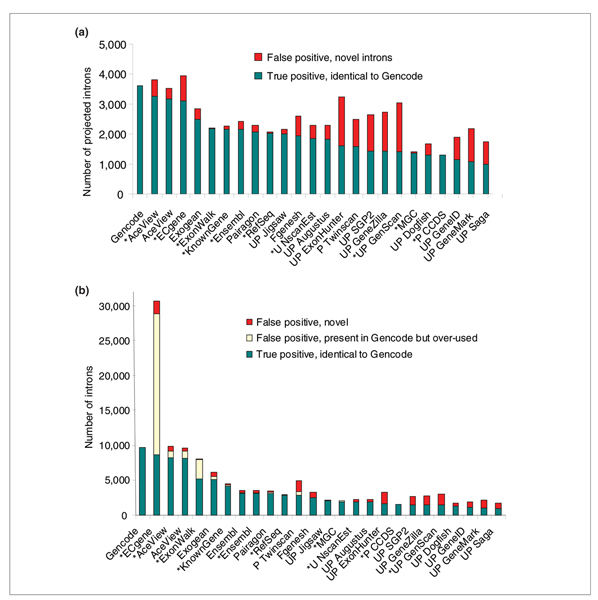
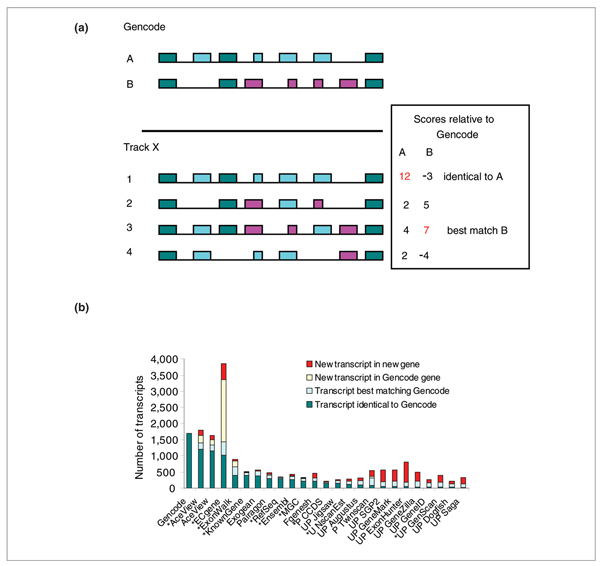
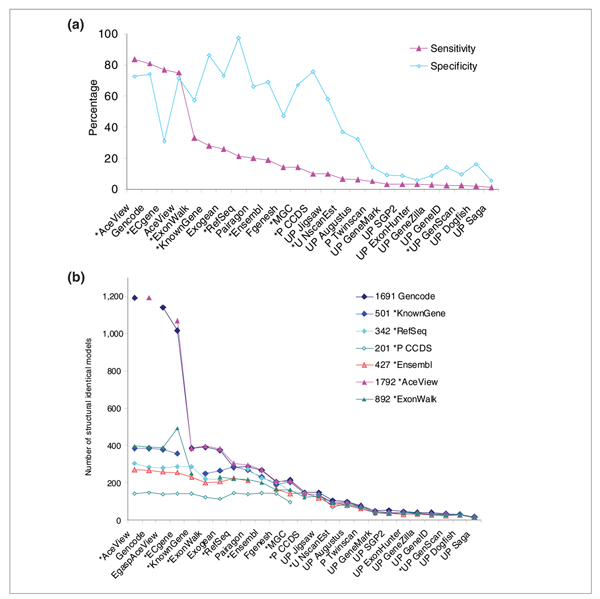
Background: Regions covering one percent of the genome, selected by ENCODE for extensive analysis, were annotated by the HAVANA/Gencode group with high quality transcripts, thus defining a benchmark. The ENCODE Genome Annotation Assessment Project (EGASP) competition aimed at reproducing Gencode and finding new genes. The organizers evaluated the protein predictions in depth. We present a complementary analysis of the mRNAs, including alternative transcript variants. Results: We evaluate 25 gene tracks from the University of California Santa Cruz (UCSC) genome browser. We either distinguish or collapse the alternative splice variants, and compare the genomic coordinates of exons, introns and nucleotides. Whole mRNA models, seen as chains of introns, are sorted to find the best matching pairs, and compared so that each mRNA is used only once. At the mRNA level, AceView is by far the closest to Gencode: the vast majority of transcripts of the two methods, including alternative variants, are identical. At the protein level, however, due to a lack of experimental data, our predictions differ: Gencode annotates proteins in only 41% of the mRNAs whereas AceView does so in virtually all. We describe the driving principles of AceView, and how, by performing hand-supervised automatic annotation, we solve the combinatorial splicing problem and summarize all of GenBank, dbEST and RefSeq into a genome-wide non-redundant but comprehensive cDNA-supported transcriptome. AceView accuracy is now validated by Gencode. Conclusion: Relative to a consensus mRNA catalog constructed from all evidence-based annotations, Gencode and AceView have 81% and 84% sensitivity, and 74% and 73% specificity, respectively. This close agreement validates a richer view of the human transcriptome, with three to five times more transcripts than in UCSC Known Genes (sensitivity 28%), RefSeq (sensitivity 21%) or Ensembl (sensitivity 19%).
Overview
The claims and statistics of this paper haven’t been checked yet.
Free: it reads the open-access text and checks the first 5 claims that cite a source we can check. Create a free account to check every claim.
Integrity signals
Registry
Cites
Statistics
Figures
Verification
Claims the paper makes
The claims and statistics of this paper haven’t been checked yet.
Free: it reads the open-access text and checks the first 5 claims that cite a source we can check. Create a free account to check every claim.
Claims other papers make about this one
Each is checked against this paper’s own text: does it say what the citing paper says it does?
The check wasn’t confident either way, so it gives no verdict — never disputed.
In the citing paper
“We also observed substantial but 12% lower agreement with TopHat2, regardless of whether it was run with or without gene model guided alignment 17 (Supplementary Figure 5a), giving a total of 1,110,550 junctions consistently found by all five analysis variants.”
From A comprehensive assessment of RNA-seq accuracy, reproducibility and information content by the Sequencing Quality Control Consortium (2014) · cites this paper as [17]
Experimental — accuracy not yet measured
Self-check
Percentages, sums and reported differences re-computed from the paper’s own numbers.
The self-check needs the paper’s full text.
Citations
Cites
Finishing the euchromatic sequence of the human genome
International Human Genome Sequencing Consortium (2004) · Nature · doi:10.1038/nature03001 · Cited by 4,971
The ENCODE (ENCyclopedia Of DNA Elements) Project
(2004) · Science · doi:10.1126/science.1105136 · Cited by 2,390 · cited 1×
“project [1], launched by the National Human Genome Research Institute, encourages a concentration of international efforts and expertise on 1% of the human genome, in 44 carefully selected regions taken as representative of the whole genome, in the hope that mature annotation techniques will be developed, validated, a…”
BackgroundThe UCSC Genome Browser Database: update 2006
Hinrichs, A. S. (2006) · Nucleic Acids Research · doi:10.1093/nar/gkj144 · Cited by 1,646 · cited 1×
“The UCSC genome browser [2] provides fast and open access to a highly configurable view of a wealth of sequence-based genome annotations.”
BackgroundFrom Birth to Death: The Complex Lives of Eukaryotic mRNAs
Moore, M. J. (2005) · Science · doi:10.1126/science.1111443 · Cited by 1,010 · cited 4×
“Indeed, activation of mRNA degradation by this pathway requires a pioneering round of translation that, due to the dual role of NMD proteins in activating translation, should be very efficient on transcripts still decorated with exon junction complexes (reviewed in [10,11]).”
BackgroundInfluentialComplete sequencing and characterization of 21,243 full-length human cDNAs
Ota, T., Suzuki, Y., Nishikawa, T., Otsuki, T., Sugiyama, T., Irie, R., Wakamatsu, A., Hayashi, K., Sato, H., Nagai, K., et al. (2004) · Nature Genetics · doi:10.1038/ng1285 · Cited by 925 · cited 1×
“Indeed, we compared the high quality full-length cDNA libraries made by Sugano using the oligo-capping method in either the nematode Caenorhabditis elegans or human (all sequences are in GenBank [7,9]).”
MethodPushing the limits of the scanning mechanism for initiation of translation
Kozak, M. (2002) · Gene · doi:10.1016/s0378-1119(02)01056-9 · Cited by 919 · cited 3×
“But it is difficult to conceive how the ribosomes would be aware of these rules, instead of following the scanning mechanism experimentally established by Kozak [14].”
BackgroundInfluentialMendell, J. T., Sharifi, N. A., Meyers, J. L., Martinez-Murillo, F., & Dietz, H. C. (2004) · Nature Genetics · doi:10.1038/ng1429 · Cited by 876
Kimura, K., Wakamatsu, A., Suzuki, Y., Ota, T., Nishikawa, T., Yamashita, R., Yamamoto, J.-I., Sekine, M., Tsuritani, K., Wakaguri, H., et al. (2006) · Genome Research · doi:10.1101/gr.4039406 · Cited by 506 · cited 1×
“…almost linearly with new cDNA sequences: the addition to GenBank in January 2006 of close to two million 5’ complete capped ESTs by the Japanese FLJ group [26] proportionately increased by 26% the number of alternative variants, and added 7% new spliced genes to the AceView collection [7].”
BackgroundKozak, M. (1989) · Molecular and Cellular Biology · doi:10.1128/mcb.9.11.5073 · Cited by 478 · cited 1×
“But if the mRNA appears to be complete, the CDS starts at the first AUG codon, unless there is, in the correct environment, an in frame NUG or ANG codon [14,17-20] at least 180 bp upstream of the first AUG.”
BackgroundEGASP: the human ENCODE Genome Annotation Assessment Project.
Guigó, R., Flicek, P., Abril, J. F., Reymond, A., Lagarde, J., Denœud, F., Antonarakis, S. E., Ashburner, M., Bajić, V. B., Birney, E., et al. (2006) · Genome biology · doi:10.1186/gb-2006-7-s1-s2 · Cited by 370
Cited by
Items 401–500 of 650
The Current Status of DNA Microarrays
Shi, L. M., Perkins, R., & Tong, W. (2009) · Springer eBooks · doi:10.1007/978-0-387-72719-6_1 · Cited by 11
Lee, J. C., Stiles, D., Lü, J., & Cam, M. C. (2007) · BMC Genomics · doi:10.1186/1471-2164-8-284 · Cited by 13
“It has been shown to offer a richer view of the transcriptome, with 3 to 5 times more high-quality transcript forms than UCSC known genes, RefSeq or Ensemble [14].”
BackgroundMethodThe effect of human genome annotation complexity on RNA-Seq gene expression quantification
Wu, P.-Y., Phan, J. H., & Wang, M. D. (2012) · IEEE International Conference on Bioinformatics and Biomedicine Workshops (BIBMW) · doi:10.1109/bibmw.2012.6470224 · Cited by 11
Discovery of NRG1-VII: the myeloid-derived class of NRG1
Berrocal-Rubio, M. Á., Prawer, Y. D. J., Dinevska, M., Paoli‐Iseppi, R. D., Widodo, S. S., Gleeson, J., Rajab, N., Nardo, W. D., Hallab, J., Li, A., et al. (2024) · BMC Genomics · doi:10.1186/s12864-024-10723-2 · Cited by 11
“It was previously reported that the highest NRG1 expression levels in human tissues was in blood plasma [41, 42].”
Polewko-Klim, A., Lesiński, W., Mnich, K., Piliszek, R., & Rudnicki, W. R. (2018) · Biology Direct · doi:10.1186/s13062-018-0222-9 · Cited by 10
“The RNA-seq data available for CAMDA challenge was preprocessed by the Magic-AceView pipeline (MAV), based on the Magic analysis tool [11] (https:// bit.ly/2K0jkwi), see Zhang et al. for details [4].”
MethodGuaita-Céspedes, M., Grillo-Risco, R., Hidalgo, M. R., Fernández‐Veledo, S., Burks, D. J., de la Iglesia-Vayá, M., Galán, A., & Garcia‐García, F. (2023) · Biology of Sex Differences · doi:10.1186/s13293-023-00506-x · Cited by 11
“html) [43] and primers (designed either by Primer3 or PrimerBlast) amplifying most represented sequence/s were chosen (Additional file 1).”
MethodNuclear CSPP1 expression defined subtypes of basal-like breast cancer
Sternemalm, J., Russnes, H. G., Zhao, X., Risberg, B. Å., Nord, S., Caldas, C., Børresen‐Dale, A., Stokke, T., & Patzke, S. (2014) · British Journal of Cancer · doi:10.1038/bjc.2014.297 · Cited by 12
Using mixtures of biological samples as process controls for RNA-sequencing experiments
Parsons, J., Munro, S. A., Pine, P. S., McDaniel, J., Mehaffey, M. G., & Salit, M. (2015) · BMC Genomics · doi:10.1186/s12864-015-1912-7 · Cited by 11
“Quantitation and Data Normalization: BLM gene counts were based on raw count data quantified using HTSeqCounts [40] based on a variety of genome and transcriptome references [42-45] after mapping reads to the genome with Topha t[46].”
MethodSimultaneous Identification of Causal Genes and Dys-Regulated Pathways in Complex Diseases
Kim, Y.-A., Wuchty, S., & Przytycka, T. M. (2010) · Lecture notes in computer science · doi:10.1007/978-3-642-12683-3_17 · Cited by 10
“Searching literature and manually examining our 25 genes in the common set using AceView [42] we found all but 6 genes, ATN1, PIGQ, C20orf108, RNASE2, TBL2 and UBN1 to be cancer-related, while one of the remaining four, ATN1, is related to brain diseases.”
MethodInvestigation of factors affecting RNA-seq gene expression calls
Harati, S., Phan, J. H., & Wang, M. D. (2014) · Annual International Conference of the IEEE Engineering in Medicine and Biology Society (EMBC) · doi:10.1109/embc.2014.6944805 · Cited by 10
“We used HTSeq to quantify gene expression as the number of reads that mapped to the exons of each gene in the AceView annotation [8, 10].”
Costa, V., Federico, A., Pollastro, C., Ziviello, C., Cataldi, S., Formisano, P., & Ciccodicola, A. (2016) · International Journal of Molecular Sciences · doi:10.3390/ijms17071008 · Cited by 11
“Our findings are in line with the gene predictions of AceView database and with ESTs. Notably, the former SNP (a 1 bp deletion) is located in an intron splicing enhancer region, and its presence is predicted to affect the binding of two different splicing factors.”
MethodInfluentialSimilarity and variation in the insulin-like growth factor 2 - H19 locus in primates
Rotwein, P. S. (2018) · Physiological Genomics · doi:10.1152/physiolgenomics.00030.2018 · Cited by 10
Trudić, B., Draškić, G., Provost, G. L., Stojnić, S., Pilipović, A., & Ivezić, A. (2021) · Silvae genetica/Silvae Genetica · doi:10.2478/sg-2021-0020 · Cited by 9
Contribution of CRNDE lncRNA in the development of cancer and the underlying mechanisms
Ghafouri‐Fard, S., Safarzadeh, A., Hussen, B. M., Taheri, M. N., & Mokhtari, M. (2023) · Pathology - Research and Practice · doi:10.1016/j.prp.2023.154387 · Cited by 9
Sanad, M. N. M. E., AL‐Huqail, A. A., Ibrahim, M. M., & Hauvermale, A. L. (2020) · Current Plant Biology · doi:10.1016/j.cpb.2020.100176 · Cited by 9
Diversification of CD1 Molecules Shapes Lipid Antigen Selectivity
Paterson, N. M., Al-Zubieri, H., & Barber, M. F. (2021) · Molecular Biology and Evolution · doi:10.1093/molbev/msab022 · Cited by 10
A Unique, Consistent Identifier for Alternatively Spliced Transcript Variants
Riva, A., & Pesole, G. (2009) · PLoS ONE · doi:10.1371/journal.pone.0007631 · Cited by 9
Holmes, R. S. (2012) · Open Access Bioinformatics · doi:10.2147/oab.s27508 · Cited by 9
“2 × the expression of the average human gene) and wide tissue expression observed for ATGL.(45) Elango and Yi(62) have recently reported that larger CpG islands are associated with gene promoters showing a broad range of gene expressions which contain more RNA polymerase II binding sites than other promoters.”
InfluentialPopulation-Based Resequencing of LIPG and ZNF202 Genes in Subjects with Extreme HDL Levels
Razzaghi, H., Santorico, S. A., & Kamboh, M. I. (2012) · Frontiers in Genetics · doi:10.3389/fgene.2012.00089 · Cited by 10
Pasluosta, C. F., Dua, P., & Lukiw, W. J. (2011) · Annual International Conference of the IEEE Engineering in Medicine and Biology Society (EMBC) · doi:10.1109/iembs.2011.6091344 · Cited by 10
Sun, F., & Handel, M. A. (2011) · Genes · doi:10.3390/genes2010021 · Cited by 9
“The remaining mRNA variants (unspliced) appear not to encode protein [28].”
CATCHprofiles: Clustering and Alignment Tool for ChIP Profiles
Nielsen, F. G. G., Markus, K. G., Friborg, R. M., Favrholdt, L. M., Stunnenberg, H. G., & Huynen, M. A. (2012) · PLoS ONE · doi:10.1371/journal.pone.0028272 · Cited by 9
“). We validated the positions of the profiles in the cluster to be enriched in promoters by comparing to annotation. Indeed, 81% of the profiles are within 1 kb of annotated Ensembl TSS. From the remaining 19% more than half (253/389) were within 1 kb of TSS predicted by Aceview”
BackgroundVickers, T. A., & Crooke, S. T. (2012) · Nucleic Acids Research · doi:10.1093/nar/gks239 · Cited by 9
“While there is no empirical evidence that the second signal is used, accessions with validated 30 ends have been identified for both the first and third signal (33).”
BackgroundGene Expression Analysis: Current Methods
Teo, Z. L., Savas, P. S., & Loi, S. (2016) · Springer eBooks · doi:10.1007/978-1-4939-6643-1_6 · Cited by 14
Fishing for a reelGene : evaluating gene models with evolution and machine learning
Schulz, A. J., Zhai, J., AuBuchon‐Elder, T., Andorf, C. M., El‐Walid, M. Z., Ferebee, T. H., Gilmore, E. H., Hufford, M. B., Johnson, L. C., Kellogg, E. A., et al. (2025) · The Plant Journal · doi:10.1111/tpj.70483 · Cited by 9
Fishing for a reelGene: evaluating gene models with evolution and machine learning
Schulz, A. J., Zhai, J., AuBuchon-Elder, T., El-Walid, M., Ferebee, T. H., Gilmore, E. H., Hufford, M. B., Johnson, L. C., Kellogg, E. A., La, T., et al. (2023) · doi:10.1101/2023.09.19.558246 · Cited by 9
Impact of Gene Annotation on RNA-seq Data Analysis
Zhao, S., & Zhang, B. (2016) · InTech eBooks · doi:10.5772/61197 · Cited by 9
“AceView provides a comprehensive non-redundant curated representation of all available human cDNA sequences.”
BackgroundInfluentialFernández, E. M., Cutraro, Y. B., Adams, J. M., Monteleone, M. C., Hughes, K. J., Frasch, A. C. C., Vidal-Gadea, A. G., & Brocco, M. A. (2021) · Journal of Neurochemistry · doi:10.1111/jnc.15543 · Cited by 11
Pruunsild, P., Bengtson, C. P., Loss, I., Lohrer, B., & Bading, H. (2023) · Journal of Biological Chemistry · doi:10.1016/j.jbc.2023.104671 · Cited by 10
“Sequences identical to human Lnc473 have been formerly categorized as protein-coding (termed C6orf176 in hg18) (36, 37).”
BackgroundNovel islands of GGC and GCC repeats coincide with human evolution
Tajeddin, N., Arabfard, M., Alizadeh, S., Salesi, M., Khamse, S., Delbari, A., & Ohadi, M. (2024) · Gene · doi:10.1016/j.gene.2024.148194 · Cited by 8
Saravanaperumal, S. A., Pediconi, D., Renieri, C., & Terza, A. L. (2012) · PLoS ONE · doi:10.1371/journal.pone.0038657 · Cited by 8
“. Alternative splicing pattern of the ovine SCF transcripts with human, mouse reference assembly were predicted using ACEVIEW”
MethodSales, G., Coppe, A., Bicciato, S., Bortoluzzi, S., & Romualdi, C. (2010) · Nucleic Acids Research · doi:10.1093/nar/gkp1239 · Cited by 9
“Target identification, moreover, was affected by alternative adenylation and multiple polyA sites in terminal exons (25,35).”
BackgroundThe impact of CD160 deficiency on alloreactive CD8 T cell responses and allograft rejection
del Rio, M., Nguyen, T. H., Tesson, L., Heslan, J., Gutiérrez‐Adán, A., Fernández‐González, R., Gutiérrez-Arroyo, J., Bühler, L. H., Pérez‐Simón, J. A., Anegón, I., et al. (2021) · Translational research · doi:10.1016/j.trsl.2021.08.006 · Cited by 9
Arabfard, M., Tajeddin, N., Alizadeh, S., Salesi, M., Bayat, H., Khorshid, H. R. K., Khamse, S., Delbari, A., & Ohadi, M. (2024) · BMC Genomic Data · doi:10.1186/s12863-024-01207-z · Cited by 8
“This information is supported by research available at the Assembly resource (https:// www. ncbi. nlm. nih. gov/ IEB/ Resea rch/ Acemb ly/), [29].”
MethodBioinformatic analysis of specific genes in diabetic nephropathy
Fu, F., Wei, X., Liu, J., & Mi, N. (2015) · Renal Failure · doi:10.3109/0886022x.2015.1061887 · Cited by 11
“According to AceView, ACTG-1 protein encoded by this gene are expected to have molecular functions (ATP binding, nucleotide binding) and localize in various compartments (cytoplasm, cytoskeleton, nucleus).(24) It is reported that ACTG-1 is expressed at very high level in DN and has been tested to be associated with va…”
MethodReid, S. J., Whittaker, D. J., Greenwood, D., & Snell, R. G. (2009) · Brain Research · doi:10.1016/j.brainres.2009.03.004 · Cited by 11
Kumbrink, J., Soni, S., Laumbacher, B., Loesch, B., & Kirsch, K. H. (2015) · Journal of Biological Chemistry · doi:10.1074/jbc.m115.649947 · Cited by 9
“Expressed sequence tags (ESTs) and cap analysis of gene expression (CAGE) tags for each variant were identified at AceView, Genomatix (ElDorado), and NCBI (BLAST, EST, and UniGene) databases.”
MethodAlternative splicing creates two new architectures for human tyrosyl-tRNA synthetase
Wei, Z., Xu, Z., Liu, X., Lo, W.-S., Ye, F., Lau, C.-F., Wang, F., Zhou, J. J., Nangle, L. A., Yang, X., et al. (2016) · Nucleic Acids Research · doi:10.1093/nar/gkw002 · Cited by 10
“To obtain a more complete sequence of the transcripts, PCR reactions were performed with a pair of primers targeting 5′ UTR/Exon1 and 3′-UTR/Exon13 of YARS (FP and RP1, Figure 1A).”
BackgroundInfluentialSelection on the regulation of sympathetic nervous activity in humans and chimpanzees
Lee, K. S., Chatterjee, P., Choi, E.-Y., Sung, M. K., Oh, J., Won, H., Park, S.-M., Kim, Y., Yi, S. V., & Choi, J. K. (2018) · PLoS Genetics · doi:10.1371/journal.pgen.1007311 · Cited by 8
Effect of data combination on predictive modeling: a study using gene expression data.
Osl, M., Dreiseitl, S., Kim, J., Patel, K., Baumgärtner, C., & Ohno-Machado, L. (2010) · PubMed Central · Cited by 9
Towards large-scale sample annotation in gene expression repositories
Pitzer, E., Lacson, R. C., Hinske, L. C., Kim, J.-H., Galante, P. A. F., & Lucila Ohno-machado, A. (2009) · BMC Bioinformatics · doi:10.1186/1471-2105-10-s9-s9 · Cited by 7
“All probes have been re-annotated to the AceView transcript database [22] and normalized using a modified version of quantile normalization [23] that has been adapted for very large datasets.”
MethodFAM171B is a novel polyglutamine protein widely expressed in the mammalian brain
Tran, Q., Sudasinghe, A. K., Jones, B., Xiong, K., Cohen, R. E., Sharlin, D. S., Hartert, K. T., & Goellner, G. M. (2021) · Brain Research · doi:10.1016/j.brainres.2021.147540 · Cited by 7
Kulichová, K., Pieters, J., Kumar, V., Honys, D., & Hafidh, S. (2022) · Frontiers in Plant Science · doi:10.3389/fpls.2022.767339 · Cited by 7
“The AKRP-coding sequence contains a + 31-1,110-bp nonsense-mediated decay target sequence (Thierry-Mieg and Thierry-Mieg, 2006); therefore, its strong expression by the 35S promoter could likely induce silencing.”
BackgroundExpression of CAP2 during early Xenopus embryogenesis
Wolanski, M., KhosrowShahian, F., Jerant, L., Jap, I.-S., Brockman, J. L., & Crawford, M. J. (2009) · The International Journal of Developmental Biology · doi:10.1387/ijdb.062158mw · Cited by 7
Berkowitz, K. M., Kaestner, K. H., & Jongens, T. A. (2008) · Molecular Human Reproduction · doi:10.1093/molehr/gan005 · Cited by 7
“The 4 kb transcript present in human tissues may arise from differences in the untranslated regions of the gene or by alternative splicing as suggested by human EST databases (Thierry-Mieg and Thierry-Mieg, 2006).”
BackgroundGFOD1 and peejar are promising markers for clear-cell renal cell carcinoma disease progression
Wu, X., Chen, Y., Chen, W., Kong, W., Huang, J., Zhang, J., Xue, W., Liu, D., & Huang, Y. (2016) · Oncotarget · doi:10.18632/oncotarget.9379 · Cited by 7
“They are corresponding to GFOD1 and peejar respectively, after align probe sequences of those two probesets to Aceview database [17] (Supplementary File S1).”
BackgroundMethodManley, W., Moreau, M., Azaro, M. A., Siecinski, S. K., Davis, G., Buyske, S. G., Vieland, V. J., Bassett, A. S., & Brzustowicz, L. M. (2018) · PLoS ONE · doi:10.1371/journal.pone.0194233 · Cited by 8
Diez‐Hermano, S., Mejias, A., Sánchez, D., Gutiérrez, G., & Ganfornina, M. D. (2020) · PLoS ONE · doi:10.1371/journal.pone.0234857 · Cited by 8
“Mammalian ApoD 5’ UTR sequences were obtained from the AceView database [26].”
MethodAraújo, A. N., Moraes, L. D. S., França, M. I. C., Hakonarson, H. H., Li, J., Pellegrino, R., Maciel, R. M. B., & Cerutti, J. M. (2014) · The Journal of Clinical Endocrinology & Metabolism · doi:10.1210/jc.2013-2993 · Cited by 9
“The deletion of this gene has previously been associated with psoriasis (27–29), with a possible role in the process of keratinization (30).”
BackgroundOnline Resources for Genomic Analysis Using High-Throughput Sequencing
Blankenberg, D. J., Taylor, J., & Nekrutenko, A. (2015) · Cold Spring Harbor Protocols · doi:10.1101/pdb.top083667 · Cited by 9
“2005), AceView (Thierry-Mieg and Thierry-Mieg 2006), Ensembl (Flicek et al.”
BackgroundLi, M., Pan, X., Zeng, T., Zhang, Y., Feng, K., Chen, L., Huang, T., & Cai, Y. (2020) · BioMed Research International · doi:10.1155/2020/6384120 · Cited by 7
Ojosnegros, S., Álvarez, J. M., Grossmann, J., Gagliardini, V., Quintanilla, L. G., Grossniklaus, U., & Fernández, H. (2022) · International Journal of Molecular Sciences · doi:10.3390/ijms232214027 · Cited by 6
“First, the interactions among ACT7 with VLN2 and PRF5, important for actin filament bundling and the organization of the actin cytoskeleton, and also among OVA4, OVA 9, and EMB276, which are t-RNA ligases involved in translation and associated with reproduction [41,94].”
BackgroundBrinzer, R. A., Winter, A. D., & Page, A. P. (2024) · G3 Genes Genomes Genetics · doi:10.1093/g3journal/jkae009 · Cited by 9
“2017) and AceView (Thierry-Mieg and Thierry-Mieg 2006) databases.”
Osteoclast microRNA Profiling in Rheumatoid Arthritis to Capture the Erosive Factor
Nguyen, H. D., Lortie, A., Nguimbus, L. M., Marrugo, J., Allard‐Chamard, H., Bouchard, L., Boire, G., Scott, M. S., & Roux, S. (2023) · JBMR Plus · doi:10.1002/jbm4.10776 · Cited by 8
“7) Menopause % F 12/15 16/19 13/14 Smoking 12 no, 2 active, 15 past 11 no, 3 active, 10 past 8 no, 8 active, 11 past Alcohol 7 no, 18 active, 3 past 5 no, 12 active, 8 past 4 no, 10 active, 12 past Serum 25-OH vitamin D nmol/L mean (SD) 87 (27) 91 (26) 83 (29)”
MethodGenetic variation of the whole ICAM4 gene in C aucasians and A frican A mericans
Srivastava, K., Almarry, N. S., & Flegel, W. A. (2014) · Transfusion · doi:10.1111/trf.12615 · Cited by 6
Bashir, S., Tariq, M., Aslam, H. M., Hashmi, A. S. M., Malik, B., Amin, A., & mumtaz, S. (2015) · Journal of Medical Case Reports · doi:10.1186/s13256-015-0561-4 · Cited by 6
“The association of PDGFB gene with the orbital neoplasm has been reported [22].”
Xu, H., Tao, X., Wei, Y., Chen, J., Xing, S., Cen, W., Wen, A., Zhu, L., Tang, G., Li, M., et al. (2014) · Gene · doi:10.1016/j.gene.2014.12.017 · Cited by 6
Mittal, V. K., & McDonald, J. F. (2012) · Nucleic Acids Research · doi:10.1093/nar/gks047 · Cited by 6
An Overview of Synergistic Data Tools for Biological Scrutiny
Olender, T., Safran, M., Edgar, R., Stelzer, G., Nativ, N., Rosen, N., Shtrichman, R., Mazor, Y., West, M. D., Keydar, I., et al. (2013) · Israel Journal of Chemistry · doi:10.1002/ijch.201200094 · Cited by 7
A SNP uncoupling Mina expression from the TGFβ signaling pathway
Lian, S. L., Mihi, B., Koyanagi, M., Nakayama, T., & Bix, M. (2017) · Immunity Inflammation and Disease · doi:10.1002/iid3.191 · Cited by 6
“Six distinctMina transcripts are documented in AceView, one of them un-spliced and non-coding [24].”
BackgroundClinical importance of the EMSY gene expression and polymorphisms in ovarian cancer
Dansonka‐Mieszkowska, A., Szafron, L. M., Moes-Sosnowska, J., Kulińczak, M., Balcerak, A., Konopka, B., Kulesza, M., Budziłowska, A., Łukasik, M., Piekarska, U., et al. (2018) · Oncotarget · doi:10.18632/oncotarget.24878 · Cited by 6
“In step with this assumption, there are as many as 23 different mRNAs in the AceView database which have been reported as splice variants of the human EMSY gene [48].”
BackgroundHolmes, R. S. (2017) · Computational Biology and Chemistry · doi:10.1016/j.compbiolchem.2017.02.009 · Cited by 6
Kolb, M., Kurz, S., Schäfer, A., Huse, K., Dietz, A., Wichmann, G., & Birkenmeier, G. (2017) · PLoS ONE · doi:10.1371/journal.pone.0180354 · Cited by 6
Support for a bipolar affective disorder susceptibility locus on chromosome 12q24.3
Buttenschøn, H. N., Foldager, L., Flint, T. J., Olsen, I. M. L., Deleuran, T., Nyegaard, M., Hansen, M. M., Kallunki, P., Christensen, K. V., Blackwood, D., et al. (2010) · Psychiatric Genetics · doi:10.1097/ypg.0b013e32833a2066 · Cited by 7
“For each new release, the models are improved by incorporating the latest cDNA data, and AceView seems to provide one of the most comprehensive and accurate representations of the entire human transcriptome (Thierry-Mieg and Thierry-Mieg, 2006).”
MethodOpossum alcohol dehydrogenases: Sequences, structures, phylogeny and evolution
Holmes, R. S. (2008) · Chemico-Biological Interactions · doi:10.1016/j.cbi.2008.09.009 · Cited by 7
HPNS seizure risk: a role for the Golgi-associated retrograde protein complex?
McCall, R. D. (2011) · PubMed · Cited by 5
Song, Y., Wu, G., Zhang, M., Kong, Q., Du, J., Zheng, Y., Yue, L.-T., & Cao, L. (2017) · Oncology Letters · doi:10.3892/ol.2017.5924 · Cited by 5
ASPicDB: A Database Web Tool for Alternative Splicing Analysis
D’Antonio, M., Castrgnanò, T., Pallocca, M., D’Erchia, A. M., Picardi, E., & Pesole, G. (2014) · Methods in molecular biology · doi:10.1007/978-1-4939-2291-8_23 · Cited by 5
Mannosyl (Alpha-1,3-)- Glycoprotein Beta-1,2-N-Acetylglucosaminyltransferase (MGAT1)
Stanley, P. (2014) · Springer eBooks · doi:10.1007/978-4-431-54240-7_129 · Cited by 8
Investigating the role of LSD2 as an epigenetic regulator in Ewing sarcoma
Patel, P. O., Pishas, K. I., Taslim, C., Selich‐Anderson, J., Theisen, E. R., & Lessnick, S. L. (2019) · Oncotarget · doi:10.18632/oncotarget.26988 · Cited by 5
Baskys, A. (2014) · Journal of Alzheimer s Disease · doi:10.3233/jad-140003 · Cited by 5
“PHLDB2 is expressed in the digestive system (liver) and nervous system (basal nuclei, caudate nucleus) as well as in blood/ hematopoietic tissues [48].”
Pinheiro, A., Silva, M. J., Pavlú-Pereira, H., Florindo, C., Barroso, M., Marques, B., Correia, H., Oliveira, A., Gaspar, A. M. C., de Almeida, I. T., et al. (2016) · Gene · doi:10.1016/j.gene.2016.06.041 · Cited by 5
C. elegans MAGU-2/Mpp5 homolog regulates epidermal phagocytosis and synapse density
Cherra, S., Goncharov, A., Boassa, D., Ellisman, M., & Jin, Y.-S. (2020) · Journal of neurogenetics · doi:10.1080/01677063.2020.1726915 · Cited by 6
“…the synapse number of cholinergic motor neurons To determine where MAGU-2 functions to modulate synaptic connectivity, we first investigated the magu-2 gene structure to identify its promoter based on the information from AceView and Wormbase (Lee et al., 2018; Thierry-Mieg & Thierry-Mieg, 2006).”
BackgroundPatterns of molar agenesis associated with p.P20L and p.R77Q variants in PAX9
Intarak, N., Theerapanon, T., Porntaveetus, T., & Shotelersuk, V. (2022) · European Journal Of Oral Sciences · doi:10.1111/eos.12855 · Cited by 5
Kaspi, A., Ziemann, M., Rafehi, H., Lazarus, R. M., & El‐Osta, A. (2012) · Biochimie · doi:10.1016/j.biochi.2012.06.002 · Cited by 5
Horse carboxylesterases: Evidence for six CES1 and four families of CES genes on chromosome 3
Holmes, R. S., Cox, L. A., & VandeBerg, J. L. (2008) · Comparative Biochemistry and Physiology Part D Genomics and Proteomics · doi:10.1016/j.cbd.2008.10.004 · Cited by 5
“In contrast with CES1 and CES2 genes, mammalian CES5 is predominantly expressed in peripheral tissues, including brain, kidney, lung and testis (Thierry-Mieg and Thierry-Mieg, 2006), and is a secreted form of CES enzyme due to the absence of the microsomal targeting sequence found at the…”
BackgroundAtlas of the Open Reading Frames in Human Diseases: Dark Matter of the Human Genome
Narayanan, R. (2015) · MOJ Proteomics & Bioinformatics · doi:10.15406/mojpb.2015.02.00036 · Cited by 4
Holmes, R. S. (2013) · Journal of Phylogenetics & Evolutionary Biology · doi:10.4172/2329-9002.1000112 · Cited by 4
“gov/IEB/Research/Acembly/ [28]; shown with capped 5’- and 3’- ends for the two isoform mRNA sequences, in each case; NM refers to the NCBI reference sequence; exons are in pink; the direction for transcription is shown as 5’ 3’; numbers within the human intron sequences refer to bps.”
BackgroundMethodInfluentialAguilera, P. M., Debat, H., Castrillo, M. L., Bich, G. Á., & Grabiele, M. (2023) · Rodriguésia · doi:10.1590/2175-7860202374020 · Cited by 4
“…AT3G47650:11E128, AT4G13830:13C59, AT5G43260:18E139 and AT5G02160:39E124, also showed high expression levels, while AT1G56300:3C17 and AT3G14200:3C48 are well expressed ABS genes, compared to moderately and low expressed DNAJs in this model species (Thierry-Mieg & Thierry-Mieg 2006; Kilian et al .”
BackgroundNewman, J. R. B., Long, S. A., Speake, C., Greenbaum, C. J., Cerosaletti, K. M., Rich, S. S., Önengüt-Gümüşcü, S., McIntyre, L. M., Buckner, J. H., & CONCANNON, P. J. (2023) · Communications Biology · doi:10.1038/s42003-023-05327-7 · Cited by 4
“%) and/or a stop codon in all three reading frames 46 .”
Saadh, M. J., Menon, S. V., Verma, R., Prasad, G. V. S., Allela, O. Q. B., Mahdi, M. S., Ahmad, N., & Husseen, B. (2024) · Pathology - Research and Practice · doi:10.1016/j.prp.2024.155778 · Cited by 5
Datler, C., & Grimm, S. (2013) · Biochimica et Biophysica Acta (BBA) - Molecular Cell Research · doi:10.1016/j.bbamcr.2013.07.006 · Cited by 4
Functional Annotation of Caenorhabditis elegans Genes by Analysis of Gene Co-Expression Networks
Liu, W., Li, L., He, Y., Cai, S., Zhao, W., Zheng, H., Zhong, Y., Wang, S., Zou, Y., Xu, Z., et al. (2018) · Biomolecules · doi:10.3390/biom8030070 · Cited by 5
“The module hub genes include collagen, unfolded protein response activated protein, and protease inhibitor, which may play roles in the cuticle structure [24].”
BackgroundCan zebrafish be a valid model to study Paget's disease of bone?
Silva, I. A. L., Conceição, N., Michou, L., & Cancela, M. L. (2014) · Journal of Applied Ichthyology · doi:10.1111/jai.12523 · Cited by 5
Analysis Considerations for Utilizing RNA-Seq to Characterize the Brain Transcriptome
ZHENG, C. L., Kawane, S., Bottomly, D., & Wilmot, B. (2014) · International review of neurobiology · doi:10.1016/b978-0-12-801105-8.00002-3 · Cited by 4
Tekin, A., Ceulaer, G. D., Govaerts, P., Bayazit, Y. A., Wuyts, W. A., de Heyning, P. V., & Topsakal, V. (2020) · Audiology and Neurotology · doi:10.1159/000508434 · Cited by 4
“Such a variety of isoforms encoded by a single gene may be explained by the presence of 6 accepted alternative promoters [Thierry-Mieg and Thierry-Mieg, 2006].”
BackgroundHolmes, R. S., & Cox, L. A. (2012) · 3 Biotech · doi:10.1007/s13205-012-0087-z · Cited by 4
“html?human) to examine predicted gene and protein structures (Thierry-Mieg and Thierry-Mieg 2006).”
InfluentialFinding Protein-Coding Genes through Human Polymorphisms
Wijaya, E., Frith, M. C., Horton, P., & Asai, K. (2013) · PLoS ONE · doi:10.1371/journal.pone.0054210 · Cited by 5
A Hemizygous Deletion Within the PGK1 Gene in Males with PGK1 Deficiency
Behlmann, A., Goyal, N., Yang, X., Chen, P. H., & Ankala, A. (2018) · JIMD Reports · doi:10.1007/8904_2018_147 · Cited by 4
“This deletion encompasses the terminal portion of the 30UTR and includes the poly-A signal sequence (ATTAAA) of the gene (Thierry-Mieg and Thierry-Mieg 2006).”
BackgroundAlizadeh, S., Khamse, S., Bernhart, S. H., Vahedi, M., Afshar, H., Rezaei, O., Delbari, A., & Ohadi, M. (2022) · Research Square · doi:10.21203/rs.3.rs-2144796/v1 · Cited by 4
Koç, B., Fucile, G., Schmucki, R., Giroud, N., Bergauer, T., & Hall, B. J. (2021) · Frontiers in Molecular Neuroscience · doi:10.3389/fnmol.2021.624881 · Cited by 3
The uniqueness of ABCB5 as a full transporter ABCB5FL and a half-transporter-like ABCB5β
Gerard, L., & Gillet, J. (2024) · Cancer Drug Resistance · doi:10.20517/cdr.2024.56 · Cited by 7
Spatial metabolomics reveal mechanisms of dexamethasone against pediatric pneumonia
Huang, Z., Chen, K., Xuexin, Y., Cui, H., Wu, Y., Wang, Y., Xia, X., Sun, H., Xie, W. C., Li, H., et al. (2023) · Journal of Pharmaceutical and Biomedical Analysis · doi:10.1016/j.jpba.2023.115369 · Cited by 3
A novel transcript for DNA repair gene Ercc1 in mouse skin
Song, L., Winter, A. G., Selfridge, J., & Melton, D. W. (2010) · Transgenic Research · doi:10.1007/s11248-010-9396-3 · Cited by 5
“Two mouse Ercc1 transcripts containing a similar extended exon 1 to that we identified in the 1.5 kb skin-specific transcript have been reported ( Thierry-Mieg and Thierry-Mieg 2006 ).”
BackgroundInfluentialOligophrenin-1 (Ophn1) is expressed in mouse retinal vessels
Sel, S., Kaiser, M., Naß, N., Trau, S., Roepke, A., Storsberg, J., Hampel, U., Paulsen, F. P., & Kalinski, T. (2011) · Gene Expression Patterns · doi:10.1016/j.gep.2011.11.003 · Cited by 3
“However, these additional protein bands are in accordance with the different splice variants of the mRNA (Thierry-Mieg and Thierry-Mieg, 2006; Xiao et al., 2004).”
BackgroundVerifying expressed transcript variants by detecting and assembling stretches of consecutive exons
Hsiao, T.-H., Lin, C.-H., Lee, T.-T., Cheng, J.-Y., Wei, P., Chuang, E. Y.-Y., & Peck, K. (2010) · Nucleic Acids Research · doi:10.1093/nar/gkq754 · Cited by 4
The impact of RNA-seq alignment pipeline on detection of differentially expressed genes
Yang, C., Wu, P.-Y., Phan, J. H., & Wang, M. D. (2014) · IEEE Global Conference on Signal and Information Processing · doi:10.1109/globalsip.2014.7032351 · Cited by 3
Holmes, R. S. (2009) · Biochemical Genetics · doi:10.1007/s10528-009-9245-3 · Cited by 3
“Further ALDH subunit multiplicity is also generated by allelic variation of ALDH genes (Holmes 1978; Harada et al. 1980; Timms and Holmes 1981) or by differential splicing events during ADH mRNA transcription (Thierry-Mieg and Thierry-Mieg 2006).”
BackgroundSafra, N., Hayward, L. J., Aguilar, M., Sacks, B. N., Westropp, J. L., Mohr, F. C., Mellersh, C. S., & Bannasch, D. L. (2015) · PLoS ONE · doi:10.1371/journal.pone.0133127 · Cited by 3
“phenotype, and Cox-2 has been tested for associations with over 60 disorders with more than 1000 articles citing this gene in PubMed [3].”
BackgroundMapping of Affymetrix probe sets to groups of transcripts using transcriptional networksPreprint
Bellis, M. (2012) · arXiv (Cornell University) · doi:10.48550/arxiv.1201.2033 · Cited by 3
“y) is intended to recover and to organize all the probe set information by interrogation of Ensembl (http://www.ensembl.org/index.html) and AceView (http://www.ncbi.nlm.nih.gov/IEB/Research/Acembly/, Thierry-Mieg and Thierry-Mieg, 2006) databases. Another developed in Matlab (PSAWNml) allows to find which probe sets t…”
Method
Metadata
- Authors
- Thierry-Mieg, D., & Thierry-Mieg, J.
- Venue
- Genome Biology
- Published
- 2006-08-07
- Volume
- 7
- Issue
- S1
- Pages
- S12.1-14
- ISSN
- 1465-6906 (ISSN-L)
- 1474-760X
- PMC
- PMC1810549
- OpenAlex
- W2095907724
- Semantic Scholar
- 4337ea68f0395c054a12a88f1927f1ad98176606
- Cited by
- 629
- References
- 23
- Citations by year
- 2025: 10 · 2024: 22 · 2023: 21 · 2022: 22 · 2021: 26 · 2020: 23 · 2019: 15 · 2018: 21 · 2017: 45 · 2016: 39 · 2015: 40 · 2014: 58 · 2013: 47 · 2012: 57
- FWCI
- 12.36
- Type
- journal article
- Language
- en
- Open access
- gold
- doi.org
- Licence
- cc-by
- creativecommons.org/licenses/by/2.0/ (tdm)
- creativecommons.org/licenses/by/2.0/ (vor)
- Locations
- Genome biology (publishedVersion, cc-by)
- PubMed Central (publishedVersion, cc-by)
- PubMed (publishedVersion)
- Funders
- National Institutes of Health
- U.S. National Library of Medicine
- Topics
- Life Sciences › Biochemistry, Genetics and Molecular Biology › Molecular Biology › Genomics and Phylogenetic Studies
- Life Sciences › Biochemistry, Genetics and Molecular Biology › Molecular Biology › RNA Research and Splicing
- Life Sciences › Biochemistry, Genetics and Molecular Biology › Molecular Biology › Genomics and Chromatin Dynamics
- Keywords
- genome annotation, transcript annotation, alternative splicing, human transcriptome, ENCODE, GENCODE, UCSC Genome Browser, exon-intron structure
- MeSH terms
- Exons, Genes, Humans, Introns, Models, Genetic, Nucleotides, RNA, Messenger, Software, Sequence Analysis, DNA, Sequence Analysis, RNA, DNA, Complementary, Computational Biology, Sequence Analysis, Protein, Genomics
About these checks
Registry, retraction, Cites and statistics results are computed, not judged, with one exception: a printed reference that no index lists is read once by a model before it counts as a citation error. Claims are extracted by a model and kept only when their quote appears verbatim in the text; each cited source is then checked, with a model’s help, for whether it says what the claim relies on. Those verdicts can be wrong — read the claim’s quote and the cited source before relying on one.
Statistics and arithmetic are recomputed, not judged.
Confidence bands are shown only for fields calibrated on our annotated test set. None is calibrated yet, so no band is shown.
What counts as a claim ›How we measure confidence ›How we check this ›
Are you an author, or do you see a problem with this page? Request a review
Data sources
Bibliographic data: Semantic Scholar, OpenAlex, Crossref.
Contains information from the Semantic Scholar Academic Graph Datasets, made available under the ODC Attribution License (ODC-BY 1.0).
Semantic Scholar’s data is described in: Kinney, R., et al. (2023). The Semantic Scholar Open Data Platform. arXiv:2301.10140.
