

AceView: a comprehensive cDNA-supported gene and transcripts annotation
Open accessThe DOI matches its Crossref record; 23 of the 23 references it cites were found in a registry or an index.
Abstract
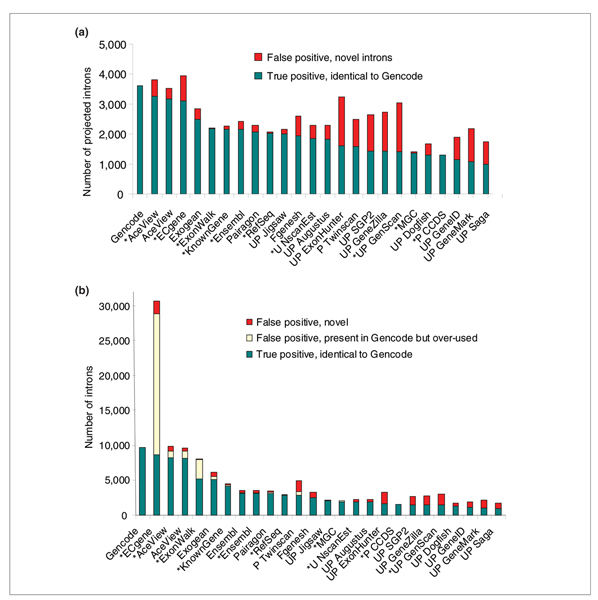
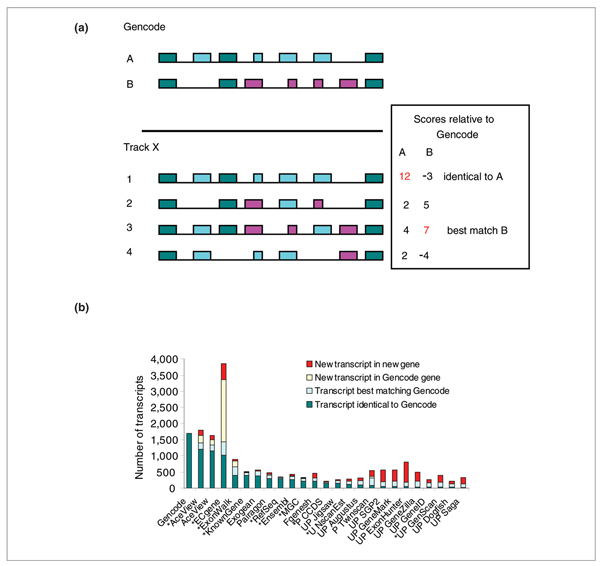
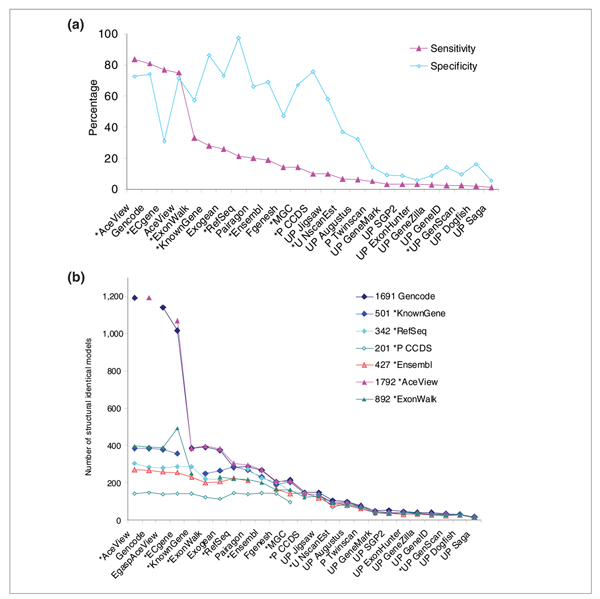
Background: Regions covering one percent of the genome, selected by ENCODE for extensive analysis, were annotated by the HAVANA/Gencode group with high quality transcripts, thus defining a benchmark. The ENCODE Genome Annotation Assessment Project (EGASP) competition aimed at reproducing Gencode and finding new genes. The organizers evaluated the protein predictions in depth. We present a complementary analysis of the mRNAs, including alternative transcript variants. Results: We evaluate 25 gene tracks from the University of California Santa Cruz (UCSC) genome browser. We either distinguish or collapse the alternative splice variants, and compare the genomic coordinates of exons, introns and nucleotides. Whole mRNA models, seen as chains of introns, are sorted to find the best matching pairs, and compared so that each mRNA is used only once. At the mRNA level, AceView is by far the closest to Gencode: the vast majority of transcripts of the two methods, including alternative variants, are identical. At the protein level, however, due to a lack of experimental data, our predictions differ: Gencode annotates proteins in only 41% of the mRNAs whereas AceView does so in virtually all. We describe the driving principles of AceView, and how, by performing hand-supervised automatic annotation, we solve the combinatorial splicing problem and summarize all of GenBank, dbEST and RefSeq into a genome-wide non-redundant but comprehensive cDNA-supported transcriptome. AceView accuracy is now validated by Gencode. Conclusion: Relative to a consensus mRNA catalog constructed from all evidence-based annotations, Gencode and AceView have 81% and 84% sensitivity, and 74% and 73% specificity, respectively. This close agreement validates a richer view of the human transcriptome, with three to five times more transcripts than in UCSC Known Genes (sensitivity 28%), RefSeq (sensitivity 21%) or Ensembl (sensitivity 19%).
Overview
The claims and statistics of this paper haven’t been checked yet.
Free: it reads the open-access text and checks the first 5 claims that cite a source we can check. Create a free account to check every claim.
Integrity signals
Registry
Cites
Statistics
Figures
Verification
Claims the paper makes
The claims and statistics of this paper haven’t been checked yet.
Free: it reads the open-access text and checks the first 5 claims that cite a source we can check. Create a free account to check every claim.
Claims other papers make about this one
Each is checked against this paper’s own text: does it say what the citing paper says it does?
The check wasn’t confident either way, so it gives no verdict — never disputed.
In the citing paper
“We also observed substantial but 12% lower agreement with TopHat2, regardless of whether it was run with or without gene model guided alignment 17 (Supplementary Figure 5a), giving a total of 1,110,550 junctions consistently found by all five analysis variants.”
From A comprehensive assessment of RNA-seq accuracy, reproducibility and information content by the Sequencing Quality Control Consortium (2014) · cites this paper as [17]
Experimental — accuracy not yet measured
Self-check
Percentages, sums and reported differences re-computed from the paper’s own numbers.
The self-check needs the paper’s full text.
Citations
Cites
Finishing the euchromatic sequence of the human genome
International Human Genome Sequencing Consortium (2004) · Nature · doi:10.1038/nature03001 · Cited by 4,971
The ENCODE (ENCyclopedia Of DNA Elements) Project
(2004) · Science · doi:10.1126/science.1105136 · Cited by 2,390 · cited 1×
“project [1], launched by the National Human Genome Research Institute, encourages a concentration of international efforts and expertise on 1% of the human genome, in 44 carefully selected regions taken as representative of the whole genome, in the hope that mature annotation techniques will be developed, validated, a…”
BackgroundThe UCSC Genome Browser Database: update 2006
Hinrichs, A. S. (2006) · Nucleic Acids Research · doi:10.1093/nar/gkj144 · Cited by 1,646 · cited 1×
“The UCSC genome browser [2] provides fast and open access to a highly configurable view of a wealth of sequence-based genome annotations.”
BackgroundFrom Birth to Death: The Complex Lives of Eukaryotic mRNAs
Moore, M. J. (2005) · Science · doi:10.1126/science.1111443 · Cited by 1,010 · cited 4×
“Indeed, activation of mRNA degradation by this pathway requires a pioneering round of translation that, due to the dual role of NMD proteins in activating translation, should be very efficient on transcripts still decorated with exon junction complexes (reviewed in [10,11]).”
BackgroundInfluentialComplete sequencing and characterization of 21,243 full-length human cDNAs
Ota, T., Suzuki, Y., Nishikawa, T., Otsuki, T., Sugiyama, T., Irie, R., Wakamatsu, A., Hayashi, K., Sato, H., Nagai, K., et al. (2004) · Nature Genetics · doi:10.1038/ng1285 · Cited by 925 · cited 1×
“Indeed, we compared the high quality full-length cDNA libraries made by Sugano using the oligo-capping method in either the nematode Caenorhabditis elegans or human (all sequences are in GenBank [7,9]).”
MethodPushing the limits of the scanning mechanism for initiation of translation
Kozak, M. (2002) · Gene · doi:10.1016/s0378-1119(02)01056-9 · Cited by 919 · cited 3×
“But it is difficult to conceive how the ribosomes would be aware of these rules, instead of following the scanning mechanism experimentally established by Kozak [14].”
BackgroundInfluentialMendell, J. T., Sharifi, N. A., Meyers, J. L., Martinez-Murillo, F., & Dietz, H. C. (2004) · Nature Genetics · doi:10.1038/ng1429 · Cited by 876
Kimura, K., Wakamatsu, A., Suzuki, Y., Ota, T., Nishikawa, T., Yamashita, R., Yamamoto, J.-I., Sekine, M., Tsuritani, K., Wakaguri, H., et al. (2006) · Genome Research · doi:10.1101/gr.4039406 · Cited by 506 · cited 1×
“…almost linearly with new cDNA sequences: the addition to GenBank in January 2006 of close to two million 5’ complete capped ESTs by the Japanese FLJ group [26] proportionately increased by 26% the number of alternative variants, and added 7% new spliced genes to the AceView collection [7].”
BackgroundKozak, M. (1989) · Molecular and Cellular Biology · doi:10.1128/mcb.9.11.5073 · Cited by 478 · cited 1×
“But if the mRNA appears to be complete, the CDS starts at the first AUG codon, unless there is, in the correct environment, an in frame NUG or ANG codon [14,17-20] at least 180 bp upstream of the first AUG.”
BackgroundEGASP: the human ENCODE Genome Annotation Assessment Project.
Guigó, R., Flicek, P., Abril, J. F., Reymond, A., Lagarde, J., Denœud, F., Antonarakis, S. E., Ashburner, M., Bajić, V. B., Birney, E., et al. (2006) · Genome biology · doi:10.1186/gb-2006-7-s1-s2 · Cited by 370
Cited by
Items 601–650 of 650
The first glimpse of Homo sapiens hereditary fusion genesPreprint
Zhuo, D. (2022) · bioRxiv (Cold Spring Harbor Laboratory) · doi:10.1101/2022.05.06.490969 · Cited by 1
The complete mitogenome of Paratanakia chii (Cypriniformes; Cyprinidae)
Zhang, H., Zhao, D., Hu, C., Duan, W., Chu, H., & Chu, Z. (2023) · Mitochondrial DNA Part B · doi:10.1080/23802359.2023.2171692
“2016), Tanakia himantegus (Cheng and Tao 2016), Rhodeus lighti (Thierry-Mieg and Thierry-Mieg 2006), Rhodeus sinensis (Zhu et al.”
BackgroundMethodInfluentialVariants in FREM1 and trisomy 18 identified in a neonatal progeria patient
Siddiqi, S., Ain, N. U., Kauser, M., Mukhtar, Z., Ansar, M., & Umair, M. (2023) · Molecular Biology Reports · doi:10.1007/s11033-023-08595-y
“Alternatively, spliced transcript variants encoding eight different isoforms have been described [12].”
BackgroundLockridge, O., Quinn, D. M., & Radić, Z. (2023) · Elsevier eBooks · doi:10.1016/b978-0-323-95488-4.00001-2
Duan, W., Zhao, B., Gong, Y., Jiang, L., Hu, C., & Chu, Z. (2024) · Mitochondrial DNA Part B · doi:10.1080/23802359.2024.2333556
“For each species, we extracted the 13 PCGs and concatenated them into one sequence (Thierry-Mieg and Thierry-Mieg 2006) (Figure 2).”
MethodThe human SMAD9 (GCC) repeat links to natural selection and late-onset neurocognitive disorders
Alizadeh, S., Khamse, S., Vafadar, S., Bernhart, S. H., Afshar, H., Vahedi, M., Rezaei, O., Delbari, A., & Ohadi, M. (2024) · Neurological Sciences · doi:10.1007/s10072-024-07637-y
“SMAD9 is predominantly expressed in the brain tissues [19], and the protein encoded by this gene can translocate into the nucleus and affect the transcriptional regulation of target genes.”
Adaptive Evolution and Functional Differentiation of Testis-Expressed Genes in Theria
Katsura, Y., Shigenobu, S., & Satta, Y. (2024) · Animals · doi:10.3390/ani14162316
“While the marsupial SERPINA10 is expressed in testes, the human and chicken genes are highly expressed in the liver (AceView) [36].”
BackgroundDonna, M. G. D., Colona, V. L., Bagnato, M. R., Bonomi, C. G., Tirrito, L., Marchionni, E., Motta, C., Sangiuolo, F. C., & Martorana, A. (2024) · Neurological Sciences · doi:10.1007/s10072-024-07908-8
“12,) is a gene composed of 33 exons [1], which encodes a single-pass transmembrane protein of 2321 amino acids belonging to a highly conserved family of receptors (Notch receptors, NRs) [2].”
Kovalenko, N. V., Popovnin, V. V., Uspenskaya, E. I., & Gubanov, A. (2024) · Scientific Research of the SCO Countries: Synergy and Integration · doi:10.34660/inf.2020.28.64095
Dulskiy, E., Ivanov, P. Y., Novikov, N. N., & Mayarchuk, P. E. (2024) · Scientific Research of the SCO Countries: Synergy and Integration · doi:10.34660/inf.2020.28.64085
MODELING THE TEMPERATURE OF THE SHOE DURING BRAKING, DEPENDING ON ITS MASS AND GEOMETRY
Ivanov, P. Y., Dulskiy, E., Khamnaeva, A., & Treskin, S. V. (2024) · Scientific Research of the SCO Countries: Synergy and Integration · doi:10.34660/inf.2020.28.64086
Prisyazhnaya, I. М., & Prisyazhnaya, S. P. (2024) · Scientific Research of the SCO Countries: Synergy and Integration · doi:10.34660/inf.2020.28.64080
STABILITY OF TRANSCRIPTS ENCODING IMMUNOPHILINS
Alimov, A. A. (2024) · Scientific Research of the SCO Countries: Synergy and Integration · doi:10.34660/inf.2020.28.64088
Akhmetov, K., Sakiev, N. M., & Imamatdinova, K. F. (2024) · Scientific Research of the SCO Countries: Synergy and Integration · doi:10.34660/inf.2020.28.64078
Baskakov, S. M., & Sukhanova, I. F. (2024) · Scientific Research of the SCO Countries: Synergy and Integration · doi:10.34660/inf.2020.28.64075
MOTIVATION AS AN INCENTIVE TO WORK AND LEARN
Makareva, E., & Pecherskaya, O. (2024) · Scientific Research of the SCO Countries: Synergy and Integration · doi:10.34660/inf.2020.28.63947
SOCIAL FACTOR AND ITS ROLE IN SHAPING THE IMAGE OF A COMMERCIAL ENTERPRISE
Korneeva, N. S., & Lapshin, V. I. (2024) · Scientific Research of the SCO Countries: Synergy and Integration · doi:10.34660/inf.2020.28.63948
INCREASING THE EFFICIENCY OF GEOLOGICAL AND TECHNICAL MEASURES TO REDUCE WATER INFLOWS
Sapashov, I. Y., Artykbaeva, B. R., & Bekturganova, S. S. (2024) · Scientific Research of the SCO Countries: Synergy and Integration · doi:10.34660/inf.2020.28.64081
SOME ASPECTS OF PREVENTION OF HEALTH CARE- ASSOCIATED INFECTIONS
СМЕТАНИН, В. Н. (2024) · Scientific Research of the SCO Countries: Synergy and Integration · doi:10.34660/inf.2020.28.64087
Suodunfu, A., Tserendagva, D., & Suolonggaowa, A. (2024) · Scientific Research of the SCO Countries: Synergy and Integration · doi:10.34660/inf.2020.28.64090
ANALYSIS FACTORS OF THE EFFECTS OF THE DEVELOPMENT OF TRADITIONAL TECTONIC SYSTEMS
Pleshivtsev, A. (2024) · Scientific Research of the SCO Countries: Synergy and Integration · doi:10.34660/inf.2020.28.64094
HOW THE STATE CAN STRENGTHEN THE POSITIVE INTERACTION OF MARKET PARTICIPANTS: METHODS AND TOOLS
Хубаев, Г. Н. (2024) · Scientific Research of the SCO Countries: Synergy and Integration · doi:10.34660/inf.2020.28.64076
Doschechkina, І., & Lalazarova, N. (2024) · Scientific Research of the SCO Countries: Synergy and Integration · doi:10.34660/inf.2020.28.64083
Khotko, R. A., & Sharapov, A. A. (2024) · Scientific Research of the SCO Countries: Synergy and Integration · doi:10.34660/inf.2020.28.64089
PREVENTION AND PROGNOSIS OF ACUTE ADHESIONS INTESTINAL OBSTRUCTION
Магомедов, М. М., & Magomedov, M. A. (2024) · Scientific Research of the SCO Countries: Synergy and Integration · doi:10.34660/inf.2020.28.64092
THE EFFECT OF TOXEMIA ON THE CIRCADIAN RHYTHM OF BLOOD PRESSURE IN SEVERE BURNS IN INFANTS
Muhitdinova, H. N., Yuldasheva, S. A., & Abdullaev, U. H. (2024) · Scientific Research of the SCO Countries: Synergy and Integration · doi:10.34660/inf.2020.28.64091
DEVELOPMENT OF OZONE GENERATORS FOR DECONTAMINATION OF AGRICULTURAL STORAGE FACILITIES
Parpiev, M. P., Simonov, A. A., & Fatkhullaev, A. (2024) · Scientific Research of the SCO Countries: Synergy and Integration · doi:10.34660/inf.2020.28.64082
MANIFESTATION OF THE VOLUNTARY COMPONENT OF HUMAN MOTOR ACTIVITY IN EEG PARAMETERS
Sharova, E. V., Болдырева, Г. Н., & Жаворонкова, Л. А. (2024) · Scientific Research of the SCO Countries: Synergy and Integration · doi:10.34660/inf.2020.28.64093
PRINCIPLES OF ENTERPRISE DEVELOPMENT BASED ON DIGITAL PLATFORMS
Golyshev, I. D. (2024) · Scientific Research of the SCO Countries: Synergy and Integration · doi:10.34660/inf.2020.28.64077
FEATURES OF THE DEVELOPMENT OF EFFECTIVE MARKETING IN THE FASHION AND BEAUTY INDUSTRY
Prokhorenko, S. A., & Lapshin, V. I. (2024) · Scientific Research of the SCO Countries: Synergy and Integration · doi:10.34660/inf.2020.28.64079
Price, A. (2021) · University of North Texas Digital Library (University of North Texas) · doi:10.12794/metadc1873553
Expanding the clinical spectrum of NDUFB9 variants: A novel case of LVNC
Abbaszadeh, R., Arefzadeh, M., Abedpour, F., Masoumi, T., Hoseinkhani, Z., Pouraliakbar, H., Emami, F., Samiee, S. M., & Mahdieh, N. (2025) · Gene Reports · doi:10.1016/j.genrep.2025.102274
Huang, D., Kwan, T.-K., Ma, S. L., & Tang, N. L. S. (2025) · bioRxiv (Cold Spring Harbor Laboratory) · doi:10.1101/2025.06.15.659434
Yang, Z., Hellwich, E., Rafiq, N. M., Joselin, A. P., Im, D. S., Kaushik, G., Singh, Y., Mulac‐Jeričević, B., Jiang, H., González-Menéndez, I., et al. (2025) · Molecular Medicine · doi:10.1186/s10020-025-01344-w
“Interestingly, the DJ-1 gene spans 23.86 kilobases (kb) on chromosome 1 which comprises of 7 exons interspersed with 17 distinct GT-AG introns splice sites (Thierry-Mieg and Thierry-Mieg 2006), thus the possibility of having a greater chance of alternative splicing at the gene locus.”
InfluentialPutting the Pieces Together: Exons and piRNAs: A Dissertation
Roy, C. K. (2014) · The Journal of the American Medical Association (JAMA) Network (American Medical Association) · doi:10.13028/m2x60k
Guaita-Céspedes, M., Grillo-Risco, R., Hidalgo, M. R., Fernández‐Veledo, S., Burks, D. J., de la Iglesia-Vayá, M., Galán, A., & Garcia-Garcia, F. (2024) · Figshare · doi:10.6084/m9.figshare.26583243
Guaita-Céspedes, M., Grillo-Risco, R., Hidalgo, M. R., Fernández‐Veledo, S., Burks, D. J., de la Iglesia-Vayá, M., Galán, A., & Garcia-Garcia, F. (2024) · Figshare · doi:10.6084/m9.figshare.26583240
Guaita-Céspedes, M., Grillo-Risco, R., Hidalgo, M. R., Fernández‐Veledo, S., Burks, D. J., de la Iglesia-Vayá, M., Galán, A., & Garcia-Garcia, F. (2024) · Figshare · doi:10.6084/m9.figshare.26583246
Additional file 1 of Discovery of NRG1-VII: the myeloid-derived class of NRG1
Berrocal-Rubio, M. Á., Pawer, Y. D. J., Dinevska, M., Paoli‐Iseppi, R. D., Widodo, S. S., Gleeson, J., Rajab, N., De Nardo, W., Hallab, J., Li, A., et al. (2024) · Figshare · doi:10.6084/m9.figshare.26944101
Inamo, J., Suzuki, K., Takeshita, M., Kassai, Y., Takiguchi, M., Kurisu, R., Okuzono, Y., Tasaki, S., Yoshimura, A., & Takeuchi, T. (2020) · Figshare · doi:10.6084/m9.figshare.12544406
Dissecting the role of long non-coding RNA in multiple myeloma
Zocchi, S. (2024) · theses.fr (ABES) · doi:10.70675/22f35f26z6442z47d6z8cdaz153527b5df6e
Radovich, M. (2012) · IUScholarWorks (Indiana University) · doi:10.7912/c2/1947 · Cited by 1
The role of the vascular KATP channel in septic models
Chan, Y. (2011) · UCL Discovery (University College London)
Décrypter les données omiques : importance du contrôle qualité. Application au cancer de l'ovaire
Sambourg, L. (2013) · theses.fr (ABES) · doi:10.70675/1d91eb8bzbee9z49b6zbccfzeffd6c25336e · Cited by 2
Gong, G. (2011) · OpenGrey (Institut de l'Information Scientifique et Technique)
The role of Y-box binding protein 1 in prostate cancer
Pokorny, M. R. (2013)
Metadata
- Authors
- Thierry-Mieg, D., & Thierry-Mieg, J.
- Venue
- Genome Biology
- Published
- 2006-08-07
- Volume
- 7
- Issue
- S1
- Pages
- S12.1-14
- ISSN
- 1465-6906 (ISSN-L)
- 1474-760X
- PMC
- PMC1810549
- OpenAlex
- W2095907724
- Semantic Scholar
- 4337ea68f0395c054a12a88f1927f1ad98176606
- Cited by
- 629
- References
- 23
- Citations by year
- 2025: 10 · 2024: 22 · 2023: 21 · 2022: 22 · 2021: 26 · 2020: 23 · 2019: 15 · 2018: 21 · 2017: 45 · 2016: 39 · 2015: 40 · 2014: 58 · 2013: 47 · 2012: 57
- FWCI
- 12.36
- Type
- journal article
- Language
- en
- Open access
- gold
- doi.org
- Licence
- cc-by
- creativecommons.org/licenses/by/2.0/ (tdm)
- creativecommons.org/licenses/by/2.0/ (vor)
- Locations
- Genome biology (publishedVersion, cc-by)
- PubMed Central (publishedVersion, cc-by)
- PubMed (publishedVersion)
- Funders
- National Institutes of Health
- U.S. National Library of Medicine
- Topics
- Life Sciences › Biochemistry, Genetics and Molecular Biology › Molecular Biology › Genomics and Phylogenetic Studies
- Life Sciences › Biochemistry, Genetics and Molecular Biology › Molecular Biology › RNA Research and Splicing
- Life Sciences › Biochemistry, Genetics and Molecular Biology › Molecular Biology › Genomics and Chromatin Dynamics
- Keywords
- genome annotation, transcript annotation, alternative splicing, human transcriptome, ENCODE, GENCODE, UCSC Genome Browser, exon-intron structure
- MeSH terms
- Exons, Genes, Humans, Introns, Models, Genetic, Nucleotides, RNA, Messenger, Software, Sequence Analysis, DNA, Sequence Analysis, RNA, DNA, Complementary, Computational Biology, Sequence Analysis, Protein, Genomics
About these checks
Registry, retraction, Cites and statistics results are computed, not judged, with one exception: a printed reference that no index lists is read once by a model before it counts as a citation error. Claims are extracted by a model and kept only when their quote appears verbatim in the text; each cited source is then checked, with a model’s help, for whether it says what the claim relies on. Those verdicts can be wrong — read the claim’s quote and the cited source before relying on one.
Statistics and arithmetic are recomputed, not judged.
Confidence bands are shown only for fields calibrated on our annotated test set. None is calibrated yet, so no band is shown.
What counts as a claim ›How we measure confidence ›How we check this ›
Are you an author, or do you see a problem with this page? Request a review
Data sources
Bibliographic data: Semantic Scholar, OpenAlex, Crossref.
Contains information from the Semantic Scholar Academic Graph Datasets, made available under the ODC Attribution License (ODC-BY 1.0).
Semantic Scholar’s data is described in: Kinney, R., et al. (2023). The Semantic Scholar Open Data Platform. arXiv:2301.10140.
