

Transposable elements reveal a stem cell-specific class of long noncoding RNAs
Open accessThe DOI matches its Crossref record; 92 of the 92 references it cites were found in a registry or an index.
Abstract
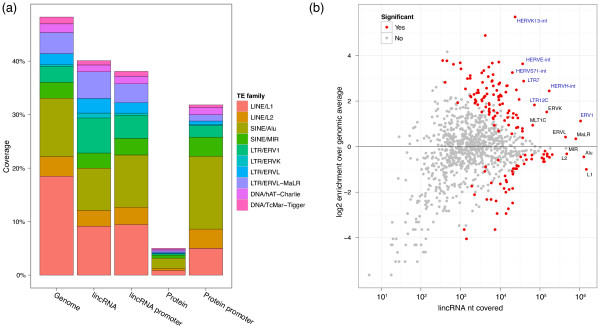
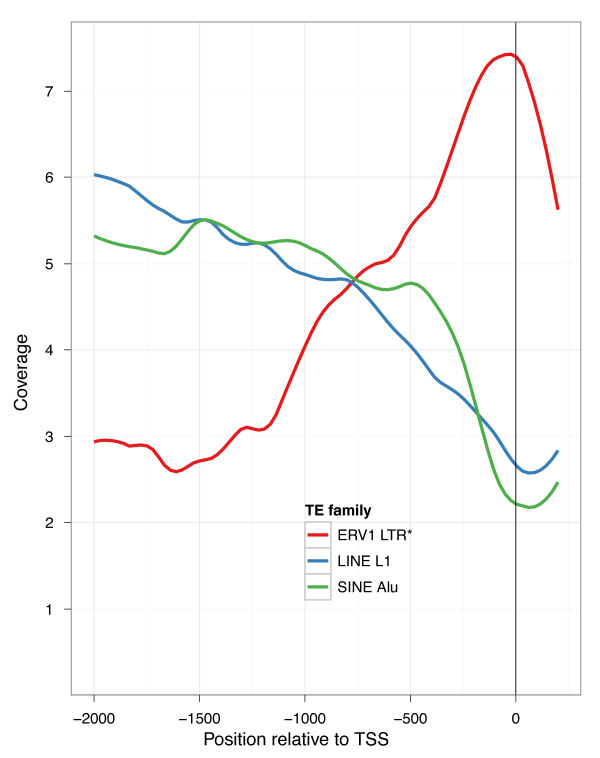
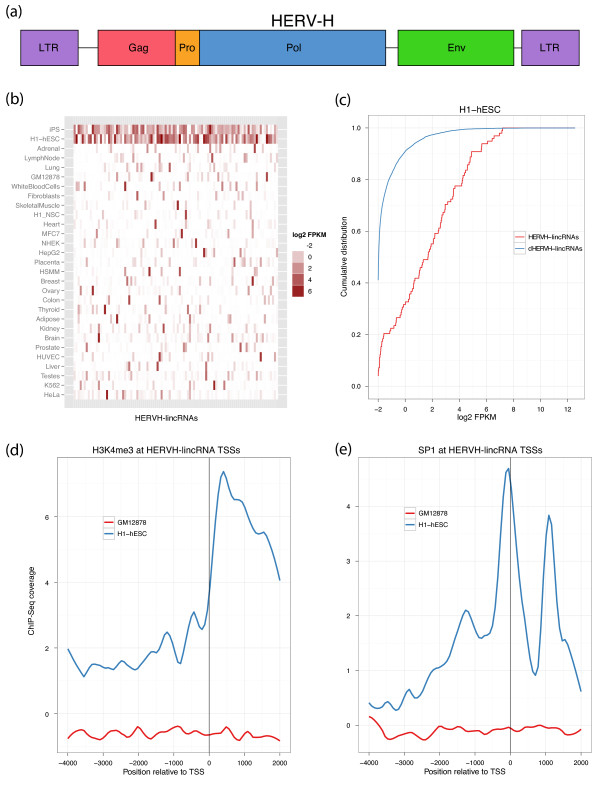
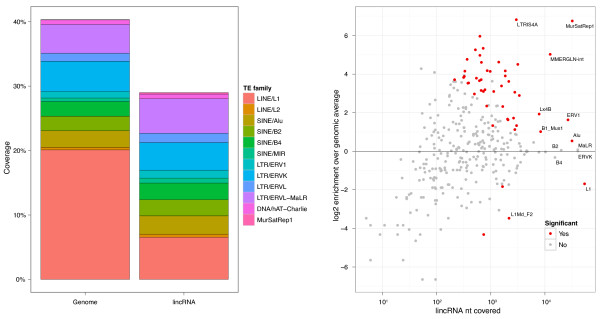
Background: Numerous studies over the past decade have elucidated a large set of long intergenic noncoding RNAs (lincRNAs) in the human genome. Research since has shown that lincRNAs constitute an important layer of genome regulation across a wide spectrum of species. However, the factors governing their evolution and origins remain relatively unexplored. One possible factor driving lincRNA evolution and biological function is transposable element (TE) insertions. Here, we comprehensively characterize the TE content of lincRNAs relative to genomic averages and protein coding transcripts. Results: Our analysis of the TE composition of 9,241 human lincRNAs revealed that, in sharp contrast to protein coding genes, 83% of lincRNAs contain a TE, and TEs comprise 42% of lincRNA sequence. lincRNA TE composition varies significantly from genomic averages - L1 and Alu elements are depleted and broad classes of endogenous retroviruses are enriched. TEs occur in biased positions and orientations within lincRNAs, particularly at their transcription start sites, suggesting a role in lincRNA transcriptional regulation. Accordingly, we observed a dramatic example of HERVH transcriptional regulatory signals correlating strongly with stem cell-specific expression of lincRNAs. Conversely, lincRNAs devoid of TEs are expressed at greater levels than lincRNAs with TEs in all tissues and cell lines, particularly in the testis. Conclusions: TEs pervade lincRNAs, dividing them into classes, and may have shaped lincRNA evolution and function by conferring tissue-specific expression from extant transcriptional regulatory signals.
Overview
The claims and statistics of this paper haven’t been checked yet.
Free: it reads the open-access text and checks the first 5 claims that cite a source we can check. Create a free account to check every claim.
Integrity signals
Registry
Cites
Statistics
Figures
Verification
Claims the paper makes
The claims and statistics of this paper haven’t been checked yet.
Free: it reads the open-access text and checks the first 5 claims that cite a source we can check. Create a free account to check every claim.
Claims other papers make about this one
Each is checked against this paper’s own text: does it say what the citing paper says it does?
The cited source doesn’t support the claim as written.
In the citing paper
“Indeed, lincRNAs containing REs showed much more tissue-specific pattern of expression in comparison with lincRNAs devoid of REs 17.”
From Are human endogenous retroviruses pathogenic? An approach to testing the hypothesis (2013) · cites this paper as [17]
Checked by a reasoning model — may be wrong.
Experimental — accuracy not yet measuredThe cited source says what the claim attributes to it.
In the citing paper
“Over 80% of lincRNAs were found to contain a RE, particularly enriched in HERVs, and more frequently inserted at the transcription start of the lincRNA 17.”
From Are human endogenous retroviruses pathogenic? An approach to testing the hypothesis (2013) · cites this paper as [17]
Self-check
Percentages, sums and reported differences re-computed from the paper’s own numbers.
The self-check needs the paper’s full text.
Citations
Cites
Controlling the False Discovery Rate: A Practical and Powerful Approach to Multiple Testing
Benjamini, Y., & Hochberg, Y. (1995) · Journal of the Royal Statistical Society Series B: Statistical Methodology · doi:10.1111/j.2517-6161.1995.tb02031.x · Cited by 109,482 · cited 1×
“P-values in all experiments were corrected for multiple hypothesis testing using Benjamini and Hochberg’s false discovery rate procedure [89].”
BEDTools: a flexible suite of utilities for comparing genomic features
Quinlan, A. R., & Hall, I. M. (2010) · Bioinformatics · doi:10.1093/bioinformatics/btq033 · Cited by 27,437
Initial sequencing and analysis of the human genome
International Human Genome Sequencing Consortium, Whitehead Institute for Biomedical Research, C. F. G. R., Lander, E. S., Linton, L. M., Birren, B., Nusbaum, C., Zody, M. C., Baldwin, J., Devon, K., Dewar, K., et al. (2001) · Nature · doi:10.1038/35057062 · Cited by 24,216
Ultrafast and memory-efficient alignment of short DNA sequences to the human genome.
Langmead, B., Trapnell, C., Pop, M., & Salzberg, S. L. (2009) · Genome Biology · doi:10.1186/gb-2009-10-3-r25 · Cited by 21,849 · cited 1×
“First, we mapped the reads to the genome using Bowtie [90] with the –best option to return the single best alignment per read.”
Model-based Analysis of ChIP-Seq (MACS)
Zhang, Y., Liu, T., Meyer, C. A., Eeckhoute, J., Johnson, D. S., Bernstein, B. E., Nusbaum, C., Myers, R. M., Brown, M., Li, W., et al. (2008) · Genome Biology · doi:10.1186/gb-2008-9-9-r137 · Cited by 18,386 · cited 1×
“Second, w e remapped the reads allowing up to twenty alignments and called peaks using the AREM softw are package, which implements an iterative algorithm to optimally allocate mult i- apping reads built on top of the MACS method[91, 92].”
Trapnell, C., Williams, B. A., Pertea, G., Mortazavi, A., Kwan, G., van Baren, M. J., Salzberg, S. L., Wold, B. J., & Pachter, L. (2010) · Nature Biotechnology · doi:10.1038/nbt.1621 · Cited by 15,556
On a Test of Whether one of Two Random Variables is Stochastically Larger than the Other
Mann, H. B., & Whitney, D. R. (1947) · The Annals of Mathematical Statistics · doi:10.1214/aoms/1177730491 · Cited by 14,320 · cited 1×
“For all comparisons of two sets of values where we were interested in whether one set was greater than another, we used a Mann-Whitney rank sum test [88].”
TopHat: discovering splice junctions with RNA-Seq
Trapnell, C., Pachter, L., & Salzberg, S. L. (2009) · Bioinformatics · doi:10.1093/bioinformatics/btp120 · Cited by 11,617
Long non-coding RNAs: insights into functions
Mercer, T. R., Dinger, M. E., & Mattick, J. S. (2009) · Nature Reviews Genetics · doi:10.1038/nrg2521 · Cited by 5,654 · cited 2×
“Background Recent comprehensive transcriptome sequencing studies uncovered a large class of previously unannotated long noncoding RNA (lncRNA) genes in various species with similar splicing and polyadenylation properties to mRNAs [1-8].”
Long non-coding RNA HOTAIR reprograms chromatin state to promote cancer metastasis
Gupta, R. A., Shah, N., Wang, K. C., Kim, J., Horlings, H. M., Wong, D. J., Tsai, M.-C., Hung, T., Argani, P., Rinn, J. L., et al. (2010) · Nature · doi:10.1038/nature08975 · Cited by 5,218 · cited 1×
“Accumulating evidence suggests lncRNAs are key regulators in cell differentiation and disease pathways[10-18].”
Self-citation
Cited by
Items 501–548 of 548
Zhang, Y., Su, W., Zhang, B., Ling, Y., Kim, W. K., & Zhang, H. (2021) · Figshare · doi:10.6084/m9.figshare.14527670
Sun, Q., Wang, J., Wang, G., Wang, H., & Liu, H. (2021) · Figshare · doi:10.6084/m9.figshare.16609007
Sun, Q., Wang, J., Wang, G., Wang, H., & Liu, H. (2021) · Figshare · doi:10.6084/m9.figshare.16608992
Zhang, Y., Su, W., Zhang, B., Ling, Y., Kim, W. K., & Zhang, H. (2021) · Figshare · doi:10.6084/m9.figshare.14527652
Zhang, Y., Su, W., Zhang, B., Ling, Y., Kim, W. K., & Zhang, H. (2021) · Figshare · doi:10.6084/m9.figshare.14527673
Zhang, Y., Su, W., Zhang, B., Ling, Y., Kim, W. K., & Zhang, H. (2021) · Figshare · doi:10.6084/m9.figshare.14527667
Sun, Q., Wang, J., Wang, G., Wang, H., & Liu, H. (2021) · Figshare · doi:10.6084/m9.figshare.16608986
Epigenetic Control of Cell Fate Decisions by Enhancer-Derived Long Noncoding RNAs
Mattick, J. S. (2024) · Springer eBooks · doi:10.1007/978-3-031-59286-7_2
HyDRA: A pipeline for integrating long- and short-read RNAseq data for custom transcriptome assembly
de Almeida, I. P., Lu, X. M., Edwards, S. L., French, J. D., & Bitar, M. (2026) · iScience · doi:10.1016/j.isci.2026.116131
Exploration on cold adaptation of Antarctic lichen via detection of positive selection genes
Wang, Y., Zhang, Y., Li, R., Qian, B., Du, X., Qiu, X., Chen, M., Shi, G., Wei, J., Wei, X., et al. (2024) · IMA Fungus · doi:10.1186/s43008-024-00160-x
Zhuang, Q. K.-W., Bauermeister, K., Gálvez, J. H., AlOgayil, N., Batdorj, E., de Villena, F. P., Taketo, T., Bourque, G., & Naumova, A. K. (2024) · bioRxiv (Cold Spring Harbor Laboratory) · doi:10.1101/2024.09.10.612032
Phylogenetic Study of Long Non-Coding RNA NEAT1 and MALAT1 to Infer Structural-Functional ConnectionPreprint
Arkhipova, K., & Drukker, M. (2024) · bioRxiv (Cold Spring Harbor Laboratory) · doi:10.1101/2024.10.22.619594
Glinsky, G. V. (2024) · Research Square · doi:10.21203/rs.3.rs-5415126/v1
Emerging Functions of the Repeat Genome in Nuclear Structure: A View from the Human Karyotype
Hall, L. L., Smith, K. P., & Lawrence, J. B. (2025) · Annual Review of Genomics and Human Genetics · doi:10.1146/annurev-genom-111522-014017 · Cited by 2
“More than 80% of human long ncRNAs (IncRNAs) contain at least one TEDS, with TEDS comprising ~40% of IncRNA sequences (93).”
Zhang, Y., Su, W., Zhang, B., Ling, Y., Kim, W. K., & Zhang, H. (2021) · Figshare · doi:10.6084/m9.figshare.14527664
Zhang, B., Zhang, C., Zhang, J., Lu, S., HuiTing, Z., Jiang, Y., & Ma, W. (2024) · Figshare · doi:10.6084/m9.figshare.26724032
Sun, Q., Wang, J., Wang, G., Wang, H., & Liu, H. (2021) · Figshare · doi:10.6084/m9.figshare.16609010
Telonis, A. G., & Rigoutsos, I. (2021) · Figshare · doi:10.6084/m9.figshare.14314576
Liu, K., Ma, X., Zhao, L., Lai, X., Chen, J., Lang, X., Han, Q., Wan, X., & Li, C. (2024) · Figshare · doi:10.6084/m9.figshare.26605867
Zhang, B., Zhang, C., Zhang, J., Lu, S., HuiTing, Z., Jiang, Y., & Ma, W. (2024) · Figshare · doi:10.6084/m9.figshare.26724029
Liu, K., Ma, X., Zhao, L., Lai, X., Chen, J., Lang, X., Han, Q., Wan, X., & Li, C. (2024) · Figshare · doi:10.6084/m9.figshare.26605870
Additional file 1 of Endogenous retroviruses in the origins and treatment of cancer
Jansz, N., & Faulkner, G. J. (2021) · Figshare · doi:10.6084/m9.figshare.14570381
Petrosino, G., Ponte, G., Volpe, M., Zarrella, I., Ansaloni, F., Langella, C., Cristina, G. D., Finaurini, S., Russo, M. T., Basu, S., et al. (2022) · Figshare · doi:10.6084/m9.figshare.19785781
The Role of Transposable Elements in the Development of Aggressive Behavior in Pigs
Mustafin, R. N., Казанцева, А. В., Gilyazova, I. R., Leonova, T. V., Khusnutdinova, E. K., & Gusev, O. G. (2026) · Russian Journal of Genetics · doi:10.1134/s1022795425701571
MiRNA degradation by a conserved target RNA regulates animal behavior
Bitetti, A. (2017) · theses.fr (ABES) · doi:10.70675/30bd04eczc40bz4791z8cffz311f59320c18
Evolution of the human & mouse X-chromosome inactivation regulatory network
Rosspopoff, O. (2018) · theses.fr (ABES) · doi:10.70675/969f9a3cz607bz4b1fzb38fzfb3fd338b65d
Rôle du long ARN non-codant CRNDE dans le myélome multiple
David, A. (2019) · theses.fr (ABES) · doi:10.70675/0a237555z2fe4z491bz9aefz7ccb14a7bb46
Etude des longs ARNs non codants dans la leucémie aiguë myéloblastique à caryotype normal
Clara, E. D. (2015) · theses.fr (ABES) · doi:10.70675/95526bc3z936bz46dazaf31z1e92122f4619
Tachtsidi, A. (2018) · theses.fr (ABES) · doi:10.70675/2ef58956zd619z4f59z94dbz6262d6448ed1
Santos, A. D. (2019) · theses.fr (ABES) · doi:10.70675/50131371z9cf2z4925zad84ze1758a9a5831 · Cited by 1
Molecular Characterization of LncRNAs : ANRIL as a Model System
Alfeghaly, C. (2020) · theses.fr (ABES) · doi:10.70675/2d0cfbdcz1c22z4a5fza77ez764ae5f439f6 · Cited by 1
Majid, M., Moeen, M., Amjad, N., Khan, H., Sun, Z., Wu, L., & Li, Z. (2026) · International Journal of Molecular Sciences · doi:10.3390/ijms27083471
“This selective regulation mirrors previous findings that stress responses often result in family and locus-specific modulation rather than global activation of TEs [47–49].”
MAJEC: unified gene, isoform, and locus-level transposable element quantification from RNA-seq
Lim, T.-Y., & Firestone, A. J. (2026) · Bioinformatics · doi:10.1093/bioinformatics/btag737
“We show that MAJEC matches TEtranscripts at the subfamily level for differential expression ( r =0.987) while providing locus-level resolution that TEtranscripts cannot, and we demonstrate through paired vignettes that the joint model correctly resolves cases where existing tools fail in opposite directions—Telescope…”
InfluentialTransposons, Stress, and the Evolution of Adaptability
Hunter, R. G. (2026) · Springer eBooks · doi:10.1007/978-3-032-24295-2_5
Rapid evolution of lncRNAs introduces novel regulatory inputs into ancestral cancer pathways
Sun, L., Dong, C., Hong, D., Du, M., Xia, S., Fan, H., Lynch, M., Li, Y., & Wei, W. (2026) · Science Advances · doi:10.1126/sciadv.aeb5510
“These insertions can increase transcript length and stability ( 18 – 20 ), thereby enhancing the likelihood of persistent expression and potential interaction with conserved cellular pathways.”
Macrophage-associated noncoding RNAs in atherosclerosis and chronic kidney disease
Jha, P. K., Nascimento, C. B., Lupieri, A., Aïkawa, E., & Aikawa, M. (2026) · Frontiers in Cardiovascular Medicine · doi:10.3389/fcvm.2026.1884576
“They regulate gene expression and cellular function through diverse mechanisms involving interactions with proteins, DNA, and other RNAs, both coding and noncoding (10, 11).”
Long Noncoding RNAs: Characteristics, Microprotein Production, and Genomic Origins
Haseltine, W. A., & Patarca, R. (2026) · Springer eBooks · doi:10.1007/978-3-032-30270-0_1
Epigenetic control of transposable elements in brain and brain disorders
Smith, C. A., & Hamilton, P. J. (2026) · Epigenetics · doi:10.1080/15592294.2026.2732514
“TEs are believed to comprise 42% of lncRNA sequences and TE-derived sequences are found in over 80% of lncRNAs [94].”
He, T., Zhang, S., Zhang, S., Liu, D., Li, H., Song, J. W., Liu, Z. H., Jin, J., & Sun, J. (2026) · Cells · doi:10.3390/cells15181707
“Given that approximately 80% of lncRNAs contain TE-derived sequences [33], the identification of TE-associated lncRNAs and elucidation of their regulatory mechanisms on target genes will become an important direction for future ZGA research.”
The “mobile bricks” of human evolution: how transposable elements shaped human phenotypes
Modenini, G., & Abondio, P. (2026) · Frontiers in Genetics · doi:10.3389/fgene.2026.1937765
“More than 80% of lncRNAs contain TE sequences, with these making up to 30%–42% of lncRNA sequence lengths (Kelley and Rinn, 2012; Kapusta et al., 2013).”
Epigenetics in development, disease, and therapy: from mechanisms to clinical interventions
Ren, Y., Yang, L., Fei, B., Guo, R., Huang, J., Xu, Z., Wang, R., Zhang, P., Cao, D., Chen, P., et al. (2026) · Science China Life Sciences · doi:10.1007/s11427-025-3356-1
The architectural and functional landscape of transposon-derived chimeric RNAs
Xiang, Y., & Liang, H. (2026) · RNA Biology · doi:10.1080/15476286.2026.2743461
“In fact, TE sequences contribute to a large proportion of lncRNA sequences across eukaryotes: approximately 66–83% of lncRNAs in mammals contain at least one TE-derived fragment [36,38,40], and wide-spread contributions have also been documented in insects and plants [41,42].”
Metadata
- Authors
- Kelley, D., & Rinn, J.
- Affiliations
- Broad Institute (US)
- Corresponding author
- Rinn, John
- Venue
- Genome Biology
- Published
- 2012-11-26
- Volume
- 13
- Issue
- 11
- Pages
- R107-R107
- ISSN
- 1465-6906 (ISSN-L)
- 1474-760X
- PMC
- PMC3580499
- OpenAlex
- W2107454957
- Semantic Scholar
- bb26db77ce3ef32a87225cd0d27691a0db872b24
- Cited by
- 531
- References
- 92
- Citations by year
- 2026: 19 · 2025: 14 · 2024: 32 · 2023: 30 · 2022: 45 · 2021: 58 · 2020: 38 · 2019: 36 · 2018: 49 · 2017: 38 · 2016: 52 · 2015: 59 · 2014: 37 · 2013: 24
- FWCI
- 43.76
- Type
- journal article
- Language
- en
- Open access
- gold
- doi.org
- Licence
- cc-by
- creativecommons.org/licenses/by/2.0/ (tdm)
- creativecommons.org/licenses/by/2.0/ (vor)
- Locations
- Genome biology (publishedVersion, cc-by)
- Europe PMC (PubMed Central) (publishedVersion, cc-by)
- PubMed Central (publishedVersion, cc-by)
- PubMed (publishedVersion)
- Funders
- Damon Runyon Cancer Research Foundation
- Richard and Susan Smith Family Foundation
- Israel National Institute for Health Policy Research
- National Institutes of Health (DP2OD006670, GM099117)
- National Heart, Lung, and Blood Institute (T32HL007893)
- National Human Genome Research Institute (P50HG006193)
- National Institute of General Medical Sciences (P01GM099117)
- Topics
- Life Sciences › Biochemistry, Genetics and Molecular Biology › Genetics › Chromosomal and Genetic Variations
- Life Sciences › Biochemistry, Genetics and Molecular Biology › Cancer Research › Cancer-related molecular mechanisms research
- Life Sciences › Biochemistry, Genetics and Molecular Biology › Molecular Biology › Genomics and Chromatin Dynamics
- Keywords
- long intergenic non-coding RNA, transposable elements, endogenous retroviruses, HERV-H, transcriptional regulation, testis expression, Alu elements, tissue-specific gene expression
- MeSH terms
- Gene Expression Regulation, Humans, Organ Specificity, Stem Cells, Genome, Human, Retroelements, Endogenous Retroviruses, RNA, Long Noncoding
About these checks
Registry, retraction, Cites and statistics results are computed, not judged, with one exception: a printed reference that no index lists is read once by a model before it counts as a citation error. Claims are extracted by a model and kept only when their quote appears verbatim in the text; each cited source is then checked, with a model’s help, for whether it says what the claim relies on. Those verdicts can be wrong — read the claim’s quote and the cited source before relying on one.
Statistics and arithmetic are recomputed, not judged.
Confidence bands are shown only for fields calibrated on our annotated test set. None is calibrated yet, so no band is shown.
What counts as a claim ›How we measure confidence ›How we check this ›
Are you an author, or do you see a problem with this page? Request a review
Data sources
Bibliographic data: Semantic Scholar, OpenAlex, Crossref.
Contains information from the Semantic Scholar Academic Graph Datasets, made available under the ODC Attribution License (ODC-BY 1.0).
Semantic Scholar’s data is described in: Kinney, R., et al. (2023). The Semantic Scholar Open Data Platform. arXiv:2301.10140.
