

Transposable elements reveal a stem cell-specific class of long noncoding RNAs
Open accessThe DOI matches its Crossref record; 92 of the 92 references it cites were found in a registry or an index.
Abstract
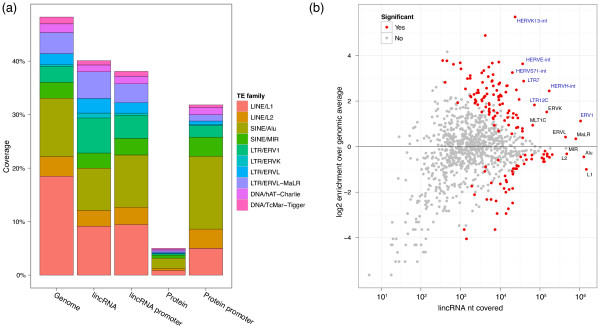
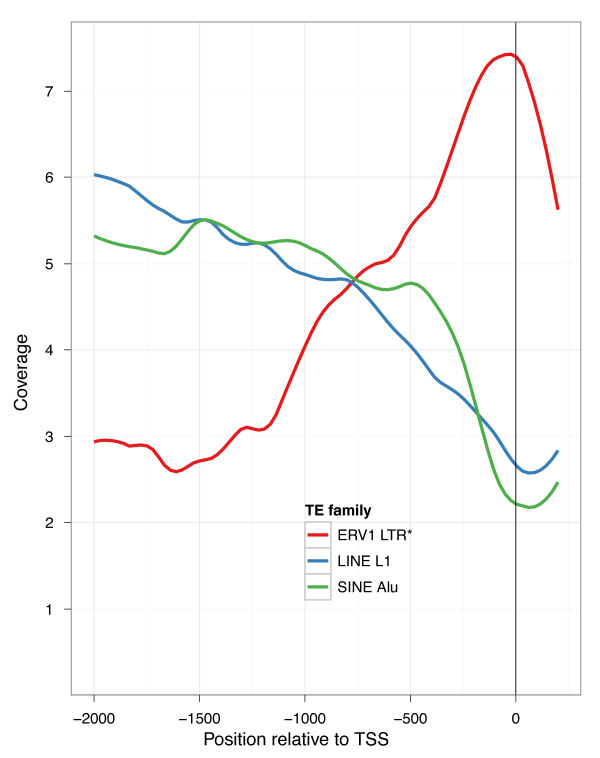
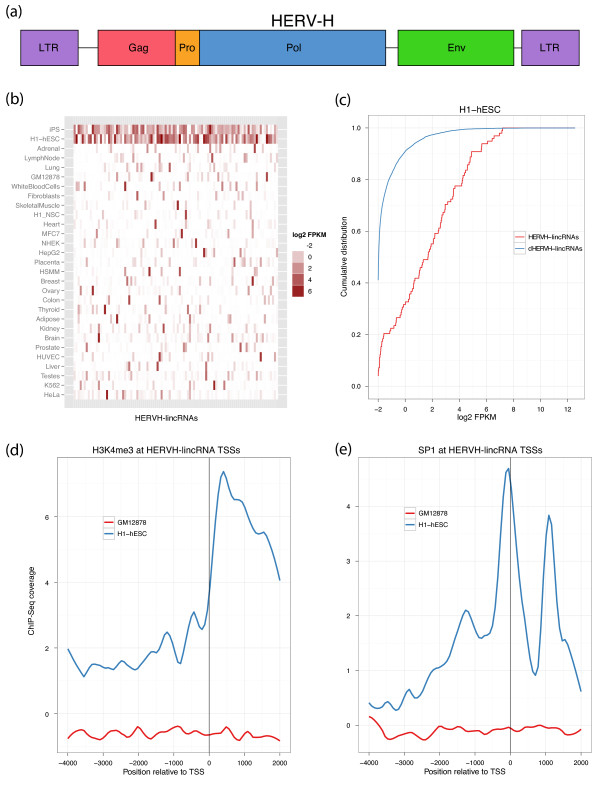
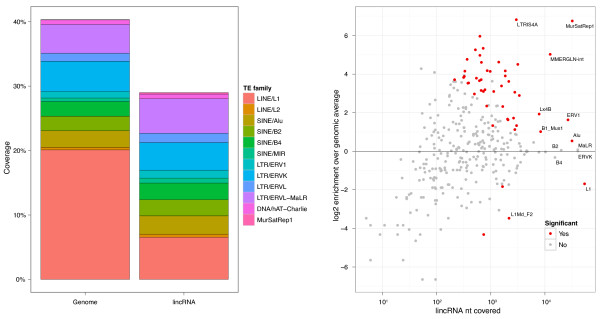
Background: Numerous studies over the past decade have elucidated a large set of long intergenic noncoding RNAs (lincRNAs) in the human genome. Research since has shown that lincRNAs constitute an important layer of genome regulation across a wide spectrum of species. However, the factors governing their evolution and origins remain relatively unexplored. One possible factor driving lincRNA evolution and biological function is transposable element (TE) insertions. Here, we comprehensively characterize the TE content of lincRNAs relative to genomic averages and protein coding transcripts. Results: Our analysis of the TE composition of 9,241 human lincRNAs revealed that, in sharp contrast to protein coding genes, 83% of lincRNAs contain a TE, and TEs comprise 42% of lincRNA sequence. lincRNA TE composition varies significantly from genomic averages - L1 and Alu elements are depleted and broad classes of endogenous retroviruses are enriched. TEs occur in biased positions and orientations within lincRNAs, particularly at their transcription start sites, suggesting a role in lincRNA transcriptional regulation. Accordingly, we observed a dramatic example of HERVH transcriptional regulatory signals correlating strongly with stem cell-specific expression of lincRNAs. Conversely, lincRNAs devoid of TEs are expressed at greater levels than lincRNAs with TEs in all tissues and cell lines, particularly in the testis. Conclusions: TEs pervade lincRNAs, dividing them into classes, and may have shaped lincRNA evolution and function by conferring tissue-specific expression from extant transcriptional regulatory signals.
Overview
The claims and statistics of this paper haven’t been checked yet.
Free: it reads the open-access text and checks the first 5 claims that cite a source we can check. Create a free account to check every claim.
Integrity signals
Registry
Cites
Statistics
Figures
Verification
Claims the paper makes
The claims and statistics of this paper haven’t been checked yet.
Free: it reads the open-access text and checks the first 5 claims that cite a source we can check. Create a free account to check every claim.
Claims other papers make about this one
Each is checked against this paper’s own text: does it say what the citing paper says it does?
The cited source doesn’t support the claim as written.
In the citing paper
“Indeed, lincRNAs containing REs showed much more tissue-specific pattern of expression in comparison with lincRNAs devoid of REs 17.”
From Are human endogenous retroviruses pathogenic? An approach to testing the hypothesis (2013) · cites this paper as [17]
Checked by a reasoning model — may be wrong.
Experimental — accuracy not yet measuredThe cited source says what the claim attributes to it.
In the citing paper
“Over 80% of lincRNAs were found to contain a RE, particularly enriched in HERVs, and more frequently inserted at the transcription start of the lincRNA 17.”
From Are human endogenous retroviruses pathogenic? An approach to testing the hypothesis (2013) · cites this paper as [17]
Self-check
Percentages, sums and reported differences re-computed from the paper’s own numbers.
The self-check needs the paper’s full text.
Citations
Cites
Controlling the False Discovery Rate: A Practical and Powerful Approach to Multiple Testing
Benjamini, Y., & Hochberg, Y. (1995) · Journal of the Royal Statistical Society Series B: Statistical Methodology · doi:10.1111/j.2517-6161.1995.tb02031.x · Cited by 109,482 · cited 1×
“P-values in all experiments were corrected for multiple hypothesis testing using Benjamini and Hochberg’s false discovery rate procedure [89].”
BEDTools: a flexible suite of utilities for comparing genomic features
Quinlan, A. R., & Hall, I. M. (2010) · Bioinformatics · doi:10.1093/bioinformatics/btq033 · Cited by 27,437
Initial sequencing and analysis of the human genome
International Human Genome Sequencing Consortium, Whitehead Institute for Biomedical Research, C. F. G. R., Lander, E. S., Linton, L. M., Birren, B., Nusbaum, C., Zody, M. C., Baldwin, J., Devon, K., Dewar, K., et al. (2001) · Nature · doi:10.1038/35057062 · Cited by 24,216
Ultrafast and memory-efficient alignment of short DNA sequences to the human genome.
Langmead, B., Trapnell, C., Pop, M., & Salzberg, S. L. (2009) · Genome Biology · doi:10.1186/gb-2009-10-3-r25 · Cited by 21,849 · cited 1×
“First, we mapped the reads to the genome using Bowtie [90] with the –best option to return the single best alignment per read.”
Model-based Analysis of ChIP-Seq (MACS)
Zhang, Y., Liu, T., Meyer, C. A., Eeckhoute, J., Johnson, D. S., Bernstein, B. E., Nusbaum, C., Myers, R. M., Brown, M., Li, W., et al. (2008) · Genome Biology · doi:10.1186/gb-2008-9-9-r137 · Cited by 18,386 · cited 1×
“Second, w e remapped the reads allowing up to twenty alignments and called peaks using the AREM softw are package, which implements an iterative algorithm to optimally allocate mult i- apping reads built on top of the MACS method[91, 92].”
Trapnell, C., Williams, B. A., Pertea, G., Mortazavi, A., Kwan, G., van Baren, M. J., Salzberg, S. L., Wold, B. J., & Pachter, L. (2010) · Nature Biotechnology · doi:10.1038/nbt.1621 · Cited by 15,556
On a Test of Whether one of Two Random Variables is Stochastically Larger than the Other
Mann, H. B., & Whitney, D. R. (1947) · The Annals of Mathematical Statistics · doi:10.1214/aoms/1177730491 · Cited by 14,320 · cited 1×
“For all comparisons of two sets of values where we were interested in whether one set was greater than another, we used a Mann-Whitney rank sum test [88].”
TopHat: discovering splice junctions with RNA-Seq
Trapnell, C., Pachter, L., & Salzberg, S. L. (2009) · Bioinformatics · doi:10.1093/bioinformatics/btp120 · Cited by 11,617
Long non-coding RNAs: insights into functions
Mercer, T. R., Dinger, M. E., & Mattick, J. S. (2009) · Nature Reviews Genetics · doi:10.1038/nrg2521 · Cited by 5,654 · cited 2×
“Background Recent comprehensive transcriptome sequencing studies uncovered a large class of previously unannotated long noncoding RNA (lncRNA) genes in various species with similar splicing and polyadenylation properties to mRNAs [1-8].”
Long non-coding RNA HOTAIR reprograms chromatin state to promote cancer metastasis
Gupta, R. A., Shah, N., Wang, K. C., Kim, J., Horlings, H. M., Wong, D. J., Tsai, M.-C., Hung, T., Argani, P., Rinn, J. L., et al. (2010) · Nature · doi:10.1038/nature08975 · Cited by 5,218 · cited 1×
“Accumulating evidence suggests lncRNAs are key regulators in cell differentiation and disease pathways[10-18].”
Self-citation
Cited by
Long non-coding RNAs: new players in cell differentiation and development
Fatica, A., & Bozzoni, I. (2014) · Nature Reviews Genetics · doi:10.1038/nrg3606 · Cited by 2,980
lincRNAs: Genomics, Evolution, and Mechanisms
Ulitsky, I., & Bartel, D. P. (2013) · Cell · doi:10.1016/j.cell.2013.06.020 · Cited by 2,608
“lincRNAs from human, mouse, and zebrafish are significantly more likely than mRNAs to overlap repetitive elements (Ulitsky et al., 2011; Kelley and Rinn, 2012), perhaps because lincRNA functions aremore tolerant of retrotransposon insertions.”
Long non-coding RNAs: definitions, functions, challenges and recommendations
Mattick, J. S., Amaral, P. P., Carninci, P., Carpenter, S., Chang, H. Y., Chen, L.-L., Chen, R., Dean, C., Dinger, M. E., Fitzgerald, K. A., et al. (2023) · Nature Reviews Molecular Cell Biology · doi:10.1038/s41580-022-00566-8 · Cited by 2,356
Self-citationMorris, K. V., & Mattick, J. S. (2014) · Nature Reviews Genetics · doi:10.1038/nrg3722 · Cited by 1,371
Regulatory activities of transposable elements: from conflicts to benefits
Chuong, E. B., Elde, N. C., & Feschotte, C. (2017) · Nature Reviews Genetics · doi:10.1038/nrg.2016.139 · Cited by 1,489
Mechanisms of stress in the brain
McEwen, B. S., Bowles, N. P., Gray, J. D., Hill, M. N., Hunter, R. G., Karatsoreos, I. N., & Nasca, C. (2015) · Nature Neuroscience · doi:10.1038/nn.4086 · Cited by 1,386
The human transcriptome across tissues and individuals
Melé, M., Ferreira, P. G., Reverter, F., DeLuca, D. S., Monlong, J., Sammeth, M., Young, T. R., Goldmann, J. M., Pervouchine, D. D., Sullivan, T. J., et al. (2015) · Science · doi:10.1126/science.aaa0355 · Cited by 1,304
The Landscape of long noncoding RNA classification
St. Laurent, G., Wahlestedt, C., & Kapranov, P. (2015) · Trends in Genetics · doi:10.1016/j.tig.2015.03.007 · Cited by 1,191
“Promoters within repeats drive expression of many ncRNAs [75], especially in pluripotent [29, 76, 77] and cancerous cells [29].”
Jin, Y., Tam, O. H., Paniagua, E., & Hammell, M. (2015) · Bioinformatics · doi:10.1093/bioinformatics/btv422 · Cited by 737
Kapusta, A., Kronenberg, Z., Lynch, V. J., Zhuo, X., Ramsay, L., Bourque, G., Yandell, M., & Feschotte, C. (2013) · PLoS Genetics · doi:10.1371/journal.pgen.1003470 · Cited by 687
“Thus, much like LTR/ERV elements have been implicated in the wiring of protein-coding genes into specific regulatory networks [55,57,59,84], they have also recruited lncRNAs serving important developmental function, notably in the pluripotency network [41,43,94].”
BackgroundResultInfluentialLocalization and abundance analysis of human lncRNAs at single-cell and single-molecule resolution
Cabili, M. N., Dunagin, M. C., McClanahan, P. D., Biaesch, A., Padovan-Merhar, O., Regev, A., Rinn, J. L., & Raj, A. (2015) · Genome Biology · doi:10.1186/s13059-015-0586-4 · Cited by 684
“Furthermore, no study has systematically tackled the unique technical challenges posed by performing single molecule RNA FISH on lncRNAs, which are shorter, lower abundance and more likely to contain repeats than mRNA [9,39].”
BackgroundSelf-citationHezroni, H., Koppstein, D., Schwartz, M. G., Avrutin, A., Bartel, D. P., & Ulitsky, I. (2015) · Cell Reports · doi:10.1016/j.celrep.2015.04.023 · Cited by 652
“Transposable Elements Globally Rewire lincRNA Transcriptomes A large fraction of lincRNA exonic sequences in human and mouse is known to derive from transposable elements (Kelley and Rinn, 2012; Kapusta et al., 2013).”
Topological organization of multichromosomal regions by the long intergenic noncoding RNA Firre
Hacisuleyman, E., Goff, L. A., Trapnell, C., Williams, A., Henao-Mejia, J., Sun, L., McClanahan, P., Hendrickson, D. G., Sauvageau, M., Kelley, D. R., et al. (2014) · Nature Structural & Molecular Biology · doi:10.1038/nsmb.2764 · Cited by 628
Self-citationTowards a complete map of the human long non-coding RNA transcriptome
Uszczynska-Ratajczak, B., Lagarde, J., Frankish, A., Guigó, R., & Johnson, R. (2018) · Nature Reviews Genetics · doi:10.1038/s41576-018-0017-y · Cited by 616
DNA methylation dynamics of the human preimplantation embryo
Smith, Z. D., Chan, M. M., Humm, K. C., Karnik, R., Mekhoubad, S., Regev, A., Eggan, K., & Meissner, A. (2014) · Nature · doi:10.1038/nature13581 · Cited by 580
“Alignment was performed using TOPHAT against human genome assembly 19 with default settings.”
BackgroundMethodInfluentialStein, J. C., Yu, Y., Copetti, D., Zwickl, D. J., Zhang, L., Zhang, C., Chougule, K., Gao, D., Iwata, A., Goicoechea, J. L., et al. (2018) · Nature Genetics · doi:10.1038/s41588-018-0040-0 · Cited by 570
Evolution to the rescue: using comparative genomics to understand long non-coding RNAs
Ulitsky, I. (2016) · Nature Reviews Genetics · doi:10.1038/nrg.2016.85 · Cited by 542
Immunobiology of Long Noncoding RNAs
Atianand, M. K., Caffrey, D. R., & Fitzgerald, K. A. (2017) · Annual Review of Immunology · doi:10.1146/annurev-immunol-041015-055459 · Cited by 463
“Third, repetitive elements are a major component of most lncRNAs (17, 18) and these repetitive sequences are difficult to align to the genome.”
BackgroundRoles of transposable elements in the regulation of mammalian transcription
Fueyo, R., Judd, J., Feschotte, C., & Wysocka, J. (2022) · Nature Reviews Molecular Cell Biology · doi:10.1038/s41580-022-00457-y · Cited by 451
Briggs, J. A., Wolvetang, E. J., Mattick, J. S., Rinn, J. L., & Barry, G. (2015) · Neuron · doi:10.1016/j.neuron.2015.09.045 · Cited by 447
Self-citationPrimate-specific endogenous retrovirus-driven transcription defines naive-like stem cells
Wang, J., Xie, G., Singh, M., Ghanbarian, A. T., Raskó, T., Szvetnik, A., Cai, H., Besser, D., Prigione, A., Fuchs, N. V., et al. (2014) · Nature · doi:10.1038/nature13804 · Cited by 448
The retrovirus HERVH is a long noncoding RNA required for human embryonic stem cell identity
Lu, X., Sachs, F., Ramsay, L., Jacques, P.-É., Göke, J., Bourque, G., & Ng, H.-H. (2014) · Nature Structural & Molecular Biology · doi:10.1038/nsmb.2799 · Cited by 435
Cytoplasmic functions of long noncoding RNAs
Noh, J. H., Kim, K. M., McClusky, W. G., Abdelmohsen, K., & Gorospe, M. (2018) · WIREs RNA · doi:10.1002/wrna.1471 · Cited by 432
“They also found that the presence of exonic transposable elements (TEs) in cytoplasmic lncRNAs correlates with their ribosome-free localization, supporting previous observations that TEs are functional lncRNA sequences (Carlevaro-Fita et al., 2016; Johnson & Guigo, 2014; Kelley & Rinn, 2012).”
Hu, G., Tang, Q., Sharma, S., Yu, F., Escobar, T. M., Muljo, S. A., Zhu, J., & Zhao, K. (2013) · Nature Immunology · doi:10.1038/ni.2712 · Cited by 406
Measuring and interpreting transposable element expression
Lanciano, S., & Cristofari, G. (2020) · Nature Reviews Genetics · doi:10.1038/s41576-020-0251-y · Cited by 401
Göke, J., Lu, X., Chan, Y.-S., Ng, H.-H., Ly, L.-H., Sachs, F., & Szczerbinska, I. (2015) · Cell Stem Cell · doi:10.1016/j.stem.2015.01.005 · Cited by 368
The Majority of Primate-Specific Regulatory Sequences Are Derived from Transposable Elements
Jacques, P.-É., Jeyakani, J., & Bourque, G. (2013) · PLoS Genetics · doi:10.1371/journal.pgen.1003504 · Cited by 355
“This result corroborates the fact that at the level of expression, TE-derived transcripts, including lincRNAs [41], are also usually tissue-specific [42].”
ResultLong noncoding RNAs: fresh perspectives into the RNA world
Yang, L., Froberg, J. E., & Lee, J. T. (2014) · Trends in Biochemical Sciences · doi:10.1016/j.tibs.2013.10.002 · Cited by 355
“In addition, a survey of human lincRNAs also revealed an enrichment for transposable elements [71].”
BackgroundCo-option of Sox3 as the male-determining factor on the Y chromosome in the fish Oryzias dancena
Takehana, Y., Matsuda, M., Myosho, T., Suster, M. L., Kawakami, K., Shin-I, T., Kohara, Y., Kuroki, Y., Toyoda, A., Fujiyama, A., et al. (2014) · Nature Communications · doi:10.1038/ncomms5157 · Cited by 341
Sequences enriched in Alu repeats drive nuclear localization of long RNAs in human cells
Lubelsky, Y., & Ulitsky, I. (2018) · Nature · doi:10.1038/nature25757 · Cited by 339
“Tiles overlapping EcoRI, BglII, BamHI recognition sequences were excluded in both libraries and tiles overlapping HindIII, XbaI and NotI were also excluded in NucLibA.”
Basic biology and therapeutic implications of lncRNA
Khorkova, O., Hsiao, J., & Wahlestedt, C. (2015) · Advanced Drug Delivery Reviews · doi:10.1016/j.addr.2015.05.012 · Cited by 341
“It has been shown that HERVH elements associated with human lincRNAs are evolutionarily younger than HERVH elements genome-wide [26].”
BackgroundInfluentialGlobal Positioning System: Understanding Long Noncoding RNAs through Subcellular Localization
Carlevaro-Fita, J., & Johnson, R. (2019) · Molecular Cell · doi:10.1016/j.molcel.2019.02.008 · Cited by 318
The RIDL hypothesis: transposable elements as functional domains of long noncoding RNAs
Johnson, R., & Guigó, R. (2014) · RNA · doi:10.1261/rna.044560.114 · Cited by 309
“Kelley and Rinn (2012) also highlighted a number of functionally characterized lncRNAs, such as TUG1 (Young et al. 2005) and BANCR (Flockhart et al. 2012), that contain significant amounts of TE-derived sequence.”
BackgroundResultInfluentialThe FANTOM Consortium, Fort, A., Hashimoto, K., Yamada, D., Salimullah, M., Keya, C. A., Saxena, A., Bonetti, A., Voineagu, I., Bertin, N., et al. (2014) · Nature Genetics · doi:10.1038/ng.2965 · Cited by 311
Thompson, P. J., Macfarlan, T. S., & Lorincz, M. C. (2016) · Molecular Cell · doi:10.1016/j.molcel.2016.03.029 · Cited by 306
“While ERVs show striking enrichment in lncRNAs (Kannan et al., 2015; Kapusta et al., 2013; Kelley and Rinn, 2012) and LTRs clearly drive expression of a subset of lncRNA transcripts that appear to play important developmental functions (Durruthy-Durruthy et al., 2016; Fort et al., 2014), it remains…”
BackgroundInfluentialVolatile evolution of long noncoding RNA repertoires: mechanisms and biological implications
Kapusta, A., & Feschotte, C. (2014) · Trends in Genetics · doi:10.1016/j.tig.2014.08.004 · Cited by 295
Host–transposon interactions: conflict, cooperation, and cooption
Cosby, R. L., Chang, N.-C., & Feschotte, C. (2019) · Genes & Development · doi:10.1101/gad.327312.119 · Cited by 290
Dealing with Pervasive Transcription
Jensen, T. H., Jacquier, A., & Libri, D. (2013) · Molecular Cell · doi:10.1016/j.molcel.2013.10.032 · Cited by 290
Fan, Y., Yang, J., Mathioni, S. M., Yu, J., Shen, J., Yang, X., Wang, L., Zhang, Q., Cai, Z., Xu, C., et al. (2016) · Proceedings of the National Academy of Sciences · doi:10.1073/pnas.1619159114 · Cited by 286
“We suspected that the 65-bp insertion might be related to the transposon (21).”
BackgroundLong Noncoding RNAs: Molecular Modalities to Organismal Functions
Rinn, J. L., & Chang, H. Y. (2020) · Annual Review of Biochemistry · doi:10.1146/annurev-biochem-062917-012708 · Cited by 282
Self-citationThe Developmental Control of Transposable Elements and the Evolution of Higher Species
Friedli, M., & Trono, D. (2015) · Annual Review of Cell and Developmental Biology · doi:10.1146/annurev-cellbio-100814-125514 · Cited by 277
Ohnuki, M., Tanabe, K., Sutou, K., Teramoto, I., Sawamura, Y., Narita, M., Nakamura, M., Tokunaga, Y., Nakamura, M., Watanabe, A., et al. (2014) · Proceedings of the National Academy of Sciences · doi:10.1073/pnas.1413299111 · Cited by 263
Widespread RNA binding by chromatin-associated proteins
G Hendrickson, D., Kelley, D. R., Tenen, D., Bernstein, B., & Rinn, J. L. (2016) · Genome Biology · doi:10.1186/s13059-016-0878-3 · Cited by 253
“ERV1 insertions appear to have played a role in the origin of many lncRNAs [37].”
BackgroundSelf-citationRetrotransposons and pseudogenes regulate mRNAs and lncRNAs via the piRNA pathway in the germline
Watanabe, T., Cheng, E.-C., Zhong, M., & Lin, H. (2015) · Genome Research · doi:10.1101/gr.180802.114 · Cited by 252
“The recent advent of deep 38 sequencing technology further revealed that a large portion of the mammalian genome is transcribed into 39 an immense number of non-coding RNAs, including over ten thousand long non-coding RNAs 40 (lncRNAs) , thousands of expressed pseudogenes, and millions of Piwi-interacting RNAs (piRNAs…”
InfluentialFunctional Long Non-coding RNAs Evolve from Junk Transcripts
Palazzo, A. F., & Koonin, E. V. (2020) · Cell · doi:10.1016/j.cell.2020.09.047 · Cited by 249
Endogenous retroviral promoter exaptation in human cancer
Babaian, A., & Mager, D. L. (2016) · Mobile DNA · doi:10.1186/s13100-016-0080-x · Cited by 247
“TE-initiated LncRNAs with oncogenic properties In an extensive study, Prensner et al. reported that the lncRNA SchLAP1 (SWI/SNF complex antagonist associated with prostate cancer 1) is overexpressed in ~25% of prostate cancers, is an independent predictor of poor clinical outcomes and is critical for invasiveness and…”
BackgroundInfluentialJain, A. K., Xi, Y., McCarthy, R., Allton, K., Akdemir, K. C., Patel, L. R., Aronow, B., Lin, C., Li, W., Yang, L., et al. (2016) · Molecular Cell · doi:10.1016/j.molcel.2016.10.039 · Cited by 241
“8% of transcripts correspond to lncRNAs, including antisense, intergenic, sense-overlapping, and processed transcripts when compared to a recent hESC lncRNA assembly (Kelley and Rinn, 2012).”
BackgroundInfluentialCytoplasmic long noncoding RNAs are frequently bound to and degraded at ribosomes in human cells
Carlevaro-Fita, J., Rahim, A., Guigó, R., Vardy, L. A., & Johnson, R. (2016) · RNA · doi:10.1261/rna.053561.115 · Cited by 239
“Endogenous retroviral fragments are negatively correlated with ribosomal recruitment There is growing evidence that transposable elements (TEs) contribute functional sequence to lncRNA (Kelley and Rinn 2012; Johnson and Guigó 2014).”
BackgroundMammalian Endogenous Retroviruses
Mager, D. L., & Stoye, J. P. (2015) · Microbiology Spectrum · doi:10.1128/microbiolspec.mdna3-0009-2014 · Cited by 233
Transcriptome sequencing reveals altered long intergenic non-coding RNAs in lung cancer
White, N. M., Cabanski, C. R., Silva-Fisher, J. M., Dang, H. X., Govindan, R., & Maher, C. A. (2014) · Genome Biology · doi:10.1186/preaccept-8565849481270705 · Cited by 225
Next-Generation Sequencing — An Overview of the History, Tools, and “Omic” Applications
Kulski, J. K. (2016) · Next Generation Sequencing - Advances, Applications and Challenges · doi:10.5772/61964 · Cited by 208
The functions of long noncoding RNAs in development and stem cells
Perry, R. B.-T., & Ulitsky, I. (2016) · Development · doi:10.1242/dev.140962 · Cited by 207
“Overall, the sequences of lncRNA exons are only marginally better conserved than those in the introns of protein-coding genes or in random intergenic regions, and they are only marginally depleted of sequences derived from transposable elements (Kapusta et al., 2013; Kelley and Rinn, 2012).”
BackgroundContext-aware transcript quantification from long-read RNA-seq data with Bambu
Chen, Y., Sim, A., Wan, Y. K., Yeo, K., Lee, J. J. X., Ling, M. H., Love, M. I., & Göke, J. (2023) · Nature Methods · doi:10.1038/s41592-023-01908-w · Cited by 191
Transposable Elements in Human Cancer: Causes and Consequences of Deregulation
Anwar, S., Wulaningsih, W., & Lehmann, U. (2017) · International Journal of Molecular Sciences · doi:10.3390/ijms18050974 · Cited by 194
“Hundreds of long non-coding RNAs (lncRNAs, up tp 80%) contain endogenous insertions of TEs in human cells that serve as regulatory signals for cell growth and proliferation [147].”
BackgroundLong non‐coding RNA regulation of reproduction and development
Taylor, D. H., Chu, E. T., Spektor, R., & Soloway, P. D. (2015) · Molecular Reproduction and Development · doi:10.1002/mrd.22581 · Cited by 187
“…to lncRNAs (Kiani et al., 2013; Zheng et al., 2013b; Batista et al., 2014; Fu et al., 2014; Schwartz et al., 2014; Wang and He, 2014; Liu et al., 2015a), and the roles transposable elements have played in lncRNA diversity (Kelley and Rinn 2012; Liang et al., 2012; Kapusta et al., 2013).”
BackgroundDurruthy-Durruthy, J., Sebastiano, V., Wossidlo, M., Cepeda, D., Cui, J., Grow, E. J., Davila, J., Mall, M., Wong, W. H., Wysocka, J., et al. (2016) · Nature Genetics · doi:10.1038/ng.3449 · Cited by 181
Posttranscriptional Regulation of Gene Expression by Piwi Proteins and piRNAs
Watanabe, T., & Lin, H. (2014) · Molecular Cell · doi:10.1016/j.molcel.2014.09.012 · Cited by 173
“These lncRNAs are possible targets of piRNAs, since retrotransposon sequences are frequently observed in lncRNAs (66% of mouse lincRNAs contain at least one transposable element) (Kelley and Rinn, 2012).”
BackgroundLong Non-Coding RNAs Control Hematopoietic Stem Cell Function
Luo, M., Jeong, M., Sun, D., Park, H. J., Rodriguez, B. A. T., Xia, Z., Yang, L., Zhang, X., Sheng, K., Darlington, G. J., et al. (2015) · Cell Stem Cell · doi:10.1016/j.stem.2015.02.002 · Cited by 169
“Because retrovirus-related transposon elements (TEs) have been shown to be enriched in ESC lncRNAs (Kelley and Rinn, 2012), we considered whether this was also applicable to LncHSCs. Consistent with a previous report (Kapusta et al., 2013), we found that TEs cover about 40% of the genomic sequence,…”
BackgroundResultMarques, A. C., Hughes, J., Graham, B., Kowalczyk, M. S., Higgs, D. R., & Ponting, C. P. (2013) · Genome Biology · doi:10.1186/gb-2013-14-11-r131 · Cited by 171
“It has previously been shown that transposable elements are enriched both at enhancer elements [39] and at the promoters of intergenic lncRNAs [40,41].”
BackgroundKornienko, A. E., Dotter, C. P., Guenzl, P. M., Gisslinger, H., Gisslinger, B., Cleary, C., Kralovics, R., Pauler, F. M., & Barlow, D. P. (2016) · Genome Biology · doi:10.1186/s13059-016-0873-8 · Cited by 170
“Many lncRNAs initiate from enhancer-like promoters that lack H3K4me3 histone modifications typical of standard mRNA promoters [28, 43], or from repetitive transposable elements normally absent from standard mRNA promoters [44].”
BackgroundA Novel RNA Motif Mediates the Strict Nuclear Localization of a Long Noncoding RNA
Zhang, B., Gunawardane, L., Niazi, F., Jahanbani, F., Chen, X., & Valadkhan, S. (2014) · Molecular and Cellular Biology · doi:10.1128/mcb.01673-13 · Cited by 168
“However, significant fractions of the sequences of many lncRNAs are derived from transposable elements (18, 19), leading to the existence of shared sequences among many lncRNAs.”
BackgroundTransposable elements in the mammalian embryo: pioneers surviving through stealth and service
Gerdes, P., Richardson, S. R., Mager, D. L., & Faulkner, G. J. (2016) · Genome Biology · doi:10.1186/s13059-016-0965-5 · Cited by 156
“As such, regulation of TE-derived enhancers and lncRNAs by pluripotency TFs can result in the formation of positive-feedback loops, potentially bolstering pluripotency networks [25, 26, 62].”
BackgroundInfluentialDUX4 Binding to Retroelements Creates Promoters That Are Active in FSHD Muscle and Testis
Young, J. M., Whiddon, J. L., Yao, Z., Kasinathan, B., Snider, L., Geng, L. N., Balog, J., Tawil, R., van der Maarel, S. M., & Tapscott, S. J. (2013) · PLoS Genetics · doi:10.1371/journal.pgen.1003947 · Cited by 158
“Two very recent reports [43,44] show that repetitive elements are enriched at the transcription start sites of lncRNAs.”
BackgroundGenomic Repeats Categorize Genes with Distinct Functions for Orchestrated Regulation
Lu, J. Y., Shao, W., Chang, L., Yin, Y., Li, T., Zhang, H., Hong, Y., Percharde, M., Guo, L., Wu, Z., et al. (2020) · Cell Reports · doi:10.1016/j.celrep.2020.02.048 · Cited by 156
“Third, lncRNAs have a higher content of ERVs in exons and downstream regions compared with mRNA genes (highlighted with the orange box), consistent with a previous report (Kelley and Rinn, 2012).”
Endogenous retroviruses in the origins and treatment of cancer
Jansz, N., & Faulkner, G. J. (2021) · Genome Biology · doi:10.1186/s13059-021-02357-4 · Cited by 155
“HERVs contribute exons to long noncoding RNAs, such as ESRG, HPAT5, and linc-ROR, which are upregulated by OCT4 and other pluripotency factors and may in turn act as molecular sponges for miRNAs limiting pluripotency factor expression [7, 8, 11, 89, 90].”
BackgroundTransposable elements ( TE s) contribute to stress‐related long intergenic noncoding RNA s in plants
Wang, D., Qu, Z., Yang, L., Zhang, Q., Liu, Z., Trung, Q., Adelson, D. L., Wang, Z., Searle, I. R., & Zhu, J. (2017) · The Plant Journal · doi:10.1111/tpj.13481 · Cited by 176
“Although TEs are proposed to be a major contributor to vertebrate lncRNAs (Kelley and Rinn, 2012; Kapusta et al., 2013), their contribution to plant lncRNAs remains unclear.”
BackgroundLong non-coding RNA-dependent transcriptional regulation in neuronal development and disease
Clark, B. S., & Blackshaw, S. (2014) · Frontiers in Genetics · doi:10.3389/fgene.2014.00164 · Cited by 150
“Compared to protein-coding genes, retrotransposon sequences and tandem repeat elements are more frequently included in lncRNA sequences (Ulitsky et al., 2011; Kelley and Rinn, 2012).”
BackgroundA comprehensive overview of lncRNA annotation resources
Xu, J., Bai, J., Zhang, X., Lv, Y., Gong, Y., Liu, L., Zhao, H., Yu, F., Ping, Y., Zhang, G., et al. (2016) · Briefings in Bioinformatics · doi:10.1093/bib/bbw015 · Cited by 159
He, S., Zhang, H., Liu, H., & Zhu, H. (2014) · Bioinformatics · doi:10.1093/bioinformatics/btu643 · Cited by 155
“Because considerable TTSs are at transposable elements, we postulate that after targeting by lncRNAs, the methylation of these transposable elements may hinder the transcription of genes and that because many lncRNA genes contain multiple transposable elements (He et al., 2013; Kelley and Rinn, 2012), the TTSs at tran…”
BackgroundTransposable elements as essential elements in the control of gene expression
Gebrie, A. (2023) · Mobile DNA · doi:10.1186/s13100-023-00297-3 · Cited by 174
“In conclusion, the distribution of TEs in the introns of lncRNA genes is essentially similar to that of the entire genome, but LINEs are underrepresented in exonic and promoter areas while LTRs are overrepresented in lncRNA exons and promoters compared to protein-coding genes [166, 179, 183].”
BackgroundTransposable elements generate regulatory novelty in a tissue-specific fashion
Trizzino, M., Kapusta, A., & Brown, C. D. (2018) · BMC Genomics · doi:10.1186/s12864-018-4850-3 · Cited by 176
“In fact, many of the 370 previous studies have proposed that TEs are frequently enriched in cis-regulatory 371 elements and lncRNAs [21, 22, 33, 39, 58], but the actual effect of the presence of 372 TEs on the associated gene expression was not tested on a large scale.”
BackgroundHa, H., Song, J., Wang, S., Kapusta, A., Feschotte, C., Chen, K. C., & Xing, J. (2014) · BMC Genomics · doi:10.1186/1471-2164-15-545 · Cited by 131
“Three resources were used for lncRNA loci annotation: 1) lncRNAs defined by Gencode ([41], release 15), 2) testisexpressed long intergenic non-coding RNAs from [30], and 3) testis-expressed long intergenic non-coding RNAs from [21].”
BackgroundMethodThe Intertwining of Transposable Elements and Non-Coding RNAs
Hadjiargyrou, M., & Delihas, N. (2013) · International Journal of Molecular Sciences · doi:10.3390/ijms140713307 · Cited by 145
“In a different study concerning HERV LTRs, other TEs and lncRNAs, Kelly and Rinn provide a comprehensive analysis of human TE sequences in long intergenic non-coding RNAs (lincRNAs) and conversely, the presence of lincRNAs sequences in transposons [56].”
BackgroundRen, H., Wang, G., Chen, L., Jiang, J., Liu, L., Li, N., Zhao, J., Sun, X., & Zhou, P. (2016) · BMC Genomics · doi:10.1186/s12864-016-2365-3 · Cited by 142
“Long terminal repeats (LTRs) harbor promoter signals that modulate gene expression in genomes [26, 27], and a recent study has indicated that endogenous retroviruses (ERVs), which is a class of LTRs, exhibit position and orientation biases, often preferring the 5′ end of lincRNA transcripts and sense orientation withi…”
BackgroundResultLong noncoding RNAs in B-cell development and activation
Brazão, T. F., Johnson, J. S., Müller, J., Heger, A., Ponting, C. P., & Tybulewicz, V. L. J. (2016) · Blood · doi:10.1182/blood-2015-11-680843 · Cited by 127
“A previous study had shown that many lncRNAs overlap with transposable elements (TEs).(28) In agreement with this, we find that approximately 40% of the lncRNAs identified here overlap with TEs, and a comparison of these with the genomic content of TEs shows an enrichment of endogenous retroviruses and a relative depl…”
ResultOnco-exaptation of an endogenous retroviral LTR drives IRF5 expression in Hodgkin lymphoma
Babaian, A., Romanish, M. T., Gagnier, L., Kuo, L. Y., Karimi, M. M., Steidl, C., & Mager, D. L. (2016) · Oncogene · doi:10.1038/onc.2015.308 · Cited by 121
Warren, I. A., Naville, M., Chalopin, D., Levin, P., Berger, C. S., Galiana-Arnoux, D., & Volff, J. (2015) · Chromosome Research · doi:10.1007/s10577-015-9493-5 · Cited by 140
Roles of piRNAs in transposon and pseudogene regulation of germline mRNAs and lncRNAs
Wang, C., & Lin, H. (2021) · Genome biology · doi:10.1186/s13059-020-02221-x · Cited by 129
Helitrons , the Eukaryotic Rolling-circle Transposable Elements
Thomas, J., & Pritham, E. J. (2015) · Microbiology Spectrum · doi:10.1128/microbiolspec.mdna3-0049-2014 · Cited by 121
Long non-coding RNAs in human early embryonic development and their potential in ART
Bouckenheimer, J., Assou, S., Riquier, S., Hou, C., Philippe, N., Sansac, C., Lavabre‐Bertrand, T., Commes, T., Lemaître, J.-M., Boureux, A., et al. (2016) · Human Reproduction Update · doi:10.1093/humupd/dmw035 · Cited by 130
“Most lincRNAs overlap with repetitive elements, such as short or long interspersed elements (SINEs or LINEs) (Ulitsky et al., 2011; Kelley and Rinn, 2012), that seem to play significant roles within lincRNAs, notably by helping homologous base pairing with other RNAs (Gong and Maquat, 2011;…”
BackgroundTransposon-Derived Non-coding RNAs and Their Function in Plants
Cho, J. (2018) · Frontiers in Plant Science · doi:10.3389/fpls.2018.00600 · Cited by 117
“There is emerging evidence of TE domestication to lncRNAs in both mammalian and plant genomes (Figure 1B; Kelley and Rinn, 2012; Kapusta et al., 2013; Johnson and Guigo, 2014; Liu et al., 2015; Wang et al., 2015, 2016; Quattro et al., 2017).”
BackgroundInfluentialIsolation and genome-wide characterization of cellular DNA:RNA triplex structures
Cetin, N. S., Kuo, C., Ribarska, T., Li, R., Costa, I. G., & Grummt, I. (2018) · Nucleic Acids Research · doi:10.1093/nar/gky1305 · Cited by 125
“This result is in accord with previous studies suggesting that repeat-derived sequences may represent functional domains that target regulatory RNAs to distant genomic regions (41–43).”
Mechanisms of Long Noncoding RNA Nuclear Retention
Guo, C., Xu, G., & Chen, L. (2020) · Trends in Biochemical Sciences · doi:10.1016/j.tibs.2020.07.001 · Cited by 119
LncRNAs Regulatory Networks in Cellular Senescence
Pavan Kumar, P. (2019) · International Journal of Molecular Sciences · doi:10.3390/ijms20112615 · Cited by 113
“Sequencing studies showed many of the transposable elements are located in the promoter regions of lncRNAs [129].”
BackgroundPredicting long non-coding RNAs using RNA sequencing
Ilott, N. E., & Ponting, C. P. (2013) · Methods · doi:10.1016/j.ymeth.2013.03.019 · Cited by 119
Transcriptome profiling of mouse samples using nanopore sequencing of cDNA and RNA molecules
Sessegolo, C., Cruaud, C., Silva, C. D., Cologne, A., Dubarry, M., Derrien, T., Lacroix, V., & Aury, J. (2019) · Scientific Reports · doi:10.1038/s41598-019-51470-9 · Cited by 114
“These TEs are sometimes considered as the functional domains of lncRNAs [10], and it has been estimated that 66% of mouse lncRNA overlap at least one TE [12].”
BackgroundVariation in proviral content among human genomes mediated by LTR recombination
Thomas, J., Perron, H., & Feschotte, C. (2018) · Mobile DNA · doi:10.1186/s13100-018-0142-3 · Cited by 114
VlincRNAs controlled by retroviral elements are a hallmark of pluripotency and cancer
Laurent, G. S., Shtokalo, D. N., Dong, B., Tackett, M., Fan, X., Lazorthes, S., Nicolas, E., Sang, N., Triche, T. J., McCaffrey, T. A., et al. (2013) · Genome biology · doi:10.1186/gb-2013-14-7-r73 · Cited by 122
“Khalil AM, Guttman M, Huarte M, Garber M, Raj A, Rivea Morales D, Thomas K, Presser A, Bernstein BE, van Oudenaarden A, Regev A, Lander ES, Rinn JL: Many human large intergenic noncoding RNAs associate with chromatin-modifying complexes and affect gene expression.”
InfluentialIntergenic lncRNAs and the evolution of gene expression
Marques, A. C., & Ponting, C. P. (2014) · Current Opinion in Genetics & Development · doi:10.1016/j.gde.2014.03.009 · Cited by 104
Sequence Determinants for Nuclear Retention and Cytoplasmic Export of mRNAs and lncRNAs
Palazzo, A. F., & Lee, E. S. (2018) · Frontiers in Genetics · doi:10.3389/fgene.2018.00440 · Cited by 101
“Although they are numerous, they are rarely found in mature mRNAs and found at moderate levels in lncRNAs (Kelley and Rinn, 2012).”
BackgroundParadigm shifts in genomics through the FANTOM projects
de Hoon, M., Shin, J. W., & Carninci, P. (2015) · Mammalian Genome · doi:10.1007/s00335-015-9593-8 · Cited by 101
“The transcripts derived from REs were further studied in later projects, revealing their importance for stem cell maintenance (Fort et al. 2014; Kelley and Rinn 2012).”
BackgroundWang, X., Ai, G., Zhang, C., Cui, L., Wang, J., Li, J., Zhang, J., & Ye, Z. (2015) · New Phytologist · doi:10.1111/nph.13718 · Cited by 111
Integrative genomic analysis reveals widespread enhancer regulation by p53 in response to DNA damage
Younger, S. T., Kenzelmann-Broz, D., Jung, H., Attardi, L. D., & Rinn, J. L. (2015) · Nucleic Acids Research · doi:10.1093/nar/gkv284 · Cited by 99
“Enrichment of Alu TEs is a distinguishing feature of p53-regulated lincRNAs as previous studies have described a depletion of these elements within lincRNAs in general (54).”
BackgroundSelf-citationA call for benchmarking transposable element annotation methods
Hoen, D. R., Hickey, G., Bourque, G., Casacuberta, J., Cordaux, R., Feschotte, C., Fiston-Lavier, A.-S., Hua-Van, A., Hubley, R., Kapusta, A., et al. (2015) · Mobile DNA · doi:10.1186/s13100-015-0044-6 · Cited by 105
“, centromere and telomere maintenance) [11], TEs also provide the raw material for evolutionary innovation, such as the formation of new protein-coding genes [12, 13], non-coding RNAs [14–16], and transcription factor binding sites [17, 18].”
BackgroundNon-coding RNAs in homeostasis, disease and stress responses: an evolutionary perspective
Amaral, P., Dinger, M. E., & Mattick, J. S. (2013) · Briefings in Functional Genomics · doi:10.1093/bfgp/elt016 · Cited by 116
LncRNAs in human cancers: signal from noise
Adnane, S., Marino, A., & Leucci, E. (2022) · Trends in Cell Biology · doi:10.1016/j.tcb.2022.01.006 · Cited by 104
Zucchelli, S., Cotella, D., Takahashi, H., Carrieri, C., Cimatti, L., Fasolo, F., Jones, M. H., Sblattero, D., Sanges, R., Santoro, C., et al. (2015) · RNA Biology · doi:10.1080/15476286.2015.1060395 · Cited by 111
“Such results are conserved in mouse with the exception that SINEs appear to be enriched as well in lncRNAs compared to the genome average.(37) In mouse 66% of lncRNAs contain TEs and a total of 33% of lncRNA basepairs appear to be derived from them.”
BackgroundA distant trophoblast-specific enhancer controls HLA-G expression at the maternal–fetal interface
Ferreira, L. M. R., Meissner, T. B., Mikkelsen, T. S., Mallard, W., O’Donnell, C. W., Tilburgs, T., Gomes, H. A. B., Camahort, R., Sherwood, R. I., Gifford, D. K., et al. (2016) · Proceedings of the National Academy of Sciences · doi:10.1073/pnas.1602886113 · Cited by 109
“Interestingly, Enhancer L is contained within a long terminal repeat (LTR) sequence, LTR7 (45), associated with a human endogenous retroviral element (ERV), ERV1, as indicated in Fig.”
BackgroundSelf-citationRegulation of the ESC transcriptome by nuclear long noncoding RNAs
Bergmann, J. H., Li, J., Eckersley-Maslin, M. A., Rigo, F., Freier, S. M., & Spector, D. L. (2015) · Genome Research · doi:10.1101/gr.189027.114 · Cited by 104
“We generally observed a greater propensity for the expression of LTR-associated lncRNAs in ESCs over more differentiated cells, consistent with the work of others (Kelley and Rinn 2012).”
Rôle des longs ARN non codants dans le développement normal et pathologique
Mathieu, È.-L., Belhocine, M., Dao, L. T. M., Puthier, D., & Spicuglia, S. (2014) · médecine/sciences · doi:10.1051/medsci/20143008018 · Cited by 104
“De multiples lncRNA contiennent des éléments répétés, comme des LINE (long interspersed nuclear elements) ou des SINE (short interspersed nuclear elements), avec des implications fonctionnelles potentielles [8, 9].”
Background
Metadata
- Authors
- Kelley, D., & Rinn, J.
- Affiliations
- Broad Institute (US)
- Corresponding author
- Rinn, John
- Venue
- Genome Biology
- Published
- 2012-11-26
- Volume
- 13
- Issue
- 11
- Pages
- R107-R107
- ISSN
- 1465-6906 (ISSN-L)
- 1474-760X
- PMC
- PMC3580499
- OpenAlex
- W2107454957
- Cited by
- 531
- References
- 92
- Citations by year
- 2026: 19 · 2025: 14 · 2024: 32 · 2023: 30 · 2022: 45 · 2021: 58 · 2020: 38 · 2019: 36 · 2018: 49 · 2017: 38 · 2016: 52 · 2015: 59 · 2014: 37 · 2013: 24
- FWCI
- 43.76
- Type
- journal article
- Language
- en
- Open access
- gold
- doi.org
- Licence
- cc-by
- creativecommons.org/licenses/by/2.0/ (tdm)
- creativecommons.org/licenses/by/2.0/ (vor)
- Locations
- Genome biology (publishedVersion, cc-by)
- Europe PMC (PubMed Central) (publishedVersion, cc-by)
- PubMed Central (publishedVersion, cc-by)
- PubMed (publishedVersion)
- Funders
- Damon Runyon Cancer Research Foundation
- Richard and Susan Smith Family Foundation
- Israel National Institute for Health Policy Research
- National Institutes of Health (DP2OD006670, GM099117)
- National Heart, Lung, and Blood Institute (T32HL007893)
- National Human Genome Research Institute (P50HG006193)
- National Institute of General Medical Sciences (P01GM099117)
- Topics
- Life Sciences › Biochemistry, Genetics and Molecular Biology › Genetics › Chromosomal and Genetic Variations
- Life Sciences › Biochemistry, Genetics and Molecular Biology › Cancer Research › Cancer-related molecular mechanisms research
- Life Sciences › Biochemistry, Genetics and Molecular Biology › Molecular Biology › Genomics and Chromatin Dynamics
- Keywords
- long intergenic non-coding RNA, transposable elements, endogenous retroviruses, HERV-H, transcriptional regulation, testis expression, Alu elements, tissue-specific gene expression
- MeSH terms
- Gene Expression Regulation, Humans, Organ Specificity, Stem Cells, Genome, Human, Retroelements, Endogenous Retroviruses, RNA, Long Noncoding
About these checks
Registry, retraction, Cites and statistics results are computed, not judged, with one exception: a printed reference that no index lists is read once by a model before it counts as a citation error. Claims are extracted by a model and kept only when their quote appears verbatim in the text; each cited source is then checked, with a model’s help, for whether it says what the claim relies on. Those verdicts can be wrong — read the claim’s quote and the cited source before relying on one.
Statistics and arithmetic are recomputed, not judged.
Confidence bands are shown only for fields calibrated on our annotated test set. None is calibrated yet, so no band is shown.
What counts as a claim ›How we measure confidence ›How we check this ›
Are you an author, or do you see a problem with this page? Request a review
Data sources
Bibliographic data: Semantic Scholar, OpenAlex, Crossref.
Contains information from the Semantic Scholar Academic Graph Datasets, made available under the ODC Attribution License (ODC-BY 1.0).
Semantic Scholar’s data is described in: Kinney, R., et al. (2023). The Semantic Scholar Open Data Platform. arXiv:2301.10140.
