

Physical and mental health impacts of COVID-19 on healthcare workers: a scoping review
Open accessThe DOI matches its Crossref record; 38 of the 38 references it cites were found in a registry or an index.
Abstract
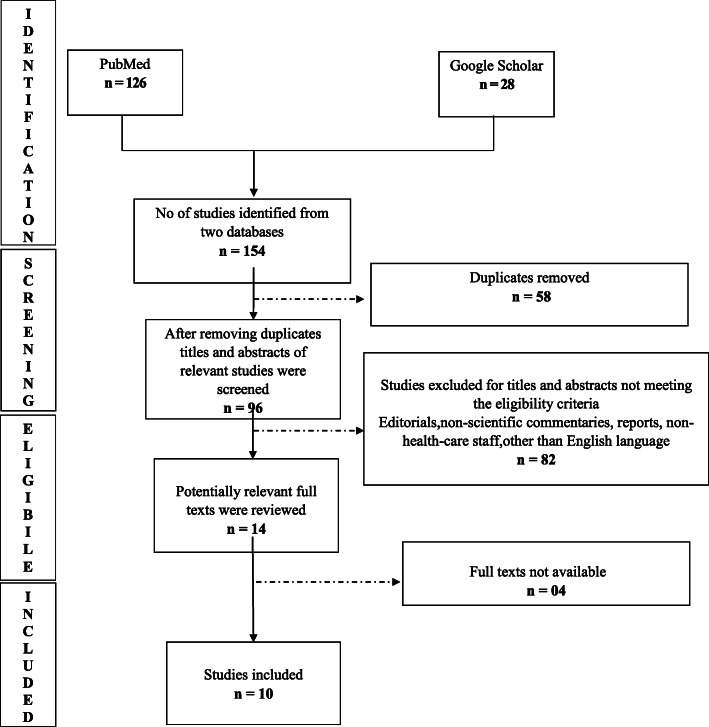
BACKGROUND: Coronavirus disease (COVID-19) pandemic has spread to 198 countries, with approximately 2.4 million confirmed cases and 150,000 deaths globally as of April 18. Frontline healthcare workers (HCWs) face a substantially higher risk of infection and death due to excessive COVID-19 exposure. This review aimed at summarizing the evidence of the physical and mental health impacts of COVID-19 pandemic on health-care workers (HCWs). METHODS: We used the Arksey O'Malley framework to conduct a scoping review. A systematic literature search was conducted using two databases: PubMed and Google Scholar. We found 154 studies, and out of which 10 met our criteria. We collected information on the date of publication, first author's country, the title of the article, study design, study population, intervention and outcome, and key findings, and divided all research articles into two domains: physical and mental health impact. RESULTS: We reviewed a total of 154 articles from PubMed (126) and Google Scholar (28), of which 58 were found to be duplicate articles and were excluded. Of the remaining 96 articles, 82 were excluded after screening for eligibility, and 4 articles did not have available full texts. Ten full-text articles were reviewed and included in this study. Our findings identified the following risk factors for COVID-19-related health impact: working in a high-risk department, diagnosed family member, inadequate hand hygiene, suboptimal hand hygiene before and after contact with patients, improper PPE use, close contact with patients (≥ 12 times/day), long daily contact hours (≥ 15 h), and unprotected exposure. The most common symptoms identified amongst HCWs were fever (85%), cough (70%), and weakness (70%). Prolonged PPE usage led to cutaneous manifestations and skin damage (97%), with the nasal bridge (83%) most commonly affected site. HCWs experienced high levels of depression, anxiety, insomnia, and distress. Female HCWs and nurses were disproportionately affected. CONCLUSION: The frontline healthcare workers are at risk of physical and mental consequences directly as the result of providing care to patients with COVID-19. Even though there are few intervention studies, early data suggest implementation strategies to reduce the chances of infections, shorter shift lengths, and mechanisms for mental health support could reduce the morbidity and mortality amongst HCWs.
Overview
The claims and statistics of this paper haven’t been checked yet.
Free: it reads the open-access text and checks the first 5 claims that cite a source we can check. Create a free account to check every claim.
Integrity signals
Registry
Cites
Statistics
Figures
Verification
Claims the paper makes
The claims and statistics of this paper haven’t been checked yet.
Free: it reads the open-access text and checks the first 5 claims that cite a source we can check. Create a free account to check every claim.
Claims other papers make about this one
Each is checked against this paper’s own text: does it say what the citing paper says it does?
The check wasn’t confident either way, so it gives no verdict — never disputed.
In the citing paper
“Thus, the COVID-19 pandemic acted as a catalyst for the development and adoption by health systems, especially of industrialized countries, of a broad range of telehealth technologies, developing and innovating in new virtual health facilities and telecare platforms to minimize these effects [3,4,5,6,7].”
From Telehealth and COVID-19 Pandemic: An Overview of the Telehealth Use, Advantages, Challenges, and Opportunities during COVID-19 Pandemic (2022) · cites this paper as [4]
Experimental — accuracy not yet measuredIn the citing paper
“Acute stress, including extreme anxiety and resignation symptoms, had already been observed, aggravated by nonoptimal disclosure of information about the pandemic (Marazziti, 2020;Shaukat, Ali & Razzak, 2020;Rossi et al., 2020;Zhang et al., 2020).”
From SECOND LINE VOLUNTEERING IN LOMBARDY COVID-19 EMERGENCY AS A PERSPECTIVE ON MEDICAL EDUCATION AND PSYCHOLOGICAL DISTRESS (2021) · doi:10.36131/cnfioritieditore20210506 · cites this paper as Shaukat, Ali & Razzak, 2020
Self-check
Percentages, sums and reported differences re-computed from the paper’s own numbers.
The self-check needs the paper’s full text.
Citations
Cites
Scoping studies: towards a methodological framework
Arksey, H., & O'Malley, L. (2005) · International Journal of Social Research Methodology · doi:10.1080/1364557032000119616 · Cited by 36,742
An interactive web-based dashboard to track COVID-19 in real time
Dong, E., Du, H., & Gardner, L. (2020) · The Lancet Infectious Diseases · doi:10.1016/s1473-3099(20)30120-1 · Cited by 10,048
Lai, J., Ma, S., Wang, Y., Cai, Z., Hu, J., Wei, N., Wu, J., Du, H., Chen, T., Li, R., et al. (2020) · JAMA Network Open · doi:10.1001/jamanetworkopen.2020.3976 · Cited by 8,015
First case of 2019 novel coronavirus in the United States
Holshue, M. L., DeBolt, C., Lindquist, S., Lofy, K. H., Wiesman, J., Bruce, H., Spitters, C., Ericson, K., Wilkerson, S., Tural, A., et al. (2020) · New England Journal of Medicine · doi:10.1056/nejmoa2001191 · Cited by 6,030
The epidemiology and pathogenesis of coronavirus disease (COVID-19) outbreak
Rothan, H. A., & Byrareddy, S. N. (2020) · Journal of Autoimmunity · doi:10.1016/j.jaut.2020.102433 · Cited by 5,840
Features, Evaluation and Treatment Coronavirus (COVID-19)
Cascella, M., Rajnik, M., Cuomo, A., Dulebohn, S. C., & Napoli, R. D. (2020) · StatPearls · Cited by 5,363
COVID-19 and Italy: what next?
Remuzzi, A., & Remuzzi, G. (2020) · The Lancet · doi:10.1016/s0140-6736(20)30627-9 · Cited by 3,119
Mental health care for medical staff in China during the COVID-19 outbreak
Chen, Q., Liang, M., Li, Y., Guo, J., Fei, D., Wang, L., He, L., Sheng, C., Cai, Y., Li, X., et al. (2020) · The Lancet Psychiatry · doi:10.1016/s2215-0366(20)30078-x · Cited by 2,233
The mental health of medical workers in Wuhan, China dealing with the 2019 novel coronavirus.
Kang, L., Li, Y., Hu, S., Chen, M., Yang, C., Yang, B. X., Wang, Y., Hu, J., Lai, J., Ma, X., et al. (2020) · The Lancet Psychiatry · doi:10.1016/s2215-0366(20)30047-x · Cited by 2,061
Maunder, R., Hunter, J., Vincent, L. H., Bennett, J. P., Peladeau, N., Leszcz, M., Sadavoy, J., Verhaeghe, L. M., Steinberg, R. J., & Mazzulli, T. (2003) · Europe PMC (PubMed Central) · Cited by 1,781
Xiao, H., Zhang, Y., Kong, D., Li, S., & Yang, N. (2020) · Medical Science Monitor · doi:10.12659/msm.923549 · Cited by 1,385
COVID-19: Protecting health-care workers
Lancet, T. (2020) · The Lancet · doi:10.1016/s0140-6736(20)30644-9 · Cited by 1,247 · cited 1×
“Similarly, Italy (20%), Spain (14%), and France (over 50 deaths amongst HCWs) reported high rates of HCW infection [10, 13, 14].”
BackgroundMaunder, R., Lancee, W., Balderson, K., Bennett, J., Borgundvaag, B., Evans, S., Fernandes, C., Goldbloom, D., Gupta, M., Hunter, J., et al. (2006) · Emerging Infectious Diseases · doi:10.3201/eid1212.060584 · Cited by 1,109
Xiao, H., Zhang, Y., Kong, D., Li, S., & Yang, N. (2020) · Medical Science Monitor · doi:10.12659/msm.923921 · Cited by 913
Wang, J., Zhou, M., & Liu, F. (2020) · Journal of Hospital Infection · doi:10.1016/j.jhin.2020.03.002 · Cited by 789
Ran, L., Chen, X., Wang, Y., Wu, W., Zhang, L., & Tan, X. (2020) · Clinical Infectious Diseases · doi:10.1093/cid/ciaa287 · Cited by 695
[Mental health survey of medical staff in a tertiary infectious disease hospital for COVID-19].
Huang, J., Han, M., Luo, T. D., Ake, R., & Zhou, X. (2020) · PubMed · doi:10.3760/cma.j.cn121094-20200219-00063 · Cited by 691 · cited 2×
“The tools used in these studies included Self-Rating Anxiety Scale [23, 25], Generalized Anxiety Disorder Scale [24], General Self-Efficacy Scale [25], Stanford Acute Stress Reaction Questionnaire [25], Pittsburgh Sleep Quality Index [25], Insomnia Severity Index [24], Social Support Rate Scale [25], Post-Traumatic St…”
BackgroundMethodCOVID-19 and the Risk to Health Care Workers: A Case Report
Ng, K., Poon, B. H., Kiat Puar, T. H., Shan Quah, J. L., Loh, W. J., Wong, Y. J., Tan, T. Y., & Raghuram, J. (2020) · Annals of Internal Medicine · doi:10.7326/l20-0175 · Cited by 612 · cited 1×
“All the HCWs were wearing surgical and N-95 masks at the time of exposure [28].”
BackgroundSkin damage among health care workers managing coronavirus disease-2019
Lan, J., Song, Z., Miao, X., Li, H., Li, Y., Dong, L., Yang, J., An, X., Zhang, Y., Yang, L., et al. (2020) · Journal of the American Academy of Dermatology · doi:10.1016/j.jaad.2020.03.014 · Cited by 587
Occupational risks for COVID-19 infection
Koh, D. (2020) · Occupational Medicine · doi:10.1093/occmed/kqaa036 · Cited by 534
Cheng, V. C. C., Wong, S.-C., Chen, J. H. K., Yip, C. C. Y., Chuang, V. W. M., Tsang, O. T. Y., Sridhar, S., Chan, J. F. W., Ho, P.-L., & Yuen, K.-Y. (2020) · Infection Control & Hospital Epidemiology · doi:10.1017/ice.2020.58 · Cited by 469 · cited 1×
“Common symptoms were fever (85%), cough (80%), weakness (70%), chest distress (7%), hemoptysis (7%), headache (7%), and diarrhea (7%) [17, 26, 27].”
BackgroundThe resilience of the Spanish health system against the COVID-19 pandemic
Legido-Quigley, H., Mateos-García, J. T., Campos, V. R., Gea-Sánchez, M., Muntaner, C., & McKee, M. (2020) · The Lancet Public Health · doi:10.1016/s2468-2667(20)30060-8 · Cited by 452
The novel Chinese coronavirus (2019-nCoV) infections: Challenges for fighting the storm.
Bassetti, M., Vena, A., & Giacobbe, D. R. (2020) · European Journal of Clinical Investigation · doi:10.1111/eci.13209 · Cited by 423
Ji, D., Ji, Y.-J., Duan, X.-Z., Li, W.-G., Sun, Z.-Q., Song, X.-A., Meng, Y.-H., Tang, H.-M., Chu, F., Niu, X.-X., et al. (2017) · Oncotarget · doi:10.18632/oncotarget.14498 · Cited by 257
[Clinical characteristics of 30 medical workers infected with new coronavirus pneumonia].
Liu, M., He, P., Liu, H. G., Wang, X. J., Li, F. J., Chen, S., Lin, J., Chen, P., Liu, H., & Li, C. H. (2020) · PubMed · doi:10.3760/cma.j.issn.1001-0939.2020.0016 · Cited by 243
Health-care worker mortality and the legacy of the Ebola epidemic
Evans, D. K., Goldstein, M., & Popova, A. (2015) · The Lancet Global Health · doi:10.1016/s2214-109x(15)00065-0 · Cited by 224
Cheng, V. C.-C., Wong, S.-C., Chan, V. W.-M., So, S. Y.-C., Chen, J. H.-K., Yip, C. C.-Y., Chan, K.-H., Chu, H., Chung, T. W.-H., Sridhar, S., et al. (2020) · Infection Control & Hospital Epidemiology · doi:10.1017/ice.2020.282 · Cited by 192
Bacterial and fungal infections in COVID-19 patients: A matter of concern
Zhou, P., Liu, Z., Chen, Y., Xiao, Y., Huang, X., & Fan, X.-G. (2020) · Infection Control & Hospital Epidemiology · doi:10.1017/ice.2020.156 · Cited by 187
Wang, X., Zhang, X., & He, J. (2020) · BioScience Trends · doi:10.5582/bst.2020.01043 · Cited by 179
Severe Acute Respiratory Syndrome (SARS) and Healthcare Workers
Chan-Yeung, M. (2004) · International Journal of Occupational and Environmental Health · doi:10.1179/oeh.2004.10.4.421 · Cited by 175
Cavallo, J. J., Donoho, D. A., & Forman, H. P. (2020) · JAMA Health Forum · doi:10.1001/jamahealthforum.2020.0345 · Cited by 163 · cited 2×
“Early COVID-19 studies indicate a worrisome situation of morbidity and mortality [16, 20].”
BackgroundProtecting Chinese healthcare workers while combating the 2019 novel coronavirus
Zhou, P., Huang, Z., Xiao, Y., Huang, X., & Fan, X.-G. (2020) · Infection Control & Hospital Epidemiology · doi:10.1017/ice.2020.60 · Cited by 149
Selvaraj, S. A., Lee, K. E., Harrell, M., Ivanov, I., & Allegranzi, B. (2018) · The Journal of Infectious Diseases · doi:10.1093/infdis/jiy435 · Cited by 125
Abolfotouh, M. A., AlQarni, A. A., Al-Ghamdi, S. M., Salam, M., Al-Assiri, M. H., & Balkhy, H. H. (2017) · BMC Infectious Diseases · doi:10.1186/s12879-016-2096-8 · Cited by 122 · cited 1×
“During the MERS outbreak, a Saudi study reported almost two-third of HCWs felt at risk of getting infected with MERS CoV and felt unsafe at work [39].”
BackgroundFactors Underlying Ebola Virus Infection Among Health Workers, Kenema, Sierra Leone, 2014–2015
Senga, M., Pringle, K. D., Ramsay, A., Brett‐Major, D. M., Fowler, R., French, I., Vandi, M. A., Sellu, J., Pratt, C., Saidu, J., et al. (2016) · Clinical Infectious Diseases · doi:10.1093/cid/ciw327 · Cited by 69
Lin, M., Beliavsky, A., Katz, K. C., Powis, J. E., Ng, W., Williams, V. L., Science, M. E., Groves, H. E., Mp, M., Vaisman, A., et al. (2020) · Canadian Medical Association Journal · doi:10.1503/cmaj.200305 · Cited by 45
Ebola Virus Disease in Health Care Workers — Guinea, 2014
Grinnell, M., Dixon, M. G., Patton, M. E., Fitter, D. L., Bilivogui, P., Johnson, C. Y., Dotson, E. M., Diallo, B., Rodier, G. R., & Raghunathan, P. L. (2015) · MMWR Morbidity and Mortality Weekly Report · doi:10.15585/mmwr.mm6438a6 · Cited by 40
Shalhoub, S., Al-Hameed, F. M., Mandourah, Y., Balkhy, H. H., Al‐Omari, A., Mekhlafi, G. A. A., Kharaba, A. M., Alraddadi, B. M., Almotairi, A., Khatib, K. A., et al. (2018) · PLoS ONE · doi:10.1371/journal.pone.0206831 · Cited by 33
Cited by
COVID-19 Vaccine Hesitancy Worldwide: A Concise Systematic Review of Vaccine Acceptance Rates
Sallam, M. (2021) · Vaccines · doi:10.3390/vaccines9020160 · Cited by 2,128
Galanis, P., Vraka, I., Fragkou, D., Bilali, A., & Kaitelidou, D. (2021) · Journal of Advanced Nursing · doi:10.1111/jan.14839 · Cited by 993
Serrano-Ripoll, M. J., Meneses-Echavez, J. F., Ricci-Cabello, I., Fraile-Navarro, D., Fiol-deRoque, M. A., Pastor-Moreno, G., Castro, A., Ruiz-Pérez, I., Zamanillo Campos, R., & Gonçalves-Bradley, D. C. (2020) · Journal of Affective Disorders · doi:10.1016/j.jad.2020.08.034 · Cited by 592
“We searched databases from inception to 3rd August 2020, and checked the list of included studies of relevant systematic reviews (Shaukat et al., 2020; Pappa et al., 2020; Pan et al., 2020; Luo et al., 2020; Kisely et al., 2020; Garcia-Iglesias et al., 2020; Carmassi et al., 2020; Brooks et al., 2018) to identify pote…”
Li, Y., Scherer, N., Felix, L., & Kuper, H. (2021) · PLOS ONE · doi:10.1371/journal.pone.0246454 · Cited by 536
Marvaldi, M., Mallet, J., Dubertret, C., Moro, M. R., & Guessoum, S. B. (2021) · Neuroscience & Biobehavioral Reviews · doi:10.1016/j.neubiorev.2021.03.024 · Cited by 517
Metadata
- Authors
- Shaukat, N., Ali, D. M., & Razzak, J.
- Affiliations
- Aga Khan University (PK)
- Corresponding author
- Shaukat, Natasha
- Venue
- International Journal of Emergency Medicine
- Published
- 2020-07-20
- Volume
- 13
- Issue
- 1
- Pages
- 40-40
- ISSN
- 1865-1372 (ISSN-L)
- 1865-1380
- PMC
- PMC7370263
- OpenAlex
- W3043065230
- Cited by
- 879
- References
- 38
- Citations by year
- 2026: 27 · 2025: 49 · 2024: 94 · 2023: 155 · 2022: 257 · 2021: 275 · 2020: 22
- FWCI
- 14.04
- Type
- journal article
- Language
- en
- Open access
- gold
- doi.org
- Licence
- cc-by
- creativecommons.org/licenses/by/4.0 (tdm)
- creativecommons.org/licenses/by/4.0 (vor)
- Locations
- International Journal of Emergency Medicine (publishedVersion, cc-by)
- PubMed Central (publishedVersion, cc-by)
- PubMed (publishedVersion)
- eCommons - AKU (Aga Khan University) (submittedVersion, cc-by)
- DOAJ (DOAJ: Directory of Open Access Journals) (submittedVersion, cc-by-sa)
- Topics
- Social Sciences › Psychology › Clinical Psychology › COVID-19 and Mental Health
- Health Sciences › Health Professions › General Health Professions › Healthcare Systems and Challenges
- Health Sciences › Medicine › Clinical Neurology › Long-Term Effects of COVID-19
- Keywords
- COVID-19 pandemic, healthcare workers, occupational exposure, physical health, mental health, depression, anxiety, insomnia, personal protective equipment, hand hygiene, skin damage, nurses, risk factors, infection control
About these checks
Registry, retraction, Cites and statistics results are computed, not judged, with one exception: a printed reference that no index lists is read once by a model before it counts as a citation error. Claims are extracted by a model and kept only when their quote appears verbatim in the text; each cited source is then checked, with a model’s help, for whether it says what the claim relies on. Those verdicts can be wrong — read the claim’s quote and the cited source before relying on one.
Statistics and arithmetic are recomputed, not judged.
Confidence bands are shown only for fields calibrated on our annotated test set. None is calibrated yet, so no band is shown.
What counts as a claim ›How we measure confidence ›How we check this ›
Are you an author, or do you see a problem with this page? Request a review
Data sources
Bibliographic data: Semantic Scholar, OpenAlex, Crossref.
Contains information from the Semantic Scholar Academic Graph Datasets, made available under the ODC Attribution License (ODC-BY 1.0).
Semantic Scholar’s data is described in: Kinney, R., et al. (2023). The Semantic Scholar Open Data Platform. arXiv:2301.10140.
