

Cost-effectiveness of the mobile application TCApp combined with face-to-face CBT treatment compared to face-to-face CBT treatment alone for patients with an eating disorder: study protocol of a multi-centre randomised controlled trial
Open accessThe DOI matches its Crossref record; 54 of the 56 references it cites were found in a registry or an index; 19 of the 50 sources its claims cite were checked for support.
Abstract
Background: The clinical utility of the existing apps for people with eating disorders (EDs) is not clear. The TCApp has been specifically developed for people with EDs, is based on the principles of Cognitive Behavioural Treatment (CBT) and allows a bidirectional link between the patient and the therapist. The objectives of the study are, first, to assess the clinical efficacy of a combined intervention for Eating Disorders (EDs) that includes an online intervention through the TCApp plus standard face-to-face CBT in comparison to standard face-to-face CBT alone, and second, to examine the cost-effectiveness of the TCApp and identify potential predicting, moderating and mediating variables that promote or hinder the implementation of the TCApp in ED units in Spain. Methods: The study methodology is that of a randomised controlled trial combining qualitative and quantitative methods, with a 6-month follow-up. Approximately 250 patients over 12 years old with a diagnosis of an ED from several ED units in Spain will be randomised to one of two different conditions. Participants, their caregivers, healthcare professionals and technical staff involved in the development and maintenance of the application will be assessed at baseline (T0), post-intervention (T1) and at 6 months follow-up (T2). Primary outcome measures will include ED symptomatology while secondary measures will include general psychopathology and quality of life for patients, quality of life and caregiving experience for family caregivers and adoption-related variables for all participants involved, such as perceived usability, user's satisfaction and technology acceptance. For the cost-effectiveness analysis, we will assess quality-adjusted life years (QALYs); total societal cost will be estimated using costs to patients and the health plan, and other related costs. Discussion: The study will provide an important advance in the treatment of EDs; in the long term, it is expected to improve the quality of patient care and the treatment efficacy and to reduce waiting lists as well as direct and indirect costs associated with the treatment of EDs in Spain. © 2018 The Author(s).
Overview
CoChat Summary
## TL;DR
This is a study protocol for a multi-centre randomized controlled trial testing whether TCApp, a mobile app added to standard face-to-face CBT for eating disorders, improves clinical outcomes and is cost-effective versus CBT alone. The planned trial will enroll approximately 250 patients in Spain and follow them for 6 months.
## Key findings
- The paper does not report trial results; it presents a protocol only.
- The planned trial will randomize approximately 250 patients with eating disorders in Spain to TCApp + treatment as usual (TAU) versus TAU alone with 1:1 allocation.
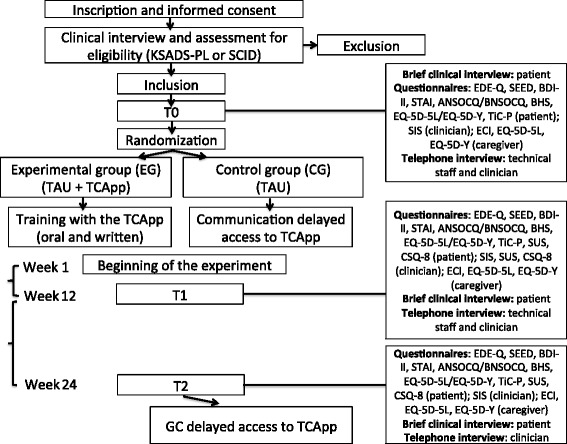
- The intervention is planned for 12 weeks, with assessments at baseline (T0), post-intervention (T1), and 6-month follow-up (T2).
- The main outcome is eating disorder symptomatology measured by the EDE-Q; secondary outcomes include depression, anxiety, quality of life, readiness to recover, suicidal risk, caregiver burden, usability, satisfaction, and technology acceptance.
## Methods
- Design: Multi-centre randomized controlled trial using a mixed-methods approach, with two parallel groups and 1:1 allocation.
- Sample/data: About 250 patients with a diagnosis of an eating disorder, age 12 years or older, recruited from public and private ED units in Spain; caregivers, clinicians, and technical staff are also assessed.
- Main analysis: Intent-to-treat and completers analyses; between-group tests include chi-square/Fisher’s exact test and t test/Mann-Whitney U, with mixed model linear regression for outcome change over time and a cost-effectiveness analysis using QALYs and ICER.
## Limitations
- The paper explicitly states two limitations: the short follow-up time and the delayed access to TCApp for the control group, both of which may influence results.
- The authors also note that it is a multi-centre study across several public and private ED units in Spain, which may introduce between-centre heterogeneity; they plan subgroup analyses to address this.
- Because this is a protocol, no efficacy or cost-effectiveness results are available yet.
Model-written summary. Check it against the paper before relying on it.
Integrity signals
Registry
Cites
Statistics
Figures
Verification
Claims the paper makes
11 Valid · 2 Not valid · 16 Not checked · 14 Own results and interpretations
Some cited sources support this claim and some don’t — read each source’s verdict below.
In the paper
“Systematic reviews of the literature demonstrate the effectiveness of eHealth as a complementary therapeutic tool in the treatment of EDs [11–16].”
§ Cost-effectiveness of the mobile application TCApp combined with face-to-face CBT treatment compared to face-to-face CBT treatment alone for patients with an eating disorder: study protocol of a multi-centre randomised controlled trial > Background
What the sources say
- Disputedcites [11] Fairburn CG, Rothwell ER. Apps and eating disorders: a systematic clinical appraisal. Int J Eat Disord. 2015;48:1038–46. 10.1002/eat.22398. PMC4737215 25728705 sourceExperimental — accuracy not yet measured
The Discussion says no studies had been published on the therapeutic effects of the eating-disorder apps it appraised (pp. 1038–1046). It presents their use to augment face-to-face treatment as a possibility, not a demonstrated effective complementary therapy. The paper addresses apps rather than all forms of eHealth. (LLM, conf=0.86)
Checked by a reasoning model — may be wrong.
- Not checked — no full text of the sourcecites [12] Bauer S Moessner M Harnessing the power of technology for the treatment and prevention of eating disorders Int J Eat Disord. 2013 46 508 515 10.1002/eat.22109 23658102 source
- Disputedcites [13] Loucas CE Fairburn CG Whittington C Pennant ME Stockton S Kendall T E-therapy in the treatment and prevention of eating disorders: a systematic review and meta-analysis Behav Res Ther 2014 63 122 131 10.1016/j.brat.2014.09.011 25461787 PMC4271736 sourceExperimental — accuracy not yet measured
The Discussion says no firm conclusions can be drawn from the eating-disorder treatment studies because few effects emerged and confidence in the estimates was low. Although the review found some beneficial effects, it explicitly concludes that the value of e-therapy as a treatment remains uncertain, rather than demonstrating its effectiveness. (LLM, conf=0.90)
Checked by a reasoning model — may be wrong.
- Not checked — no full text of the sourcecites [14] Aardoom JJ Dingemans AE Spinhoven P Van Furth EF Beintner I Jacobi C Treating eating disorders over the Internet: a systematic review and future research directions Behav Res Ther 2013 4 1 16 23674367 source
- Disputedcites [15] Juarascio AS, Manasse SM, Goldstein SP, Forman EM, Butryn ML. Review of smartphone applications for the treatment of eating disorders. Eur Eat Disord Rev. 2015;23:1-11. 10.1002/erv.2327. PMC4847127 25303148 sourceExperimental — accuracy not yet measured
The Discussion (Future research; Conclusion, page not available) describes smartphone apps as a promising adjunct to eating-disorder treatment, but says their effectiveness has not been established. It states that none of the reviewed apps had undergone rigorous evaluation and that there was no empirical evidence they improved treatment efficacy. This review therefore does not demonstrate the effectiveness attributed to it; its conclusion is narrower than a claim about all eHealth interventions. (LLM, conf=0.85)
Checked by a reasoning model — may be wrong.
- Partly supportedcites [16] Traviss-Turner GD, West RM, Hill AJ. Guided self-help for eating disorders: A systematic review and metaregression. Eur Eat Disord Rev. 2017;25:148–64.10.1002/erv.2507. 28276171 sourceExperimental — accuracy not yet measured
The Conclusions report that guided self-help is effective for eating disorders, and the Intervention section says some included studies delivered it online. But the review does not establish the effectiveness of eHealth as a complementary therapeutic tool; the Conclusions call for further research on incorporating eHealth into guided self-help. The cited passages have section labels but no page numbers. (LLM, conf=0.87)
boostedstates a cause- Asserted: passes — The authors put it forward as true.
- Checkable: passes — It can be checked against evidence.
- Load-bearing: passes — The paper’s conclusions depend on it.
- Based: passes — The paper gives a reason why it holds.
- Disputed
The sources with a verdict support this claim; the rest weren’t checked yet, have no full text we could read, or their verdicts aren’t rated yet.
In the paper
“The clinical utility of the existing apps for people with eating disorders (EDs) is not clear.”
§ Cost-effectiveness of the mobile application TCApp combined with face-to-face CBT treatment compared to face-to-face CBT treatment alone for patients with an eating disorder: study protocol of a multi-centre randomised controlled trial > Abstract > Background
What the sources say
- Supportedcites [20] Juarascio AS, Goldstein SP, Manasse SM, Forman EM, Butryn ML. Perceptions of the feasibility and acceptability of a smartphone application for the treatment of binge eating disorders: qualitative feedback from a user population and clinicians. Int J Med Inform. 2015;84:808–16. 10.1016/j.ijmedinf.2015.06.004. PMC4860812 26113461 source
The Introduction (§1.4; page not provided) lists eating-disorder apps among existing mental-health apps and says these apps have not been assessed for effectiveness, while many lack an empirical basis. That supports the statement that their clinical utility is unclear. (LLM, conf=0.92)
- Could not verifycites [21] Nitsch M, Dimopoulos CN, Flaschberger E, Saffran K, Kruger F, Garlock L, et al. A Guided Online and Mobile Self-Help Program for Individuals With Eating Disorders: An Iterative Engagement and Usability Study. J Med Internet Res. 2016;18:1–11. 10.2196/jmir.4972. PMC4726867 26753539 sourceExperimental — accuracy not yet measured
The Introduction (page unavailable) says online eating-disorder programs have shown promising results, while identifying uncertainty about dropout and engagement—not about the clinical utility of existing apps. The Methods and Conclusions (pages unavailable) describe usability testing of one program. Searches for app effectiveness, clinical outcomes, and clinical utility found no passage making the attributed claim. (LLM, conf=0.72)
- Not checked — no full text of the sourcecites [22] Tregarthen JP, Lock J, Darcy AM. Development of a smartphone application for eating disorder self-monitoring. Int J Eat Disord. 2015;48:972-82. 10.1002/eat.22386. 26213130 source
plain- Asserted: passes — The authors put it forward as true.
- Checkable: passes — It can be checked against evidence.
- Load-bearing: passes — The paper’s conclusions depend on it.
- Based: passes — The paper gives a reason why it holds.
- Supported
The sources with a verdict support this claim; the rest weren’t checked yet, have no full text we could read, or their verdicts aren’t rated yet.
In the paper
“Internet-based interventions have proved their efficacy in reducing ED-related symptoms in a number of Randomised Controlled Trials (RCTs) [17–19].”
§ Cost-effectiveness of the mobile application TCApp combined with face-to-face CBT treatment compared to face-to-face CBT treatment alone for patients with an eating disorder: study protocol of a multi-centre randomised controlled trial > Background
What the sources say
- Supportedcites [17] Kass AE, Trockel M, Safer DL, Sinton MM, Cunning D, Rizk MT, et al. Internet-based preventive intervention for reducing eating disorder risk: a randomized controlled trial comparing guided with unguided self-help. Behav Res Ther. 2014;631:90–8. 10.1016/j.brat.2014.09.010. PMC4383716 25461783 source
The opening passage labeled Abstract in our copy says internet-based interventions have been tested against face-to-face treatment, educational materials and wait-list controls, and have demonstrated reductions in eating-disorder symptoms. The References also identify multiple randomized trials of internet-based eating-disorder interventions. The claim describes that broader trial literature, rather than asserting that guided self-help outperformed unguided self-help in this particular trial. (LLM, conf=0.88)
- Not checked — no full text of the sourcecites [18] Hötzel K, Von Brachel R, Schmidt U, Rieger E, Kosfelder J, Hechler T, et al. An internet-based program to enhance motivation to change in females with symptoms of an eating disorder: a randomized controlled trial. Psychol Med. 2014;44:1947–63. 10.1017/S0033291713002481. 24128818 source
- Not checked — no full text of the sourcecites [19] Sanchez-Ortiz V, Munro C, Stahl D, J H, Startup H, Treasure J, et al. A randomized controlled trial of internet-based cognitive-behavioural therapy for bulimia nervosa or related disorders in a student population. Psychol Med. 2011;41:407–17. 10.1017/S0033291710000711. 20406523 source
boostedstates a cause- Asserted: passes — The authors put it forward as true.
- Checkable: passes — It can be checked against evidence.
- Load-bearing: unclear — It is unclear whether the paper’s conclusions depend on it.
- Based: passes — The paper gives a reason why it holds.
- Supported
The cited sources support only part of this claim — read each source’s verdict below.
In the paper
“The a priori sample size calculation was based on results from previous studies that implemented Internet-based programs in the treatment of EDs [58–60].”
§ Cost-effectiveness of the mobile application TCApp combined with face-to-face CBT treatment compared to face-to-face CBT treatment alone for patients with an eating disorder: study protocol of a multi-centre randomised controlled trial > Methods > Sample size calculation
What the sources say
- Partly supportedcites [58] Aardoom JJ Dingemans AE Spinhoven P Roijen LH Van Furth EF An internet-based intervention for eating disorders consisting of automated computer-tailored feedback with or without supplemented frequent or infrequent support from a coach: study protocol for a randomized controlled trial Trials 2013 14 340 10.1186/1745-6215-14-340 24135131 PMC3853403 sourceExperimental — accuracy not yet measured
The Methods > Sample size section describes an a priori calculation for an Internet-based eating-disorder intervention. It bases the calculation on an expected effect size and a dropout estimate from Internet-based interventions generally, not on reported results of previous Internet-based eating-disorder treatment studies. This paper is a study protocol and does not report treatment results of its own. (LLM, conf=0.85)
- Not checked — no full text of the sourcecites [59] Hötzel K von Brachel R Schmidt U Rieger E Kosfelder J Hechler T An internet-based program to enhance motivation to change in females with symptoms of an eating disorder: a randomized controlled trial Psychol Med 2014 44 1947 1963 10.1017/S0033291713002481 24128818 source
- Not checked — no full text of the sourcecites [60] Ruwaard J Lange A Broeksteeg J Renteria-Agirre A Schrieken B Dolan CV Online cognitive-Behavioural treatment of bulimic symptoms: a randomized controlled trial Clin Psychol Psychother 2013 20 308 318 10.1002/cpp.1767 22298417 source
plain- Asserted: passes — The authors put it forward as true.
- Checkable: passes — It can be checked against evidence.
- Load-bearing: unclear — It is unclear whether the paper’s conclusions depend on it.
- Based: passes — The paper gives a reason why it holds.
- Partly supported
What the paper did — it cites no source for this, so there is none to check. The quote shows it is in the paper.
In the paper
“Assuming an alpha of 0.05 and a power of 0.80 (β − 1) in an independent samples one-way t-test study, a minimum of 100 participants would be required per study arm.”
§ Cost-effectiveness of the mobile application TCApp combined with face-to-face CBT treatment compared to face-to-face CBT treatment alone for patients with an eating disorder: study protocol of a multi-centre randomised controlled trial > Methods > Sample size calculation
plainn = 100- Asserted: passes — The authors put it forward as true.
- Checkable: passes — It can be checked against evidence.
- Load-bearing: passes — The paper’s conclusions depend on it.
- Based: passes — The paper gives a reason why it holds.
1 more claim
Create a free account to see all 43 claims and to verify the 3 references still open.
- Probably not a substantial claim. 27
- It may state two separate claims as one. 21
Citations
Cites
(1970) · Cited by 24,983
EuroQol: a new facility for the measurement of health-related quality of life
(1990) · Health Policy · doi:10.1016/0168-8510(90)90421-9 · Cited by 15,736
KAUFMAN, J., BIRMAHER, B., BRENT, D., RAO, U., FLYNN, C., MORECI, P., WILLIAMSON, D., & RYAN, N. (1997) · Journal of the American Academy of Child & Adolescent Psychiatry · doi:10.1097/00004583-199707000-00021 · Cited by 10,148 · cited 1×
“Diagnosis of an Eating or Feeding Disorder, based on: a) the Schedule for Affective Disorders and Schizophrenia-Present and Lifetime version (K-SADS-S-PL) (DSM-V criteria) [29] for minor patients or b) the Structural Clinical Interview for DSM-IV (SCID-1) [30] for adult patients.”
MethodLippa, N. C., & Sanderson, S. C. (2013) · Human Heredity · doi:10.1159/000353712 · Cited by 6,078
Comparison of Beck Depression Inventories -IA and -II in psychiatric outpatients
Beck, A. T., Steer, R. A., Ball, R., & Ranieri, W. F. (1996) · Journal of Personality Assessment · doi:10.1207/s15327752jpa6703_13 · Cited by 5,965 · cited 2×
“For patients Beck Depression Inventory (BDI-II) [35].”
The measurement of pessimism: the hopelessness scale
Beck, A. T., Weissman, A., Lester, D., & Trexler, L. (1974) · Journal of Consulting and Clinical Psychology · doi:10.1037/h0037562 · Cited by 5,494
State-Trait Anxiety Inventory for Adults
Spielberger, C. D. (2012) · PsycTESTS Dataset · doi:10.1037/t06496-000 · Cited by 3,479
Assessment of client/patient satisfaction: development of a general scale
Larsen, D. L., Attkisson, C. C., Hargreaves, W. A., & Nguyen, T. D. (1979) · Evaluation and Program Planning · doi:10.1016/0149-7189(79)90094-6 · Cited by 2,887 · cited 4×
“The CSQ-8 is an 8-item questionnaire that is designed to measure client satisfaction with services.”
InfluentialThe outcome of anorexia nervosa in the 20th century
Steinhausen, H.-C. (2002) · American Journal of Psychiatry · doi:10.1176/appi.ajp.159.8.1284 · Cited by 1,761 · cited 1×
“Although we do not have specific data related to the economic burden of treatment in Spain, various Cost Of Illness (COI) studies conducted in other European countries indicate that the direct costs for diagnosis and treatment of patients (medical expenditures, nonmedical costs, out-of-pocket expenses of the patient a…”
Background(2013) · Journal of Usability Studies archive · Cited by 1,357
Smartphones for smarter delivery of mental health programs: A systematic review
Donker, T., Petrie, K., Proudfoot, J., Clarke, J., Birch, M.-R., & Christensen, H. (2013) · Journal of Medical Internet Research · doi:10.2196/jmir.2791 · Cited by 1,136 · cited 1×
“This is an important strength of this study because to our knowledge, there are only a few apps for mental disorders with supporting evidence from RCTs and none of them was specifically designed for people with EDs or ED professionals [11, 61].”
BackgroundOn the Validity of the Beck Depression Inventory
Richter, P., Werner, J., Heerlein, A., Kraus, A., & Sauer, H. (1998) · Psychopathology · doi:10.1159/000066239 · Cited by 1,113
Measuring processes of change: Applications to the cessation of smoking.
Prochaska, J. O., Velicer, W. F., DiClemente, C. C., & Fava, J. (1988) · Journal of Consulting and Clinical Psychology · doi:10.1037//0022-006x.56.4.520 · Cited by 1,110 · cited 1×
“Both questionnaires are composed of 20 items and scores on each item range from 1 to 5, following stages of change model by Prochaska and colleagues (1998) [43], according to which "1" signifies the Precontemplation stage, "2" is for Contemplation, "3" is for Preparation, "4" is for Action and "5" is for Maintenance.”
MethodBerg, K. C., Peterson, C. B., Frazier, P., & Crow, S. J. (2012) · International Journal of Eating Disorders · doi:10.1002/eat.20931 · Cited by 1,042 · cited 1×
“The EDE-Q has demonstrated good reliability and validity both in its original version [33] and in Spanish [32].”
BackgroundDevelopment of suicidal intent scales.
Beck, A. T., Schuyler, D., & Herman, I. (1974) · Cited by 710
Szmukler, G. I., Burgess, P., Herrman, H., Bloch, S., Benson, A., & Colusa, S. (1996) · Social Psychiatry and Psychiatric Epidemiology · doi:10.1007/bf00785760 · Cited by 453
Bouwmans, C., De Jong, K., Timman, R., Zijlstra-Vlasveld, M., Van der Feltz-Cornelis, C., Tan, S. S., & Hakkaart-van Roijen, L. (2013) · BMC Health Services Research · doi:10.1186/1472-6963-13-217 · Cited by 401 · cited 1×
“The feasibility and reliability of the instrument was satisfactory and the construct validity of the questions related to healthcare utilisation and longterm work absenteeism was also good [50].”
BackgroundA comprehensive meta‐analysis of the risk of suicide in eating disorders
Preti, A., Rocchi, M. B. L., Sisti, D., Camboni, M. V., & Miotto, P. (2011) · Acta Psychiatrica Scandinavica · doi:10.1111/j.1600-0447.2010.01641.x · Cited by 295 · cited 1×
“to their growing incidence, the severity of the associated physical and psychiatric comorbidities [1], the high suicide and mortality rates [2] and the resistance of patients to treatment [3], among other reasons.”
BackgroundA systematic review of family caregiving in eating disorders
Anastasiadou, D., Medina-Pradas, C., Sepulveda, A. R., & Treasure, J. (2014) · Eating Behaviors · doi:10.1016/j.eatbeh.2014.06.001 · Cited by 222 · cited 1×
“Although we do not have specific data related to the economic burden of treatment in Spain, various Cost Of Illness (COI) studies conducted in other European countries indicate that the direct costs for diagnosis and treatment of patients (medical expenditures, nonmedical costs, out-of-pocket expenses of the patient a…”
BackgroundSelf-citationTHE CONSEQUENCES AND COSTS OF THE EATING DISORDERS
Agras, W. S. (2001) · Psychiatric Clinics of North America · doi:10.1016/s0193-953x(05)70232-x · Cited by 213 · cited 1×
“to their growing incidence, the severity of the associated physical and psychiatric comorbidities [1], the high suicide and mortality rates [2] and the resistance of patients to treatment [3], among other reasons.”
BackgroundRieger, E., Touyz, S. W., & Beumont, P. J. V. (2002) · International Journal of Eating Disorders · doi:10.1002/eat.10056 · Cited by 179 · cited 5×
“The ANSOCQ showed good internal consistency and one-week test-retest reliability, both in the English and Spanish version [44].”
MethodInfluentialCost‐of‐illness studies and cost‐effectiveness analyses in eating disorders: A systematic review
Stuhldreher, N., Konnopka, A., Wild, B., Herzog, W., Zipfel, S., Löwe, B., & König, H. (2012) · International Journal of Eating Disorders · doi:10.1002/eat.20977 · Cited by 179 · cited 1×
“However, according to the systematic review conducted by Stuhldreher et al. (2012), COI studies are sparse, the costs are often underestimated, the majority target only outpatient settings, and due to their heterogeneous nature, it is impossible to carry out comparisons between studies.”
BackgroundA psychometric comparison of the Beck Depression Inventory-II in English and Spanish.
Wiebe, J. S., & Penley, J. A. (2005) · Psychological Assessment · doi:10.1037/1040-3590.17.4.481 · Cited by 178 · cited 1×
“languages, among clinical and non-clinical samples [36, 37].”
E-therapy in the treatment and prevention of eating disorders: A systematic review and meta-analysis
Loucas, C. E., Fairburn, C. G., Whittington, C., Pennant, M. E., Stockton, S., & Kendall, T. (2014) · Behaviour Research and Therapy · doi:10.1016/j.brat.2014.09.011 · Cited by 169 · cited 1×
“Although the efficacy of online CBT interventions as alternatives to face-to-face treatment for patients with EDs is rather controversial [13, 23], such interventions may have a lot of advantages when used as therapeutic tools.”
BackgroundTreating eating disorders over the internet: A systematic review and future research directions
Aardoom, J. J., Dingemans, A. E., Spinhoven, P., & Van Furth, E. F. (2013) · International Journal of Eating Disorders · doi:10.1002/eat.22135 · Cited by 158
The global dissemination of psychological treatments: A road map for research and practice
Fairburn, C. G., & Patel, V. (2014) · American Journal of Psychiatry · doi:10.1176/appi.ajp.2013.13111546 · Cited by 157 · cited 1×
“In addition, reminders and motivational messages as well as bidirectional interactions between patient and therapist can improve adherence to treatment [24].”
BackgroundSánchez-Ortiz, V. C., Munro, C., Stahl, D., House, J., Startup, H., Treasure, J., Williams, C., & Schmidt, U. (2011) · Psychological Medicine · doi:10.1017/s0033291710000711 · Cited by 154
Development of a smartphone application for eating disorder self‐monitoring
Tregarthen, J. P., Lock, J., & Darcy, A. M. (2015) · International Journal of Eating Disorders · doi:10.1002/eat.22386 · Cited by 152
Decaluwé, V., & Braet, C. (2004) · Behaviour Research and Therapy · doi:10.1016/j.brat.2003.07.008 · Cited by 152
Studies in desensitization—II: Flooding
Rachman, S. (1966) · Behaviour Research and Therapy · doi:10.1016/0005-7967(66)90037-4 · Cited by 149
Review of Smartphone Applications for the Treatment of Eating Disorders
Juarascio, A. S., Manasse, S. M., Goldstein, S. P., Forman, E. M., & Butryn, M. L. (2015) · European Eating Disorders Review · doi:10.1002/erv.2327 · Cited by 143
App-based psychological interventions: friend or foe?
Leigh, S., & Flatt, S. (2015) · Evidence Based Mental Health · doi:10.1136/eb-2015-102203 · Cited by 140 · cited 1×
“As a result, a huge number of health apps are widely available to the general healthcare public without possessing best-practice guidelines and certifications or a standardised validation process to assess their long-term cost benefits [28].”
BackgroundConstruction, scoring and validation of the Short Evaluation of Eating Disorders (SEED)
Bauer, S., Winn, S., Schmidt, U., & Kordy, H. (2005) · European Eating Disorders Review · doi:10.1002/erv.637 · Cited by 129 · cited 6×
“The construct validity and the criterion-related validity of the SEED yielded positive results and the sensitivity to change of the instrument was also satisfactory [34].”
BackgroundInfluentialHarnessing the power of technology for the treatment and prevention of eating disorders
Bauer, S., & Moessner, M. (2013) · International Journal of Eating Disorders · doi:10.1002/eat.22109 · Cited by 128 · cited 1×
“Self-monitoring is the key driver of behavioural change as it helps patients intervene in the moment [12].”
BackgroundApps and eating disorders: A systematic clinical appraisal
Fairburn, C. G., & Rothwell, E. R. (2015) · International Journal of Eating Disorders · doi:10.1002/eat.22398 · Cited by 121 · cited 1×
“This is an important strength of this study because to our knowledge, there are only a few apps for mental disorders with supporting evidence from RCTs and none of them was specifically designed for people with EDs or ED professionals [11, 61].”
BackgroundThe Economics of eHealth and mHealth
Schweitzer, J., & Synowiec, C. (2012) · Journal of Health Communication · doi:10.1080/10810730.2011.649158 · Cited by 109
Internet-based interventions for eating disorders in adults: a systematic review
Dölemeyer, R., Tietjen, A., Kersting, A., & Wagner, B. (2013) · BMC Psychiatry · doi:10.1186/1471-244x-13-207 · Cited by 99 · cited 1×
“Although the efficacy of online CBT interventions as alternatives to face-to-face treatment for patients with EDs is rather controversial [13, 23], such interventions may have a lot of advantages when used as therapeutic tools.”
BackgroundGuided self-help for eating disorders: a systematic review and metaregression
Traviss‐Turner, G. D., West, R. M., & Hill, A. J. (2017) · European Eating Disorders Review · doi:10.1002/erv.2507 · Cited by 98
Nitsch, M., Dimopoulos, C. N., Flaschberger, E., Saffran, K., Kruger, J. F., Garlock, L., Wilfley, D. E., Taylor, C. B., & Jones, M. (2016) · Journal of Medical Internet Research · doi:10.2196/jmir.4972 · Cited by 87
Juarascio, A. S., Goldstein, S. P., Manasse, S. M., Forman, E. M., & Butryn, M. L. (2015) · International Journal of Medical Informatics · doi:10.1016/j.ijmedinf.2015.06.004 · Cited by 81 · cited 1×
“Additionally, considering the shortage of ED specialists and the long waiting lists in mental health outpatient settings, mHealth interventions may offer improved accessibility and availability of treatment, at lower costs [20].”
BackgroundOnline Cognitive–Behavioural Treatment of Bulimic Symptoms: A Randomized Controlled Trial
Ruwaard, J., Lange, A., Broeksteeg, J., Renteria‐Agirre, A., Schrieken, B., Dolan, C. V., & Emmelkamp, P. (2013) · Clinical Psychology & Psychotherapy · doi:10.1002/cpp.1767 · Cited by 75
Austin, S. B. (2011) · American Journal of Public Health · doi:10.2105/ajph.2011.300182 · Cited by 75 · cited 1×
“In addition, they constitute today the third most prevalent chronic illness among the adolescent female population in developed and westernized societies and a public health priority around the world [4, 5].”
BackgroundKass, A. E., Trockel, M., Safer, D. L., Sinton, M. M., Cunning, D., Rizk, M. T., Genkin, B. H., Weisman, H. L., Bailey, J. O., Jacobi, C., et al. (2014) · Behaviour Research and Therapy · doi:10.1016/j.brat.2014.09.010 · Cited by 71
Peláez-Fernández, M. A., Labrador, F. J., & Raich, R. M. (2012) · The Spanish journal of psychology · doi:10.5209/rev_sjop.2012.v15.n2.38893 · Cited by 70 · cited 19×
“The Spanish validation of the instrument showed adequate reliability (Cronbach’s α ranging from 0.82 to 0.84) and moderate construct validity [46].”
BackgroundInfluentialBeck, A. T., Resnik, A. T., & Lettieri, D. J. (2014) · PsycTESTS Dataset · doi:10.1037/t15303-000 · Cited by 69
Kazanjian, A., & Green, C. J. (2002) · Computers in Biology and Medicine · doi:10.1016/s0010-4825(02)00013-6 · Cited by 60
Hötzel, K., von Brachel, R., Schmidt, U., Rieger, E., Kosfelder, J., Hechler, T., Schulte, D., & Vocks, S. (2014) · Psychological Medicine · doi:10.1017/s0033291713002481 · Cited by 55
Assessing motivation to change in eating disorders: a systematic review
Hoetzel, K., von Brachel, R., Schlossmacher, L., & Vocks, S. (2013) · Journal of Eating Disorders · doi:10.1186/2050-2974-1-38 · Cited by 42 · cited 1×
“to their growing incidence, the severity of the associated physical and psychiatric comorbidities [1], the high suicide and mortality rates [2] and the resistance of patients to treatment [3], among other reasons.”
BackgroundMartinez, E., Castro, J., Bigorra, A., Morer, A., Calvo, R., Vila, M., Toro, J., & Rieger, E. (2007) · European Eating Disorders Review · doi:10.1002/erv.725 · Cited by 34 · cited 2×
“Anorexia Nervosa Stages of Change Questionnaire (ANSOCQ) [41] and the Bulimia Nervosa Stages of Change Questionnaire [42] will be used to measure patients’ readiness to recover behaviours and attitudes related to their eating disorder.”
MethodKordy, H., & B6, F. C. A. (2005) · European Eating Disorders Review · doi:10.1002/erv.634 · Cited by 19 · cited 7×
“Although we do not have specific data related to the economic burden of treatment in Spain, various Cost Of Illness (COI) studies conducted in other European countries indicate that the direct costs for diagnosis and treatment of patients (medical expenditures, nonmedical costs, out-of-pocket expenses of the patient a…”
BackgroundInfluentialValidity of a measure of readiness to recover in Spanish adolescent patients with anorexia nervosa
Serrano, E., Castro, J., Ametller, L., Martínez, E., & Toro, J. (2004) · Psychology and Psychotherapy: Theory, Research and Practice · doi:10.1348/147608304322874272 · Cited by 19 · cited 1×
“The ANSOCQ showed good internal consistency and one-week test-retest reliability, both in the English and Spanish version [44].”
MethodAardoom, J. J., Dingemans, A. E., Spinhoven, P., Roijen, L. H.-V., & Van Furth, E. F. (2013) · Trials · doi:10.1186/1745-6215-14-340 · Cited by 13
Fernández, M. B., & Azumendi, Ó. M. (2000) · Hispana · Cited by 7
Assessment of eating disorders: interview or self-report questionnaire
Fairburn, C. G., & Beglin, S. J. (1994) · International Journal of Eating Disorders · doi:10.1002/1098-108x(199412)16:4<363::aid-eat2260160405>3.0.co;2-#
Beck, Aaron, T., Resnik, Harvey, L. P., Lettieri, & Dan, J. (1975) · THE JOURNAL OF NERVOUS AND MENTAL DISEASE · doi:10.1097/00005053-197508000-00010
Research works printed but not linked: 8
- Gandarillas A Sepulveda AR Epidemiological surveillance of eating disorders and related behaviors [Vigilancia epidemiológica de los trastornos del comportamiento alimentario y conductas asociadas] Bol Epidemiológico CAM 2003 9 26 45
- First M Spitzer R Gibbon M Williams J Structured clinical interview for DSM-IV-TR Axis I disorders, research version, patient edition. (SCID-I/P) 2002 New York Biometrics Research, New York State Psychiatric Institute
- Spielberger C Gorsuch R Lushene R STAI. Cuestionario de Ansiedad Estado/Rasgo 1982 Madrid Tecnicos Especialistas Asociados (TEA)
- Aguilar E Hidalgo M Cano R López J Campillo M Hernández J Estudio prospectivo de la desesperanza en pacientes psicóticos de inicio: características psicométricas de la escala de desesperanza de Beck en este grupo An Psiquiatr 1995 11 121 125
- Hakkaart-van Roijen L Donker M Tiemens B Trimbos/iMTA questionnaire for costs associated with psychiatric illness (TiC-P): Handleiding 2002 Rotterdam Institute for Medical Technology Assessment
- Brooke J. ‘SUS-A quick and dirty usability scale.’ Usability evaluation in industry. London, UK: Taylor & Francis Ltd; 1996.
- Bobes García J Paz G-Portilla M Fernández MTB Martínez PAS M Bousoño G Banco de instrumentos básicos para la práctica de la psiquiatría clínica 2002 Barcelona Ars Medica
- Hötzel K von Brachel R Schmidt U Rieger E Kosfelder J Hechler T An internet-based program to enhance motivation to change in females with symptoms of an eating disorder: a randomized controlled trial Psychol Med 2014 44 1947 1963 10.1017/S0033291713002481 24128818 · DOI · Paper page
Cited by
A systematic review of mHealth interventions for the support of eating disorders
Anastasiadou, D., Folkvord, F., & Lupiañez‐Villanueva, F. (2018) · European Eating Disorders Review · doi:10.1002/erv.2609 · Cited by 90
Self-citationAnastasiadou, D., Folkvord, F., Serrano-Troncoso, E., & Lupiañez-Villanueva, F. (2019) · JMIR mHealth and uHealth · doi:10.2196/12920 · Cited by 75
“A total of 108 patients were recruited from this larger study, the protocol of which has been published elsewhere [36].”
InfluentialSelf-citationAssociation between single nucleotide polymorphisms of TPH1 and TPH2 genes, and depressive disorders
Wigner, P., Czarny, P., Synowiec, E., Bijak, M., Białek, K., Talarowska, M., Galecki, P., Szemraj, J., & Sliwinski, T. (2018) · Journal of Cellular and Molecular Medicine · doi:10.1111/jcmm.13459 · Cited by 60
Almuqrin, A., Hammoud, R., Terbagou, I., Tognin, S., & Mechelli, A. (2025) · BMJ Open · doi:10.1136/bmjopen-2024-093932 · Cited by 61
Anastasiadou, D., Folkvord, F., Brugnera, A., Cañas Vinader, L., SerranoTroncoso, E., Carretero Jardí, C., Linares Bertolin, R., Muñoz Rodríguez, R., Martínez Nuñez, B., Graell Berna, M., et al. (2020) · International Journal of Eating Disorders · doi:10.1002/eat.23286 · Cited by 42
Self-citation
Metadata
- Authors
- Anastasiadou, D., Lupiañez-Villanueva, F., Faulí, C., Arcal Cunillera, J., & Serrano-Troncoso, E.
- Affiliations
- Universitat Oberta de Catalunya (ES)
- Corresponding author
- Anastasiadou, Dimitra
- Venue
- BMC Psychiatry
- Published
- 2018-05-02
- Volume
- 18
- Issue
- 1
- Pages
- 118-118
- ISSN
- 1471-244X (ISSN-L)
- PMC
- PMC5930846
- OpenAlex
- W2803134543
- Cited by
- 16
- References
- 56
- Citations by year
- 2026: 1 · 2025: 1 · 2024: 4 · 2022: 2 · 2021: 1 · 2020: 2 · 2019: 3 · 2018: 2
- FWCI
- 2.34
- Type
- journal article
- Language
- en
- Open access
- gold
- doi.org
- Licence
- cc-by
- creativecommons.org/licenses/by/4.0/ (tdm)
- Locations
- BMC Psychiatry (publishedVersion, cc-by)
- Europe PMC (PubMed Central) (publishedVersion, other-oa)
- PubMed Central (publishedVersion, cc-by)
- PubMed (publishedVersion)
- The Oberta in Open Access (Universitat Oberta de Catalunya) (publishedVersion, cc-by-nc)
- LA Referencia (Red Federada de Repositorios Institucionales de Publicaciones Científicas) (submittedVersion, cc-by-nc)
- DOAJ (DOAJ: Directory of Open Access Journals) (submittedVersion, cc-by-sa)
- Funders
- RecerCaixa of “La Caixa” Foundation
- Topics
- Social Sciences › Psychology › Clinical Psychology › Eating Disorders and Behaviors
- Social Sciences › Psychology › Applied Psychology › Digital Mental Health Interventions
- Health Sciences › Health Professions › General Health Professions › Mobile Health and mHealth Applications
- Keywords
- eating disorders, mobile health apps, cognitive behavioral therapy, cost-effectiveness, quality-adjusted life years, family caregivers, technology acceptance, user satisfaction, perceived usability, quality of life, treatment waiting lists
- MeSH terms
- Adolescent, Adult, Feeding and Eating Disorders, Child, Cost-Benefit Analysis, Female, Humans, Male, Middle Aged, Quality of Life, Research Design, Spain, Multicenter Studies as Topic, Cognitive Behavioral Therapy, Randomized Controlled Trials as Topic, Treatment Outcome, Quality-Adjusted Life Years, Qualitative Research, Young Adult, Mobile Applications
About these checks
Registry, retraction, Cites and statistics results are computed, not judged, with one exception: a printed reference that no index lists is read once by a model before it counts as a citation error. Claims are extracted by a model and kept only when their quote appears verbatim in the text; each cited source is then checked, with a model’s help, for whether it says what the claim relies on. Those verdicts can be wrong — read the claim’s quote and the cited source before relying on one.
The claim verdicts this report counts are experimental: their accuracy is not yet measured.
A language model drew the claims from the paper on 2026-10-11, under version 3 of the claim definition (model deepseek-v4.1-flash, prompt extract-v3).
A second model labelled each claim on 2026-10-11 (model jev-1.13-20260917, definition revision gold-guideline-v0.2).
Cited sources are checked with a language model’s help (gpt-6-sol).
Statistics and arithmetic are recomputed, not judged.
Confidence bands are shown only for fields calibrated on our annotated test set. None is calibrated yet, so no band is shown.
What counts as a claim ›How we measure confidence ›How we check this ›
Are you an author, or do you see a problem with this page? Request a review
Data sources
Bibliographic data: Semantic Scholar, OpenAlex, Crossref.
Contains information from the Semantic Scholar Academic Graph Datasets, made available under the ODC Attribution License (ODC-BY 1.0).
Semantic Scholar’s data is described in: Kinney, R., et al. (2023). The Semantic Scholar Open Data Platform. arXiv:2301.10140.
