

Low intensity technology-delivered cognitive behavioral therapy for obsessive-compulsive disorder: a meta-analysis
Open accessThe DOI matches its Crossref record; 81 of the 81 references it cites were found in a registry or an index; 5 of the 38 sources its claims cite were checked for support.
Abstract
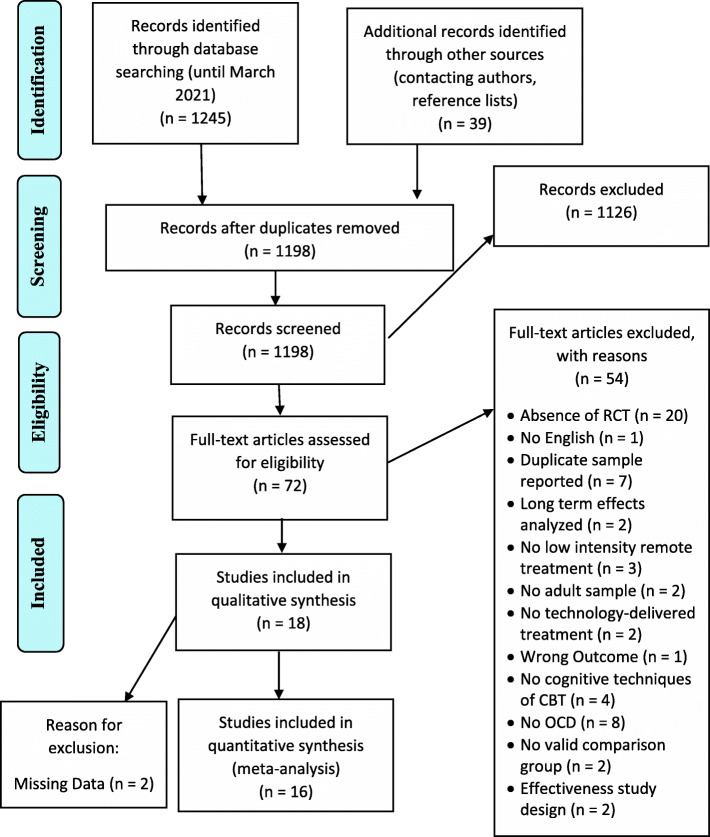
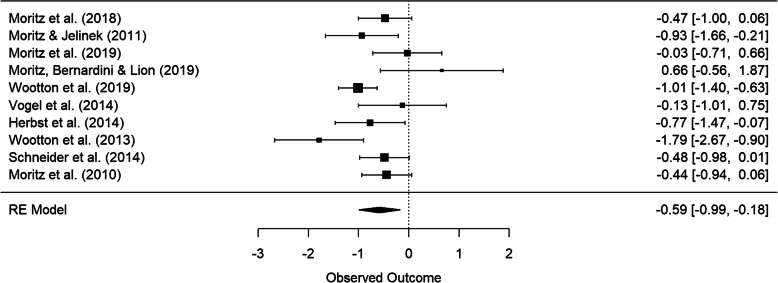
Background: Cognitive behavioral therapy (CBT) is a well-established treatment for people suffering from obsessive-compulsive disorder (OCD) and technology-based CBT applications are an emerging treatment option for people with OCD. These applications involve treatment protocols with automated content delivery and relatively low clinical contact. Whilst such CBT applications are promising, however, further investigation is needed to establish the efficacy of this treatment approach for individuals with OCD. The aim of the present study was to review the efficacy of technology-delivered CBT with minimal clinician support for OCD using a meta-analytic approach. Methods: Randomized controlled trials (RCT) were identified through PsycINFO, Medline and Scopus resulting in 18 eligible studies ( n = 1707). Control conditions comprised both passive (namely no treatment, other treatments and waitlist controls) and active. Measurement of OCD symptoms improvement was the outcome in each study. Results: Participants in the technology-delivered CBT group scored lower on Yale-Brown Obsessive-Compulsive Scale (Y-BOCS) ( g = − 0.59, 95% CI = [− 0.99, − 0.18], p = 0.01), Y-BOCS and Dimensional Obsessive-Compulsive Scale (DOCS) combined ( g = − 0.55, 95% CI = [− 0.87, − 0.24], p = 0.003) and Obsessive-Compulsive-Inventory-Revised (OCI-R) ( g = − 0.36, 95% CI = [− 0.62, − 0.09], p = 0.02) at post-treatment than passive control groups. There were no significant findings when compared to controls with other treatments. Conclusions: This meta-analysis suggests that technology-delivered CBT with low personal contact intensity, relative to passive control groups, is an efficacious and promising treatment option for individuals with OCD. Further research is needed to allow for a comparison with control groups with other treatments.
Overview
CoChat Summary
TL;DR
This meta-analysis found that low-intensity technology-delivered CBT for OCD was superior to passive controls, with moderate effects on OCD symptom outcomes, but it did not significantly outperform other active treatments. The evidence base was limited to 18 randomized controlled trials (n = 1707), all in adults, and moderator analyses suggested no clear effect of therapist support or diagnostic method.
Key findings
- Across 18 eligible RCTs (n = 1707), technology-delivered CBT with low personal contact intensity outperformed passive controls at post-treatment on multiple OCD measures: Y-BOCS (g = −0.59, 95% CI [−0.99, −0.18], p = 0.01), Y-BOCS and DOCS combined (g = −0.55, 95% CI [−0.87, −0.24], p = 0.003), and OCI-R (g = −0.36, 95% CI [−0.62, −0.09], p = 0.02).
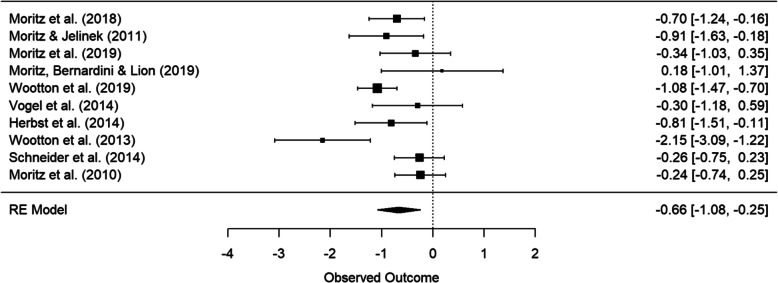
- The group-by-time interaction versus passive controls was also significant: Y-BOCS only (g = −0.66, 95% CI [−1.08, −0.25], p = 0.006), Y-BOCS and DOCS combined (g = −0.57, 95% CI [−0.85, −0.30], p = 0.001), and OCI-R (g = −0.30, 95% CI [−0.56, −0.04], p = 0.03).
- Compared with controls with other treatments, pooled effects were not significant: Y-BOCS (g = −0.14, 95% CI [−1.02, 0.74], p = 0.71) and Y-BOCS/DOCS combined (g = −0.22, 95% CI [−0.97, 0.53], p = 0.51); the paper also reports no studies for OCI-R in this comparison.
- In moderator analyses for Y-BOCS versus passive controls, age, intervention duration, support condition, DSM-based diagnosis, and study quality were not significant moderators; percentage of women showed a small significant moderating effect (b = −0.03, SE = 0.01, 95% CI [−0.06, −0.002], p = 0.04).
Methods
- Systematic review and meta-analysis of randomized controlled trials identified in PsycINFO, Medline, and Scopus up to March 2021, with additional searching of reference lists and contact with authors.
- Included adult OCD samples only; interventions were technology-delivered CBT with low personal contact intensity (e.g., cCBT, iCBT, bCBT; self-help with assistance or pure self-help), compared with passive controls (wait-list/no treatment) or active controls.
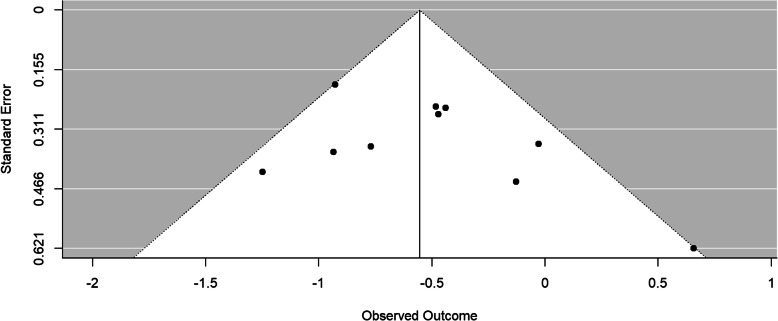
- Quantitative synthesis used random-effects meta-analytic models in R/metafor, calculating Hedges’ g from pre-post change scores; moderator analyses used meta-regression, and publication bias was assessed with funnel plots and Egger’s tests.
Limitations
- Stated by the paper: only 18 RCTs were included, and several had small sample sizes, so moderator analyses should be interpreted with caution; control conditions with other treatments were heterogeneous; follow-up data were sparse, with only five studies including follow-up, preventing meta-analytic conclusions about long-term efficacy; the protocol was not preregistered; study selection was performed by a single author, so relevant studies may have been missed; concurrent medication was not controlled for.
- Evident from the text: some outcomes and studies were excluded from quantitative synthesis because of missing means/SDs, and some analyses relied on imputed assumptions for effect-size computation (e.g., assumed pre-post correlation r = 0.5), which adds uncertainty.
Model-written summary. Check it against the paper before relying on it.
Integrity signals
Registry
Cites
Statistics
Figures
Verification
Claims the paper makes
3 Valid · 0 Not valid · 29 Not checked · 60 Own results and interpretations
Every source the paper cites for this claim was checked and supports it.
In the paper
“In line with Bennet et al. (2019) [39], detection bias regarding OCD self-report measures were considered to be based on a low risk of bias.”
§ Low intensity technology-delivered cognitive behavioral therapy for obsessive-compulsive disorder: a meta-analysis > Methods > Study quality Study quality was assessed focussing on criteria for judging risk of bias developed by the Cochrane Collaboration [38]. Study quality was assessed by independent evaluators and discrepancies were solved until full agreement was obtained. Assessed criteria were the following: selection bias (allocation concealment and random sequence generation), attrition bias (incomplete outcome data focussing on OCD symptoms outcome), detection bias (blinding of OCD symptoms assessment), and reporting bias (selective reporting). Blinding of participants and personnel was not included in the study quality assessment as this criterion is hardly possible to fulfil in psychotherapy research. In line with Bennet et al. (2019) [39], detection bias regarding OCD self-report measures were considered to be based on a low risk of bias. In particular, this conclusion is made as self-administered versus clinician-administered versions of the Y-BOCS show identical capability to differentiate OCD patients from other subjects [40, 41]. The response unclear was used when no further information was provided or when descriptions did not provide enough information. Quality criteria were rated either high (coded with 2), low (coded with 0) or unclear (coded with 1). For an examination of the relationship between risk of bias and effect sizes, final risk of bias scores for each study were entered as an additional moderator. Moreover, we conducted a sub analysis including only studies with low risk of bias.
What the sources say
- Supportedcites [39] Bennett SD Cuijpers P Ebert DD McKenzie Smith M Coughtrey AE Heyman I Practitioner review: unguided and guided self-help interventions for common mental health disorders in children and adolescents: a systematic review and meta-analysis J Child Psychol Psychiatry 2019 60 8 828 847 10.1111/jcpp.13010 30775782 source
The 'Assessment of risk of bias in included studies' section states that blinding of outcome assessment was considered at the individual outcome-measure level and that 'self-report measures were considered to be at low risk of bias for the purposes of this review' — the Cochrane domain the citing paper calls detection bias. The review's scope includes OCD among the common mental health disorders studied (OCD appears in study inclusion criteria and is defined in the Table 2 abbreviation list), so the blanket low-risk ruling covers OCD self-report measures; the source does not make an OCD-specific sentence, but its general rule entails the claim. (LLM, conf=0.82)
plain- Asserted: passes — The authors put it forward as true.
- Checkable: passes — It can be checked against evidence.
- Load-bearing: passes — The paper’s conclusions depend on it.
- Based: passes — The paper gives a reason why it holds.
- Supported
The cited sources support only part of this claim — read each source’s verdict below.
In the paper
“However, pure self-help interventions result in significant reduction of symptoms as well [24, 25].”
§ Low intensity technology-delivered cognitive behavioral therapy for obsessive-compulsive disorder: a meta-analysis > Background > Evidence about technology-delivered CBT for OCD
What the sources say
- Supportedcites [24] Cuijpers P Donker T Johansson R Mohr DC van Straten A Andersson G Self-guided psychological treatment for depressive symptoms: a meta-analysis PLoS One 2011 6 6 1 7 10.1371/journal.pone.0021274 PMC3119687 21712998 source
The Discussion (p. 7) reports a small but statistically significant effect of self-guided treatment without therapist support in participants with elevated depressive symptoms. The Results (p. 5) give a significant post-treatment effect compared with controls (d = 0.28, p < 0.001). (LLM, conf=0.91)
- Could not verifycites [25] Spek V Cuijpers P Nyklíček I Riper H Keyzer J Pop V Internet-based cognitive behaviour therapy for symptoms of depression and anxiety: a meta-analysis Psychol Med 2007 37 3 319 328 10.1017/S0033291706008944 17112400 sourceExperimental — accuracy not yet measured
Searches for self-help, interventions without therapist support, and effect size found no full-text passage addressing whether pure self-help interventions significantly reduced symptoms. The only substantive indexed match was labeled Abstract, which is not eligible evidence under the stated rule. (LLM, conf=0.72)
plainstates a cause- Asserted: passes — The authors put it forward as true.
- Checkable: passes — It can be checked against evidence.
- Load-bearing: unclear — It is unclear whether the paper’s conclusions depend on it.
- Based: passes — The paper gives a reason why it holds.
- Supported
None of the sources cited for this claim have been checked yet.
In the paper
“Overall, the current state of research indicates reduced efficacy and effectiveness of technology-delivered CBT when provided without a regular clinician support (e.g., [22, 23]).”
§ Low intensity technology-delivered cognitive behavioral therapy for obsessive-compulsive disorder: a meta-analysis > Background > Evidence about technology-delivered CBT for OCD
What the sources say
- Not checked yetcites [22] Andersson G Cuijpers P Internet-based and other computerized psychological treatments for adult depression: a meta-analysis Cogn Behav Ther 2009 38 4 196 205 10.1080/16506070903318960 20183695 source
- Could not verifycites [23] Andrews G Cuijpers P Craske MG McEvoy P Titov N Computer therapy for the anxiety and depressive disorders is effective, acceptable and practical health care: a meta-analysis PLoS One 2010 5 10 e13196 10.1371/journal.pone.0013196 20967242 PMC2954140 sourceExperimental — accuracy not yet measured
The Introduction (page unavailable) distinguishes self-guided CBT from programs supported by technicians or clinicians. The Results and Discussion (pages unavailable) report benefits from computerized CBT, including treatment with brief assistance, but do not establish that efficacy or effectiveness is lower without regular clinician support. Searches for guided-versus-unguided outcomes and clinician-support comparisons found no such conclusion in our copy. (LLM, conf=0.72)
hedgedstates a cause- Asserted: passes — The authors put it forward as true.
- Checkable: passes — It can be checked against evidence.
- Load-bearing: passes — The paper’s conclusions depend on it.
- Based: passes — The paper gives a reason why it holds.
A result the paper reports from its own data — it cites no other source for it, so there is none to check. The quote shows it is in the paper.
In the paper
“There were no significant findings when compared to controls with other treatments.”
§ Low intensity technology-delivered cognitive behavioral therapy for obsessive-compulsive disorder: a meta-analysis > Abstract > Results
plain- Asserted: passes — The authors put it forward as true.
- Checkable: passes — It can be checked against evidence.
- Load-bearing: unclear — It is unclear whether the paper’s conclusions depend on it.
- Based: passes — The paper gives a reason why it holds.
A result the paper reports from its own data — it cites no other source for it, so there is none to check. The quote shows it is in the paper.
In the paper
“Obsessive-Compulsive-Inventory-Revised (OCI-R) (g = − 0.36, 95% CI = [− 0.62, − 0.09], p = 0.02) at post-treatment than passive control groups.”
§ Low intensity technology-delivered cognitive behavioral therapy for obsessive-compulsive disorder: a meta-analysis > Abstract > Results
plainstates a cause- Asserted: passes — The authors put it forward as true.
- Checkable: passes — It can be checked against evidence.
- Load-bearing: passes — The paper’s conclusions depend on it.
- Based: passes — The paper gives a reason why it holds.
- Rests on an assumption not shown here.
43 more claims
Create a free account to see all 92 claims and to verify the 33 references still open.
- Probably not a substantial claim. 31
- It may state two separate claims as one. 22
Claims other papers make about this one
Each is checked against this paper’s own text: does it say what the citing paper says it does?
The source backs part of the claim, not all of it — or backs it for a different population, condition or comparison.
In the citing paper
“Although the evidence for iCBT remains preliminary, active online interventions using digital platforms may potentially facilitate treatment adherence in certain environments where regular face-to-face CBT is not viable [46].”
From Clinical Advances in Treatment Strategies for Obsessive-compulsive Disorder in Adults (2023) · cites this paper as [46]
Experimental — accuracy not yet measured
Citations
Cites
Diagnostic and Statistical Manual of Mental Disorders
American Psychiatric Association (2013) · doi:10.1176/appi.books.9780890425596 · Cited by 116,369
Preferred Reporting Items for Systematic Reviews and Meta-Analyses: the PRISMA statement
Moher, D., Liberati, A., Tetzlaff, J., Altman, D. G., & for the PRISMA Group (2009) · BMJ · doi:10.1136/bmj.b2535 · Cited by 83,823
Bias in meta-analysis detected by a simple, graphical test
Egger, M., Smith, G. D., Schneider, M., & Minder, C. (1997) · BMJ · doi:10.1136/bmj.315.7109.629 · Cited by 56,722
Preferred reporting items for systematic reviews and meta-analyses: the PRISMA Statement.
(2009) · PubMed Central · Cited by 44,859
Preferred reporting items for systematic reviews and meta-analyses: The PRISMA statement
Moher, D., Liberati, A., Tetzlaff, J., Altman, D. G., & the PRISMA Group* (2009) · Annals of Internal Medicine · doi:10.7326/0003-4819-151-4-200908180-00135 · Cited by 37,554
Quantifying heterogeneity in a meta‐analysis
Higgins, J. P. T., & Thompson, S. G. (2002) · Statistics in Medicine · doi:10.1002/sim.1186 · Cited by 36,763 · cited 4×
“We applied the statistical heterogeneity by using I(2) method by Higgins and Thompson (2002) and also investigated the between study and between effect size variance estimates directly [35].”
BackgroundMethodInfluentialConducting Meta-Analyses in R with the metafor Package
Viechtbauer, W. (2010) · Journal of Statistical Software · doi:10.18637/jss.v036.i03 · Cited by 20,464 · cited 1×
“1; R Core Team, 2019) and specifically with the help of the R package metafor [42].”
MethodLakens, D. (2013) · Frontiers in Psychology · doi:10.3389/fpsyg.2013.00863 · Cited by 10,303
(2000) · Cited by 9,198
The Yale-Brown Obsessive Compulsive Scale: I. Development, Use, and Reliability
Goodman, W. K. (1989) · Archives of General Psychiatry · doi:10.1001/archpsyc.1989.01810110048007 · Cited by 7,712 · cited 2×
“, Yale-Brown Obsessive-Compulsive Scale (Y-BOCS) [32]; ObsessiveCompulsive-Inventory-Revised (OCI-R) [33]; Dimensional Obsessive-Compulsive Scale (DOCS) [34]).”
BackgroundThe Handbook of Research Synthesis and Meta-Analysis
(2019) · doi:10.7758/9781610448864 · Cited by 4,553 · cited 2×
“(2016) showed a greater reduction in Y-BOCS score for the myMCTgroups (in the analysis combined) compared to the control group (complete cases for group-by-time interaction: F [1, 48] = 4.”
MethodResultThe Obsessive-Compulsive Inventory: Development and validation of a short version.
Foa, E. B., Huppert, J. D., Leiberg, S., Langner, R., Kichic, R., Hajcak, G., & Salkovskis, P. M. (2002) · Psychological Assessment · doi:10.1037/1040-3590.14.4.485 · Cited by 2,959 · cited 16×
“There were no studies measuring OCI-R.”
MethodInfluentialThe epidemiology of obsessive-compulsive disorder in the National Comorbidity Survey Replication
Ruscio, A. M., Stein, D. J., Chiu, W. T., & Kessler, R. C. (2010) · Molecular Psychiatry · doi:10.1038/mp.2008.94 · Cited by 2,771 · cited 1×
“Obsessive-compulsive disorder (OCD) is a common mental disorder with a lifetime prevalence of 2–3% [1, 2].”
BackgroundInternet-based cognitive behaviour therapy for symptoms of depression and anxiety: A meta-analysis
SPEK, V., CUIJPERS, P., NYKLÍČEK, I., RIPER, H., KEYZER, J., & POP, V. (2007) · Psychological Medicine · doi:10.1017/s0033291706008944 · Cited by 1,586 · cited 1×
“However, pure self-help interventions result in significant reduction of symptoms as well [24, 25].”
BackgroundInternet-Based and Other Computerized Psychological Treatments for Adult Depression: A Meta-Analysis
Andersson, G., & Cuijpers, P. (2009) · Cognitive Behaviour Therapy · doi:10.1080/16506070903318960 · Cited by 1,368
Andrews, G., Cuijpers, P., Craske, M. G., McEvoy, P., & Titov, N. (2010) · PLoS ONE · doi:10.1371/journal.pone.0013196 · Cited by 1,311
Advantages and limitations of Internet-based interventions for common mental disorders
Andersson, G., & Titov, N. (2014) · World Psychiatry · doi:10.1002/wps.20083 · Cited by 1,160 · cited 1×
“One of the key problems in technology-based intervention research is the lack of an appropriate psychological diagnostic process with reference to well-known classification systems [77].”
BackgroundAndersson, G., Cuijpers, P., Carlbring, P., Riper, H., & Hedman, E. (2014) · World Psychiatry · doi:10.1002/wps.20151 · Cited by 1,077
Andrews, G., Basu, A., Cuijpers, P., Craske, M. G., McEvoy, P., English, C. L., & Newby, J. M. (2018) · Journal of Anxiety Disorders · doi:10.1016/j.janxdis.2018.01.001 · Cited by 922 · cited 2×
“Importantly, even though patients may prefer face-to-face sessions instead of internet-based treatments [15], technology-delivered CBT results in a high rate of satisfaction from consumers [10].”
BackgroundAbramowitz, J. S., Deacon, B. J., Olatunji, B. O., Wheaton, M. G., Berman, N. C., Losardo, D., Timpano, K. R., McGrath, P. B., Riemann, B. C., Adams, T., et al. (2010) · Psychological Assessment · doi:10.1037/a0018260 · Cited by 848 · cited 3×
“OCD outcome measures were the Y-BOCS [27] in 17 studies, OCI-R [33] in ten studies and DOCS [34] in three studies.”
BackgroundMethodInternet-delivered psychological treatments: from innovation to implementation
Andersson, G., Titov, N., Dear, B. F., Rozental, A., & Carlbring, P. (2019) · World Psychiatry · doi:10.1002/wps.20610 · Cited by 750 · cited 1×
“As there were many recent randomized controlled trials, providing an updated meta-analysis was highly recommended [75].”
BackgroundOlatunji, B. O., Davis, M. L., Powers, M. B., & Smits, J. A. J. (2013) · Journal of Psychiatric Research · doi:10.1016/j.jpsychires.2012.08.020 · Cited by 659 · cited 1×
“Cognitivebehavioral therapy (CBT) including ERP is an evidencebased therapeutic intervention for OCD [8] and is recommended by expert guidelines (National Institute for Health and Care Excellence; NICE, 2005).”
MethodFurukawa, T. A., Noma, H., Caldwell, D. M., Honyashiki, M., Shinohara, K., Imai, H., Chen, P., Hunot, V., & Churchill, R. (2014) · Acta Psychiatrica Scandinavica · doi:10.1111/acps.12275 · Cited by 521 · cited 1×
“Waiting list conditions are generating higher effect sizes for CBT than other conditions such as no treatment [76].”
BackgroundInternet-based psychological treatments for depression
Johansson, R., & Andersson, G. (2012) · Expert Review of Neurotherapeutics · doi:10.1586/ern.12.63 · Cited by 509 · cited 1×
“In their meta-analysis on internet-based psychological interventions for depression, Johannson and Andersson (2012) shed light on the influence of time of therapistguidance on symptom outcome [72].”
BackgroundNewman, M. G., Szkodny, L. E., Llera, S. J., & Przeworski, A. (2011) · Clinical Psychology Review · doi:10.1016/j.cpr.2010.09.008 · Cited by 480 · cited 8×
“As explained above, our definition for a low contact intensity included self-help with assistance to ensure engagement with the tool (ASH) and pure self-help (PSH) with a maximal timeframe of 100 min per participant and per intervention independent of the intervention length.”
BackgroundMethodInfluentialPsychological treatment of obsessive–compulsive disorder: A meta-analysis
Rosa-Alcázar, A. I., Sánchez-Meca, J., Gómez-Conesa, A., & Marín-Martínez, F. (2008) · Clinical Psychology Review · doi:10.1016/j.cpr.2008.07.001 · Cited by 444 · cited 1×
“Rosa-Alcázar, Sánchez-Meca, Gómez-Conesa, and Marín-Martínez (2008) demonstrated that both cognitive restructuring (CR) and ERP alone, and in combination, are effective in the treatment of OCD [9].”
BackgroundEvidence-based treatment and therapist drift
Waller, G. (2009) · Behaviour Research and Therapy · doi:10.1016/j.brat.2008.10.018 · Cited by 359 · cited 1×
“Therapist drift is a common pattern during face-to-face CBT sessions [73], hence, reduced therapist contact during interventions coulddecrease this phenomenon potentially.”
BackgroundCognitive therapy and exposure in vivo in the treatment of obsessive–compulsive disorder
Van Oppen, P., De Haan, E., Van Balkom, A. J. L. M., Spinhoven, P., Hoogduin, K., & Van Dyck, R. (1995) · Behaviour Research and Therapy · doi:10.1016/0005-7967(94)00052-l · Cited by 350 · cited 1×
“Randomized controlled trials (RCTs) have demonstrated the efficacy of different types of treatments for OCD including exposure and response prevention (ERP), cognitive therapy [6], and pharmacotherapy with Selective Serotonin Reuptake Inhibitors (SSRIs) [7].”
BackgroundAndersson, G., Carlbring, P., Titov, N., & Lindefors, N. (2019) · The Canadian Journal of Psychiatry · doi:10.1177/0706743719839381 · Cited by 324 · cited 1×
“Our findings are in line with results of other systematic reviews and meta-analyses supporting the conclusion that technology-delivered CBT is a promising efficacious treatment in comparison to passive control conditions [70].”
ResultGreist, J. H., Marks, I. M., Baer, L., Kobak, K. A., Wenzel, K. W., Hirsch, M. J., Mantle, J. M., & Clary, C. M. (2002) · The Journal of Clinical Psychiatry · doi:10.4088/jcp.v63n0209 · Cited by 321
The descriptive epidemiology of obsessive–compulsive disorder
Fontenelle, L. F., Mendlowicz, M. V., & Versiani, M. (2006) · Progress in Neuro-Psychopharmacology and Biological Psychiatry · doi:10.1016/j.pnpbp.2005.11.001 · Cited by 310 · cited 3×
“(2016) showed a greater reduction in Y-BOCS score for the myMCTgroups (in the analysis combined) compared to the control group (complete cases for group-by-time interaction: F [1, 48] = 4.”
BackgroundMethodResultPalmqvist, B., Carlbring, P., & Andersson, G. (2007) · Expert Review of Pharmacoeconomics & Outcomes Research · doi:10.1586/14737167.7.3.291 · Cited by 290 · cited 1×
“Due to the cost-advantages of technology-delivered interventions [12], as well as the difficulty in accessing welltrained therapists in many countries (e.”
BackgroundAndersson, E., Enander, J., Andrén, P., Hedman, E., Ljótsson, B., Hursti, T., Bergström, J., Kaldo, V., Lindefors, N., Andersson, G., et al. (2012) · Psychological Medicine · doi:10.1017/s0033291712000244 · Cited by 274 · cited 2×
“, 2012 [51] Other treatments (online non-directive supportive therapy); N = 51 − 1.”
Self-guided psychological treatment for depressive symptoms: a meta-analysis
Cuijpers, P., Donker, T., Johansson, R., Mohr, D. C., van Straten, A., & Andersson, G. (2011) · PLoS ONE · doi:10.1371/journal.pone.0021274 · Cited by 250 · cited 1×
“However, pure self-help interventions result in significant reduction of symptoms as well [24, 25].”
BackgroundGönner, S., Leonhart, R., & Ecker, W. (2008) · Journal of Anxiety Disorders · doi:10.1016/j.janxdis.2007.07.007 · Cited by 235
What Makes Internet Therapy Work?
Andersson, G., Carlbring, P., Berger, T., Almlöv, J., & Cuijpers, P. (2009) · Cognitive Behaviour Therapy · doi:10.1080/16506070902916400 · Cited by 234 · cited 1×
“(2011) and Andersson, Calbring, Berger, Almlöv, and Cuijpers (2009) [17, 31], we defined a maximal timeframe of 100 min for category [3] in terms of phone calls.”
BackgroundCurrent status of pharmacological and behavioral treatment of obsessive-compulsive disorder
Stanley, M. A., & Turner, S. M. (1995) · Behavior Therapy · doi:10.1016/s0005-7894(05)80089-9 · Cited by 172 · cited 1×
“Randomized controlled trials (RCTs) have demonstrated the efficacy of different types of treatments for OCD including exposure and response prevention (ERP), cognitive therapy [6], and pharmacotherapy with Selective Serotonin Reuptake Inhibitors (SSRIs) [7].”
BackgroundQuality of life and symptom dimensions of patients with obsessive–compulsive disorder
Fontenelle, I. S., Fontenelle, L. F., Borges, M., Prazeres, A. M., Rangé, B., Mendlowicz, M. V., & Versiani, M. (2010) · Psychiatry Research · doi:10.1016/j.psychres.2009.04.005 · Cited by 162 · cited 3×
“5 h); and, [4] pure self-help (PSH) (only contact with a clinician for the assessment, otherwise no support at all during fully automated intervention programs) [17].”
BackgroundRemote cognitive-behavior therapy for obsessive-compulsive symptoms: A meta-analysis.
Wootton, B. M. (2016) · Clinical Psychology Review · doi:10.1016/j.cpr.2015.10.001 · Cited by 162 · cited 2×
“Wootton (2016) performed the only meta-analysis that quantified outcomes of remote treatments for OCD by comparing types of remote treatments and the contact intensity during treatments [21].”
BackgroundSelf-citationBennett, S. D., Cuijpers, P., Ebert, D. D., McKenzie Smith, M., Coughtrey, A. E., Heyman, I., Manzotti, G., & Shafran, R. (2019) · Journal of Child Psychology and Psychiatry · doi:10.1111/jcpp.13010 · Cited by 162 · cited 1×
“(2019) [39], detection bias regarding OCD self-report measures were considered to be based on a low risk of bias.”
BackgroundEconomic costs of obsessive-compulsive disorder.
Dupont, R., Rice, D. P., Shiraki, S. S., & Rowland, C. R. (1995) · PubMed · Cited by 145
Computer-Aided Psychological Treatments: Evolving Issues
Marks, I., & Cavanagh, K. (2009) · Annual Review of Clinical Psychology · doi:10.1146/annurev.clinpsy.032408.153538 · Cited by 133 · cited 1×
“For instance, interventions can be delivered through a computer, which may or may not be linked to the internet, personal digital assistants, virtual reality devices, an interactive voice response (IVR) system, a PDF file sent via email, web-cameras, CD-ROMS, DVDs, telephones, and mobile phone software applications [1…”
BackgroundRemote treatment of obsessive-compulsive disorder: A randomized controlled trial
Wootton, B. M., Dear, B. F., Johnston, L., Terides, M. D., & Titov, N. (2013) · Journal of Obsessive-Compulsive and Related Disorders · doi:10.1016/j.jocrd.2013.07.002 · Cited by 125
Self-citationA Computer-Administered Version of the Yale-Brown Obsessive-Compulsive Scale.
Rosenfeld, R., Dar, R., Anderson, D., Kobak, K. A., & Greist, J. H. (1992) · Psychological Assessment · doi:10.1037/1040-3590.4.3.329 · Cited by 117 · cited 1×
“In particular, this conclusion is made as self-administered versus clinician-administered versions of the Y-BOCS show identical capability to differentiate OCD patients from other subjects [40, 41].”
Moritz, S., Jelinek, L., Hauschildt, M., & Naber, D. (2010) · Dialogues in Clinical Neuroscience · doi:10.31887/dcns.2010.12.2/smoritz · Cited by 113 · cited 3×
“, [27, 28]), self-reported OCD symptoms (i.”
Mahoney, A., Mackenzie, A., Williams, A. D., Smith, J. S., & Andrews, G. (2014) · Behaviour Research and Therapy · doi:10.1016/j.brat.2014.09.012 · Cited by 98 · cited 2×
“, 2014 [60] Other treatments (treatment as usual); N = 35 − 0.”
BackgroundCavanagh, K. (2014) · Behavioural and Cognitive Psychotherapy · doi:10.1017/s1352465813000568 · Cited by 84
Kyrios, M., Ahern, C., Fassnacht, D. B., Nedeljkovic, M., Moulding, R., & Meyer, D. (2018) · Journal of Medical Internet Research · doi:10.2196/jmir.9566 · Cited by 84
Vogel, P. A., Solem, S., Hagen, K., Moen, E. M., Launes, G., Håland, Å. T., Hansen, B., & Himle, J. A. (2014) · Behaviour Research and Therapy · doi:10.1016/j.brat.2014.10.007 · Cited by 77 · cited 2×
“, 2014 (b) [62] Other treatments (video-conference assisted ERP); N = 10 2.”
GEOGRAPHIC INEQUITY IN THE AVAILABILITY OF COGNITIVE BEHAVIOURAL THERAPY IN ENG LAND AND WALES
Shapiro, D. A., Cavanagh, K., & Lomas, H. (2003) · Behavioural and Cognitive Psychotherapy · doi:10.1017/s1352465803002066 · Cited by 75 · cited 2×
“, Germany [13], England and Wales [14]), technology-delivered CBT is an important addition to the treatment of mental health disorders.”
BackgroundHerbst, N., Voderholzer, U., Thiel, N., Schaub, R., Knaevelsrud, C., Stracke, S., Hertenstein, E., Nissen, C., & Külz, A. K. (2014) · Psychotherapy and Psychosomatics · doi:10.1159/000357570 · Cited by 69
An interactive computer-administered self-assessment and self-help program for behavior therapy.
Baer, L., & Greist, J. H. (1997) · PubMed · Cited by 69
Pearcy, C. P., Anderson, R. A., Egan, S. J., & Rees, C. S. (2016) · Journal of Behavior Therapy and Experimental Psychiatry · doi:10.1016/j.jbtep.2015.12.007 · Cited by 66 · cited 3×
“(2016) analyzed all trials with available technology-delivered self-help interventions for OCD, and thus included interventions that were not cognitivebehavioral in orientation [20].”
BackgroundMethodYale-Brown Obsessive Compulsive Scale: Sind Selbst- und Fremdrating äquivalent?
Schaible, R., Armbrust, M., & Nutzinger, D. O. (2001) · Verhaltenstherapie · doi:10.1159/000056673 · Cited by 61
Dèttore, D., Pozza, A., & Andersson, G. (2015) · Cognitive Behaviour Therapy · doi:10.1080/16506073.2015.1005660 · Cited by 60 · cited 3×
“Dèttore et al. (2015) conducted a meta-analysis integrating samples with a primary OCD diagnosis (both adults and children/adolescents) [19].”
BackgroundInfluentialMoritz, S., Jelinek, L., Klinge, R., & Naber, D. (2007) · Behavioural and Cognitive Psychotherapy · doi:10.1017/s1352465807003931 · Cited by 58 · cited 1×
“Technology-delivered interventions with CBT elements were Association Splitting (AS [65]) sent through email (k = 2), Metacognitive Training (myMCT [28]) with the help of a self-help book sent through email (k = 6), internet based CBT (iCBT, k = 7), a self-help book by Foa & Kozak (1997) delivered through email (k = 1…”
MethodHauschildt, M., Dar, R., Schröder, J., & Moritz, S. (2019) · Psychiatry Research · doi:10.1016/j.psychres.2019.01.092 · Cited by 53 · cited 1×
“In particular, this conclusion is made as self-administered versus clinician-administered versions of the Y-BOCS show identical capability to differentiate OCD patients from other subjects [40, 41].”
Wootton, B. M., Karin, E., Titov, N., & Dear, B. F. (2019) · Journal of Anxiety Disorders · doi:10.1016/j.janxdis.2019.102111 · Cited by 51 · cited 10×
“(2014) published a metaanalysis that includeda variety of different study designs (i.e., pre−/ post-test, one-group designs, and RCTs) [18].”
BackgroundInfluentialSelf-citationCochrane Consumers and Communication Review Group Study Quality Guide
Prictor, M., Hill, S., Oliver, S. R., Horey, D., Broclain, D., & Ryan, R. E. (2007) · Cited by 47
Moritz, S., & Jelinek, L. (2011) · Depression and Anxiety · doi:10.1002/da.20843 · Cited by 42 · cited 1×
“Moritz & Jelinek, 2011 [59] Passive (WLC); N = 23 − 0.”
Do Patients Prefer Face-to-Face or Internet-Based Therapy?
Berle, D., Starcevic, V., Milicevic, D., Hannan, A., Dale, E., Brakoulias, V., & Viswasam, K. (2015) · Psychotherapy and Psychosomatics · doi:10.1159/000367944 · Cited by 41 · cited 1×
“Importantly, even though patients may prefer face-to-face sessions instead of internet-based treatments [15], technology-delivered CBT results in a high rate of satisfaction from consumers [10].”
BackgroundBürkner, P.-C., Bittner, N., Holling, H., & Buhlmann, U. (2017) · PLoS ONE · doi:10.1371/journal.pone.0173660 · Cited by 41
Self-citationSchröder, J., Werkle, N., Cludius, B., Jelinek, L., Moritz, S., & Westermann, S. (2020) · Depression and Anxiety · doi:10.1002/da.23105 · Cited by 39 · cited 13×
“Risk of bias for the attrition bias was high in three studies as an ITT analysis was not conducted [28, 60, 63].”
BackgroundInfluentialLópez‐Solà, C., Gutiérrez, F., Alonso, P., Rosado, S., Taberner, J., Segalàs, C., Real, E., Menchón, J. M., & Fullana, M. A. (2013) · Comprehensive Psychiatry · doi:10.1016/j.comppsych.2013.08.015 · Cited by 38
Hauschildt, M., Schröder, J., & Moritz, S. (2016) · Journal of Obsessive-Compulsive and Related Disorders · doi:10.1016/j.jocrd.2016.04.010 · Cited by 37 · cited 12×
“(2014) published a metaanalysis that includeda variety of different study designs (i.e., pre−/ post-test, one-group designs, and RCTs) [18].”
BackgroundInfluentialMoritz, S., & Russu, R. (2012) · Journal of Obsessive-Compulsive and Related Disorders · doi:10.1016/j.jocrd.2012.12.002 · Cited by 36 · cited 2×
“(2016) [56, 58], these studies did not provide enough information for inclusion in the quantitative analysis.”
BackgroundCost-effectiveness of internet-based cognitive-behavioural therapy for obsessive-compulsive disorder
Osborne, D., Meyer, D., Moulding, R., Kyrios, M., Bailey, E., & Nedeljkovic, M. (2019) · Internet Interventions · doi:10.1016/j.invent.2019.100277 · Cited by 34
Moritz, S., Stepulovs, O., Schröder, J., Hottenrott, B., Meyer, B., & Hauschildt, M. (2016) · Journal of Obsessive-Compulsive and Related Disorders · doi:10.1016/j.jocrd.2016.04.001 · Cited by 32 · cited 13×
“(2014) published a metaanalysis that includeda variety of different study designs (i.e., pre−/ post-test, one-group designs, and RCTs) [18].”
BackgroundInfluentialThree decades of telemedicine in obsessive-compulsive disorder: A review across platforms
Aboujaoude, E. N. (2017) · Journal of Obsessive-Compulsive and Related Disorders · doi:10.1016/j.jocrd.2017.06.003 · Cited by 32
Webster, R. J., Carter, K. W., Warrington, N. M., Loh, A. M., Zaloumis, S. G., Kuijpers, T. W., Palmer, L. J., & Burgner, D. P. (2011) · PLoS ONE · doi:10.1371/journal.pone.0028004 · Cited by 32
The Dimensional Obsessive-Compulsive Scale: Development and Validation of a Short Form (DOCS-SF)
Eilertsen, T., Hansen, B. K. A., Kvale, G., Abramowitz, J. S., Holm, S. E. H., & Solem, S. (2017) · Frontiers in Psychology · doi:10.3389/fpsyg.2017.01503 · Cited by 31 · cited 1×
“In their per protocol analysis, Moritz and Russu (2013) presented an improvement on the Y-BOCS score for group-by-time interaction (F [1, 45] = 4.”
MethodCompetitive Memory Training (COMET) for OCD: A Self-treatment Approach to Obsessions
Schneider, B. C., Wittekind, C. E., Talhof, A., Korrelboom, K., & Moritz, S. (2015) · Cognitive Behaviour Therapy · doi:10.1080/16506073.2014.981758 · Cited by 29 · cited 1×
“(2016) [56, 58], these studies did not provide enough information for inclusion in the quantitative analysis.”
BackgroundInternet interventions: Moving from efficacy to effectiveness
Andersson, G., Carlbring, P., & Cuijpers, P. (2010) · E-Journal of Applied Psychology · doi:10.7790/ejap.v5i2.169 · Cited by 27 · cited 1×
“Additionally, the question arises if we can appropriately distinguish between effectiveness and efficacy studies since internet interventions can be conducted in clinical settings and in an extensive public health setting [36].”
BackgroundWalendzik, A., Raabe-Menssen, C., Lux, G., Wasem, J., & Jahn, R. (2013) · Das Gesundheitswesen · doi:10.1055/s-0033-1343444 · Cited by 26
O’Kearney, R., Kim, S., Dawson, R. L., & Calear, A. L. (2019) · Australian & New Zealand Journal of Psychiatry · doi:10.1177/0004867419864433 · Cited by 23 · cited 10×
“(2014) published a metaanalysis that includeda variety of different study designs (i.e., pre−/ post-test, one-group designs, and RCTs) [18].”
BackgroundInfluentialTreating obsessions with Competitive Memory Training: A pilot study.
Korrelboom, K., van der Gaag, M., Hendriks, V. M., Huijbrechts, I. P. A. M., & Berretty, E. W. (2008) · Digital Academic REpository of VU University Amsterdam (Vrije Universiteit Amsterdam) · Cited by 22
Pozza, A., Andersson, G., Antonelli, P., & Dèttore, D. (2014) · The Cognitive Behaviour Therapist · doi:10.1017/s1754470x1400021x · Cited by 20 · cited 14×
“(2014) published a metaanalysis that includeda variety of different study designs (i.e., pre−/ post-test, one-group designs, and RCTs) [18].”
BackgroundInfluentialMoritz, S., Hauschildt, M., Murray, S. C., Pedersen, A., Krausz, M., & Jelinek, L. (2018) · Journal of Obsessive-Compulsive and Related Disorders · doi:10.1016/j.jocrd.2017.12.009 · Cited by 18 · cited 4×
“Additionally, there was a high risk of bias owing to incomplete outcome data reporting for five studies: missing means and standard deviations [56, 68], incomplete ITT results report [27, 30] and missing report of the amount of sample [29].”
BackgroundMethodInfluentialMoritz, S., Irshaid, S., Beiner, A., Hauschildt, M., & Miegel, F. (2019) · Journal of Experimental Psychopathology · doi:10.1177/2043808718820683 · Cited by 13 · cited 4×
“Additionally, there was a high risk of bias owing to incomplete outcome data reporting for five studies: missing means and standard deviations [56, 68], incomplete ITT results report [27, 30] and missing report of the amount of sample [29].”
BackgroundMethodInfluentialVeale, D. M., Lim, L. F., Tunkel, S. L., & Gledhill, L. J. (2016) · Journal of Obsessive-Compulsive and Related Disorders · doi:10.1016/j.jocrd.2016.02.001 · Cited by 13 · cited 1×
“However, this could be due to the small amount of studies (N = 7) or due to a smaller sensitivity to change compared to Y-BOCS [69].”
ResultMoritz, S., Bernardini, J., & Lion, D. (2020) · European Archives of Psychiatry and Clinical Neuroscience · doi:10.1007/s00406-019-01080-3 · Cited by 7 · cited 14×
“(2014) published a metaanalysis that includeda variety of different study designs (i.e., pre−/ post-test, one-group designs, and RCTs) [18].”
BackgroundInfluential
Cited by
Bandelow, B., Allgulander, C., Baldwin, D. S., Costa, D. L. D. C., Denys, D., Dilbaz, N., Domschke, K., Hollander, E., Kasper, S., Möller, H.-J., et al. (2023) · The World Journal of Biological Psychiatry · doi:10.1080/15622975.2022.2086296 · Cited by 84
“Another meta-analysis found that iCBT was more effective than inactive controls, but did not differ from active controls (Hoppen et al. 2021).”
Backgroundde Pablo, G. S., Pascual-Sánchez, A., Panchal, U. R., Clark, B., & Krebs, G. (2022) · Journal of Affective Disorders · doi:10.1016/j.jad.2022.11.007 · Cited by 42
Digitalising mental health care: Practical recommendations from the European Psychiatric Association
Kalman, J. L., Burkhardt, G., Samochowiec, J., Gebhard, C., Dom, G., John, M., Kılıç, Ö., Kurimay, T., Lien, L., Schouler‐Ocak, M., et al. (2023) · European Psychiatry · doi:10.1192/j.eurpsy.2023.2466 · Cited by 50
“There are also promising findings from studies investigating other mental health disorders, like bipolar disorder [26], eating disorders, obsessive-compulsive disorders [27], tic disorders [28], autism spectrum disorder [29], or substance use disorders.”
ResultHiranandani, S., Ipek, S. I., Wilhelm, S., & Greenberg, J. L. (2023) · Journal of Obsessive-Compulsive and Related Disorders · doi:10.1016/j.jocrd.2022.100765 · Cited by 24
Polak, M., & Tanzer, N. K. (2024) · Clinical Psychology & Psychotherapy · doi:10.1002/cpp.2989 · Cited by 25
Metadata
- Authors
- Hoppen, L. M., Kuck, N., Bürkner, P.-C., Karin, E., Wootton, B. M., & Buhlmann, U.
- Affiliations
- University of Münster (DE)
- University of Stuttgart (DE)
- Macquarie University (AU)
- University of Technology Sydney (AU)
- Corresponding author
- Buhlmann, Ulrike
- Venue
- BMC Psychiatry
- Published
- 2021-06-30
- Volume
- 21
- Issue
- 1
- Pages
- 322-322
- ISSN
- 1471-244X (ISSN-L)
- PMC
- PMC8243493
- OpenAlex
- W3175516695
- Cited by
- 45
- References
- 81
- Citations by year
- 2026: 4 · 2025: 9 · 2024: 10 · 2023: 13 · 2022: 9
- FWCI
- 1.06
- Type
- journal article
- Language
- en
- Open access
- gold
- doi.org
- Licence
- cc-by
- creativecommons.org/licenses/by/4.0 (tdm)
- creativecommons.org/licenses/by/4.0 (vor)
- Locations
- BMC Psychiatry (publishedVersion, cc-by)
- PubMed Central (publishedVersion, cc-by)
- PubMed (publishedVersion)
- DOAJ (DOAJ: Directory of Open Access Journals) (submittedVersion, cc-by-sa)
- UTS ePRESS (University of Technology Sydney) (submittedVersion, other-oa)
- OSF Preprints (OSF Preprints) (submittedVersion)
- Funders
- Westfälische Wilhelms-Universität Münster
- Topics
- Social Sciences › Psychology › Clinical Psychology › Obsessive-Compulsive Spectrum Disorders
- Social Sciences › Psychology › Applied Psychology › Digital Mental Health Interventions
- Social Sciences › Psychology › Experimental and Cognitive Psychology › Anxiety, Depression, Psychometrics, Treatment, Cognitive Processes
- Keywords
- obsessive-compulsive disorder, low-intensity treatment, digital mental health interventions, treatment efficacy, symptom improvement
- MeSH terms
- Humans, Obsessive-Compulsive Disorder, Psychotherapy, Group, Technology, Waiting Lists, Cognitive Behavioral Therapy, Treatment Outcome
About these checks
Registry, retraction, Cites and statistics results are computed, not judged, with one exception: a printed reference that no index lists is read once by a model before it counts as a citation error. Claims are extracted by a model and kept only when their quote appears verbatim in the text; each cited source is then checked, with a model’s help, for whether it says what the claim relies on. Those verdicts can be wrong — read the claim’s quote and the cited source before relying on one.
The claim verdicts this report counts are experimental: their accuracy is not yet measured.
A language model drew the claims from the paper on 2026-10-11, under version 3 of the claim definition (model deepseek-v4.1-flash, prompt extract-v3).
A second model labelled each claim on 2026-10-11 (model jev-1.13-20260917, definition revision gold-guideline-v0.2).
Cited sources are checked with a language model’s help (qwen3.8-omni-flash and gpt-6-sol).
Statistics and arithmetic are recomputed, not judged.
Confidence bands are shown only for fields calibrated on our annotated test set. None is calibrated yet, so no band is shown.
What counts as a claim ›How we measure confidence ›How we check this ›
Are you an author, or do you see a problem with this page? Request a review
Data sources
Bibliographic data: Semantic Scholar, OpenAlex, Crossref.
Contains information from the Semantic Scholar Academic Graph Datasets, made available under the ODC Attribution License (ODC-BY 1.0).
Semantic Scholar’s data is described in: Kinney, R., et al. (2023). The Semantic Scholar Open Data Platform. arXiv:2301.10140.
