

The moderating effect of cognitive impairment on the relationship between inner speech and auditory verbal hallucinations among chronic patients with schizophrenia
Open accessThe DOI matches its Crossref record; 67 of the 67 references it cites were found in a registry or an index.
Abstract
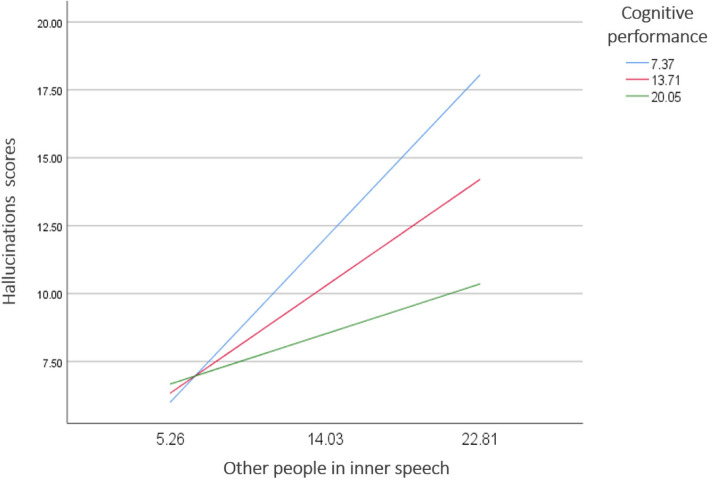
Background: Even though there is an increasing amount of evidence from behavioral and neuroimaging studies to suggest that pathological inner speech plays a role in the emergence of auditory verbal hallucinations (AVH), studies investigating the mechanisms underlying this relationship are rather scarce. Examining moderators might inform the development of new treatment options for AVH. We sought to extend the existing knowledge by testing the moderating role of cognitive impairment in the association between inner speech and hallucinations in a sample of Lebanese patients with schizophrenia. Methods: A cross-sectional study was conducted from May till August 2022, enrolling 189 chronic patients. Results: Moderation analysis revealed that, after controlling for delusions, the interaction of experiencing voices of other people in inner speech by cognitive performance was significantly associated with AVH. In people having low (Beta = 0.69; t = 5.048; p < .001) and moderate (Beta = 0.45; t = 4.096; p < .001) cognitive performance, the presence of voices of other people in inner speech was significantly associated with more hallucinations. This association was not significant in patients with high cognitive function (Beta = 0.21; t = 1.417; p = .158). Conclusion: This preliminarily study suggests that interventions aiming at improving cognitive performance may also have a beneficial effect in reducing hallucinations in schizophrenia.
Overview
The claims and statistics of this paper haven’t been checked yet.
Free: it reads the open-access text and checks the first 5 claims that cite a source we can check. Create a free account to check every claim.
Integrity signals
Registry
Cites
Statistics
Figures
Verification
Claims the paper makes
The claims and statistics of this paper haven’t been checked yet.
Free: it reads the open-access text and checks the first 5 claims that cite a source we can check. Create a free account to check every claim.
Claims other papers make about this one
Each is checked against this paper’s own text: does it say what the citing paper says it does?
The source backs part of the claim, not all of it — or backs it for a different population, condition or comparison.
In the citing paper
“Patterns of IS use have been linked to atypical cognitive flexibility in the autism spectrum [121], although it remains difficult to establish the direction of any causal relations.”
From Inner speech as language process and cognitive tool (2023) · cites this paper as [121]
Experimental — accuracy not yet measured
Self-check
Percentages, sums and reported differences re-computed from the paper’s own numbers.
The self-check needs the paper’s full text.
Citations
Cites
Diagnostic and Statistical Manual of Mental Disorders
American Psychiatric Association (2013) · doi:10.1176/appi.books.9780890425596 · Cited by 116,369
Baron, R. M., & Kenny, D. A. (1986) · Journal of Personality and Social Psychology · doi:10.1037/0022-3514.51.6.1173 · Cited by 91,532 · cited 1×
“A moderator is a variable that affects either the direction or the strength of the association between an independent variable (here, inner speech) and an outcome variable (AVH, in this study) [26].”
BackgroundThe Montreal Cognitive Assessment, MoCA: a brief screening tool for mild cognitive impairment
Nasreddine, Z. S., Phillips, N. A., Bédirian, V., Charbonneau, S., Whitehead, V., Collin, I., Cummings, J. L., & Chertkow, H. (2005) · Journal of the American Geriatrics Society · doi:10.1111/j.1532-5415.2005.53221.x · Cited by 25,553 · cited 2×
“Montreal Cognitive Assessment or MoCA Test [41] is a widely used screening assessment tool for detecting mild cognitive impairment (MCI).”
MethodPerceiving is believing: a Bayesian approach to explaining the positive symptoms of schizophrenia
Fletcher, P. C., & Frith, C. D. (2009) · Nature Reviews Neuroscience · doi:10.1038/nrn2536 · Cited by 1,462
HADDOCK, G., McCARRON, J., TARRIER, N., & FARAGHER, E. B. (1999) · Psychological Medicine · doi:10.1017/s0033291799008661 · Cited by 1,461
Education and cognitive functioning across the life span
Lövdén, M., Fratiglioni, L., Glymour, M. M., Lindenberger, U., & Tucker-Drob, E. M. (2020) · Psychological Science in the Public Interest · doi:10.1177/1529100620920576 · Cited by 1,224 · cited 1×
“2%) are illiterate which might have affected their cognitive functioning and performance, especially that higher level of education is coupled with greater long-term enhancements in cognitive performance [56].”
BackgroundA re‐examination of Montreal Cognitive Assessment (MoCA) cutoff scores
Carson, N., Leach, L., & Murphy, K. J. (2018) · International Journal of Geriatric Psychiatry · doi:10.1002/gps.4756 · Cited by 935 · cited 1×
“A MoCA cutoff score of 23 allows for differentiating healthy cognitive aging from possible Mild Cognitive Impairment [46].”
BackgroundInner Speech: Development, Cognitive Functions, Phenomenology, and Neurobiology
Alderson-Day, B., & Fernyhough, C. (2015) · Psychological Bulletin · doi:10.1037/bul0000021 · Cited by 864
Definition and description of schizophrenia in the DSM-5
Tandon, R., Gaebel, W., Barch, D. M., Bustillo, J., Gur, R. E., Heckers, S., Malaspina, D., Owen, M. J., Schultz, S., Tsuang, M., et al. (2013) · Schizophrenia Research · doi:10.1016/j.schres.2013.05.028 · Cited by 807 · cited 1×
“Background Even though schizophrenia has been recognized as a disease for over a century, its etiology and pathophysiology remain uncertain [1].”
BackgroundTowards a Neuropsychology of Schizophrenia
Frith, C. D., & Done, D. J. (1988) · British Journal of Psychiatry · doi:10.1192/bjp.153.4.437 · Cited by 595 · cited 2×
“Several other cognitive functions like self-monitoring [35], and speech processing, the inhibition of irrelevant verbal information, have been shown to be impaired in patients experiencing AVH [61].”
BackgroundHallucinations and strong priors
Corlett, P. R., Horga, G., Fletcher, P. C., Alderson-Day, B., Schmack, K., & Powers, A. R. (2019) · Trends in Cognitive Sciences · doi:10.1016/j.tics.2018.12.001 · Cited by 534 · cited 1×
“Hallucinations can happen in every sensory modality, although auditory verbal hallucinations (AVH) are the most prevalent [5], affecting two thirds of people diagnosed with schizophrenia [6].”
Backgroundvan der Meer, L., Costafreda, S., Aleman, A., & David, A. S. (2010) · Neuroscience & Biobehavioral Reviews · doi:10.1016/j.neubiorev.2009.12.004 · Cited by 520
Stahl's Essential Psychopharmacology: Neuroscientific Basis and Practical Applications
Stahl, S. M. (2021) · doi:10.1017/9781108975292 · Cited by 480
Vita, A., Barlati, S., Ceraso, A., Nibbio, G., Ariu, C., Deste, G., & Wykes, T. (2021) · JAMA Psychiatry · doi:10.1001/jamapsychiatry.2021.0620 · Cited by 457
Waters, F., Allen, P., Aleman, A., Fernyhough, C., Woodward, T. S., Badcock, J. C., Barkus, E., Johns, L., Varese, F., Menon, M., et al. (2012) · Schizophrenia Bulletin · doi:10.1093/schbul/sbs045 · Cited by 423
Advances in understanding and treating persecutory delusions: a review
Freeman, D., & Garety, P. (2014) · Social Psychiatry and Psychiatric Epidemiology · doi:10.1007/s00127-014-0928-7 · Cited by 348
Perrone-Bertolotti, M., Rapin, L., Lachaux, J.-P., Baciu, M., & Lœvenbruck, H. (2014) · Behavioural Brain Research · doi:10.1016/j.bbr.2013.12.034 · Cited by 317
Miyake, A., Emerson, M. J., Padilla, F., & Ahn, J.-C. (2004) · Acta Psychologica · doi:10.1016/j.actpsy.2003.12.004 · Cited by 317 · cited 1×
“Inner speech supports executive functioning related to task switching performance [31], and is considered to play some role in mediating short-term/working memory [32].”
BackgroundLaroi, F., Sommer, I. E., Blom, J. D., Fernyhough, C., ffytche, D. H., Hugdahl, K., Johns, L. C., McCarthy-Jones, S., Preti, A., Raballo, A., et al. (2012) · Schizophrenia Bulletin · doi:10.1093/schbul/sbs061 · Cited by 315
The assessment of neuropsychological functioning in schizophrenia
Reichenberg, A. (. (2010) · Dialogues in Clinical Neuroscience · doi:10.31887/dcns.2010.12.3/areichenberg · Cited by 271 · cited 1×
“Impaired cognitive performance seems to be a central characteristic of schizophrenia, with 70–80% of patients presenting cognitive impairments in the form of significant general intellectual impairment and executive functioning problems [27].”
Corollary discharge dysfunction in schizophrenia: Can it explain auditory hallucinations?
Ford, J. M., & Mathalon, D. H. (2005) · International Journal of Psychophysiology · doi:10.1016/j.ijpsycho.2005.01.014 · Cited by 267
Compassionate mind training with people who hear malevolent voices: A case series report
Mayhew, S. L., & Gilbert, P. (2008) · Clinical Psychology & Psychotherapy · doi:10.1002/cpp.566 · Cited by 259 · cited 1×
“Many therapies focus on the patient’s internal monologue such as compassionate focused therapy (CFT), which aims to establish more compassionate inner speech by changing content from negative or persecutory to more positive and comforting [62].”
BackgroundLuhrmann, T. M., Padmavati, R., Tharoor, H., & Osei, A. (2015) · British Journal of Psychiatry · doi:10.1192/bjp.bp.113.139048 · Cited by 250
Auditory hallucinations in schizophrenia: intrusive thoughts and forgotten memories
Waters, F., Badcock, J., Michie, P., & Maybery, M. (2006) · Cognitive Neuropsychiatry · doi:10.1080/13546800444000191 · Cited by 233 · cited 1×
“These often involve processes that assess memory recordings in order to form a concise overview of an event [30].”
BackgroundMcCarthy-Jones, S., & Fernyhough, C. (2011) · Consciousness and Cognition · doi:10.1016/j.concog.2011.08.005 · Cited by 222 · cited 2×
“Varieties of Inner Speech Questionnaire – Revised (VISQ‐R) The Varieties of Inner Speech Questionnaire – Revised (VISQ-R) was employed to assess individual variations in the phenomenological qualities and characteristics that distinguish the participants’ usual inner speech [13, 19].”
BackgroundMethodA neurobiological approach to the cognitive deficits of psychiatric disorders
Etkin, A., Gyurak, A., & O'Hara, R. (2013) · Dialogues in Clinical Neuroscience · doi:10.31887/dcns.2013.15.4/aetkin · Cited by 208 · cited 1×
“Previous research has demonstrated that cognitive deficits may predispose people to psychiatric disorders, could serve as an early indicator of future illness, and predict the disease prognosis [28].”
BackgroundAllen, P., Aleman, A., & Mcguire, P. K. (2007) · International Review of Psychiatry · doi:10.1080/09540260701486498 · Cited by 188
What voices can do with words: pragmatics of verbal hallucinations
LEUDAR, I., THOMAS, P., McNALLY, D., & GLINSKI, A. (1997) · Psychological Medicine · doi:10.1017/s0033291797005138 · Cited by 187 · cited 1×
“Therefore, malfunction of this circuit may lead to an outer spatial perception of the inner voice which can explain the outside-the-head interpretation of the inner voice that arises in AVH [15], even though some voicehearers perceive their voices as occurring inside their head which may be regarded as a form of inner…”
BackgroundRelations of Symptoms to Cognitive Deficits in Schizophrenia
Strauss, M. E. (1993) · Schizophrenia Bulletin · doi:10.1093/schbul/19.2.215 · Cited by 163 · cited 1×
“More particularly, a variety of hallucinatory cognitive mechanisms such as verbal memory and language processing have been hypothesized [29].”
BackgroundAlderson-Day, B., Mitrenga, K., Wilkinson, S., McCarthy-Jones, S., & Fernyhough, C. (2018) · Consciousness and Cognition · doi:10.1016/j.concog.2018.07.001 · Cited by 116
Moseley, P., Fernyhough, C., & Ellison, A. (2013) · Neuroscience & Biobehavioral Reviews · doi:10.1016/j.neubiorev.2013.10.001 · Cited by 113
Perceptual reality monitoring: Neural mechanisms dissociating imagination from reality
Dijkstra, N., Kok, P., & Fleming, S. M. (2022) · Neuroscience & Biobehavioral Reviews · doi:10.1016/j.neubiorev.2022.104557 · Cited by 107
Taking the Perspective of the Other Contributes to Awareness of Illness in Schizophrenia
Langdon, R., & Ward, P. (2009) · Schizophrenia Bulletin · doi:10.1093/schbul/sbn039 · Cited by 90 · cited 1×
“Future research can focus on other potential moderators of this association, such as insight, since lack of insight, or unawareness of one’s mental disease is a common occurrence in psychiatric disorders [65], and insight has been suggested to rely on metacognitive skills for self-reflection and perspective-taking [66…”
BackgroundWilliams, D. M., Bowler, D. M., & Jarrold, C. (2012) · Development and Psychopathology · doi:10.1017/s0954579411000794 · Cited by 89 · cited 1×
“Inner speech supports executive functioning related to task switching performance [31], and is considered to play some role in mediating short-term/working memory [32].”
BackgroundThe ice in voices: Understanding negative content in auditory-verbal hallucinations
Larøi, F., Thomas, N., Aleman, A., Fernyhough, C., Wilkinson, S., Deamer, F., & McCarthy-Jones, S. (2019) · Clinical Psychology Review · doi:10.1016/j.cpr.2018.11.001 · Cited by 89 · cited 1×
“Besides, the correlation with evaluative inner speech may be due to the fact that the same factors affecting negative AVH may affect, in turn, ongoing inner speech, including adverse life experiences, emotion regulation approaches, the presence of physical or social threat, and a bad relationship with AVH [52].”
BackgroundCortical Responsiveness During Inner Speech in Schizophrenia: An Event-Related Potential Study
Ford, J. M., Mathalon, D. H., Kalba, S., Whitfield, S., Faustman, W. O., & Roth, W. T. (2001) · American Journal of Psychiatry · doi:10.1176/appi.ajp.158.11.1914 · Cited by 84 · cited 1×
“This could be caused by schizophrenia patients’ defective auditory cortical reactivity to inner speech, and may lead to a misidentification of inner speech as external voices [14].”
BackgroundMontreal Cognitive Assessment as a screening instrument for cognitive impairments in schizophrenia
Yang, Z., Rashid, N. A. A., Quek, Y. F., Lam, M., See, Y. M., Maniam, Y., Dauwels, J., Tan, B., & Lee, J. (2018) · Schizophrenia Research · doi:10.1016/j.schres.2018.03.008 · Cited by 82
Auditory verbal hallucinations and cognitive functioning in healthy individuals
Daalman, K., van Zandvoort, M., Bootsman, F., Boks, M., Kahn, R., & Sommer, I. (2011) · Schizophrenia Research · doi:10.1016/j.schres.2011.07.013 · Cited by 77 · cited 1×
“Several other cognitive functions like self-monitoring [35], and speech processing, the inhibition of irrelevant verbal information, have been shown to be impaired in patients experiencing AVH [61].”
BackgroundConscious Thinking: Language or Elimination?
Carruthers, P. (1998) · Mind & Language · doi:10.1111/1468-0017.00087 · Cited by 69
Alderson-Day, B., McCarthy-Jones, S., Bedford, S., Collins, H., Dunne, H., Rooke, C., & Fernyhough, C. (2014) · Consciousness and Cognition · doi:10.1016/j.concog.2014.05.010 · Cited by 69 · cited 3×
“To our knowledge, the only studied pattern was the mediating effect of dissociation between varieties of inner speech (other people and evaluative) and hallucination proneness [37].”
BackgroundResultThe Emergence of Inner Speech and Its Measurement in Atypically Developing Children
Vissers, C., Tomas, E., & Law, J. (2020) · Frontiers in Psychology · doi:10.3389/fpsyg.2020.00279 · Cited by 65 · cited 2×
“Besides, inner speech disturbances may affect socio-emotional functioning, and general cognitive processing such as silent remembering, reading, writing [33], planning, behavioral control, inhibition, cognitive flexibility [11], and attentional improvement [34].”
BackgroundAffective modulation of external misattribution bias in source monitoring in schizophrenia
Costafreda, S. G., Brébion, G., Allen, P., McGuire, P. K., & Fu, C. H. Y. (2008) · Psychological Medicine · doi:10.1017/s0033291708003243 · Cited by 57 · cited 1×
“Patients with schizophrenia experiencing delusions have also been shown to have challenges in self-monitoring their speech [17] and are as well prone to experience external misattributions [18].”
BackgroundMusso, M. W., Cohen, A. S., Auster, T. L., & McGovern, J. E. (2014) · Psychiatry Research · doi:10.1016/j.psychres.2014.07.078 · Cited by 57
The Cognitive Neuropsychology of Auditory Hallucinations: A Parallel Auditory Pathways Framework
Badcock, J. C. (2010) · Schizophrenia Bulletin · doi:10.1093/schbul/sbn128 · Cited by 54 · cited 1×
“Many theories concerning the origin of AVH claimed that impaired cognition leads to reduced inhibitory control which is suggested to result in the emergence of hallucinations [58].”
BackgroundMechanisms Underlying Auditory Hallucinations—Understanding Perception without Stimulus
Tracy, D., & Shergill, S. (2013) · Brain Sciences · doi:10.3390/brainsci3020642 · Cited by 53
Utility of the MoCA for cognitive impairment screening in long-term psychosis patients
Gil‐Berrozpe, G. J., Sánchez-Torres, A. M., de Jalón, E. G., Moreno-Izco, L., Fañanás, L., Peralta, V., Cuesta, M. J., Ballesteros, A., Hernández, R., Janda, L., et al. (2019) · Schizophrenia Research · doi:10.1016/j.schres.2019.10.054 · Cited by 53 · cited 1×
“The MoCA has demonstrated its utility in schizophrenia patients aged over 18 years [42, 45].”
BackgroundJenkins, L. M., Bodapati, A. S., Sharma, R. P., & Rosen, C. (2018) · Journal of Clinical and Experimental Neuropsychology · doi:10.1080/13803395.2017.1321106 · Cited by 51
Thirioux, B., Harika‐Germaneau, G., Langbour, N., & Jaafari, N. (2020) · Frontiers in Psychiatry · doi:10.3389/fpsyt.2019.00966 · Cited by 51
Tailoring Cognitive Behavioral Therapy to Subtypes of Voice-Hearing
Smailes, D., Alderson-Day, B., Fernyhough, C., McCarthy-Jones, S., & Dodgson, G. (2015) · Frontiers in Psychology · doi:10.3389/fpsyg.2015.01933 · Cited by 49 · cited 2×
“Psychoeducation can help in explaining how inner speech arises and the many ways in which people might perceive it, such as varieties of inner speech that are perceived as other people’s voices, and how stress can make it challenging to identify thought patterns as self-generated [63].”
BackgroundPetrolini, V., Jorba, M., & Vicente, A. (2020) · Frontiers in Psychology · doi:10.3389/fpsyg.2020.572035 · Cited by 33
Brébion, G., Stephan‐Otto, C., Ochoa, S., Roca, M., Nieto, L. L., & Usall, J. (2016) · Frontiers in Psychology · doi:10.3389/fpsyg.2016.01381 · Cited by 31 · cited 2×
“Patients with schizophrenia experiencing delusions have also been shown to have challenges in self-monitoring their speech [17] and are as well prone to experience external misattributions [18].”
BackgroundHallucinations as intensified forms of mind-wandering
Fazekas, P. (2020) · Philosophical Transactions of the Royal Society B Biological Sciences · doi:10.1098/rstb.2019.0700 · Cited by 31 · cited 1×
“In other words, internally generated representations appear as if they were easily produced without cognitive effort, making them mistaken for perception triggered by external sources [60].”
BackgroundKeeping the inner voice inside the head, a pilot fMRI study
Stephane, M., Džemidžić, M., & Yoon, G. (2021) · Brain and Behavior · doi:10.1002/brb3.2042 · Cited by 29 · cited 1×
“Therefore, malfunction of this circuit may lead to an outer spatial perception of the inner voice which can explain the outside-the-head interpretation of the inner voice that arises in AVH [15], even though some voicehearers perceive their voices as occurring inside their head which may be regarded as a form of inner…”
BackgroundInner Speech and Clarity of Self-Concept in Thought Disorder and Auditory-Verbal Hallucinations
de Sousa, P., Sellwood, W., Spray, A., Fernyhough, C., & Bentall, R. P. (2016) · Journal of Nervous & Mental Disease · doi:10.1097/nmd.0000000000000584 · Cited by 27 · cited 3×
“Moreover, higher other people in inner speech scores were significantly associated with more hallucinations, which is concordant with previous studies [20, 37, 48].”
BackgroundResultHow Hallucinations Make Themselves Heard
Frith, C. (1999) · Neuron · doi:10.1016/s0896-6273(00)80694-7 · Cited by 24
The tangled roots of inner speech, voices and delusions
Rosen, C., McCarthy-Jones, S., Chase, K. A., Humpston, C. S., Melbourne, J. K., Kling, L., & Sharma, R. P. (2018) · Psychiatry Research · doi:10.1016/j.psychres.2018.04.022 · Cited by 22 · cited 4×
“However, it is also possible that voices motivate people to engage in greater inner communication that is dialogic [20].”
BackgroundResultInfluentialSelf, Voices and Embodiment: A Phenomenological Analysis.
Rosen, C., Jones, N., Chase, K. A., Grossman, L. S., Gin, H., & Sharma, R. P. (2015) · PubMed · Cited by 20
Auditory verbal hallucinations and inner speech: a predictive processing perspective
Wilkinson, S., & Fernyhough, C. (2017) · Before Consciousness : In Search of the Fundamentals of Mind · doi:10.26530/oapen_1001597 · Cited by 18
Varieties of inner speech and creative potential
de Rooij, A. (2022) · Imagination, Cognition and Personality · doi:10.1177/02762366211070999 · Cited by 14
Haddad, C., Salameh, P., Sacre, H., Clément, J., & Calvet, B. (2022) · Asian Journal of Psychiatry · doi:10.1016/j.ajp.2022.103029 · Cited by 14
Self-citationThe Sensory and Perceptual Scaffolding of Absorption, Inner Speech, and Self in Psychosis
Rosen, C., Tufano, M., Humpston, C. S., Chase, K. A., Jones, N., Abramowitz, A., Chakkalakal, A. F., & Sharma, R. P. (2021) · Frontiers in Psychiatry · doi:10.3389/fpsyt.2021.649808 · Cited by 11 · cited 1×
“Previous research found that dialogic and evaluative inner speech predicted cognitive disorganization [50], and are most likely to affect executive processes especially that a critical evaluation of one’s performance is likely to be disruptive [36].”
BackgroundPsychological Approaches to Understanding and Treating Auditory Hallucinations
Thomas, N., Paulik, G., Louise, S., Farhall, J., & Hayward, M. (2014) · Routledge eBooks · doi:10.4324/9781315753829 · Cited by 10
Neurocognitive bases of self-monitoring of inner speech in hallucination prone individuals
Stephan‐Otto, C., Núñez, C., Lombardini, F., Cambra-Martí, M. R., Ochoa, S., Senior, C., & Brébion, G. (2023) · Scientific Reports · doi:10.1038/s41598-023-32042-4 · Cited by 10 · cited 1×
“A recent study has found that verbal hallucination proneness in a non-clinical sample was associated with higher rates of false recognition of high-frequency words and activation of language and decisional brain areas during false recognition of lowfrequency words, suggesting a failure in the self-monitoring of inner…”
BackgroundA review of inner speech in cultural-historical tradition
Werani, A. (2014) · Cambridge University Press eBooks · doi:10.1017/cbo9781139028097.016 · Cited by 6 · cited 1×
“The core evolution of the human being occurs in a social context, moving from the social to the individual [38].”
Background[Treatment strategies for auditory verbal hallucinations].
Slotema, C. W., Blom, J. D., & Sommer, I. E. (2014) · PubMed · Cited by 6
Fišeković, S., Memić, A., & Burnazović-Ristić, L. (2013) · European Psychiatry · doi:10.1016/s0924-9338(13)76653-7 · Cited by 3
Assessing complex cognitive functioning requires multiple tasks
Tierney, A. A., & Hart, C. L. (2015) · NeuroImage · doi:10.1016/j.neuroimage.2015.06.045 · Cited by 2
Research works printed but not linked: 1
- L. S. Vygotsky, Thinking and Speech, vol. 1. in In The collected works of L. S. Vygotsky, vol. 1. New York: Plenum, 1934.
Cited by
Inner speech as language process and cognitive tool
Fernyhough, C., & Borghi, A. M. (2023) · Trends in Cognitive Sciences · doi:10.1016/j.tics.2023.08.014 · Cited by 101
Peng, Z., Jia, Q., Mao, J., Jiang, S., Ma, Q., Luo, X., An, Z., Huang, A., Ma, C., & Yi, Q. (2025) · Schizophrenia · doi:10.1038/s41537-025-00555-8 · Cited by 25
Clinical features and comorbidity in very early-onset schizophrenia: a systematic review
Luzio, M. D., Pontillo, M., Villa, M., Attardi, A. G., Bellantoni, D., Vincenzo, C. D., & Vicari, S. (2023) · Frontiers in Psychiatry · doi:10.3389/fpsyt.2023.1270799 · Cited by 38
Dahò, M., & Monzani, D. (2025) · Cognitive Neuropsychology · doi:10.1080/02643294.2025.2527983 · Cited by 19
“It has also been previously defined as silent articulation, self-talk, or verbal thinking, in both clinical and non-clinical populations (e.g., Alderson-Day & Ferny-hough, 2015; 2016; 2020; Alderson-Day & Pearson, 2023; Jack et al., 2019; Mahfoud et al., 2023).”
InfluentialWei, L., Liu, W., Li, X., Zhang, Y., Luo, Y., Xie, Y., Lin, L., Chang, Z., Du, X., Wei, X., et al. (2025) · Schizophrenia Bulletin · doi:10.1093/schbul/sbaf037 · Cited by 6
Metadata
- Authors
- Mahfoud, D., Hallit, S., Haddad, C., Fekih-Romdhane, F., & Haddad, G.
- Affiliations
- Lebanese University (LB)
- Applied Science Private University (JO)
- Modern University for Business and Science (LB)
- Holy Spirit University of Kaslik (LB)
- Corresponding author
- Mahfoud, Daniella
- Hallit, Souheil
- Venue
- BMC Psychiatry
- Published
- 2023-06-14
- Volume
- 23
- Issue
- 1
- Pages
- 431-431
- ISSN
- 1471-244X (ISSN-L)
- PMC
- PMC10265809
- OpenAlex
- W4380729974
- Semantic Scholar
- fd0742ac4752933c31599ba0e00ebb918e538227
- Cited by
- 12
- References
- 67
- Citations by year
- 2026: 3 · 2025: 4 · 2024: 3 · 2023: 2
- FWCI
- 2.44
- Type
- journal article
- Language
- en
- Open access
- gold
- doi.org
- Licence
- cc-by
- creativecommons.org/licenses/by/4.0 (tdm)
- creativecommons.org/licenses/by/4.0 (vor)
- Locations
- BMC Psychiatry (publishedVersion, cc-by)
- PubMed Central (publishedVersion, cc-by)
- PubMed (publishedVersion)
- DOAJ (DOAJ: Directory of Open Access Journals) (submittedVersion, cc-by-sa)
- Topics
- Health Sciences › Medicine › Psychiatry and Mental health › Schizophrenia research and treatment
- Life Sciences › Neuroscience › Cognitive Neuroscience › Hallucinations in medical conditions
- Social Sciences › Arts and Humanities › Philosophy › Mental Health and Psychiatry
- Keywords
- inner speech, auditory verbal hallucinations, schizophrenia, cognitive impairment, cognitive performance, delusions, chronic schizophrenia, moderation, cognitive rehabilitation
- MeSH terms
- Cross-Sectional Studies, Hallucinations, Humans, Schizophrenia, Speech, Cognitive Dysfunction
About these checks
Registry, retraction, Cites and statistics results are computed, not judged, with one exception: a printed reference that no index lists is read once by a model before it counts as a citation error. Claims are extracted by a model and kept only when their quote appears verbatim in the text; each cited source is then checked, with a model’s help, for whether it says what the claim relies on. Those verdicts can be wrong — read the claim’s quote and the cited source before relying on one.
Statistics and arithmetic are recomputed, not judged.
Confidence bands are shown only for fields calibrated on our annotated test set. None is calibrated yet, so no band is shown.
What counts as a claim ›How we measure confidence ›How we check this ›
Are you an author, or do you see a problem with this page? Request a review
Data sources
Bibliographic data: Semantic Scholar, OpenAlex, Crossref.
Contains information from the Semantic Scholar Academic Graph Datasets, made available under the ODC Attribution License (ODC-BY 1.0).
Semantic Scholar’s data is described in: Kinney, R., et al. (2023). The Semantic Scholar Open Data Platform. arXiv:2301.10140.
