

The World Health Organization's Health Promoting Schools framework: a Cochrane systematic review and meta-analysis
Open accessThe DOI matches its Crossref record; 119 of the 124 references it cites were found in a registry or an index; 1 of the 7 sources its claims cite were checked for support.
Abstract
BACKGROUND: Healthy children achieve better educational outcomes which, in turn, are associated with improved health later in life. The World Health Organization's Health Promoting Schools (HPS) framework is a holistic approach to promoting health and educational attainment in school. The effectiveness of this approach has not yet been rigorously reviewed. METHODS: We searched 20 health, education and social science databases, and trials registries and relevant websites in 2011 and 2013. We included cluster randomised controlled trials. Participants were children and young people aged four to 18 years attending schools/colleges. HPS interventions had to include the following three elements: input into the curriculum; changes to the school's ethos or environment; and engagement with families and/or local communities. Two reviewers identified relevant trials, extracted data and assessed risk of bias. We grouped studies according to the health topic(s) targeted. Where data permitted, we performed random-effects meta-analyses. RESULTS: We identified 67 eligible trials tackling a range of health issues. Few studies included any academic/attendance outcomes. We found positive average intervention effects for: body mass index (BMI), physical activity, physical fitness, fruit and vegetable intake, tobacco use, and being bullied. Intervention effects were generally small. On average across studies, we found little evidence of effectiveness for zBMI (BMI, standardized for age and gender), and no evidence for fat intake, alcohol use, drug use, mental health, violence and bullying others. It was not possible to meta-analyse data on other health outcomes due to lack of data. Methodological limitations were identified including reliance on self-reported data, lack of long-term follow-up, and high attrition rates. CONCLUSION: This Cochrane review has found the WHO HPS framework is effective at improving some aspects of student health. The effects are small but potentially important at a population level.
Overview
CoChat Summary
## TL;DR
This Cochrane systematic review/meta-analysis of 67 cluster RCTs found that the WHO Health Promoting Schools framework improves some student health outcomes, but the effects are generally small. Evidence was strongest for reductions in smoking and being bullied, with mixed or little evidence for many other outcomes and very limited evidence on educational attainment.
## Key findings
- The review included 67 eligible trials/studies and found positive average intervention effects for BMI, physical activity, physical fitness, fruit and vegetable intake, tobacco use, and being bullied.
- For BMI, physical activity interventions reduced BMI by 0.38 kg/m² (95% CI 0.03 to 0.73), while physical activity + nutrition interventions reduced BMI by 0.11 kg/m² (95% CI −0.24 to 0.02).
- For smoking, tobacco-only interventions reduced smoking (OR = 0.77, 95% CI 0.64 to 0.93) and multiple risk behaviour interventions also reduced smoking (OR = 0.84, 95% CI 0.76 to 0.93).
- For bullying, anti-bullying interventions reduced reports of being bullied by 17% (OR = 0.83, 95% CI 0.72 to 0.96), but evidence for bullying others was not clear overall (OR = 0.90, 95% CI 0.78 to 1.04).
## Methods
- Design: Cochrane systematic review and meta-analysis of cluster randomized controlled trials evaluating interventions that included all three HPS domains: curriculum input, school ethos/environment change, and family/community engagement.
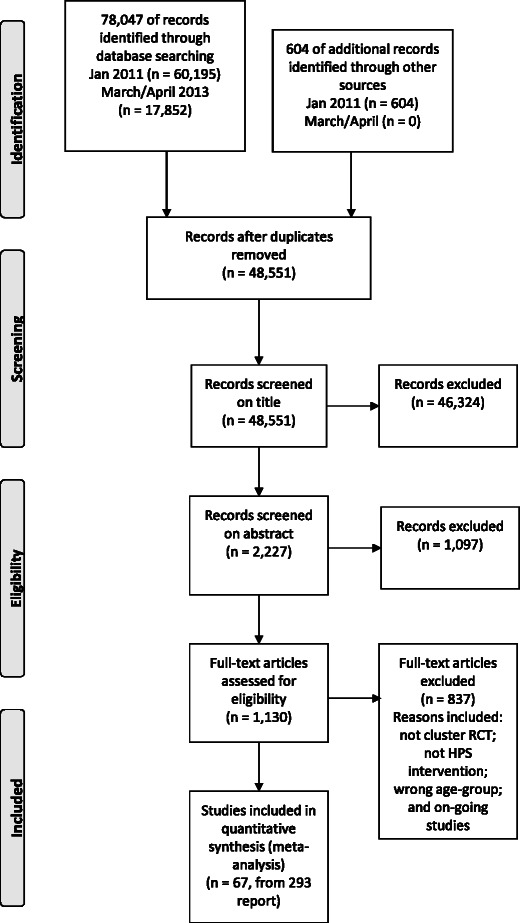
- Data/sample: Searches of 20 databases plus trials registries and websites in 2011 and 2013 identified studies of children and young people aged 4–18 years in schools/colleges; 67 studies met eligibility.
- Analysis: Two reviewers screened, extracted data, and assessed bias; outcomes were grouped by health topic, and random-effects meta-analyses were used where data permitted, with odds ratios for dichotomous outcomes and mean differences/SMDs for continuous outcomes.
## Limitations
- The paper states several methodological limitations: reliance on self-reported data, lack of long-term follow-up, high attrition rates, and poor reporting that made risk-of-bias assessment difficult.
- The authors note that few studies reported academic/attendance outcomes, and many outcomes could not be meta-analyzed because of paucity of data.
- Evident from the text: the evidence base is predominantly from high-income contexts, mostly North America, with only eight studies outside high-income countries and one in a low-income country, limiting generalizability.
Model-written summary. Check it against the paper before relying on it.
Integrity signals
Registry
Cites
Statistics
Figures
Verification
Claims the paper makes
1 Valid · 1 Not valid · 4 Not checked · 46 Own results and interpretations
The paper states this without a source or data behind it here, so there is nothing to check it against. The quote shows it is in the paper.
In the paper
“Intervention effects were generally small.”
§ The World Health Organization’s Health Promoting Schools framework: a Cochrane systematic review and meta-analysis > Abstract > Results
- Asserted: passes — The authors put it forward as true.
- Checkable: passes — It can be checked against evidence.
- Load-bearing: passes — The paper’s conclusions depend on it.
- Based: unclear — It is unclear why the paper says it holds.
A result the paper reports from its own data — it cites no other source for it, so there is none to check. The quote shows it is in the paper.
In the paper
“For physical fitness, there was evidence that Physical Activity + Nutrition interventions were effective at increasing fitness levels in students (SMD = 0.12, 95% CI 0.04, 0.20).”
§ The World Health Organization’s Health Promoting Schools framework: a Cochrane systematic review and meta-analysis > Results > Physical activity/fitness
plainstates a cause- Asserted: passes — The authors put it forward as true.
- Checkable: passes — It can be checked against evidence.
- Load-bearing: passes — The paper’s conclusions depend on it.
- Based: passes — The paper gives a reason why it holds.
A result the paper reports from its own data — it cites no other source for it, so there is none to check. The quote shows it is in the paper.
In the paper
“There was no evidence that these interventions were effective in reducing depression (Table 4).”
§ The World Health Organization’s Health Promoting Schools framework: a Cochrane systematic review and meta-analysis > Results > Mental health
plain- Asserted: passes — The authors put it forward as true.
- Checkable: passes — It can be checked against evidence.
- Load-bearing: passes — The paper’s conclusions depend on it.
- Based: passes — The paper gives a reason why it holds.
A result the paper reports from its own data — it cites no other source for it, so there is none to check. The quote shows it is in the paper.
In the paper
“Nutrition-only interventions were effective on average in increasing reported fruit and vegetable intake among students (SMD = 0.15, 95% CI 0.02 to 0.29, I2 = 83%), but not for reducing fat intake.”
§ The World Health Organization’s Health Promoting Schools framework: a Cochrane systematic review and meta-analysis > Results > Nutrition
plainstates a cause- Asserted: passes — The authors put it forward as true.
- Checkable: passes — It can be checked against evidence.
- Load-bearing: passes — The paper’s conclusions depend on it.
- Based: passes — The paper gives a reason why it holds.
A result the paper reports from its own data — it cites no other source for it, so there is none to check. The quote shows it is in the paper.
In the paper
“Methodological limitations were identified including reliance on self-reported data, lack of long-term follow-up, and high attrition rates.”
§ The World Health Organization’s Health Promoting Schools framework: a Cochrane systematic review and meta-analysis > Abstract > Results
plain- Asserted: passes — The authors put it forward as true.
- Checkable: passes — It can be checked against evidence.
- Load-bearing: unclear — It is unclear whether the paper’s conclusions depend on it.
- Based: passes — The paper gives a reason why it holds.
25 more claims
Create a free account to see all 52 claims and to verify the 2 references still open.
- It may state two separate claims as one. 18
- The quote only partly states this claim. 1
- Probably not a substantial claim. 3
Claims other papers make about this one
Each is checked against this paper’s own text: does it say what the citing paper says it does?
The source backs part of the claim, not all of it — or backs it for a different population, condition or comparison.
In the citing paper
“Within the school setting single or multi-component interventions that address dietary intake, and/or physical activity or sedentary behavior have shown limited effectiveness in reducing sedentary behavior and BMI [8–10].”
From Barriers, facilitators and capacities for childhood obesity prevention in 12 European nations: results of a policy-maker survey (2018) · cites this paper as [10]
Experimental — accuracy not yet measuredThe cited source says what the claim attributes to it.
In the citing paper
“On the whole, an HPS approach demonstrated effectiveness for physical activity promotion.”
From The school environment and adolescent physical activity and sedentary behaviour: a mixed-studies systematic review (2016) · cites this paper as [12]
The cited source says what the claim attributes to it.
In the citing paper
“However, limited conclusions can be drawn regarding the specific role of the school environment as interventions combined environmental modifications with traditional health education and/or family involvement.”
From The school environment and adolescent physical activity and sedentary behaviour: a mixed-studies systematic review (2016) · cites this paper as [12]
The cited source says what the claim attributes to it.
In the citing paper
“Given that the aforementioned reviews 11, 12 and others 14, 15, 16 examine evidence across childhood and adolescence (e.g. 5–18 years old), it is unclear how the associations observed operate among different age groups.”
From The school environment and adolescent physical activity and sedentary behaviour: a mixed-studies systematic review (2016) · cites this paper as [12]
In the citing paper
“Evidence‐based school health promotion (HP) programs have the potential to promote students' health behavior [1, 2].”
From Balancing Fidelity and Adaptation: Action‐Oriented Research Towards Implementing a Nutrition Education Program Among Adolescents (2025) · cites this paper as [1]
Self-check
Percentages, sums and reported differences re-computed from the paper’s own numbers.
Rated major: it would touch a result — a value a result rests on, reported and recomputed p-values on opposite sides of the significance level, two passages that conflict with no sign which is right, or a cited work retracted before this paper was published.
In the paper
“Indeed, for the two studies focusing specifically on mental health and emotional well-being, estimated effect sizes were in the opposite direction with intervention students reporting slightly poorer mental health (OR = 0.06, 95% CI 0.00 to 0.13).”
§ The World Health Organization’s Health Promoting Schools framework: a Cochrane systematic review and meta-analysis > Results > Mental health
Reported 0.06 · recomputed 0.13
Citations
Cites
Preferred Reporting Items for Systematic Reviews and Meta-Analyses: the PRISMA statement
Moher, D., Liberati, A., Tetzlaff, J., Altman, D. G., & for the PRISMA Group (2009) · BMJ · doi:10.1136/bmj.b2535 · Cited by 83,823
Measuring inconsistency in meta-analyses
Higgins, J. P. T., Thompson, S. G., Deeks, J. J., & Altman, D. G. (2003) · BMJ · doi:10.1136/bmj.327.7414.557 · Cited by 63,139
Preferred reporting items for systematic reviews and meta-analyses: the PRISMA Statement.
(2009) · PubMed Central · Cited by 44,859
Cochrane Handbook for Systematic Reviews of Interventions: Cochrane Book Series
(2008) · doi:10.1002/9780470712184 · Cited by 25,048
Preferred Reporting Items for Systematic Reviews and Meta-Analyses: The PRISMA Statement
Moher, D., Liberati, A., Tetzlaff, J., & Altman, D. G. (2009) · Journal of Clinical Epidemiology · doi:10.1016/j.jclinepi.2009.06.005 · Cited by 19,575
Felitti, V. J., Anda, R. F., Nordenberg, D., Williamson, D. F., Spitz, A. M., Edwards, V., Koss, M. P., & Marks, J. S. (1998) · American Journal of Preventive Medicine · doi:10.1016/s0749-3797(98)00017-8 · Cited by 18,943
Hao (2015) · doi:10.1002/14651858 · Cited by 11,321
Child abuse: Adolescent records vs. adult recall
Femina, D. D., Yeager, C. A., & Lewis, D. O. (1990) · Child Abuse & Neglect · doi:10.1016/0145-2134(90)90033-p · Cited by 8,820
Genetics of Food Intake Self-Regulation in Childhood: Literature Review and Research Opportunities
Faith, M. S., Carnell, S., & Kral, T. V. E. (2013) · Human Heredity · doi:10.1159/000353879 · Cited by 7,601
The cochrane database of systematic reviews
Geddes, J. (1996) · Journal of Psychosomatic Research · doi:10.1016/s0022-3999(96)90063-x · Cited by 5,989
Research works printed but not linked: 4
- World Health Organization Europe Health Promotion Evaluation: Recommendations for Policy Makers 1999 Copenhagen WHO Working group on Health Promotion Evaluation
- International Union for Health Promotion and Education Promoting Health in Schools: From evidence to Action 2010
- Keats S Wiggins S Future Diets. Implications for Agriculture and Food Prices 2014 London Overseas Development Institute
- United Nations World Population Prospects: The 2012 Revision, Highlights and Advance Tables 2013 New York Department of Economic and Social Affairs Population Division
Cited by
Bullying in schools: the state of knowledge and effective interventions
Menesini, E., & Salmivalli, C. (2017) · Psychology, Health & Medicine · doi:10.1080/13548506.2017.1279740 · Cited by 804
“However, the effects vary considerably across programmes; they are also weaker when programmes are evaluated with more stringent designs, such as randomised controlled trials (Langford et al., 2015; Ttofi & Farrington, 2011).”
BackgroundCraig, P., Di Ruggiero, E., Frohlich, K. L., Mykhalovskiy, E., White, M., on behalf of the Canadian Institutes of Health Research (CIHR)–National Institute for Health Research (NIHR) Context Guidance Authors Group (listed alphabetically), Campbell, R., Cummins, S., Edwards, N., Hunt, K., et al. (2018) · doi:10.3310/cihr-nihr-01 · Cited by 370
“Summary The review synthesised evidence from cluster randomised controlled trials on the effectiveness of interventions using the Health Promoting Schools framework for improving the health, well-being and educational achievement of school students.(118,119)”
MethodSelf-citationGoldberg, J. M., Sklad, M., Elfrink, T. R., Schreurs, K. M. G., Bohlmeijer, E. T., & Clarke, A. M. (2019) · European Journal of Psychology of Education · doi:10.1007/s10212-018-0406-9 · Cited by 364
Caldwell, D. M., Davies, S. R., Hetrick, S. E., Palmer, J. C., Caro, P., López-López, J. A., Gunnell, D., Kidger, J., Thomas, J., French, C., et al. (2019) · The Lancet Psychiatry · doi:10.1016/s2215-0366(19)30403-1 · Cited by 336
Self-citationMorton, K. L., Atkin, A. J., Corder, K., Suhrcke, M., & van Sluijs, E. M. F. (2016) · Obesity Reviews · doi:10.1111/obr.12352 · Cited by 325
“A recent Cochrane review (12) examined the evidence for the ‘health promoting schools’ (HPS) framework, which combines (a) the school’s social and physical environment, (b) health education within the formal school curriculum and (c) links with families and the wider community.”
BackgroundThe Transition from Childhood to Adolescence: Between Health and Vulnerability
Mastorci, F., Lazzeri, M. F. L., Vassalle, C., & Pingitore, A. (2024) · Children · doi:10.3390/children11080989 · Cited by 219
“In recent years, many school-based programs have addressed the management of bullying, with a reduction in bullying victimization of 20–30% [95].”
BackgroundJones, M., Defever, E., Letsinger, A., Steele, J., & Mackintosh, K. A. (2020) · Journal of Sport and Health Science · doi:10.1016/j.jshs.2019.06.009 · Cited by 189
“A number of existing systematic reviews, meta-analyses, and narrative reviews have examined the effectiveness of interventions promoting PA within the school-setting(16) 20 and during specific parts of a school day, including during play/recess,(21) 23 outside of curricular time,(24) physically active curriculum,(25)…”
BackgroundFarrington, D. P., Gaffney, H., Lösel, F., & Ttofi, M. M. (2017) · Aggression and Violent Behavior · doi:10.1016/j.avb.2016.11.003 · Cited by 185
Raniti, M., Rakesh, D., Patton, G. C., & Sawyer, S. M. (2022) · BMC Public Health · doi:10.1186/s12889-022-14364-6 · Cited by 184
“Our findings indicate that very few interventions that were designed to improve school connectedness assessed depression and anxiety outcomes, in much the same way that school-based interventions designed to improve health typically fail to include educational outcomes [70].”
BackgroundBartelink, N. H. M., van Assema, P., Kremers, S. P. J., Savelberg, H. H. C. M., Oosterhoff, M., Willeboordse, M., van Schayck, O. C. P., Winkens, B., & Jansen, M. W. J. (2019) · Nutrients · doi:10.3390/nu11030689 · Cited by 165
“, who investigated comparable school-based initiatives [18].”
Kearney, C. A., & Graczyk, P. A. (2020) · Clinical Child and Family Psychology Review · doi:10.1007/s10567-020-00317-1 · Cited by 157
The Health Promoting Schools Framework: Known Unknowns and an Agenda for Future Research
Langford, R., Bonell, C., Komro, K., Murphy, S., Magnus, D., Waters, E., Gibbs, L., & Campbell, R. (2017) · Health Education & Behavior · doi:10.1177/1090198116673800 · Cited by 130
Self-citationAerobic fitness and academic achievement: A systematic review and meta-analysis
Álvarez‐Bueno, C., Hillman, C. H., Cavero‐Redondo, I., Sánchez‐López, M., Pozuelo‐Carrascosa, D. P., & Martínez‐Vizcaíno, V. (2020) · Journal of Sports Sciences · doi:10.1080/02640414.2020.1720496 · Cited by 156
“physical activity for children’s physical and mental health (Diamond, 2015; Langford et al., 2015).”
BackgroundResultSupporting every school to become a foundation for healthy lives
Jourdan, D., Gray, N. J., Barry, M. M., Caffe, S., Cornu, C., Diagne, F., Hage, F. E., Farmer, M. Y., Slade, S., Marmot, M. G., et al. (2021) · The Lancet Child & Adolescent Health · doi:10.1016/s2352-4642(20)30316-3 · Cited by 171
Effects of cooperative learning on peer relations, empathy, and bullying in middle school
Ryzin, M. J. V., & Roseth, C. J. (2019) · Aggressive Behavior · doi:10.1002/ab.21858 · Cited by 181
“In addition, effects of bullying prevention programs tend to be weaker when study designs are more stringent (i.e., randomized trials; Langford et al., 2015).”
BackgroundObesity and Eating Disorders in Children and Adolescents: The Bidirectional Link
Stabouli, S., Erdine, S., Suurorg, L., Jankauskienė, A., & Lurbe, E. (2021) · Nutrients · doi:10.3390/nu13124321 · Cited by 123
“In a Cochrane review, the WHO HPS framework was found to be effective at improving aspects of student health including BMI z-score at the population level [86].”
MethodThe Ottawa Charter 30 years on: still an important standard for health promotion
Thompson, S. R., Watson, M. C., & Tilford, S. (2017) · International Journal of Health Promotion and Education · doi:10.1080/14635240.2017.1415765 · Cited by 157
“For those settings, where there is a body of evaluation evidence it appears stronger where specific components of a setting have been addressed rather than holistic developments (Whitehead 2004; Groene and Jorgenson 2005; Stewart–Brown 2006; Lee et al. 2013; Langford et al. 2015).”
BackgroundDay, R. E., Sahota, P., & Christian, M. S. (2019) · BMC Public Health · doi:10.1186/s12889-019-7550-2 · Cited by 103
Kruk, M. E., Lewis, T. P., Arsenault, C., Bhutta, Z. A., Irimu, G., Jeong, J., Lassi, Z. S., Sawyer, S. M., Vaivada, T., Waiswa, P., et al. (2022) · The Lancet · doi:10.1016/s0140-6736(21)02532-0 · Cited by 103
Making every school a health-promoting school
Sawyer, S. M., Raniti, M. B., & Aston, R. (2021) · The Lancet Child & Adolescent Health · doi:10.1016/s2352-4642(21)00190-5 · Cited by 136
“Various terms have been used for HPS (51) and similar whole-school approaches to health, such as “comprehensive school health”, “healthy school communities” and “school health education”.”
Prescott, M. P., Burg, X., Metcalfe, J. J., Lipka, A. E., Herritt, C., & Cunningham-Sabo, L. D. (2019) · Nutrients · doi:10.3390/nu11081869 · Cited by 124
Singla, D. R., Shinde, S., Patton, G. C., & Patel, V. (2020) · Journal of Adolescent Health · doi:10.1016/j.jadohealth.2020.09.030 · Cited by 125
García-Moya, I., Bunn, F., Jiménez-Iglesias, A., Paniagua, C., & Brooks, F. M. (2019) · Educational Review · doi:10.1080/00131911.2018.1424117 · Cited by 102
“There is increasing consensus that educational attainment and wellbeing are interconnected and that a positive environment at school favours both educational and wellbeing outcomes (Bonell et al. 2014; Langford et al. 2015).”
BackgroundO’Brien, K. M., Barnes, C., Yoong, S., Campbell, E., Wyse, R., Delaney, T., Brown, A., Stacey, F., Davies, L., Lorien, S., et al. (2021) · Nutrients · doi:10.3390/nu13114113 · Cited by 100
“Langford 2014 [22,49] Country: Any Age: 4 to 18 Setting: School, college Design: CRCTs Intervention: School interventions based on the HPS framework, with active components in school education, environment, and partnerships for improving health and wellbeing (range: 5 months to 3 years) Comparator: No intervention, us…”
BackgroundMethodHudson, K. G., Lawton, R., & Hugh‐Jones, S. (2020) · BMC Health Services Research · doi:10.1186/s12913-020-4942-z · Cited by 156
Prevention and treatment of childhood and adolescent obesity: a systematic review of meta-analyses
Ψαλτοπούλου, Θ., Tzanninis, S., Ntanasis‐Stathopoulos, I., Panotopoulos, G., Kostopoulou, M., Tzanninis, I., Tsagianni, A., & Sergentanis, T. Ν. (2019) · World Journal of Pediatrics · doi:10.1007/s12519-019-00266-y · Cited by 112
Kansiime, C., Hytti, L., Nalugya, R., Nakuya, K., Namirembe, P., Nakalema, S., Neema, S., Tanton, C., Alezuyo, C., Musoke, S. N., et al. (2020) · BMJ Open · doi:10.1136/bmjopen-2019-031182 · Cited by 113
Self-citationWaters, E., Gibbs, L., Tadic, M., Ukoumunne, O. C., Magarey, A., Okely, A. D., de Silva, A., Armit, C., Green, J., O’Connor, T., et al. (2018) · BMC Public Health · doi:10.1186/s12889-017-4625-9 · Cited by 94
Charlton, K., Comerford, T., Deavin, N., & Walton, K. (2021) · Public Health Nutrition · doi:10.1017/s1368980020004024 · Cited by 90
Mental health of unaccompanied refugee minors in Europe: A systematic review
Daniel-Calveras, A., Baldaquí, N., & Baeza, I. (2022) · Child Abuse & Neglect · doi:10.1016/j.chiabu.2022.105865 · Cited by 119
“It is worth noting that there may be a cyclical effect: healthy children achieve better educational outcomes, which, in turn, are associated with improved health later in life (Langford et al., 2015).”
BackgroundDonaldson, C., Moore, G. F., & Hawkins, J. L. (2022) · School Mental Health · doi:10.1007/s12310-022-09539-w · Cited by 121
“Schools have a long history as settings for interventions to improve health and wellbeing (for example, Jacob et al., 2021; Langford et al., 2015; Shackle-ton et al., 2016), both because of the important role of the school environment for wellbeing and because schools offer a means of accessing…”
BackgroundNavarro Mateos, C., Pérez López, I. J., & Marzo, P. F. (2021) · Retos · doi:10.47197/retos.v42i0.87384 · Cited by 79
Divecha, D., & Brackett, M. A. (2019) · International Journal of Bullying Prevention · doi:10.1007/s42380-019-00019-5 · Cited by 126
Abu-Omar (2018) · doi:10.1186/s12889-018-6368-7 · Cited by 67
Farm to School Activities and Student Outcomes: A Systematic Review
Prescott, M. P., Cleary, R., Bonanno, A., Costanigro, M., Jablonski, B. B. R., & Long, A. (2019) · Advances in Nutrition · doi:10.1093/advances/nmz094 · Cited by 98
Campbell, R. M., Wright, C., Hickman, M., Kipping, R., Smith, M. C., Pouliou, T., & Heron, J. E. (2020) · Preventive Medicine · doi:10.1016/j.ypmed.2020.106157 · Cited by 91
Self-citationSubstance Use among Adolescents Involved in Bullying: A Cross-Sectional Multilevel Study
Gaete, J., Tornero, B., Valenzuela, D., Rojas‐Barahona, C. A., Salmivalli, C., Valenzuela, E., & Araya, R. (2017) · Frontiers in Psychology · doi:10.3389/fpsyg.2017.01056 · Cited by 90
Peralta, L. R., Mihrshahi, S., Bellew, B., Reece, L. J., & Hardy, L. L. (2019) · Journal of School Health · doi:10.1111/josh.12761 · Cited by 85
Kearney, C. A., Dupont, R., Fensken, M., & Gonzálvez, C. (2023) · Frontiers in Education · doi:10.3389/feduc.2023.1253595 · Cited by 71
Schneller, M. B., Duncan, S., Schipperijn, J., Nielsen, G., Mygind, E., & Bentsen, P. (2017) · BMC Public Health · doi:10.1186/s12889-017-4430-5 · Cited by 79
“A recent meta-analysis [12] found trials adhering to the Health Promoting School’s framework to provide small positive effects on health parameters, including PA, that are potentially important at population level.”
MethodThe Role of School Leaders’ Health Literacy for the Implementation of Health Promoting Schools
Dadaczynski, K., Rathmann, K., Hering, T., & Okan, O. (2020) · International Journal of Environmental Research and Public Health · doi:10.3390/ijerph17061855 · Cited by 89
“, social‐emotional competencies and aggressive behavior) [9,11,13].”
Occupational Therapy Practice Guidelines for Children and Youth Ages 5–21 Years
Cahill, S., & Beisbier, S. (2020) · American Journal of Occupational Therapy · doi:10.5014/ajot.2020.744001 · Cited by 88
“A Cochrane review conducted by Langford et al. (2015) examined cluster RCTs in 2011 – 2013 concerning health programs consistent with WHO ’ s Health Promoting Schools framework.”
Brigden, A., Anderson, E., Linney, C., Morris, R., Parslow, R., Serafimova, T., Smith, L., Briggs, E., Loades, M., & Crawley, E. (2020) · Journal of Medical Internet Research · doi:10.2196/16924 · Cited by 63
Effectiveness of school-based nutrition interventions in sub-Saharan Africa: a systematic review
Kyere, P., Veerman, L. J., Lee, P. J., & Stewart, D. (2020) · Public Health Nutrition · doi:10.1017/s1368980020000506 · Cited by 78
HealthLit4Kids study protocol; crossing boundaries for positive health literacy outcomes
Nash, R., Elmer, S., Thomas, K., Osborne, R. H., Macintyre, K., Shelley, B., Murray, L., Harpur, S., & Webb, D. (2018) · BMC Public Health · doi:10.1186/s12889-018-5558-7 · Cited by 75
Teesson, M., Champion, K. E., Newton, N. C., KAY‐LAMBKIN, F. J., Chapman, C., Thornton, L. K., Slade, T. N., Sunderland, M., Mills, K. L., Gardner, L. A., et al. (2020) · BMJ Open · doi:10.1136/bmjopen-2019-035662 · Cited by 59
“25 26 Schools are ideal settings to implement healthy lifestyle interventions as they provide access to large numbers of students at a critical time period, are the place where students spend most of their waking hours, and, in many countries, including Australia, have a mandated health education…”
Brennan, S., Lavelle, F., Moore, S. E., Dean, M., McKinley, M. C., McCole, P., Hunter, R. F., Dunne, L., O’Connell, N. E., Cardwell, C. R., et al. (2021) · International Journal of Behavioral Nutrition and Physical Activity · doi:10.1186/s12966-021-01086-y · Cited by 70
Jones, M., Pitt, H., Oxford, L., Bray, I., Kimberlee, R., & Orme, J. (2017) · International Journal of Environmental Research and Public Health · doi:10.3390/ijerph14060639 · Cited by 45
“Interventions, building on the WHO’s influential Whole Settings model [14], the Whole School Approach [15], and the Health Promoting Schools framework [16], include several components that are intended to generate an effect through interdependent and systemic actions [17].”
BackgroundSchool culture and student mental health: a qualitative study in UK secondary schools
Jessiman, P., Kidger, J., Spencer, L. P., Geijer‐Simpson, E., Kaluževičiūtė, G., Burn, A., Leonard, N., & Limmer, M. (2022) · BMC Public Health · doi:10.1186/s12889-022-13034-x · Cited by 135
“There is evidence of positive effects on physical health (including weight, physical activity and diet), and limited evidence for the impact of the health promoting school approach on student mental health [2].”
BackgroundAn RCT to facilitate implementation of school practices known to increase physical activity
Sutherland, R. L., Nathan, N. K., Lubans, D. R., Cohen, K., Davies, L. J., Desmet, C., Cohen, J., McCarthy, N. J., Butler, P., Wiggers, J., et al. (2017) · American Journal of Preventive Medicine · doi:10.1016/j.amepre.2017.08.009 · Cited by 58
Sutherland, R., Campbell, E. M., Nathan, N., Wolfenden, L., Lubans, D. R., Morgan, P. J., Gillham, K. E., Oldmeadow, C. J., Searles, A., Reeves, P., et al. (2019) · BMC Public Health · doi:10.1186/s12889-019-6965-0 · Cited by 51
“The implementation of comprehensive school PA programs and the use of the Health Promoting Schools (HPS) framework for school based programs can enhance PA outcomes [13, 20, 21], with systematic review evidence supporting the effectiveness of interventions that address: the curriculum (physical education (PE) and spor…”
BackgroundMcHugh, C., Hurst, A., Bethel, A., Lloyd, J., Logan, S., & Wyatt, K. (2020) · Public Health · doi:10.1016/j.puhe.2020.02.006 · Cited by 54
Haraldstad, K., Kvarme, L. G., Christophersen, K.-A., & Helseth, S. (2019) · BMC Public Health · doi:10.1186/s12889-019-7115-4 · Cited by 53
FOODLIT-PRO: Food Literacy Domains, Influential Factors and Determinants—A Qualitative Study
Rosas, R., Pimenta, F., Leal, I. M. P., & Schwarzer, R. (2019) · Nutrients · doi:10.3390/nu12010088 · Cited by 72
Danish ‘add-in’ school-based health promotion: integrating health in curriculum time
Bentsen, P., Bonde, A. H., Schneller, M. B., Danielsen, D., Bruselius-Jensen, M., & Aagaard‐Hansen, J. (2018) · Health Promotion International · doi:10.1093/heapro/day095 · Cited by 58
Dadaczynski, K., & Hering, T. (2021) · International Journal of Environmental Research and Public Health · doi:10.3390/ijerph18052623 · Cited by 49
“, social–emotional competencies and aggressive behaviour) [25,27,29].”
BackgroundMethodHummel, K., Whittaker, S., Sillett, N., Basken, A., Berghammer, M. C., Chalela, T., Chauhan, J., Garcia, L. A., Hasan, B. S., Jenkins, K. J., et al. (2021) · European Heart Journal - Quality of Care and Clinical Outcomes · doi:10.1093/ehjqcco/qcab009 · Cited by 53
“37 For adults, as a corollary to children school absenteeism, the WG recommends the Work Productivity and Activity Impairment Questionnaire, which scores work absenteeism and presenteeism, work productivity loss, and activity impairment impacting work production.”
BackgroundFactors Associated With Unhealthy Snacks Consumption Among Adolescents in Iran’s Schools
Yazdi‐Feyzabadi, V., Mohammadi, N. K., Omidvar, N., Karimi‐Shahanjarini, A., Nedjat, S., & Rashidian, A. (2017) · International Journal of Health Policy and Management · doi:10.15171/ijhpm.2017.09 · Cited by 56
“International Journal of Health Policy and Management, 2017, 6(9), 519–528 526 study in Australia in 2009-2010 showed that in addition to television food advertising, digital food marketing and print/ transport/school food marketing were also associated with unhealthy snacks consumption.”
BackgroundInfluentialSchneller, M. B., Schipperijn, J., Nielsen, G., & Bentsen, P. (2017) · International Journal of Behavioral Nutrition and Physical Activity · doi:10.1186/s12966-017-0534-7 · Cited by 54
“Recently, there have been calls for school-based PA interventions targeting the school curriculum and seeking integration with the existing practices within educational systems and schools [14].”
BackgroundLekamge, R. B., Jain, R., Sheen, J., Solanki, P., Zhou, Y., Romero, L., Barry, M. M., Chen, L., Karim, M. N., & Ilić, D. (2025) · Journal of Youth and Adolescence · doi:10.1007/s10964-025-02135-6 · Cited by 93
Organizational Health Literacy in Schools: Concept Development for Health-Literate Schools
Kirchhoff, S., Dadaczynski, K., Pelikan, J. M., Zelinka-Roitner, I., Dietscher, C., Bittlingmayer, U. H., & Okan, O. (2022) · International Journal of Environmental Research and Public Health · doi:10.3390/ijerph19148795 · Cited by 67
“(iii) Considering that the organizational health literacy approach represents a whole-of-school or settings-approach, and that the WHO-driven health promoting school framework [41] is already being implemented in selected German schools, including state networks [42,43], the HeLit-Schools project also aims to interlin…”
BackgroundBray, I., Slater, A., Lewis‐Smith, H., Bird, E. L., & Sabey, A. (2018) · Preventive Medicine · doi:10.1016/j.ypmed.2018.08.011 · Cited by 64
“Evidence about the effectiveness of such programmes is mixed (Mears & Jago, 2016), and a particular problem is sustaining the benefits in the longer-term (Langford et al., 2015).”
BackgroundFalkenberg, H. K., Langaas, T., & Svarverud, E. (2019) · BMC Ophthalmology · doi:10.1186/s12886-019-1178-y · Cited by 56
Food and nutrition education opportunities within Australian primary schools
Love, P., Booth, A., Margerison, C., Nowson, C. A., & Grimes, C. A. (2020) · Health Promotion International · doi:10.1093/heapro/daz132 · Cited by 59
Whelan, J., Fraser, P., Bolton, K. A., Love, P., Strugnell, C., Boelsen‐Robinson, T., Blake, M. R., Martin, E., Allender, S. E., & Bell, C. (2023) · Health Research Policy and Systems · doi:10.1186/s12961-023-01023-4 · Cited by 54
“Other authors used frameworks developed from peak bodies, such as the Health Promoting Schools’ Framework [56], and the Building Blocks for a Strong Health System [57].”
MethodAmpofo, A. G., Boyes, A., Khumalo, P., & Mackenzie, L. (2022) · Gynecologic Oncology · doi:10.1016/j.ygyno.2021.12.021 · Cited by 55
“Fortaleça sua Saúde” Working Group, Barbosa Filho, V. C., Lopes, A. D. S., Lima, A. B., de Souza, E. A., Gubert, F. D. A., Silva, K. S., Vieira, N. F. C., Trompieri Filho, N., de Araújo, T. S., et al. (2015) · BMC Public Health · doi:10.1186/s12889-015-2543-2 · Cited by 42
“First, in general, interventions had modest effect on behavior change [10, 11, 14, 16].”
BackgroundMethodInfluentialDo Observed Teaching Behaviors Relate to Students’ Engagement in Physical Education?
González-Peño, A., Álvarez, E. F., & López, J. C. (2021) · International Journal of Environmental Research and Public Health · doi:10.3390/ijerph18052234 · Cited by 60
“The physical education (PE) setting can be an ideal context to encourage the acquisition of healthy lifestyles and adherence to physical activity (PA) and sport throughout a pupil’s life development [1,2].”
BackgroundConsidering mindfulness techniques in school-based anti-bullying programmes
Foody, M., & Samara, M. M. (2018) · Journal of New Approaches in Educational Research · doi:10.7821/naer.2018.1.253 · Cited by 52
“Fur - thermore, schools play an important role in student’s social lives (Bond et al., 2004) and in promoting a safe and secure environ - ment is often a primary concern and considered a prerequisite for student learning and attendance (Langford et al., 2015).”
Universal prevention of alcohol and drug use: An overview of reviews in an Australian context
Mewton, L. R., Visontay, R., Chapman, C., Newton, N. C., Slade, T. N., KAY‐LAMBKIN, F. J., & Teesson, M. (2018) · Drug and Alcohol Review · doi:10.1111/dar.12694 · Cited by 40
“a multi-component approach that involved changes to the curriculum, school ethos and engagement with communities or families) [20].”
BackgroundResultCaldwell, D. M., Davies, S. R., Thorn, J. C., Palmer, J. C., Caro, P., Hetrick, S. E., Gunnell, D., Anwer, S., López-López, J. A., French, C. E., et al. (2021) · Public Health Research · doi:10.3310/phr09080 · Cited by 45
Self-citationon behalf of MOVI group, Sánchez‐López, M., Hermosa, A. R., Redondo‐Tébar, A., Visier‐Alfonso, M. E., Jiménez‐López, E., Martínez-Andrés, M., Solera-Martínez, M., Soriano‐Cano, A., & Martínez‐Vizcaíno, V. (2019) · BMC Public Health · doi:10.1186/s12889-019-6742-0 · Cited by 45
Chang, F., Chiu, C., Chen, P., Miao, N., Chiang, J., & Chuang, H. (2018) · Cyberpsychology Behavior and Social Networking · doi:10.1089/cyber.2017.0324 · Cited by 45
“40 During the past decade, the Taiwan government funded the HPS program to support school collaboration with communities, parent teacher associations (PTA), and experts in a concerted effort to promote the health of children.”
The traits of Autism Spectrum Disorder and bullying victimization in an epidemiological population
Junttila, M., Kielinen, M., Jussila, K. K., Joskitt, L., Mäntymaa, M., Ebeling, H. E., & Mattila, M. (2023) · European Child & Adolescent Psychiatry · doi:10.1007/s00787-023-02228-2 · Cited by 44
Long, K. Q., Hoang, T. N. A., Phuong, N. H., Hanh, T. T. T., Park, K., Takeuchi, M., Lam, N. T., Nga, P. T., Le, P.-A., Tuấn, L. V., et al. (2021) · The Lancet Regional Health - Western Pacific · doi:10.1016/j.lanwpc.2021.100225 · Cited by 56
Nash, R., Cruickshank, V. J., Pill, S., MacDonald, A., Coleman, C., & Elmer, S. (2020) · Health Education Journal · doi:10.1177/0017896920961423 · Cited by 44
“This finding aligns with the recommendations of researchers (e.g. Langford et al., 2015; Nutbeam, 2000; Paakkari, 2015; Paakkari and Okan, 2019) who have advocated for a whole-school approach to the development of HL.”
ResultTidwell, J. B., Gopalakrishnan, A., Unni, A., Sheth, E., Daryanani, A., Singh, S., & Sidibe, M. (2020) · PLoS ONE · doi:10.1371/journal.pone.0229655 · Cited by 47
“Based on this evidence, the World Health Organization has recommended the “Health Promoting Schools,” approach, which goes beyond simple education to work more holistically in the school environment [23].”
BackgroundKennedy, S. G., Peralta, L. R., Lubans, D. R., Foweather, L., & Smith, J. J. (2019) · Physical Education and Sport Pedagogy · doi:10.1080/17408989.2019.1571182 · Cited by 38
“Consequently, the long-term sustainability of such programs depends on the likelihood that teachers will continue implementation after research-oriented resources are withdrawn (Hung et al. 2014; Langford et al. 2015).”
BackgroundHealth risk behaviours amongst school adolescents: protocol for a mixed methods study
Achhab, Y. E., El-Ammari, A., Kazdouh, H. E., Najdi, A., Berraho, M., Tachfouti, N., Lamri, D., Fakir, S. E., & Nejjari, C. (2016) · BMC Public Health · doi:10.1186/s12889-016-3873-4 · Cited by 49
“Additionally, results from this research may be recognize the need for programmes that teach children and teenagers the basic concepts of health and fitness and how to improve present and future health status [14, 28].”
BackgroundA Systematic Review of Healthy Nutrition Intervention Programs in Kindergarten and Primary Education
Collado-Soler, R., Alférez-Pastor, M., Torres, F. L., Trigueros, R., Aguilar-Parra, J. M., & Navarro, N. (2023) · Nutrients · doi:10.3390/nu15030541 · Cited by 35
“These programs should be carried out as early as possible because adult eating habits are developed from an early age [30,31].”
BackgroundGaskin, C. J., Hargous, C. V., Stephens, L. D., Nyam, G., Brown, V., Lander, N., Yoong, S., Morrissey, B., Allender, S. E., & Strugnell, C. (2024) · SLEEP Advances · doi:10.1093/sleepadvances/zpae019 · Cited by 54
“…(2) promotion of health via the informal curriculum (e.g. values and attitudes espoused within schools, and the physical environments of schools), and (3) engagement with families, outside agencies, and wider communities in recognition of their importance in influencing child health [64].”
BackgroundHealy, S. R., Valente, J. Y., Caetano, S. C., Martins, S. S., & Sanchez, Z. M. (2020) · Aggression and Violent Behavior · doi:10.1016/j.avb.2020.101486 · Cited by 46
Shinde, S., Wang, D., Moulton, G. E., & Fawzi, W. W. (2025) · Maternal & Child Nutrition · doi:10.1111/mcn.13437 · Cited by 34
“Al ‐ Khudairy et al., 2017; Bleich et al., 2018; Brown et al., 2016; Langford et al., 2015; Saraf et al., 2012; WHO, 2001, 2017a, 2017b, 2021).”
Improving adolescents' dietary behaviours in the school-setting: challenges and opportunities
Devine, L. D., Hill, A., & Gallagher, A. M. (2023) · Proceedings of The Nutrition Society · doi:10.1017/s0029665123002197 · Cited by 53
Betschart, S., Sandmeier, A., Skedsmo, G., Hascher, T., Okan, O., & Dadaczynski, K. (2022) · International Journal of Environmental Research and Public Health · doi:10.3390/ijerph192214829 · Cited by 37
“In other words, HPS seek to promote health through the school curriculum (formal), the ethos or environment (informal values, attitudes, and physical environment of a school), and families and communities [8].”
BackgroundThoonen, K., van Osch, L., de Vries, H., Jongen, S., & Schneider, F. (2020) · International Journal of Environmental Research and Public Health · doi:10.3390/ijerph17020529 · Cited by 50
Abamecha, F., Sudhakar, M., Abebe, L., Kebede, Y., Alemayehu, G., & Birhanu, Z. (2021) · Malaria Journal · doi:10.1186/s12936-020-03578-x · Cited by 40
“Family participation in school health programmes was considered one of the principal components of the Health Promoting Schools policy [40].”
BackgroundChilds‐Fegredo, J., Burn, A., Duschinsky, R., Humphrey, A., Ford, T. J., Jones, P. B., & Howarth, E. (2020) · School Mental Health · doi:10.1007/s12310-020-09398-3 · Cited by 41
Connolly, S., Carlin, A., Johnston, A., Woods, C. B., Powell, C., Belton, S., O’Brien, W., Saunders, J. A., Duff, C., Farmer, O., et al. (2020) · International Journal of Environmental Research and Public Health · doi:10.3390/ijerph17186849 · Cited by 37
“A Cochrane Review of the WHO Health Promoting Schools Framework reported it to be effective in improving PA and physical fitness [67].”
BackgroundHealthLit4Kids: Supporting schools to be health literacy responsive organisations
Elmer, S., Nash, R., Kemp, N., Coleman, C., Wyss, M., & Roach, J. (2020) · Health Promotion Journal of Australia · doi:10.1002/hpja.412 · Cited by 36
Tabacchi, G., Faigenbaum, A. D., Jemni, M., Thomas, E., Capranica, L., Palma, A., Breda, J., & Bianco, A. (2018) · International Journal of Environmental Research and Public Health · doi:10.3390/ijerph15091933 · Cited by 40
Botfield, J. R., Zwi, A. B., Rutherford, A., & Newman, C. E. (2018) · Sex Education · doi:10.1080/14681811.2018.1464905 · Cited by 31
“…and capacities of educational institutions as settings with much potential to support and promote the health and wellbeing of young people (Aggleton, Dennison, and Warwick 2010; Langford et al. 2015), including their sexual and reproductive health (Smith et al. 2011; Thomas and Aggleton 2016).”
BackgroundOfosu, N. N., Ekwaru, J. P., Bastian, K. A., Loehr, S. A., Storey, K., Spence, J. C., & Veugelers, P. J. (2018) · BMC Public Health · doi:10.1186/s12889-018-5427-4 · Cited by 31
“Thus, the most effective programs have characteristics such as being of long duration and high intensity, involving the whole school, being a multifactorial intervention, and comprising changes to the school environment [39].”
BackgroundRecess: A Study of Belongingness, Affect, and Victimization on the Playground
McNamara, L., Lodewyk, K. R., & Franklin, N. (2018) · Children & Schools · doi:10.1093/cs/cdy006 · Cited by 39
Bergeron, D. A., Talbot, L. R., & Gaboury, I. (2019) · Health Education Journal · doi:10.1177/0017896919833422 · Cited by 33
“Despite all of the work done and evidence demonstrating positive outcomes in children (Langford et al., 2015; Mukamana and Johri, 2016; Turunen et al., 2017), the implementation and evaluation of SHPI remain problematic (Haggis, 2010; Joyce et al., 2016; Turunen et al., 2017).”
BackgroundInfluentialFeasibility study of the SWITCH implementation process for enhancing school wellness
Chen, S., Dzewaltowski, D. A., Rosenkranz, R. R., Lanningham‐Foster, L., Vazou, S., Gentile, D. A., Lee, J. A., Braun, K. J., Wolff, M. M., & Welk, G. J. (2018) · BMC Public Health · doi:10.1186/s12889-018-6024-2 · Cited by 33
Teachers’ recognition of anxiety and somatic symptoms in their pupils
Neil, L., & SMITH, M. A. (2017) · Psychology in the Schools · doi:10.1002/pits.22055 · Cited by 41
Gaete, J., Montero‐Marín, J., Rojas‐Barahona, C. A., Olivares, E., & Araya, R. (2016) · Frontiers in Psychology · doi:10.3389/fpsyg.2016.01901 · Cited by 41
“In the last several years, there has been an increasing interest in the evaluation of school-based interventions that aim to improve school climate and school membership; these interventions boast promising results (Bonell et al., 2014; Langford et al., 2014, 2015).”
BackgroundFabbri, C., Rodrigues, K., Leurent, B., Allen, E., Qiu, M., Zuakulu, M., Nombo, D., Kaemingk, M., Filippo, A. D., Torrats‐Espinosa, G., et al. (2021) · PLoS Medicine · doi:10.1371/journal.pmed.1003808 · Cited by 32
Halliday, K. E., Witek-McManus, S. S., Opondo, C., Mtali, A., Allen, E., Bauleni, A., Ndau, S., Phondiwa, E., Ali, D., Kachigunda, V., et al. (2020) · BMJ Global Health · doi:10.1136/bmjgh-2019-001666 · Cited by 29
Metadata
- Authors
- Langford, R., Bonell, C., Jones, H., Pouliou, T., Murphy, S., Waters, E., Komro, K., Gibbs, L., Magnus, D., & Campbell, R.
- Affiliations
- University of Bristol (GB)
- Cardiff University (GB)
- The University of Melbourne (AU)
- University of Florida Health (US)
- Corresponding author
- Langford, Rebecca
- ORCID
- Venue
- BMC Public Health
- Published
- 2015-02-12
- Volume
- 15
- Issue
- 1
- Pages
- 130-130
- ISSN
- 1471-2458 (ISSN-L)
- PMC
- PMC4339015
- OpenAlex
- W2002670491
- Semantic Scholar
- b1b578741aed2db446db524e00dd1818c47d5e0e
- Cited by
- 578
- References
- 124
- Citations by year
- 2026: 51 · 2025: 60 · 2024: 52 · 2023: 61 · 2022: 73 · 2021: 83 · 2020: 74 · 2019: 39 · 2018: 34 · 2017: 28 · 2016: 20 · 2015: 3
- FWCI
- 6.30
- Type
- journal article
- Language
- en
- Open access
- gold
- doi.org
- Locations
- BMC Public Health (publishedVersion, cc-by)
- Europe PMC (PubMed Central) (publishedVersion, cc-by)
- PubMed Central (publishedVersion, cc-by)
- PubMed (publishedVersion)
- LSHTM Research Online (London School of Hygiene and Tropical Medicine) (acceptedVersion)
- UCL Discovery (University College London) (submittedVersion, cc-by)
- Minerva Access (University of Melbourne) (submittedVersion, cc-by)
- Bristol Research (University of Bristol) (submittedVersion)
- Funders
- Wellcome Trust (MR/KO232331/1)
- United Kingdom Clinical Research Collaboration (MR/KO232331/1)
- Llywodraeth Cymru (MR/KO232331/1)
- Cancer Research UK (MR/KO232331/1)
- National Institute for Health and Care Research (NF-SI-0514-10114)
- British Heart Foundation (MR/KO232331/1)
- Medical Research Council (MR/K025643/1, MR/KO232331/1, MR/K023233/1)
- Economic and Social Research Council (MR/KO232331/1)
- Centre for the Development and Evaluation of Complex Interventions for Public Health Improvement (MR/KO232331/1)
- Topics
- Health Sciences › Medicine › Public Health, Environmental and Occupational Health › School Health and Nursing Education
- Health Sciences › Medicine › Public Health, Environmental and Occupational Health › Obesity, Physical Activity, Diet
- Health Sciences › Medicine › Public Health, Environmental and Occupational Health › Adolescent Health and Behaviors
- Keywords
- health promoting schools, school health promotion, child and adolescent health, body mass index, physical activity, physical fitness, fruit and vegetable intake, tobacco use, bullying, school curriculum, school environment, family and community involvement, educational attainment
- MeSH terms
- Achievement, Adolescent, Child, Child, Preschool, Diet, Female, Fruit, Humans, Male, Mental Health, Physical Fitness, School Health Services, World Health Organization, Program Evaluation, Health Behavior, Body Mass Index, Randomized Controlled Trials as Topic
About these checks
Registry, retraction, Cites and statistics results are computed, not judged, with one exception: a printed reference that no index lists is read once by a model before it counts as a citation error. Claims are extracted by a model and kept only when their quote appears verbatim in the text; each cited source is then checked, with a model’s help, for whether it says what the claim relies on. Those verdicts can be wrong — read the claim’s quote and the cited source before relying on one.
A language model drew the claims from the paper on 2026-10-10, under version 3 of the claim definition (model deepseek-v4.1-flash, prompt extract-v3).
A second model labelled each claim on 2026-10-10 (model jev-1.13-20260917, definition revision gold-guideline-v0.2).
Statistics and arithmetic are recomputed, not judged.
Confidence bands are shown only for fields calibrated on our annotated test set. None is calibrated yet, so no band is shown.
What counts as a claim ›How we measure confidence ›How we check this ›
Are you an author, or do you see a problem with this page? Request a review
Data sources
Bibliographic data: Semantic Scholar, OpenAlex, Crossref.
Contains information from the Semantic Scholar Academic Graph Datasets, made available under the ODC Attribution License (ODC-BY 1.0).
Semantic Scholar’s data is described in: Kinney, R., et al. (2023). The Semantic Scholar Open Data Platform. arXiv:2301.10140.
