

Breaking barriers: using the behavior change wheel to develop a tailored intervention to overcome workplace inhibitors to breaking up sitting time
Open accessPublished version of a preprint
The DOI matches its Crossref record; 85 of the 88 references it cites were found in a registry or an index.
Abstract
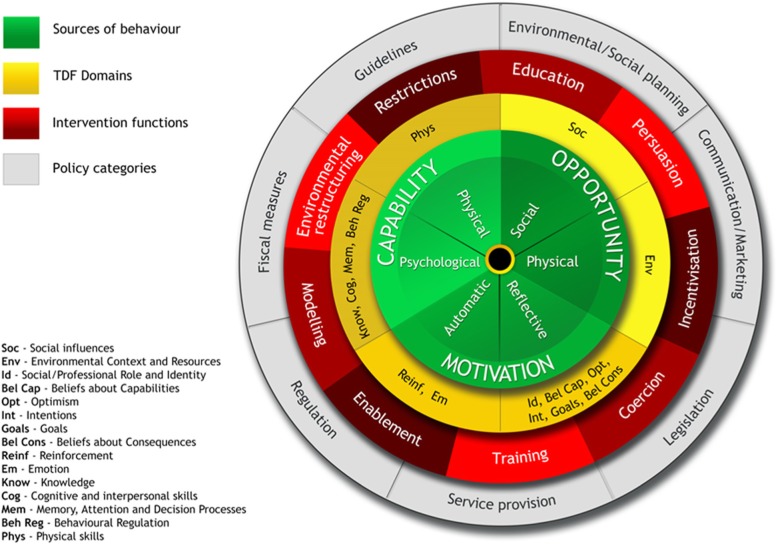
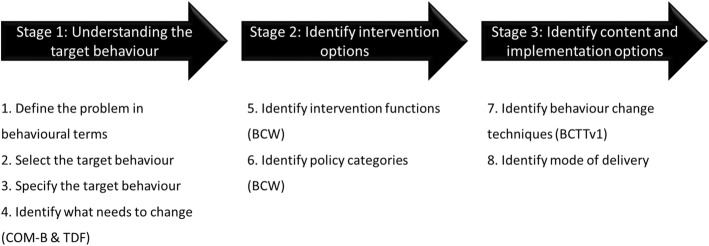
BACKGROUND: The workplace is a prominent domain for excessive sitting. The consequences of increased sitting time include adverse health outcomes such as cardiovascular disease and poor mental wellbeing. There is evidence that breaking up sitting could improve health, however, any such intervention in the workplace would need to be informed by a theoretical evidence-based framework. The aim of this study was to use the Behaviour Change Wheel (BCW) to develop a tailored intervention to break up and reduce workplace sitting in desk-based workers. METHODS: The BCW guide was followed for this qualitative, pre-intervention development study. Semi-structured interviews were conducted with 25 office workers (26-59 years, mean age 40.9 [SD = 10.8] years; 68% female) who were purposively recruited from local council offices and a university in the East of England region. The interview questions were developed using the Theoretical Domains Framework (TDF). Transcripts were deductively analysed using the COM-B (Capability, Opportunity, Motivation - Behaviour) model of behaviour. The Behaviour Change Technique Taxonomy Version 1 (BCTv1) was thereafter used to identify possible strategies that could be used to facilitate change in sitting behaviour of office workers in a future intervention. RESULTS: Qualitative analysis using COM-B identified that participants felt that they had the physical Capability to break up their sitting time, however, some lacked the psychological Capability in relation to the knowledge of both guidelines for sitting time and the consequences of excess sitting. Social and physical Opportunity was identified as important, such as a supportive organisational culture (social) and the need for environmental resources (physical). Motivation was highlighted as a core target for intervention, both reflective Motivation, such as beliefs about capability and intention and automatic in terms of overcoming habit through reinforcement. Seven intervention functions and three policy categories from the BCW were identified as relevant. Finally, 39 behaviour change techniques (BCTs) were identified as potential active components for an intervention to break up sitting time in the workplace. CONCLUSIONS: The TDF, COM-B model and BCW can be successfully applied through a systematic process to understand the drivers of behaviour of office workers to develop a co-created intervention that can be used to break up and decrease sitting in the workplace. Intervention designers should consider the identified BCW factors and BCTs when developing interventions to reduce and break up workplace sitting.
Overview
The claims and statistics of this paper haven’t been checked yet.
Free: it reads the open-access text and checks the first 5 claims that cite a source we can check. Create a free account to check every claim.
Integrity signals
Registry
Cites
Statistics
Figures
Verification
Claims the paper makes
The claims and statistics of this paper haven’t been checked yet.
Free: it reads the open-access text and checks the first 5 claims that cite a source we can check. Create a free account to check every claim.
Claims other papers make about this one
Each is checked against this paper’s own text: does it say what the citing paper says it does?
The source backs part of the claim, not all of it — or backs it for a different population, condition or comparison.
In the citing paper
“Types of health knowledge included: knowledge of personal health and health conditions [15, 21, 25, 30, 32], suitable PA intervention strategies [15, 22, 26, 28, 30–32], PA guidelines [31, 32], and benefits of PA for their well-being [15, 21, 22, 30, 32].”
From Identifying the factors affecting ‘patient engagement’ in exercise rehabilitation (2022) · cites this paper as [32]
Experimental — accuracy not yet measuredThe source backs part of the claim, not all of it — or backs it for a different population, condition or comparison.
In the citing paper
“Strong beliefs about capabilities (self-efficacy) were identified as strong facilitators developing autonomous motivation for patients in six studies [15, 18, 24, 29, 31, 32]”
From Identifying the factors affecting ‘patient engagement’ in exercise rehabilitation (2022) · cites this paper as [32]
Experimental — accuracy not yet measured
5 more claims about this paper
Create a free account to see every claim other papers make about this one.
Self-check
Percentages, sums and reported differences re-computed from the paper’s own numbers.
The self-check needs the paper’s full text.
Citations
Cites
The theory of planned behavior
Ajzen, I. (1991) · Organizational Behavior and Human Decision Processes · doi:10.1016/0749-5978(91)90020-t · Cited by 134,657
Michie, S., van Stralen, M. M., & West, R. (2011) · Implementation Science · doi:10.1186/1748-5908-6-42 · Cited by 13,697
Developing and evaluating complex interventions: the new Medical Research Council guidance
Craig, P., Dieppe, P., Macintyre, S., Michie, S., Nazareth, I., & Petticrew, M. (2008) · BMJ · doi:10.1136/bmj.a1655 · Cited by 10,995
Gale, N. K., Heath, G., Cameron, E., Rashid, S., & Redwood, S. (2013) · BMC Medical Research Methodology · doi:10.1186/1471-2288-13-117 · Cited by 10,865
‘Small Changes' to Diet and Physical Activity Behaviors for Weight Management
Hills, A. P., Byrne, N. M., Lindstrom, R., & Hill, J. O. (2013) · Obesity Facts · doi:10.1159/000345030 · Cited by 9,493
Physical Activity in the United States Measured by Accelerometer
TROIANO, R. P., BERRIGAN, D., DODD, K. W., MÂSSE, L. C., TILERT, T., & MCDOWELL, M. (2008) · Medicine & Science in Sports & Exercise · doi:10.1249/mss.0b013e31815a51b3 · Cited by 7,638
Michie, S., Richardson, M., Johnston, M., Abraham, C., Francis, J., Hardeman, W., Eccles, M. P., Cane, J., & Wood, C. E. (2013) · Annals of Behavioral Medicine · doi:10.1007/s12160-013-9486-6 · Cited by 7,629
Cane, J., O’Connor, D., & Michie, S. (2012) · Implementation Science · doi:10.1186/1748-5908-7-37 · Cited by 4,888
The Theory of Planned Behaviour
Conner, M. T., & McMillan, B. (2004) · Research Explorer (The University of Manchester) · Cited by 4,463
Sedentary Behavior Research Network (SBRN)—Terminology Consensus Project process and outcome
on behalf of SBRN Terminology Consensus Project Participants, Tremblay, M. S., Aubert, S., Barnes, J. D., Saunders, T. J., Carson, V., Latimer-Cheung, A. E., Chastin, S. F. M., Altenburg, T. M., & Chinapaw, M. J. M. (2017) · International Journal of Behavioral Nutrition and Physical Activity · doi:10.1186/s12966-017-0525-8 · Cited by 3,793
Making psychological theory useful for implementing evidence based practice: a consensus approach
Michie, S. (2005) · Quality and Safety in Health Care · doi:10.1136/qshc.2004.011155 · Cited by 3,440
Ekelund, U., Steene-Johannessen, J., Brown, W. J., Fagerland, M. W., Owen, N., Powell, K. E., Bauman, A., & Lee, I.-M. (2016) · The Lancet · doi:10.1016/s0140-6736(16)30370-1 · Cited by 2,648
Why People Use Health Services
ROSENSTOCK, I. M. (2005) · The Milbank Quarterly · doi:10.1111/j.1468-0009.2005.00425.x · Cited by 2,325
Why People Use Health Services
Rosenstock, I. M. (1966) · The Milbank Memorial Fund Quarterly · doi:10.2307/3348967 · Cited by 2,305
(2014) · Cited by 2,276
Blundell, J. E., Baker, J. L., Boyland, E., Blaak, E., Charzewska, J., de Henauw, S., Frühbeck, G., Gonzalez-Gross, M., Hebebrand, J., Holm, L., et al. (2017) · Obesity Facts · doi:10.1159/000455952 · Cited by 1,945
Michie, S., Johnston, M., Francis, J., Hardeman, W., & Eccles, M. (2008) · Applied Psychology · doi:10.1111/j.1464-0597.2008.00341.x · Cited by 1,789
Wilmot, E. G., Edwardson, C. L., Achana, F. A., Davies, M. J., Gorely, T., Gray, L. J., Khunti, K., Yates, T., & Biddle, S. J. H. (2012) · Diabetologia · doi:10.1007/s00125-012-2677-z · Cited by 1,789
Organizational behavior and human decision processes
Armstrong, J. S. (1988) · International Journal of Forecasting · doi:10.1016/0169-2070(88)90125-2 · Cited by 1,753
Sitting time and mortality from all causes, cardiovascular disease, and cancer
KATZMARZYK, P. T., CHURCH, T. S., CRAIG, C. L., & BOUCHARD, C. (2009) · Medicine & Science in Sports & Exercise · doi:10.1249/mss.0b013e3181930355 · Cited by 1,611
Sedentary time and cardio-metabolic biomarkers in US adults: NHANES 2003–06
Healy, G. N., Matthews, C. E., Dunstan, D. W., Winkler, E. A. H., & Owen, N. (2011) · European Heart Journal · doi:10.1093/eurheartj/ehq451 · Cited by 1,368
Designing and evaluating complex interventions to improve health care
Campbell, N. C., Murray, E., Darbyshire, J., Emery, J., Farmer, A., Griffiths, F., Guthrie, B., Lester, H., Wilson, P., & Kinmonth, A. L. (2007) · BMJ · doi:10.1136/bmj.39108.379965.be · Cited by 1,331
Church, T. S., Thomas, D. M., Tudor-Locke, C., Katzmarzyk, P. T., Earnest, C. P., Rodarte, R. Q., Martin, C. K., Blair, S. N., & Bouchard, C. (2011) · PLoS ONE · doi:10.1371/journal.pone.0019657 · Cited by 1,294
Colley, R. C., Garriguet, D., Janssen, I., Craig, C. L., Clarke, J., & Tremblay, M. S. (2011) · PubMed · Cited by 1,265
Shephard, R. J. (2011) · Yearbook of Sports Medicine · doi:10.1016/j.yspm.2011.03.006 · Cited by 877
Dunstan, D. W., Barr, E. L. M., Healy, G. N., Salmon, J., Shaw, J. E., Balkau, B., Magliano, D. J., Cameron, A. J., Zimmet, P. Z., & Owen, N. (2010) · Circulation · doi:10.1161/circulationaha.109.894824 · Cited by 825
Protecting Respondent Confidentiality in Qualitative Research
Kaiser, K. (2009) · Qualitative Health Research · doi:10.1177/1049732309350879 · Cited by 797
Gardner, B., Smith, L., Lorencatto, F., Hamer, M., & Biddle, S. J. (2016) · Health Psychology Review · doi:10.1080/17437199.2015.1082146 · Cited by 513
The contribution of office work to sedentary behaviour associated risk
Parry, S., & Straker, L. (2013) · BMC Public Health · doi:10.1186/1471-2458-13-296 · Cited by 501
Sedentary Behavior and Depression Among Adults: A Review
Teychenne, M., Ball, K., & Salmon, J. (2010) · International Journal of Behavioral Medicine · doi:10.1007/s12529-010-9075-z · Cited by 497
Thorp, A. A., Healy, G. N., Winkler, E., Clark, B. K., Gardiner, P. A., Owen, N., & Dunstan, D. W. (2012) · International Journal of Behavioral Nutrition and Physical Activity · doi:10.1186/1479-5868-9-128 · Cited by 467
Brug, J., Oenema, A., & Ferreira, I. (2005) · International Journal of Behavioral Nutrition and Physical Activity · doi:10.1186/1479-5868-2-2 · Cited by 448
Buckley, J. P., Hedge, A., Yates, T., Copeland, R. J., Loosemore, M., Hamer, M., Bradley, G., & Dunstan, D. W. (2015) · British Journal of Sports Medicine · doi:10.1136/bjsports-2015-094618 · Cited by 437
Physical activity, sedentary behavior, and health: Paradigm paralysis or paradigm shift?
Katzmarzyk, P. T. (2010) · Diabetes · doi:10.2337/db10-0822 · Cited by 365
Intervention Mapping: Protocol for Applying Health Psychology Theory to Prevention Programmes
Kok, G., Schaalma, H., Ruiter, R. A. C., Van Empelen, P., & Brug, J. (2004) · Journal of Health Psychology · doi:10.1177/1359105304038379 · Cited by 362
The association between sedentary behaviour and risk of anxiety: a systematic review
Teychenne, M., Costigan, S. A., & Parker, K. (2015) · BMC Public Health · doi:10.1186/s12889-015-1843-x · Cited by 351
Clemes, S. A., O'Connell, S. E., & Edwardson, C. L. (2014) · Journal of Occupational & Environmental Medicine · doi:10.1097/jom.0000000000000101 · Cited by 348
Reducing sitting time in office workers: Short-term efficacy of a multicomponent intervention
Healy, G. N., Eakin, E. G., LaMontagne, A. D., Owen, N., Winkler, E. A. H., Wiesner, G., Gunning, L., Neuhaus, M., Lawler, S., Fjeldsoe, B. S., et al. (2013) · Preventive Medicine · doi:10.1016/j.ypmed.2013.04.004 · Cited by 340
Michie, S., Thomas, J., Johnston, M., Aonghusa, P. M., Shawe-Taylor, J., Kelly, M. P., Deleris, L. A., Finnerty, A. N., Marques, M. M., Norris, E., et al. (2017) · Implementation Science · doi:10.1186/s13012-017-0641-5 · Cited by 338
Barker, F., Atkins, L., & de Lusignan, S. (2016) · International Journal of Audiology · doi:10.3109/14992027.2015.1120894 · Cited by 326
Effectiveness of the Stand More AT (SMArT) Work intervention: cluster randomised controlled trial
Edwardson, C. L., Yates, T., Biddle, S. J. H., Davies, M. J., Dunstan, D. W., Esliger, D. W., Gray, L. J., Jackson, B., O’Connell, S. E., Waheed, G., et al. (2018) · BMJ · doi:10.1136/bmj.k3870 · Cited by 272
the Canada PRIME Plus Team, Patey, A. M., Islam, R., Francis, J. J., Bryson, G. L., & Grimshaw, J. M. (2012) · Implementation Science · doi:10.1186/1748-5908-7-52 · Cited by 237
Sitting patterns at work: objective measurement of adherence to current recommendations
Ryan, C. G., Dall, P. M., Granat, M. H., & Grant, P. M. (2011) · Ergonomics · doi:10.1080/00140139.2011.570458 · Cited by 225
Alexander, K. E., Brijnath, B., & Mazza, D. (2014) · Implementation Science · doi:10.1186/1748-5908-9-60 · Cited by 211
Owen, N., Salmon, J., Koohsari, M. J., Turrell, G., & Giles-Corti, B. (2014) · British Journal of Sports Medicine · doi:10.1136/bjsports-2013-093107 · Cited by 208
Point-of-Choice Prompts to Reduce Sitting Time at Work
Evans, R. E., Fawole, H. O., Sheriff, S. A., Dall, P. M., Grant, P. M., & Ryan, C. G. (2012) · American Journal of Preventive Medicine · doi:10.1016/j.amepre.2012.05.010 · Cited by 203
Islam, R., Tinmouth, A. T., Francis, J. J., Brehaut, J. C., Born, J., Stockton, C., Stanworth, S. J., Eccles, M. P., Cuthbertson, B. H., Hyde, C., et al. (2012) · Implementation Science · doi:10.1186/1748-5908-7-93 · Cited by 181
A tool for measuring workers' sitting time by domain: the Workforce Sitting Questionnaire
Chau, J. Y., van der Ploeg, H. P., Dunn, S., Kurko, J., & Bauman, A. E. (2011) · British Journal of Sports Medicine · doi:10.1136/bjsports-2011-090214 · Cited by 171
Evaluation of sit-stand workstations in an office setting: a randomised controlled trial
E. F. Graves, L., C. Murphy, R., Shepherd, S. O., Cabot, J., & Hopkins, N. D. (2015) · BMC Public Health · doi:10.1186/s12889-015-2469-8 · Cited by 167
Parry, S., Straker, L., Gilson, N. D., & Smith, A. J. (2013) · PLoS ONE · doi:10.1371/journal.pone.0078957 · Cited by 161
Dunstan, D. W., Wiesner, G., Eakin, E. G., Neuhaus, M., Owen, N., LaMontagne, A. D., Moodie, M., Winkler, E. A., Fjeldsoe, B. S., Lawler, S., et al. (2013) · BMC Public Health · doi:10.1186/1471-2458-13-1057 · Cited by 160
Sinnott, C., Mercer, S. W., Payne, R., Duerden, M. G., Bradley, C., & Byrne, M. (2015) · Implementation Science · doi:10.1186/s13012-015-0322-1 · Cited by 154
Motor and cognitive development: the role of karate
Alesi, M., Bianco, A., Padulo, J., Vella, F. P., Petrucci, M. N., Paoli, A., Palma, A., & Pepi, A. (2014) · Muscles Ligaments and Tendons Journal · doi:10.11138/mltj/2014.4.2.114 · Cited by 152
Sedentariness at Work: How Much Do We Really Sit?
McCrady, S. K., & Levine, J. A. (2009) · Obesity · doi:10.1038/oby.2009.117 · Cited by 151
Waters, C. N., Ling, E. P., Chu, A. H. Y., Ng, S. H.-X., Chia, A., Lim, Y. W., & Müller‐Riemenschneider, F. (2016) · BMC Public Health · doi:10.1186/s12889-016-3023-z · Cited by 143
Munir, F., Biddle, S. J. H., Davies, M. J., Dunstan, D., Esliger, D., Gray, L. J., Jackson, B. R., O’Connell, S. E., Yates, T., & Edwardson, C. L. (2018) · BMC Public Health · doi:10.1186/s12889-018-5187-1 · Cited by 138
Variation between seated and standing/walking postures among male and female call centre operators
Toomingas, A., Forsman, M., Mathiassen, S. E., Heiden, M., & Nilsson, T. (2012) · BMC Public Health · doi:10.1186/1471-2458-12-154 · Cited by 131
Petersen, C., Bauman, A., Grønbæk, M., Helge, J., Thygesen, L., & Tolstrup, J. S. (2014) · International Journal of Behavioral Nutrition and Physical Activity · doi:10.1186/1479-5868-11-13 · Cited by 129
McSherry, L. A., Dombrowski, S. U., Francis, J. J., Murphy, J., Martin, C. M., O’Leary, J. J., Sharp, L., & ATHENS Group (2012) · Implementation Science · doi:10.1186/1748-5908-7-73 · Cited by 129
Hadgraft, N. T., Brakenridge, C. L., LaMontagne, A. D., Fjeldsoe, B. S., Lynch, B. M., Dunstan, D. W., Owen, N., Healy, G. N., & Lawler, S. P. (2016) · BMC Public Health · doi:10.1186/s12889-016-3611-y · Cited by 121
Sitting Time and Mortality from All Causes, Cardiovascular Disease, and Cancer
Shephard, R. J. (2010) · Yearbook of Sports Medicine · doi:10.1016/s0162-0908(09)79519-4 · Cited by 105
Descriptive epidemiology of domain-specific sitting in working adults: the Stormont Study
Clemes, S. A., Houdmont, J., Munir, F., Wilson, K. L., Kerr, R., & Addley, K. (2015) · Journal of Public Health · doi:10.1093/pubmed/fdu114 · Cited by 101
Pulsford, R. M., Blackwell, J., Hillsdon, M., & Kos, K. (2017) · Journal of Science and Medicine in Sport · doi:10.1016/j.jsams.2016.08.012 · Cited by 100
Interventions to Reduce Sedentary Behavior
Manini, T. M., Carr, L. J., King, A. C., Marshall, S., Robinson, T. N., & Rejeski, W. J. (2015) · Medicine & Science in Sports & Exercise · doi:10.1249/mss.0000000000000519 · Cited by 98
The Impact of Active Workstations on Workplace Productivity and Performance: A Systematic Review
Ojo, S. O., Bailey, D. P., Chater, A., & Hewson, D. J. (2018) · International Journal of Environmental Research and Public Health · doi:10.3390/ijerph15030417 · Cited by 98
Self-citationWebb, J., Foster, J., & Poulter, E. (2016) · Public Health · doi:10.1016/j.puhe.2015.12.009 · Cited by 97
Cole, J. A., Tully, M. A., & Cupples, M. (2015) · BMC Research Notes · doi:10.1186/s13104-015-1670-2 · Cited by 95
Total and domain‐specific sitting time among employees in desk‐based work settings in Australia
Bennie, J. A., Pedišić, Ž., Timperio, A. F., Crawford, D. A., Dunstan, D. W., Bauman, A. E., van Uffelen, J. G. Z., & Salmon, J. (2014) · Australian and New Zealand Journal of Public Health · doi:10.1111/1753-6405.12293 · Cited by 94
Murphy, K., O’Connor, D. A., Browning, C. J., French, S. D., Michie, S., Francis, J. J., Russell, G. M., Workman, B., Flicker, L., Eccles, M. P., et al. (2014) · Implementation Science · doi:10.1186/1748-5908-9-31 · Cited by 94
Ellingson, L. D., Meyer, J. D., Shook, R. P., Dixon, P. M., Hand, G. A., Wirth, M. D., Paluch, A. E., Burgess, S., Hébert, J. R., & Blair, S. N. (2018) · Preventive Medicine Reports · doi:10.1016/j.pmedr.2018.07.013 · Cited by 85
Gibson, A., Muggeridge, D. J., Hughes, A. R., Kelly, L. A., & Kirk, A. F. (2017) · PLoS ONE · doi:10.1371/journal.pone.0185143 · Cited by 65
Mc Sharry, J., Murphy, P. J., & Byrne, M. (2016) · Implementation Science · doi:10.1186/s13012-016-0493-4 · Cited by 62
Barker, F., de Lusignan, S., & Deborah, C. (2017) · Annals of Behavioral Medicine · doi:10.1007/s12160-016-9843-3 · Cited by 61
Siragusa, L., & Dixon, K. (2009) · ASCILITE Publications · doi:10.14742/apubs.2009.2171 · Cited by 60
O'Connell, S. E., Jackson, B. R., Edwardson, C. L., Yates, T. E., Biddle, S., Davies, M. J., Dunstan, D. W., Esliger, D., Gray, L. J., Miller, P., et al. (2015) · BMC Public Health · doi:10.1186/s12889-015-2532-5 · Cited by 44
Physical Activity and Sedentary Time: Male Perceptions in a University Work Environment
George, E. S., Kolt, G. S., Rosenkranz, R. R., & Guagliano, J. M. (2013) · American Journal of Men s Health · doi:10.1177/1557988313497217 · Cited by 37
Strickland, J. R., Eyler, A. A., Purnell, J. Q., Kinghorn, A. M., Herrick, C., & Evanoff, B. (2015) · Preventing Chronic Disease · doi:10.5888/pcd12.140405 · Cited by 35
Mache, S., Jensen, S., Linnig, S., Jahn, R., Steudtner, M., Ochsmann, E., & Preuß, G. (2015) · Journal of Occupational Medicine and Toxicology · doi:10.1186/s12995-015-0068-3 · Cited by 28
Planning for sedentary behaviour interventions: office workers’ survey and focus group responses
McGuckin, T., Sealey, R., & Barnett, F. (2017) · Perspectives in Public Health · doi:10.1177/1757913917698003 · Cited by 26
Hall, J., Mansfield, L., Kay, T., & MCCONNELL, A. K. (2015) · BMC Public Health · doi:10.1186/s12889-015-1506-y · Cited by 24
Health promotion interventions in social economy companies in Flanders (Belgium)
Hublet, A., Maes, L., Mommen, J., Deforche, B. I., & Bourdeaudhuij, I. D. (2015) · BMC Public Health · doi:10.1186/s12889-015-2682-5 · Cited by 16
Yang, L., Hipp, J. A., Lee, J. A., Tabak, R. G., Dodson, E. A., Marx, C. M., & Brownson, R. C. (2017) · Preventive Medicine Reports · doi:10.1016/j.pmedr.2017.03.008 · Cited by 14
Jackson, C., Lewis, K., Conner, M. T., Lawton, R., & McEachan, R. (2014) · International Journal of Workplace Health Management · doi:10.1108/ijwhm-03-2013-0013 · Cited by 9
Troiano, R. P., & Berrigan, D. A. (2008) · Medicine & Science in Sports & Exercise · doi:10.1249/mss.0b013e31817057eb · Cited by 6
Physical Activity and Sedentary Time: Male Perceptions in a University Work Environment
George, E. S., Kolt, G. S., Rosenkranz, R. R., & Guagliano, J. M. (2016) · Cited by 2
Research works printed but not linked: 2
- Quintiliani L, Sattelmair J, Sorensen G. The workplace as a setting for interventions to improve diet and promote physical activity. Geneva: WHO Press; 2008.
- Michie S, Johnston M, West R, Abraham C, Hardeman W, Wood C. Designing behaviour change interventions: the behaviour change wheel and behaviour change techniques. Ann Behav Med. 2014;47:S157.
Cited by
The Impact of Active Workstations on Workplace Productivity and Performance: A Systematic Review
Ojo, S. O., Bailey, D. P., Chater, A., & Hewson, D. J. (2018) · International Journal of Environmental Research and Public Health · doi:10.3390/ijerph15030417 · Cited by 98
Self-citationIdentifying the factors affecting ‘patient engagement’ in exercise rehabilitation
Teo, J. L., Zheng, Z., & Bird, S. R. (2022) · BMC Sports Science, Medicine and Rehabilitation · doi:10.1186/s13102-022-00407-3 · Cited by 96
“Other sources of motivation included: incentives to exercise such as rewards and positive health outcomes [15, 27, 32, 34], and enjoyment of exercise and physical activity [20, 24, 34].”
BackgroundInfluentialMcGill, B., Corbett, L., Grunseit, A. C., Irving, M. J., & O'Hara, B. J. (2022) · Healthcare · doi:10.3390/healthcare10040647 · Cited by 81
Greene, C., & Wilson, J. A. (2022) · Journal of Infection Prevention · doi:10.1177/17571774211066779 · Cited by 68
McQuinn, S., Belton, S., Staines, A., & Sweeney, M. R. (2022) · BMC Public Health · doi:10.1186/s12889-022-12635-w · Cited by 43
“The COM-B model and Behaviour Change Wheel has been successfully used in different contexts to inform and design behaviour change intervention, including providing sexual counselling [47], decreasing sedentary behaviour in the workplace [48] and more specifically, increasing PA [49–53].”
Method
Metadata
- Authors
- Ojo, S. O., Bailey, D. P., Brierley, M. L., Hewson, D. J., & Chater, A. M.
- Affiliations
- University of Bedfordshire (GB)
- Corresponding author
- Ojo, Samson O.
- Venue
- BMC Public Health
- Published
- 2019-08-16
- Volume
- 19
- Issue
- 1
- Pages
- 1126-1126
- ISSN
- 1471-2458 (ISSN-L)
- PMC
- PMC6697980
- OpenAlex
- W2967341595
- Cited by
- 117
- References
- 88
- Citations by year
- 2026: 11 · 2025: 20 · 2024: 21 · 2023: 25 · 2022: 25 · 2021: 9 · 2020: 5
- FWCI
- 6.62
- Type
- journal article
- Language
- en
- Open access
- gold
- doi.org
- Licence
- cc-by
- creativecommons.org/licenses/by/4.0/ (tdm)
- creativecommons.org/licenses/by/4.0/ (vor)
- Locations
- BMC Public Health (publishedVersion, cc-by)
- Research Square (acceptedVersion, cc-by)
- Europe PMC (PubMed Central) (publishedVersion, cc-by)
- PubMed Central (publishedVersion, cc-by)
- PubMed (publishedVersion)
- Brunel University Research Archive (BURA) (Brunel University London) (submittedVersion, cc-by)
- DOAJ (DOAJ: Directory of Open Access Journals) (submittedVersion, cc-by-sa)
- University of Bedfordshire Repository (University of Bedfordshire) (submittedVersion, cc-by-nc-nd)
- Topics
- Health Sciences › Medicine › Public Health, Environmental and Occupational Health › Physical Activity and Health
- Social Sciences › Psychology › Applied Psychology › Behavioral Health and Interventions
- Health Sciences › Medicine › Public Health, Environmental and Occupational Health › Workplace Health and Well-being
- Keywords
- workplace sitting, sedentary behavior, office workers, Behaviour Change Wheel, COM-B model, Theoretical Domains Framework, behaviour change techniques, personalized interventions, organizational culture, intervention development, co-creation
- MeSH terms
- Sitting Position, Adult, England, Female, Health Promotion, Humans, Male, Middle Aged, Motivation, Time Factors, Organizational Culture, Occupational Health, Workplace, Qualitative Research
About these checks
Registry, retraction, Cites and statistics results are computed, not judged, with one exception: a printed reference that no index lists is read once by a model before it counts as a citation error. Claims are extracted by a model and kept only when their quote appears verbatim in the text; each cited source is then checked, with a model’s help, for whether it says what the claim relies on. Those verdicts can be wrong — read the claim’s quote and the cited source before relying on one.
Statistics and arithmetic are recomputed, not judged.
Confidence bands are shown only for fields calibrated on our annotated test set. None is calibrated yet, so no band is shown.
What counts as a claim ›How we measure confidence ›How we check this ›
Are you an author, or do you see a problem with this page? Request a review
Data sources
Bibliographic data: Semantic Scholar, OpenAlex, Crossref.
Contains information from the Semantic Scholar Academic Graph Datasets, made available under the ODC Attribution License (ODC-BY 1.0).
Semantic Scholar’s data is described in: Kinney, R., et al. (2023). The Semantic Scholar Open Data Platform. arXiv:2301.10140.
