

Quantifying the impact of physical distance measures on the transmission of COVID-19 in the UK
Open accessPublished version of a preprint
The DOI matches its Crossref record; 33 of the 33 references it cites were found in a registry or an index.
Abstract
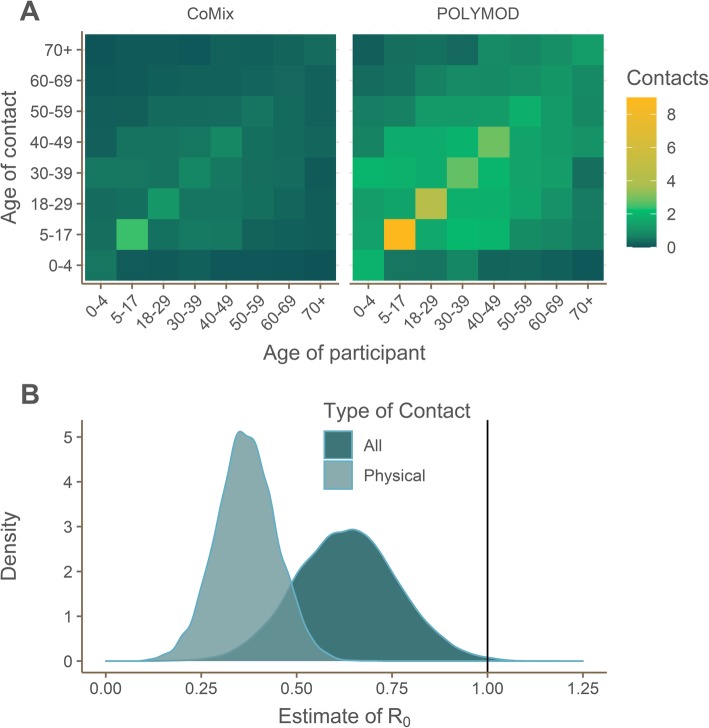
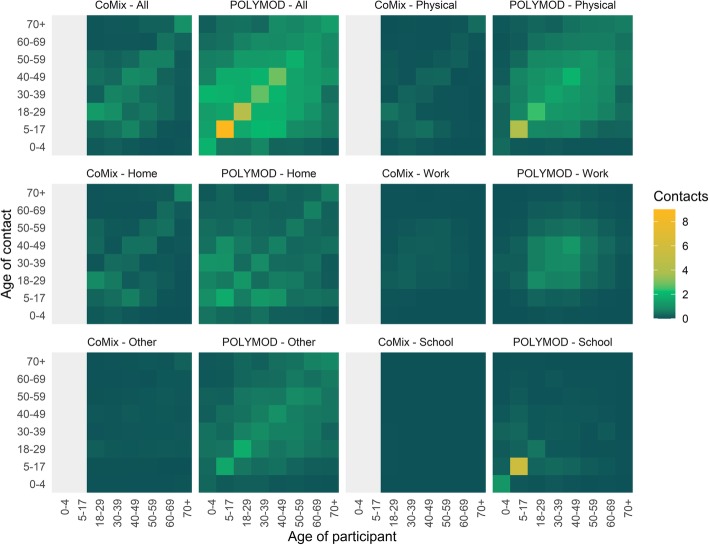
Background: To mitigate and slow the spread of COVID-19, many countries have adopted unprecedented physical distancing policies, including the UK. We evaluate whether these measures might be sufficient to control the epidemic by estimating their impact on the reproduction number ( R 0 , the average number of secondary cases generated per case). Methods: We asked a representative sample of UK adults about their contact patterns on the previous day. The questionnaire was conducted online via email recruitment and documents the age and location of contacts and a measure of their intimacy (whether physical contact was made or not). In addition, we asked about adherence to different physical distancing measures. The first surveys were sent on Tuesday, 24 March, 1 day after a “lockdown” was implemented across the UK. We compared measured contact patterns during the “lockdown” to patterns of social contact made during a non-epidemic period. By comparing these, we estimated the change in reproduction number as a consequence of the physical distancing measures imposed. We used a meta-analysis of published estimates to inform our estimates of the reproduction number before interventions were put in place. Results: We found a 74% reduction in the average daily number of contacts observed per participant (from 10.8 to 2.8). This would be sufficient to reduce R 0 from 2.6 prior to lockdown to 0.62 (95% confidence interval [CI] 0.37–0.89) after the lockdown, based on all types of contact and 0.37 (95% CI = 0.22–0.53) for physical (skin to skin) contacts only. Conclusions: The physical distancing measures adopted by the UK public have substantially reduced contact levels and will likely lead to a substantial impact and a decline in cases in the coming weeks. However, this projected decline in incidence will not occur immediately as there are significant delays between infection, the onset of symptomatic disease, and hospitalisation, as well as further delays to these events being reported. Tracking behavioural change can give a more rapid assessment of the impact of physical distancing measures than routine epidemiological surveillance.
Overview
The claims and statistics of this paper haven’t been checked yet.
Free: it reads the open-access text and checks the first 5 claims that cite a source we can check. Create a free account to check every claim.
Integrity signals
Registry
Cites
Statistics
Figures
Verification
Claims the paper makes
The claims and statistics of this paper haven’t been checked yet.
Free: it reads the open-access text and checks the first 5 claims that cite a source we can check. Create a free account to check every claim.
Claims other papers make about this one
Each is checked against this paper’s own text: does it say what the citing paper says it does?
The source backs part of the claim, not all of it — or backs it for a different population, condition or comparison.
In the citing paper
“we did not find substantial differences in social interactions between regions of high and low VOC 202012/01 prevalence, as measured by Google mobility (11) and social contact survey data (12) from September to December 2020 (Fig. 1, E and F).”
From Estimated transmissibility and impact of SARS-CoV-2 lineage B.1.1.7 in England (2021) · cites this paper as [12]
Experimental — accuracy not yet measuredThe check wasn’t confident either way, so it gives no verdict — never disputed.
In the citing paper
“These younger individuals tend to have more contacts than older age groups 33,34 .”
From Spread of a SARS-CoV-2 variant through Europe in the summer of 2020 (2021) · cites this paper as [34]
Experimental — accuracy not yet measured
Self-check
Percentages, sums and reported differences re-computed from the paper’s own numbers.
The self-check needs the paper’s full text.
Citations
Cites
R: A Language and Environment for Statistical Computing
R Core Team (2025) · doi:10.32614/r.manuals · Cited by 352,181
Wickham, H. (2016) · Use R! · doi:10.1007/978-3-319-24277-4 · Cited by 33,115
Early transmission dynamics in Wuhan, China, of novel coronavirus-infected pneumonia
Li, Q., Guan, X., Wu, P., Wang, X., Zhou, L., Tong, Y., Ren, R., Leung, K. S. M., Lau, E. H. Y., Wong, J. Y., et al. (2020) · New England Journal of Medicine · doi:10.1056/nejmoa2001316 · Cited by 16,575
ggplot2: Elegant Graphics for Data Analysis
Wickham, H. (2009) · doi:10.1007/978-0-387-98141-3 · Cited by 14,447
The effect of travel restrictions on the spread of the 2019 novel coronavirus (COVID-19) outbreak
Chinazzi, M., Davis, J. T., Ajelli, M., Gioannini, C., Litvinova, M., Merler, S., Pastore y Piontti, A., Mu, K., Rossi, L., Sun, K., et al. (2020) · Science · doi:10.1126/science.aba9757 · Cited by 3,694
Social Contacts and Mixing Patterns Relevant to the Spread of Infectious Diseases
Mossong, J., Hens, N., Jit, M., Beutels, P., Auranen, K., Mikolajczyk, R., Massari, M., Salmaso, S., Tomba, G. S., Wallinga, J., et al. (2008) · PLoS Medicine · doi:10.1371/journal.pmed.0050074 · Cited by 2,900
Self-citationF. T. Z. H. O. W. U. N. C. M. A. R. T., Jin, Y.-H., Cai, L., Cheng, Z.-S., Cheng, H., Deng, T., Fan, Y.-P., Fang, C., Huang, D., Huang, L.-Q., et al. (2020) · Military Medical Research · doi:10.1186/s40779-020-0233-6 · Cited by 2,254
The construction of next-generation matrices for compartmental epidemic models
Diekmann, O., Heesterbeek, J. A. P., & Roberts, M. G. (2010) · Journal of The Royal Society Interface · doi:10.1098/rsif.2009.0386 · Cited by 2,119
Zhao, S., Lin, Q., Ran, J., Musa, S. S., Yang, G., Wang, W., Lou, Y., Gao, D., Yang, L., He, D., et al. (2020) · International Journal of Infectious Diseases · doi:10.1016/j.ijid.2020.01.050 · Cited by 1,853
Riou, J., & Althaus, C. L. (2020) · Eurosurveillance · doi:10.2807/1560-7917.es.2020.25.4.2000058 · Cited by 1,297
Research works printed but not linked: 3
- 3. Acaps M. COVID-19: government measures. 2020.
- 4. Public Health England. Guidance on social distancing for everyone in the UK. gov.uk. 2020.
- 5. Savanta. Savanta coronavirus daily tracker - 30th March. Savanta coronavirus daily tracker. 2020.
Cited by
Items 401–500 of 719
Transmission matrices used in epidemiologic modelling
Dunbar, M. B. (2023) · Infectious Disease Modelling · doi:10.1016/j.idm.2023.11.009 · Cited by 6
Social contacts in Switzerland during the COVID-19 pandemic: Insights from the CoMix study
Reichmuth, M. L., Heron, L., Beutels, P., Hens, N., Low, N. N., & Althaus, C. L. (2024) · Epidemics · doi:10.1016/j.epidem.2024.100771 · Cited by 6
Prestige, E., Coletti, P., Backer, J. A., Davies, N. G., Edmunds, W. J., & Jarvis, C. I. (2025) · Epidemics · doi:10.1016/j.epidem.2025.100830 · Cited by 6
Self-citationCOVID-19 and Assisted Reproduction: A Point of View on the Brazilian Scenario
de Carvalho, B. R., Silva, A. C. J. D. S. R. E., Ferriani, R. A., dos Reis, R. M., & de Sá, M. F. S. (2020) · Revista Brasileira Ginecologia e Obstetrícia · doi:10.1055/s-0040-1713795 · Cited by 6
A pandémia hatása a személyes kapcsolathálózati struktúrára.
Dávid, B., Herke, B. L., Huszti, É., Tóth, G., Túry-Angyal, E., & Albert, F. (2021) · Scientia et Securitas · doi:10.1556/112.2021.00056 · Cited by 6
Morese, R., & Longobardi, C. (2022) · Frontiers in Psychology · doi:10.3389/fpsyg.2022.861329 · Cited by 6
Combating COVID-19 crisis and predicting the second wave in Europe: an Age-structured modeling
Upadhyay, R. K., Chatterjee, S., Roy, P., & Bhardwaj, D. (2022) · Journal of Applied Mathematics and Computing · doi:10.1007/s12190-022-01723-0 · Cited by 7
Patient Satisfaction on the Holistic Care Approach Rendered by Nurses in the Oncology Ward
Almaghrabi, Z. A., & Saati, H. S. (2022) · The Egyptian Journal of Hospital Medicine · doi:10.21608/ejhm.2022.267296 · Cited by 6
“Sex differences in disease prevalence, manifestation, and response to treatment are rooted in the genetic differences between men and women ((18)).”
BackgroundBridgen, J. R. E., Jewell, C., & Read, J. M. (2022) · BMJ Open · doi:10.1136/bmjopen-2021-059231 · Cited by 9
Revealing human mobility trends during the SARS-CoV-2 pandemic in Nigeria via a data-driven approach
Luo, W., Xiong, C., Wan, J., Feng, Z., Ayorinde, O., Blanco, N., Charurat, M., Naranbhai, V., Riley, C., Winters, A., et al. (2023) · South African Journal of Science · doi:10.17159/sajs.2023/14727 · Cited by 7
Social distancing mediated generalized model to predict epidemic spread of COVID-19
Yasir, K. A., & Liu, W.-M. (2021) · Nonlinear Dynamics · doi:10.1007/s11071-021-06424-0 · Cited by 6
Effective reproduction number for COVID-19 in Aotearoa New ZealandPreprint
Binny, R. N., Lustig, A. G., Brower, A. L., Hendy, S. C., James, A., Parry, M. F., Plank, M. J., & Steyn, N. (2020) · medRxiv · doi:10.1101/2020.08.10.20172320 · Cited by 6
“For example, Jarvis et al. 2020 reported a 74% reduction in Reff (from a mean of 2.6 to 0.62), as a result of physical distancing during lockdown in the UK.”
BackgroundInfluentialDesigning Efficient Contact Tracing Through Risk-Based Quarantining
Perrault, A., Charpignon, M., B, J. G. A., Tambe, M., & Majumder, M. S. (2020) · National Bureau of Economic Research · doi:10.3386/w28135 · Cited by 8
A within-host model of SARS-CoV-2 infectionPreprint
Carruthers, J., Xu, J., Finnie, T., & Hall, I. (2022) · medRxiv · doi:10.1101/2022.04.22.22274137 · Cited by 7
“The contact rate is simply interpreted as the number of contacts an individual makes per unit time, with insights provided from social contact studies [4, 5].”
BackgroundGeorge, A., Lacey, P., Badrinath, P., Gray, A., Turner, P., Harwood, C., & Gregson, M. (2023) · BMJ Open · doi:10.1136/bmjopen-2023-072975 · Cited by 5
Social contact patterns in South Korea: an analysis of a survey conducted in 2023-2024
Son, W., Chae, M.-K., Hwang, D., Nah, K., Kim, M., Kim, J., & Lee, J. (2025) · BMC Infectious Diseases · doi:10.1186/s12879-025-10706-y · Cited by 7
Shen, J., & Zhu, T. (2021) · Second International Meeting for Applied Geoscience & Energy · doi:10.1190/segam2021-3584263.1 · Cited by 5
Impact of the COVID-19 pandemic on Physical Activity and Student Achievement
Karo, A. A. P. K., Hidayat, D. A., Pasaribu, R. F., Silalahi, F. A., & Sari, L. P. (2022) · JUARA Jurnal Olahraga · doi:10.33222/juara.v7i2.1676 · Cited by 7
Cao, L., Zhao, H., Wang, X., & An, X. (2023) · Frontiers in Physics · doi:10.3389/fphy.2023.1293177 · Cited by 5
Chan, C. P., Lee, S. S., Kwan, T. H., Wong, S. Y. S., Yeoh, E., & Wong, N. S. (2024) · JMIR Public Health and Surveillance · doi:10.2196/51498 · Cited by 5
“Previous studies have analyzed the social contact and mobility pattern to model the change in the transmission dynamics [3,4].”
BackgroundFinch, E., Nilles, E. J., Paulino, C. T., Skewes-Ramm, R., Lau, C. L., Lowe, R., & Kucharski, A. J. (2024) · The Lancet Regional Health - Americas · doi:10.1016/j.lana.2024.100860 · Cited by 5
“23,29 School contact rates were set to zero during school closures and school holiday periods.”
BackgroundConcept of Gamification in Adaptation of Snake Ladder Online Representation Education Covid-19
Ariessanti, H. D., Trisetyo, A., Suparta, W., & Abudurahman, E. (2020) · International Conference on Information Technology Systems and Innovation · doi:10.1109/icitsi50517.2020.9264961 · Cited by 5
Sychik, S. I. (2020) · Health Risk Analysis · doi:10.21668/health.risk/2020.4.01.eng · Cited by 6
Whittaker, D. J., Herrera-Reyes, A. D., Hendrix, M., Owen, M. R., Band, L. R., Mirams, G. R., Bolton, K. J., & Preston, S. (2022) · Journal of Theoretical Biology · doi:10.1016/j.jtbi.2022.111337 · Cited by 5
“Society SET-C (2020) and references therein] or surveyed contact rates in late March 2020 (Jarvis et al., 2020).”
Albert, F., Brys, Z., Czermann, M., & Gerdán, M. (2022) · Socio hu · doi:10.18030/socio.hu.2022.4.140 · Cited by 5
Lajot, A., Wambua, J., Coletti, P., Franco, N., Brondeel, R., Faes, C., & Hens, N. (2023) · BMC Infectious Diseases · doi:10.1186/s12879-023-08369-8 · Cited by 5
“the study period, except between wave 12 and 20 for age groups [0-12) and [12-18).”
BackgroundMajor‐Smith, D., Northstone, K., Bowring, C. E., Wells, N., Crawford, M., Pearson, R. M., Thomas, A. C., Brooks‐Pollock, E., Lawlor, D. A., & Timpson, N. J. (2020) · Wellcome Open Research · doi:10.12688/wellcomeopenres.16414.2 · Cited by 7
Labétoulle, M., Sahyoun, M., Rousseau, A., & Baudouin, C. (2020) · European Journal of Ophthalmology · doi:10.1177/1120672120978881 · Cited by 5
Country Wise Measures in Contrast to The Spread of SARS-COV2/COVID-19
Ahad, H. A., Chinthaginjala, H., Dharani, B. H. S., Ayisha, M. U., Reddy, C. A., Manasa, G. C., & Nandini, N. (2022) · Asian Journal of Research in Pharmaceutical Sciences · doi:10.52711/2231-5659.2022.00012 · Cited by 6
Leather, J. Z., Keyworth, C., Epton, T., Goldthorpe, J., Ulph, F., & Armitage, C. J. (2022) · British Journal of Health Psychology · doi:10.1111/bjhp.12591 · Cited by 6
“Imposing measures to enforce the 1–2 metre physical distancing rule reduced virus transmission in the UK (Jarvis et al., 2020) and worldwide (Islam, Vidot, & Camacho-Rivera, 2021; McGrail, Dai, McAndrews, & Kalluri, 2020), leading to a gradual easing of restrictions (Han et al., 2020) and reduced…”
BackgroundSpread of COVID-19 in the Russian regions in 2020: factors of excess mortality
Колосницына, М. Г., & Chubarov, M. Y. (2022) · Population and Economics · doi:10.3897/popecon.6.e87739 · Cited by 5
Sensitivity analysis of the infection transmissibility in the UK during the COVID-19 pandemic
Biglarbeigi, P., Ng, K. Y., Finlay, D., Bond, R., Jing, M., & McLaughlin, J. A. (2021) · PeerJ · doi:10.7717/peerj.10992 · Cited by 6
“Moreover, in order to take into account the heterogeneity nature of the contacts in different occupations, the CoMix weekly report data is used (Jarvis et al., 2020).”
BackgroundMethodThe reproduction number R for COVID-19 in England: Why hasn’t “lockdown” been more effective?Preprint
Grant, A. (2020) · medRxiv · doi:10.1101/2020.07.02.20144840 · Cited by 5
“Governments have responded to this with the introduction of a range of infection control measures, including extensive restriction of social and economic interactions, often referred to as “lockdown” (see Jarvis et al., 2020, for a more detailed discussion of the UK regulations).”
BackgroundMethodInfluentialWestmoreland, D. A., Berry, A., Zimba, R., Kulkarni, S., Parcesepe, A. M., Maroko, A., Poehlein, E., You, W., Mirzayi, C. A., Kochhar, S., et al. (2021) · medRxiv · doi:10.1101/2021.03.10.21252851 · Cited by 6
Simons, D., Shahab, L., Brown, J., & Perski, O. (2021) · Qeios · doi:10.32388/ujr2aw.11 · Cited by 5
Simons, D., Shahab, L., Brown, J., & Perski, O. (2020) · Qeios · doi:10.32388/ujr2aw.10 · Cited by 6
Kar, S. S., Krishnamoorthy, Y., Sivanantham, P., Anandraj, J., & Gnanadhas, J. (2022) · Journal of Postgraduate Medicine · doi:10.4103/jpgm.jpgm_1085_21 · Cited by 4
Place of distancing measures in containing epidemics: a scoping review
Chebil, D., Hassine, D. B., Melki, S., Nouira, S., Rebai, W. K., Hannachi, H., Merzougui, L., & Abdelaziz, A. B. (2022) · Libyan Journal of Medicine · doi:10.1080/19932820.2022.2140473 · Cited by 4
“Epidemiological studies Jarvis CI, 2020 [10] Lockdown COVID-19 A 74% reduction in the average daily number of contacts observed per participant (from 10.”
BackgroundINSIGHT OF PANDEMIC COVID-19: DEVELOPMENTS AND CHALLENGES
Muneer, M. A., Arshad, M., Abbas, G., Arshad, M., Munir, K., Iqbal, A., Mustafa, A., Amin, Q., Khan, M. A., Qureshi, R. A., et al. (2023) · Pakistan Journal of Science · doi:10.57041/pjs.v75i1.831 · Cited by 4
“Some SARS-CoV-2 outbreak reports highlight the possibility of airborne transmission beyond two meters in poorly ventilated indoor environments (Jarvis et al., 2020).”
BackgroundImpact of density on the COVID-19 pandemic: Evidence from Chinese cities
Han, S., Miao, C., & Zhang, B. (2023) · Cities · doi:10.1016/j.cities.2023.104534 · Cited by 4
Lucchini, L., Marziano, V., Trentini, F., Chiavenna, C., D’Agnese, E., Offeddu, V., Manica, M., Poletti, P., Balsamo, D., Guzzetta, G., et al. (2026) · Communications Medicine · doi:10.1038/s43856-026-01543-4 · Cited by 6
“This dif fi cult task is usually addressed through mathematical modelling, which largely relies on the availability of information on how many social contacts individuals experience across different socio-demographicstrati fi cations,socialsettingsandactivities 7 – 12 .”
Dissecting Disaster Responses during COVID-19: An eThekwini Municipality Experience
Mantzaris, E. A., & Ngcamu, B. S. (2020) · Alternation Interdisciplinary Journal for the Study of the Arts and Humanities in Southern Africa · doi:10.29086/2519-5476/2020/sp32a5 · Cited by 4
“Jarvis et al. (2020) ponder that the lockdown regulations which have been successfully implemented and enforced in the developed world (such as China and Europe), where the virus has been suppressed, can have less success in the urban informal settlements. eThekwini Municipality cannot be…”
BackgroundMaral, İ., Yaylalı, E., Güçlü, H., İkiışık, H., & Güner, A. E. (2021) · Mikrobiyoloji Bulteni · doi:10.5578/mb.20219808 · Cited by 4
Risky restrictions? Mobility restriction effects on risk awareness and anxiety
Costa‐Font, J., & Vilaplana‐Prieto, C. (2022) · Health Policy · doi:10.1016/j.healthpol.2022.08.009 · Cited by 5
Suharsa, H., Soleh, D. J., & Miftahuddin, A. (2022) · JURNAL APARATUR · doi:10.52596/ja.v6i1.152 · Cited by 4
“Namun, keberhasilan strategi ini bergantung pada kepatuhan masyarakat untuk implementasinya (Jarvis et al., 2020).”
BackgroundGeismar, C., White, P. J., Cori, A., & Jombart, T. (2024) · PLoS ONE · doi:10.1371/journal.pone.0313037 · Cited by 4
“Unfortunately, the underlying contact data can be biased, have limited sample size or representativeness, and may not be generalisable across different epidemic contexts [9–11].”
Coronavirus testing in women attending antenatal care
Rolnik, D. L., Korman, T. M., Rindt, A., Stuart, R. L., Giles, M., Rawlins, J., Palmer, K. R., Stripp, A. M., Wallace, E. M., & Hodges, R. J. (2020) · Women and Birth · doi:10.1016/j.wombi.2020.09.024 · Cited by 4
Salvia, A., Morone, G., Iosa, M., Balice, M. P., Paolucci, S., Grasso, M. G., Traballesi, M., Nocentini, U., Formisano, R., Molinari, M., et al. (2020) · Frontiers in Neurology · doi:10.3389/fneur.2020.584317 · Cited by 4
“This effect was already well-known and at the basis of social distancing and isolation of infected patients (12).”
BackgroundHEALTH PROFESSIONALS LIVED EXPERIENCED DURING THE FIRST WAVE OF COVID-19
Ferreira, R. J. O., Marques, A., Marques, M., Meneses, S., Pimentel, G., Gonçalves, R. F. L., Loureiro, L. M. D. J., & Marques, A. (2021) · Psicologia Saúde & Doenças · doi:10.15309/20psd210302 · Cited by 4
Systematic Literature Review Strategy Gamification Through Snake Ladder Game
Ariessanti, H. D., Meyliana, M., Hidayanto, A. N., & Prabowo, H. (2020) · International Conference on Informatics, Multimedia, Cyber and Information System (ICIMCIS) · doi:10.1109/icimcis51567.2020.9354285 · Cited by 4
“In addition, gamification strategies can also be interpreted specifically as the use of learning tools that can increase attractiveness [7] and social participation [8].”
BackgroundAvaliação da funcionalidade familiar em pessoas idosas convivendo com HIV/AIDS
Souza, L. S., dos Santos, N. P., Lima, P. V., de Brito, I. T., de Oliveira, A. S., & dos Reis, L. A. (2021) · Revista Recien · doi:10.24276/rrecien2021.11.33.99-106 · Cited by 4
Limits of lockdown: characterising essential contacts during strict physical distancing
Thomas, A. C., Danon, L., Christensen, H., Northstone, K., Major‐Smith, D., Nixon, E. J., Trickey, A., Hemani, G., Sauchelli, S., Finn, A. H. R., et al. (2021) · Wellcome Open Research · doi:10.12688/wellcomeopenres.16785.1 · Cited by 4
Viral Diseases and Youth Sports: How to Handle Common Infections that Sideline Athletes
Yao, K. V., Szybinski, S., Varghese, M., & Fazekas, M. L. (2021) · Pediatric Annals · doi:10.3928/19382359-20211017-01 · Cited by 4
Eum, N. J., & Kim, S. H. (2021) · JMIR Public Health and Surveillance · doi:10.2196/31066 · Cited by 9
“Additional Analysis Although it has not been long since the COVID-19 outbreak and the transmission mechanism of the virus has not yet been clarified, it is apparent that human-to-human interaction increases the risk of infection [14,34].”
Wong, N. S., Lee, S. S., Mitchell, K. M., Yeoh, E., & Wang, C. (2022) · BMC Infectious Diseases · doi:10.1186/s12879-021-06963-2 · Cited by 5
“The importance of contact rate on epidemic growth could be re ected from the implementation of physical distancing measures in the real-world with effectiveness shown in modelling studies.[25-27] To minimize the adverse impact of organizing an event, the contact rate in the community would have to be taken into consid…”
BackgroundChen, P.-Y., Guo, X., Jiao, Z., Liang, S., Li, L., Yan, J., Huang, Y., Liu, Y., & Fan, W. (2022) · Frontiers in Physics · doi:10.3389/fphy.2022.915441 · Cited by 6
Cristóbal, T., Quesada-Arencibia, A., de Blasio, G., Padrón, G., Alayón, F., & García, C. R. (2022) · IEEE Access · doi:10.1109/access.2022.3206838 · Cited by 4
“pandemic periods in Luxemburg [28], China [29], UK [30], 171 Netherlands [31] and USA [32].”
BackgroundKang, M. W., Kim, Y., Lee, I., Park, H., Park, J. Y., An, J. N., Yoo, K. D., Kim, Y. C., Park, N.-Y., Kho, Y., et al. (2022) · Scientific Reports · doi:10.1038/s41598-022-19787-0 · Cited by 5
Human-like tele-health robotics for older adults – A preliminary feasibility trial and vision
Jafari, N., Lim, M., Hassani, A., Cordeiro, J., Kam, C., & Ho, K. (2022) · Journal of Rehabilitation and Assistive Technologies Engineering · doi:10.1177/20556683221140345 · Cited by 6
Yang, M., Chen, C., Zhang, X., Cao, K., Du, Y., Jiang, D., Yan, R., Wu, X., Chen, M., You, Y., et al. (2024) · Journal of Public Health · doi:10.1007/s10389-024-02213-2 · Cited by 4
“In the UK, a study also found that the average daily number of contacts of each participant decreased by 74.0% during the COVID-19 pandemic (Jarvis et al. 2020).”
InfluentialModes of transmission and inter-human dissemination of SARS-CoV-2 virus
Bejarano, D. P. (2021) · Revista de salud publica del Paraguay · doi:10.18004/rspp.2021.junio.87 · Cited by 5
Socio-Life Science and the COVID-19 Outbreak: Public Health and Public Policy
Yano, M., Matsuda, F., Sakuntabhai, A., & Hirota, S. (2021) · Economics, law, and institutions in Asia Pacific · doi:10.1007/978-981-16-5727-6 · Cited by 8
An SEIR Model with Contact Tracing and Age-Structured Social Mixing for COVID-19 outbreakPreprint
Teimouri, A. (2020) · medRxiv · doi:10.1101/2020.07.05.20146647 · Cited by 4
“77 over the weeks four to nine for all age groups and setups, this is comparable to results of [20] and [25] (when averaged on weekly basis).”
BackgroundMethodResultInfluentialBenfer, E. A., Vlahov, D., Long, M., Walker-Wells, E., Pottenger, J. L., Gonsalves, G., & Keene, D. E. (2020) · SSRN Electronic Journal · doi:10.2139/ssrn.3736457 · Cited by 4
COVID-19 outbreak in Brazil: Adherence to national preventive measures and impact on people’s livesPreprint
Villela, E. F. D. M., López, R. V. M., Sato, A. P. S., de Oliveira, F. M., Waldman, E. A., den Bergh, R. V., Fodjo, J. N. S., & Colebunders, R. (2020) · Research Square · doi:10.21203/rs.3.rs-40186/v1 · Cited by 4
“The population-level adherence to such measures may determine to a considerable extent the national magnitude and duration of the COVID–19 pandemic [6,7].”
BackgroundSullivan, O., Gershuny, J., Sevilla, A., Foliano, F., Vega-Rapun, M., Pérez, J. L. D. G., Harms, T. A., & Walthéry, P. (2021) · SocArXiv (OSF Preprints) · doi:10.31235/osf.io/9nk53 · Cited by 6
Reichmuth, M. L., Heron, L., Riou, J., Moser, A., Hauser, A., Low, N. N., & Althaus, C. L. (2023) · medRxiv · doi:10.1101/2023.03.13.23287183 · Cited by 4
Kang, X., & Stamolampros, P. (2024) · BMC Public Health · doi:10.1186/s12889-024-20160-1 · Cited by 3
Robles‐Zurita, J. A. (2022) · The European Journal of Health Economics · doi:10.1007/s10198-022-01500-7 · Cited by 3
“89) under lockdown according to estimates for the UK [19].”
Kuhlmann, I., Muehlmann, M., Danqa, D., & Tomczyk, S. (2025) · European Journal of Psychological Assessment · doi:10.1027/1015-5759/a000893 · Cited by 3
Nakamura, T., Kinoshita, R., Endo, A., Atkins, K. E., Oshitani, H., Ibuka, Y., Suzuki, M., Ariyoshi, K., & O’Reilly, K. M. (2025) · PLOS Global Public Health · doi:10.1371/journal.pgph.0004600 · Cited by 3
“The survey was adapted from the UK CoMix study [17–19] in Japanese to capture the daily frequency and type of contacts.”
Social mixing and risk exposures for SARS-CoV-2 infections in elderly persons
Haag, C., Höglinger, M., Moser, A., Hämmig, O., Puhan, M. A., & von Wyl, V. (2020) · Swiss Medical Weekly · doi:10.4414/smw.2020.20416 · Cited by 3
Dynamics and logic of COVID-19 containment measures
Raskina, Y., Novkunskaya, A., & Барчук, А. А. (2020) · Medicine of Extreme Situations · doi:10.47183/mes.2020.025 · Cited by 3
“A survey was launched in the UK a day after the lockdown started [22].”
BackgroundAre the upper bounds for new SARS-CoV-2 infections in Germany useful?
Böck, W., Goetz, T., Jayathunga, Y., & Rockenfeller, R. (2021) · Computational and Mathematical Biophysics · doi:10.1515/cmb-2020-0126 · Cited by 3
Indoor air pollution and behavioral factors affecting to COVID-19 transition
Ehsanifar, M., Rafati, M., & Yavari, Z. (2022) · Journal of Community Medicine and Health Solutions · doi:10.29328/journal.jcmhs.1001015 · Cited by 3
“Transmission of the virus at shorter distances seems to be the dominant route for the spread of SARS-CoV-2, so social distancing is the effective way for limiting the spread of disease [28].”
BackgroundHo, K., Rivest‐Hénault, D., Jafari, N., Lim, M., Hassani, A., Cordeiro, J., Falardeau, B., Pecora, L., Pagiatakis, C., M’hiri, F., et al. (2022) · PubMed Central · Cited by 3
Baráti kapcsolatok változása a Covid19-járvány alatt
Albert, F., & Herke, B. L. (2022) · Socio hu · doi:10.18030/socio.hu.2022.4.162 · Cited by 3
Roubenoff, E., Feehan, D. M., & Mahmud, A. S. (2023) · Epidemics · doi:10.1016/j.epidem.2023.100686 · Cited by 4
Soroprevalência de anticorpos do vírus SARS-CoV-2 em escolares no município de São Paulo, 2020
Kamioka, G. A., Madalosso, G., de Albuquerque, J. O. M., Costa, S. A., Ferreira, P. B., Sato, A. P. S., Glasser, P. R., Pino, F. A., Burihan, P. C. P. R., de Carvalho, A. C. A., et al. (2023) · Revista de Saúde Pública · doi:10.11606/s1518-8787.2023057004782 · Cited by 3
“Studies show that social distancing and adoption of protective measures against covid-19 reduce contact between people and the possibility of contracting the disease by shortening the virus transmission chain 26 .”
BackgroundBacker, J. A., van de Kassteele, J., Fakiri, F. E., Hens, N., & Wallinga, J. (2023) · BMC Public Health · doi:10.1186/s12889-023-16725-1 · Cited by 3
“Contact surveys showed that in the first wave of the COVID-19 pandemic, contact rates decreased by more than half in China [1], the UK [2], the Netherlands [3], and other countries worldwide [4–7].”
BackgroundStratified epidemic model using a latent marked Hawkes process
Lamprinakou, S., & Gandy, A. (2024) · Mathematical Biosciences · doi:10.1016/j.mbs.2024.109260 · Cited by 3
Quilty, B. J., Chapman, L. A. C., Munday, J. D., Wong, K. L., Gimma, A., Pickering, S., Neil, S. J. D., Galão, R. P., Edmunds, W. J., Jarvis, C. I., et al. (2026) · PLoS Computational Biology · doi:10.1371/journal.pcbi.1014715 · Cited by 3
“…in the 24-hour period prior to filling in the survey for the BBC Pandemic survey (here referred to as Pre-pandemic) and nine indicative time periods between March 2020 and May 2021 from the CoMix survey representing different levels of restrictions, as defined in previous work [11,12] (Table 1).”
InfluentialSelf-citationSocial contacts and mixing patterns in rural Gambia
Osei, I., Mendy, E., van Zandvoort, K., Young, B., Jobe, O., Sarwar, G., Mohammed, N. I., Bruce, J., Greenwood, B. M., Flasche, S., et al. (2025) · BMC Infectious Diseases · doi:10.1186/s12879-025-10640-z · Cited by 3
“…be used to project the effect of interventions such as quarantine, lockdown, or travel restrictions against infectious diseases, and to predict transmission patterns of infectious diseases of pandemic potential such as the COVID-19, severe acute respiratory syndrome (SARS) and influenza [4, 16–18].”
Lasala Jr, N., Ricafort, J., Prado, J., Funa, A., & Dioneda, N. (2025) · Pakistan Journal of Life and Social Sciences (PJLSS) · doi:10.57239/pjlss-2025-23.1.00568 · Cited by 4
Planning for the aftershocks: a model of post-acute care needs for hospitalized COVID-19 patientsPreprint
Maloney, M., Morley, R., Checketts, R., Weir, P., Barfuss, D., Meredith, H. R., Hofmann, M. G., Samore, M. H., & Keegan, L. T. (2020) · medRxiv · doi:10.1101/2020.06.12.20129551 · Cited by 3
Designing Efficient Contact Tracing Through Risk-Based QuarantiningPreprint
Perrault, A., Charpignon, M., B, J. G. A., Tambe, M., & Majumder, M. S. (2020) · medRxiv · doi:10.1101/2020.11.16.20227389 · Cited by 3
“(2008), but not as large as the 75% reduction that was reported at the peak of lockdown (Jarvis et al. 2020).”
Impact of Clinical and Genomic Factors on SARS-CoV2 Disease SeverityPreprint
Dey, S. K., Bose, A., Chakraborty, P., Ghalwash, M. F., Guzmán-Sáenz, A., Utro, F., Ng, K., Hu, J., Parida, L., & Sow, D. (2021) · medRxiv · doi:10.1101/2021.03.15.21253549 · Cited by 3
Jarvis, C. I., Coletti, P., Backer, J. A., Munday, J. D., Faes, C., Beutels, P., Althaus, C. L., Low, N. N., Wallinga, J., Hens, N., et al. (2023) · medRxiv · doi:10.1101/2023.08.29.23294767 · Cited by 3
“Comparison to pre-pandemic and pandemic contact levels We estimated the potential relative change in basic reproduction number R0 of an infection (that spreads along the contacts, assuming everyone would be susceptible to that infection) due to change in contact levels compared to pre-pandemic levels by calculating th…”
BackgroundMethodSelf-citation25 Models in the COVID-19 Pandemic
Imai, N., Baguelin, M., & Ferguson, N. M. (2024) · Springer eBooks · doi:10.1007/978-3-031-48408-7_37 · Cited by 2
On real-time calibrated prediction for complex model-based decision support in pandemics: Part 2
McKinley, T. J., Williamson, D., Xiong, X., Salter, J. M., Challen, R., Danon, L., Youngman, B. D., & McNeall, D. (2026) · PLoS Computational Biology · doi:10.1371/journal.pcbi.1014299 · Cited by 2
Hodel, E. M., Wegmüller, S., Iff, F., Lim, E., Grimm, K., Gasser, L., Domenico, L. D., Schüller, S., Wandeler, G., & Low, N. N. (2025) · BMJ Open · doi:10.1136/bmjopen-2025-109555 · Cited by 2
“5 6 21–24 We used the estimated contact matrix to quantify the variation in the reproductive number R0 compared with pre-pandemic contacts.”
Disease-driven network adaptivity: implications for epidemic dynamics
Saiprasad, V. R., Senthilkumar, D. V., Chandrasekar, V. K., & Kurths, J. (2025) · Journal of The Royal Society Interface · doi:10.1098/rsif.2025.0380 · Cited by 2
The Effect of Covid-19 on the Information and Technology Companies in the USA
Yetgin, M. A. (2020) · BİLTÜRK Journal of Economics and Related Studies · doi:10.47103/bilturk.753097 · Cited by 2
COVID-19: The First 30 Days at a UK Level 1 Trauma Centre and Lessons Learnt
Andrzejowski, P., Howard, A., Vun, J. S. H., Manzoor, N., Patsiogiannis, N., Kanakaris, N. K., & Giannoudis, P. V. (2020) · Cureus · doi:10.7759/cureus.11547 · Cited by 2
“DOI 10.7759/cureus.11547 circumstances, which became known as the “Lockdown” [7].”
BackgroundInfluentialAfrica’s COVID-19 third wave: A coupled behavior-disease system in a mutual feedback loop
Kangbai, J. B., Sheku, M., Koroma, B. M., Macarthy, J. M., Kaitibi, D. B., Sahr, F., George, A. M., Gegbe, F., Cummings-Wray, D., & Babawo, L. S. (2021) · The Gazette of Medical Sciences · doi:10.46766/thegms.epidemiol.21101704 · Cited by 3
“Mathematical models backed by empirical analysis have also shown that physical distancing can mitigate COVID-19 transmission and control [7-9], and that such mitigating measures can actually reduce the reproduction number of COVID-19 to below one [10-12].”
BackgroundLiu, C. Y., Smith, S., Chamberlain, A. T., Gandhi, N. R., Khan, F. N., Williams, S., & Shah, S. (2022) · Annals of Epidemiology · doi:10.1016/j.annepidem.2022.09.010 · Cited by 2
The Influences of COVID-19 Pandemic on Patient with Eating Disorders - A Literature Review
Priyanka, R. A., Nayan, M. I. H., Alam, M. M., & Nandi, T. (2022) · Journal of Pharmaceutical Research International · doi:10.9734/jpri/2022/v34i567252 · Cited by 2
Rais, M., Hartoto, H., & Aryani, F. (2022) · Journal of Educational Science and Technology (EST) · doi:10.26858/est.v8i3.37318 · Cited by 2
Modelling and Control of COVID-19 in Small Environments with Two-Group Population
Niu, Z., & Scarciotti, G. (2023) · IFAC-PapersOnLine · doi:10.1016/j.ifacol.2023.10.1288 · Cited by 2
Gupta, P., Mahajan, A., Chander, V., & Barwal, V. K. (2023) · Indian Journal of Public Health · doi:10.4103/ijph.ijph_1525_22 · Cited by 2
Metadata
- Authors
- CMMID COVID-19 working group, Jarvis, C. I., Van Zandvoort, K., Gimma, A., Prem, K., Klepac, P., Rubin, G. J., & Edmunds, W. J.
- Affiliations
- London School of Hygiene & Tropical Medicine (GB)
- King's College London (GB)
- Corresponding author
- Jarvis, Christopher I.
- Venue
- BMC Medicine
- Published
- 2020-05-07
- Volume
- 18
- Issue
- 1
- Pages
- 124-124
- ISSN
- 1741-7015 (ISSN-L)
- PMC
- PMC7202922
- OpenAlex
- W3021151406
- Cited by
- 720
- References
- 28
- Citations by year
- 2026: 21 · 2025: 25 · 2024: 46 · 2023: 80 · 2022: 134 · 2021: 279 · 2020: 135
- FWCI
- 24.98
- Type
- journal article
- Language
- en
- Open access
- gold
- doi.org
- Licence
- cc-by
- creativecommons.org/licenses/by/4.0/ (tdm)
- creativecommons.org/licenses/by/4.0/ (vor)
- Locations
- BMC Medicine (publishedVersion, cc-by)
- medRxiv (acceptedVersion, cc-by-nd)
- PubMed Central (publishedVersion, cc-by)
- PubMed (publishedVersion)
- LSHTM Research Online (London School of Hygiene and Tropical Medicine) (acceptedVersion)
- DOAJ (DOAJ: Directory of Open Access Journals) (submittedVersion, cc-by-sa)
- Informationszentrum Lebenswissenschaften (ZB MED) (submittedVersion, cc-by)
- Funders
- Horizon 2020 (101003688)
- Topics
- Physical Sciences › Mathematics › Modeling and Simulation › COVID-19 epidemiological studies
- Social Sciences › Sociology and Political Science › COVID-19 Prevention and Impact
- Health Sciences › Medicine › Infectious Diseases › SARS-CoV-2 and COVID-19 Research
- Keywords
- COVID-19 pandemic, social distancing, lockdown, social contact patterns, reproduction number, skin-to-skin contact, epidemic control, behavior change
- MeSH terms
- Betacoronavirus, COVID-19, SARS-CoV-2, Activities of Daily Living, Adult, United Kingdom, Health Policy, Humans, Interpersonal Relations, Models, Theoretical, Pneumonia, Viral, Surveys and Questionnaires, Social Isolation, Incidence, Contact Tracing, Coronavirus Infections, Basic Reproduction Number, Epidemics, Pandemics
About these checks
Registry, retraction, Cites and statistics results are computed, not judged, with one exception: a printed reference that no index lists is read once by a model before it counts as a citation error. Claims are extracted by a model and kept only when their quote appears verbatim in the text; each cited source is then checked, with a model’s help, for whether it says what the claim relies on. Those verdicts can be wrong — read the claim’s quote and the cited source before relying on one.
Statistics and arithmetic are recomputed, not judged.
Confidence bands are shown only for fields calibrated on our annotated test set. None is calibrated yet, so no band is shown.
What counts as a claim ›How we measure confidence ›How we check this ›
Are you an author, or do you see a problem with this page? Request a review
Data sources
Bibliographic data: Semantic Scholar, OpenAlex, Crossref.
Contains information from the Semantic Scholar Academic Graph Datasets, made available under the ODC Attribution License (ODC-BY 1.0).
Semantic Scholar’s data is described in: Kinney, R., et al. (2023). The Semantic Scholar Open Data Platform. arXiv:2301.10140.
