

Quantifying the impact of physical distance measures on the transmission of COVID-19 in the UK
Open accessPublished version of a preprint
The DOI matches its Crossref record; 33 of the 33 references it cites were found in a registry or an index.
Abstract
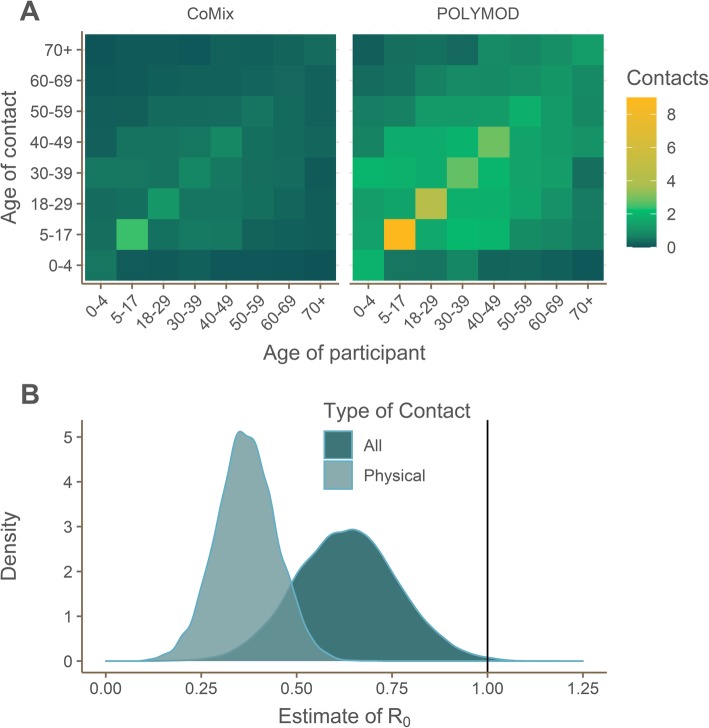
Background: To mitigate and slow the spread of COVID-19, many countries have adopted unprecedented physical distancing policies, including the UK. We evaluate whether these measures might be sufficient to control the epidemic by estimating their impact on the reproduction number ( R 0 , the average number of secondary cases generated per case). Methods: We asked a representative sample of UK adults about their contact patterns on the previous day. The questionnaire was conducted online via email recruitment and documents the age and location of contacts and a measure of their intimacy (whether physical contact was made or not). In addition, we asked about adherence to different physical distancing measures. The first surveys were sent on Tuesday, 24 March, 1 day after a “lockdown” was implemented across the UK. We compared measured contact patterns during the “lockdown” to patterns of social contact made during a non-epidemic period. By comparing these, we estimated the change in reproduction number as a consequence of the physical distancing measures imposed. We used a meta-analysis of published estimates to inform our estimates of the reproduction number before interventions were put in place. Results: We found a 74% reduction in the average daily number of contacts observed per participant (from 10.8 to 2.8). This would be sufficient to reduce R 0 from 2.6 prior to lockdown to 0.62 (95% confidence interval [CI] 0.37–0.89) after the lockdown, based on all types of contact and 0.37 (95% CI = 0.22–0.53) for physical (skin to skin) contacts only. Conclusions: The physical distancing measures adopted by the UK public have substantially reduced contact levels and will likely lead to a substantial impact and a decline in cases in the coming weeks. However, this projected decline in incidence will not occur immediately as there are significant delays between infection, the onset of symptomatic disease, and hospitalisation, as well as further delays to these events being reported. Tracking behavioural change can give a more rapid assessment of the impact of physical distancing measures than routine epidemiological surveillance.
Overview
The claims and statistics of this paper haven’t been checked yet.
Free: it reads the open-access text and checks the first 5 claims that cite a source we can check. Create a free account to check every claim.
Integrity signals
Registry
Cites
Statistics
Figures
Verification
Claims the paper makes
The claims and statistics of this paper haven’t been checked yet.
Free: it reads the open-access text and checks the first 5 claims that cite a source we can check. Create a free account to check every claim.
Claims other papers make about this one
Each is checked against this paper’s own text: does it say what the citing paper says it does?
The source backs part of the claim, not all of it — or backs it for a different population, condition or comparison.
In the citing paper
“we did not find substantial differences in social interactions between regions of high and low VOC 202012/01 prevalence, as measured by Google mobility (11) and social contact survey data (12) from September to December 2020 (Fig. 1, E and F).”
From Estimated transmissibility and impact of SARS-CoV-2 lineage B.1.1.7 in England (2021) · cites this paper as [12]
Experimental — accuracy not yet measuredThe check wasn’t confident either way, so it gives no verdict — never disputed.
In the citing paper
“These younger individuals tend to have more contacts than older age groups 33,34 .”
From Spread of a SARS-CoV-2 variant through Europe in the summer of 2020 (2021) · cites this paper as [34]
Experimental — accuracy not yet measured
Self-check
Percentages, sums and reported differences re-computed from the paper’s own numbers.
The self-check needs the paper’s full text.
Citations
Cites
R: A Language and Environment for Statistical Computing
R Core Team (2025) · doi:10.32614/r.manuals · Cited by 352,181
Wickham, H. (2016) · Use R! · doi:10.1007/978-3-319-24277-4 · Cited by 33,115
Early transmission dynamics in Wuhan, China, of novel coronavirus-infected pneumonia
Li, Q., Guan, X., Wu, P., Wang, X., Zhou, L., Tong, Y., Ren, R., Leung, K. S. M., Lau, E. H. Y., Wong, J. Y., et al. (2020) · New England Journal of Medicine · doi:10.1056/nejmoa2001316 · Cited by 16,575
ggplot2: Elegant Graphics for Data Analysis
Wickham, H. (2009) · doi:10.1007/978-0-387-98141-3 · Cited by 14,447
The effect of travel restrictions on the spread of the 2019 novel coronavirus (COVID-19) outbreak
Chinazzi, M., Davis, J. T., Ajelli, M., Gioannini, C., Litvinova, M., Merler, S., Pastore y Piontti, A., Mu, K., Rossi, L., Sun, K., et al. (2020) · Science · doi:10.1126/science.aba9757 · Cited by 3,694
Social Contacts and Mixing Patterns Relevant to the Spread of Infectious Diseases
Mossong, J., Hens, N., Jit, M., Beutels, P., Auranen, K., Mikolajczyk, R., Massari, M., Salmaso, S., Tomba, G. S., Wallinga, J., et al. (2008) · PLoS Medicine · doi:10.1371/journal.pmed.0050074 · Cited by 2,900
Self-citationF. T. Z. H. O. W. U. N. C. M. A. R. T., Jin, Y.-H., Cai, L., Cheng, Z.-S., Cheng, H., Deng, T., Fan, Y.-P., Fang, C., Huang, D., Huang, L.-Q., et al. (2020) · Military Medical Research · doi:10.1186/s40779-020-0233-6 · Cited by 2,254
The construction of next-generation matrices for compartmental epidemic models
Diekmann, O., Heesterbeek, J. A. P., & Roberts, M. G. (2010) · Journal of The Royal Society Interface · doi:10.1098/rsif.2009.0386 · Cited by 2,119
Zhao, S., Lin, Q., Ran, J., Musa, S. S., Yang, G., Wang, W., Lou, Y., Gao, D., Yang, L., He, D., et al. (2020) · International Journal of Infectious Diseases · doi:10.1016/j.ijid.2020.01.050 · Cited by 1,853
Riou, J., & Althaus, C. L. (2020) · Eurosurveillance · doi:10.2807/1560-7917.es.2020.25.4.2000058 · Cited by 1,297
Research works printed but not linked: 3
- 3. Acaps M. COVID-19: government measures. 2020.
- 4. Public Health England. Guidance on social distancing for everyone in the UK. gov.uk. 2020.
- 5. Savanta. Savanta coronavirus daily tracker - 30th March. Savanta coronavirus daily tracker. 2020.
Cited by
Items 501–600 of 719
Engeli, V., Roussos, S., Demiris, N., Hatzakis, A., & Sypsa, V. (2024) · Emerging infectious diseases · doi:10.3201/eid3101.240737 · Cited by 2
“Similar marked reductions in social contacts during lockdowns, particularly dur - ing March–April 2020, have been reported elsewhere ( 6 , 8 , 10 , 16 , 18 ).”
The Role of Household Heterogeneity on Unplanned Water Demand Shifts
Balado‐Naves, R., & García-Valiñas, M. Á. (2025) · Water · doi:10.3390/w17030363 · Cited by 2
The importance of playing the long game when it comes to pandemic surveillance
Shearer, F. M., & Lipsitch, M. (2025) · Proceedings of the National Academy of Sciences · doi:10.1073/pnas.2500328122 · Cited by 2
Gaythorpe, K. A. M., Bhatia, S., Mangal, T. D., Unwin, H. J. T., Imai, N., Cuomo-Dannenburg, G., Walters, C. E., Jauneikaite, E., Bayley, H., Kont, M. D., et al. (2020) · Spiral (Imperial College London) · doi:10.25561/84220 · Cited by 4
How portuguese people deal with COVID-19 pandemic? Immediate impact of lockdown
Pombo, S., Pestana, P. C., Marinho, Â., & Novais, F. (2020) · Portuguese National Funding Agency for Science, Research and Technology (RCAAP Project by FCT) · Cited by 3
Harris, T. E., Jayasundara, P., Ragonnet, R. R., Trauer, J. M., Geard, N. L., & Zachreson, C. (2026) · Epidemics · doi:10.1016/j.epidem.2026.100940 · Cited by 2
Comparison of Estimated and Real COVID-19 Cases and Deaths for 45 Days
Sözen, M. E., Savaş, H. B., & Cakir, Z. (2021) · Journal of Clinical and Experimental Investigations · doi:10.29333/jcei/9565 · Cited by 2
“Routinely exercising [3], eating healthy foods [4], general hygiene, hand hygiene and using personal protective equipment like masks to prevent contamination [5], maintaining physical distance measures [6] and stopping tobacco consumption are effective precautions [7].”
BackgroundOrtega-Quijano, D., & Ortega-Quijano, N. (2021) · International Journal of Epidemiology · doi:10.1093/ije/dyab043 · Cited by 3
Pandeminin Almanya’daki Bilgi Teknolojileri Şirketlerine Etkisine Yönelik Bir Araştırma
Yetgin, M. A. (2021) · İnsan ve Toplum Bilimleri Araştırmaları Dergisi · doi:10.15869/itobiad.826452 · Cited by 2
Trickey, A., Nixon, E. J., Christensen, H., Finn, A. H. R., Thomas, A. C., Relton, C. L., Montgomery, C., Hemani, G., Metz, J., Walker, J. G., et al. (2021) · Epidemiology and Infection · doi:10.1017/s0950268821001618 · Cited by 2
“8 among their general population participants [20], comparable to the 3.”
ResultVásquez‐Velásquez, C., Fernández-Delgado, K., Fano-Sizgorich, D., Quispe-Bravo, B. E., Marquina-Quispe, R., Ramírez-Herrera, J., Accinelli, R. A., Gamboa-Serpa, H., Robles-Camarena, R. C., & Gonzales, G. F. (2022) · Diagnóstico · doi:10.33734/diagnostico.v61i1.340 · Cited by 2
Educational Technology: A Last Resort to Academia Amid Pandemic
Dash, A., & Kuddus, K. (2022) · Springer proceedings in business and economics · doi:10.1007/978-981-19-0357-1_22 · Cited by 2
Jothimani, D. K., Simon, E. B., Palanichamy, S., Murugesan, S., Ramachandran, H., Sridhar, V., Rajakumar, A., Kaliamoorthy, I., Narasimhan, G., & Rela, M. (2023) · Journal of Clinical and Experimental Hepatology · doi:10.1016/j.jceh.2023.02.001 · Cited by 2
“In the absence of definitive therapy, several measures have been implemented across various countries to reduce disease transmission including face mask, social distancing, and implementation of lockdown.(4,5) Although these measures provided an initial brief respite, subsequent surge in the number of cases has deplet…”
BackgroundHeart Rate Measurement on PC and Phone using Facial Videos
Rahman, T., Krathu, W., & Arpnikanondt, C. (2023) · International Conference on Knowledge and Smart Technology · doi:10.1109/kst57286.2023.10086729 · Cited by 2
“Moreover, contactless methods can prevent the transmission of contagious diseases [28] – [30].”
BackgroundMurgaš, F., Petrovič, F., & Tirpáková, A. (2024) · Heliyon · doi:10.1016/j.heliyon.2024.e26261 · Cited by 2
Venturieri, V. R., Gonçalves, M. S., & Fuck, V. R. (2021) · medRxiv · doi:10.1101/2021.01.12.21249495 · Cited by 2
“At the current stage of the pandemic, many authors have modeled the effect of non-pharmaceutical measures to help decision-makers to reduce disease spreading [12, 5, 8, 13, 6].”
BackgroundDeterminants of COVID-19 outcomes: A systematic reviewPreprint
Crankson, S., Pokhrel, S., & Anokye, N. (2021) · medRxiv · doi:10.1101/2021.03.21.21254068 · Cited by 2
Functional dependence of COVID-19 growth rate on lockdown conditions and rate of vaccinationPreprint
Mairanowski, F. G., & Below, D. (2021) · medRxiv · doi:10.1101/2021.06.06.21258425 · Cited by 2
“However, as approximately 60% of transmission is attributable to exposure to family members at home [17], the effective impact of social distancing on the epidemic is much lower, which suggests that N c= 1 - 0.”
BackgroundInfluentialRisk of COVID-19 Introduction into the Scottish Hebrides and Strategies for ControlPreprint
Ruget, A.-S., Banks, C. J., Enright, J. A., & Kao, R. R. (2021) · Research Square · doi:10.21203/rs.3.rs-721590/v1 · Cited by 2
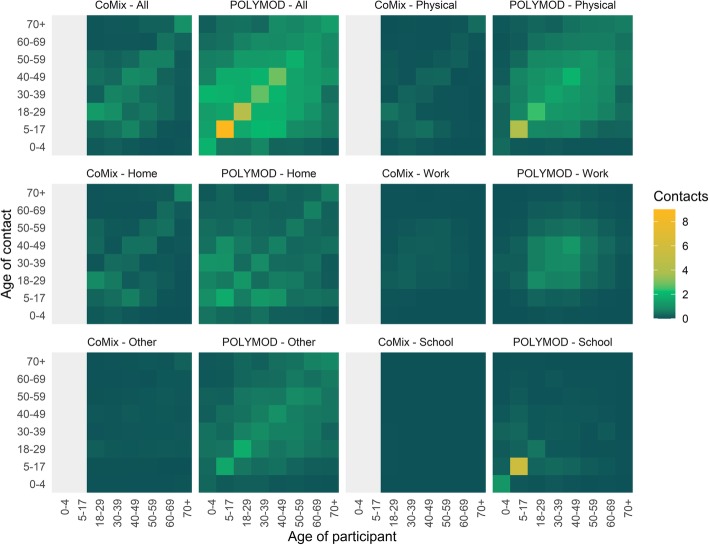
“For contacts before the pandemic we used POLYMOD matrices (Mossong et al., 2017), gathered before the pandemic, and for contacts during the pandemic we used CoMix matrices (Jarvis et al., 2020) gathered during the pandemic.”
MethodResultInfluentialPolicy During an Epidemic With Super-SpreadersPreprint
van Vlokhoven, H. (2020) · SSRN Electronic Journal · doi:10.2139/ssrn.3600441 · Cited by 2
Simons, D., Shahab, L., Brown, J., & Perski, O. (2021) · Qeios · doi:10.32388/ujr2aw.14 · Cited by 2
Smith, L., POTTS, H. W. W., Amlôt, R., Fear, N. T., Michie, S., & Rubin, J. H. (2022) · OSF Preprints (OSF Preprints) · doi:10.31219/osf.io/duxvf · Cited by 2
The effect of depression on compliance with physical distancing during the COVID-19 pandemicPreprint
Kim, J., Yun, I., Kim, H., Park, E., & Jang, S. (2022) · Research Square · doi:10.21203/rs.3.rs-2009618/v1 · Cited by 2
Inference of epidemic dynamics in the COVID-19 era and beyondPreprint
Cori, A., & Kucharski, A. J. (2024) · OSF Preprints (OSF Preprints) · doi:10.31219/osf.io/mg497 · Cited by 3
Quintana, G. R., Santibáñez-Palma, F., & Escudero‐Pastén, J. (2024) · Research Square · doi:10.21203/rs.3.rs-5006077/v1 · Cited by 2
Gamification Strategy Through Snake Ladder Game Systematic Literature Review
Ariessanti, H. D., Meyliaana, Hidayanto, A. N., & Prabowo, H. (2020) · International Conference on Information Technology and Education (ICITE) · doi:10.2991/assehr.k.201214.230 · Cited by 1
“In addition, gamification strategies can also be interpreted specifically as the use of game media that can increase attractiveness [7] and social participation [8].”
BackgroundNon-Parametric Model-Based Estimation of the Effective Reproduction Number for SARS-CoV-2
Hermes, J., Rosenblatt, M., Tönsing, C., & Timmer, J. (2023) · Algorithms · doi:10.3390/a16120533 · Cited by 1
Choi, S., Kim, C., Park, K., & Kim, J. (2023) · Epidemiology and Health · doi:10.4178/epih.e2023065 · Cited by 1
“Understanding this trend can help inform social distancing policies and prevent the spread of infectious diseases (17-19).”
BackgroundAcute And Chronic Disease Diagnosis Using ML For Post Covid 19 Medical Issues
Wadhwa, D., & Chhabra, D. (2023) · International Conference on Advance Computing and Innovative Technologies in Engineering (ICACITE) · doi:10.1109/icacite57410.2023.10182762 · Cited by 1
A Critical Glance to Non-Pharmacological Management of Novel COVID-19 Infection
Saleem, A., Davis, M., Rafique, S., Meer, S., Qader, A., & Aslam, M. N. (2023) · Pakistan Journal of Health Sciences · doi:10.54393/pjhs.v4i11.821 · Cited by 3
Basic Life Support Training Method in Undergraduate Nursing Students: a Comparative Research
Puspitasari, D. I., & Huzaimah, N. (2023) · Journal of Applied Nursing and Health · doi:10.55018/janh.v5i2.168 · Cited by 1
Xia, F., Xiao, Y., & Ma, J. (2024) · PLoS Computational Biology · doi:10.1371/journal.pcbi.1012498 · Cited by 1
A simple model for the analysis of epidemics based on hospitalization data
Leisman, K. P., Park, S., Simpson, S., & Rapti, Z. (2025) · Mathematical Biosciences · doi:10.1016/j.mbs.2025.109380 · Cited by 1
On real-time calibrated prediction for complex model-based decision support in pandemics: Part 1
Williamson, D., McKinley, T. J., Xiong, X., Salter, J. M., Challen, R., Danon, L., Youngman, B. D., & McNeall, D. (2026) · PLoS Computational Biology · doi:10.1101/2025.05.16.25327688 · Cited by 1
“To simplify the narrative, we use the CoMix contact matrix [Jarvis et al., 2020] here, but if this analysis were undertaken prior to the policy decision, we would have needed to apply scalings to the contact matrix by hand.”
An agent-based model for estimating daily face-to-face contact networks in large urban systems
Saadi, I., Côme, É., Nguyen, L. B. L., & Zargayouna, M. (2025) · Computers Environment and Urban Systems · doi:10.1016/j.compenvurbsys.2025.102321 · Cited by 1
Quantifying H5N1 outbreak potential and control effectiveness in high-risk agricultural populations
Avkan, I., Gokool, S., Smith, L. E., Clapp, G., Cox, R., Thomas, A. C., & Brooks‐Pollock, E. (2025) · PLOS Global Public Health · doi:10.1371/journal.pgph.0005463 · Cited by 1
van Leeuwen, E., Sandmann, F., Eggo, R. M., & White, P. J. (2026) · Journal of Theoretical Biology · doi:10.1016/j.jtbi.2025.112349 · Cited by 1
Ma, Y., Ledberg, A., Aradhya, S., & Juárez, S. (2026) · Communications Medicine · doi:10.1038/s43856-025-01357-w · Cited by 1
“Moreover, given the nonlinear nature of infectious disease outbreaks, even small differences in social contacts may play a major role in disease spread in communities 24 – 26 .”
Zhang, X., Deng, H., Ruan, Z., & Zhang, X. (2026) · Physica A Statistical Mechanics and its Applications · doi:10.1016/j.physa.2026.131376 · Cited by 4
Movilidad laboral urbana y Covid-19: los casos de tres zonas metropolitanas de México
de México, U. A. D. E., Mora, J. A. S., Becerril, J. G. G., de México, U. A. D. E., Zepeda, R. A., de México, U. A. D. E., Forero, E. A. S., & de México, U. A. D. E. (2021) · Papeles de Población · doi:10.22185/24487147.2021.107.09 · Cited by 1
Tetali, S., Jammy, G. R., Asirvatham, E. S., Kumar, B. R., & Choudhury, L. P. (2021) · Open Journal of Epidemiology · doi:10.4236/ojepi.2021.111005 · Cited by 1
“111005 53 Open Journal of Epidemiology Essentially, the effect of lockdown is consistent with the general understanding that social distancing reduces the risk and spread of disease, as demonstrated in other disease models [28] [29].”
BackgroundCoronavirus in the Children’s World: Discourses and Drawings
Duban, N. Y., & Şen, F. G. (2021) · Open Journal for Educational Research · doi:10.32591/coas.ojer.0502.03141d · Cited by 1
“Three-way public health measures (restriction in intensive intracity and intercity traffic, social distance measures, house arrest, and central quarantine) proved to be significant (Pan et al., 2020; Jarvis et al., 2020).”
Backgroundde Laclause, G. P., Delenda, A., & Polec, L. A. (2021) · Santé Publique · doi:10.3917/spub.212.0255 · Cited by 1
Non-parametric model-based estimation of the effective reproduction number for SARS-CoV-2
Hermes, J., Rosenblatt, M., Tönsing, C., & Timmer, J. (2023) · AIP conference proceedings · doi:10.1063/5.0163819 · Cited by 1
Integrating Social Sciences to Mitigate Against Covid
Paul, R. E. L., Telle, O., & Benkimoun, S. (2021) · Economics, law, and institutions in Asia Pacific · doi:10.1007/978-981-16-5727-6_3 · Cited by 1
“A study in the UK estimated that the observed 74% reduction in number of contacts per person during lockdown enabled a reduction of R from the pre-lockdown value 2.6 to below 1 (Jarvis et al. 2020).”
BackgroundInfluentialCOVID-19 exposure risk level in daily activity in adapting to new habits in the pandemic period
Haerana, B. T., Jalaluddin, S., Satrianegara, M. F., Wijaya, D. R., Basri, S., & Bujawati, E. (2021) · Enfermería Clínica · doi:10.1016/j.enfcli.2021.10.010 · Cited by 1
Reimagining quarantine: Assuring hopefulness in nursing and healthcare
Arde, B. O. J. A., Purisima, E. M. R., Ito, H., & Locsin, R. C. (2021) · Nursing Inquiry · doi:10.1111/nin.12481 · Cited by 1
Development of Wearable System to Help Preventing the Spread of Covid-19 in Public Indoor Area
Arrahmah, A. I., & Ramadhan, S. (2021) · International Journal of Advanced Computer Science and Applications · doi:10.14569/ijacsa.2021.0121166 · Cited by 1
Impact of Covid-19 risk perception on compliance with preventive measures among adult Egyptians
Elsayed, E. A. H. (2022) · Medical Science · doi:10.54905/disssi/v26i120/ms65e1826 · Cited by 1
“Int J Environ Res Public Health 2020; 4124(11):17 6.”
BackgroundTakahashi, H., Iori, T., Higuchi, T., Takada, D., Shin, J., Kunisawa, S., & Imanaka, Y. (2022) · PLoS ONE · doi:10.1371/journal.pone.0266342 · Cited by 1
Nurbaiti, N., & Ayuningtyas, D. (2022) · Journal of Indonesian Health Policy and Administration · doi:10.7454/ihpa.v7i1.4117 · Cited by 1
“The research article comes from: Hungary (9); Germany and England (10); USA (11); Indonesia and Irak (12); United Kingdom (UK) (13); Canada (14); Indonesia (15); Australia (16); Jepang and Vietnam (17); and Myanmar and UK (18).”
BackgroundSession 3 of the RSS Special Topic Meeting on Covid-19 Transmission: Replies to the Discussion
Dunbar, M. B., Hofmann, F., & Held, L. (2022) · Journal of the Royal Statistical Society Series A (Statistics in Society) · doi:10.1111/rssa.12985 · Cited by 1
“An alternative would be to use contact surveys conducted during the COVID-19 pandemic (Feehan & Mahmud, 2021; Jarvis et al., 2020, 2020a; Latsuzbaia et al., 2020).”
BackgroundBridgen, J. R. E., Wei, H., Whitfield, C. A., Han, Y., Hall, I., Jewell, C., van Tongeren, M., & Read, J. M. (2023) · Occupational and Environmental Medicine · doi:10.1136/oemed-2022-108646 · Cited by 1
COVID-19: La evidencia sobre las medidas preventivas
Cabrera, J. L. (2023) · Interciencia médica · doi:10.56838/icmed.v13i2.140 · Cited by 1
The role of frailty in shaping social contact patterns in Belgium, 2022–2023
Loedy, N., Hermans, L., Bosschaert, M. M., Torneri, A., & Hens, N. (2025) · Scientific Reports · doi:10.1038/s41598-025-96662-8 · Cited by 2
IMPACT OF COVID-19 ON WATER CONSUMPTION HABITS IN KOCAELI TURKEY
Görenekli, K., & Gülbağ, A. (2025) · Environmental Engineering and Management Journal · doi:10.30638/eemj.2025.132 · Cited by 1
Automatic Contact Tracing for Outbreak Detection Using Hospital Electronic Medical Record DataPreprint
DeWitt, M. (2020) · medRxiv · doi:10.1101/2020.09.08.20190876 · Cited by 1
“With each non-isolated positive case making roughly 10 (Jarvis et al. 2020) contacts per day1 and a serial interval of 4-5 days (Nishiura, Linton, and Akhmetzhanov 2020; Bi et al. 2020), this means that for each positive case, somewhere between 20-40 unique contacts need to be tracked per new case,…”
BackgroundSmoking and COVID Living Review (v11): a bayesian analysisPreprint
Simons, D., Shahab, L., Brown, J., & Perski, O. (2021) · Qeios · doi:10.32388/ujr2aw.12 · Cited by 1
“…stages of the pandemic, at least partly due to differential contact matrices by age, sex and socioeconomic position (CMMID COVID-19 working group et al., 2020), which are associated with smoking status. ii) The probability of viral exposure depends largely on local prevalence, which…”
BackgroundApplying Behavioral Science in Combating COVID-19 at the Workplace: A Narrative ReviewPreprint
Ahadzi, D. F., Owusu, H.-M., Otoo, J. E., & Akumah, E. E. (2021) · Preprints.org · doi:10.20944/preprints202104.0136.v1 · Cited by 1
“The most effective way of preventing the spread of an infection is by breaking physical contacts (Chu et al., 2020; Drake et al., 2020; Huremović, 2019; C. I. Jarvis et al., 2020; Tuite et al., 2020).”
BackgroundLi, Z., Wang, J., Yang, B., Li, W., Xu, J., & Wang, T. (2021) · medRxiv · doi:10.1101/2021.10.27.21265522 · Cited by 1
Cheetham, N. J., Waites, W., Ebyarimpa, I., Leber, W., Brennan, K., & Panovska‐Griffiths, J. (2020) · Research Square · doi:10.21203/rs.3.rs-68209/v2 · Cited by 1
Heemann, M., Pape, U. J., & Vollmer, S. (2022) · World Bank policy research working paper · doi:10.1596/1813-9450-9963 · Cited by 6
“…measures aiming to reduce mobility and social contacts are a key tool in slowing the spread of the virus and as such, saving lives and buying vital time to develop vaccines and flatten the curve such that a country’s health infrastructure is not overwhelmed (Yilmazkuday 2021, Jarvis et al. 2020).”
BackgroundPhylogenomic Early Warning Signals for SARS-CoV-2 Epidemic WavesPreprint
Drake, K. O., Boyd, O., Franceschi, V. B., Colquhoun, R., Ellaby, N. A. F., & Volz, E. (2023) · SSRN Electronic Journal · doi:10.2139/ssrn.4522412 · Cited by 1
Bouman, J. A., Hauser, A., Grimm, S. L., Wohlfender, M., Bhatt, S., Semenova, E., Gelman, A., Althaus, C. L., & Riou, J. (2023) · medRxiv · doi:10.1101/2023.10.09.23296742 · Cited by 2
Data-driven modeling of COVID-19 spread in France to inform pandemic response
Domenico, L. D. (2022) · theses.fr (ABES) · doi:10.70675/74cb72f2z2942z43dfza52fz2e3c0e5b38f5 · Cited by 2
Straka, J. W. (2020) · Preprints.org · doi:10.20944/preprints202005.0326.v3
Ullah, S., Zheng, J., Zuo, Z., Zhang, F., Shang, K., Yu, W., Fu, Y., Han, C., Lin, Y., Jiang, K., et al. (2020) · medRxiv · doi:10.1101/2020.06.11.20107086
“From the recently published literature, the first focus is on the impact of social factors, especially government control on the pandemic situation of COVID-19[2-18]; According to the data of pandemic situation, a model is developed to predict the effect of government intervention measures to slow down the pandemic si…”
Backgroundde Laclause, G. P., & Delenda, A. (2020) · SSRN Electronic Journal · doi:10.2139/ssrn.3598484
Should Asymptomatic and Low-Risk Individuals be Tested for SARS-CoV-2?
Sehgal, A. R. (2020) · Journal of General Internal Medicine · doi:10.1007/s11606-020-06000-z
“1.(5) The number of people subsequently infected by each infected case disease was calculated using the formula R + R(2) + R(3) +.”
MethodCOVID-19: the United States experience
Ciottone, G. R. (2020) · Saudi Journal of Emergency Medicine · doi:10.24911/sjemed/72-1590005225
Até que ponto Brasil e o mundo se beneficiam de medidas de isolamento mais rígidas?
Suetugo, I. M., & Carvalho, P. B. (2020) · Revista Científica Multidisciplinar Núcleo do Conhecimento · doi:10.32749/nucleodoconhecimento.com.br/saude/medidas-de-isolamento
Effects of Policy Responses to the Spread of Covid-19 Pandemic
Briola, H., & Briola, K. (2020) · HAPSc Policy Briefs Series · doi:10.12681/hapscpbs.24946
“One of these is by Jarvis et al. (2020), which revealed that the physical removal measures adopted by the United Kingdom's public, have greatly reduced the contact level and is estimated to have a significant impact in reducing the transmission of COVID-19.”
BackgroundShen, J., & Zhu, T. (2020) · doi:10.1002/essoar.10504512.1
van Leeuwen, E., Sandmann, F., Eggo, R. M., PHE Joint modelling group, & White, P. J. (2020) · medRxiv · doi:10.1101/2020.12.21.20248607
Forecasting the Spread of the COVID-19 Epidemic in Lombardy: A Dynamic Model Averaging ApproachPreprint
Gianmoena, L., & Ríos, V. O. (2021) · medRxiv · doi:10.1101/2021.01.18.21250053 · Cited by 1
Shoukat, A., Galvani, A. P., & Fitzpatrick, M. C. (2021) · medRxiv · doi:10.1101/2021.03.31.21254646
“Social mixing patterns were derived from empirical studies conducted both prior to and during 2020.(2,3) Upon transmission, individuals enter a latent stage from which an age-specific proportion proceeds to an asymptomatic infectious stage.”
MethodLa pandemia de covid-19 en Colombia: una visión desde la salud pública
Vargas‐Uricoechea, H., & Vargas-Sierra, H. D. (2020) · Medicina · doi:10.56050/01205498.1539 · Cited by 2
Humphrey, L. (2021) · The Atrium (University of Guelph)
HEALTH AND WELNESS PROGRAM AND NEW NORMAL LIFESTYLE OF CvSU FACULTY AND THEIR PERFORMANCE
Jacob, L. A. B. (2021) · EPRA International Journal of Research & Development (IJRD) · doi:10.36713/epra7487 · Cited by 1
Meiksin, A. A. (2021) · medRxiv · doi:10.1101/2021.08.11.21261903
Aspectos globales de la epidemiología y de la toma de decisiones en la pandemia por COVID-19
Vargas‐Uricoechea, H., & Vargas-Sierra, H. D. (2020) · Revista Colombiana de Endocrinología Diabetes & Metabolismo · doi:10.53853/encr.7.2s.583
Elzehiri, D. A. I., Salime, R. A. A., & Ibrahim, R. A. S. (2021) · Egyptian Journal of Health Care · doi:10.21608/ejhc.2021.194866
Koltai, M., Warsame, A., Bashiir, F., Freemantle, T., Reeve, C., Williams, C., Jit, M., Flasche, S., Davies, N. G. M., CMMID COVID-19 working group, et al. (2021) · Wellcome Open Research · doi:10.12688/wellcomeopenres.17247.1
Self-citationCOVID-19: A New Wave of Chronic Disease
Beernink, C., Martin, J., & Otto, L. M. (2020) · CAND Journal · doi:10.54434/candj.63
Cheetham, N. J., Waites, W., Ebyarimpa, I., Leber, W., Brennan, K., & Panovska‐Griffiths, J. (2020) · Research Square · doi:10.21203/rs.3.rs-68209/v1
“Ongoing surveys on a representative sample of UK adults about their contact patterns on the previous day, by colleagues at LSHTM suggest that the number of daily contacts has reduced 73% with the imposed lockdown measures [14].”
BackgroundMethodResultInfluentialNovel coronavirus 2019 testing in women attending routine antenatal care: a cross-sectional studyPreprint
Rolnik, D. L., Korman, T. M., Rindt, A., Stuart, R. L., Giles, M., Rawlins, J., Palmer, K. R., Stripp, A. M., Wallace, E. M., & Hodges, R. J. (2020) · doi:10.22541/au.159373554.45443497
Contagions under control - Mathematical models to inform infectious disease prevention and control
Pham, T. M. (2022) · Utrecht University Repository (Utrecht University) · doi:10.33540/1194
الأشرم, ر. إ. م. (2021) · مجلة التربية الخاصة والتأهيل · doi:10.21608/sero.2021.218598
de Laclause, G. P., & Delenda, A. (2020) · SSRN Electronic Journal · doi:10.2139/ssrn.3603177
Leading change amidst COVID-19: a narrative study of respiratory care managers
Harshberger, M. J., & Geller, K. D. (2021) · iDEA - Drexel University Institutional Repository · doi:10.17918/00000576
Febres, G. L. (2021) · arXiv (Cornell University) · doi:10.48550/arxiv.2106.04085
“[13], which computed a reduction of 74% in the reproduction rate by implementing social distancing measures in the UK.”
BackgroundUsing an ontology based big data architecture for predicting pandemic outbreak risk (Preprint)Preprint
Lau, A. S. M. (2022) · doi:10.2196/preprints.38983
Systematic literature review on physical distancing policy for mass gathering events
Ramely, A., Nawawi, M. K. M., Khalid, R., Wibowo, A., & Zahra, A. (2022) · AIP conference proceedings · doi:10.1063/5.0092831
Metadata
- Authors
- CMMID COVID-19 working group, Jarvis, C. I., Van Zandvoort, K., Gimma, A., Prem, K., Klepac, P., Rubin, G. J., & Edmunds, W. J.
- Affiliations
- London School of Hygiene & Tropical Medicine (GB)
- King's College London (GB)
- Corresponding author
- Jarvis, Christopher I.
- Venue
- BMC Medicine
- Published
- 2020-05-07
- Volume
- 18
- Issue
- 1
- Pages
- 124-124
- ISSN
- 1741-7015 (ISSN-L)
- PMC
- PMC7202922
- OpenAlex
- W3021151406
- Cited by
- 720
- References
- 28
- Citations by year
- 2026: 21 · 2025: 25 · 2024: 46 · 2023: 80 · 2022: 134 · 2021: 279 · 2020: 135
- FWCI
- 24.98
- Type
- journal article
- Language
- en
- Open access
- gold
- doi.org
- Licence
- cc-by
- creativecommons.org/licenses/by/4.0/ (tdm)
- creativecommons.org/licenses/by/4.0/ (vor)
- Locations
- BMC Medicine (publishedVersion, cc-by)
- medRxiv (acceptedVersion, cc-by-nd)
- PubMed Central (publishedVersion, cc-by)
- PubMed (publishedVersion)
- LSHTM Research Online (London School of Hygiene and Tropical Medicine) (acceptedVersion)
- DOAJ (DOAJ: Directory of Open Access Journals) (submittedVersion, cc-by-sa)
- Informationszentrum Lebenswissenschaften (ZB MED) (submittedVersion, cc-by)
- Funders
- Horizon 2020 (101003688)
- Topics
- Physical Sciences › Mathematics › Modeling and Simulation › COVID-19 epidemiological studies
- Social Sciences › Sociology and Political Science › COVID-19 Prevention and Impact
- Health Sciences › Medicine › Infectious Diseases › SARS-CoV-2 and COVID-19 Research
- Keywords
- COVID-19 pandemic, social distancing, lockdown, social contact patterns, reproduction number, skin-to-skin contact, epidemic control, behavior change
- MeSH terms
- Betacoronavirus, COVID-19, SARS-CoV-2, Activities of Daily Living, Adult, United Kingdom, Health Policy, Humans, Interpersonal Relations, Models, Theoretical, Pneumonia, Viral, Surveys and Questionnaires, Social Isolation, Incidence, Contact Tracing, Coronavirus Infections, Basic Reproduction Number, Epidemics, Pandemics
About these checks
Registry, retraction, Cites and statistics results are computed, not judged, with one exception: a printed reference that no index lists is read once by a model before it counts as a citation error. Claims are extracted by a model and kept only when their quote appears verbatim in the text; each cited source is then checked, with a model’s help, for whether it says what the claim relies on. Those verdicts can be wrong — read the claim’s quote and the cited source before relying on one.
Statistics and arithmetic are recomputed, not judged.
Confidence bands are shown only for fields calibrated on our annotated test set. None is calibrated yet, so no band is shown.
What counts as a claim ›How we measure confidence ›How we check this ›
Are you an author, or do you see a problem with this page? Request a review
Data sources
Bibliographic data: Semantic Scholar, OpenAlex, Crossref.
Contains information from the Semantic Scholar Academic Graph Datasets, made available under the ODC Attribution License (ODC-BY 1.0).
Semantic Scholar’s data is described in: Kinney, R., et al. (2023). The Semantic Scholar Open Data Platform. arXiv:2301.10140.
