

Dissolution and solubility of calcite-rhodochrosite solid solutions [(Ca1-xMnx)CO3] at 25 °C
Open accessThe DOI matches its Crossref record; 57 of the 58 references it cites were found in a registry or an index, and 1 are not checked yet; 17 of the 105 sources its claims cite were checked for support.
Abstract
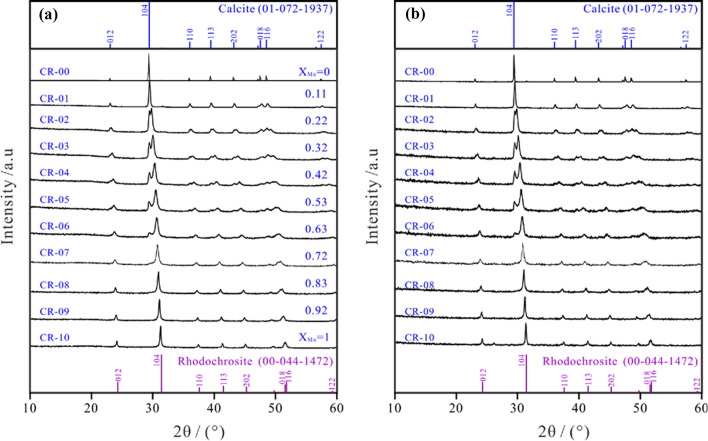
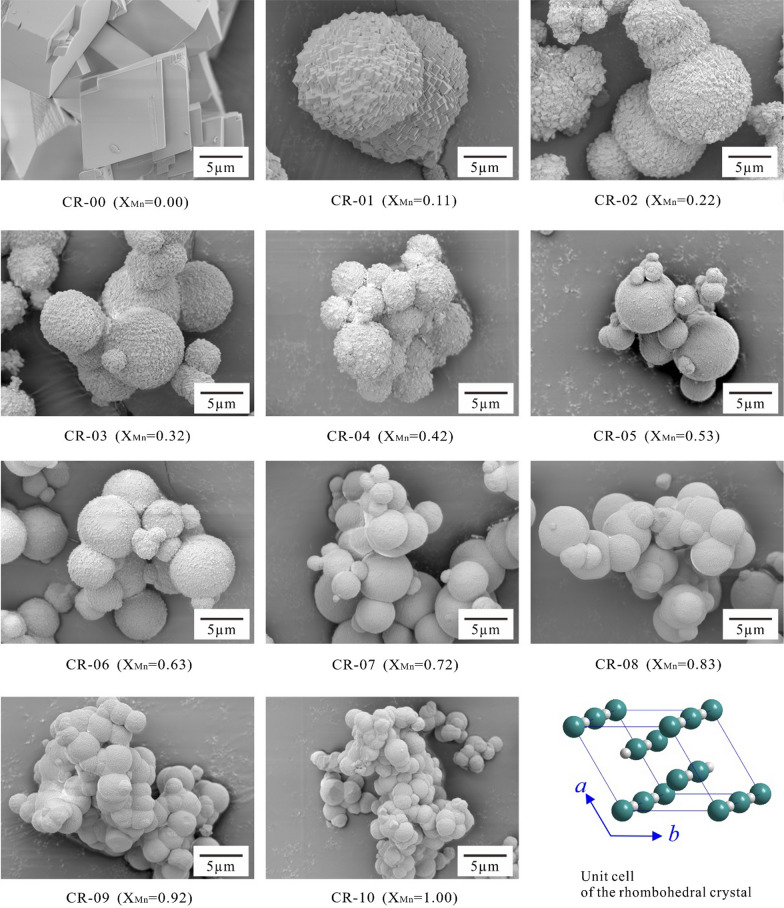
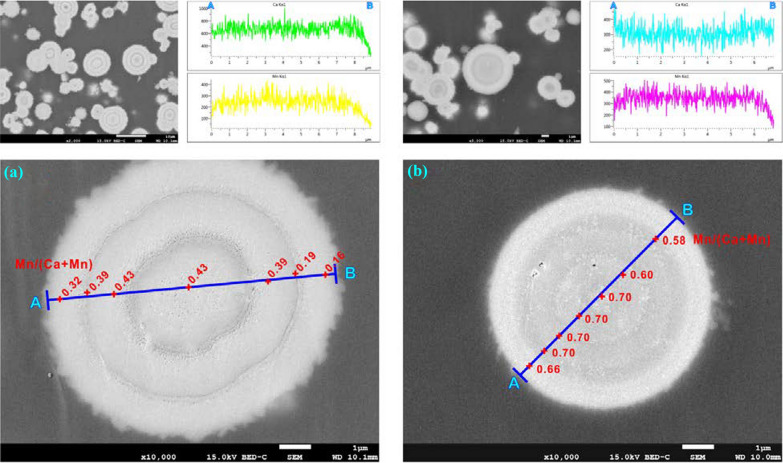
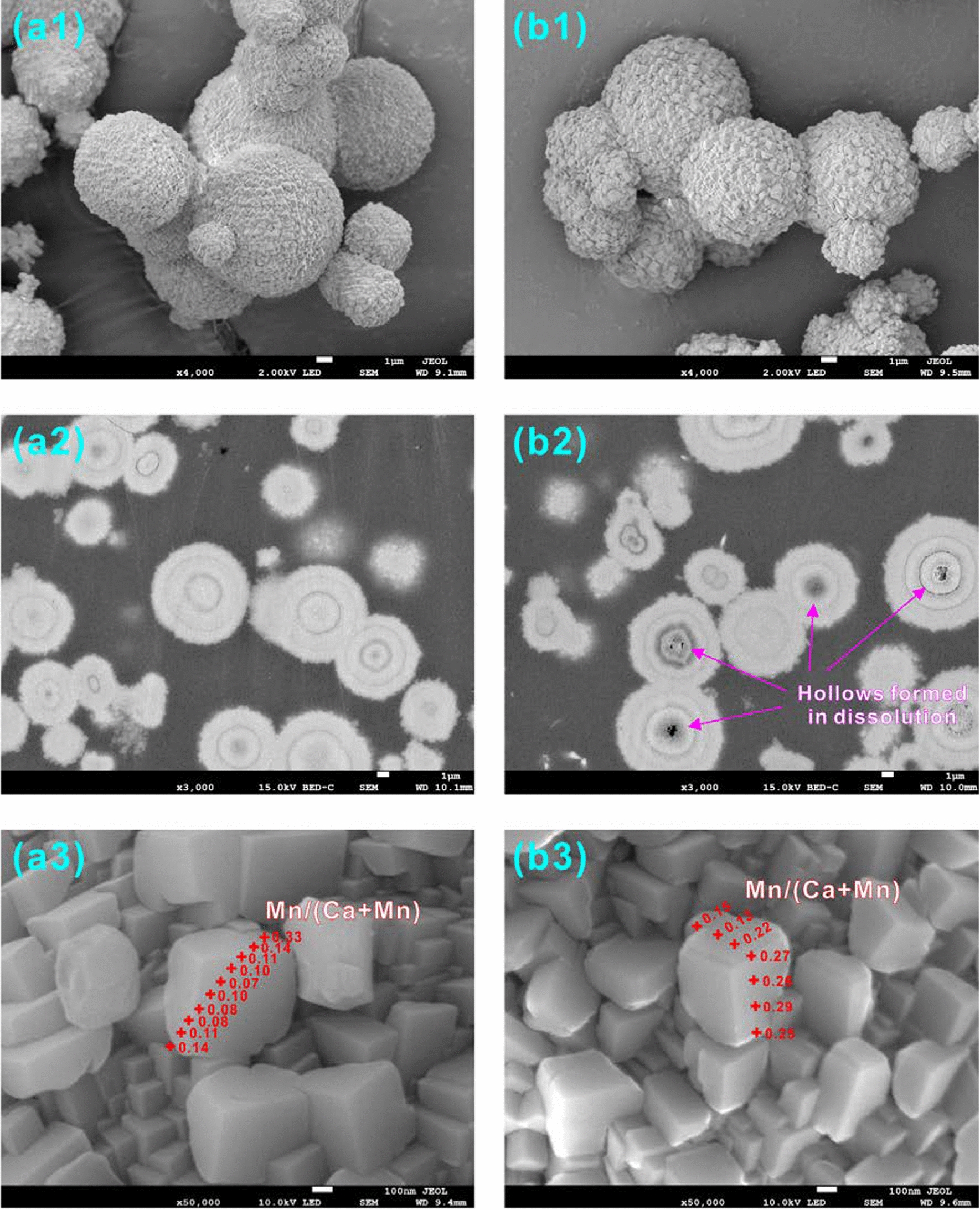
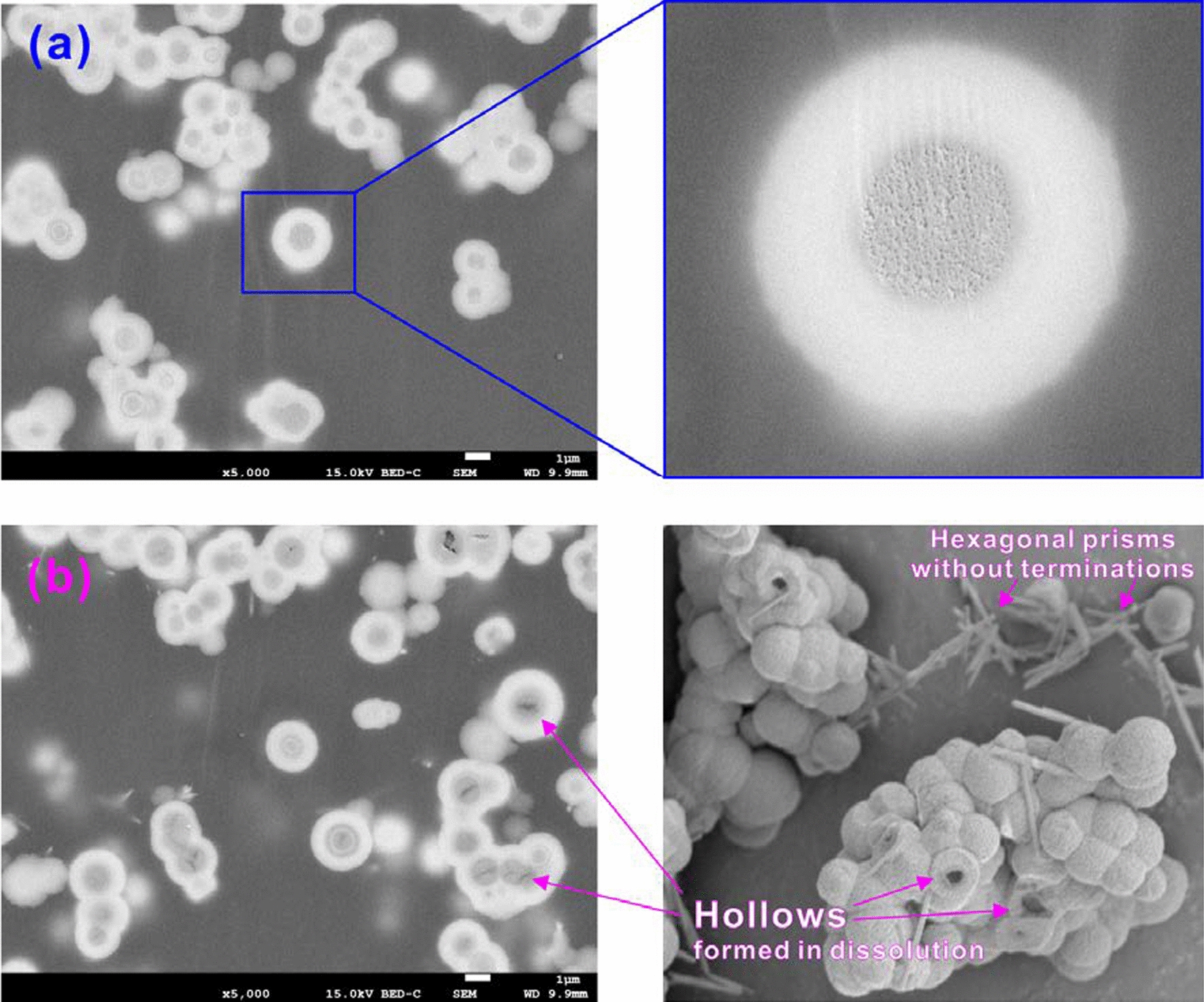
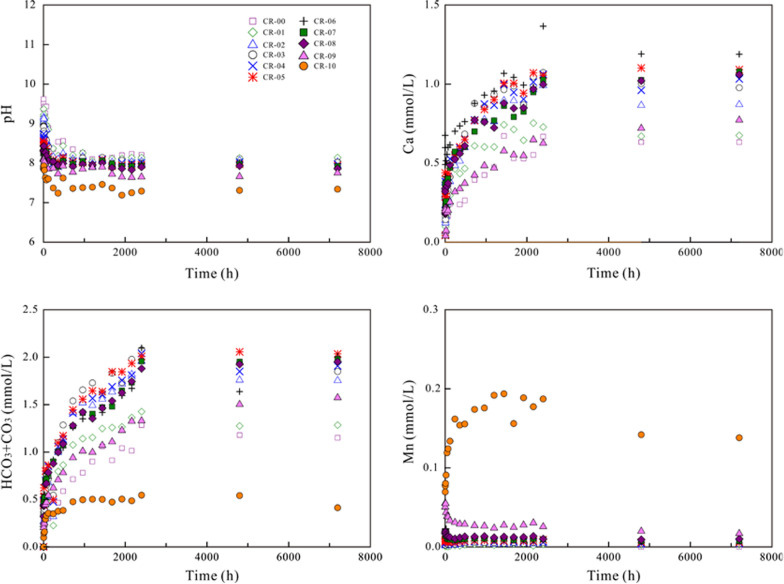
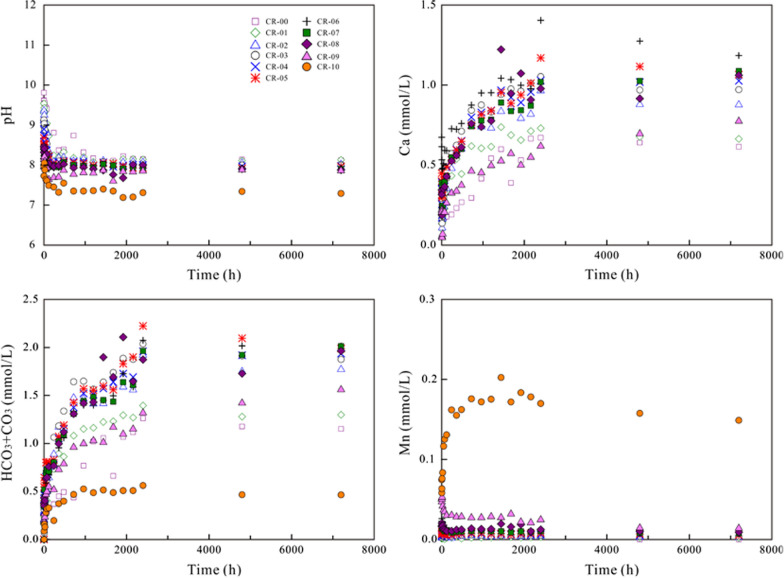
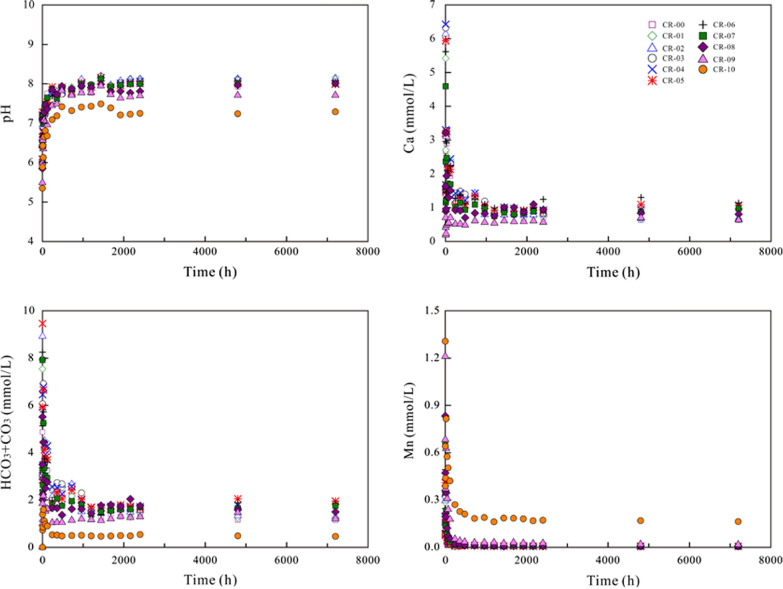
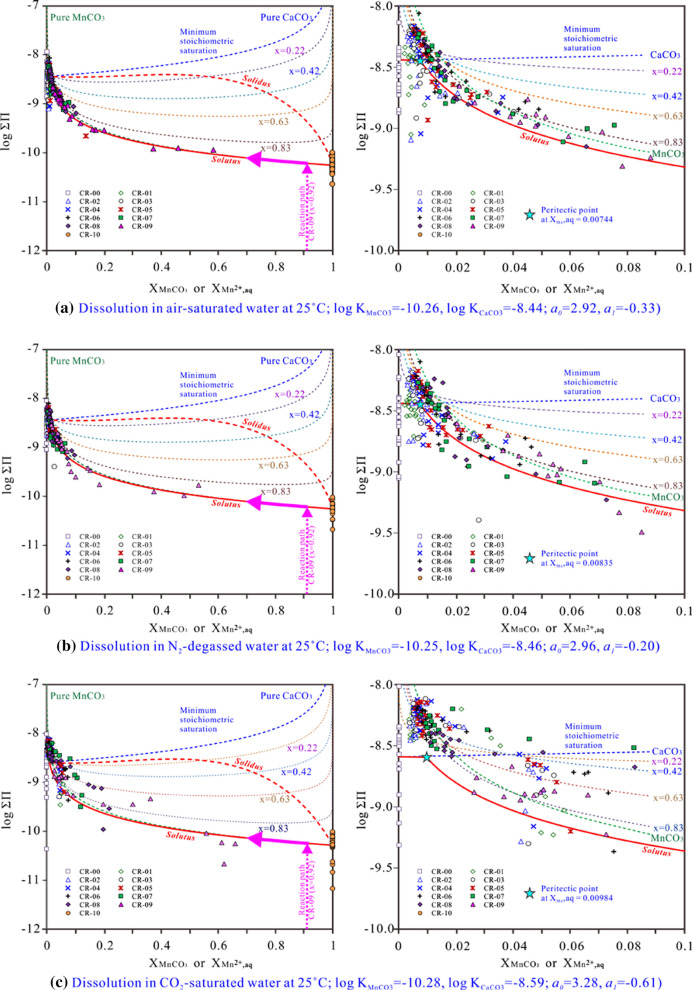
A complete series of calcite-rhodochrosite solid solutions [(Ca 1-x Mn x )CO 3 ] are prepared, and their dissolution processes in various water samples are experimentally investigated. The crystal morphologies of the solid solutions vary from blocky spherical crystal aggregates to smaller spheres with an increasing incorporation of Mn in the solids. Regarding dissolution in N 2 -degassed water, air-saturated water and CO 2 -saturated water at 25 °C, the aqueous Ca and Mn concentrations reach their highest values after 1240–2400 h, 6–12 h and < 1 h, respectively, and then decrease gradually to a steady state; additionally, the ion activity products (log_IAP) at the final steady state (≈ solubility products in log_ K sp ) are estimated to be − 8.46 ± 0.06, − 8.44 ± 0.10 and − 8.59 ± 0.10 for calcite [CaCO 3 ], respectively, and − 10.25 ± 0.08, − 10.26 ± 0.10 and − 10.28 ± 0.03, for rhodochrosite [MnCO 3 ], respectively. As X Mn increases, the log_IAP values decrease from − 8.44 ~ − 8.59 for calcite to − 10.25 ~ − 10.28 for rhodochrosite. The aqueous Mn concentrations increase with an increasing Mn/(Ca + Mn) molar ratio (X Mn ) of the (Ca 1-x Mn x )CO 3 solid solutions, while the aqueous Ca concentrations show the highest values at X Mn = 0.53–0.63. In the constructed Lippmann diagram of subregular (Ca 1-x Mn x )CO 3 solid solutions, the solids dissolve incongruently, and the data points of the aqueous solutions move progressively up to the Lippmann solutus curve and then along the solutus curve or saturation curve of pure MnCO 3 to the Mn-poor side. The microcrystalline cores of the spherical crystal aggregates are preferentially dissolved to form core hollows while simultaneously precipitating Mn-rich hexagonal prisms.
Verified 2026-11-22 · 1 reference not checked yet
Overview
CoChat Summary
## TL;DR
This paper synthesizes a full series of calcite–rhodochrosite solid solutions [(Ca1-xMnx)CO3] and measures how they dissolve at 25 °C in N2-degassed, air-saturated, and CO2-saturated water. The authors find incongruent dissolution, Mn-rich residual/precipitated phases, and estimate endmember solubility products of log_IAP ≈ -8.44 to -8.59 for calcite and -10.25 to -10.28 for rhodochrosite.
## Key findings
- Eleven solids (CR-00–CR-10) spanning XMn = 0.00 to 1.00 were prepared; their compositions were close to the starting Mn/(Ca + Mn) ratios, but measured XMn was not linearly correlated with the starting ratios, indicating preferential Mn uptake.
- Dissolution at 25 °C was time-dependent and water-chemistry dependent: in N2-degassed and air-saturated water, aqueous Ca and HCO3−/CO32− peaked after 1240–2400 h, while aqueous Mn peaked after 6–12 h; in CO2-saturated water, Ca and Mn peaked within < 1 h.
- Final steady-state solubility estimates were log_IAP = -8.46 ± 0.06, -8.44 ± 0.10, and -8.59 ± 0.10 for calcite, and -10.25 ± 0.08, -10.26 ± 0.10, and -10.28 ± 0.03 for rhodochrosite, depending on the water condition.
- The Lippmann diagram indicated incongruent dissolution: solution compositions moved to the solutus curve and then along the solutus curve and/or pure MnCO3 saturation curve, with preferential dissolution of microcrystalline cores and simultaneous precipitation of Mn-rich hexagonal prisms.
## Methods
- Eleven (Ca1-xMnx)CO3 solids were synthesized at room temperature by precipitating mixed Ca/Mn nitrate solutions with NH4HCO3 under N2, then filtering, washing with ethanol, and drying.
- The solids were characterized by ICP-OES, XRD, FE-SEM, and BSEI; dissolution experiments used 5 g solid in 100 mL ultrapure water that was N2-degassed, air-saturated, or CO2-saturated, held at 25 °C for up to 7200 h.
- Dissolution products were tracked by pH measurement, potentiometric titration for HCO3−/CO32−, ICP-OES for Ca and Mn, and PHREEQC-based thermodynamic calculations; Lippmann diagrams were then constructed with a subregular solid-solution model.
## Limitations
- The paper states that thermodynamic data for (Ca,Mn)CO3 solid solutions are “still scarce,” and that many published solubility products for rhodochrosite are contradictory, which complicates model construction.
- The authors note that the exact formation and stability conditions of rhodochrosite–calcite solid solutions are “still not fully understood” and that experimental data remain deficient.
- Evident from the text: the work relies on batch experiments at a single temperature (25 °C) and on PHREEQC-based speciation/model assumptions, so the conclusions are limited to the studied conditions and chosen thermodynamic framework.
Model-written summary. Check it against the paper before relying on it.
Integrity signals
Registry
Cites
Statistics
Figures
Verification
Claims the paper makes
13 Valid · 2 Not valid · 56 Not checked · 77 Own results and interpretations
The cited sources support only part of this claim — read each source’s verdict below.
In the paper
“A variety of crystal morphologies were obtained, showing the effects of Mn2+ (even at low concentrations) on the growth of the {104} faces of calcite [2, 11].”
§ Dissolution and solubility of calcite-rhodochrosite solid solutions [(Ca1-xMnx)CO3] at 25 °C > Results and discussion > Solid characterization
What the sources say
- Not checked — no full text of the sourcecites [2] Katsikopoulos D Fernández-González Á Prieto M Crystallization behaviour of the (Mn, Ca)CO3 solid solution in silica gel: nucleation, growth and zoning phenomena Mineral Mag 2009 73 269 284 10.1180/minmag.2009.073.2.269 source
- Partly supportedcites [11] Astilleros JM Pina CM Fernndez-Daz L Putnis A Molecular-scale surface processes during the growth of calcite in the presence of manganese Geochim Cosmochim Acta 2002 66 3177 3189 10.1016/S0016-7037(02)00892-X sourceExperimental — accuracy not yet measured
The AFM Observations and Discussion report that Mn affects growth on calcite {10̄14} faces, including changes in step shape and a shift in growth mechanism as Mn concentration increases. Table 1 includes a low-Mn solution (0.01 mmol/L). The paper describes molecular-scale surface features, however, not a variety of whole-crystal morphologies obtained in the experiments. (LLM, conf=0.85)
plainstates a cause- Asserted: passes — The authors put it forward as true.
- Checkable: passes — It can be checked against evidence.
- Load-bearing: unclear — It is unclear whether the paper’s conclusions depend on it.
- Based: passes — The paper gives a reason why it holds.
Every source the paper cites for this claim was checked and supports it.
In the paper
“As the Mn concentrations increased, the (Ca1-xMnx)CO3 solid solutions varied from blocky crystals to spherulites and peanut-like aggregates [23].”
§ Dissolution and solubility of calcite-rhodochrosite solid solutions [(Ca1-xMnx)CO3] at 25 °C > Results and discussion > Solid characterization
What the sources say
- Supportedcites [23] Fernández-Díaz L Astilleros JM Pina CM The morphology of calcite crystals grown in a porous medium doped with divalent cations Chem Geol 2006 225 314 321 10.1016/j.chemgeo.2005.08.024 source
Section 3.2.2 (page unavailable) says calcite grown in Mn²⁺-doped gel develops morphologies ranging from blocky crystals to peanut-like aggregates, spheres and spherulites, depending on dopant concentration. It describes blocky crystals at lower concentrations and more pronounced splitting into aggregates as concentration rises. (LLM, conf=0.88)
plainstates a cause- Asserted: passes — The authors put it forward as true.
- Checkable: passes — It can be checked against evidence.
- Load-bearing: unclear — It is unclear whether the paper’s conclusions depend on it.
- Based: passes — The paper gives a reason why it holds.
- Supported
The cited sources support only part of this claim — read each source’s verdict below.
In the paper
“During the dissolution of four (Ca1-xMnx)CO3 solids (x = 0–0.12) in acidic solutions, the aqueous Mn2+ concentrations first increased and then decreased with the formation of rhodochrosite (MnCO3)”
§ Dissolution and solubility of calcite-rhodochrosite solid solutions [(Ca1-xMnx)CO3] at 25 °C > Introduction
What the sources say
- Partly supportedcites [20] Zhang X Wu S Chen F Nano precipitates formed during the dissolution of calcite incorporated with Cu and Mn Minerals 2018 8 484 1 10 sourceExperimental — accuracy not yet measured
The Abstract reports that aqueous Mn²⁺ first increased and then decreased during acidic dissolution and that rhodochrosite formed; the Release of Metals section gives this trend for Mn-02, Mn-04, and Mn-10. The paper includes a fourth, Mn-free calcite sample, but does not report an aqueous Mn trend for it. Its Coprecipitation Procedures give a highest nominal Mn/Ca ratio of 0.1, not an x value of 0.12. (LLM, conf=0.86)
plainstates a cause- Asserted: passes — The authors put it forward as true.
- Checkable: passes — It can be checked against evidence.
- Load-bearing: passes — The paper’s conclusions depend on it.
- Based: passes — The paper gives a reason why it holds.
- Partly supported
Every source the paper cites for this claim was checked and supports it.
In the paper
“The lack of agreement among (Ca,Mn)CO3 solid solutions make it difficult to put forward reliable geochemical models [11].”
§ Dissolution and solubility of calcite-rhodochrosite solid solutions [(Ca1-xMnx)CO3] at 25 °C > Introduction
What the sources say
- Supportedcites [11] Astilleros JM Pina CM Fernndez-Daz L Putnis A Molecular-scale surface processes during the growth of calcite in the presence of manganese Geochim Cosmochim Acta 2002 66 3177 3189 10.1016/S0016-7037(02)00892-X source
The thermodynamic-background discussion describes disagreement over the properties of (Ca,Mn)CO3 solid solutions. The paper then states that this lack of agreement makes it difficult to propose a consistent thermodynamic model for the system, supporting the citing sentence’s paraphrase. (LLM, conf=0.91)
plainstates a cause- Asserted: passes — The authors put it forward as true.
- Checkable: passes — It can be checked against evidence.
- Load-bearing: passes — The paper’s conclusions depend on it.
- Based: passes — The paper gives a reason why it holds.
- Supported
The sources with a verdict support this claim; the rest weren’t checked yet, have no full text we could read, or their verdicts aren’t rated yet.
In the paper
“The notable pH variation showed that the initial dissolution was pH-controlled [20, 32].”
§ Dissolution and solubility of calcite-rhodochrosite solid solutions [(Ca1-xMnx)CO3] at 25 °C > Results and discussion > Variation of the aqueous solution
What the sources say
- Supportedcites [20] Zhang X Wu S Chen F Nano precipitates formed during the dissolution of calcite incorporated with Cu and Mn Minerals 2018 8 484 1 10 source
The Discussion explicitly says that the marked early pH change indicated that the initial dissolution of the solid solutions was controlled by pH. The Methods’ statement that solution pH was not experimentally controlled describes the setup, not a contrary finding. (LLM, conf=0.95)
- Not checked — no full text of the sourcecites [32] Alkattan M Oelkers EH Dandurand J-L Schott J An experimental study of calcite and limestone dissolution rates as a function of pH from -1 to 3 and temperature from 25 to 80°C Chem Geol 1998 151 199 214 10.1016/S0009-2541(98)00080-1 source
plainstates a cause- Asserted: passes — The authors put it forward as true.
- Checkable: passes — It can be checked against evidence.
- Load-bearing: passes — The paper’s conclusions depend on it.
- Based: passes — The paper gives a reason why it holds.
- Supported
72 more claims · 2 with their cited sources checked
Create a free account to see all 148 claims and every source verdict.
- Probably not a substantial claim. 35
- It may state two separate claims as one. 44
- The quote only partly states this claim. 1
Citations
Cites
Aquatic chemistry: chemical equilibria and rates in natural waters
(1996) · Choice Reviews Online · doi:10.5860/choice.33-6312 · Cited by 6,443 · cited 1×
“9 kJ/mol [35], the free energies of formation, ΔGf°[(Ca1-xMnx)CO3], were also estimated.”
BackgroundAlgebraic Representation of Thermodynamic Properties and the Classification of Solutions
Redlich, O., & Kister, A. T. (1948) · Industrial & Engineering Chemistry · doi:10.1021/ie50458a036 · Cited by 5,879 · cited 1×
“The solid activity coefficients of CaCO3 ( γCa ) and MnCO3 ( γMn ) in terms of solid components (1−x, x) can be estimated by the Redlich and Kister equations [50, 54, 60], which are expressed as:”
MethodParkhurst, D. L., & Appelo, C. A. J. (2013) · Techniques and Methods · doi:10.3133/tm6a43 · Cited by 3,779 · cited 1×
“2) [21], and then the ion activity products (IAPs) were calculated after the definitions, which equaled the solubility products (Ksp) of the (Ca1-xMnx)CO3 solid solutions at equilibrium.”
MethodPlummer, L. N., & Busenberg, E. (1982) · Geochimica et Cosmochimica Acta · doi:10.1016/0016-7037(82)90056-4 · Cited by 1,886
(1991) · OSTI OAI (U.S. Department of Energy Office of Scientific and Technical Information) · Cited by 1,743
(1982) · Medical Entomology and Zoology · Cited by 1,294
The Oxidation States of the Elements and Their Potentials in Aqueous Solutions
LATIMER, W. M. (1939) · Soil Science · doi:10.1097/00010694-193910000-00009 · Cited by 1,148
Manganese toxicity upon overexposure
Crossgrove, J., & Zheng, W. (2004) · NMR in Biomedicine · doi:10.1002/nbm.931 · Cited by 801 · cited 1×
“Introduction Manganese (II) is a toxic divalent metal that can be found in excessive amounts in various water bodies, soils and rocks [1, 2].”
BackgroundPrinciples and applications of water chemistry
F.D. (1968) · Journal of Hydrology · doi:10.1016/0022-1694(68)90164-9 · Cited by 317
Stability of some carbonates at 25 degrees C and one atmosphere total pressure
Garrels, R. M., Thompson, M. E., & Siever, R. (1960) · American Journal of Science · doi:10.2475/ajs.258.6.402 · Cited by 297
Alkattan, M., Oelkers, E. H., Dandurand, J.-L., & Schott, J. (1998) · Chemical Geology · doi:10.1016/s0009-2541(98)00080-1 · Cited by 235 · cited 1×
“The notable pH variation showed that the initial dissolution was pH-controlled [20, 32].”
BackgroundSolid-solution aqueous-solution equilibria; thermodynamic theory and representation
Glynn, P. D., & Reardon, E. J. (1990) · American Journal of Science · doi:10.2475/ajs.290.2.164 · Cited by 219 · cited 2×
“The solid activity coefficients of CaCO3 ( γCa ) and MnCO3 ( γMn ) in terms of solid components (1−x, x) can be estimated by the Redlich and Kister equations [50, 54, 60], which are expressed as:”
BackgroundMethodFluid supersaturation and crystallization in porous media
Putnis, A., Prieto, M., & Fernandez-Diaz, L. (1995) · Geological Magazine · doi:10.1017/s0016756800011389 · Cited by 192 · cited 1×
“, the less soluble Mn-rich phases were more metastable; consequently, they crystallized at a higher supersaturation [24].”
BackgroundMonnin, C. (1999) · Chemical Geology · doi:10.1016/s0009-2541(98)00171-5 · Cited by 188
The solubility of rhodochrosite (MnCO3) and siderite (FeCO3) in anaerobic aquatic environments
Jensen, D. L., Boddum, J. K., Tjell, J. C., & Christensen, T. H. (2002) · Applied Geochemistry · doi:10.1016/s0883-2927(01)00118-4 · Cited by 172
Thermodynamics of Solid Solution-Aqueous Solution Systems
Prieto, M. (2009) · Reviews in Mineralogy and Geochemistry · doi:10.2138/rmg.2009.70.2 · Cited by 160 · cited 1×
“The solid activity coefficients of CaCO3 ( γCa ) and MnCO3 ( γMn ) in terms of solid components (1−x, x) can be estimated by the Redlich and Kister equations [50, 54, 60], which are expressed as:”
MethodPrieto, M., Fernández-González, A., Putnis, A., & Fernández-Díaz, L. (1997) · Geochimica et Cosmochimica Acta · doi:10.1016/s0016-7037(97)00160-9 · Cited by 156 · cited 1×
“High compositional gradients of crystals have been proven to be a major characteristic of solid solutions with a great difference in the solubilities of the endmembers (2 to 3 orders of magnitude) [25, 26] and could be easy to explain considering changes in the fluid composition during crystal growth [2, 27, 28].”
BackgroundReaction paths and equilibrium end-points in solid-solution aqueous-solution systems
Glynn, P. D., Reardon, E. J., Plummer, L. N., & Busenberg, E. (1990) · Geochimica et Cosmochimica Acta · doi:10.1016/0016-7037(90)90317-e · Cited by 130
The coprecipitation of manganese(II) with calcite: an experimental study
Pingitore, N. E., Eastman, M. P., Sandidge, M., Oden, K., & Freiha, B. (1988) · Marine Chemistry · doi:10.1016/0304-4203(88)90059-x · Cited by 129
Thermodynamic Databases for Water-Rock Interaction
Oelkers, E. H., Benezeth, P., & Pokrovski, G. S. (2009) · Reviews in Mineralogy and Geochemistry · doi:10.2138/rmg.2009.70.1 · Cited by 126 · cited 1×
“experimental analyses and their derivation/extrapolation, from the differences in the involved aqueous speciations [49] or from the impurities in solid samples [5].”
BackgroundEffect of Pretreatment on Leaching Primary Copper Sulfide in Acid-Chloride Media
Cerda, C., Taboada, M. E., Jamett, N. E., et al. (2017) · Minerals · doi:10.3390/min8010001 · Cited by 117
Formation and solid solution behavior of Ca-rhodochrosites in marine muds of the Baltic deeps
Jakobsen, R., & Postma, D. (1989) · Geochimica et Cosmochimica Acta · doi:10.1016/0016-7037(89)90135-x · Cited by 96 · cited 2×
“5 (5 °C) [18], which is nearly equal to the a0 value of − 4 (20 °C) for synthetic Mn-calcite [Ca0.”
BackgroundBamforth, S. M., Manning, D. A. C., Singleton, I., Younger, P. L., & Johnson, K. L. (2006) · Applied Geochemistry · doi:10.1016/j.apgeochem.2006.06.004 · Cited by 95 · cited 1×
“Furthermore, the precipitation of solid (Ca, Mn)CO3 solutions can be a potential technique to eliminate Mn(II) from wastewater [7].”
BackgroundMucci, A. (2004) · Aquatic Geochemistry · doi:10.1023/b:aqua.0000038958.56221.b4 · Cited by 94 · cited 3×
“The working principle of the closed-system was described in detail previously [6].”
BackgroundSolubility of rhodochrosite (MnCO3) in water and seawater
Johnson, K. S. (1982) · Geochimica et Cosmochimica Acta · doi:10.1016/0016-7037(82)90119-3 · Cited by 85
The morphology of calcite crystals grown in a porous medium doped with divalent cations
Fernández-Díaz, L., Astilleros, J. M., & Pina, C. M. (2006) · Chemical Geology · doi:10.1016/j.chemgeo.2005.08.024 · Cited by 83 · cited 2×
“As the Mn concentrations increased, the (Ca1-xMnx)CO3 solid solutions varied from blocky crystals to spherulites and peanut-like aggregates [23].”
BackgroundResultThe system CaOMnOC02: Solid-solution and decomposition relations
Goldsmith, J. R., & Graf, D. L. (1957) · Geochimica et Cosmochimica Acta · doi:10.1016/0016-7037(57)90101-1 · Cited by 83
Böttcher, M. E. (1998) · Marine Chemistry · doi:10.1016/s0304-4203(98)00039-5 · Cited by 79 · cited 2×
“During the precipitation of the complete (Ca1-xMnx)CO3 solid solutions, no Ca2+ and Mn2+ fractionation between the solid and water was detected at a very high precipitation rate, whereas the Mn2+ cations were commonly enriched in the solid phase at a lower precipitation rate [13].”
BackgroundMolecular-scale surface processes during the growth of calcite in the presence of manganese
Astilleros, J. M., Pina, C. M., Fernndez-daz, L., & Putnis, A. (2002) · Geochimica et Cosmochimica Acta · doi:10.1016/s0016-7037(02)00892-x · Cited by 77 · cited 5×
“obtained, showing the effects of Mn2+ (even at low concentrations) on the growth of the {104} faces of calcite [2, 11].”
BackgroundMethodInfluentialGlynn, P. D. (1991) · Computers & Geosciences · doi:10.1016/0098-3004(91)90090-z · Cited by 74
Böttcher, M. E., & Dietzel, M. (2012) · Ion Partitioning in Ambient-Temperature Aqueous Systems · doi:10.1180/emu-notes.10.4 · Cited by 72
Solid-solution aqueous-solution reactions between jarosite (KFe3(SO4)2(OH)6) and its chromate analog
Baron, D., & Palmer, C. D. (2002) · Geochimica et Cosmochimica Acta · doi:10.1016/s0016-7037(02)00880-3 · Cited by 58
Dana's System of Mineralogy. 7. Ed
Palache, C., Berman, H., & Frondel, C. (1952) · Geologiska Föreningen i Stockholm Förhandlingar · doi:10.1080/11035895209453366 · Cited by 58
Lippmann Diagrams: Theory and Application to Carbonate Systems
Gamsjäger, H., Königsberger, E., & Preis, W. (2000) · Aquatic Geochemistry · doi:10.1023/a:1009690502299 · Cited by 43
Lea, S., Hurt, T. T., Azab, A. E., Amonette, J. E., & Baer, D. R. (2003) · Surface Science · doi:10.1016/s0039-6028(02)02479-2 · Cited by 43 · cited 1×
“during the interaction between the calcite crystals and Mn2+ solution [30, 31].”
BackgroundKulik, D. A., Kersten, M., Heiser, U., & Neumann, T. (2000) · Aquatic Geochemistry · doi:10.1023/a:1009694703207 · Cited by 42 · cited 1×
“Conversely, natural calcian rhodochrosite and manganoan calcite have been reported to have a complete component range between calcite and rhodochrosite [4, 12], and a nearly continuous series between CaCO3 and MnCO3 can be prepared in the laboratory [6, 13].”
BackgroundConcentric zoning patterns in crystallizing (Cd,Ca)CO3solid solutions from aqueous solutions
Fernández-González, Á., Prieto, M., Putnis, A., & López-Andrés, S. (1999) · Mineralogical Magazine · doi:10.1180/002646199548556 · Cited by 41
Precipitation and mixing properties of the “disordered” (Mn,Ca)CO3 solid solution
Katsikopoulos, D., Fernández-González, Á., & Prieto, M. (2009) · Geochimica et Cosmochimica Acta · doi:10.1016/j.gca.2009.07.001 · Cited by 39
Wang, Q., Grau-Crespo, R., & de Leeuw, N. H. (2011) · The Journal of Physical Chemistry B · doi:10.1021/jp200378q · Cited by 39 · cited 1×
“The study of these solid solutions is therefore valuable to understand the Mn cycle in the environment [8].”
BackgroundCharacterization and Crystallization of Ba(SO4,SeO4) Solid Solution
Andara, A. J., Heasman, D. M., Fernández-González, Á., & Prieto, M. (2005) · Crystal Growth & Design · doi:10.1021/cg0497290 · Cited by 37 · cited 1×
“High compositional gradients of crystals have been proven to be a major characteristic of solid solutions with a great difference in the solubilities of the endmembers (2 to 3 orders of magnitude) [25, 26] and could be easy to explain considering changes in the fluid composition during crystal growth [2, 27, 28].”
BackgroundPhysico-chemical properties of MnCO3–CaCO3 and MnO–CaO solid solutions
Fubini, B., & Stone, F. S. (1983) · Journal of the Chemical Society, Faraday Transactions 1: Physical Chemistry in Condensed Phases · doi:10.1039/f19837901215 · Cited by 36
Coupled fluctuations in element release during dolomite dissolution
Putnis, C. V., Ruiz-Agudo, E., & Hövelmann, J. (2014) · Mineralogical Magazine · doi:10.1180/minmag.2014.078.6.01 · Cited by 36 · cited 1×
“(6) CO 3 + nH + = HnCO (2−n)− 3 (n = 1, 2) manganese more favorably nucleated on the crystal surfaces to form new precipitates [20, 33].”
Background(1987) · American Mineralogist · Cited by 35
Hydrothermal solubility of rhodochrosite, Mn (II) speciation, and equilibrium constants
Wolfram, O., & Krupp, R. E. (1996) · Geochimica et Cosmochimica Acta · doi:10.1016/s0016-7037(96)00224-4 · Cited by 32
Pérez-Garrido, C., Astilleros, J. M., Fernández-Díaz, L., & Rubio, M. P. (2009) · Journal of Crystal Growth · doi:10.1016/j.jcrysgro.2009.09.017 · Cited by 29 · cited 1×
“during the interaction between the calcite crystals and Mn2+ solution [30, 31].”
Background(1991) · The Canadian Mineralogist · Cited by 29
McBeath, M. K., Rock, P. A., Casey, W. H., & Mandell, G. K. (1998) · Geochimica et Cosmochimica Acta · doi:10.1016/s0016-7037(98)00190-2 · Cited by 28 · cited 5×
“The predicted Mn/(Ca + Mn) molar ratios (XMn) were not linearly correlated with the measured XMn, showing the preferential Mn uptake of the solids [5].”
BackgroundMethodInfluentialThe transformation of aragonite to Mn Ca(1 − )CO3 solid-solutions at 20 °C: An experimental study
Böttcher, M. E. (1997) · Marine Chemistry · doi:10.1016/s0304-4203(96)00096-5 · Cited by 28
Modeling Solid—Solution Reactions in Low-Temperature Aqueous Systems
Glynn, P. D. (1990) · ACS Symposium Series · doi:10.1021/bk-1990-0416.ch006 · Cited by 22 · cited 3×
“The a0 parameter was calculated from the miscibility gap [15] to be a0 < 2 at 25 °C [16].”
BackgroundMethodBOTTCHER, M. (1997) · Solid State Ionics · doi:10.1016/s0167-2738(97)00212-9 · Cited by 21 · cited 8×
“The congruent dissolution part for the solids (CR-01–CR-09) was not detected, most likely due to the very high effective surface of the initial solids that caused quick dissolution and acted as the seeds for forming new solid phases [4].”
BackgroundMethodInfluentialXu, M., Riechers, S. L., Ilton, E. S., Du, Y., Kovařík, L., Varga, T. R., Arey, B. W., Qafoku, O. S., & Kerisit, S. (2017) · Chemical Geology · doi:10.1016/j.chemgeo.2017.09.001 · Cited by 21
Crystallization of zoned (Ba,Pb)SO4 single crystals from aqueous solutions in silica gel
González, Á. F., Pedreira, V. B., & Rubio, M. P. (2008) · Journal of Crystal Growth · doi:10.1016/j.jcrysgro.2008.07.078 · Cited by 20 · cited 1×
“High compositional gradients of crystals have been proven to be a major characteristic of solid solutions with a great difference in the solubilities of the endmembers (2 to 3 orders of magnitude) [25, 26] and could be easy to explain considering changes in the fluid composition during crystal growth [2, 27, 28].”
BackgroundNano Precipitates Formed during the Dissolution of Calcite Incorporated with Cu and Mn
Zhang, X., Wu, S., & Chen, F. (2018) · Minerals · doi:10.3390/min8110484 · Cited by 20
Solubility of Rhodochrosite (MnCO3) in NaCl Solutions
Luo, Y., & Millero, F. J. (2003) · Journal of Solution Chemistry · doi:10.1023/a:1024568711020 · Cited by 18 · cited 1×
“50 is usually accepted in the geochemical literature [48].”
BackgroundKatsikopoulos, D., Fernández-González, Á., & Prieto, M. (2009) · Mineralogical Magazine · doi:10.1180/minmag.2009.073.2.269 · Cited by 16 · cited 10×
“obtained, showing the effects of Mn2+ (even at low concentrations) on the growth of the {104} faces of calcite [2, 11].”
BackgroundResultInfluentialManganese cycling in a eutrophic lake ? Rates and pathways
Sternbeck, J. (1996) · Aquatic Geochemistry · doi:10.1007/bf00702741 · Cited by 16
Néher-Neumann, E., Larsen, E., Larsen, S., Wang, D.-N., Springborg, J., Paulsen, G. B., Nielsen, R. I., Olsen, C. E., Pedersen, C. S., & Stidsen, C. E. (1994) · Acta chemica Scandinavica/Acta chemica Scandinavica. B, Organic chemistry and biochemistry/Acta chemica Scandinavica. A, Physical and inorganic chemistry/Acta chemica Scandinavica. Series B. Organic chemistry and biochemistry/Acta chemica Scandinavica. Series A, Physical and inorganic chemistry · doi:10.3891/acta.chem.scand.48-0393 · Cited by 8
Research works printed but not linked: 6
- Lippmann F Phase diagrams depicting the aqueous solubility of binary mineral systems N Jahrb Mineral Abh 1980 139 1 25
- Palache C Berman H Frondel C Dana’s system of mineralogy 1951 New York Wiley
- Böttcher ME The rhodochrosite-calcite solid-solution aqueous-solution system at low temperatures Geophys Res Abstracts 2006 8 10034
- Robie RA Handbook of physical constants: thermodynamic properties of minerals GSA Mem 1966 97 437
- Boynton WV (1971) An investigation of the thermodynamics of calcite-rhodochrosite solid solutions. PhD Thesis, Carnegie-Mellon University
- Capobianco C Navrotsky A Solid-solution thermodynamics in CaCO3-MnCO3 Am Mineral 1987 72 312 318
Cited by
Exotic Carbonate Mineralization Recovered from a Deep Basalt Carbon Storage Demonstration
Polites, E. G., Schaef, H. T., Horner, J. A., Owen, A. T., Holliman, J. E., McGrail, B. P., & Miller, Q. R. S. (2022) · Environmental Science & Technology · doi:10.1021/acs.est.2c03269 · Cited by 59
Difficulties and Recent Achievements in Flotation Separation of Fluorite from Calcite—An Overview
Huang, J., Zhang, Q., Li, H., & Wang, C. (2022) · Minerals · doi:10.3390/min12080957 · Cited by 35
Zhu, Y., Yu, X., Pan, S., Nong, P., Kong, Q., Wang, X., Zhang, L., Tan, S., & Zhu, Z. (2022) · Chemical Geology · doi:10.1016/j.chemgeo.2022.120886 · Cited by 7
Self-citationYan, H., Jin, S., Sun, X., Han, Z., Wang, H., Woo, J., Meng, L., Chi, X., Han, C., Zhao, Y., et al. (2024) · World Journal of Microbiology and Biotechnology · doi:10.1007/s11274-023-03879-8 · Cited by 7
“Higher supersaturation resulted in a greater density of nucleation, leading to a reduction in the size of individual crystals (Zhu et al. 2021).”
Zhang, S., Liang, W., Wu, M., Zhong, Q., & Fan, D. (2024) · Physics and Chemistry of Minerals · doi:10.1007/s00269-024-01269-6 · Cited by 3
“The obtained 2 θ peak positions of X-ray diffraction patterns for pure CaCO 3 and MnCO 3 end members in this study agree closely with the reported values of previous studies (Zhang et al. 2018a, b; Katsikopoulos et al. 2009; Zhu et al. 2021).”
Metadata
- Authors
- Zhu, Y., Nong, P., Mo, N., Zhu, Z., Deng, H., Tang, S., Yang, H., Zhang, L., & Wang, X.
- Affiliations
- Guilin University of Technology (CN)
- Corresponding author
- Zhu, Yinian
- Zhu, Zongqiang
- Venue
- Geochemical Transactions
- Published
- 2021-05-26
- Volume
- 22
- Issue
- 1
- Pages
- 1-1
- ISSN
- 1467-4866 (ISSN-L)
- PMC
- PMC8157444
- OpenAlex
- W3164041835
- Semantic Scholar
- f2b3e7271760b08d3d0cc7b5965c20160cb05904
- Cited by
- 11
- References
- 58
- Citations by year
- 2026: 3 · 2025: 2 · 2024: 3 · 2022: 3
- FWCI
- 0.49
- Type
- journal article
- Language
- en
- Open access
- gold
- doi.org
- Licence
- cc-by
- creativecommons.org/licenses/by/4.0 (tdm)
- creativecommons.org/licenses/by/4.0 (vor)
- Locations
- Geochemical Transactions (publishedVersion, cc-by)
- PubMed Central (publishedVersion, cc-by)
- PubMed (publishedVersion)
- DOAJ (DOAJ: Directory of Open Access Journals) (submittedVersion, cc-by-sa)
- Funders
- National Natural Science Foundation of China (42063003 and 41763012)
- Scientific Research and Technology Development Program of Guangxi (2018GXNSFAA050044)
- Topics
- Physical Sciences › Environmental Science › Environmental Engineering › CO2 Sequestration and Geologic Interactions
- Physical Sciences › Materials Science › Biomaterials › Calcium Carbonate Crystallization and Inhibition
- Physical Sciences › Earth and Planetary Sciences › Geochemistry and Petrology › Geochemistry and Elemental Analysis
- Keywords
- manganese carbonate, calcite dissolution, solubility, ion activity product, incongruent dissolution, crystal morphology, CO2-saturated water, dissolution kinetics
About these checks
Registry, retraction, Cites and statistics results are computed, not judged, with one exception: a printed reference that no index lists is read once by a model before it counts as a citation error. Claims are extracted by a model and kept only when their quote appears verbatim in the text; each cited source is then checked, with a model’s help, for whether it says what the claim relies on. Those verdicts can be wrong — read the claim’s quote and the cited source before relying on one.
The claim verdicts this report counts are experimental: their accuracy is not yet measured.
A language model drew the claims from the paper on 2026-10-10, under version 3 of the claim definition (model deepseek-v4.1-flash, prompt extract-v3).
A second model labelled each claim on 2026-10-10 (model jev-1.13-20260917, definition revision gold-guideline-v0.2).
Cited sources are checked with a language model’s help (gpt-6-sol).
Statistics and arithmetic are recomputed, not judged.
Confidence bands are shown only for fields calibrated on our annotated test set. None is calibrated yet, so no band is shown.
What counts as a claim ›How we measure confidence ›How we check this ›
Are you an author, or do you see a problem with this page? Request a review
Data sources
Bibliographic data: Semantic Scholar, OpenAlex, Crossref.
Contains information from the Semantic Scholar Academic Graph Datasets, made available under the ODC Attribution License (ODC-BY 1.0).
Semantic Scholar’s data is described in: Kinney, R., et al. (2023). The Semantic Scholar Open Data Platform. arXiv:2301.10140.
