

Effect of a high protein diet and/or resistance exercise on the preservation of fat free mass during weight loss in overweight and obese older adults: a randomized controlled trial
Open accessThe DOI matches its Crossref record; 29 of the 29 references it cites were found in a registry or an index.
Abstract
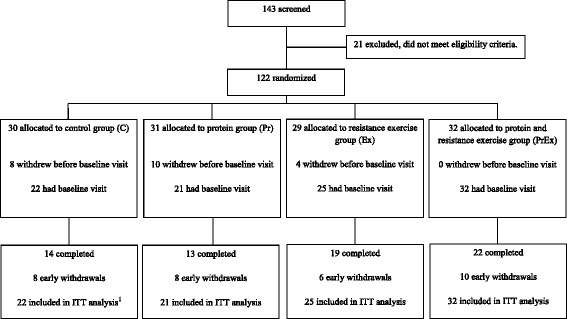
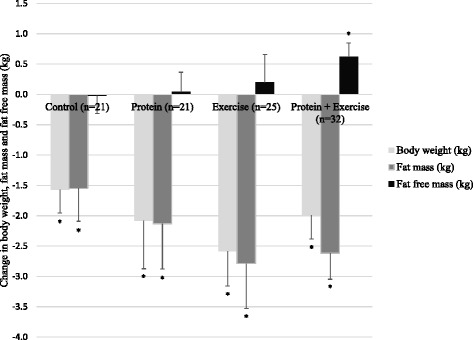
BACKGROUND: Intentional weight loss in obese older adults is a risk factor for accelerated muscle mass loss. We investigated whether a high protein diet and/or resistance exercise preserves fat free mass (FFM) during weight loss in overweight and obese older adults. METHODS: We included 100 overweight and obese adults (55-80 year) in a randomized controlled trial (RCT) with a 2 × 2 factorial design and intention-to-treat analysis. During a 10-week weight loss program all subjects followed a hypocaloric diet. Subjects were randomly allocated to either a high protein (1.3 g/kg body weight) or normal protein diet (0.8 g/kg), with or without a resistance exercise program 3 times/week. FFM was assessed by air displacement plethysmography. RESULTS: . During intervention, protein intake was 1.13 ± 0.35 g/kg in the high protein groups vs. 0.98 ± 0.29 in the normal protein groups, which reflects a 16.3 ± 5.2 g/d higher protein intake in the high protein groups. Both high protein diet and exercise did not significantly affect change in body weight, FFM and fat mass (FM). No significant protein*exercise interaction effect was observed for FFM. However, within-group analysis showed that high protein in combination with exercise significantly increased FFM (+0.6 ± 1.3 kg, p = 0.011). CONCLUSION: A high protein diet, though lower than targeted, did not significantly affect changes in FFM during modest weight loss in older overweight and obese adults. There was no significant interaction between the high protein diet and resistance exercise for change in FFM. However, only the group with the combined intervention of high protein diet and resistance exercise significantly increased in FFM. TRIAL REGISTRATION: Dutch Trial Register, number NTR4556, date 05-01-2014.
Overview
The claims and statistics of this paper haven’t been checked yet.
Free: it reads the open-access text and checks the first 5 claims that cite a source we can check. Create a free account to check every claim.
Integrity signals
Registry
Cites
Statistics
Figures
Verification
Claims the paper makes
The claims and statistics of this paper haven’t been checked yet.
Free: it reads the open-access text and checks the first 5 claims that cite a source we can check. Create a free account to check every claim.
Claims other papers make about this one
Each is checked against this paper’s own text: does it say what the citing paper says it does?
The source backs part of the claim, not all of it — or backs it for a different population, condition or comparison.
In the citing paper
“a high- protein diet in conjunction with resistance training preserved appendicular lean mass during weight loss264”
From Sarcopenic obesity in older adults: aetiology, epidemiology and treatment strategies (2018) · cites this paper as [264]
Experimental — accuracy not yet measuredThe source backs part of the claim, not all of it — or backs it for a different population, condition or comparison.
In the citing paper
“Without this, there is no physiological mechanism to effectively utilise excessive dietary protein, which can then result in increased AT mass (depending on insulin sensitivity) through storage of these extra calories as fat, or putting additional strain on the kidneys [104].”
From Optimised Skeletal Muscle Mass as a Key Strategy for Obesity Management (2025) · cites this paper as [104]
Experimental — accuracy not yet measuredIn the citing paper
“Only the group with the combined intervention of the high protein diet and the resistance exercise program significantly increased in FFM.”
From Nutrition and Physical Activity in Optimizing Weight Loss and Lean Mass Preservation in the Incretin-Based Medications Era: A Narrative Review (2025) · cites this paper as [80]
In the citing paper
“High-protein hypocaloric diet did not affect changes in FFM during weight loss in overweight and obese older adults in a 10-week weight loss program with or without a resistance exercise program [80].”
From Nutrition and Physical Activity in Optimizing Weight Loss and Lean Mass Preservation in the Incretin-Based Medications Era: A Narrative Review (2025) · cites this paper as [80]
Self-check
Percentages, sums and reported differences re-computed from the paper’s own numbers.
The self-check needs the paper’s full text.
Citations
Cites
Guralnik, J. M., Simonsick, E. M., Ferrucci, L., Glynn, R. J., Berkman, L. F., Blazer, D. G., Scherr, P. A., & Wallace, R. B. (1994) · Journal of Gerontology · doi:10.1093/geronj/49.2.m85 · Cited by 9,792
Bauer, J., Biolo, G., Cederholm, T., Cesari, M., Cruz-Jentoft, A. J., Morley, J. E., Phillips, S., Sieber, C., Stehle, P., Teta, D., et al. (2013) · Journal of the American Medical Directors Association · doi:10.1016/j.jamda.2013.05.021 · Cited by 2,553
Deutz, N. E. P., Bauer, J. M., Barazzoni, R., Biolo, G., Boirie, Y., Bosy-Westphal, A., Cederholm, T., Cruz-Jentoft, A., Krznariç, Z., Nair, K. S., et al. (2014) · Clinical Nutrition · doi:10.1016/j.clnu.2014.04.007 · Cited by 1,738
Moore, D. R., Churchward-Venne, T. A., Witard, O., Breen, L., Burd, N. A., Tipton, K. D., & Phillips, S. M. (2015) · The Journals of Gerontology: Series A · doi:10.1093/gerona/glu103 · Cited by 770 · cited 1×
“Previous studies showed that a minimal amount of 20 g of high quality protein per meal is needed to stimulate protein synthesis above baseline levels [27].”
BackgroundScientific Opinion on Dietary Reference Values for protein
EFSA Panel on Dietetic Products, N. A. A. (. (2012) · EFSA Journal · doi:10.2903/j.efsa.2012.2557 · Cited by 739
Pennings, B., Boirie, Y., Senden, J. M., Gijsen, A. P., Kuipers, H., & van Loon, L. J. (2011) · The American Journal of Clinical Nutrition · doi:10.3945/ajcn.110.008102 · Cited by 656
Breen, L., & Phillips, S. M. (2011) · Nutrition & Metabolism · doi:10.1186/1743-7075-8-68 · Cited by 576 · cited 2×
“it is likely that the amount of leucine known to stimulate muscle protein synthesis (at least 2 g per meal [12]) for”
BackgroundNoakes, M., Keogh, J. B., Foster, P. R., & Clifton, P. M. (2005) · The American Journal of Clinical Nutrition · doi:10.1093/ajcn/81.6.1298 · Cited by 483
Optimal protein intake in the elderly
Wolfe, R. R., Miller, S. L., & Miller, K. B. (2008) · Clinical Nutrition · doi:10.1016/j.clnu.2008.06.008 · Cited by 456
Davison, K. K., Ford, E. S., Cogswell, M. E., & Dietz, W. H. (2002) · Journal of the American Geriatrics Society · doi:10.1046/j.1532-5415.2002.50508.x · Cited by 435
Weinheimer, E. M., Sands, L. P., & Campbell, W. W. (2010) · Nutrition Reviews · doi:10.1111/j.1753-4887.2010.00298.x · Cited by 391 · cited 1×
“Strategies to reduce the loss of skeletal muscle mass during weight loss include resistance exercise and sufficient intake of high quality protein [6, 7].”
BackgroundThe danger of weight loss in the elderly
Miller, S. L., & Wolfe, R. R. (2008) · The Journal of nutrition, health and aging · doi:10.1007/bf02982710 · Cited by 384 · cited 1×
“[4], which in turn might accelerate the development of sarcopenia [5].”
BackgroundHigher Protein Intake Preserves Lean Mass and Satiety with Weight Loss in Pre‐obese and Obese Women
Leidy, H. J., Carnell, N. S., Mattes, R. D., & Campbell, W. W. (2007) · Obesity · doi:10.1038/oby.2007.531 · Cited by 277
Burd, N. A., Yang, Y., Moore, D. R., Tang, J. E., Tarnopolsky, M. A., & Phillips, S. M. (2012) · British Journal of Nutrition · doi:10.1017/s0007114511006271 · Cited by 276
Mathus-Vliegen, E. M. H., Basdevant, A., Finer, N., Hainer, V., Hauner, H., Micic, D., Maislos, M., Roman, G., Schutz, Y., Tsigos, C., et al. (2012) · Obesity Facts · doi:10.1159/000341193 · Cited by 261
Kim, J. E., O’Connor, L. E., Sands, L. P., Slebodnik, M. B., & Campbell, W. W. (2016) · Nutrition Reviews · doi:10.1093/nutrit/nuv065 · Cited by 238
Verreijen, A. M., Verlaan, S., Engberink, M. F., Swinkels, S., de Vogel-van den Bosch, J., & Weijs, P. J. (2015) · The American Journal of Clinical Nutrition · doi:10.3945/ajcn.114.090290 · Cited by 237 · cited 3×
“We previously studied the effect of a high whey protein-, leucine- and vitamin D-enriched supplement on muscle mass preservation during a 13-week weight loss program including 3 times/ week resistance exercise in obese older adults [15].”
BackgroundMethodInfluentialSelf-citationExercise attenuates the weight-loss-induced reduction in muscle mass in frail obese older adults
FRIMEL, T. N., SINACORE, D. R., & VILLAREAL, D. T. (2008) · Medicine & Science in Sports & Exercise · doi:10.1249/mss.0b013e31816a85ce · Cited by 230 · cited 1×
“Resistance exercise stimulates muscle protein synthesis, which in turn supports muscle mass preservation and muscle function [8].”
BackgroundWeighty Concerns: The Growing Prevalence of Obesity among Older Adults
Houston, D. K., Nicklas, B. J., & Zizza, C. A. (2009) · Journal of the American Dietetic Association · doi:10.1016/j.jada.2009.08.014 · Cited by 200
Bales, C. W., & Buhr, G. (2008) · Journal of the American Medical Directors Association · doi:10.1016/j.jamda.2008.01.006 · Cited by 197
Weight loss in obese adults 65years and older: A review of the controversy
Waters, D. L., Ward, A. L., & Villareal, D. T. (2013) · Experimental Gerontology · doi:10.1016/j.exger.2013.02.005 · Cited by 176
Body mass index and quality of well-being in a community of older adults
Groessl, E. J., Kaplan, R. M., Barrett-Connor, E. L., & Ganiats, T. G. (2004) · American Journal of Preventive Medicine · doi:10.1016/j.amepre.2003.10.007 · Cited by 142
Hector, A. J., Marcotte, G. R., Churchward-Venne, T. A., Murphy, C. H., Breen, L., von Allmen, M., Baker, S. K., & Phillips, S. M. (2015) · The Journal of Nutrition · doi:10.3945/jn.114.200832 · Cited by 119 · cited 1×
“older men [28, 29], which has been ascribed to its fast digestion and to the high leucine content.”
BackgroundSayers, S. P., Guralnik, J. M., Newman, A. B., Brach, J. S., & Fielding, R. A. (2006) · Aging Clinical and Experimental Research · doi:10.1007/bf03327424 · Cited by 97
Sanal, E., Ardic, F., & Kirac, S. (2013) · PubMed · Cited by 89
Porter Starr, K. N., Pieper, C. F., Orenduff, M. C., McDonald, S. R., McClure, L. B., Zhou, R., Payne, M. E., & Bales, C. W. (2016) · The Journals of Gerontology Series A: Biological Sciences and Medical Sciences · doi:10.1093/gerona/glv210 · Cited by 83 · cited 1×
“[16] recently evaluated the effect of a high protein hypocaloric diet using meal-based protein foods in obese older adults over a 6month period.”
BackgroundWeijs, P. J. M., Sauerwein, H. P., & Kondrup, J. (2012) · Clinical Nutrition · doi:10.1016/j.clnu.2012.04.007 · Cited by 82
Self-citationExploration of the protein requirement during weight loss in obese older adults
Weijs, P. J. M., & Wolfe, R. R. (2016) · Clinical Nutrition · doi:10.1016/j.clnu.2015.02.016 · Cited by 48
Self-citationDietary protein in weight management: a review proposing protein spread and change theories
Bosse, J. D., & Dixon, B. M. (2012) · Nutrition & Metabolism · doi:10.1186/1743-7075-9-81 · Cited by 31
Cited by
Sarcopenic obesity in older adults: aetiology, epidemiology and treatment strategies
Batsis, J. A., & Villareal, D. T. (2018) · Nature Reviews Endocrinology · doi:10.1038/s41574-018-0062-9 · Cited by 1,382
Exercise and nutrition strategies to counteract sarcopenic obesity
Trouwborst, I., Verreijen, A., Memelink, R., Massanet, P., Boirie, Y., Weijs, P., & Tieland, M. (2018) · Nutrients · doi:10.3390/nu10050605 · Cited by 210
“[151] all included a training component in their studies, which might have explained the muscle preserving effect of the protein in these studies in comparison with the studies of Porter Starr et al.”
ResultSelf-citationStrasser, B., Wolters, M., Weyh, C., Krüger, K., & Ticinesi, A. (2021) · Nutrients · doi:10.3390/nu13062045 · Cited by 176
Merchant, R. A., Seetharaman, S. K., Au, L. S. Y., Wong, M. W. K., Wong, B., Tan, L. F., Chen, M. Z., Ng, S. E., Soong, J. T. Y., Hui, R. J. Y., et al. (2021) · Frontiers in Endocrinology · doi:10.3389/fendo.2021.765415 · Cited by 175
Weight loss strategies and the risk of skeletal muscle mass loss
McCarthy, D., & Berg, A. (2021) · Nutrients · doi:10.3390/nu13072473 · Cited by 163
“On this occasion, increasing protein intake above habitual levels did not preserve LBM. Similar findings have been observed by Verreijen et al. (2017) in older individuals following a hypocaloric weight loss programme for 10 weeks [74].”
Background
Metadata
- Authors
- Verreijen, A. M., Engberink, M. F., Memelink, R. G., van der Plas, S. E., Visser, M., & Weijs, P. J. M.
- Affiliations
- Amsterdam University of Applied Sciences (NL)
- Vrije Universiteit Amsterdam (NL)
- Corresponding author
- Verreijen, Amely M.
- Venue
- Nutrition Journal
- Published
- 2017-02-06
- Volume
- 16
- Issue
- 1
- Pages
- 10-10
- ISSN
- 1475-2891 (ISSN-L)
- PMC
- PMC5294725
- OpenAlex
- W2587159172
- Cited by
- 121
- References
- 29
- Citations by year
- 2026: 16 · 2025: 10 · 2024: 22 · 2023: 11 · 2022: 9 · 2021: 18 · 2020: 12 · 2019: 10 · 2018: 11 · 2017: 2
- FWCI
- 7.08
- Type
- journal article
- Language
- en
- Open access
- gold
- doi.org
- Licence
- cc-by
- Locations
- Nutrition Journal (publishedVersion, cc-by)
- PubMed Central (publishedVersion, cc-by)
- PubMed (publishedVersion)
- Pure Amsterdam UMC (publishedVersion, other-oa)
- VU Research Portal (publishedVersion, other-oa)
- Data Archiving and Networked Services (DANS) (submittedVersion, cc-by)
- Amsterdam UMC (VU Amsterdam) - Institutional Repository (submittedVersion)
- Data Archiving and Networked Services (DANS) (submittedVersion, other-oa)
- Data Archiving and Networked Services (DANS) (submittedVersion)
- Funders
- This research did not receive any specific grant from funding agencies in the public, commercial, or not-for-profit sectors.
- Topics
- Health Sciences › Medicine › Physiology (medical) › Nutrition and Health in Aging
- Health Sciences › Nursing › Nutrition and Dietetics › Muscle metabolism and nutrition
- Health Sciences › Medicine › Physiology (medical) › Body Composition Measurement Techniques
- Keywords
- high-protein diet, resistance training, fat-free mass, weight loss, obesity, overweight, older adults, muscle mass preservation, hypocaloric diet, fat mass, protein intake
- MeSH terms
- Diet, High-Protein, Aged, Aged, 80 and over, Body Composition, Diet, Reducing, Dietary Fats, Dietary Proteins, Female, Humans, Male, Middle Aged, Obesity, Patient Compliance, Weight Loss, Body Mass Index, Treatment Outcome, Hand Strength, Caloric Restriction, Overweight, Resistance Training, Waist Circumference
About these checks
Registry, retraction, Cites and statistics results are computed, not judged, with one exception: a printed reference that no index lists is read once by a model before it counts as a citation error. Claims are extracted by a model and kept only when their quote appears verbatim in the text; each cited source is then checked, with a model’s help, for whether it says what the claim relies on. Those verdicts can be wrong — read the claim’s quote and the cited source before relying on one.
Statistics and arithmetic are recomputed, not judged.
Confidence bands are shown only for fields calibrated on our annotated test set. None is calibrated yet, so no band is shown.
What counts as a claim ›How we measure confidence ›How we check this ›
Are you an author, or do you see a problem with this page? Request a review
Data sources
Bibliographic data: Semantic Scholar, OpenAlex, Crossref.
Contains information from the Semantic Scholar Academic Graph Datasets, made available under the ODC Attribution License (ODC-BY 1.0).
Semantic Scholar’s data is described in: Kinney, R., et al. (2023). The Semantic Scholar Open Data Platform. arXiv:2301.10140.
